

 Download PDF
Market Overview
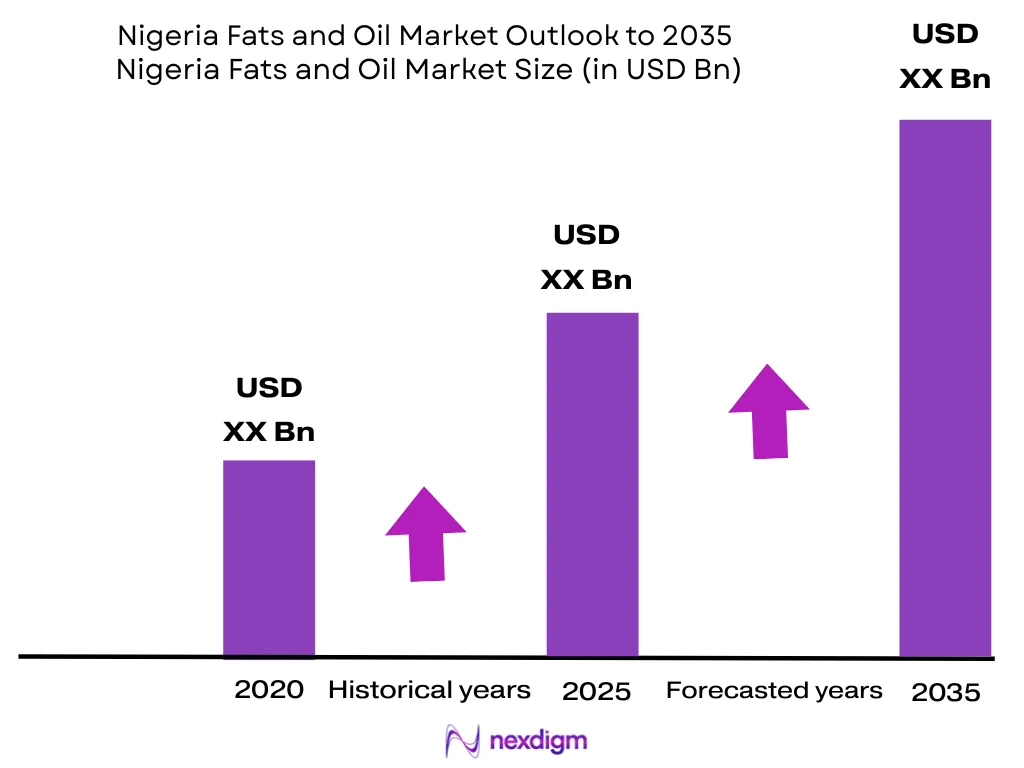
Nigeria Fats and Oil Market is valued at USD ~ billion, based on a five-year historical analysis, and is forecasted to grow at a CAGR of ~% during the forecast period. Demand is driven by crude palm oil, refined palm oil, palm kernel oil, soybean oil, groundnut oil, shea butter, bakery fats, margarine, frying oils and packaged vegetable oils. Palm oil production reached 1.6 MMT after 1.5 MMT, while GDP reached USD 252.26 billion and GDP per capita reached USD 1,084.2. Lagos, Ogun, Rivers, Edo, Delta, Ondo, Cross River, Akwa Ibom, Kano, Kaduna and the Federal Capital Territory dominate Nigeria Fats and Oil Market due to food manufacturing, open-market trade, oil palm estates, palm kernel crushing, groundnut trading, logistics access and urban cooking oil demand. Edo State allocated about 120,000 hectares for oil palm investors, while palm kernel production reached 1.2 MMT after 1.1 MMT, supporting domestic oilseed processing.
Market Segmentation
By Product Type
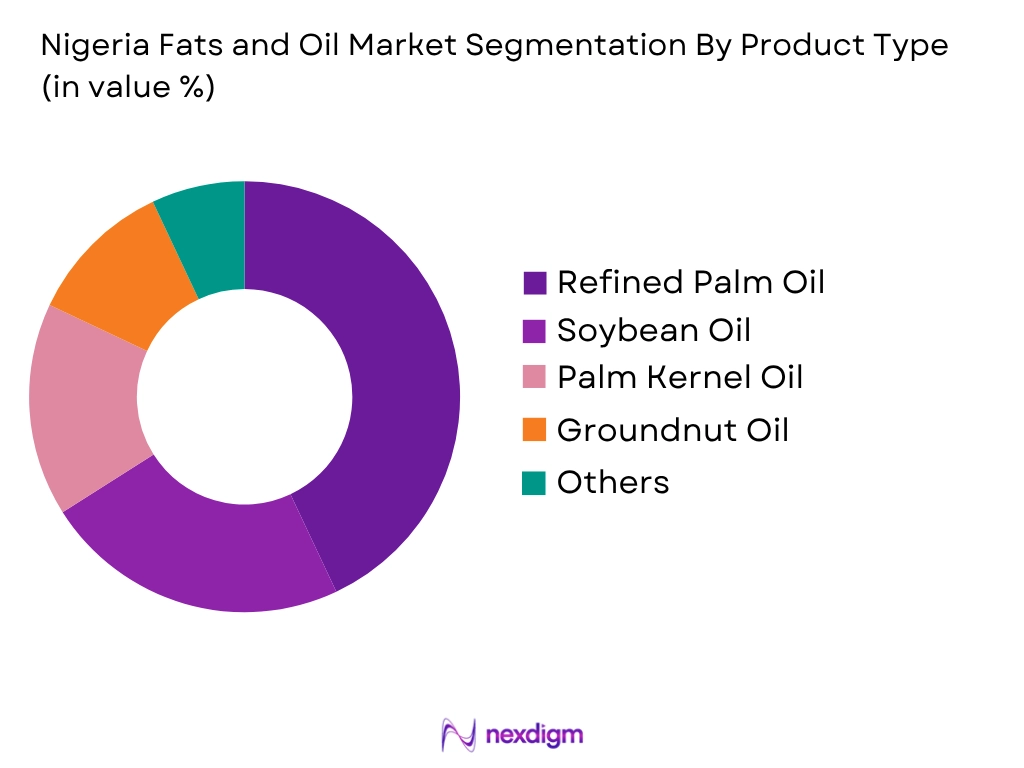
Nigeria Fats and Oil Market is segmented by product type into crude palm oil, refined palm oil, palm olein, palm kernel oil, soybean oil, groundnut oil, cottonseed oil, coconut oil, sesame oil, shea butter, vegetable oil blends, margarine, spreads, shortening, bakery fats, frying oils, butter, dairy fats and animal fats. Recently, palm oil has had a dominant market share under the product type segmentation due to its central role in Nigerian cooking, stew preparation, open-market retail, foodservice frying, soap manufacturing, margarine production and industrial uses. Red palm oil is culturally embedded in southern Nigerian cuisines, while refined palm olein and vegetable oil blends serve urban households and foodservice outlets. Palm kernel oil is also used in food and non-food applications, including soap, glycerin, lubricants and specialty fats. Soybean and groundnut oils are important alternatives, especially in urban packaged oils and northern cooking traditions, but palm-based oils remain dominant because Nigeria has a domestic oil palm base and widespread consumer familiarity.
By Distribution Channel
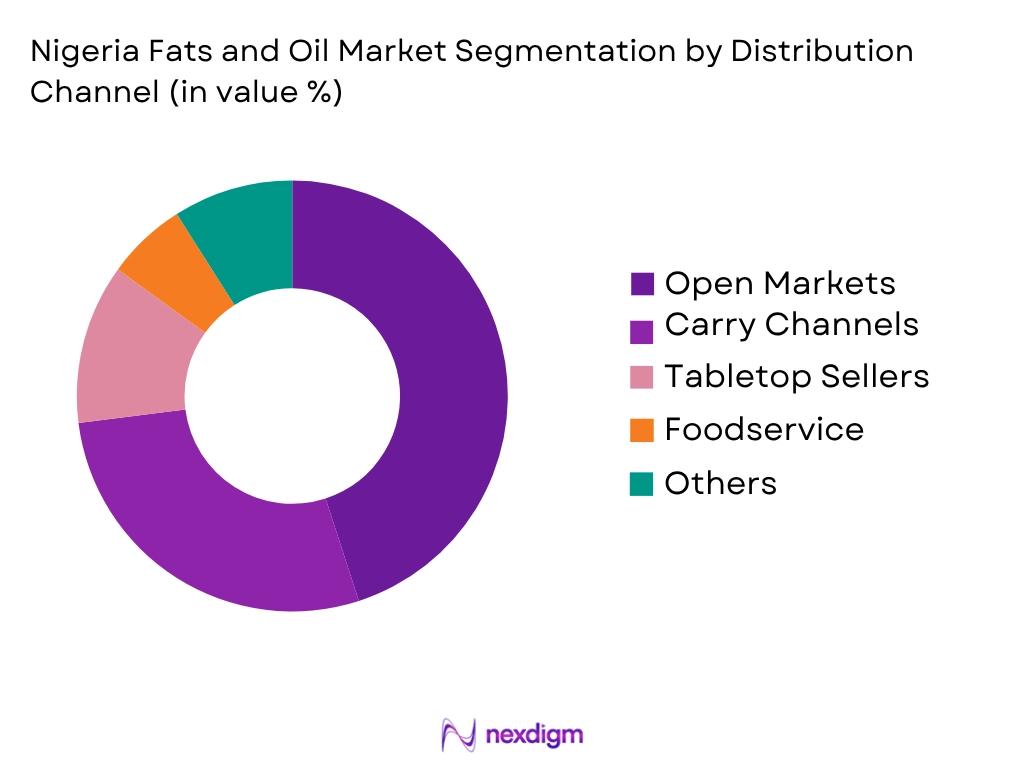
Nigeria Fats and Oil Market is segmented by distribution channel into open markets, traditional grocery stores, supermarkets and hypermarkets, wholesale and cash-and-carry channels, informal retail, tabletop sellers, convenience stores, e-commerce, foodservice distributors, hotel and catering suppliers, industrial ingredient suppliers, commodity traders and export channels. Recently, open markets have had a dominant market share under the distribution channel segmentation because palm oil, loose vegetable oil, groundnut oil, palm kernel oil and bulk edible fats are frequently purchased through traditional market networks. These markets support price-sensitive households, street-food vendors, small restaurants, rural buyers and micro-retailers. Open-market traders also distribute oil in unbranded containers, jerry cans and bulk formats, which makes them central to affordability-driven consumption. Supermarkets are gaining relevance for branded tamper-proof oils such as Mamador and Devon King’s, while industrial ingredient channels serve soap, bakery, noodle and packaged food manufacturers. However, open markets remain structurally dominant because they combine reach, informal credit, bulk breaking and everyday cooking oil access.
Competitive Landscape
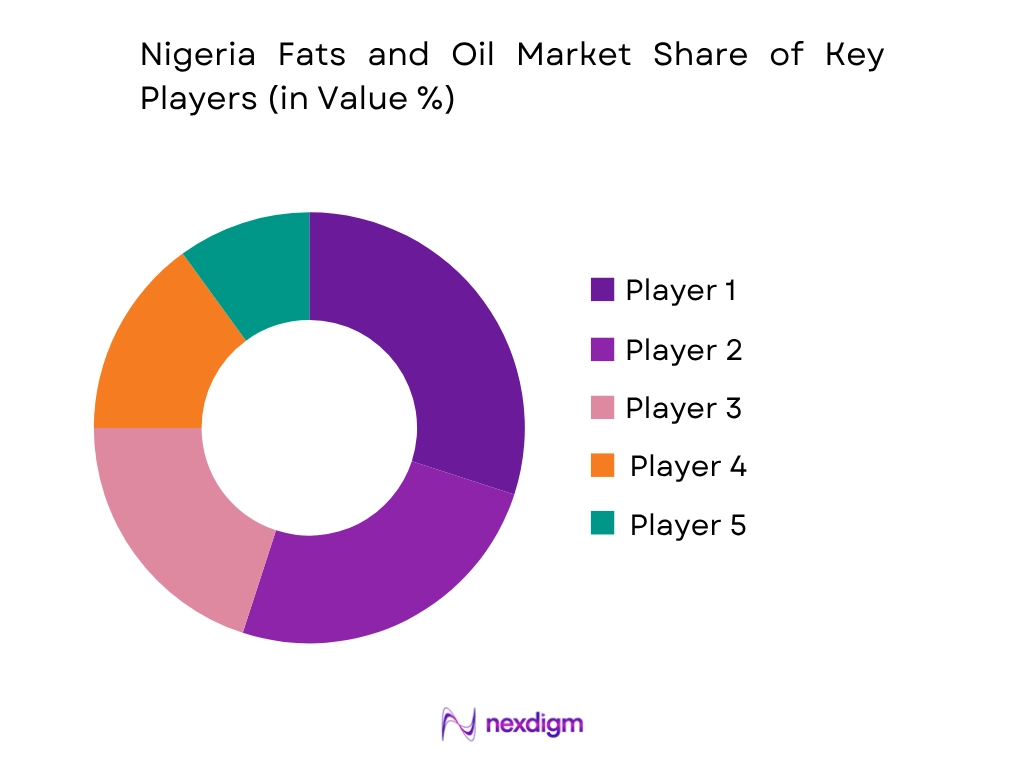
Nigeria Fats and Oil Market is led by integrated palm oil producers, packaged cooking oil brands, plantation-backed processors, food manufacturing groups, industrial fat suppliers and open-market commodity traders. PZ Wilmar, Presco, Okomu Oil Palm Company, Flour Mills of Nigeria, and Dufil Prima Foods are major players due to palm plantation access, domestic refining, branded cooking oils, industrial food manufacturing, distribution reach and packaging capability. PZ Wilmar’s Mamador and Devon King’s cooking oils are sold in tamper-proof packaging, and Wilmar describes PZ Wilmar’s edible cooking oils under Mamador and Devon King’s as market leaders in Nigeria.
| Company | Establishment Year | Headquarters | Core Portfolio | Processing Strength | Key End Users | Channel Strength | Packaging / Quality Focus | Market-Specific Advantage |
| PZ Wilmar Nigeria | 2010 | Lagos, Nigeria | ~ | ~ | ~ | ~ | ~ | ~ |
| Presco Plc | 1991 | Benin City, Nigeria | ~ | ~ | ~ | ~ | ~ | ~ |
| Okomu Oil Palm Company | 1976 | Edo State, Nigeria | ~ | ~ | ~ | ~ | ~ | ~ |
| Flour Mills of Nigeria / Premium Edible Oils | 1960 | Lagos, Nigeria | ~ | ~ | ~ | ~ | ~ | ~ |
| Dufil Prima Foods | 1995 | Lagos, Nigeria | ~ | ~ | ~ | ~ | ~ | ~ |
Nigeria Fats and Oil Market Analysis
Growth Drivers
Palm Oil Production Base and Household Cooking Demand
Nigeria’s palm oil production base is a major growth driver for the Nigeria Fats and Oil Market because crude palm oil, refined palm oil, palm olein, red palm oil and palm kernel oil are used across household cooking, soups, stews, street food, foodservice frying, margarine, bakery fats, soap and personal care ingredients. USDA FAS forecasts palm oil production at 1.6 MMT after 1.5 MMT, palm kernel production at 1.2 MMT after 1.1 MMT, and palm kernel oil consumption at 500,000 MT. These numbers confirm a domestic palm-based feedstock base that supports both food and non-food demand. World Bank records Nigeria’s GDP at USD 290.79 billion, GDP per capita at USD 1,224.3, population at 237,527,782 and GDP growth at 4.0, indicating a large essential-consumption base for cooking oils despite low per-capita income. The driver is market specific because Nigerian households rely on red palm oil for traditional dishes, while refiners, street-food vendors, bakeries and soap manufacturers require palm-based oils in bulk.
Groundnut, Soybean and Palm Kernel Processing Linkages
Groundnut, soybean and palm kernel processing linkages drive the Nigeria Fats and Oil Market because the market is not limited to palm oil; it also includes groundnut oil, soybean oil, palm kernel oil, vegetable oil blends, shortening, margarine, bakery fats and industrial oils. USDA FAS forecasts peanut production at 4.7 MMT after 4.3 MMT, with food use at 2.9 MMT after 2.7 MMT, supporting groundnut oil and groundnut cake production in northern trading corridors. The same USDA source records palm kernel oil consumption at 500,000 MT, with food use at 330,000 MT and industrial domestic consumption at 170,000 MT, showing demand from cooking fats, margarine, soap, glycerin and lubricants. IMF lists Nigeria’s country population at 242.578 million and projected real GDP change at 4.1 for 2026, reinforcing a large consumption and processing base. This driver is market specific because oilseed crushers, palm kernel processors, soap makers, bakeries, noodle manufacturers and packaged oil brands depend on these domestic feedstock linkages.
Market Challenges
Palm Oil Supply Gap and Smallholder Productivity Constraints
Palm oil supply gaps and smallholder productivity constraints remain major challenges for the Nigeria Fats and Oil Market because domestic demand for palm oil, palm olein, palm kernel oil and refined vegetable oil exceeds the consistency of local supply. USDA FAS forecasts palm oil production at 1.6 MMT after 1.5 MMT, but the same market remains exposed to supply shortages because plantations, smallholder mills, crude palm oil aggregation, palm kernel crushing, logistics and refining are fragmented. Edo State allocated about 120,000 hectares for oil palm investors, showing that additional estate development is being pursued to close the supply gap, but plantation maturation and mill efficiency take time. World Bank records Nigeria’s population at 237,527,782 and GDP per capita at USD 1,224.3, confirming a very large consumer base with limited affordability cushion. This challenge is market specific because any shortfall in palm fruit, crude palm oil or palm kernel supply affects red palm oil availability, packaged cooking oil production, foodservice frying, bakery fat blending, soap manufacturing and open-market prices.
Foreign Exchange Pressure, Power Reliability and Informal Distribution
Foreign exchange pressure, power reliability and informal distribution restrain the Nigeria Fats and Oil Market because refiners and packaged oil companies depend on imported equipment, packaging resin, additives, spare parts, soft oils and logistics inputs, while local operations face energy and distribution bottlenecks. World Bank records GDP at USD 290.79 billion, GDP growth at 4.0 and internet users at 41 out of every 100 people, while IMF lists Nigeria’s projected 2026 real GDP change at 4.1 and population at 242.578 million. These macro indicators show scale, but also a market where operating efficiency is critical. Reuters reported that Nigeria’s 2026 budget assumes an exchange rate of 1,400 naira per dollar and projects a fiscal deficit of 23.85 trillion naira, illustrating currency and fiscal pressure around imported inputs and trade flows. The challenge is market specific because edible oil companies must maintain refining, bottling, tamper-proof packaging, NAFDAC registration, open-market distribution, bulk oil delivery and quality control across fragmented channels where loose oil remains common.
Market Opportunities
Packaged Cooking Oil Conversion and Anti-Adulteration Positioning
Packaged cooking oil conversion creates a future growth opportunity for the Nigeria Fats and Oil Market because loose oil still moves heavily through open markets, tabletop sellers, wholesalers and informal retail, while branded products can compete on tamper-proof packs, NAFDAC registration visibility, freshness, hygiene and measured pack sizes. USDA FAS records palm oil production at 1.6 MMT, palm kernel production at 1.2 MMT and palm kernel oil consumption at 500,000 MT, providing a domestic feedstock base for refined and packaged oils. World Bank records population at 237,527,782, GDP per capita at USD 1,224.3 and internet users at 41 out of every 100 people, supporting a broad consumer market where awareness and brand visibility can gradually expand. The opportunity is market specific because packaged oil brands can serve low-income consumers through sachets, pillow packs and small PET bottles, while offering larger jerry cans and family packs for households, restaurants and street-food vendors. This also supports quality differentiation from adulterated loose oil and bulk open-market products.
Industrial Palm Kernel Oil, Shea Butter and Regional Export Value Addition
Industrial palm kernel oil, shea butter and regional export value addition create future growth opportunities for the Nigeria Fats and Oil Market because domestic fats and oils are used beyond household cooking in soap, detergents, cosmetics, personal care, bakery fats, margarine, noodles, confectionery and specialty ingredients. USDA FAS records palm kernel oil consumption at 500,000 MT, including 330,000 MT for food use and 170,000 MT for industrial domestic consumption, confirming a dual-use market. The same source reports peanut production at 4.7 MMT and palm kernel production at 1.2 MMT, supporting oilseed crushing, cake, meal and industrial fat supply. IMF lists Nigeria’s 2026 population at 242.578 million and real GDP change at 4.1, while Reuters reported World Bank support of USD 1.25 billion for Nigeria’s 2026–2032 partnership strategy to spur jobs and private investment. This opportunity is market specific because companies can invest in refined palm kernel oil, shea butter processing, soap-grade oils, bakery shortening, regional ECOWAS supply and export-quality specialty fats.
Future Outlook
Nigeria Fats and Oil Market is expected to expand steadily during the forecast period, supported by household palm oil consumption, packaged oil conversion, plantation investment, foodservice frying, bakery demand, noodle manufacturing, soap and detergent demand, and shea butter value addition. Palm oil will remain structurally important because it is central to Nigerian cooking, food manufacturing, industrial fats and personal care inputs. USDA FAS forecasts palm oil production at 1.6 MMT after 1.5 MMT, supported by expanded harvested area and private-sector investment in commercial palm oil production.
Packaged edible oils will gain relevance as consumers seek quality assurance, tamper-proof packaging, freshness and brand trust. PZ Wilmar highlights Mamador and Devon King’s as hygienically produced cooking oils sold in tamper-proof packaging, with domestic production and multiple pack sizes supporting freshness and affordability. Industrial demand will remain a major growth platform. Palm kernel oil is used for soap making, glycerin, margarine, cooking fats and lubricants, while industrial domestic consumption reached 170,000 MT after 115,000 MT. This creates opportunities for palm kernel crushers, refiners, soap manufacturers, bakery-fat producers and industrial fat suppliers. Nigeria will remain exposed to supply gaps, energy costs, logistics bottlenecks, open-market adulteration, foreign exchange pressure and informal distribution fragmentation. Companies with plantation integration, local refining, pack-size flexibility, anti-adulteration systems and open-market reach will have stronger market resilience.
Major Players
- PZ Wilmar Nigeria
- Presco Plc
- Okomu Oil Palm Company
- Flour Mills of Nigeria / Premium Edible Oils Limited
- Dufil Prima Foods
- BUA Foods
- Grand Cereals Limited
- Mamador
- Power Oil
- Devon King’s
- Golden Penny Foods
- Tropical General Investments Group
- Saro Oil Palm
- JB Farms
- Olam Agri Nigeria
Key Target Audience
- Edible Oil Manufacturers
- Palm Oil Plantation Companies
- Oilseed Crushers and Refiners
- Food Processing Companies
- Foodservice and Street Food Supply Operators
- Soap, Cosmetics and Personal Care Manufacturers
- Investments and Venture Capitalist Firms
- Government and Regulatory Bodies (National Agency for Food and Drug Administration and Control, Standards Organisation of Nigeria, Federal Ministry of Agriculture and Food Security, Nigeria Customs Service, Federal Competition and Consumer Protection Commission)
Research Methodology
Step 1: Identification of Key Variables
The initial phase involves constructing an ecosystem map encompassing all major stakeholders within the Nigeria Fats and Oil Market. This includes plantation owners, smallholder farmers, palm oil mills, palm kernel crushers, refiners, packaged oil brands, open-market traders, industrial buyers, foodservice suppliers and regulators. The objective is to define variables such as product type, source, application, packaging format, channel mix, regional supply cluster and import dependency.
Step 2: Market Analysis and Construction
In this phase, historical data is compiled and analyzed for the Nigeria Fats and Oil Market. The assessment covers crude palm oil, palm kernel oil, refined vegetable oils, soybean oil, groundnut oil, shea butter, margarine, shortening, bakery fats, foodservice oils and industrial fats. Top-down validation uses agricultural, trade and macroeconomic datasets, while bottom-up validation uses retail SKU mapping, open-market checks and distributor interviews.
Step 3: Hypothesis Validation and Expert Consultation
Market hypotheses are developed and validated through computer-assisted telephone interviews with palm oil producers, refiners, open-market distributors, supermarket category managers, foodservice buyers, soap manufacturers, bakery ingredient suppliers and packaged food manufacturers. These consultations provide insights into sourcing, adulteration risk, consumer trade-down, pack-size movement, industrial fat demand, palm kernel oil use and brand positioning.
Step 4: Research Synthesis and Final Output
The final phase integrates desk research, primary interviews, retail audits, trade-flow assessment, plantation mapping and competitive benchmarking into a consolidated market model. Supplier inputs are compared with observed shelf presence, open-market movement, palm oil supply, industrial consumption and regional demand clusters. The final output provides a validated view of market size, segmentation, competition, future outlook and strategic implications.

- Executive Summary
- Research Methodology (Market Definitions and Assumptions, Abbreviations, Edible Fats and Oils Classification, Palm Oil and Palm Kernel Oil Inclusion Criteria, Groundnut Oil and Soybean Oil Inclusion Criteria, Packaged Cooking Oil vs Open-Market Loose Oil Inclusion Criteria, Vegetable Oil and Animal Fat Inclusion Criteria, Shea Butter and Specialty Fat Inclusion Criteria, Domestic Plantation and Smallholder Supply Mapping, Refining and Fractionation Capacity Assessment, Retail vs Foodservice vs Industrial Demand Mapping, Market Sizing Approach, Top-Down Analysis, Bottom-Up Analysis, Demand-Side Assessment, Supply-Side Assessment, Palm Oil Import and Domestic Production Validation, Nigerian Commodity Trade Flow Assessment, Retail SKU Audits, Open-Market Distributor Interviews, Foodservice Channel Interviews, Industrial Ingredient Buyer Interviews, Primary Industry Interviews, Data Triangulation, Forecasting Framework, Limitations and Future Conclusions)

- Definition and Scope
- Market Evolution and Industry Genesis
- Timeline of Major Industry Developments
- Business Cycle and Seasonal Demand Pattern
- Oil Palm Plantation and Smallholder Value Chain Analysis
- Palm Kernel Crushing and Specialty Fat Value Chain Analysis

- Growth Drivers (Large Household Cooking Oil Consumption Base, Palm Oil Cultural Relevance, Domestic Oil Palm Plantation Investments, Foodservice and Street Food Frying Demand, Bakery and Noodle Manufacturing Growth, Soap and Detergent Industrial Demand, Packaged Oil Conversion from Loose Oil, Small-Pack Affordability, Groundnut and Soybean Processing Linkages)
- Market Challenges (Domestic Palm Oil Supply Gap, Low Smallholder Yields, Import Dependence for Refined Vegetable Oils, Foreign Exchange Constraints, Power and Processing Reliability Issues, Open-Market Adulteration Risk, Informal Distribution Fragmentation, Logistics Bottlenecks, Quality and Food Safety Compliance Pressure)
- Market Opportunities (Palm Plantation Expansion, Backward Integration by Large Processors, Packaged Cooking Oil Penetration, Small Sachet and Pillow-Pack Growth, Shea Butter Value Addition, Groundnut Oil Premiumization, Foodservice Frying Oil Management, Industrial Specialty Fats, Sustainable Palm Oil Traceability, Regional ECOWAS Export Potential)
- Market Trends (Shift from Loose Oil to Packaged Branded Oils, Tamper-Proof Packaging Adoption, Palm Oil Refining and Fractionation Expansion, Red Palm Oil Premiumization, Groundnut Oil Niche Positioning, Shea Butter Export Linkage, Private Label Cooking Oils, High-Stability Frying Oils, Industrial Palm Kernel Oil Demand, Fortified Oil Labeling)
- SWOT Analysis
- Porter’s Five Forces Analysis
- PESTLE Analysis

- By Market Value (2020-2025)
- By Volume Consumption (2020-2025)
- By Average Selling Price (2020-2025)

- By Product Type (In Value %)
Crude Palm Oil
Refined Palm Oil
Palm Olein
Palm Kernel Oil
Soybean Oil
Groundnut Oil - By Source Type (In Value %)
Vegetable Oils
Palm-Based Oils and Fats
Domestic Oilseed-Based Oils
Imported Soft Oils
Animal-Based Fats
Dairy-Based Fats - By Distribution Channel (In Value %)
Open Markets
Traditional Grocery Stores
Supermarkets and Hypermarkets
Wholesale and Cash-and-Carry Channels
Informal Retail and Tabletop Sellers
Convenience Stores - By Region (In Value %)
Lagos
Ogun
Oyo
Rivers
Delta

- Market Share of Major Players (By Value, Volume, Product Type, Application, Channel, Source Type)
- Competitive Positioning Matrix (Plantation Ownership, Refining Capacity, Palm Kernel Crushing Capability, Packaged Cooking Oil Portfolio, Open-Market Distribution Reach, Modern Retail Presence, Industrial Fat Capability, Sustainability and Traceability Coverage)
- Cross Comparison Parameters (Oil Palm Plantation Area, Crude Palm Oil Milling Capacity, Refining and Fractionation Capability, Palm Kernel Crushing Strength, Packaged Cooking Oil SKU Count, Open-Market and Wholesale Distribution Reach, Tamper-Proof Small-Pack Portfolio, Industrial Fat and Soap-Grade Oil Supply Capability)
- SWOT Analysis of Major Players
- Detailed Profiles of Major Companies
PZ Wilmar Nigeria
Presco Plc
Okomu Oil Palm Company
Flour Mills of Nigeria / Premium Edible Oils Limited
Dufil Prima Foods
BUA Foods
Grand Cereals Limited
Mamador
Power Oil
Devon King’s
Golden Penny Foods
Tropical General Investments Group
Saro Oil Palm
JB Farms
Olam Agri Nigeria

- Household Consumption Behavior Assessment
- Regional Oil Preference Assessment
- Foodservice Demand Assessment
- Industrial Food Manufacturer Demand Assessment
- Health and Safety Influence on Purchase Decisions
- Purchasing Power and Trade-Down Analysis

- By Market Value (2026-2035)
- By Volume Consumption (2026-2035)
- By Average Selling Price (2026-2035)


 Request a Sample
 Ask for Customization
 Get a Quote
 Enquire Now