
 Download PDF
Market Overview
The Nigeria fertilizer market is the largest and most strategically critical agricultural input market in West Africa and one of the most significant on the African continent, supported by the country’s position as Africa’s most populous nation and one of its largest agricultural producers. Nigeria cultivates approximately 34 million hectares of agricultural land, producing maize, rice, cassava, sorghum, millet, yam, sugarcane, vegetables, and a broad range of food and cash crops across highly diverse agro-ecological zones. Fertilizer consumption is driven by the urgent need to improve soil fertility on millions of smallholder farms, rising population-driven food demand, government subsidy and distribution programs, and increasing private sector investment in blending plants and commercial agriculture. Despite its vast agricultural potential and significant natural gas reserves that support domestic urea production, Nigeria’s fertilizer consumption per hectare remains among the lowest in the world, presenting both a critical challenge and an enormous long-term growth opportunity for the country’s agricultural input sector.
Market Segmentation
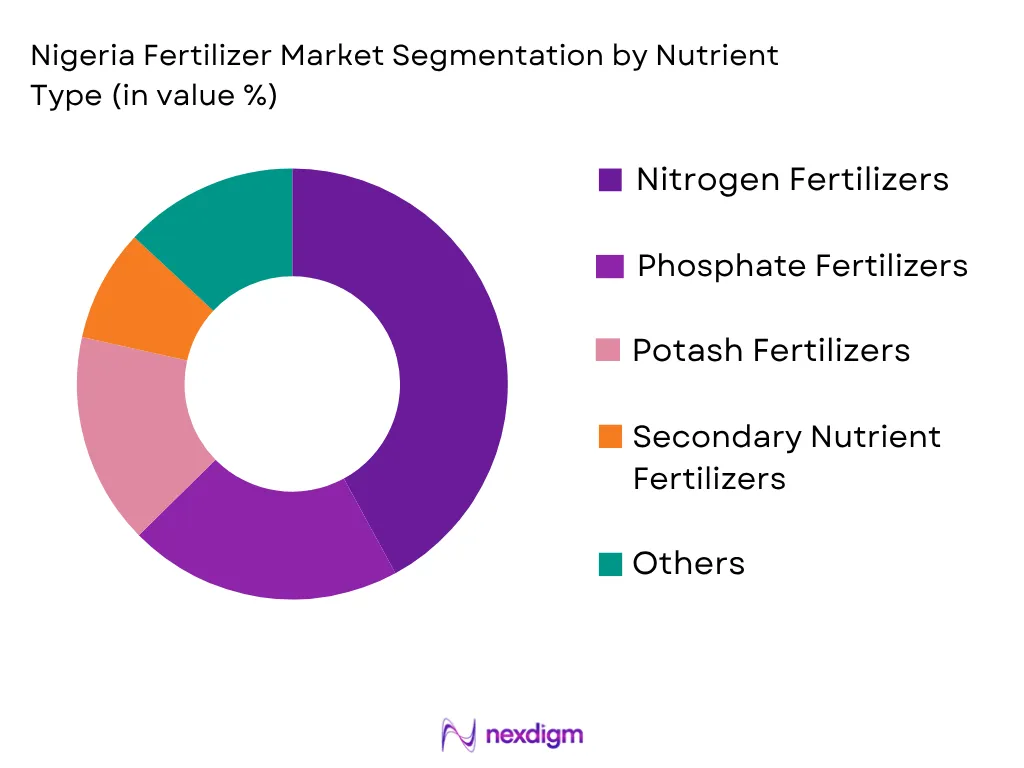
By Nutrient Type
Nitrogen fertilizers dominate the Nigeria fertilizer market due to the country’s extensive cultivation of maize, rice, sorghum, and vegetables across millions of smallholder and commercial farms, all of which require consistent nitrogen applications to sustain productivity on soils that are widely depleted of organic matter and plant-available nutrients. Nigerian soils across the Sudan Savanna, Guinea Savanna, and forest zones exhibit moderate to severe nitrogen deficiency resulting from decades of continuous cropping without adequate nutrient replenishment. Urea and calcium ammonium nitrate (CAN) are the most widely consumed nitrogen fertilizers due to their cost-effectiveness and broad availability through government subsidy programs and agro-dealer networks. The Presidential Fertilizer Initiative and state-level distribution programs have historically channeled urea and blended NPK fertilizers as the primary subsidized products, further reinforcing nitrogen fertilizer dominance. Growing adoption of blended NPK formulations is gradually increasing demand for phosphate and potash components, but nitrogen remains the cornerstone of fertilizer use across the country.
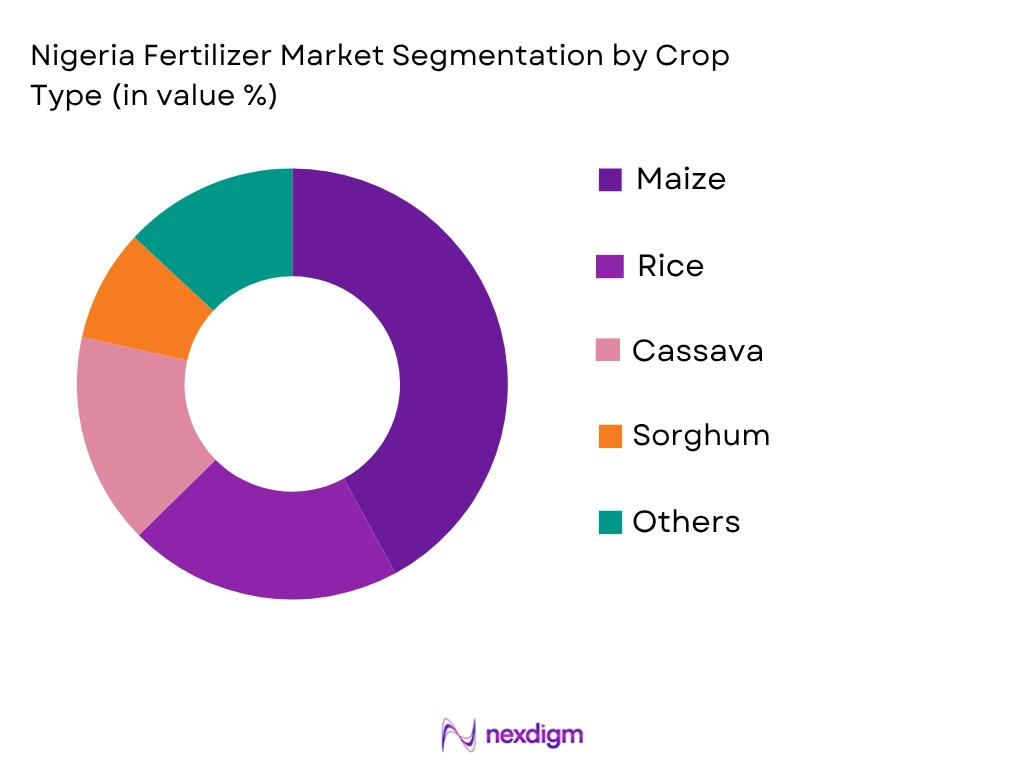
By Crop Type
Maize represents the dominant crop segment within the Nigeria fertilizer market as it is the most widely cultivated cereal crop in the country, grown across all six geopolitical zones by tens of millions of smallholder farmers as a staple food and livestock feed ingredient. Nigeria produced approximately 12 million metric tons of maize in 2024, with the Middle Belt states of Kaduna, Kogi, Benue, Niger, and Plateau accounting for the largest production volumes. Maize requires substantial applications of nitrogen, phosphorus, and potassium fertilizers to achieve commercially viable yields, and it is the crop most commonly targeted by government fertilizer subsidy and distribution programs. Rising domestic demand for maize from the poultry and livestock feed industry, flour mills, and starch processors has encouraged expansion of cultivated area and intensification of production practices. Consequently, maize farming remains the largest single contributor to fertilizer consumption throughout Nigeria.
Competitive Landscape
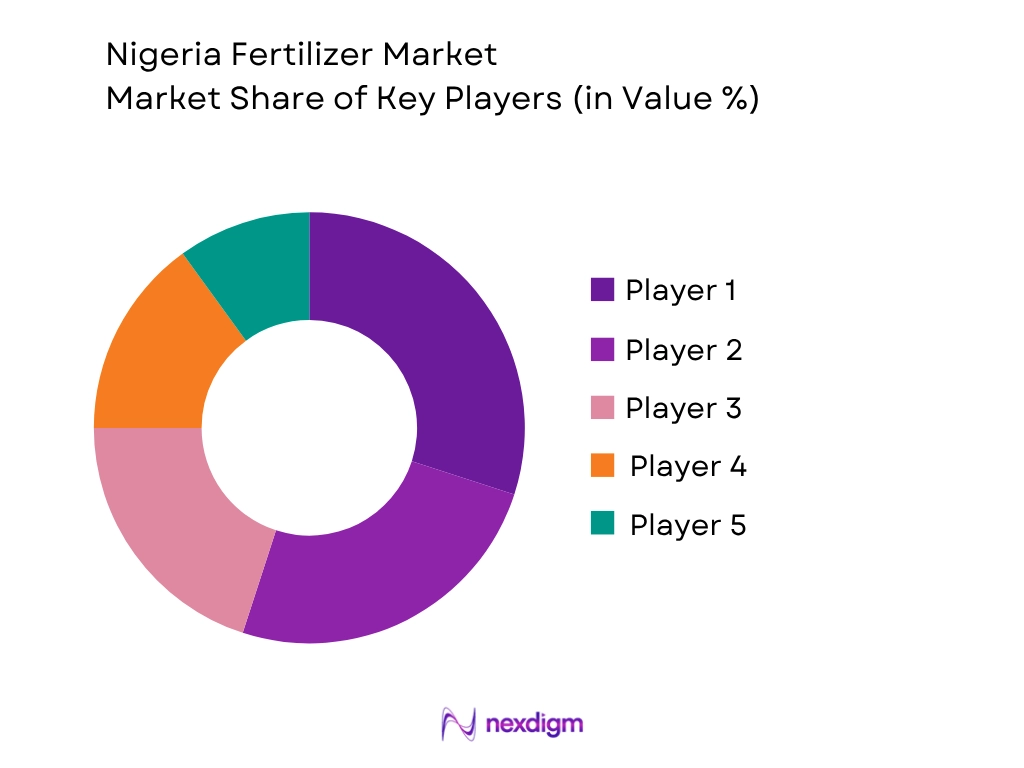
The Nigeria fertilizer market is moderately concentrated, with a small number of large domestic producers and blending companies alongside numerous distributors, agro-dealers, and government program participants competing across the value chain. Dangote Fertilizer and Indorama Eleme together represent a significant share of domestic urea production capacity, while OCP Africa, Notore, and WACOT are prominent in blended NPK supply. Government distribution programs including the Presidential Fertilizer Initiative significantly influence market structure by directing subsidized fertilizer volumes through designated blending plants and state government distribution channels. Companies compete through production scale, government program participation, distribution network reach, product quality assurance, and increasingly through digital agri-input platforms that are transforming last-mile delivery in rural farming communities.
| Company | Establishment Year | Headquarters | Product Portfolio | Production & Blending Facilities
|
Import Infrastructure | Distribution Reach | Specialty Fertilizer Portfolio | Agronomic Support Network |
| Dangote Fertilizer Limited | 2019 | ~ | ~ | ~ | ~ | ~ | ~ | ~ |
| Notore Chemical Industries | 2005 | ~ | ~ | ~ | ~ | ~ | ~ | ~ |
| Indorama Eleme Fertilizers | 2013 | ~ | ~ | ~ | ~ | ~ | ~ | ~ |
| OCP Africa Nigeria | 1920 | ~ | ~ | ~ | ~ | ~ | ~ | ~ |
| WACOT Limited | 1995 | ~ | ~ | ~ | ~ | ~ | ~ | ~ |
Nigeria Fertilizer Market Analysis
Growth Drivers
Rapid Population Growth and Rising Domestic Food Demand
Nigeria’s fertilizer market is fundamentally driven by the country’s exceptional population growth rate and the resulting surge in domestic food demand. According to the United Nations Population Division, Nigeria’s population surpassed 230 million in 2024, making it the most populous country in Africa and the sixth most populous globally. The country’s population is projected to reach 375 million by 2050, placing enormous pressure on agricultural systems to dramatically increase food production. The National Bureau of Statistics reported that Nigeria’s agricultural sector contributed approximately 24% of GDP in 2024, underscoring the sector’s critical role in the national economy. Demand for staple foods including maize, rice, cassava, and sorghum is rising rapidly, encouraging smallholder farmers and commercial agricultural enterprises to expand cultivated area and intensify production through improved seed varieties, irrigation, and fertilizer application. The Federal Ministry of Agriculture and Food Security estimates that Nigeria’s annual food import bill exceeds USD 5 billion, creating urgent policy imperative to boost domestic productivity. Increasing fertilizer use is widely recognized as the single most impactful lever available to raise crop yields across Nigeria’s vast smallholder farming sector. This population-driven food demand dynamic is expected to remain the most powerful long-term structural driver of fertilizer consumption growth throughout the country.
Government Fertilizer Programs and Presidential Fertilizer Initiative
Government-led fertilizer programs have historically been the primary mechanism driving fertilizer distribution and consumption in Nigeria, and ongoing policy commitment to agricultural input support continues to shape market dynamics significantly. The Presidential Fertilizer Initiative (PFI), launched in 2016 under a public-private partnership framework, engaged domestic blending plants to produce subsidized NPK fertilizer using locally sourced raw materials and internationally procured nutrients. According to the Federal Ministry of Agriculture and Food Security, the PFI produced and distributed tens of millions of bags of blended fertilizer to farmers across all 36 states and the FCT, substantially increasing fertilizer availability in rural areas. State governments have complemented federal programs with their own input subsidy and distribution schemes, further expanding the reach of affordable fertilizers to smallholder farmers. Nigeria’s GDP exceeded USD 360 billion in 2024 according to the World Bank, and agriculture remains a cornerstone of government economic diversification policy under the Nigeria Agenda 2050 and various agricultural transformation programs. The Anchor Borrowers Program administered by the Central Bank of Nigeria has also channeled agricultural credit to smallholder farmers, supporting fertilizer procurement alongside improved seed and irrigation investments. These combined government-led programs continue to underpin a substantial portion of annual fertilizer demand, making public sector agricultural policy one of the most important demand drivers in the Nigerian fertilizer market.
Market Challenges
Subsidy Inefficiencies, Fertilizer Diversion, and Counterfeiting
One of the most persistent and damaging challenges facing the Nigeria fertilizer market is the widespread inefficiency of fertilizer subsidy programs, including product diversion away from target beneficiaries and the prevalence of counterfeit and adulterated fertilizer products across rural distribution networks. According to reports from the Federal Ministry of Agriculture and Food Security and independent agricultural sector assessments, a significant proportion of subsidized fertilizer distributed through government programs has historically been diverted by middlemen and resold at higher prices in urban markets or neighboring countries, failing to reach the smallholder farmers for whom it was intended. The National Agency for Food and Drug Administration and Control (NAFDAC) and the Standards Organisation of Nigeria (SON) have documented widespread cases of fertilizer adulteration, including the dilution of genuine NPK and urea products with sand, sawdust, or low-grade fillers. Such counterfeiting undermines farmer confidence, reduces crop yields, and distorts market pricing. The introduction of e-wallet and digital voucher systems in several states has partially improved targeting and accountability, but implementation gaps and infrastructure deficits in rural areas continue to limit effectiveness. Addressing subsidy governance and product quality assurance remains one of the most critical regulatory and market development priorities within the Nigerian fertilizer sector.
Poor Rural Infrastructure and Last-Mile Distribution Constraints
Nigeria’s fertilizer market faces severe structural challenges related to inadequate rural infrastructure that severely limit the availability and affordability of fertilizer products at the farm level. According to the Federal Ministry of Works and Housing, Nigeria has approximately 195,000 kilometers of road network, but a large proportion of rural feeder roads connecting farming communities to agricultural input markets are in poor condition, particularly during the rainy season when demand for fertilizers peaks. This infrastructure deficit increases transportation costs, extends delivery lead times, and raises the final price of fertilizer for smallholder farmers located in remote agricultural areas. The Nigerian Electricity Regulatory Commission reported that the national electricity grid supplies unreliable power to fertilizer blending facilities and agro-dealer storage infrastructure, increasing operational costs through diesel generator dependency. Nigeria’s vast geographic spread across 923,768 square kilometers, combined with highly fragmented smallholder farm structures averaging less than two hectares per household, creates an exceptionally complex last-mile distribution challenge. According to the Fertilizer Producers and Suppliers Association of Nigeria (FEPSAN), the country requires a network of tens of thousands of functional agro-dealers to adequately serve its farming population, but dealer financing, product access, and training remain significant constraints. These infrastructure and distribution challenges continue to suppress fertilizer adoption rates well below agronomically recommended levels across much of the country.
Market Opportunities
Expansion of Gas-to-Fertilizer Production Capacity
Nigeria’s substantial natural gas reserves present a transformative opportunity to develop world-class domestic fertilizer production capacity and reduce the country’s heavy reliance on imported urea and nitrogen fertilizers. According to the Nigerian National Petroleum Company Limited (NNPCL), Nigeria holds proven natural gas reserves of approximately 209 trillion cubic feet, ranking among the largest in Africa and globally. The commissioning of the Dangote Fertilizer plant in Lagos — with an installed urea production capacity of 3 million metric tons per annum — represents the largest single investment in Nigerian fertilizer production history and a landmark development in reducing import dependency. Indorama Eleme Fertilizers in Rivers State similarly operates a significant urea production facility integrated with the Eleme Petrochemicals complex, leveraging associated gas feedstock. Despite these developments, Nigeria’s gas-to-fertilizer production potential remains substantially underutilized due to gas flaring, infrastructure constraints, and limited pipeline connectivity to stranded gas reserves in the Niger Delta. Investments in gas gathering infrastructure, pipeline connectivity, and additional ammonia-urea production units represent one of the highest-impact opportunities in the Nigerian fertilizer industry. Increasing domestic urea production would reduce import exposure, lower fertilizer prices for farmers, generate foreign exchange savings, and create significant industrial employment across the manufacturing and logistics value chain.
Digital Agriculture and E-Voucher Platforms Transforming Input Access
The rapid penetration of mobile telephony and digital financial services across Nigeria is creating a powerful opportunity to transform fertilizer distribution, improve subsidy targeting, and expand access to agricultural inputs for millions of smallholder farmers who have historically been underserved by conventional distribution channels. According to the Nigerian Communications Commission, Nigeria had over 220 million active mobile subscriptions in 2024, with mobile internet penetration growing rapidly across urban and peri-urban areas. Digital e-voucher and e-wallet platforms developed by state governments, development finance institutions, and private agri-fintech companies enable farmers to receive subsidized fertilizer entitlements directly on their mobile phones, reducing diversion and improving accountability. Platforms such as the Growth Enhancement Support Scheme (GESS) and its successors have demonstrated that digital input delivery can substantially improve the reach and efficiency of government fertilizer programs. Private sector agri-input platforms including those developed by companies such as Saro Agrosciences, Hello Tractor, and various fintech-agricultural crossovers are expanding digital procurement, credit access, and agronomic advisory services to smallholders. As smartphone penetration increases and mobile payment infrastructure deepens, digital channels are expected to capture a growing share of fertilizer distribution, improving market transparency, reducing counterfeiting risk, and enabling more targeted and data-driven nutrient management recommendations across Nigeria’s diverse farming communities.
Future Outlook
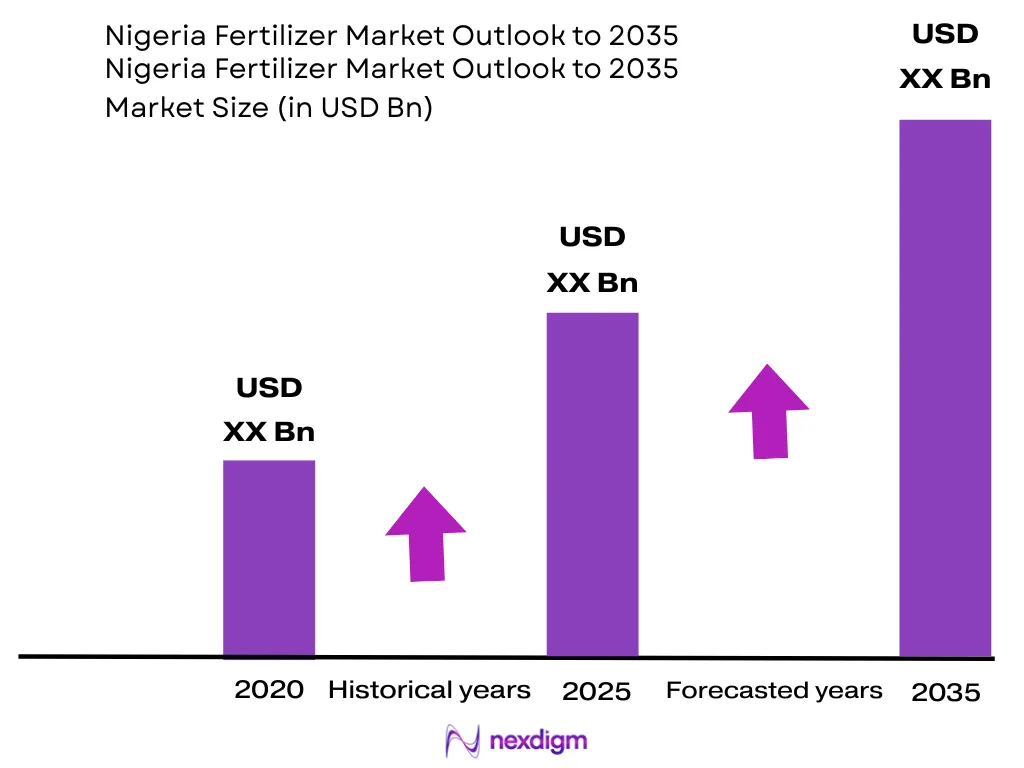
The Nigeria fertilizer market is expected to witness substantial growth over the forecast period driven by accelerating population growth, rising food demand, expanding domestic fertilizer production capacity, and ongoing government investment in agricultural input programs. The commissioning and ramp-up of Dangote Fertilizer and continued operations at Indorama Eleme are expected to significantly increase domestic urea availability and reduce import dependency. Digital distribution platforms and improved subsidy governance are anticipated to improve fertilizer access and adoption rates among the country’s vast smallholder farming population. Rising commercial agricultural investment, expanding irrigated farming areas, and growing demand for blended NPK and specialty fertilizers will further support market expansion. Nigeria’s trajectory toward becoming one of the world’s largest agricultural producers, supported by its land resources, tropical climate, and young population, positions the fertilizer market for sustained long-term growth through 2035.
Major Players
- Dangote Fertilizer Limited
- Notore Chemical Industries
- Indorama Eleme Fertilizers and Chemicals
- OCP Africa Nigeria
- Yara Nigeria
- Fertilizer Producers and Suppliers Limited (FEPSAN members)
- WACOT Limited (TGI Group)
- Saro Agrosciences
- Dizengoff Nigeria
- Premier Agri Sciences
- Jubaili Agrotec
- Agri-Input Supplies Nigeria
- Chi Farms
- Flour Mills of Nigeria Agro-Allied
- Olam Agri Nigeria
Key Target Audience
- Fertilizer Manufacturers and Blending Companies
- Agricultural Input Distributors, Agro-Dealers, and Retailers
- Commercial Farming Enterprises and Agribusinesses
- Smallholder Farmer Cooperatives and Associations
- Investments and Venture Capitalist Firms
- Government and Regulatory Bodies (Federal Ministry of Agriculture and Food Security, Fertilizer Producers and Suppliers Association of Nigeria – FEPSAN, National Agricultural Seeds Council, Standards Organisation of Nigeria, NAFDAC)
- Fertilizer Importers and Exporters
- Agri-Fintech and Digital Agriculture Platform Providers
Research Methodology
Step 1: Identification of Key Variables
The initial phase involves constructing an ecosystem map encompassing all major stakeholders within the Nigeria Fertilizer Market. Extensive secondary research is conducted through industry publications, government databases, company annual reports, trade associations, and agricultural statistics. The objective is to identify critical variables influencing fertilizer demand, supply, pricing, imports, and crop production.
Step 2: Market Analysis and Construction
This phase focuses on gathering and analyzing historical information regarding fertilizer production, imports, nutrient consumption, crop acreage, and agricultural output. Market revenues are estimated through analysis of fertilizer volumes, average selling prices, and nutrient demand trends. Both supply-side and demand-side assessments are incorporated to develop comprehensive market estimates.
Step 3: Hypothesis Validation and Expert Consultation
Preliminary findings and market assumptions are validated through structured interviews with fertilizer manufacturers, distributors, agricultural cooperatives, agronomists, and industry specialists. These consultations provide valuable insights into purchasing patterns, nutrient application trends, production economics, and future market developments.
Step 4: Research Synthesis and Final Output
The final stage integrates findings obtained from primary and secondary research. Data triangulation techniques are applied to ensure consistency and reliability across all market estimates. The resulting report provides a comprehensive assessment of market structure, competitive dynamics, growth opportunities, and long-term industry outlook for the Nigeria Fertilizer Market.

- Executive Summary
- Research Methodology (Market Definitions and Assumptions, Abbreviations, Market Sizing Approach, Top-Down Analysis, Bottom-Up Analysis, Fertilizer Demand Assessment by Crop Area, Nutrient Consumption Analysis, Import-Export Assessment, Primary Industry Interviews, Data Triangulation, Forecasting Framework, Limitations and Future Conclusions)

- Definition and Scope
- Market Evolution and Industry Genesis
- Timeline of Major Industry Developments
- Nigeria Agricultural Production Ecosystem
- Fertilizer Industry Value Chain Analysis

- Growth Drivers (Expansion of Maize and Rice Cultivation, Rising Population and Food Demand, Government Fertilizer Subsidy and Distribution Programs, Increasing Adoption of Improved Farming Practices, Growth in Commercial Agriculture, Rising Demand for Food Security Solutions)
- Market Challenges (Fertilizer Subsidy Inefficiencies and Diversion, Dependence on Imported Raw Materials, Poor Rural Infrastructure and Last-Mile Distribution, Currency Devaluation and Macroeconomic Instability, Counterfeiting and Adulteration of Fertilizer Products)
- Market Opportunities (Domestic Fertilizer Production Expansion via Gas-to-Fertilizer Plants, Presidential Fertilizer Initiative Scale-Up, Specialty Fertilizer Growth, Biofertilizer Adoption, Digital Agri-Input Distribution Platforms)
- Market Trends (Increased Use of Blended NPK Fertilizers, Digital Agriculture and E-Voucher Integration, Customized Nutrient Blends for Nigerian Soil Types, Expansion of Biological and Organic Inputs, Growing Private Sector Investment in Blending Plants)
- Government Regulations (Federal Fertilizer Quality Control Act, NASC and NAFDAC Registration Requirements, Presidential Fertilizer Initiative Standards, Nutrient Quality Regulations, Import and Trade Policies)
- Import Dependency Assessment (Urea Import Ratio, Phosphate Import Ratio, Potash Import Ratio, Supplier Country Concentration)
- Raw Material Analysis (Natural Gas Feedstock Availability, Phosphate Rock Supply, Potash Availability, Sulfur Supply)
- Fertilizer Consumption Intensity Analysis (Kg per Hectare, Nutrient Use Efficiency, Crop-Wise Consumption, Regional Application Rates)
- Price Trend Analysis (Urea Prices, NPK Prices, CAN Prices, DAP Prices, MOP Prices)
- Supply-Demand Gap Analysis (Domestic Production Capacity, Installed Capacity Utilization, Import Requirements, Inventory Levels)
- SWOT Analysis
- Porter’s Five Forces Analysis
- PESTLE Analysis
- Stakeholder Ecosystem
- Competition Ecosystem

- By Market Value (2020-2025)
- By Production Volume (2020-2025)
- By Average Selling Price (2020-2025)

- By Nutrient Type (In Value %)
Nitrogen Fertilizers
Phosphate Fertilizers
Potash Fertilizers
Secondary Nutrient Fertilizers
Micronutrient Fertilizers
Specialty and Customized Fertilizers - By Application Method (In Value %)
Soil Application
Fertigation
Foliar Application
Seed Treatment
Precision Agriculture Application - By Crop Type (In Value %)
Maize
Rice
Cassava
Sorghum
Wheat
Sugarcane
Vegetables and Tomatoes
Cotton
Others - By Region (In Value %)
North West
North Central
North East
South West
South South
South East - By Distribution Channel (In Value %)
Government Distribution Programs (AFAP, Presidential Fertilizer Initiative)
Agricultural Retailers and Agro-Dealers
Direct Sales by Manufacturers
Distributors and Wholesalers
Digital Agricultural Platforms and E-Voucher Systems

- Market Share Analysis of Major Players (By Value, By Volume, Nutrient Segment, Crop Segment, By Region)
- Market Concentration Analysis
- Cross Comparison Parameters (Product Portfolio Diversity, Annual Fertilizer Production Capacity, Blending Capacity, Distribution Network Reach, Government Program Participation, Agronomic Technical Service Coverage, Specialty Fertilizer Portfolio Strength, Crop-Specific Nutrient Solution Capability)
- SWOT Analysis of Major Players
- Pricing Analysis by Product Type and Nutrient Grade
- Detailed Profiles of Major Companies
Dangote Fertilizer Limited
Notore Chemical Industries
Indorama Eleme Fertilizers and Chemicals
OCP Africa Nigeria
Yara Nigeria
Fertilizer Producers and Suppliers Limited (FEPSAN members)
WACOT Limited (TGI Group)
Saro Agrosciences
Dizengoff Nigeria
Premier Agri Sciences
Jubaili Agrotec
Agri-Input Supplies Nigeria
Chi Farms
Flour Mills of Nigeria Agro-Allied
Olam Agri Nigeria

- Crop Nutrient Consumption Assessment (Crop Area, Yield Targets, Nutrient Removal Rates, Fertilizer Intensity)
- Farm Size Analysis (Smallholder Subsistence Farms, Medium Farms, Large Commercial Farms)
- Purchasing Power Analysis (Farm Income Levels, Subsidy Access, Credit Availability, Fertilizer Budget Allocation)
- Seasonal Demand Assessment (Planting Cycles, Crop Calendar, Procurement Patterns)
- Farmer Purchasing Behavior (Brand Preference, Nutrient Preference, Price Sensitivity)
- Precision Agriculture Adoption Analysis (Mobile-Based Advisory, Variable Rate Technology, Digital Farm Management)
- Sustainability Adoption Analysis (Carbon Reduction Practices, Soil Health Management, Conservation Agriculture)
- Pain Point Analysis (Input Costs, Product Availability, Last-Mile Access, Counterfeiting, Agronomic Support)
- Purchase Decision-Making Process

- By Market Value (2026-2035)
- By Production Volume (2026-2035)
- By Average Selling Price (2026-2035)


 Request a Sample
 Ask for Customization
 Get a Quote
 Enquire Now