
 Download PDF
Market Overview
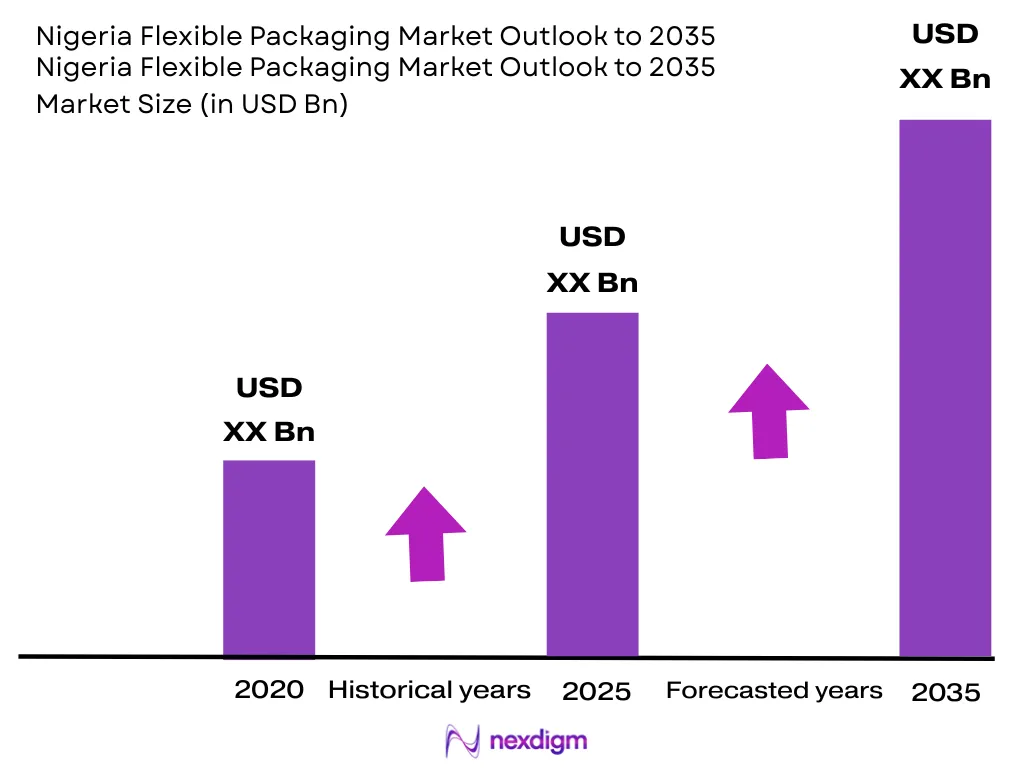
The Nigeria Flexible Packaging Market was valued at USD ~ Billion in 2024 and is anticipated to expand at a CAGR of ~% during 2026-2035. The market is primarily driven by rapid expansion of Nigeria’s food processing industry, Africa’s largest by population base exceeding 230 million consumers, alongside rising agro-export volumes and growing e-commerce activity. The National Agency for Food and Drug Administration and Control (NAFDAC) reported a 38% rise in registered food processing companies between 2019 and 2023, with approximately 82% of these companies using flexible plastic packaging for their products. Industry estimates place the Nigeria flexible packaging market at approximately USD ~ billion in 2025, growing toward approximately USD ~ billion by 2030. A significant structural shift occurred in March 2025 with the start-up of Dangote’s 900,000 tonne-per-annum polypropylene plant, which is set to substantially reduce Nigerian converters’ historical dependence on imported resin, a segment in which converters previously imported an estimated 70-85% of feedstock.
Market Segmentation
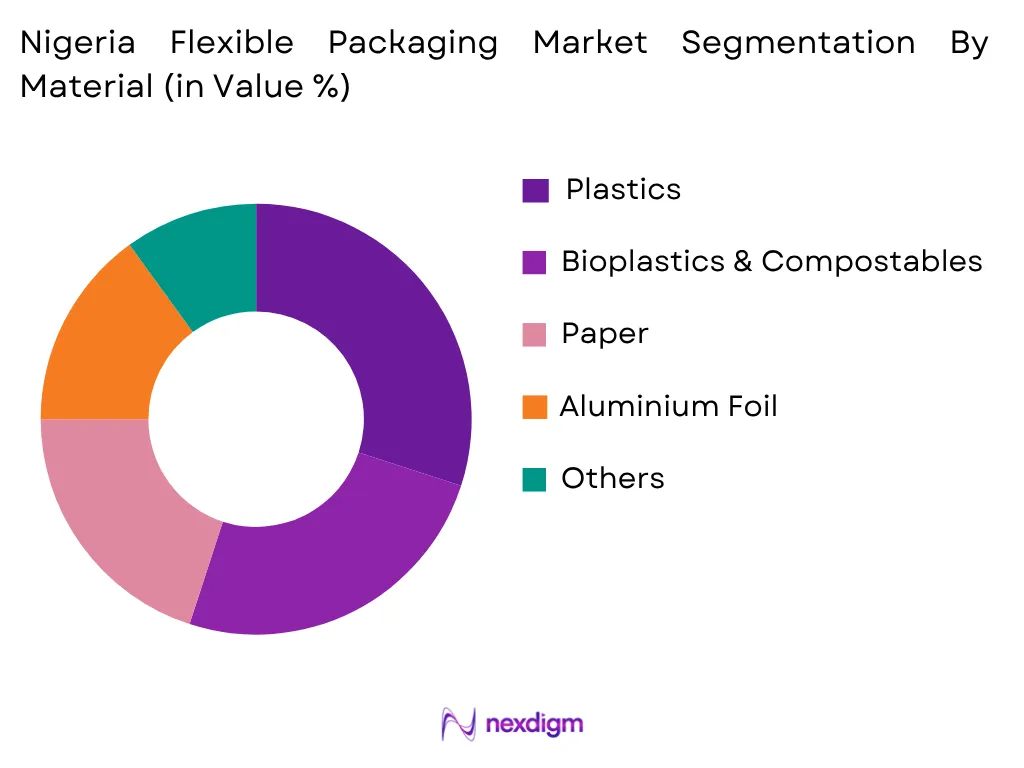
By Material
Plastic, primarily polyethylene and polypropylene, dominates the Nigeria Flexible Packaging Market, benefiting from established filling lines across food, beverage, and household goods applications and a cost advantage that has historically outweighed sustainability concerns among price-sensitive converters and brand owners. The March 2025 start-up of Dangote’s 900,000 tonne-per-annum polypropylene plant is expected to further reinforce plastic’s dominance by providing converters with steady, naira-denominated resin supply that shields them from currency swings previously affecting imported feedstock. Paper-based laminates and molded fiber formats are gaining incremental share, driven by e-commerce logistics growth and multinational FMCG commitments to reduce virgin plastic content, though from a comparatively small base. Bioplastics and compostable formats remain nascent in Nigeria relative to more developed African markets such as South Africa and Kenya, constrained by higher costs and limited local compostable resin production capacity.
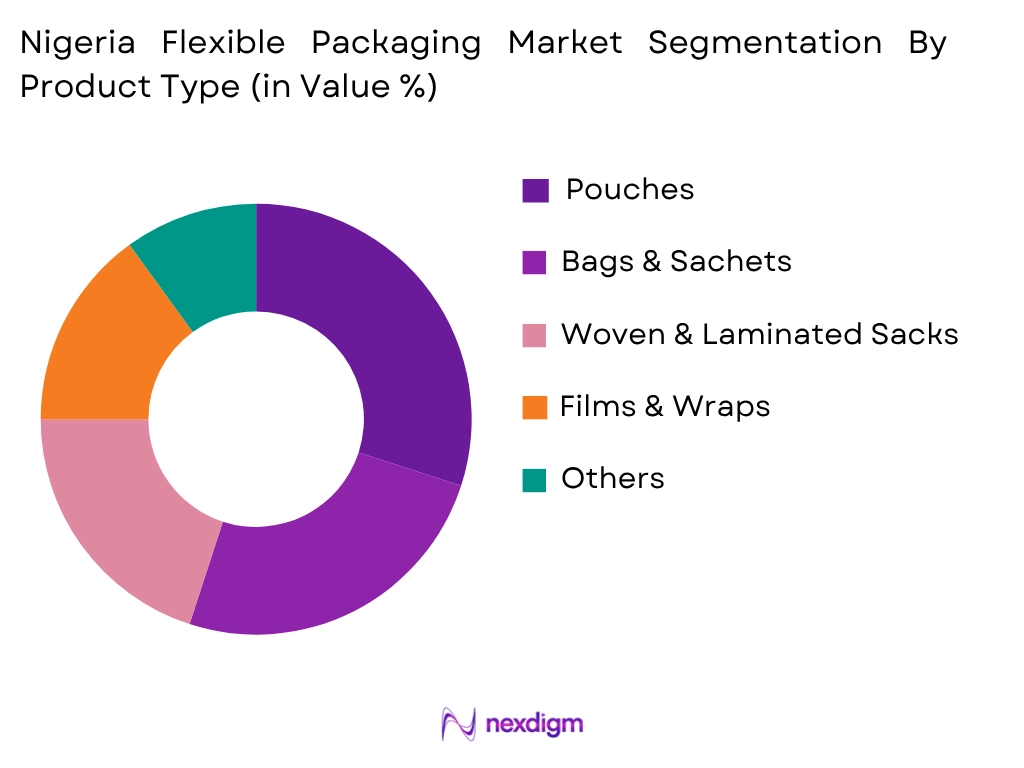
By Product Type
Bags & Sachets represent the largest product-type segment, reflecting Nigeria’s deeply established sachet economy across food, beverage, and household goods, where flexible sachets provide affordable, single-serve formats accessible to price-sensitive consumers across both urban and rural markets. Woven & Laminated Sacks maintain a substantial and distinct share given Nigeria’s large agricultural export base, with domestic converters such as Sonnex Packaging co-developing moisture-barrier pouches specifically engineered for Nigeria’s cassava processing program, which targets throughput of 20 million tonnes by 2027. The Nigerian Export Promotion Council reported that processed food exports rose approximately 27.3% in 2023, with flexible packaging accounting for nearly 65% of all packaging materials used in food exports, reinforcing the centrality of flexible formats to Nigeria’s agro-export value chain. Pouches and films continue to expand alongside growing demand for dairy products, snacks, and ready-to-eat meals among Nigeria’s rapidly urbanizing population.
Competitive Landscape
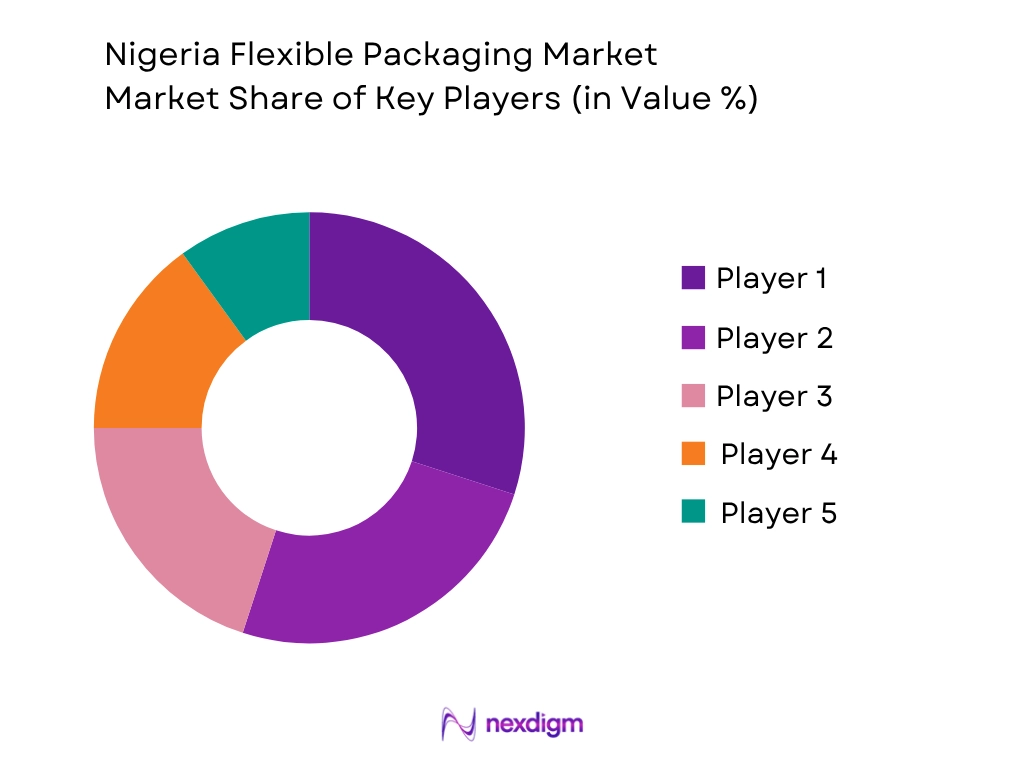
The Nigeria Flexible Packaging Market remains fragmented, with a mix of established domestic converters, industrial conglomerate-backed manufacturers, and international players competing across different price points and technical specifications. Competition is primarily based on price competitiveness, particularly amid currency volatility, local manufacturing presence, regulatory compliance with NAFDAC and SON requirements, and the ability to serve both large multinational FMCG customers and Nigeria’s extensive base of small and medium-sized food processing enterprises. All Time Packaging has built a strong reputation since its establishment in 2016 for serving both SME and multinational customers with food-grade nylon packaging and printed laminates, while established industrial players such as BAGCO maintain large-scale capacity in woven and laminated sacks backed by strong distribution networks. Dangote Group’s entry into domestic polypropylene production is reshaping competitive dynamics industry-wide, as converters with access to indexed, naira-denominated resin supply gain a structural cost advantage over competitors still reliant on imported feedstock exposed to Nigeria’s volatile foreign exchange environment.
| Company | Establishment Year | Headquarters | Primary Product Portfolio | Flexible Packaging Portfolio
|
Manufacturing Presence | Major End-Use Industries | Key Strategic Focus | Certifications & Compliance |
| UFlex Limited | 1985 | ~ | ~ | ~ | ~ | ~ | ~ | ~ |
| Nampak Nigeria Plc | 1927 | ~ | ~ | ~ | ~ | ~ | ~ | ~ |
| All Time Packaging | 2016 | ~ | ~ | ~ | ~ | ~ | ~ | ~ |
| BAGCO (Bag Manufacturing Company of Nigeria) | 1961 | ~ | ~ | ~ | ~ | ~ | ~ | ~ |
| Dangote Group | 1981 | ~ | ~ | ~ | ~ | ~ | ~ | ~ |
Nigeria Flexible Packaging Market Analysis
Growth Drivers
Rapid Growth of Nigeria’s Food Processing and Agro-Export Sector
Nigeria’s flexible packaging market is experiencing sustained growth due to rapid expansion of the country’s food processing industry, which the Manufacturers Association of Nigeria (MAN) reported grew approximately 11.2% in 2023, making it Nigeria’s largest manufacturing subsector, with packaging accounting for roughly 23% of total production costs, primarily for flexible plastic solutions. NAFDAC reported a 38% rise in registered food processing companies between 2019 and 2023, with approximately 82% of these companies relying on flexible plastic packaging for their products. The Nigerian Export Promotion Council reported that processed food exports rose approximately 27.3% in 2023, with flexible packaging accounting for nearly 65% of all packaging materials used in food exports, underscoring the sector’s centrality to Nigeria’s growing agro-export ambitions. Nigeria’s cassava processing program, which targets throughput of 20 million tonnes by 2027, is driving demand for specialized moisture-barrier pouches, exemplified by domestic converter Sonnex Packaging’s collaboration with machinery vendors to develop application-specific packaging solutions for the sector.
Domestic Resin Supply Expansion Reducing Import Dependency
The March 2025 start-up of Dangote’s 900,000 tonne-per-annum polypropylene plant represents a structural turning point for Nigeria’s flexible packaging industry, which has historically imported an estimated 70-85% of its resin feedstock. This import dependency has left converters highly exposed to Nigeria’s volatile foreign exchange environment, with the naira depreciating approximately 42% against the US dollar over a recent 24-month period, compounding the impact of polyethylene and polypropylene price swings between USD 800 and USD 1,400 per tonne during 2025. Domestic polypropylene supply from Dangote’s new facility is expected to curb import exposure and provide converters with more predictable, naira-denominated input costs, insulating the industry from currency-driven margin compression. As this new domestic capacity ramps up, flexible packaging converters positioned to secure long-term supply agreements with Dangote are likely to gain a meaningful structural cost advantage over competitors still dependent on imported resin.
Market Challenges
Currency Volatility and High Feedstock Import Dependency
Nigeria’s flexible packaging converters continue to navigate significant currency volatility that has substantially eroded margins across the industry. The Nigerian naira depreciated approximately 42% against the US dollar over a recent 24-month period, while polyethylene and polypropylene prices swung between USD 800 and USD 1,400 per tonne during 2025, creating a difficult operating environment for converters that have historically imported an estimated 70-85% of their feedstock. Converters importing the majority of their raw materials struggle to maintain margins when resin price spikes coincide with power outages and logistics bottlenecks, both persistent challenges within Nigeria’s broader industrial operating environment. While Dangote’s new domestic polypropylene capacity is expected to gradually ease this pressure, the transition will take time, and converters without the scale or relationships to secure long-term domestic supply agreements remain acutely exposed to continued currency and commodity price volatility in the interim.
Single-Use Plastics Ban and Emerging EPR Regulatory Uncertainty
Nigeria’s regulatory environment for flexible packaging is evolving rapidly, creating compliance uncertainty for converters and brand owners alike. In January 2024, the Nigerian government announced a ban on single-use plastics, encompassing bags, containers, and bottles, directly affecting a significant share of the flexible packaging formats historically used across Nigeria’s food, beverage, and household goods sectors. In September 2023, the Landbell Group, in collaboration with BlackForest Solutions, completed an Extended Producer Responsibility advisory mission on behalf of Nigeria’s Federal Ministry of Environment, part of the World Bank-backed PROBLUE multi-donor trust fund, signaling that a formal EPR framework similar to those already implemented in South Africa and Kenya may be forthcoming. Converters and brand owners currently face uncertainty regarding the specific scope, timeline, and compliance obligations of Nigeria’s evolving plastic waste regulations, complicating long-term investment planning for packaging formats that may face future restriction or recycled-content mandates.
Market Opportunities
Vertical Integration Leveraging Domestic Polypropylene Capacity
Dangote’s new 900,000 tonne-per-annum polypropylene plant, which began operations in March 2025, creates substantial opportunity for flexible packaging converters to secure stable, competitively priced, naira-denominated resin supply and reduce exposure to currency-driven cost volatility. Converters that establish long-term off-take agreements with Dangote are positioned to gain a durable structural cost advantage over competitors still reliant on imported feedstock, particularly given Nigeria’s continued foreign exchange volatility. This domestic supply expansion also supports Nigeria’s broader Nigeria Industrial Revolution Plan objectives of reducing import dependency and strengthening domestic manufacturing capacity across the packaging value chain. As domestic polypropylene availability scales, Nigerian converters may also find new opportunities to compete more effectively on cost with imported flexible packaging products, both within Nigeria and across the broader West African region.
Expansion of Agro-Export Barrier Packaging
Nigeria’s growing role in regional agro-export value chains, reinforced by the African Continental Free Trade Area’s tariff elimination on 90% of goods, which catalyzed approximately USD 12 billion in new processing plant investment across Africa between 2023 and 2025, creates substantial opportunity for converters specializing in high-barrier agro-export packaging. Nigeria’s cassava processing program, targeting throughput of 20 million tonnes by 2027, exemplifies the scale of demand for moisture-barrier pouches and specialized packaging formats, with domestic converter Sonnex Packaging’s collaboration with machinery vendors illustrating the type of application-specific innovation increasingly rewarded by export-oriented processors. Growing multinational brand owner sustainability commitments, including Nestlé Nigeria’s pledge to make over 95% of its plastic packaging recyclable by 2025 and Coca-Cola’s Apapa PET collection hub targeting 35-40% recycled content by 2035, further signal expanding opportunity for converters capable of delivering both export-grade barrier performance and credible sustainability credentials to Nigeria’s largest multinational FMCG customers.
Future Outlook
The Nigeria Flexible Packaging Market is expected to witness steady expansion over the forecast period, supported by continued food processing sector growth, rising agro-export volumes, and the structural benefits of Dangote’s new domestic polypropylene capacity reducing the industry’s historical exposure to currency volatility and import dependency. Continued investment in moisture-barrier agro-export packaging, recycled-content partnerships with multinational brand owners, and evolving compliance capability ahead of an anticipated formal EPR framework will further shape competitive positioning across the industry. The market is also likely to benefit from Nigeria’s position as Africa’s most populous country and a key beneficiary of AfCFTA-driven regional trade integration.
Major Players
- Nampak Nigeria Plc
- All Time Packaging
- BAGCO (Bag Manufacturing Company of Nigeria)
- UFlex Limited
- Dangote Group
- Victor Oscar Company
- Flexipack Plastics Ltd.
- PrimePak Industries Nigeria Ltd.
- Quantum Plastic Nigeria Ltd.
- Tempo Paper Pulp & Packaging Ltd.
- Sonnex Packaging
- Amcor
- Constantia Flexibles
- Huhtamaki
- Berry Global
Key Target Audience
- Flexible Packaging Manufacturers
- Food & Beverage Processing Companies
- Agro-Export & Processing Companies
- Healthcare & Pharmaceutical Companies
- Household & Personal Care Manufacturers
- Investment and Venture Capitalist Firms
- Government and Regulatory Bodies (National Agency for Food and Drug Administration and Control (NAFDAC), Standards Organization of Nigeria (SON), Federal Ministry of Environment)
- Raw Material Suppliers and Resin Producers
Research Methodology
Step 1: Identification of Key Variables
The research process begins with identifying the complete ecosystem of the Nigeria Flexible Packaging Market, including raw material suppliers, packaging converters, printing technology providers, brand owners, retailers, and regulatory authorities. Extensive secondary research is conducted using company annual reports, government publications, trade associations, customs statistics, industry journals, and proprietary databases to determine the variables influencing market demand, pricing, production, consumption, and technological developments.
Step 2: Market Analysis and Construction
Historical market information is collected and analyzed to estimate market size, production volumes, import-export activity, application-wise demand, and pricing trends. A combination of top-down and bottom-up approaches is used to estimate market revenues and validate segment-level performance. Consumption patterns across food processing, agro-export, beverage, and household goods packaging are evaluated to establish an accurate representation of the industry.
Step 3: Hypothesis Validation and Expert Consultation
The preliminary findings are validated through Computer-Assisted Telephone Interviews (CATIs) and structured discussions with flexible packaging converters, procurement managers, distributors, packaging engineers, regulatory experts, and senior executives operating within the Nigerian packaging industry. These interviews help verify market assumptions, competitive developments, technology adoption trends, pricing dynamics, and future investment opportunities while refining the overall market estimates.
Step 4: Research Synthesis and Final Output
The final stage integrates insights obtained from primary interviews with quantitative information collected through secondary sources. Data triangulation techniques are applied to reconcile differences between supply-side and demand-side estimates, ensuring robust market forecasting. The report is then reviewed through multiple quality assurance checkpoints to deliver a comprehensive analysis covering market size, segmentation, competitive landscape, future outlook, and strategic recommendations for industry stakeholders.

- Executive Summary
- Research Methodology (Market Definitions and Assumptions, Abbreviations, Market Sizing Approach, Top-Down Analysis, Bottom-Up Analysis, Demand-Side Assessment, Supply-Side Assessment, Primary Industry Interviews, Secondary Research Validation, Data Triangulation, Forecasting Framework, Limitations and Future Conclusions)

- Definition and Scope
- Market Evolution and Industry Genesis
- Timeline of Major Industry Developments
- Flexible Packaging Industry Value Chain Analysis
- Supply Chain Analysis

- Growth Drivers (Rapid Growth of Food Processing Sector, Rising Agro-Export Demand, Domestic Resin Supply Expansion, Growth of E-Commerce & Online Retail, Urbanization-Driven Convenience Packaging Demand, Expansion of Registered Food Processing Companies)
- Market Challenges (Currency Volatility & Naira Depreciation, High Feedstock Import Dependency, Single-Use Plastics Ban Compliance, Emerging EPR Regulatory Uncertainty, Power Supply Constraints, Limited Recycling Infrastructure)
- Market Opportunities (Vertical Integration via Domestic Polypropylene Capacity, Expansion of Agro-Export Barrier Packaging, AfCFTA-Driven Regional Trade Growth, Growth in Recycled-Content Partnerships, SME Digitalization & Short-Run Printing, Cassava & Cocoa Processing Packaging Demand)
- Market Trends (Shift Toward Recyclable Mono-Polyethylene Structures, Growth in Moisture-Barrier Agro-Export Pouches, Local Resin Sourcing Expansion, Retailer Sustainability Commitments, Indexed Supply Contract Adoption, Multilingual Regional Packaging Design)
- Government Regulations (NAFDAC Food-Grade Packaging Approvals, Standards Organization of Nigeria (SON) Compliance, Nigeria Industrial Revolution Plan (NIRP), January 2024 Single-Use Plastics Ban, Emerging Extended Producer Responsibility Framework, Import Compliance)
- Import and Export Analysis (Trade Volume, Major Import Sources, Export Destinations, HS Code Analysis, Trade Balance)
- Raw Material Availability Analysis (Domestic Polypropylene Supply, Imported Polyethylene Resins, Recycled PET & PCR Feedstock, Kraft Paper & Pulp, Aluminum Foil Stock)
- Technology Landscape (Multilayer Coextrusion Technologies, Flexographic & Digital Printing Systems, Barrier Coating Technologies, Woven Sack Lamination Technologies, Mechanical Recycling Technologies)
- Sustainability Assessment (Post-Consumer Recycled Content Adoption, Mono-Material Recyclability, PET Collection Hub Expansion, Carbon Footprint Reduction, Circular Economy Partnerships)
- PESTLE Analysis
- SWOT Analysis
- Porter’s Five Forces Analysis
- Stakeholder Ecosystem
- Competition Ecosystem

- By Market Value (2020-2025)
- By Volume Consumption (2020-2025)
- By Average Selling Price (2020-2025)

- By Material Type (In Value %)
Plastic (Polyethylene & Polypropylene)
Paper-Based Laminates
Aluminum Foil
Bioplastics & Compostables
Multilayer Composite Films - By Product Type (In Value %)
Bags & Sachets
Pouches
Films & Wraps
Woven & Laminated Sacks
Laminates & Rollstock
Shrink & Stretch Films - By Printing Technology (In Value %)
Flexography
Rotogravure
Digital Printing
Offset Printing
Others - By End User (In Value %)
Food Processing
Beverage
Household & Personal Care
Healthcare & Pharmaceutical
Agriculture & Agro-Export (Cassava, Cocoa, Cashew)
E-Commerce & Retail
Industrial & Building Materials - By Region (In Value %)
Southwest Nigeria (Lagos)
South-South Nigeria (Niger Delta)
Southeast Nigeria
North Central Nigeria (Abuja/FCT)
Northern Nigeria

- Market Share of Major Players (By Value, Volume, Material Type, Application Industry, Product Category)
- Cross Comparison Parameters (Product Portfolio Breadth, Feedstock Integration, Barrier Technology Performance, Application Technical Support, Manufacturing Capacity, Regulatory Compliance & Certifications, Food & Beverage Customer Base, Innovation & New Product Launch Frequency)
- SWOT Analysis of Major Players
- Pricing Analysis by Product Category and SKU
- Production Capacity Analysis
- Manufacturing Footprint Analysis
- Distribution Network Analysis
- Innovation Benchmarking
- Detailed Profiles of Major Companies
Nampak Nigeria Plc
All Time Packaging
BAGCO (Bag Manufacturing Company of Nigeria)
UFlex Limited
Dangote Group
Victor Oscar Company
Flexipack Plastics Ltd.
PrimePak Industries Nigeria Ltd.
Quantum Plastic Nigeria Ltd.
Tempo Paper Pulp & Packaging Ltd.
Sonnex Packaging
Amcor
Constantia Flexibles
Huhtamaki
Berry Global

- Consumption Pattern Analysis (Industrial Usage, Batch Size, Product Category Penetration, Seasonal Demand, Reformulation Activity)
- Purchasing Criteria (Barrier Performance, NAFDAC/SON Compliance, Cost Efficiency, Recyclability, Print Quality, Shelf Appeal)
- Procurement and Supplier Selection Analysis
- Recycled-Content Adoption Assessment
- SME vs Large Manufacturer Packaging Demand
- Product Attribute Preference Analysis (Moisture Barrier Performance, Seal Integrity, Print Definition, Recyclability, Tensile Strength, Shelf Life Extension)
- Currency & Import Dependency Influence on Procurement Decisions
- Pain Point Analysis
- Decision-Making Process

- By Market Value (2026-2035)
- By Volume Consumption (2026-2035)
- By Average Selling Price (2026-2035)


 Request a Sample
 Ask for Customization
 Get a Quote
 Enquire Now