
 Download PDF
Market Overview
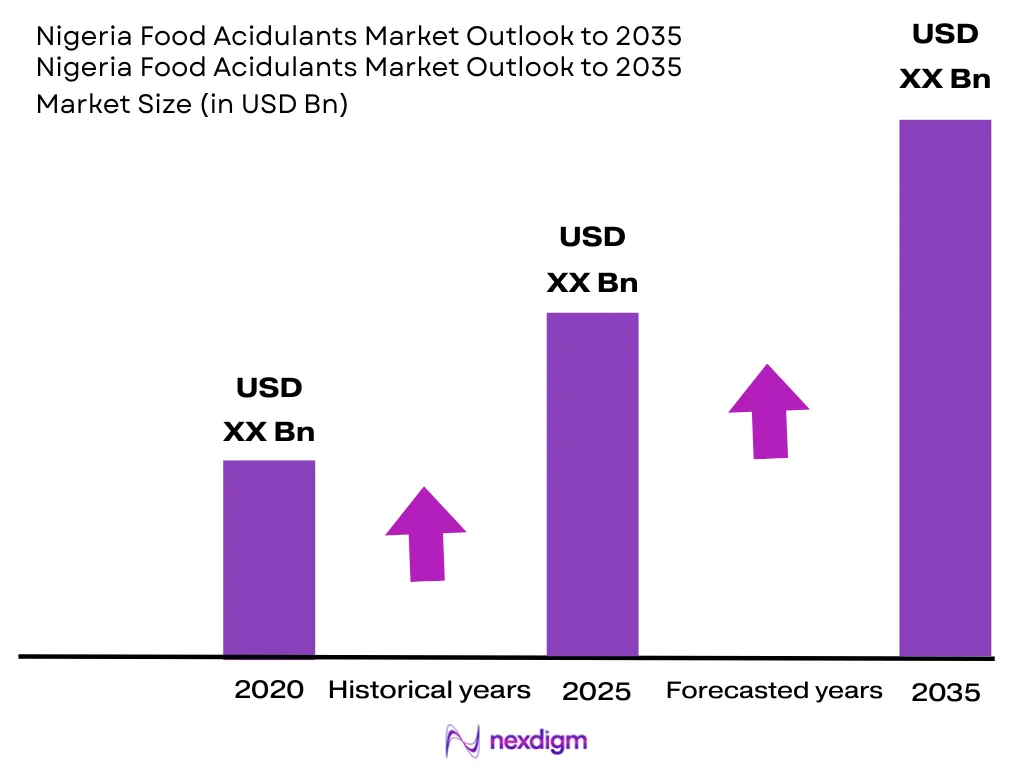
The Nigeria Food Acidulants Market was valued at USD ~ million in 2024 and is projected to expand at a CAGR of ~% during the 2026–2035 forecast period. According to data published by the National Agency for Food and Drug Administration and Control (NAFDAC), the Standards Organisation of Nigeria (SON), the Nigerian Bureau of Statistics (NBS), and the Manufacturers Association of Nigeria (MAN), Nigeria’s food and beverage manufacturing sector is the largest in Sub-Saharan Africa by output volume and the primary driver of food acidulant demand across the country. Food acidulants, encompassing organic acids such as citric acid, lactic acid, malic acid, tartaric acid, fumaric acid, and acetic acid, as well as inorganic acids including phosphoric acid and functional acidulant systems such as glucono delta-lactone (GDL), are essential functional ingredients used across Nigeria’s large beverage manufacturing industry, dairy processing sector, bakery and confectionery manufacturers, processed meat and poultry operations, and sauce and seasoning producers. Nigeria’s food acidulant market is almost entirely supplied through imports channelled through the Apapa and Tin Can Island port complexes in Lagos, with specialty chemical and ingredient distributors, import agents, and open market trading companies serving as the dominant supply chain intermediaries between international producers and domestic food manufacturers. The market’s growth trajectory is closely aligned with Nigeria’s rapidly expanding population, accelerating urbanisation, the progressive formalisation of the food manufacturing sector driven by NAFDAC enforcement, and the country’s unique potential for cassava-based bio-acidulant production that could progressively reduce import dependency over the long term.
Market Segmentation
By Acidulant Type
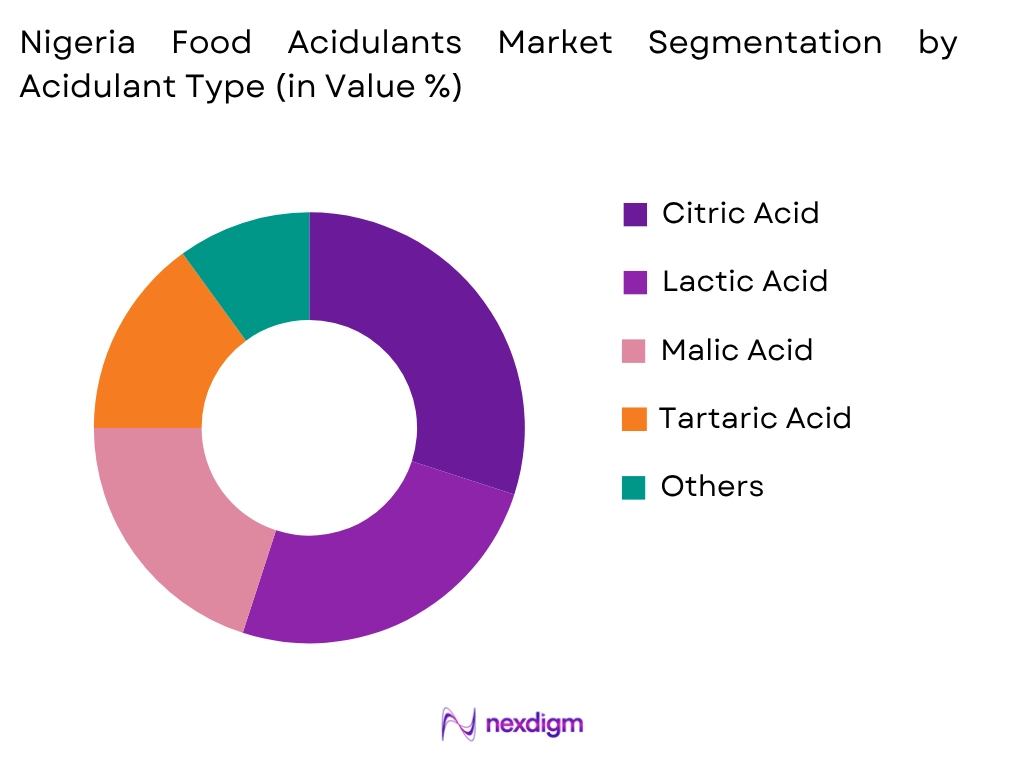
Citric acid dominates the Nigeria Food Acidulants Market by both value and volume, driven by its essential role across the country’s large and diversified beverage manufacturing industry, which encompasses carbonated soft drinks, malt drinks, fruit juices, energy drinks, flavoured water, and sachet drink products consumed across all income segments of Nigeria’s population of over 220 million people. According to the Manufacturers Association of Nigeria (MAN) and NAFDAC industry data, Nigeria’s beverage sector is one of the largest in Africa, led by major producers including Nigerian Breweries (Heineken), Guinness Nigeria (Diageo), Seven-Up Bottling Company (PepsiCo), Coca-Cola HBC Nigeria, and Chi Limited, all of which are significant consumers of citric acid for pH regulation, flavour enhancement, and preservation across their carbonated and non-carbonated product portfolios. Nigeria’s distinctive malt drink category, encompassing brands such as Malta Guinness, Amstel Malta, Maltina, and Hi-Malt, represents a particularly significant application segment for citric acid and malic acid, as these non-alcoholic fermented grain beverages require precise pH management and flavour balance that relies on carefully formulated acidulant systems. Lactic acid represents the second most significant acidulant segment, driven by Nigeria’s large dairy processing industry producing fermented milk products including wara, nono, and commercially produced yoghurt and laban, as well as processed meat preservation requirements and growing demand for natural preservation systems among formal sector food manufacturers seeking to extend product shelf life without synthetic preservative declarations. The open market trade channel for citric acid also remains substantial, supplying small food processors, artisan beverage producers, confectioners, and household-scale food businesses across Nigeria’s extensive informal food economy, particularly in major trading hubs including Onitsha, Kano, Lagos, and Aba.
By Distribution Channel
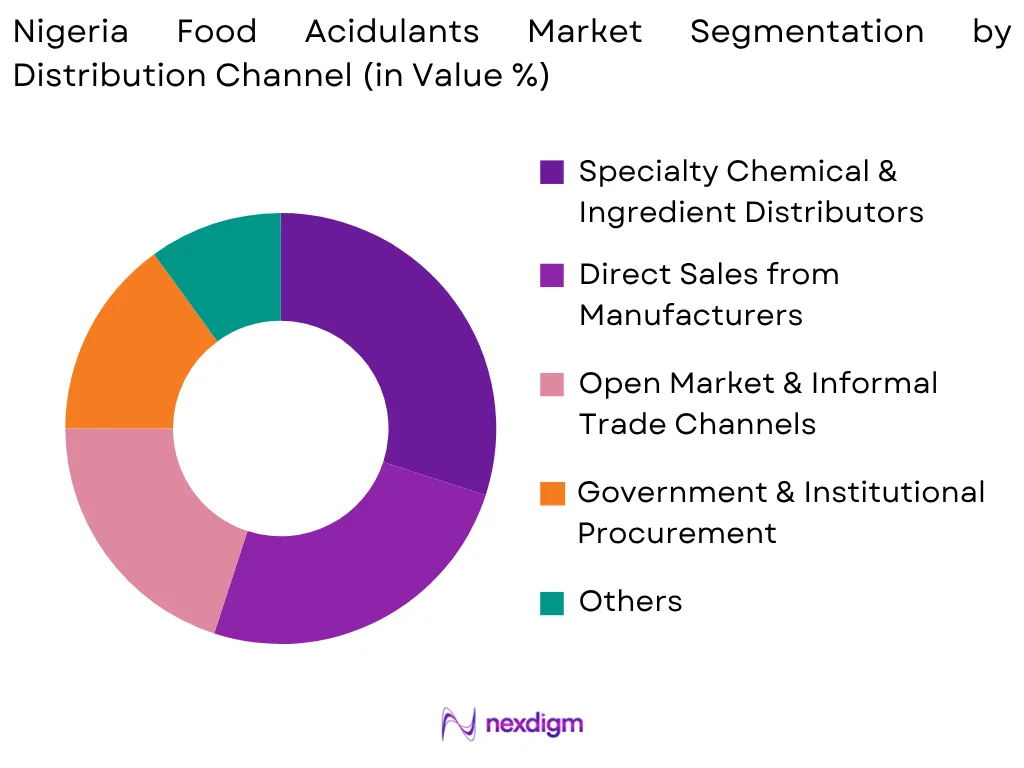
Specialty chemical and ingredient distributors represent the dominant formal distribution channel for food acidulants in Nigeria, as the country’s absence of domestic organic acid manufacturing capacity makes all acidulant volumes dependent on imports managed through established distribution companies with NAFDAC-registered product portfolios and Lagos-based warehousing infrastructure. Leading specialty ingredient and chemical distributors including Brenntag Nigeria, BASF West Africa, Chemical and Allied Products (CAP) Nigeria, and Interfield Group maintain product registration compliance, import documentation management, and direct technical sales relationships with Nigeria’s large and medium-sized food and beverage manufacturers concentrated in Lagos, Ogun, Kano, and Port Harcourt industrial zones. Open market and informal trade channels represent a distinctive and significant distribution segment in Nigeria’s food acidulant landscape, as a substantial proportion of the country’s food processing activity is conducted by small and medium enterprises, informal food manufacturers, artisan beverage producers, and household-scale processors that source citric acid and other commodity acidulants through open market chemical trading companies in major commercial hubs including Onitsha Main Market, Kano Central Market, and Lagos Island markets. Import agents and trading companies serve as critical intermediaries between Chinese and European acidulant manufacturers and Nigerian buyers, particularly for commodity-grade citric acid where price competitiveness is the primary procurement criterion. Direct sales from international ingredient manufacturers to large Nigerian food companies represent a smaller but growing channel as leading beverage and food manufacturers including Nestle Nigeria, Unilever Nigeria, and Dangote Food Operations increasingly professionalise their ingredient procurement through direct international manufacturer engagement and long-term supply contracts.
Competitive Landscape
The Nigeria Food Acidulants Market is characterised by a mix of multinational specialty ingredient and chemical distribution companies with established Nigeria operations, regional West African distributors, import agents, and a substantial informal trading sector that collectively supply the country’s diverse food and beverage manufacturing base. Multinational distribution companies including Brenntag Nigeria and BASF West Africa serve the formal food manufacturing sector with NAFDAC-registered acidulant products, regulatory compliance documentation, and technical sales support, while domestic specialty chemical companies including Chemical and Allied Products (CAP) Nigeria, Interfield Group, and Deli Foods Nigeria compete through established local distribution networks, competitive pricing, and knowledge of Nigeria’s complex regulatory and logistics environment. The informal trading sector, operating through open markets in Lagos, Kano, Onitsha, and other major commercial centres, serves a large segment of Nigeria’s SME food processing base with commodity-grade citric acid and basic acidulants, frequently without formal NAFDAC registration, representing a significant competitive pressure on formal sector distributors. Competition in the commodity citric acid segment is particularly intense due to Chinese import pricing dominance, while specialty and fermentation-derived acidulant segments offer higher margin opportunities for technically differentiated and NAFDAC-compliant suppliers.
| Company | Establishment Year | Headquarters | Primary Acidulant Portfolio | Key Application Industries
|
Manufacturing Presence | R&D Capability | Distribution Network | Clean Label Solutions |
| Olam International (Ingredient Division, Nigeria) | 1989 | ~ | ~ | ~ | ~ | ~ | ~ | ~ |
| Flour Mills of Nigeria (Ingredient Division) | 1960 | ~ | ~ | ~ | ~ | ~ | ~ | ~ |
| BASF West Africa (Nigeria) | 1865 | ~ | ~ | ~ | ~ | ~ | ~ | ~ |
| Jungbunzlauer West Africa (Nigeria) | 1867 | ~ | ~ | ~ | ~ | ~ | ~ | ~ |
| Brenntag Nigeria | 1874 | ~ | ~ | ~ | ~ | ~ | ~ | ~ |
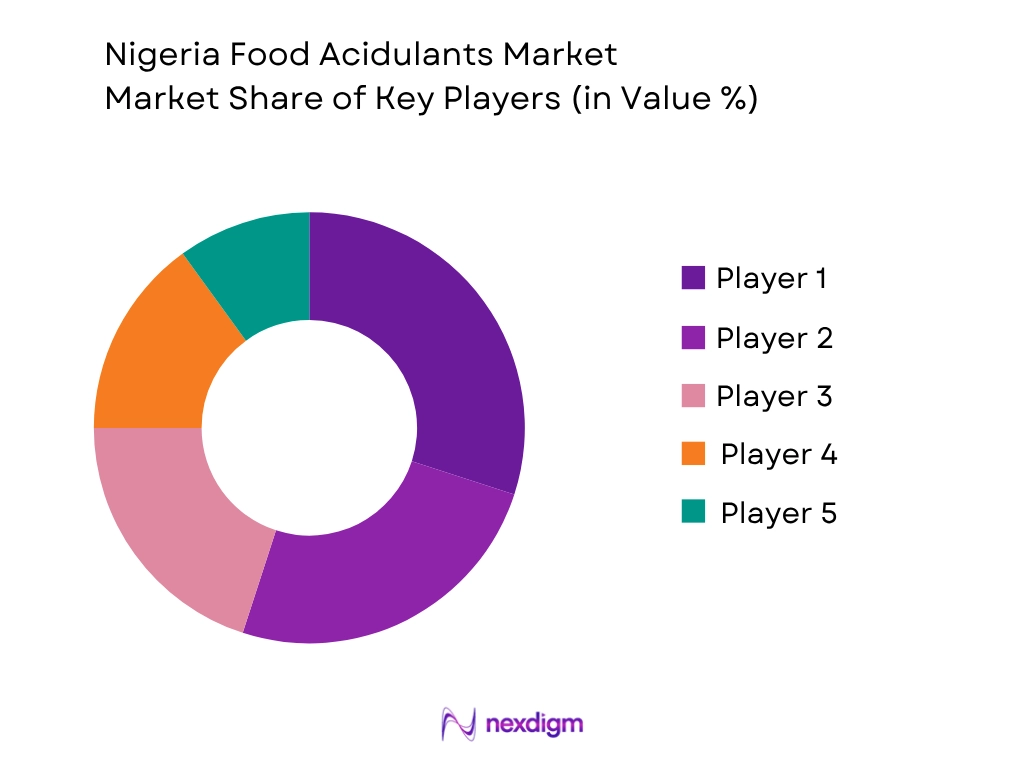
Nigeria Food Acidulants Market Analysis
Growth Drivers
Expanding Beverage Manufacturing, Malt Drink Sector and Rising Population-Driven Demand
Nigeria’s position as Africa’s most populous nation and the continent’s largest beverage market continues to be the most significant structural growth driver for the Nigeria Food Acidulants Market, as the country’s large and growing population of over 220 million people generates substantial and continuously expanding consumption across carbonated soft drinks, malt drinks, fruit juices, energy drinks, and flavoured beverages that collectively represent the dominant application segment for citric acid, malic acid, and phosphoric acid. According to the Nigerian Bureau of Statistics (NBS), Nigeria’s food and beverage manufacturing sector remains one of the largest contributors to non-oil GDP, with beverage production representing a major component of total manufacturing output. The World Bank estimated Nigeria’s GDP at approximately USD 362 billion in 2024, reflecting the largest economy in Sub-Saharan Africa and a consumer market supported by the country’s large and youthful population structure, with the National Population Commission projecting Nigeria to reach approximately 400 million people by 2050, creating one of the world’s fastest-expanding consumer bases for packaged food and beverage products. The International Monetary Fund (IMF) projected continued GDP growth for Nigeria, supported by ongoing economic reform, oil revenue stabilisation, and expanding non-oil sector activity, gradually strengthening household purchasing power and packaged food consumption. Nigeria’s distinctive malt drink category, which has no direct equivalent in most other major food markets, generates particularly large and consistent citric acid and malic acid procurement volumes from leading producers including Nigerian Breweries (Malta Guinness), Guinness Nigeria (Amstel Malta), International Breweries (Trophy Malt), and Chi Limited (Chivita Malt), reinforcing beverages as the primary and most resilient demand driver for food acidulants across the Nigerian market.
NAFDAC Regulatory Enforcement and Formalisation of the Food Manufacturing Sector
The progressive strengthening of regulatory enforcement by the National Agency for Food and Drug Administration and Control (NAFDAC) and the Standards Organisation of Nigeria (SON) continues to drive the formalisation of Nigeria’s food manufacturing sector, creating a structural growth driver for the formal food acidulant supply chain as manufacturers transition from unregistered, open-market sourced ingredients to NAFDAC-compliant, properly documented food additive inputs. According to NAFDAC, the agency has been intensifying its enforcement activities across food manufacturing facilities, open market chemical trading operations, and import channels, implementing product registration requirements, pre-shipment inspection mandates, and facility audit programmes that are progressively raising compliance standards across Nigeria’s food processing industry. The Manufacturers Association of Nigeria (MAN) has reported growing investment by its food and beverage member companies in regulatory compliance infrastructure, including NAFDAC product registration management, raw material traceability systems, and ingredient quality assurance programmes that drive preference for formally registered and technically documented acidulant suppliers over unregistered open market alternatives. The introduction of NAFDAC’s e-registration platform and the agency’s digital enforcement initiatives are improving the efficiency and reach of compliance monitoring, making it increasingly difficult for food manufacturers supplying formal retail channels, export markets, and institutional buyers to justify sourcing from unregistered ingredient suppliers. This regulatory formalisation trend creates a sustained commercial opportunity for NAFDAC-registered acidulant distributors and international ingredient suppliers with compliant product registrations to capture market share from informal and unregistered supply channels, as Nigeria’s formal food manufacturing sector continues to professionalise its procurement and quality management practices under intensifying regulatory and commercial scrutiny.
Market Challenges
Naira Foreign Exchange Volatility and Near-Total Import Dependency
The Nigeria Food Acidulants Market faces its most acute structural challenge from the combination of the country’s complete reliance on imported acidulant ingredients and the severe and persistent volatility of the Nigerian naira against major foreign currencies, which has substantially increased the naira-denominated cost of imported acidulants and compressed the margins of food manufacturers and distributors dependent on foreign-currency-priced ingredient procurement. According to the Central Bank of Nigeria (CBN), the naira experienced significant devaluation following the CBN’s foreign exchange market unification policy in 2023, which removed the managed exchange rate regime and allowed the naira to depreciate sharply against the US dollar, euro, and Chinese renminbi, substantially increasing the naira cost of all imported acidulant categories for Nigerian food manufacturers. Nigeria imports essentially all of its citric acid requirements, predominantly from China, along with lactic acid, malic acid, fumaric acid, tartaric acid, GDL, and phosphoric acid from European and North American manufacturers, making the food acidulant supply chain highly exposed to currency movements, global shipping cost fluctuations, and the operational complexities of managing ingredient imports through Nigeria’s Apapa and Tin Can Island port complexes, which are subject to congestion delays, port handling inefficiencies, and customs clearance backlogs that can extend to multiple weeks during peak import periods. The NBS reported that food inflation in Nigeria reached elevated levels in recent years, driven substantially by the pass-through of naira depreciation into imported food ingredient costs, creating significant pressure on food manufacturers’ input cost structures and limiting their ability to absorb acidulant price increases without corresponding consumer price adjustments that risk volume loss in Nigeria’s price-sensitive mass market consumer segments.
Inadequate Cold Chain Infrastructure, Power Supply Challenges and Informal Market Competition
The Nigeria Food Acidulants Market faces compounding operational challenges arising from inadequate cold chain and warehousing infrastructure, unreliable power supply that increases operational costs for ingredient storage and food manufacturing, and intense price competition from the country’s extensive informal trading sector that undercuts formal sector acidulant distributors through unregistered, often substandard ingredient sourcing. According to the Nigerian Electricity Regulatory Commission (NERC), Nigeria’s power sector continues to struggle with chronic generation shortfalls, grid instability, and distribution infrastructure constraints, leaving the majority of food manufacturers and ingredient distributors dependent on diesel generators for operational continuity, significantly increasing energy costs for temperature-sensitive acidulant storage, food processing operations, and distribution logistics. Certain specialty liquid acidulants including lactic acid solutions and certain hydrated acid forms require temperature-controlled storage to maintain specification and prevent quality degradation in Nigeria’s tropical climate, adding cold chain infrastructure costs that formal sector distributors must manage but that informal market competitors frequently disregard. The prevalence of substandard and adulterated citric acid and other commodity acidulants circulating through Nigeria’s open market trading networks, often imported without NAFDAC registration, proper specification documentation, or quality assurance testing, represents a significant competitive and food safety challenge for formal sector acidulant suppliers, as these unregistered products are typically priced substantially below NAFDAC-compliant material, attracting price-sensitive small food processors away from the formal supply chain. The Federal Competition and Consumer Protection Commission (FCCPC) and NAFDAC continue to pursue market surveillance and enforcement actions against substandard food ingredient traders, but the scale and geographic distribution of Nigeria’s informal trading economy makes comprehensive enforcement a persistent long-term challenge.
Market Opportunities
Cassava-Based Bio-Acidulant Development and Local Agricultural Feedstock Utilisation
Nigeria’s position as the world’s largest cassava producer presents a strategically distinctive and long-term opportunity for the development of locally produced bio-based food acidulants through fermentation of cassava-derived starch substrates, which could progressively reduce the country’s acute import dependency for citric acid and other organic acids while generating significant agricultural value-addition and foreign exchange savings. According to the Food and Agriculture Organization (FAO) and the Federal Ministry of Agriculture and Rural Development (FMARD), Nigeria produces approximately 60 million metric tonnes of cassava annually, accounting for approximately 20 percent of global cassava output and providing the world’s most abundant single-country supply of this high-starch fermentation feedstock. The International Institute of Tropical Agriculture (IITA), based in Ibadan, and the Federal Institute of Industrial Research Owerri (FIIRO) have both conducted research programmes exploring the fermentation of cassava hydrolysate for the production of citric acid, lactic acid, and other organic acids by Aspergillus niger, Lactobacillus species, and other industrial fermentation organisms, demonstrating technical feasibility at laboratory and pilot scale. The Bank of Industry (BOI) and the Nigerian Export-Import Bank (NEXIM) have identified cassava value-chain industrialisation as a priority investment area, with potential to support capital investment in cassava starch processing, fermentation infrastructure, and food-grade organic acid purification capacity that could establish Nigeria as a domestic and regional producer of bio-based food acidulants. Growing global demand for bio-based, sustainably sourced, and traceable food ingredients across European and North American premium food markets, combined with the AfCFTA continental trade framework that could open West and Central African export markets to Nigerian-produced bio-acidulants, provides a compelling long-term commercial rationale for investment in cassava-based organic acid production infrastructure that would simultaneously serve domestic food manufacturer demand and develop new export revenue streams for Nigeria’s agricultural processing sector.
West African Regional Export Development via ECOWAS and AfCFTA Trade Frameworks
Nigeria’s strategic position as the largest economy and most populous nation in West Africa, combined with the progressive implementation of the ECOWAS free trade framework and the African Continental Free Trade Area (AfCFTA) agreement, presents a significant long-term opportunity for Nigerian food acidulant distributors and food manufacturers to develop regional export supply chains serving neighbouring West African markets. According to the Nigerian Export Promotion Council (NEPC) and the Ministry of Industry, Trade and Investment, Nigeria currently serves as an informal re-export hub for a range of food ingredients and processed food products destined for landlocked West African markets including Niger, Chad, and Cameroon, as well as coastal markets including Benin Republic, Togo, and Ghana, channelled through cross-border trade networks operating through Cotonou, Kano, and Lagos-based trading companies. The AfCFTA, which Nigeria ratified in 2020 and which became operational for trade in goods in 2021, is expected to progressively reduce tariff and non-tariff trade barriers for food ingredients and processed food products traded across participating African countries, creating a more commercially attractive framework for Nigerian-based food ingredient distributors to formalise and expand their regional supply operations. Formal-sector acidulant distributors in Nigeria that invest in NAFDAC and SON-compliant product documentation, regional logistics infrastructure, and commercial relationships with food manufacturers across West Africa’s secondary food processing markets in Ghana, Senegal, and Côte d’Ivoire would be well positioned to capture growing regional demand for food-grade acidulants as the West African packaged food manufacturing sector expands under rising urban consumer demand. These developments offer Nigerian acidulant market participants a strategic opportunity to leverage the country’s scale, port infrastructure, and established trading networks to develop regionally significant food ingredient distribution operations that extend beyond the domestic Nigerian market through 2035.
Future Outlook
The Nigeria Food Acidulants Market is expected to witness sustained growth throughout the forecast period, supported by Nigeria’s rapidly expanding population generating growing demand for packaged beverages and processed foods, progressive NAFDAC regulatory enforcement driving formalisation of the food manufacturing sector, the country’s large beverage industry creating consistent high-volume citric acid demand, and the long-term potential for cassava-based domestic bio-acidulant production that could progressively reduce import dependency. Formal sector acidulant distributors are increasingly investing in NAFDAC-compliant product portfolios, warehousing infrastructure, national distribution network expansion, and technical application support capabilities tailored to Nigerian food manufacturer requirements. Growing functional beverage innovation, West African regional export market development through AfCFTA, expanding plant-based food reformulation demand, and institutional food programme procurement will create additional growth opportunities. Continued investments in import supply chain diversification, power resilience infrastructure, and cassava biorefinery research and development will strengthen the long-term competitive and strategic positioning of the Nigeria Food Acidulants Market through 2035.
Major Players
- Brenntag Nigeria
- Olam International (Ingredient Division, Nigeria)
- Flour Mills of Nigeria (Ingredient Division)
- BASF West Africa (Nigeria)
- Jungbunzlauer West Africa (Nigeria)
- Corbion West Africa (Nigeria)
- Univar Solutions Nigeria
- Tate & Lyle West Africa (Nigeria)
- Chemical and Allied Products (CAP) Nigeria
- Interfield Group Nigeria
- Deli Foods Nigeria
- Framan Pharmaceutical (Chemical Division)
- Fidson Healthcare (Ingredient Division)
- PZ Cussons Nigeria (Ingredient Supply Chain)
- IMCD Nigeria
Key Target Audience
- Food & Beverage Manufacturers and Product Developers
- Beverage Producers, Juice Processors, Malt Drink Manufacturers and Bottlers
- Dairy Processors and Fermented Food Manufacturers
- Processed Meat and Poultry Manufacturers
- Bakery and Confectionery Manufacturers
- Investments and Venture Capitalist Firms
- Government and Regulatory Bodies (National Agency for Food and Drug Administration and Control (NAFDAC), Standards Organisation of Nigeria (SON), Manufacturers Association of Nigeria (MAN), Federal Ministry of Agriculture and Rural Development (FMARD), Nigerian Export Promotion Council (NEPC), Bank of Industry (BOI))
- Specialty Chemical and Food Ingredient Distributors
- Cassava Processors and Agricultural Biorefinery Developers
Research Methodology
Step 1: Identification of Key Variables
The research begins by identifying the major stakeholders across the Nigeria Food Acidulants value chain, including international acidulant manufacturers, importers, specialty chemical and ingredient distributors, open market traders, food and beverage manufacturers, dairy processors, meat and poultry processors, NAFDAC and SON regulatory bodies, agricultural research institutions including IITA and FIIRO, and cassava value chain operators. Extensive secondary research is conducted using NAFDAC publications, NBS trade and manufacturing statistics, MAN industry data, SON standards documentation, FAO agricultural data, company annual reports, and proprietary food ingredient market databases to establish the key variables influencing market performance.
Step 2: Market Analysis and Construction
Historical market information is compiled and evaluated to estimate overall market size, acidulant import volumes by type, formal versus informal channel split, pricing dynamics, application penetration across food and beverage manufacturing segments, and revenue generation by acidulant category. Both demand-side indicators, including beverage production volumes, dairy processing output, processed food manufacturing statistics, and malt drink sector data, and supply-side indicators, including import volumes by acidulant type, NAFDAC-registered product availability, and distributor network coverage across Nigeria’s major regional markets, are analysed using bottom-up and top-down approaches to construct a comprehensive market model.
Step 3: Hypothesis Validation and Expert Consultation
Preliminary market estimates and assumptions are validated through Computer Assisted Telephone Interviews (CATIs) and structured discussions with food ingredient company commercial and technical directors, food and beverage manufacturer procurement and R&D managers, specialty chemical distributors, open market trading company operators, beverage industry formulation specialists, NAFDAC regulatory affairs consultants, and agricultural research institution scientists with expertise in cassava fermentation and local ingredient development. These consultations provide critical insights into acidulant procurement patterns, pricing dynamics, naira exposure management, NAFDAC compliance behaviour, informal market dynamics, and emerging local ingredient development priorities.
Step 4: Research Synthesis and Final Output
The final stage integrates primary research findings with secondary data to develop a comprehensive market assessment covering acidulant type segments, application categories, formal and informal distribution channel analysis, regional market dynamics, competitive landscape, and future growth opportunities. Multiple validation techniques, including cross-verification with Nigerian Customs Service import data, NBS manufacturing statistics, and NAFDAC product registration records, are employed to ensure the consistency and credibility of the final market report.

- Executive Summary
- Research Methodology (Market Definitions and Assumptions, Abbreviations, Market Taxonomy, Market Sizing Approach, Top-Down Analysis, Bottom-Up Analysis, Demand-Side Assessment, Supply-Side Assessment, Primary Industry Interviews, Secondary Research Validation, Data Triangulation, Forecasting Framework, Limitations and Future Conclusions)

- Definition and Scope
- Market Evolution and Industry Genesis
- Timeline of Major Industry Developments
- Industry Value Chain Analysis
- Supply Chain Analysis

- Growth Drivers (Expanding Beverage Manufacturing and Malt Drink Sector, Large and Growing Processed Food Industry, Rising Urbanisation and Packaged Food Demand, Increasing NAFDAC Regulatory Enforcement Driving Compliance, Population Growth and Youth Consumer Base, Cassava and Agricultural Feedstock Availability for Bio-Based Acidulant Potential, Growing Foodservice and QSR Expansion, West African Regional Food Export Development)
- Market Challenges (Near-Total Import Dependency and Naira Foreign Exchange Volatility, Dominance of Chinese Commodity Citric Acid and Price Pressure, NAFDAC Regulatory Complexity and Import Documentation Requirements, Inadequate Cold Chain Infrastructure for Sensitive Acidulant Storage, High Logistics Costs Across Nigeria’s Diverse Geography, Prevalence of Substandard and Adulterated Ingredients in Informal Markets, Unreliable Power Supply Increasing Operational Costs, Limited Domestic Food Ingredient Manufacturing Base)
- Market Opportunities (Cassava-Based Bio-Acidulant Development Leveraging Nigeria’s Agricultural Base, West African Regional Export Market via ECOWAS and AfCFTA, Functional Beverage and Energy Drink Acidulant Innovation, Natural Preservation Demand in Extended Shelf-Life Products, Malt and Sorghum-Based Fermented Beverage Acidulant Systems, Formal Sector Growth Driven by NAFDAC Compliance Enforcement, Plant-Based Food Reformulation Acidulant Demand, Institutional and Government Food Programme Procurement)
- Market Trends (Clean-Label and Natural Acidulant Awareness Growth, Fermentation-Derived Acid Interest Among Premium Manufacturers, Reduced-Sugar Beverage Acidulant Systems, Multi-Functional Acidulant Blends for Extended Shelf Life, Digital B2B Ingredient Procurement Adoption, Sustainable Sourcing Interest Among Export-Oriented Manufacturers, Local Cassava-Derived Organic Acid Research, pH Management Innovation in Traditional Nigerian Fermented Foods)
- Government Regulations and Policies (National Agency for Food and Drug Administration and Control (NAFDAC) Food Additive Regulations, Standards Organisation of Nigeria (SON) Quality Standards, National Food Safety Management Committee (NFSMC) Framework, Codex Alimentarius Nigeria Implementation, Import Permit and Pre-Shipment Inspection Requirements, Nigerian Customs Service Import Tariff Framework, ECOWAS Trade Facilitation Protocols, Federal Ministry of Agriculture and Rural Development Agro-Processing Guidelines)
- Raw Material and Import Supply Analysis (Citric Acid Import Sources – China Dependency, Lactic Acid and Specialty Acidulant Import Chains, Phosphoric Acid Supply from Industrial Chemical Imports, Port Apapa and Tin Can Island Port Clearance Dynamics, Naira Devaluation Impact on Import Costs)
- Import and Trade Flow Analysis (Acidulant Import Volumes by Type, West African Intra-Trade via ECOWAS, Re-Export from Lagos to Neighbouring Markets, NAFDAC Import Accreditation Requirements, Counterfeit and Substandard Ingredient Risk)
- Beverage Industry Demand Analysis (Carbonated Soft Drink Acidulant Use, Malt Drink Formulations, Fruit Drink and Nectar Acidulant Requirements, Energy Drink Growth, Sachet Water Industry Acidulant Use)
- Informal Sector and Open Market Analysis (Role of Alaba and Ladipo Markets in Ingredient Distribution, Substandard Ingredient Prevalence, NAFDAC Enforcement Trends, SME Food Manufacturer Sourcing Behaviour)
- Agricultural Feedstock and Local Ingredient Potential Analysis (Cassava Starch as Fermentation Feedstock, Sorghum and Maize Availability, Citric Acid from Cassava Fermentation Research, IITA and FIIRO Research Programmes)
- SWOT Analysis
- Porter’s Five Forces Analysis
- PESTLE Analysis
- Stakeholder Ecosystem
- Competition Ecosystem

- By Market Value (2020-2025)
- By Volume Consumption (2020-2025)
- By Average Selling Price (2020-2025)

- By Acidulant Type (In Value %)
Citric Acid
Lactic Acid
Acetic Acid & Vinegar-Based Acidulants
Malic Acid
Fumaric Acid
Phosphoric Acid
Tartaric Acid
Glucono Delta-Lactone (GDL)
Other Acidulants - By Application (In Value %)
Beverages
Bakery & Confectionery
Dairy & Fermented Products
Processed Meat & Poultry
Sauces, Seasonings & Condiments
Snacks & Savoury Products
Canned & Preserved Foods
Functional & Nutraceutical Foods - By Function (In Value %)
pH Regulation & Buffering
Preservation & Antimicrobial Activity
Flavour Enhancement & Taste Modulation
Texture & Gel Formation
Colour Stabilisation
Leavening Agent Activation
Chelation & Mineral Binding - By Distribution Channel (In Value %)
Direct Sales from Manufacturers & Importers
Specialty Chemical & Ingredient Distributors
Open Market & Informal Trade Channels
B2B Online Ingredient Procurement Platforms
Government & Institutional Procurement
Import Agents & Trading Companies - By Region (In Value %)
Lagos & South-West Nigeria
Kano & North-West Nigeria
Abuja & North-Central Nigeria
Port Harcourt & South-South Nigeria
Onitsha & South-East Nigeria
North-East Nigeria

- Market Share Analysis (By Value, Acidulant Type, Application Segment, End-User Category, Region)
- Cross Comparison Parameters (Product Portfolio Breadth Across Acidulant Types, Application Coverage, Nigeria and West Africa Regional Distribution Network Depth, NAFDAC and SON Regulatory Compliance Capabilities, Import Sourcing Diversification, Warehousing and Cold Chain Infrastructure, Bio-Based and Natural Acidulant Portfolio Strength, Technical Sales and Food Application Support Capability, Open Market and Informal Sector Reach)
- SWOT Analysis of Major Players
- Pricing Analysis (By Acidulant Type, Purity Grade, Source, Application Segment, Volume Tier, Contract Duration, Formal vs Informal Channel)
- Detailed Profiles of Major Companies
Brenntag Nigeria
Olam International (Ingredient Division, Nigeria)
Flour Mills of Nigeria (Ingredient Division)
BASF West Africa (Nigeria)
Jungbunzlauer West Africa (Nigeria)
Corbion West Africa (Nigeria)
Univar Solutions Nigeria
Tate & Lyle West Africa (Nigeria)
Chemical and Allied Products (CAP) Nigeria
Interfield Group Nigeria
Deli Foods Nigeria
Framan Pharmaceutical (Chemical Division)
Fidson Healthcare (Ingredient Division)
PZ Cussons Nigeria (Ingredient Supply Chain)
IMCD Nigeria

- Procurement Pattern Analysis (Long-Term Supply Contract Preference, Spot vs Annual Contract Purchasing, Direct vs Distributor vs Open Market Sourcing, Import Agent vs Direct Manufacturer Procurement)
- End-User Demand Analysis (Beverage Manufacturer Requirements, Dairy Processor Needs, Meat and Poultry Processor Specifications, Bakery and Confectionery Manufacturer Preferences, SME Food Processor Behaviour)
- Budget and Expenditure Analysis by Application Segment
- Premium vs Commodity Acidulant Preference Analysis
- NAFDAC Compliance and Certification Preference
- Technical Support and Application Development Service Preference
- Product Attribute Preference Analysis (Purity Grade, NAFDAC Compliance, SON Certification, Price, Country of Origin, Solubility, pH Buffering Capacity, Taste Profile, Availability Through Local Distributors)
- Technology Adoption in Acidulant Application and Formulation
- Formal vs Informal Market Sourcing Behaviour
- Buyer Pain Point Analysis
- Supplier Switching and Long-Term Contract Behaviour

- By Market Value (2026-2035)
- By Volume Consumption (2026-2035)
- By Average Selling Price (2026-2035)


 Request a Sample
 Ask for Customization
 Get a Quote
 Enquire Now