
 Download PDF
Market Overview
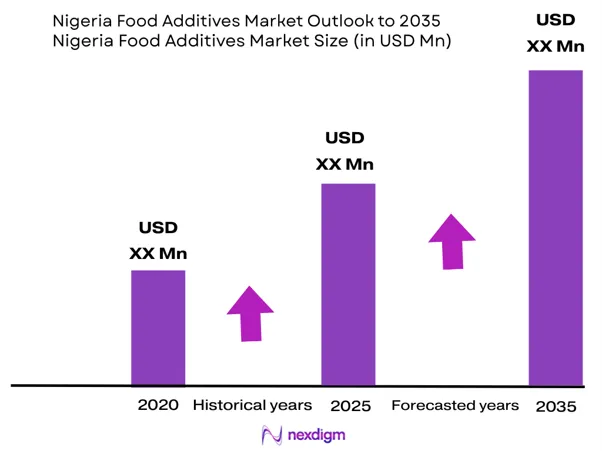
The Nigeria Food Additives Market is valued at USD ~ million, based on a five-year historical analysis, and is forecast to grow at % CAGR during the forecast period. Demand is driven by bakery, flour-based foods, beverages, seasonings, bouillon cubes, noodles, snacks, dairy, sauces and fortified staples. Nigeria’s GDP reached USD 187.8 billion, population reached 232.68 million, and GDP growth improved from 2.9% to 3.4%, supporting broad packaged food consumption. The Nigeria Food Additives Market is dominated by Lagos, Ogun, Ibadan, Kano, Kaduna, Abuja, Port Harcourt, Onitsha and Aba. Lagos and Ogun dominate through beverage, flour milling, bakery, seasoning, snack and import-linked ingredient distribution. Kano and Kaduna dominate northern food processing and seasoning trade, while Port Harcourt supports port-linked imports. NAFDAC’s food regulation portal lists active food regulations updated to November 26, 2024, reinforcing formal compliance requirements for packaged food manufacturers.
Market Segmentation
By Additive Type
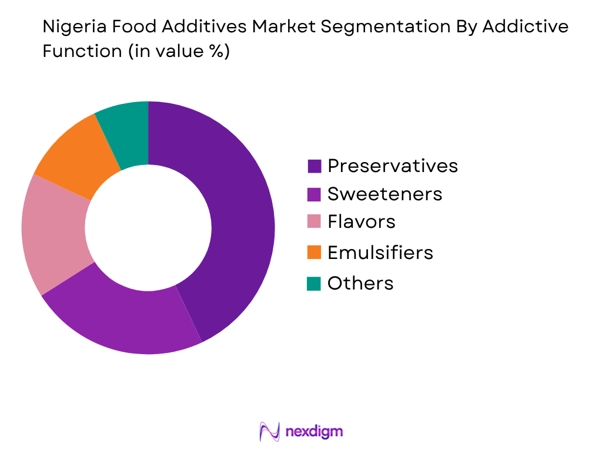
Nigeria Food Additives Market is segmented by additive type into preservatives, flavours, flavour enhancers, emulsifiers, stabilizers, sweeteners, colours, acidity regulators, antioxidants, hydrocolloids, enzymes and other functional additives. Recently, preservatives have a dominant market share in Nigeria under the additive type segmentation because the country’s hot and humid climate, long distribution routes, open market trading, informal retail channels and limited cold-chain depth increase the need for shelf-life extension. Preservatives are widely used in bread, cakes, carbonated soft drinks, malt drinks, fruit drinks, sauces, noodles, snacks, dairy products, processed meat, seasonings and ready-to-eat foods. Their dominance is reinforced by Nigeria’s large population base and strong demand for affordable, shelf-stable packaged foods. Food manufacturers require permitted preservative systems that can reduce spoilage, maintain taste, control microbial risk and support NAFDAC-compliant label declarations across formal supermarkets, wholesale markets, kiosks and regional distributors.
By Application
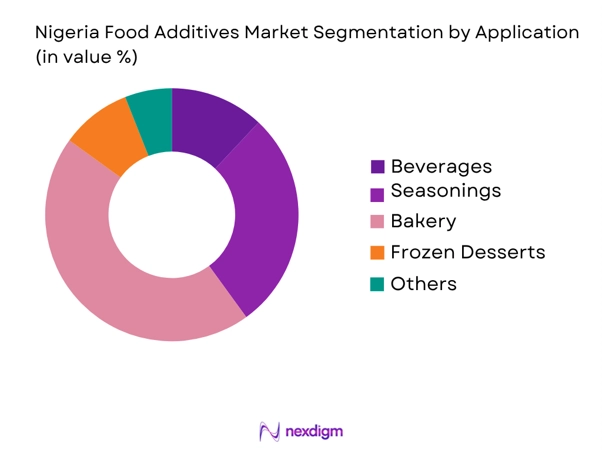
Nigeria Food Additives Market is segmented by application into bakery and flour-based foods, beverages, malt drinks, seasonings, bouillon cubes, noodles, pasta, snacks, dairy, frozen desserts, sauces, condiments, confectionery, infant foods, nutritional foods and fortified staples. Recently, bakery and flour-based foods have a dominant market share in Nigeria under the application segmentation because bread, biscuits, cakes, buns, flour mixes and other wheat-based foods are high-frequency consumption products across income groups. This category uses multiple additive systems including emulsifiers, enzymes, preservatives, anti-caking agents, dough conditioners, colours, flavours and fortification carriers. Industrial bakeries require mould control, crumb softness, dough strength, moisture retention and longer shelf life for nationwide distribution. Flour millers and bakery ingredient suppliers also require improvers, vitamins, minerals and processing aids to support consistent performance across variable wheat quality, production conditions and regional bakery practices. This makes bakery structurally more additive-intensive than several single-function categories.
Competitive Landscape
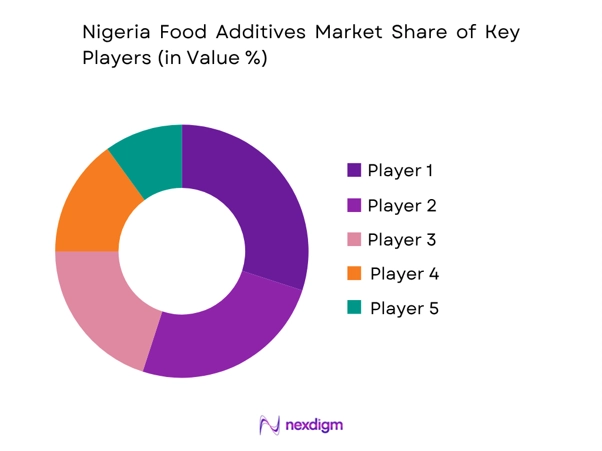
The Nigeria Food Additives Market is served by global ingredient companies, West Africa distributors, Nigerian importers, food chemical traders, flavour houses, bakery improver suppliers and seasoning-system specialists. The market remains fragmented across open-market ingredient trading but more consolidated in technical supply for large FMCG, beverage, flour milling, seasoning, bakery and noodle manufacturers. Competitive advantage is increasingly linked to NAFDAC documentation, product registration support, local stockholding, FX-risk management, application troubleshooting, supply reliability and ability to serve both formal manufacturers and regional wholesalers.
| Company | Establishment Year | Headquarters | Core Additive Focus | Nigeria Market Role | Key Applications | Distribution Strength | Compliance Capability | Market-Specific Capability |
| Kerry Ingredients Nigeria | 1972 | Tralee, Ireland | ~ | ~ | ~ | ~ | ~ | ~ |
| DSM-Firmenich Nigeria | 2023 | Maastricht / Geneva | ~ | ~ | ~ | ~ | ~ | ~ |
| Givaudan Nigeria | 1895 | Vernier, Switzerland | ~ | ~ | ~ | ~ | ~ | ~ |
| Brenntag Nigeria | 1874 | Essen, Germany | ~ | ~ | ~ | ~ | ~ | ~ |
| BASF West Africa | 1865 | Ludwigshafen, Germany | ~ | ~ | ~ | ~ | ~ | ~ |
Nigeria Food Additives Market Analysis
Growth Drivers
Urbanization and demand for shelf-stable packaged foods
Nigeria Food Additives Market is supported by rapid urban consumption expansion, where preservatives, flavours, colour systems, sweeteners, emulsifiers, stabilizers, acidulants and anti-caking agents are used to keep bread, beverages, noodles, snacks, bouillon cubes, sauces and dairy products stable across hot and humid distribution channels. World Bank-linked data records Nigeria’s population at 233 million and GDP per capita at USD 1,084.16 in 2024, while World Bank data places the total population at 237,527,782 in 2025. Urban population data from the World Bank shows Nigeria’s urban share at 55.03 units per 100 units in 2024 and 64 units per 100 units in 2025, reflecting the shift toward city-based food demand. This supports market-specific additive usage because urban consumers rely more on packaged bread, carbonated drinks, malt drinks, powdered beverages, noodles, snacks and seasonings sold through supermarkets, kiosks, wholesalers and open markets. These products require longer shelf life, colour retention, texture consistency, sweetness control and microbial stability.
Food, beverage and tobacco manufacturing as an industrial demand base
Nigeria Food Additives Market is driven by industrial food and beverage manufacturing, especially bakery, flour milling, seasonings, soft drinks, malt drinks, noodles, pasta, dairy and snack production. The National Bureau of Statistics reported that the non-oil sector grew 2.80 units per 100 units in real terms in Q2 2024 and was driven by financial institutions, telecommunications, crop production, trade and manufacturing, including Food, Beverage and Tobacco. The same NBS GDP release recorded real manufacturing growth of 1.49 units per 100 units in Q1 2024, 0.92 units per 100 units in Q3 2024, and a manufacturing contribution to nominal GDP of 13.88 units per 100 units in Q4 2024. NBS also reported that GDP grew 3.89 units per 100 units in Q1 2026 and manufacturing real growth reached 3.29 units per 100 units. These figures justify additive demand because factory-scale food production requires preservatives, emulsifiers, sweeteners, stabilizers, antioxidants, flavour enhancers and fortification carriers to maintain process efficiency, batch uniformity and national distribution quality.
Market Challenges
NAFDAC labelling, product registration and permitted-ingredient compliance
Nigeria Food Additives Market faces a major compliance challenge because food additives are not purchased only as technical ingredients; they must support product registration, labelling, ingredient declaration and safety documentation. NAFDAC’s food regulation portal lists food regulations updated to November 26, 2024, while its Pre-Packaged Food Labelling Regulations apply to pre-packaged food manufactured, imported, exported, sold, distributed or used in Nigeria. This directly affects additive suppliers serving beverage companies, flour millers, bakeries, seasoning producers, noodle manufacturers, dairy processors and snack makers because each colour, sweetener, preservative, flavour enhancer, antioxidant, acidulant or stabilizer must be correctly declared and supported with supplier documents. The challenge is amplified by Nigeria’s large consumer base of 233 million people in 2024 and 237,527,782 people in 2025, because non-compliant products can create broad retail and regulatory exposure. For manufacturers, additive compliance affects NAFDAC registration timelines, label artwork, import files, certificates of analysis, traceability records and distributor acceptance.
Import dependence, FX exposure and uneven technical formulation capability
Nigeria Food Additives Market is constrained by imported specialty additive dependence and uneven formulation support across large manufacturers and SMEs. Hydrocolloids, enzymes, natural colours, high-intensity sweeteners, specialty preservatives, acidulants, emulsifiers and stabilizer blends are often sourced through importers, distributors and open-market traders, creating risks around batch consistency, documentation, stock availability and traceability. The World Bank country data shows Nigeria’s GDP per capita at USD 1,224.3 in 2025, inflation at 23.0 units per 100 units in 2025 and foreign direct investment net inflows at 0.6 units per 100 units of GDP in 2024, indicating a pressured operating environment for imported-input manufacturing. NBS data also shows food inflation readings on its homepage series reaching 16.96 under the food indicator, while access to electricity stood at 61.2 units per 100 units of population in 2023, creating processing and cold-chain limitations. In additives, these constraints make reformulation difficult because changing one preservative, sweetener, colour or stabilizer can alter pH, viscosity, taste release, shelf life and consumer acceptance.
Market Opportunities
Verified B2B sourcing and documentation-ready additive supply
Nigeria Food Additives Market has a strong opportunity in verified B2B sourcing because large food processors increasingly require traceable, documented and consistent additives rather than informal commodity inputs. NAFDAC’s food regulation portal, updated to November 26, 2024, and its pre-packaged food labelling framework create current demand for suppliers that can provide certificates of analysis, permitted-use guidance, ingredient specifications, additive declarations and NAFDAC-support documentation. This is directly relevant to beverages, noodles, bakery, seasonings, dairy, confectionery, sauces and fortified staples because these categories use multiple additives simultaneously. Nigeria’s population base of 233 million in 2024 and 237,527,782 in 2025 gives organized suppliers a large addressable food manufacturing base, while NBS reported GDP growth of 3.89 units per 100 units and manufacturing real growth of 3.29 units per 100 units in Q1 2026. Suppliers with Lagos, Ogun, Kano and Port Harcourt stockholding can reduce lead-time risk for preservatives, sweeteners, colours, emulsifiers, stabilizers, hydrocolloids and flavour systems while improving compliance confidence for food manufacturers.
Local starch-based texturizers, fortification carriers and application-specific blends
Nigeria Food Additives Market has a future growth opportunity in locally adapted additive systems such as cassava- and starch-based texturizers, bakery improver blends, beverage acid-sweetener systems, seasoning anti-caking systems, flavour carriers, stabilizer blends and fortification carriers. The opportunity is supported by Nigeria’s large food consumption base, with World Bank-linked data showing 233 million people in 2024 and urbanization at 55.03 units per 100 units in 2024. World Bank country data also reports 41 units per 100 units internet usage in 2024, supporting digital B2B procurement, distributor discovery and product education for ingredient buyers. NBS data indicates manufacturing recovery, with Q1 2026 manufacturing real growth of 3.29 units per 100 units, while food, beverage and tobacco is repeatedly cited by NBS as one of the manufacturing activities supporting GDP output. For additive suppliers, this creates a practical opportunity to serve bakeries, beverage companies, seasoning producers, noodle manufacturers and fortified-food processors with application-specific blends that reduce trial complexity, improve product consistency and lower dependence on fragmented open-market sourcing.
Future Outlook
Over the forecast period, the Nigeria Food Additives Market is expected to expand steadily through packaged food manufacturing, beverage demand, flour milling, bakery consumption, seasoning and bouillon cube demand, noodles, snacks and fortified foods. Additives will remain important for shelf-life extension, taste consistency, colour stability, texture control, pH management, anti-caking, moisture retention and fortified-food delivery.
Bakery and flour-based foods will continue to anchor demand. Bread, biscuits, cakes, buns, flour mixes and wheat-based convenience foods require improvers, enzymes, preservatives, emulsifiers and fortification carriers. Suppliers that can support industrial bakeries with consistent performance across flour quality variation and humid distribution conditions will remain well positioned.
Beverages will remain a strong application area because carbonated drinks, malt drinks, juices, powdered drinks and flavoured drinks require sweeteners, acidulants, colours, flavours, preservatives, clouding agents and stabilizers. Reduced-sugar beverage reformulation will increase demand for taste modulation, masking systems and sweetener-acid balance.
Seasonings and bouillon cubes will remain structurally important in Nigeria’s additive demand. This category requires flavour enhancers, colours, anti-caking agents, carrier ingredients, salt-fat-savoury balancing systems and moisture-control additives. The segment is highly relevant due to household cooking habits, small-pack affordability and strong distribution through open markets and kiosks.
Noodles, pasta and packaged snacks will continue to support demand for colours, antioxidants, seasoning carriers, anti-caking agents, texture modifiers, flavour systems and shelf-life enhancers. These products depend on affordability, consistency and long ambient storage.
Clean-label and compliant additive sourcing will become more relevant, especially for organized food manufacturers. Natural colours, cassava-based texturizers, plant-based hydrocolloids, fermentation-derived preservatives and fortification premixes will gain attention where manufacturers need to balance cost, nutrition, shelf life and label transparency.
Regulatory documentation will become a stronger competitive differentiator. NAFDAC food regulations, pre-packaged food labelling requirements and product registration obligations mean additive suppliers must support food manufacturers with certificates of analysis, permitted-use guidance, ingredient specifications, label declarations and traceability records. NAFDAC’s food regulation portal lists food regulations and pre-packaged food labelling regulations, with content current as of November 26, 2024.
Major Players
- Kerry Ingredients Nigeria
- Cargill Nigeria
- DSM-Firmenich Nigeria
- International Flavors & Fragrances Nigeria
- Givaudan Nigeria
- Symrise Nigeria
- Brenntag Nigeria
- Corbion West Africa
- BASF West Africa
- ADM West Africa
- Tate & Lyle West Africa
- Roquette West Africa
- Ita Food Improvers
- Matna Foods Company Limited
- Dansa Foods Limited
Key Target Audience
- Food additive manufacturers
- Food and beverage processing companies
- Bakery, flour milling and confectionery manufacturers
- Beverage, malt drink and dairy manufacturers
- Seasoning, bouillon cube, noodle and snack manufacturers
- Ingredient importers and specialty ingredient distributors
- Investments and venture capitalist firms
- Government and regulatory bodies (National Agency for Food and Drug Administration and Control, Standards Organisation of Nigeria, Federal Ministry of Health and Social Welfare, Federal Ministry of Agriculture and Food Security, Federal Competition and Consumer Protection Commission, Nigeria Customs Service)
Research Methodology
Step 1: Identification of Key Variables
The initial phase involves constructing an ecosystem map covering additive manufacturers, importers, distributors, open-market ingredient traders, beverage producers, flour millers, bakeries, seasoning manufacturers, noodle producers and dairy processors. This step uses desk research, regulatory review, trade indicators and company-level mapping. The objective is to define variables such as additive type, application, source, functionality, compliance type, region and distribution model.
Step 2: Market Analysis and Construction
In this phase, historical data is compiled across food manufacturing activity, population growth, packaged food consumption, flour milling, beverage production, seasoning demand, import dependency and channel structure. The top-down approach evaluates macroeconomic and food-sector indicators, while the bottom-up approach assesses additive usage across bakery, beverages, seasonings, noodles, dairy, snacks and sauces. This supports value, volume and segment-level modelling.
Step 3: Hypothesis Validation and Expert Consultation
Market hypotheses are validated through computer-assisted telephone interviews with additive suppliers, food ingredient distributors, importers, food technologists, bakery ingredient specialists, beverage formulators and procurement teams. These consultations help verify preservative dominance, additive use by application, NAFDAC documentation requirements, open-market risks and clean-label reformulation trends. Expert inputs are used to refine segmentation, competitive structure and future outlook.
Step 4: Research Synthesis and Final Output
The final phase integrates secondary research, NAFDAC regulatory review, company benchmarking, trade indicators, channel checks and expert consultations into a consolidated market model. Data triangulation is applied across manufacturer demand, distributor movement, application usage and food-category requirements. The final output includes market size, segmentation, competitive landscape, future outlook and strategic recommendations for Nigeria Food Additives Market participants.

- Executive Summary
- Research Methodology (Market Definitions and Assumptions, Abbreviations, INS/E-Number Mapping, NAFDAC Food Category Mapping, SON Standards Mapping, Codex Alignment, HS Code Mapping, Market Sizing Approach, Top-Down Analysis, Bottom-Up Analysis, Demand-Side Assessment, Supply-Side Assessment, Import-Export Assessment, Food Processor Procurement Checks, Distributor and Trader Interviews, Primary Industry Interviews, Data Triangulation, Forecasting Framework, Limitations and Future Conclusions)

- Definition and Scope
- Market Evolution and Industry Genesis
- Timeline of Major Industry Developments
- Role of Food Additives in Nigerian Food Processing and Packaged Food Manufacturing

- Growth Drivers (Expansion of Packaged Food Manufacturing, High Demand for Affordable Shelf-Stable Foods, Flour Milling and Bakery Consumption, Beverage and Malt Drink Manufacturing, Seasoning and Bouillon Cube Demand, Noodles and Pasta Consumption, Urban Population Growth, Formal Retail and Foodservice Expansion)
- Market Challenges (Import Dependency for Specialty Additives, FX Volatility Impact on Imported Ingredients, NAFDAC Registration and Labelling Compliance Burden, Quality Variation in Open Market Ingredient Supply, Counterfeit and Substandard Ingredients Risk, Cold Chain and Shelf-Life Stress, Clean-Label Reformulation Difficulty, Limited Application Lab Access for SMEs)
- Market Opportunities (Natural Colours and Preservatives, Cassava and Local Starch-Based Texturizers, Sugar Reduction Sweetener Systems, Bakery Improver and Enzyme Systems, Beverage Acidulant and Stabilizer Blends, Seasoning and Savoury Flavour Systems, Fortified Food Additive Systems, NAFDAC-Ready Documentation and Testing Support)
- Market Trends (Shift Toward Verified B2B Ingredient Sourcing, Clean-Label Ingredient Interest, Increased Use of Stabilizers in Dairy and Frozen Desserts, Enzyme-Based Bakery Processing, Reduced Sugar Beverage Development, Natural Colour Replacement, Fortification Support in Staples, Application-Specific Additive Blends)
- SWOT Analysis
- Porter’s Five Forces Analysis
- PESTLE Analysis

- By Market Value (2020-2025)
- By Consumption Volume (2020-2025)
- By Import Value (2020-2025)

- By Additive Type (In Value %)
Preservatives
Emulsifiers
Stabilizers
Thickeners
Sweeteners
Colours - By Source Type (In Value %)
Synthetic Additives
Natural Additives
Nature-Identical Additives
Fermentation-Derived Additives
Plant-Based Additives - By Distribution Channel (In Value %)
Direct Sales to Food Processors
Ingredient Distributors
Specialty Chemical Distributors
Importers - By Region (In Value %)
South West
South South
South East
North Central
North West
North East

- Market Share of Major Players (By Value, Volume, Additive Type, Application, End User, Region, Distribution Channel, Domestic vs Imported Portfolio)
- Cross Comparison Parameters (NAFDAC Documentation Capability, Additive Portfolio Breadth, Natural and Clean-Label Product Range, Nigeria Stockholding and Warehousing Strength, Food Category-Specific Formulation Expertise, Distribution Reach Across Lagos-Ogun-Kano-Port Harcourt Corridors, Technical Support and Shelf-Life Testing Capability, Open Market Risk Mitigation and Traceability Strength)
- SWOT Analysis of Major Players
- Detailed Profiles of Major Companies
Kerry Ingredients Nigeria
Cargill Nigeria
DSM-Firmenich Nigeria
International Flavors & Fragrances Nigeria
Givaudan Nigeria
Symrise Nigeria
Brenntag Nigeria
Corbion West Africa
BASF West Africa
ADM West Africa
Tate & Lyle West Africa
Roquette West Africa
Ita Food Improvers
Matna Foods Company Limited
Dansa Foods Limited

- Food and Beverage Manufacturer Analysis
- Bakery and Flour-Based Food Manufacturer Analysis
- Beverage and Malt Drink Manufacturer Analysis
- Seasoning and Bouillon Producer Analysis
- Noodle and Pasta Manufacturer Analysis
- Dairy and Frozen Dessert Processor Analysis

- By Market Value (2026-2035)
- By Consumption Volume (2026-2035)
- By Import Value (2026-2035)


 Request a Sample
 Ask for Customization
 Get a Quote
 Enquire Now