

 Download PDF
Market Overview
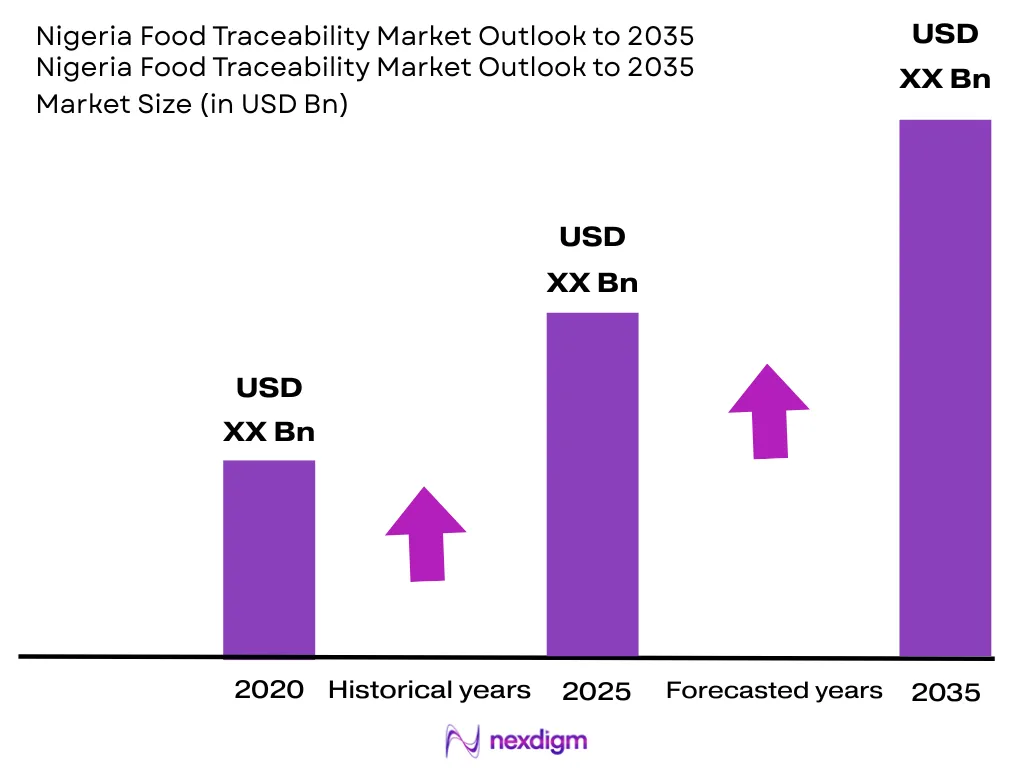
The Nigeria Food Traceability Market was valued at USD ~ Billion in 2024 and is anticipated to expand at a CAGR of ~% during 2026–2035. The market is primarily driven by Nigeria’s position as one of Africa’s leading cocoa producers, escalating compliance requirements under the European Union’s Deforestation Regulation (EUDR), and rising government and donor-backed investment in digitizing the country’s largely informal agricultural supply chains. Nigeria’s agriculture sector contributed approximately 26% of GDP in 2024 and employs more than 35% of the country’s labor force, yet food exports accounted for only 2.8% of total exports in 2022, reflecting a food trade deficit in which the country imported close to ₦16 trillion in food between 2021 and 2024 against just ₦7 trillion in food export earnings. Blockchain-backed traceability projects already connect more than 600 cooperatives across Nigeria’s cocoa and palm oil trade, laying the groundwork for wider digital traceability adoption as export compliance pressure and domestic food safety enforcement both intensify.
Market Segmentation
By Technology Type
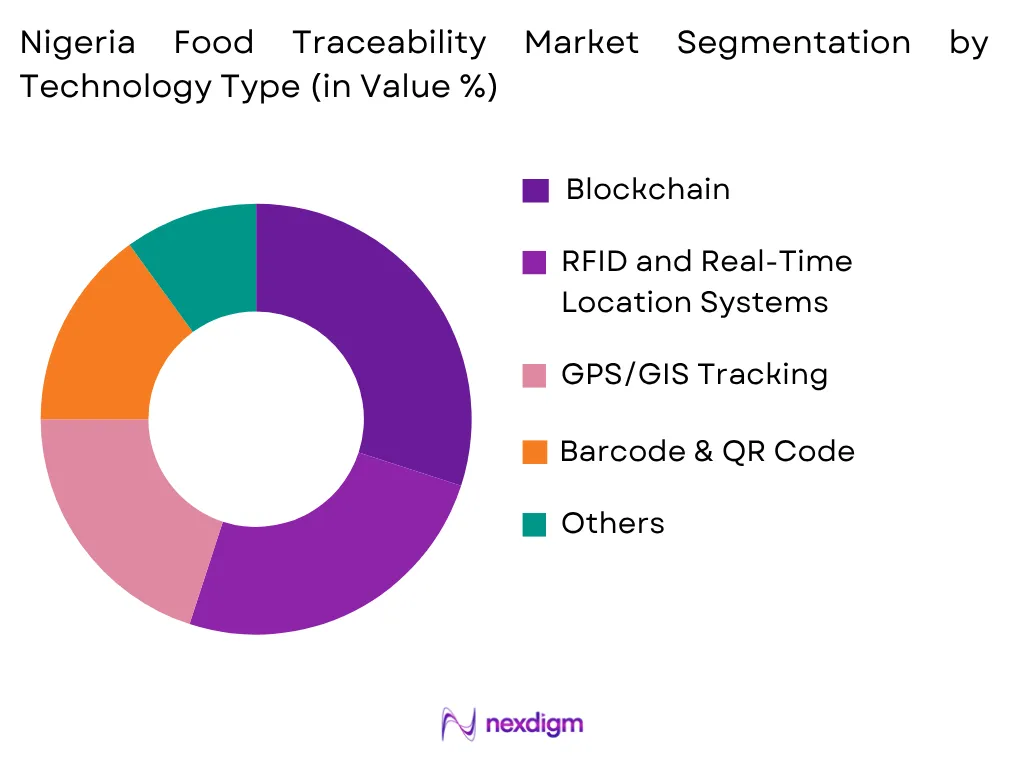
Blockchain holds a rapidly growing share of the Nigeria Food Traceability Market, driven primarily by cocoa exporters seeking to meet EUDR due diligence requirements through digital onboarding of smallholders, geolocation mapping, and automated compliance documentation. Mobile-based data collection tools are particularly important in the Nigerian context, given that the majority of the country’s estimated 70% of households engaged in agriculture operate as smallholders with limited access to fixed infrastructure; platforms that function reliably over basic mobile networks and support offline data capture in low-connectivity farming areas have a distinct adoption advantage. GPS/GIS Tracking and satellite-based farm mapping are increasingly deployed to verify that cocoa and other export commodities originate from areas free of deforestation, addressing the core challenge that many smallholder farmers currently lack geolocation data and proper documentation to prove compliant sourcing.
By Application
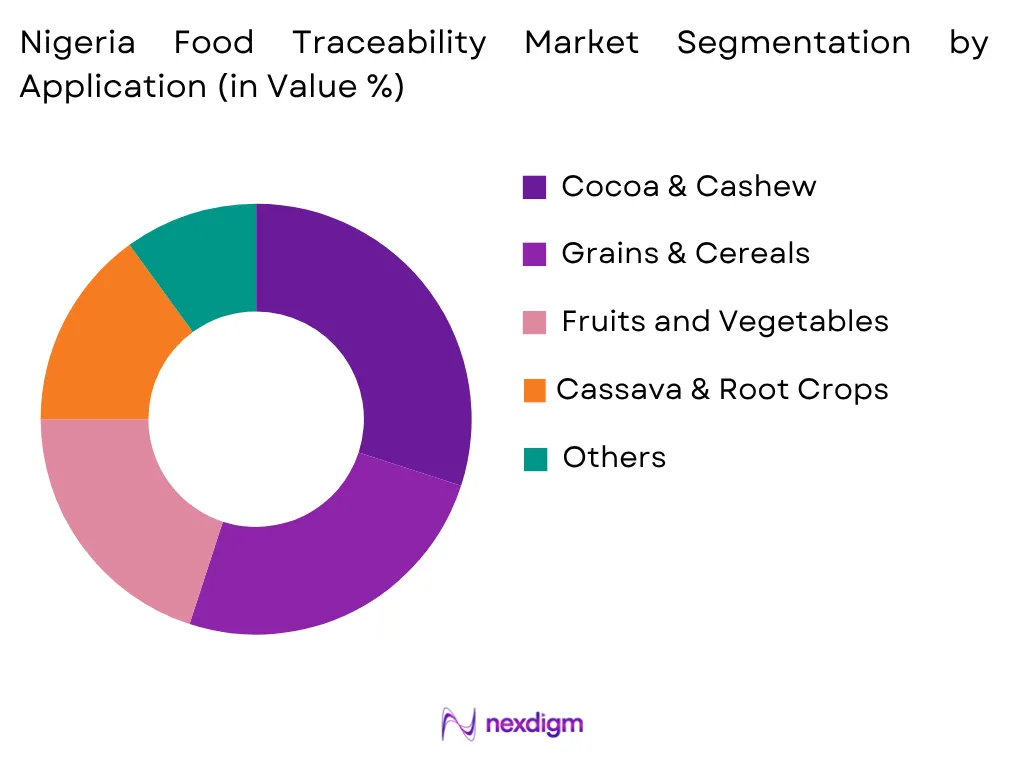
Cocoa & Cashew represents the leading application segment in the Nigeria Food Traceability Market, reflecting Nigeria’s position as one of Africa’s top cocoa producers and the acute pressure exporters face to demonstrate EUDR-compliant, deforestation-free sourcing to retain access to the lucrative EU market. Fragmented data, informal trade networks, and limited farm-to-export visibility have historically constrained Nigerian cocoa’s ability to compete as a premium, sustainably sourced origin, creating strong incentive for exporters to invest in blockchain and geolocation-based traceability tools. Grains & Cereals and Cassava & Root Crops form a significant secondary application area, given that Nigeria is the world’s largest producer of cassava and yam, while Livestock & Poultry traceability remains comparatively nascent but is gaining attention amid rising concerns over food safety, counterfeit food products, and the need to reduce Nigeria’s heavy reliance on food imports.
Competitive Landscape
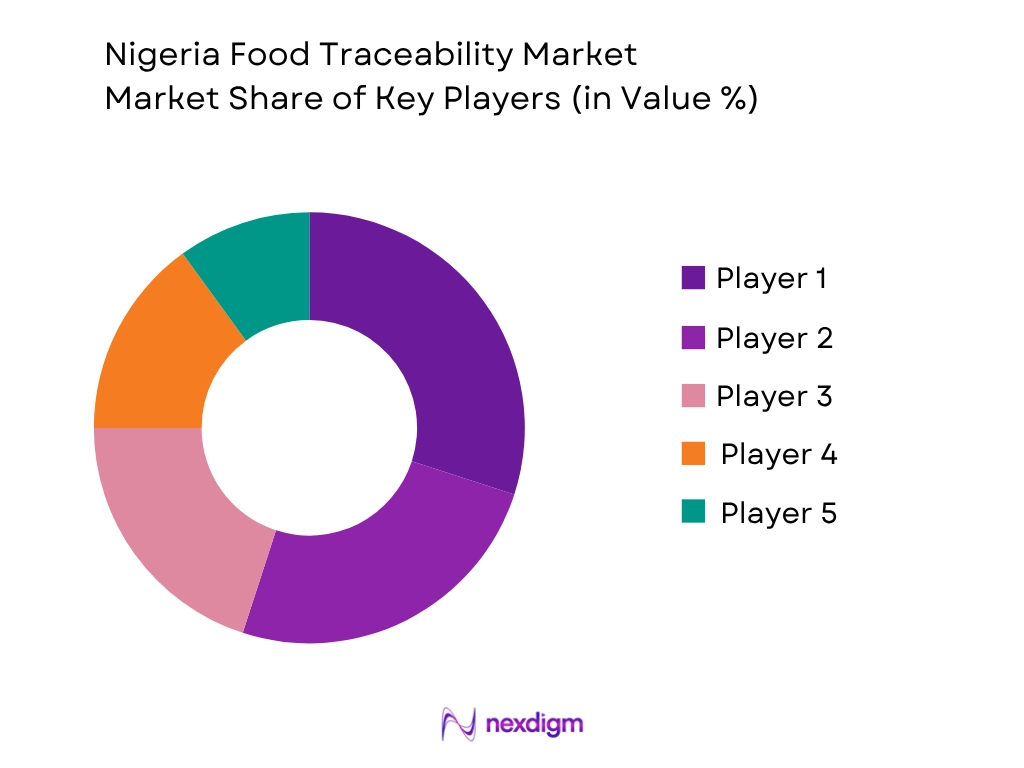
The Nigeria Food Traceability Market is fragmented and at a relatively early stage of development, comprising a mix of homegrown agritech platforms, regional West African providers, and global technology majors supporting export-oriented traceability projects. AFEX Commodities Exchange, an Abuja-based commodities exchange, has built digital warehouse receipt infrastructure that underpins traceability and financing for grains moving through its network of collateral management centers across Nigeria. ThriveAgric, a Lagos-based agritech platform, combines farmer data collection with financing to support traceable sourcing relationships between smallholders and off-takers. International providers such as TraceX Technologies have worked directly with Nigerian cocoa exporting firms to improve data accuracy and achieve EUDR-compliant supply chain traceability, while IBM’s Food Trust platform, which handles more than 18 million transactions monthly across global supply chains, has supported blockchain deployments spanning Nigeria’s cocoa and palm oil trade that now connect more than 600 cooperatives. Complete Farmer, a pan-African blockchain-enabled agricultural marketplace headquartered in Ghana, is also active in extending traceability and market access tools to smallholder farmers across West Africa, including Nigeria.
| Company | Establishment Year | Headquarters | Primary Product Portfolio | Traceability Solution Portfolio
|
Deployment Presence | Major End-Use Industries | Key Strategic Focus | Certifications & Compliance |
| TraceX Technologies | 2019 | ~ | ~ | ~ | ~ | ~ | ~ | ~ |
| AFEX Commodities Exchange | 2014 | ~ | ~ | ~ | ~ | ~ | ~ | ~ |
| IBM | 1911 | ~ | ~ | ~ | ~ | ~ | ~ | ~ |
| ThriveAgric | 2017 | ~ | ~ | ~ | ~ | ~ | ~ | ~ |
| Complete Farmer | 2019 | ~ | ~ | ~ | ~ | ~ | ~ | ~ |
Nigeria Food Traceability Market Analysis
Growth Drivers
Escalating EUDR Compliance Pressure on Cocoa and Sesame Exports
The Nigeria food traceability market is being reshaped by mounting regulatory pressure from the European Union, which requires that cocoa and other regulated commodities be verifiably free of deforestation occurring after December 31, 2020, and compliant with the legislation of the country of production. As one of Africa’s top cocoa producers, Nigeria faces the risk of losing access to the lucrative EU market without robust digital traceability solutions, given that many smallholder farmers currently lack geolocation data and proper documentation to prove deforestation-free sourcing. Blockchain-backed traceability projects supporting transparency in Nigeria’s cocoa and palm oil trade already connect more than 600 cooperatives, and Nigerian cocoa exporters that have adopted blockchain-based platforms such as TraceX have reported improved data accuracy, enhanced efficiency, and full supply chain traceability, positioning early adopters to capture premium pricing from sustainability-conscious global buyers.
Rising Food Fraud Concerns and Government Food Safety Modernization
Growing incidents of counterfeit and adulterated food products across Nigerian and wider African urban markets are increasing pressure on regulators and food businesses to strengthen traceability and verification systems. The National Agency for Food and Drug Administration and Control (NAFDAC) has stepped up warnings against unsafe food handling practices, reflecting broader concern over food fraud that has been described as an emerging epidemic in African urban life. With agriculture contributing approximately 26% of Nigeria’s GDP in 2024 and employing more than 35% of the labor force, and with the country’s food import bill running at roughly double its food export earnings between 2021 and 2024, government and donor-backed programs are increasingly prioritizing digital traceability as a tool to strengthen food safety, reduce import dependency, and support local processing industries. Rising internet connectivity across rural farmland, which has grown from 10% of productive farmland in 2017 to around 34% today according to ConectarAgro’s Rural Connectivity Indicator, is further enabling the digitization needed to underpin these traceability systems.
Market Challenges
Fragmented, Informal Supply Chains and Weak Geolocation Data
Nigeria’s agricultural supply chains, particularly for cocoa, are characterized by fragmented data, informal trade networks, and limited visibility from farm to export. Smallholder farmers, who account for the large majority of Nigeria’s farming population, frequently lack geolocation data, land titles, and proper documentation, making it difficult to prove deforestation-free or fully traceable sourcing even where the underlying farming practices are compliant. This lack of baseline data complicates efforts by exporters and technology providers to build reliable digital traceability records, particularly in a supply chain structure where produce often passes through multiple layers of informal aggregators and middlemen before reaching processors or exporters.
High Implementation Costs and Limited Rural Connectivity
Extending digital traceability to Nigeria’s large base of smallholder farmers remains costly and logistically complex, compounded by uneven rural infrastructure. While rural internet connectivity has improved from 10% of productive farmland in 2017 to around 34% today, access remains highly heterogeneous across the country, and heavy taxation on mobile phones, SIM cards, and data plans continues to raise the effective cost of connecting sensors and mobile data-collection tools in rural areas. Certification and compliance costs, along with the complexity of meeting international sustainability standards such as Fairtrade, Rainforest Alliance, and organic certification, add further financial pressure on smallholders and exporters, while low digital literacy among farmers slows the pace of adoption of blockchain and mobile-based traceability platforms outside better-connected cooperative networks.
Market Opportunities
Blockchain-Based Cocoa Certification and Cooperative Digitalization
Nigeria’s push to retain and expand access to the EU cocoa market is creating substantial opportunities for blockchain-based traceability platforms combined with satellite-based land monitoring and digital onboarding of smallholder cooperatives. Blockchain-backed traceability projects already connect more than 600 cooperatives across Nigeria’s cocoa and palm oil trade, demonstrating a scalable model for further expansion. Technology providers that can combine geolocation mapping, automated compliance documentation, and cooperative digitalization into affordable, mobile-first platforms are well positioned to capture growing demand from cocoa, sesame, and cashew exporters seeking to position Nigerian commodities as sustainable, ethically sourced, and premium-market ready rather than bulk, undifferentiated exports.
Public-Private Partnerships and Financing-Linked Traceability Platforms
Nigeria’s severe food trade deficit, with food imports running at roughly double export earnings between 2021 and 2024, is prompting growing government and donor interest in strengthening domestic food supply chains through digital traceability, storage infrastructure, and local processing support. Platforms such as AFEX Commodities Exchange, which combine digital warehouse receipts with commodity financing, illustrate an opportunity to link traceability directly to smallholder access to credit and formal markets, addressing two structural constraints simultaneously. As rural connectivity continues to expand from its current base of roughly 34% of productive farmland, and as corporate partners continue to back digitalization initiatives, there is significant headroom for traceability platforms that combine financing, market access, and compliance documentation into a single farmer-facing offering across cocoa, grains, and cassava value chains.
Future Outlook
The Nigeria Food Traceability Market is expected to witness sustained expansion over the forecast period, supported by intensifying EUDR compliance requirements for cocoa exporters, government and donor-backed digitalization of smallholder cooperatives, and rising domestic concern over food safety and counterfeit food products. Growing rural connectivity, expanding blockchain-backed cooperative networks, and increasing integration between traceability platforms and agricultural financing are expected to further accelerate adoption. The market is also likely to benefit from Nigeria’s strategic push to reposition its cocoa, sesame, and cashew exports as sustainably sourced and premium-market ready, as global buyers increasingly condition market access on verifiable, deforestation-free, and fully traceable supply chains.
Major Players
- AFEX Commodities Exchange
- TraceX Technologies
- IBM
- ThriveAgric
- Complete Farmer
- Releaf
- Babban Gona
- Cellulant
- Farmcrowdy
- AgroXchange
- SAP SE
- Cargill
- Microsoft
- GS1
- TrustTrace
Key Target Audience
- Food Traceability Technology Providers
- Cocoa, Sesame, and Cashew Exporters and Trading Companies
- Food Processors and Manufacturers
- Retailers and Supermarket Chains
- Cooperatives and Smallholder Aggregators
- Investment and Venture Capitalist Firms
- Government and Regulatory Bodies (National Agency for Food and Drug Administration and Control – NAFDAC, Standards Organisation of Nigeria – SON, Nigerian Export Promotion Council – NEPC)
- Technology Distributors and Systems Integrators
Research Methodology
Step 1: Identification of Key Variables
The research process begins with identifying the complete ecosystem of the Nigeria Food Traceability Market, including blockchain and mobile technology providers, cooperative aggregators, food processors, exporters, retailers, and regulatory authorities. Extensive secondary research is conducted using company reports, government publications, trade associations, customs statistics, industry journals, and proprietary databases to determine the variables influencing market demand, pricing, deployment, adoption, and technological developments.
Step 2: Market Analysis and Construction
Historical market information is collected and analyzed to estimate market size, deployment volumes, application-wise demand, and pricing trends. A combination of top-down and bottom-up approaches is used to estimate market revenues and validate segment-level performance. Adoption patterns across cocoa, grains, cassava, livestock, and processed food applications are evaluated to establish an accurate representation of the industry.
Step 3: Hypothesis Validation and Expert Consultation
The preliminary findings are validated through Computer-Assisted Telephone Interviews (CATIs) and structured discussions with technology distributors, cooperative managers, compliance officers, regulatory experts, and senior executives operating within the Nigerian agrifood industry. These interviews help verify market assumptions, competitive developments, technology adoption trends, pricing dynamics, and future investment opportunities while refining the overall market estimates.
Step 4: Research Synthesis and Final Output
The final stage integrates insights obtained from primary interviews with quantitative information collected through secondary sources. Data triangulation techniques are applied to reconcile differences between supply-side and demand-side estimates, ensuring robust market forecasting. The report is then reviewed through multiple quality assurance checkpoints to deliver a comprehensive analysis covering market size, segmentation, competitive landscape, future outlook, and strategic recommendations for industry stakeholders.

- Executive Summary
- Research Methodology (Market Definitions and Assumptions, Abbreviations, Market Sizing Approach, Top-Down Analysis, Bottom-Up Analysis, Demand-Side Assessment, Supply-Side Assessment, Primary Industry Interviews, Secondary Research Validation, Data Triangulation, Forecasting Framework, Limitations and Future Conclusions)

- Definition and Scope
- Market Evolution and Industry Genesis
- Timeline of Major Industry Developments
- Food Traceability Industry Value Chain Analysis
- Supply Chain Analysis

- Growth Drivers (Rising Export Compliance Requirements, Growing Food Fraud and Counterfeit Concerns, Expansion of Blockchain and Mobile-Based Traceability, Government Food Safety Modernization, Cooperative Digitalization Programs, Rising Demand for Certified Sustainable Cocoa)
- Market Challenges (High Implementation Costs for Smallholder Farmers, Fragmented and Informal Supply Chains, Limited Rural Connectivity and Digital Infrastructure, Low Digital Literacy Among Farmers, Weak Land Tenure and Geolocation Data, Interoperability Issues Between Platforms)
- Market Opportunities (Blockchain-Based Export Certification for Cocoa and Sesame, Smallholder Digital Onboarding Programs, Integration with Satellite Land Monitoring, Public-Private Traceability Partnerships, Expansion into Domestic Retail Traceability, Value-Added Certification and Financing Services)
- Market Trends (Rise of Blockchain-Based Deforestation-Free Cocoa Certification, Digital Cooperative Registration Platforms, Satellite-Based Farm Mapping, Consolidation of Agritech Traceability Platforms, Government-Backed Digital Agriculture Programs, Growing Use of Mobile-First Farmer Data Tools)
- Government Regulations (NAFDAC Food Safety and Registration Requirements, Standards Organisation of Nigeria (SON) Conformity Standards, Nigerian Export Promotion Council (NEPC) Export Certification, EU Deforestation Regulation (EUDR) Compliance, National Agricultural Technology and Innovation Policy, Food Safety and Quality Regulations)
- Import and Export Analysis (Trade Volume, Major Export Destinations, EUDR Compliance for Cocoa, HS Code Analysis, Trade Balance)
- Technology Infrastructure Availability Analysis (Blockchain Platform Availability, Mobile Network and Data Connectivity, Satellite and GPS Data Access, Cloud Computing Infrastructure, Cooperative Digitalization Coverage)
- Technology Landscape (Blockchain Platforms, Mobile-Based Farmer Data Tools, Satellite and GIS Mapping Tools, AI and Machine Learning Analytics, Cloud-Based Traceability Platforms)
- Sustainability Assessment (Deforestation-Free Cocoa Verification, Smallholder Inclusion Programs, Carbon and Land-Use Monitoring, Post-Harvest Loss Reduction, Circular Economy Alignment)
- PESTLE Analysis
- SWOT Analysis
- Porter’s Five Forces Analysis
- Stakeholder Ecosystem
- Competition Ecosystem

- By Market Value (2020-2025)
- By Volume of Deployments (2020-2025)
- By Average Selling Price (2020-2025)

- By Technology (In Value %)
Blockchain
RFID (Radio Frequency Identification)
Barcode & QR Code
GPS/GIS Tracking
IoT Sensors & Devices - By Component (In Value %)
Hardware
Software
Services - By Application (In Value %)
Cocoa & Cashew
Grains & Cereals
Cassava & Root Crops
Fruits & Vegetables
Livestock & Poultry
Processed Foods & Beverages - By End User (In Value %)
Food Processors & Manufacturers
Retailers & Supermarkets
Exporters & Trading Companies
Government & Regulatory Agencies
Cooperatives & Smallholder Aggregators - By Region (In Value %)
South West
North Central
South South
North West
South East
North East

- Market Share of Major Players (By Value, Deployment Volume, Technology Type, Application Industry, Product Category)
- Cross Comparison Parameters (Blockchain Platform Capability, Mobile/Offline Functionality, Satellite Monitoring Capability, Application Technical Support, Deployment Scale, Regulatory Compliance & Certifications, Cooperative Network Reach, Innovation & New Product Launch Frequency)
- SWOT Analysis of Major Players
- Pricing Analysis by Solution Type and Application
- Deployment Capacity Analysis
- Geographic Footprint Analysis
- Distribution and Partnership Network Analysis
- Innovation Benchmarking
- Detailed Profiles of Major Companies
AFEX Commodities Exchange
TraceX Technologies
IBM
ThriveAgric
Complete Farmer
Releaf
Babban Gona
Cellulant
Farmcrowdy
AgroXchange
SAP SE
Cargill
Microsoft
GS1
TrustTrace

- Consumption Pattern Analysis (Platform Usage Intensity, Deployment Scale, Application Penetration, Seasonal Demand, Cooperative Onboarding Activity)
- Purchasing Criteria (Regulatory Compliance, Data Accuracy, Cost Efficiency, Ease of Farmer Onboarding, Offline/Low-Connectivity Functionality, Audit Readiness)
- Procurement and Supplier Selection Analysis
- Blockchain and Mobile Digital Adoption Assessment
- Premium Export-Grade vs Domestic-Grade Traceability Demand
- Product Attribute Preference Analysis (Data Immutability, Real-Time Visibility, Integration Capability, Reporting Accuracy, Certification Compatibility, Farmer Accessibility)
- Sustainability & ESG Influence on Procurement Decisions
- Pain Point Analysis
- Decision-Making Process

- By Market Value (2026-2035)
- By Volume of Deployments (2026-2035)
- By Average Selling Price (2026-2035)


 Request a Sample
 Ask for Customization
 Get a Quote
 Enquire Now