
 Download PDF
Market Overview
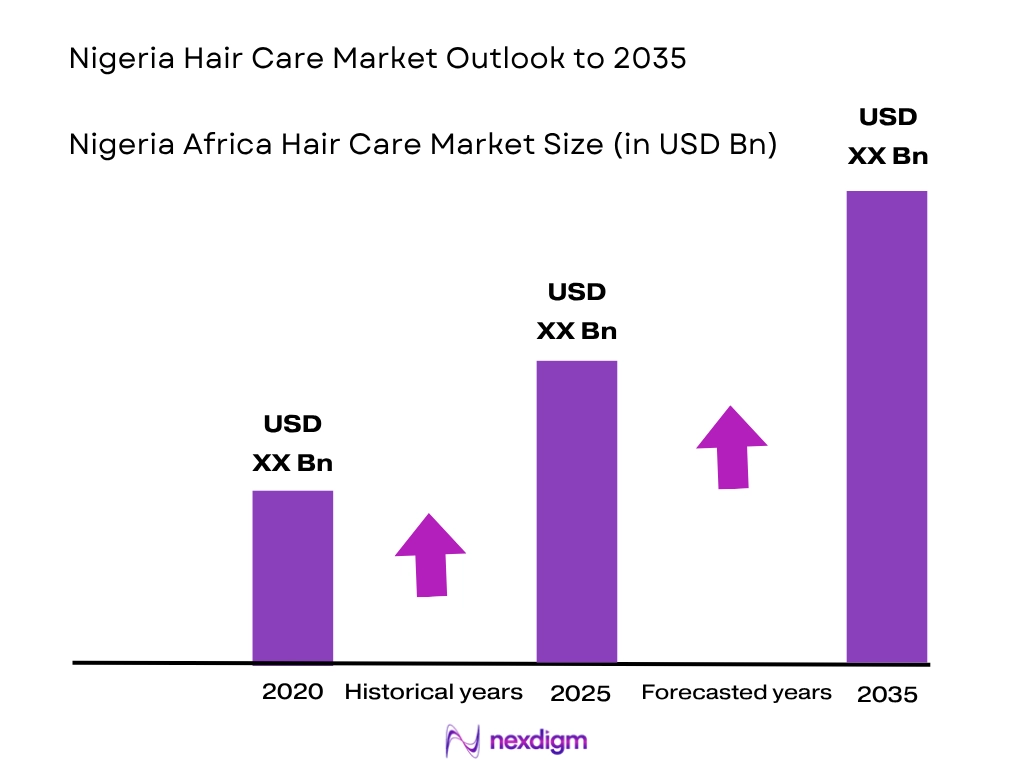
The Nigeria Hair Care Market is valued at USD ~ billion, supported by a five-year historical view in which the segment generated USD ~ billion with average per-capita hair care spend of USD ~. Growth is driven by essential grooming demand, textured-hair routines, relaxer usage, protective styling, salon-led recommendations, and imported SKU price inflation. Nexdigm also notes that Nigeria’s hair care value growth was strong, but average unit prices rose by more than 60%, while volumes declined due to inflation and naira depreciation.
Lagos, Abuja, Port Harcourt, Kano, Ibadan, Onitsha and Aba dominate the Nigeria Hair Care Market because they concentrate salons, beauty supply stores, open-market wholesalers, supermarkets, e-commerce delivery routes and premium imported product consumption. Nigeria’s urban population reached 128,043,517, while Lagos alone is widely treated as the commercial anchor due to its large metropolitan population, port access and fashion-led grooming culture. Abuja supports premium and professional sales, while Onitsha, Aba and Kano strengthen wholesale redistribution.
Market Segmentation
By Product Category
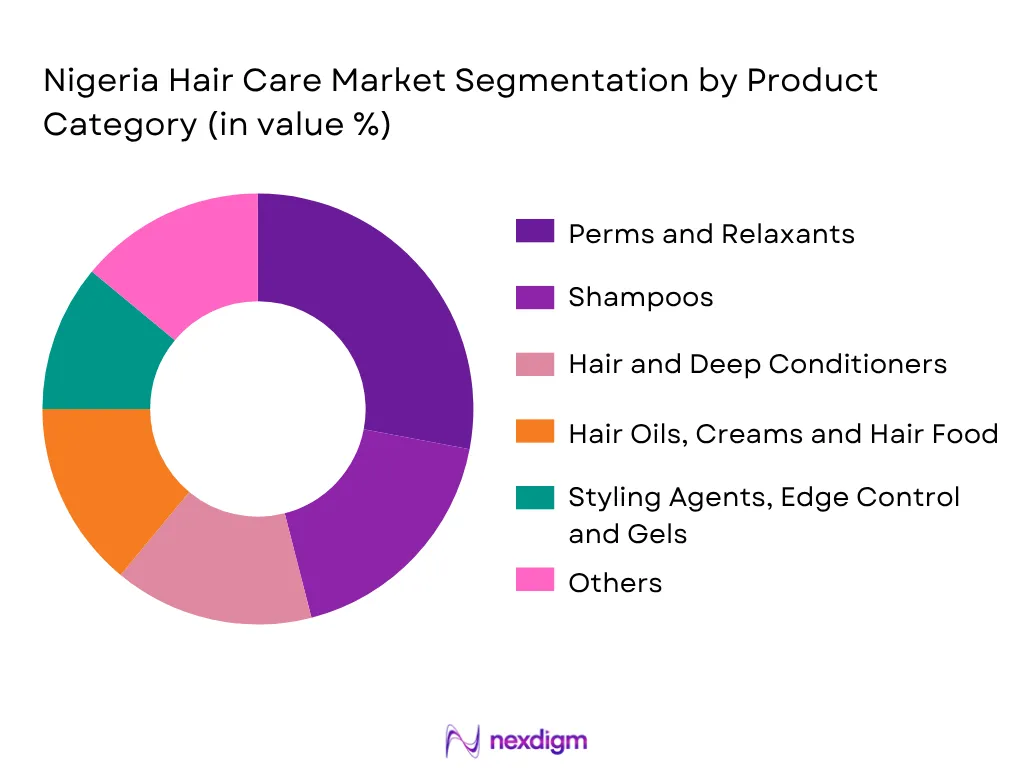
Nigeria Hair Care Market is segmented by product category into perms and relaxants, shampoos, conditioners and deep conditioners, hair oils, creams and hair food, styling agents, hair loss and scalp treatment products, hair colourants, and wig-care products. Recently, perms and relaxants have retained the dominant position under product category segmentation, driven by long-standing consumer habits, manageability needs for tightly coiled hair, and strong salon familiarity. Euromonitor specifically identifies perms and relaxants as the dominant category in Nigeria despite the natural-hair trend, while The Guardian identifies Dark & Lovely as the best-selling relaxer in Nigeria and ORS Olive Oil No-Lye Relaxer as the second-ranked relaxer brand.
By Distribution Channel
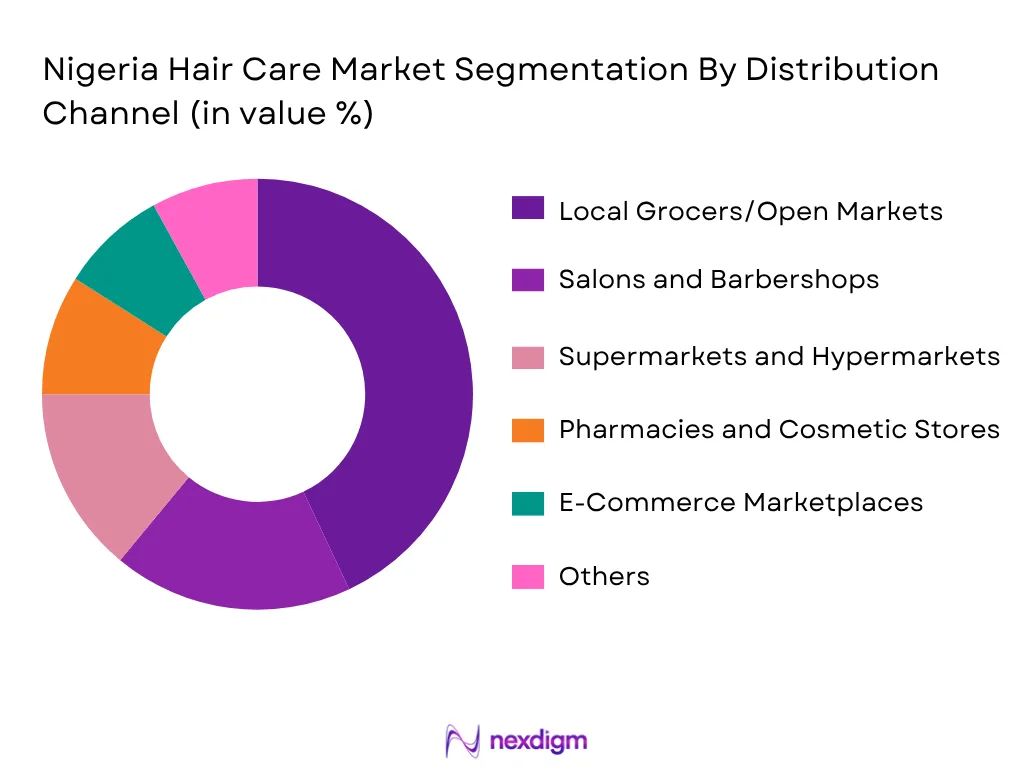
Nigeria Hair Care Market is segmented by distribution channel into small local grocers, open markets, beauty supply stores, salons and barbershops, supermarkets and hypermarkets, pharmacies and cosmetic stores, e-commerce marketplaces, social commerce, and brand-owned direct-to-consumer channels. Recently, small local grocers, open markets and beauty supply stores have dominated the channel mix because hair care is purchased frequently, price comparisons are common, and informal retail networks provide deep availability across urban, semi-urban and wholesale redistribution hubs. Euromonitor identifies small local grocers as the dominant channel, while noting that supermarkets and e-commerce are gaining share.
Competitive Landscape
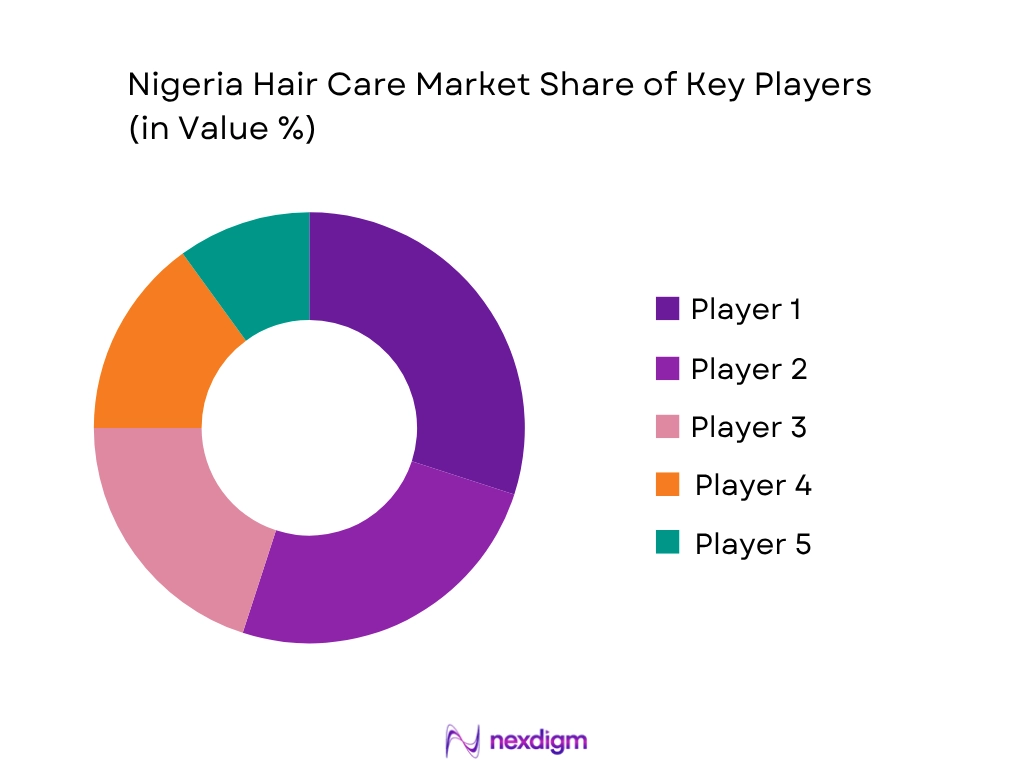
The Nigeria Hair Care Market is competitive but not evenly fragmented. Multinational African-hair specialists dominate relaxers, textured-hair solutions and imported premium SKUs, while strong Nigerian manufacturers compete through price accessibility, natural-ingredient claims, salon trust and open-market reach. Franemm Industries has extended its leadership according to Euromonitor, while L’Oréal/Dark & Lovely, Godrej/TCB Naturals, ORS, Strength of Nature, Recare/Nature’s Gentle Touch and Avila Naturalle remain highly visible across salons, beauty stores and online channels.
| Company | Establishment Year | Headquarters | Hero Brands / Lines | Core Product Strength | Nigeria Route-to-Market | Hair-Type Positioning | Price Tier | Market-Specific Strength |
| L’Oréal | 1909 | Clichy, France | ~ | ~ | ~ | ~ | ~ | ~ |
| Godrej Consumer Products | 1897 group origin | Mumbai, India | ~ | ~ | ~ | ~ | ~ | ~ |
| ORS / Namaste Laboratories | 1996 | Illinois, USA | ~ | ~ | ~ | ~ | ~ | ~ |
| Franemm Industries | Not publicly disclosed | Isheri, Ogun State, Nigeria | ~ | ~ | ~ | ~ | ~ | ~ |
| Recare / Nature’s Gentle Touch | 1997 brand introduction | Lagos, Nigeria | ~ | ~ | ~ | ~ | ~ | ~ |
Nigeria Hair Care Market Analysis
Growth Drivers
Large Young Population
Nigeria Hair Care Market is strongly supported by a large youth and working-age base that sustains demand for daily grooming, protective styling, relaxers, shampoos, conditioners, oils, creams, edge control and children’s hair products. World Bank data shows Nigeria’s population at 232,679,478 people in 2024, making it the largest consumer base in Africa. The working-age population, which includes the key earning and grooming-spending cohort, reached 130,155,065 people in 2024. The under-15 population was also sizeable at 95,430,802 people, supporting recurring demand for children’s detanglers, mild shampoos, hair food, oils and protective-style maintenance products. For hair care brands, this creates two simultaneous demand pools: self-purchasing adults and household-led purchases for children. This is market specific because textured hair care in Nigeria is routine-based; consumers purchase multiple SKUs for washing, moisturising, relaxing, braiding, wig maintenance, scalp care and edge styling rather than relying on a single product. A population base of this size gives mass brands room to scale sachets, small tubs and affordable oils, while premium brands can target young urban professionals through salons, online beauty stores and social commerce.
Urban Grooming Culture
Nigeria Hair Care Market benefits from the concentration of grooming behaviour in cities, where salons, barbershops, beauty supply stores, open markets, supermarkets, pharmacies, e-commerce delivery networks and social sellers operate at higher density. World Bank-linked data reports Nigeria’s urban population at 128,043,517 people in 2024, while the urban population ratio stood at 55.03% in 2024. This urban base supports frequent salon visits, braid installation, wig maintenance, relaxer touch-ups, men’s grooming, edge styling and wash-day product replenishment. Lagos, Abuja, Port Harcourt, Kano, Ibadan, Aba and Onitsha are especially relevant because they combine consumer traffic, wholesale redistribution, beauty retail clusters and stylist-led product recommendations. Urban digital behaviour also strengthens hair care discovery: the Nigerian Communications Commission reported 138,983,537 active internet subscriptions at December 2024, enabling Instagram vendors, WhatsApp sellers, marketplace listings, influencer tutorials and user reviews to shape brand switching and product trials. This is directly market specific because Nigerian hair care purchase decisions are heavily influenced by visual results, stylist validation, before-after content and product availability through informal and digital channels. Urbanisation therefore expands both physical retail reach and digital demand generation for hair creams, leave-ins, oils, styling gels, natural hair products and scalp treatments.
Market Challenges
Inflation
Inflation is a major challenge for Nigeria Hair Care Market because hair care is a recurring household and personal-care purchase, but consumers become more price sensitive when the general cost of living rises. The National Bureau of Statistics reported headline inflation at 34.80% in December 2024, compared with 34.60% in November 2024. Food inflation reached 39.84% in December 2024, intensifying pressure on household budgets and forcing many consumers to prioritise essentials before discretionary beauty upgrades. World Bank data also reports Nigeria’s annual consumer inflation at 33.2% for 2024, confirming broad macroeconomic pressure. In hair care, this affects the market through down-trading from premium imported brands to mass local brands, smaller pack purchases, longer intervals between salon treatments, and higher demand for multipurpose products such as hair food, oils and leave-in creams. The effect is market specific because many Nigerian consumers use complete routines for textured hair: shampoo, conditioner, oil, moisturiser, styling gel, relaxer or protective-style aftercare. Inflation therefore does not eliminate demand, but it reshapes baskets toward affordable SKUs, open-market purchases, refill behaviour, and local alternatives with acceptable performance.
Naira Depreciation
Naira depreciation is a direct challenge for Nigeria Hair Care Market because a significant part of the category depends on imported finished products, imported fragrances, surfactants, preservatives, actives, packaging inputs, salon-grade products and branded premium SKUs. The Central Bank of Nigeria’s exchange-rate page identifies the Nigerian Foreign Exchange Market rate as the official volume-weighted exchange rate for the day, while public CBN-cited market reporting shows the dollar quoted at NGN1,535 on December 31, 2024, compared with NGN 997 on December 31, 2023. The U.S. Treasury’s official exchange-rate table also lists Nigeria at NGN1,540.0000 per US dollar on December 31, 2024. This creates pressure for importers, distributors and salon suppliers handling relaxers, colourants, professional treatments, branded natural hair products and packaging-intensive SKUs. In the hair care market, depreciation typically shows up as reduced product availability, delayed restocking, smaller shipment sizes, wider price dispersion across open markets, and substitution toward locally blended creams, oils and conditioners. It also affects salons because professional back-bar products and treatment lines become harder to replenish consistently. The challenge is therefore market specific: Nigerian consumers still require routine hair maintenance, but exchange-rate pressure changes brand access, channel preference and product affordability across mass, mid-market and premium tiers.
Opportunities
Local Manufacturing
Local manufacturing presents a strong future-growth opportunity for Nigeria Hair Care Market because it can reduce exposure to imported finished goods, improve product availability, support affordable pack sizes and allow brands to tailor formulations to Nigerian textured hair. World Bank-linked data reports Nigeria’s manufacturing value added at USD 25,364,113,924 in 2024, while National Bureau of Statistics GDP reporting shows manufacturing contributed 12.68% to nominal GDP in the second quarter of 2024 and 14.79% in the first quarter of 2024. These figures indicate that Nigeria has an existing industrial base that hair care companies can leverage for blending, filling, labelling, packaging and contract manufacturing. For the hair care market, the opportunity is especially clear in shampoos, conditioners, relaxer kits, hair creams, oils, edge-control gels, leave-ins, children’s products and scalp treatments, where local production can support faster replenishment and smaller retail formats. Local production also enables market-specific innovation: heavier moisturising textures, shea/castor/coconut oil positioning, anti-breakage claims, dry-scalp relief and protective-style maintenance. As inflation and FX pressure alter affordability, Nigerian manufacturing becomes strategically important for distributors, salons and beauty stores that need reliable stock availability without depending entirely on imported replenishment cycles.
Shea Butter Value Addition
Shea butter value addition is a market-specific opportunity for Nigeria Hair Care Market because shea is a core ingredient in hair creams, conditioners, leave-ins, scalp balms, children’s hair products, curl moisturisers and anti-breakage formulations. The Nigerian Export Promotion Council stated in 2024 that Nigeria produces about 400,000 tons of shea nuts, positioning the country as the world’s largest producer. NEPC also reported that NEXIM had spent NGN 5 billion to set up major shea processing plants, while a four-year NEPC–CBI intervention was aimed at sustaining production capacity and enhancing export readiness. Government-level policy attention has continued into the current period: the State House stated that Nigeria’s installed shea processing capacity is 160,000 metric tonnes, while processors operate at only 35 to 50 percent capacity and more than 90,000 metric tonnes of raw shea are lost each year through informal cross-border trade. For hair care companies, this creates a clear opportunity to move from raw nut export dependence toward processed shea butter, shea oil and shea derivatives for domestic formulations. This supports ingredient authenticity, local sourcing claims, lower import dependence, rural supplier linkages and product differentiation in natural and textured hair care.
Future Outlook
The Nigeria Hair Care Market is expected to expand at a forecast CAGR of 6.6% for 2026–2035, aligned with Middle East and Africa haircare growth benchmarks and supported by natural-hair routines, salon-grade home care, scalp treatments, e-commerce, social commerce and local manufacturing. The outlook remains value-led rather than purely volume-led because inflation, FX volatility and import-cost pressure continue to affect affordability. Growth will be strongest in natural hair care, leave-in oils, edge control, scalp treatments, wig-care routines and locally produced mass products. Broader Africa haircare is forecast to grow at 8.1% CAGR over the shorter-term forecast window, while Middle East and Africa haircare is reported at 6.6% CAGR, supporting Nigeria’s structurally positive but price-sensitive outlook. Natural hair care will remain one of the most attractive opportunity pools. Nigeria Natural Hair Care Product Market is valued at USD 67.85 million and projected to reach USD 131.21 million, with a 7.67% CAGR in the published forecast period. Shampoos represented the largest product share in natural hair care, while leave-in treatments and oils are expected to remain faster-growth categories due to wash-day routines, moisture retention, protective styling, and breakage prevention.
Major Players
- L’Oréal West Africa / Dark & Lovely
- Godrej Consumer Products / TCB Naturals, MegaGrowth, Darling
- ORS Hair Care / Namaste Laboratories
- Strength of Nature / African Pride, Motions, Creme of Nature
- Unilever Nigeria / SheaMoisture and mass personal care portfolio
- Procter & Gamble / Pantene and Mielle
- PZ Cussons Nigeria
- Franemm Industries
- Recare Limited / Nature’s Gentle Touch
- Avila Naturalle
- Natural Nigerian
- African Naturalistas
- Arami Essentials
- Midas Naturals
- Cantu Beauty
Key Target Audience
- Hair care product manufacturers
- Cosmetic and personal care brand owners
- Salon chains, barbershop networks and professional beauty operators
- Beauty product distributors, wholesalers and importers
- Supermarkets, hypermarkets and pharmacy retail chains
- E-commerce marketplaces and social commerce beauty sellers
- Investments and venture capitalist firms
- Government and regulatory bodies: National Agency for Food and Drug Administration and Control, Standards Organisation of Nigeria, Federal Ministry of Industry, Trade and Investment, Nigeria Customs Service
Research Methodology
Step 1: Identification of Key Variables
The initial phase involves constructing an ecosystem map for the Nigeria Hair Care Market, covering manufacturers, importers, distributors, open-market traders, salons, beauty supply stores, e-commerce platforms and regulatory bodies. Key variables include product category demand, relaxer penetration, natural-hair adoption, salon influence, urban consumption and imported-versus-local product availability.
Step 2: Market Analysis and Construction
Historical market indicators are compiled across retail sales, product category performance, channel penetration, price inflation, consumer hair routines and company-level visibility. The market model uses both top-down macro consumption analysis and bottom-up SKU/channel reconstruction to validate product-level revenue pools and category share.
Step 3: Hypothesis Validation and Expert Consultation
Market hypotheses are validated through interviews with salon owners, barbers, beauty-store operators, wholesalers, distributors, local manufacturers and e-commerce sellers. These discussions test assumptions around relaxer usage, edge-control demand, natural-hair routines, imported brand availability, price sensitivity and consumer switching behaviour.
Step 4: Research Synthesis and Final Output
The final phase integrates secondary research, retail checks, expert inputs, price tracking and brand benchmarking into a consolidated Nigeria Hair Care Market view. Findings are triangulated across product category, distribution channel, city demand clusters, regulatory environment and competitive positioning to produce a validated market assessment.

- Executive Summary
- Research Methodology (Market Definitions and Scope, Abbreviations, Category Taxonomy, Market Sizing Approach, Top-Down Demand Modelling, Bottom-Up SKU and Channel Build-Up, Retail Audit Approach, Salon and Barbershop Interview Framework, Distributor and Open-Market Validation, E-Commerce Price Scraping, NAFDAC Registration Review, Import and Local Manufacturing Assumptions, Data Triangulation, Forecast Modelling, Limitations and Risk Controls)

- Definition and Scope
- Market Genesis and Evolution
- Timeline of Major Players
- Business Cycle
- Demand Seasonality
- Supply Chain and Value Chain Analysis
- Route-to-Market Structure
- Informal Salon and Open-Market Ecosystem
- Local Manufacturing versus Imported Finished Goods
- Consumer Hair Culture and Styling Behaviour

- Growth Drivers (Large Young Population, Urban Grooming Culture, Natural Hair Communities, Social Media Hair Education, Salon Density, Protective Styling Frequency, Premiumisation in Lagos and Abuja, Men’s Grooming Expansion, Children’s Hair Care Demand)
- Market Challenges (Inflation, Naira Depreciation, Import Cost Pressure, Counterfeit Products, Informal Retail Fragmentation, Low Disposable Income, Salon Price Sensitivity, Product Dilution, Regulatory Delays, Raw Material Quality Variability)
- Opportunities (Local Manufacturing, Shea Butter Value Addition, Natural Hair Science, Scalp Health, Children’s Hair Care, Men’s Hair Care, Salon Professional Lines, Mini Packs, Refill Formats, D2C Subscription Models)
- Trends (Natural Hair Movement, Protective Styling, Ingredient-Led Purchasing, Relaxer Reassessment, DIY Hair Routines, Influencer Education, Premiumisation, Scalpification, Men’s Grooming, Clean Beauty Claims)
- Government Regulation (NAFDAC Product Registration, Cosmetic Labelling, Advertising Claims, Import Documentation, Product Safety, Ingredient Disclosure, Batch Traceability, Manufacturing Practice, Counterfeit Control)
- SWOT Analysis (Brand Strength, Local Ingredient Access, Channel Fragmentation, Import Substitution, Consumer Education, Counterfeit Risk, Premiumisation, Price Elasticity)
- Stakeholder Ecosystem (Manufacturers, Importers, Distributors, Sub-Distributors, Open-Market Traders, Salons, Barbershops, Beauty Supply Stores, E-Commerce Platforms, Social Sellers, Ingredient Suppliers, Packaging Vendors, NAFDAC, Influencers, Consumers)
- Porter’s Five Forces (Supplier Power, Buyer Power, Threat of Substitutes, Competitive Rivalry, Threat of New Entrants, Informal Channel Intensity, Brand Switching, Private Label Threat)
- Competition Ecosystem (Multinational FMCG Brands, African Hair Specialists, Local Natural Hair Brands, Importers, Salon Professional Brands, E-Commerce Sellers, Informal Market Brands, Premium Niche Brands)
- Pricing and SKU Architecture (Sachets, Small Bottles, Family Packs, Salon Tubs, Relaxer Kits, Bundle Packs, Premium Imported SKUs, Price-per-ml, Price-per-use, Margin Stack)
- Import and Local Manufacturing Analysis (Finished Goods Imports, Bulk Ingredient Imports, Local Shea Butter Inputs, Packaging Imports, FX Exposure, Contract Manufacturing, Local Blending, Quality Control)

- By Value (2020-2025)
- By Volume (2020-2025)
- By Average Unit Price (2020-2025)
- By Retail Sales Value (2020-2025)
- By Professional Salon Sales Value (2020-2025)
- By Mass versus Premium Consumption (2020-2025)
- By Imported versus Locally Manufactured Product Value (2020-2025)

- By Product Category (In Value%)
Shampoo
Conditioner
Hair Oil
Hair Cream and Hair Food
Hair Relaxer
Leave-In Treatment
Hair Mask and Deep Conditioner
Styling Gel and Edge Control
Hair Colorant
Anti-Dandruff and Scalp Treatment
Hair Growth Treatment
Hair Extensions Products
Wigs Care Products - By Hair Type and Hair Need (In Value%)
Natural Kinky/Coily Hair
Relaxed Hair
Transitioning Hair
Protective Styles
Braids
Weaves
Low-Porosity Hair
High-Porosity Hair
Dry Scalp
Dandruff
Hair Breakage
Thinning Edges
Heat-Damaged Hair - By Consumer Group (In Value%)
Women
Men
Children
Teenage Consumers
Working Professionals
Salon-Led Consumers
DIY At-Home Users
Natural Hair Communities
Premium Urban Consumers
Value-Seeking Mass Consumers - By Price Tier (In Value%)
Economy Sachets
Mass-Market Bottles
Mid-Market Local Brands
Premium Imported Brands
Professional Salon SKUs
Luxury Natural Hair Brands
Bundle and Wash-Day Kits - By Distribution Channel (In Value%)
Open Markets
Wholesalers
Beauty Supply Stores
Salons and Barbershops
Supermarkets and Hypermarkets
Pharmacies and Cosmetic Stores
E-Commerce Marketplaces
Social Commerce
Brand-Owned D2C
Distributors and Sub-Distributors - By Geography (In Value%)
Lagos
Abuja/FCT
South West
South East
North Central
North West
North East
Tier-One Cities
Tier-Two Cities - By Ingredient and Claim Positioning (In Value%)
Shea Butter
Coconut Oil
Castor Oil
Olive Oil
Argan Oil
Aloe Vera
Tea Tree
Black Soap
Herbal Extracts
Sulfate-Free
Paraben-Free - By Usage Occasion (In Value%)
Wash Day
Daily Moisturising
Protective Styling
Relaxer Touch-Up
Wig and Weave Maintenance
Edge Styling
Hair Growth Routine
Scalp Treatment
Children’s Hair Care
Men’s Grooming
Salon Treatment
At-Home Treatment

- Market Share of Major Players (Value Share, Volume Share, Product Category Share, Relaxer Share, Natural Hair Product Share, Hair Extensions Care Share, Modern Trade Share, E-Commerce Share, Salon Share)
- Cross Comparison Parameters (Product Portfolio Fit for Textured Hair, Relaxer and Natural Hair Balance, Shea/Coconut/Castor/Olive Ingredient Positioning, SKU Pack-Size Architecture, Average Price Index, NAFDAC Registration and Labelling Compliance, Salon and Stylist Penetration, Open-Market and Distributor Reach)
- SWOT Analysis of Major Players (Brand Equity, Local Relevance, Channel Control, Import Risk, Counterfeit Exposure, Pricing Power, Innovation Speed, Salon Trust)
- Pricing Analysis Basis SKUs for Major Players (Shampoo ml Pricing, Conditioner ml Pricing, Relaxer Kit Pricing, Hair Oil ml Pricing, Edge Control g Pricing, Hair Cream g Pricing, Leave-In ml Pricing, Deep Conditioner Tub Pricing, Bundle Kit Pricing)
- Brand Positioning Matrix (Mass versus Premium, Natural versus Chemical, Salon versus Retail, Imported versus Local, Youth-Oriented versus Family-Oriented, Ingredient-Led versus Performance-Led)
- Distribution Benchmarking (Open Market Coverage, Modern Trade Presence, Beauty Supply Store Depth, Salon Retailing, E-Commerce Visibility, Social Seller Network, Regional Distributor Network)
- Digital and Influencer Benchmarking (Instagram Reach, TikTok Education, YouTube Hair Tutorials, Influencer Collaborations, User-Generated Content, Review Density, Marketplace Ratings)
- Detailed Profiles of Major Companies
L’Oréal West Africa
Godrej Nigeria / Darling, MegaGrowth, TCB Naturals
ORS Hair Care
Strength of Nature
Unilever Nigeria
PZ Cussons Nigeria
Procter & Gamble
Cantu Beauty
Revlon Professional
Nature’s Gentle Touch
Natural Nigerian
Avila Naturalle
African Naturalistas
Arami Essentials
Midas Naturals

- Market Demand and Utilization (Wash Frequency, Moisturising Frequency, Relaxer Touch-Up Cycle, Protective Style Cycle, Salon Visit Frequency, Wig Maintenance Frequency, Children’s Hair Care Routine)
- Purchasing Power and Budget Allocation (Economy Users, Mass Users, Mid-Market Users, Premium Imported Buyers, Salon Service Bundles, Monthly Hair Care Spend, Down-Trading, Bulk Buying)
- Needs, Desires and Pain Point Analysis (Dryness, Shrinkage, Breakage, Itchy Scalp, Dandruff, Thinning Edges, Product Build-Up, Heat Damage, Relaxer Burns, Wig Itch, Children’s Hair Detangling)
- Decision-Making Process (Stylist Influence, Peer Recommendation, Influencer Education, Ingredient Claims, Price Sensitivity, NAFDAC Number Trust, Brand Familiarity, Availability, Scent and Texture Preference)
- Customer Cohort Analysis (Natural Hair Enthusiasts, Relaxed Hair Loyalists, Protective Styling Users, Wig and Weave Users, Men’s Grooming Users, Kids’ Hair Care Buyers, Premium Urban Shoppers, Value-Driven Open-Market Buyers)
- Salon and Barbershop Behaviour (Professional Product Usage, Back-Bar Consumption, Retail Resale, Stylist Training, Preferred Brands, Margin Expectations, Service Bundling, Client Education)
- E-Commerce and Social Commerce Behaviour (Marketplace Discovery, Instagram Vendors, WhatsApp Resellers, Cross-Border Imports, Reviews, Delivery Costs, Authenticity Concerns, Promo Dependence)

- By Value (2026-2035)
- By Volume (2026-2035)
- By Average Unit Price (2026-2035)
- By Retail Sales Value (2026-2035)
- By Professional Salon Sales Value (2026-2035)
- By Mass versus Premium Consumption (2026-2035)
- By Imported versus Locally Manufactured Product Value (2026-2035)


 Request a Sample
 Ask for Customization
 Get a Quote
 Enquire Now