
 Download PDF
Market Overview
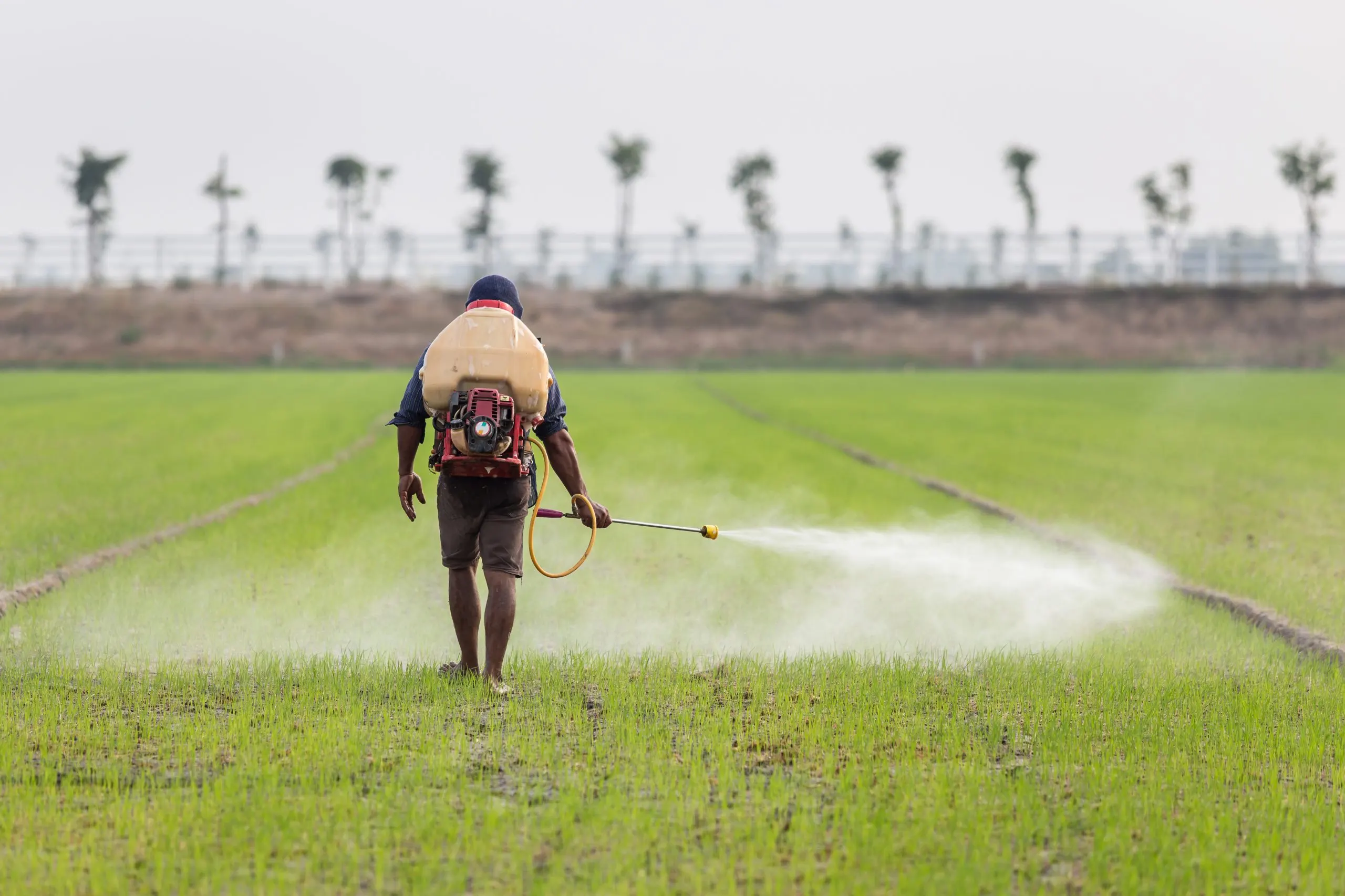
The Nigeria Herbicide Market is valued at USD ~ million, derived from the published Nigeria herbicides value of USD 74.83 million and the Nigeria-specific growth benchmark of 5.4%. Demand is driven by cassava, maize, rice, yam, oil palm and cocoa systems where herbicides substitute labour-intensive manual weeding. Corn output was reported at 12 million metric tons in MY 2023/24 and 11 million metric tons in MY 2024/25, reinforcing staple-crop weed-control demand. Kano, Kaduna, Niger, Benue, Oyo, Ogun, Cross River, Edo and Lagos dominate the Nigeria Herbicide Market because demand is linked to maize, rice, cassava, yam, cocoa, oil palm and agrochemical distribution corridors. North West and North Central states drive maize, rice and sorghum herbicide use, while South West and South South support cassava, cocoa and oil palm demand. Rice output was reported at 8.3 million tons in MY 2023/24 and 7.7 million tons in MY 2024/25.
Market Segmentation
By Crop Type
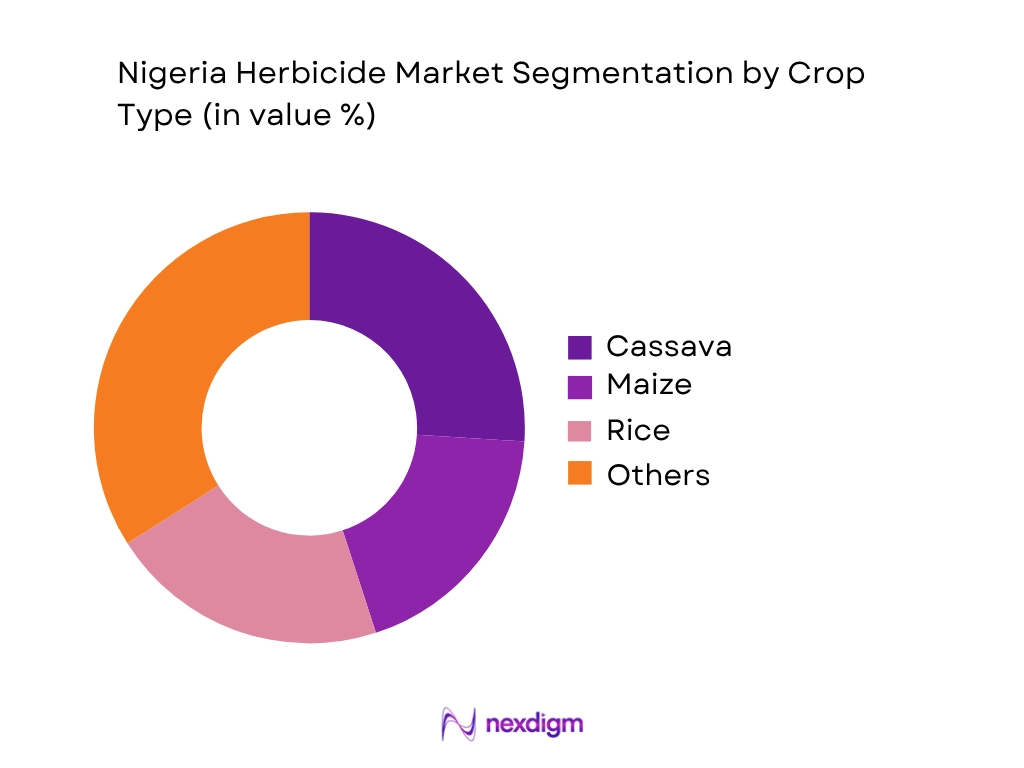
Nigeria Herbicide Market is segmented by crop type into cassava, maize, rice, yam, cowpea & soybean, oil palm, cocoa, plantain & banana, vegetables, horticulture and non-crop areas. Recently, cassava has a dominant market share in Nigeria under crop type segmentation due to the crop’s large smallholder base and high manual weeding burden. Cassava fields require early weed control because weeds compete strongly during establishment and can reduce farmer productivity when labour is scarce or costly. Herbicides are used for pre-plant burn-down, pre-emergence weed suppression and farm preparation, particularly in South West, South East and North Central cassava belts. The segment is further supported by cassava processing demand, outgrower schemes and private-sector scaling of herbicides tested through Nigeria’s cassava weed-management initiatives.
By Herbicide Type
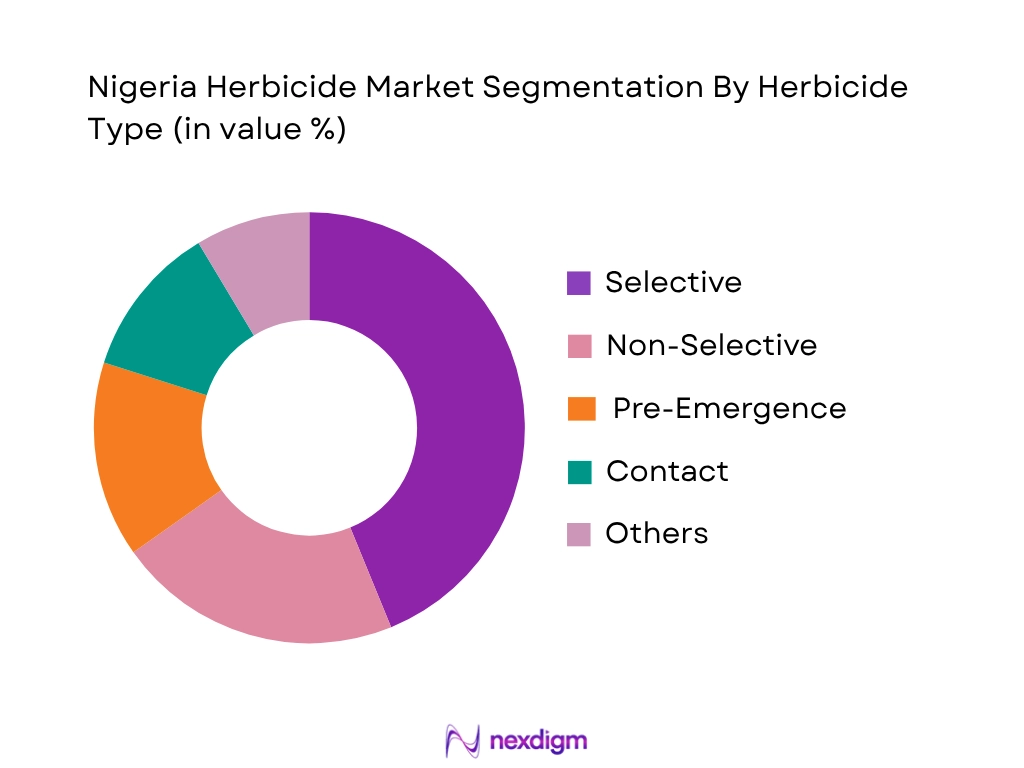
Nigeria Herbicide Market is segmented by herbicide type into non-selective herbicides, selective herbicides, pre-emergence herbicides, post-emergence herbicides, contact herbicides, and bio-based & other herbicides. Recently, non-selective herbicides have a dominant market share in Nigeria under this segmentation because they are widely used for land clearing, pre-plant burn-down, cassava and maize field preparation, plantation floor management and non-crop vegetation control. Glyphosate and paraquat-type products remain familiar to smallholders and agro-dealers because they offer rapid weed suppression before planting or during field maintenance. The dominance of non-selective herbicides is also linked to limited mechanisation, fragmented smallholder plots and the need to replace manual slashing or hoe-weeding with lower-labour weed-control methods. NAFDAC regulation, however, makes registered-product compliance central to this segment.
Competitive Landscape
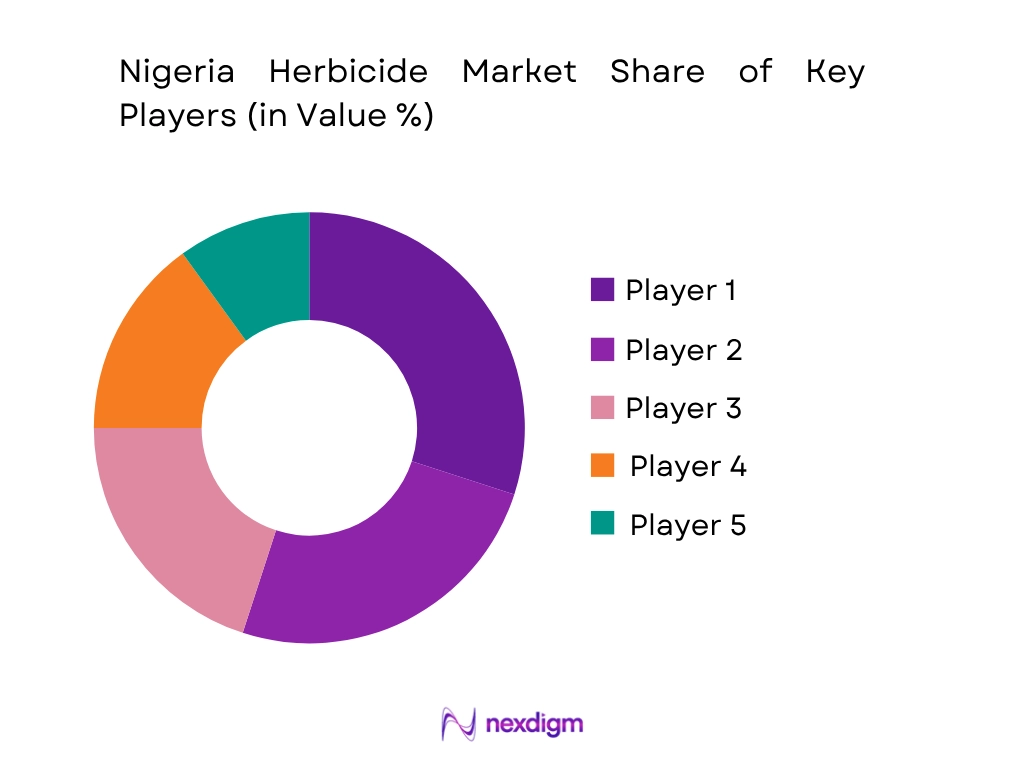
The Nigeria Herbicide Market is fragmented across multinational crop-protection suppliers, Nigerian agrochemical importers, local formulators, agro-dealer networks and regional distributors. Multinationals compete through global chemistry, stewardship and crop-specific programmes, while domestic firms compete through agro-dealer reach, pack-size affordability, warehousing and product availability. NAFDAC’s pesticide regulations apply to pesticides manufactured, imported, exported, advertised, sold, distributed or used in Nigeria, creating a compliance barrier for informal or unregistered products.
| Company | Establishment Year | Headquarters | Herbicide Portfolio Focus | Key Crop Focus | Distribution Strength | Registration / Compliance Position | Farmer Support | Strategic Positioning |
| Saro AgroSciences Limited | 1991 | Lagos, Nigeria | ~ | ~ | ~ | ~ | ~ | ~ |
| Harvestfield Industries Limited | 2000 | Lagos, Nigeria | ~ | ~ | ~ | ~ | ~ | ~ |
| Jubaili Agrotec Nigeria | 2002 | Kano / Lagos, Nigeria | ~ | ~ | ~ | ~ | ~ | ~ |
| Syngenta Nigeria | 2000 | Basel, Switzerland / Nigeria operations | ~ | ~ | ~ | ~ | ~ | ~ |
| UPL Nigeria | 1969 | Mumbai, India / Nigeria operations | ~ | ~ | ~ | ~ | ~ | ~ |
Nigeria Herbicide Market Analysis
Growth Drivers
Staple Crop Scale is Creating Recurring Herbicide Demand
Nigeria Herbicide Market is supported by large staple-crop systems where weed control is required across land preparation, early crop establishment and post-emergence stages. Nigeria’s population reached 232,679,478 people, creating a large domestic food-demand base for cassava, maize, rice, yam and legumes. World Bank data places Nigeria’s GDP at USD 252.26 billion and GDP per capita at USD 1,084.2, showing the macroeconomic scale behind staple-food consumption and input procurement. Maize output was reported at 12 million metric tons for MY 2023/24 and 11 million metric tons for MY 2024/25, while rice output was reported at 8.3 million tons and 7.7 million tons across the same marketing years. For herbicide suppliers, these crop volumes justify crop-specific products for maize burn-down, rice pre-emergence treatment, cassava land preparation and post-emergence weed suppression. Weed pressure in these systems is market-specific because smallholders often depend on timely field clearing before planting, and delays can reduce crop stand and farmer productivity.
Rural Labour Pressure is Strengthening Manual-Weeding Substitution
Nigeria Herbicide Market is driven by labour substitution because manual weeding remains one of the most demanding farm operations in cassava, yam, maize and rice systems. World Bank-linked data places Nigeria’s rural population at 104,635,961 people, while total population reached 232,679,478, indicating a large rural farming base but also a large food-consumption burden. The World Bank reports Nigeria’s GDP at USD 252.26 billion, while IMF noted that agriculture remained subdued due to security challenges and sliding productivity, despite overall economic growth accelerating to 3.4 in 2024 and expected real GDP expansion of 3.4 in 2025. This creates a clear need for productivity-enhancing inputs that reduce reliance on manual field operations. Herbicides address this need by lowering the number of hoe-weeding rounds in cassava and yam, improving land preparation speed in maize and rice, and supporting larger cultivated areas where household labour is insufficient. For distributors and agro-dealers, the growth driver is not generic chemical use; it is the farmer need to complete weed control within narrow planting windows using knapsack-compatible, affordable and crop-appropriate products.
Market Challenges
Security and Productivity Constraints Disrupt Crop-Linked Herbicide Demand
Nigeria Herbicide Market faces demand volatility because major crop belts are affected by security disruption, farm-access constraints and subdued productivity. IMF stated that agriculture remained subdued due to security challenges and sliding productivity, while real GDP was expected to expand by 3.4 in 2025 after growth accelerated to 3.4 in 2024. USDA-linked crop reporting showed maize declining from 12 million metric tons in MY 2023/24 to 11 million metric tons in MY 2024/25, while rice declined from 8.3 million tons to 7.7 million tons across the same period. These figures directly affect herbicide planning because maize and rice require pre-plant, pre-emergence and post-emergence applications; when farmers reduce planted area, delay field work or face limited access to land, agro-dealer replenishment cycles and distributor stock movement weaken. Nigeria’s population of 232,679,478 people and GDP of USD 252.26 billion make food production commercially important, but insecurity can shift demand away from structured crop-protection programs toward irregular, price-sensitive purchases.
Regulatory Compliance and Product Quality Risks Limit Formal Channel Expansion
Nigeria Herbicide Market faces a major challenge from product registration, counterfeit risk and unsafe pesticide circulation. NAFDAC’s pesticide regulations apply to products manufactured, imported, exported, advertised, sold, distributed or used in Nigeria, making formal registration central to legal market participation. NAFDAC also initiated an action plan covering the ban or phase-out of 12 active ingredients and reclassification of 4 others, showing tighter scrutiny of pesticide safety and permitted active ingredients. The issue is market-specific because smallholder herbicide demand is routed through fragmented agro-dealer networks, where fake labels, under-dosed formulations, poor storage and incorrect product advice can damage farmer trust. Nigeria’s macro base is large, with GDP at USD 252.26 billion, GDP per capita at USD 1,084.2, and rural population at 104,635,961, but formal suppliers must invest in registration, product authentication, dealer training and safe-use communication before they can convert this demand into reliable sales. For herbicide companies, regulatory compliance is not only a legal requirement; it is a channel-quality differentiator.
Market Opportunities
Cassava, Maize and Rice Programs Create Scope for Crop-Specific Herbicide Bundles
Nigeria Herbicide Market has an opportunity to move from generic land-clearing products toward crop-specific herbicide programs for cassava, maize and rice. The current food-demand base is large, with Nigeria’s population at 232,679,478 and GDP at USD 252.26 billion, while GDP per capita stands at USD 1,084.2. Maize output of 11 million metric tons and rice output of 7.7 million tons in MY 2024/25 indicate sizeable treated-area potential for pre-emergence residuals, selective post-emergence herbicides and land-preparation products. The opportunity is strongest where farmer groups, processors and agro-dealers can package herbicides with dosage guidance, spray calendars and crop-stage recommendations. Cassava farmers need early weed-free windows; maize farmers require broadleaf and grass control; rice farmers need lowland and upland weed-spectrum solutions. Current crop volumes support future growth because suppliers can build labelled, crop-safe programs rather than relying on one-size-fits-all glyphosate or paraquat use.
Agro-Dealer Formalisation and Agricultural Value-Chain Financing Can Improve Adoption
Nigeria Herbicide Market has an opportunity in formal agro-dealer networks, product authentication and bundled input distribution because rural demand is large but fragmented. World Bank-linked data shows rural population at 104,635,961, while total population reached 232,679,478, giving herbicide suppliers a broad smallholder base to serve through local input channels. In 2026, the World Bank approved a six-year Nigeria project expected to mobilise an additional USD 220 million from private agribusiness investment, aligned with Agriconnect and aimed at transforming smallholder farming into commercially successful agribusiness. This supports the case for structured input delivery, including registered herbicides, verified packaging, cooperative procurement and spray-service models. Nigeria’s GDP of USD 252.26 billion and GDP per capita of USD 1,084.2 show a large but affordability-sensitive economy, so formalisation should focus on small packs, knapsack-dose compatibility and dealer training. The future opportunity is to combine registered herbicides with credit-linked supply, processor-led outgrower programs and QR or scratch-code verification to reduce counterfeit exposure.
Future Outlook
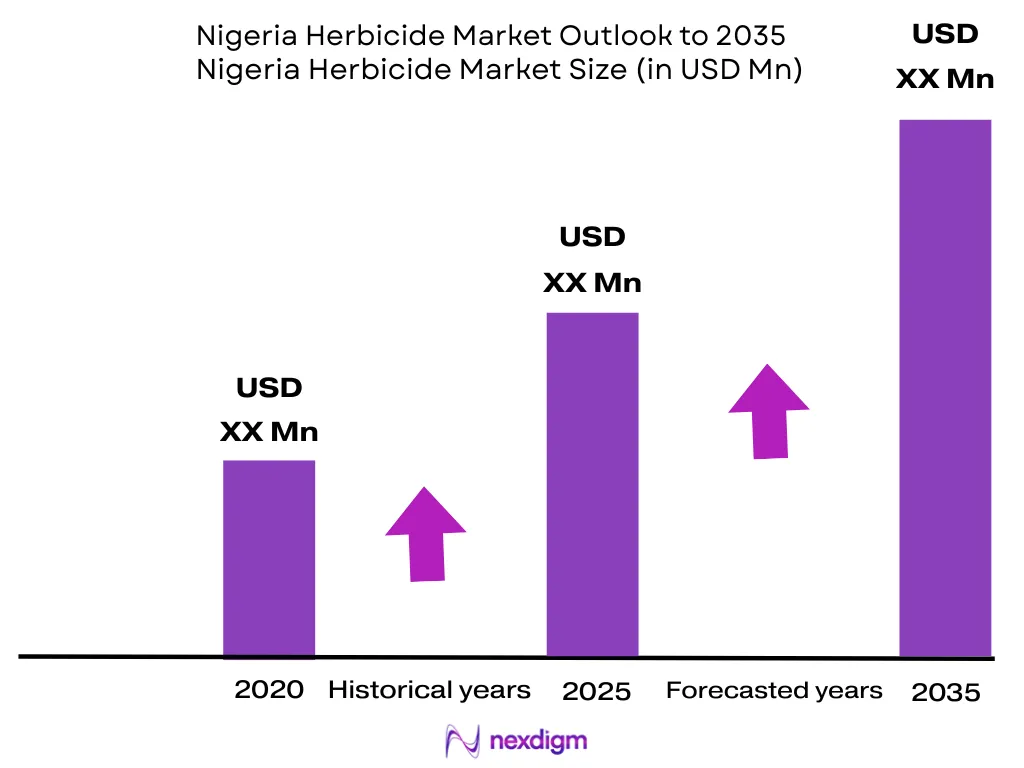
The Nigeria Herbicide Market is expected to grow at a forecasted CAGR of 5.4% during 2026-2035, using the Nigeria-specific herbicide growth benchmark as the baseline. Growth will be supported by staple-crop intensification, labour substitution, cassava weed-management programmes, agro-dealer expansion and gradual adoption of crop-specific herbicide protocols. Over the next decade, Nigeria’s herbicide demand will be shaped by cassava, maize and rice systems. Cassava will remain important because weed pressure is high during early crop establishment, and manual weeding is labour-intensive. Maize and rice will support demand for pre-emergence and post-emergence products, particularly in North West, North Central and irrigated rice clusters. The market will also shift gradually from generic land-clearing products toward crop-specific programmes. Selective cassava herbicides, rice herbicide sequences, maize residual products and smallholder-compatible pack sizes are expected to gain relevance as farmers seek better weed control with lower crop-injury risk. Agro-dealers will remain central to product recommendation, replenishment and farmer adoption.
Major Players
- Saro AgroSciences Limited
- Harvestfield Industries Limited
- Jubaili Agrotec Nigeria
- WACOT Limited
- Syngenta Nigeria
- BASF Nigeria
- UPL Nigeria
- Bayer CropScience Nigeria
- Corteva Agriscience Nigeria
- FMC Nigeria
- Cormart Nigeria Limited
- Dizengoff Nigeria
- Springfield Agro Limited
- Greenlife Crop Protection Africa
- Global Alliance for Chemical Industries
Key Target Audience
- Herbicide manufacturers
- Agrochemical importers and distributors
- Local pesticide formulators
- Agro-dealer and agricultural input retail networks
- Cassava, maize and rice outgrower scheme operators
- Investments and venture capitalist firms
- Government and regulatory bodies — National Agency for Food and Drug Administration and Control, Federal Ministry of Agriculture and Food Security, National Agricultural Extension and Research Liaison Services
- Spray-service providers and mechanised application operators
Research Methodology
Step 1: Identification of Key Variables
The initial phase involves constructing an ecosystem map of the Nigeria Herbicide Market, covering importers, formulators, agro-dealers, distributors, crop aggregators, smallholder farmers and regulatory agencies. Key variables include crop treated area, herbicide type, active ingredient, pack size, crop fit, application timing, agro-dealer reach and NAFDAC registration status.
Step 2: Market Analysis and Construction
In this phase, historical herbicide revenue data, pesticide registration sources, crop production indicators, import-led supply patterns and company portfolios are compiled. The market is constructed through top-down herbicide-market references and bottom-up validation across cassava, maize, rice, yam, oil palm, cocoa, vegetables and non-crop applications.
Step 3: Hypothesis Validation and Expert Consultation
Market hypotheses are validated through structured interviews with agrochemical importers, local formulators, distributors, agro-dealers, cassava growers, maize farmers, rice farmers, plantation managers and spray-service operators. These consultations help verify product movement, farmer adoption, counterfeit risks, crop-wise herbicide intensity and regional sales seasonality.
Step 4: Research Synthesis and Final Output
The final phase integrates desk research, regulatory review and field-level validation into a final market model. Segment shares are refined through triangulation of crop volumes, agro-dealer feedback, herbicide application windows, product registration status, farmer purchasing behaviour and regional crop concentration across Nigeria.

- Executive Summary
- Research Methodology (Market Definitions and Assumptions, Abbreviations, Active Ingredient Mapping, Crop-Wise Treated Area, Smallholder Adoption Modelling, Agro-Dealer Sell-Out Checks, Importer and Distributor Validation, NAFDAC Product Registration Screening, Farmer-Level Usage Interviews, Bottom-Up SKU Build-Up, Top-Down Crop Protection Allocation, Limitations and Future Conclusions)

- Definition and Scope
- Market Genesis
- Evolution of Herbicide Adoption
- Business Cycle
- Supply Chain and Value Chain Analysis

- Growth Drivers (Smallholder Labour Shortage, Cassava Weed Management, Maize and Rice Expansion, Manual Weeding Substitution, Agro-Dealer Penetration, Mechanised Spraying, Outgrower Schemes, Food Security Programmes)
- Market Challenges (Counterfeit Agrochemicals, Unregistered Products, Safety Risk, Low Farmer Training, Currency Volatility, Import Dependence, Agro-Dealer Fragmentation, Paraquat Scrutiny, Spray Equipment Gaps)
- Opportunities (Cassava Herbicide Scaling, Rice-Specific Herbicide Programs, Smallholder Pack Innovation, Spray-Service Models, Bio-Based Herbicides, Digital Agro-Dealer Platforms, Counterfeit-Proof Packaging, Cooperative Procurement)
- Market Trends (Glyphosate Dominance, Paraquat Safety Scrutiny, Cassava-Specific Herbicide Adoption, Ready-Mix Products, Agro-Dealer Digitalisation, Small Pack Growth, Stewardship Campaigns, Local Formulation Interest)
- SWOT Analysis
- Porter’s Five Forces

- By Value (2020-2025)
- By Volume (2020-2025)
- By Average Realisation (2020-2025)

- By Herbicide Type (In Value %)
Selective Herbicides
Non-Selective Herbicides
Pre-Emergence Herbicides
Post-Emergence Herbicides
Contact Herbicides - By Crop Type (In Value %)
Cassava
Maize
Rice
Yam
Cowpea and Soybean - By Sales Channel (In Value %)
Importer-Distributor
Agro-Dealer Retail
Agricultural Input Wholesaler
Cooperative Procurement
Outgrower Scheme Procurement - By Region (In Value %)
North West
North Central
North East
South West

- Market Share of Major Players on the Basis of Value and Volume
- Cross Comparison Parameters (NAFDAC Registered Herbicide Portfolio, Cassava Herbicide Strength, Maize and Rice Product Depth, Glyphosate and Paraquat Portfolio, Agro-Dealer Network Reach, Local Formulation and Warehousing Capability, Smallholder Pack Strategy, Farmer Stewardship and Anti-Counterfeit Support)
- SWOT Analysis of Major Players
- Detailed Profiles of Major Companies
Saro AgroSciences Limited
Harvestfield Industries Limited
Jubaili Agrotec Nigeria
WACOT Limited
Syngenta Nigeria
BASF Nigeria
UPL Nigeria
Bayer CropScience Nigeria
Corteva Agriscience Nigeria
FMC Nigeria
Cormart Nigeria Limited
Dizengoff Nigeria
Springfield Agro Limited
Greenlife Crop Protection Africa
Global Alliance for Chemical Industries

- Market Demand and Utilisation
- Purchasing Power and Budget Allocation
- Regulatory and Compliance Requirements
- Needs, Desires and Pain Point Analysis
- Decision-Making Process

- By Value (2026-2035)
- By Volume (2026-2035)
- By Average Realisation (2026-2035)


 Request a Sample
 Ask for Customization
 Get a Quote
 Enquire Now