
 Download PDF
Market Overview
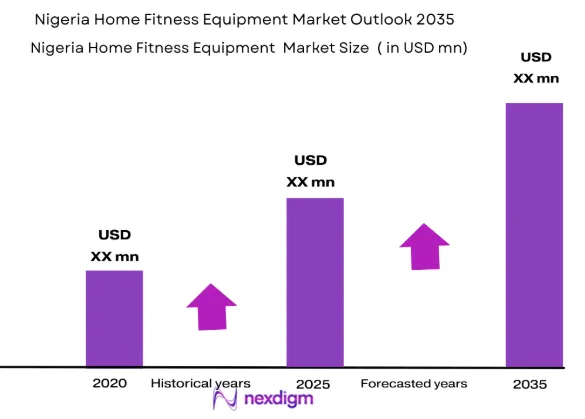
The Nigeria Home Fitness Equipment Market is valued at USD ~ million, supported by a robust growth trajectory due to increasing health consciousness, especially in urban areas. With rising disposable incomes and an expanding middle class, home fitness equipment adoption is witnessing notable momentum. The market growth is driven by technological advancements in fitness devices, such as smart fitness equipment that integrates with apps for personalized health tracking. In addition, the increasing closure of gyms due to the COVID-19 pandemic accelerated the demand for in-home workout solutions, particularly in metropolitan regions.
The dominant cities in Nigeria’s home fitness equipment market include Lagos, Abuja, and Port Harcourt. Lagos, with its status as Nigeria’s commercial hub, leads in market demand, driven by its urban population’s increasing health awareness and high disposable income levels. Abuja, the political capital, follows suit with its growing middle class and corporate wellness initiatives. Port Harcourt, being an oil city, has an affluent demographic that values fitness and wellness. These cities dominate due to urbanization, an increasing focus on wellness, and greater purchasing power.
Market Segmentation
By Equipment Type
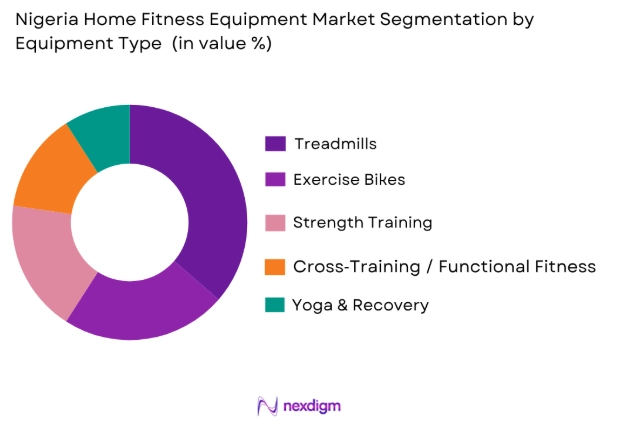
Nigeria’s home fitness equipment market is segmented by equipment type into treadmills, exercise bikes, strength training equipment, cross-training machines, and yoga & recovery equipment. The treadmill segment holds a dominant market share, primarily driven by its wide appeal among fitness enthusiasts looking for cardio workouts at home. The popularity of treadmills is further enhanced by the growing number of online fitness programs, which offer users a variety of guided running and walking sessions. In 2024, treadmills account for nearly 40% of the market share, as they remain an essential piece of home fitness equipment, especially in urban households focused on cardiovascular health.
By Distribution Channel
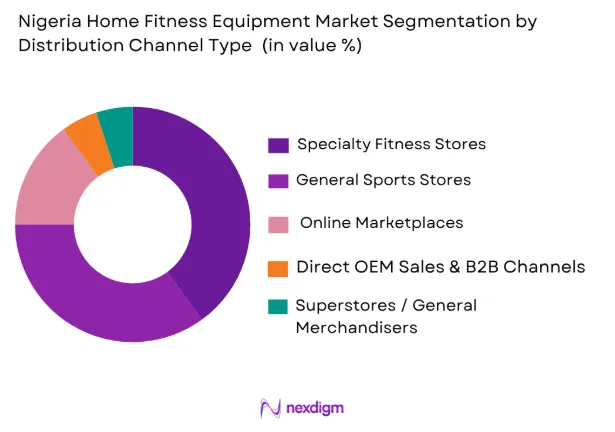
The home fitness equipment market in Nigeria is also segmented by distribution channel into specialty fitness stores, general sports stores, online marketplaces, superstores, and direct OEM sales. The online marketplace segment is the largest contributor to market share, as it caters to the growing preference for e-commerce and home delivery services. The ease of comparison, product reviews, and convenience offered by platforms such as Jumia and Konga contribute significantly to the increasing online sales. The online marketplace holds a market share of about 35% in 2024, reflecting a shift in consumer purchasing habits.
Competitive Landscape
The Nigeria Home Fitness Equipment Market is highly competitive, with a mix of both local and international players. Key players in the market include Icon Health & Fitness (NordicTrack), Life Fitness, ProForm, Technogym, and Johnson Health Tech. These companies dominate the market with their diverse product portfolios and strong distribution networks. While international brands leverage technology and innovation to drive consumer preference, local players have an advantage in terms of price sensitivity and catering to the specific needs of Nigerian consumers.
| Company | Establishment Year | Headquarters | Product Portfolio | Distribution Channels | Technology Integration | Consumer Loyalty |
| Icon Health & Fitness | 1977 | USA | ~ | ~ | ~ | ~ |
| Life Fitness | 1968 | USA | ~ | ~ | ~ | ~ |
| ProForm | 1977 | USA | ~ | ~ | ~ | ~ |
| Technogym | 1983 | Italy | ~ | ~ | ~ | ~ |
| Johnson Health Tech | 1975 | Taiwan | ~ | ~ | ~ | ~ |
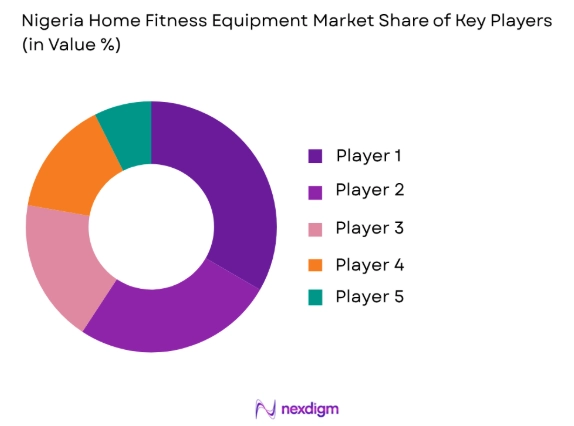
Nigeria Home Fitness Equipment Market Analysis
Growth Drivers
Rising Health Awareness & Lifestyle Shift
As health awareness increases globally, individuals are adopting healthier lifestyles, contributing to a surge in fitness-related activities. According to the World Health Organization (WHO), physical inactivity is one of the leading risk factors for non-communicable diseases, which has led to a growing emphasis on fitness as part of preventative health. As of 2023, the global obesity rate stands at approximately 2.8 billion people, a number that continues to grow as urbanization accelerates. Governments and health organizations are pushing for more active lifestyles, with many nations implementing policies to combat sedentary behavior. In India, for example, the National Health Profile 2022 reported that nearly 70% of urban youth are becoming increasingly aware of their health, directly influencing the growth of fitness trends. By 2025, health initiatives, including fitness programs and gym memberships, are expected to grow, aligning with the increasing focus on fitness for disease prevention.
Urbanization & Affluence Growth
Urbanization continues to drive the fitness market as more people in developing countries move to cities, increasing disposable income and access to fitness services. The United Nations estimates that urban populations will increase by 1.4 billion people between 2020 and 2030. With higher income levels, urban consumers are spending more on personal wellness, with increased expenditure on gym memberships, health supplements, and fitness equipment. According to the World Bank, GDP per capita in urban areas globally is projected to grow by 2.6% in 2024, supporting the demand for wellness and fitness products. In China, urban incomes have seen significant increases, rising by over 10% annually in cities such as Beijing and Shanghai. As affluence grows, fitness services, including boutique fitness studios and gyms, are becoming more accessible and popular in urban centers, driving the adoption of a healthier lifestyle.
Challenges
High Cost of Fitness Equipment
The high cost of fitness equipment remains a significant barrier to broader adoption of home fitness solutions. Fitness equipment, especially high-end machines such as treadmills, elliptical machines, and strength training machines, can cost thousands of dollars, making it difficult for the average consumer to invest in them. The global supply chain disruptions, exacerbated by the COVID-19 pandemic, have led to increased costs for raw materials, which in turn has inflated the prices of fitness equipment. According to a 2023 report from the U.S. Bureau of Labor Statistics, inflation in the U.S. alone led to a 6% increase in the price of consumer electronics and fitness equipment in 2022. This makes fitness solutions less affordable for lower and middle-income households, limiting market expansion in certain segments. As of 2024, the cost of premium fitness equipment remains a substantial obstacle to greater market penetration.
Limited Consumer Awareness and Education
A significant challenge in the fitness market is the lack of consumer education, which can hinder people from fully understanding the benefits of regular exercise and how to use fitness products effectively. A report by the U.S. Department of Health and Human Services in 2022 highlighted that nearly 40% of the adult population in the U.S. did not meet the recommended levels of physical activity, largely due to misconceptions about the intensity and duration of exercise needed for health benefits. This gap in consumer knowledge directly impacts the demand for fitness equipment and services. Additionally, in many developing nations, the fitness culture is still emerging, and lack of awareness about the importance of physical fitness is prevalent. In these regions, governments and fitness companies are increasingly focusing on educational campaigns to address these issues and promote active lifestyles.
Opportunities
OEM Partnerships with Fitness Apps
Original Equipment Manufacturers (OEMs) partnering with fitness apps present a significant opportunity for growth in the fitness market. Fitness apps are increasingly being integrated into connected fitness devices, allowing users to track their health and performance metrics seamlessly. As of 2023, the global number of mobile health app users was estimated at over 5.5 billion, with numbers continuing to rise in 2024. According to the International Telecommunication Union (ITU), mobile network penetration is at 90% globally, which creates an opportunity for fitness equipment manufacturers to work with fitness app developers. In North America and Europe, OEMs have begun integrating their devices with popular apps such as Strava, Peloton, and Fitbit, enhancing the overall customer experience. These partnerships offer a robust pathway to reach a broader audience, especially as mobile apps are becoming a key part of fitness regimens across various demographics.
Local Assembly and Value Chain Localization
In response to the increasing demand for fitness equipment, many companies are focusing on local assembly and value chain localization to reduce costs and improve supply chain efficiency. For instance, the U.S. has seen a rise in local manufacturing and assembly of fitness products, as companies seek to mitigate the impact of global shipping disruptions. A report by the U.S. Department of Commerce in 2023 showed that local manufacturing in the fitness sector increased by 12% in 2022, and this trend is expected to continue in 2024. This localization strategy not only reduces production and shipping costs but also creates jobs in the local economies, contributing to the growth of the fitness market. Additionally, governments are offering incentives for businesses to invest in local manufacturing, further driving the trend.
Future Outlook
Over the next six years, Nigeria’s home fitness equipment market is expected to continue its upward trajectory, driven by growing consumer demand for health-conscious living, greater penetration of e-commerce platforms, and increasing urbanization. With advancements in fitness technologies and a rise in the adoption of connected fitness devices, the market will witness robust growth. The rise of corporate wellness programs and individual fitness goals further fuels demand for home fitness solutions. The anticipated market growth is also supported by the expansion of local manufacturing capabilities and improving economic conditions.
Major Players
- Icon Health & Fitness
- Life Fitness
- ProForm
- Technogym
- Johnson Health Tech
- Decathlon Nigeria
- BougeRV
- Jumia Fitness
- GymMaster Nigeria
- XTERRA Fitness
- Sunny Health & Fitness
- Schwinn Fitness
- Body Solid
- Hammer Strength
- NordicTrack
Key Target Audience
- Investments and Venture Capitalist Firms
- Government and Regulatory Bodies
- Fitness Equipment Distributors
- Retail Chains and Superstores
- Fitness Equipment OEMs
- Corporate Wellness Programs Managers
- Technology Integrators and App Developers
- Consumer Product Retailers
Research Methodology
Step 1: Identification of Key Variables
The first step involves identifying all crucial factors influencing the Nigeria Home Fitness Equipment Market, such as consumer trends, technological innovations, and retail distribution strategies. This process includes gathering historical data from proprietary databases and secondary research sources to establish baseline trends in market behavior.
Step 2: Market Analysis and Construction
In this phase, comprehensive data is gathered and analyzed, including market penetration, growth rates, and the competitive landscape. We assess the role of key players, distribution channels, and technology integration. The construction of the market forecast includes both top-down and bottom-up approaches to enhance accuracy.
Step 3: Hypothesis Validation and Expert Consultation
Market assumptions are validated through expert interviews and consultations with industry stakeholders, including fitness equipment manufacturers, distributors, and app developers. These discussions provide valuable insights to refine our data and strengthen market predictions.
Step 4: Research Synthesis and Final Output
The final phase involves synthesizing all the research findings, cross-referencing them with industry benchmarks, and engaging directly with major manufacturers. This final output ensures the research accurately represents the current state and future projections of the market, supported by expert validations.

- Executive Summary
- Research Methodology (Market Definitions and Standard Terminology, Assumptions and Base Year, Data Collection Framework, Primary vs. Secondary Data Matrix, Sampling Approach, Market Estimation & Sizing Models, Quality Assurance & Validation, Limitations and Areas for Future Enhancement)

- Definition and Scope
- Overview Genesis and Industry Context
- Market Maturity and Adoption Curve
- Product & Service Value Chain
- Distribution Channel Architecture
- Consumer Adoption Life Cycle

- Growth Drivers
Rising Health Awareness & Lifestyle Shift
Urbanization & Affluence Growth
Increasing Gym Closures During Pandemic and Shift to Home Fitness
Fitness Ecosystem Adoption - Challenges
High Cost of Fitness Equipment
Limited Consumer Awareness and Education
Logistical and Distribution Challenges
Economic Instability and Low Disposable Income - Opportunities
OEM Partnerships with Fitness Apps
Local Assembly and Value Chain Localization
Expansion of Financing & Rental Models - Market Trends
Connected Fitness Subscription Bundling
Fitness Data Analytics and Performance Tracking
Lease & Rental Channels Growth - Government Regulations
- SWOT Analysis of Key Competitors
- Porter’s Five Forces

- By Value, 2020-2025
- By Units Sold, 2020-2025
- By Average Selling Price, 2020-2025

- By Equipment Type (In Value % )
Treadmills
Exercise Bikes
Strength Training
Cross‑Training / Functional Fitness
Yoga & Recovery - By Technology Integration (In Value % )
Connected / Smart
Sensor‑Driven / AI‑Assisted Feedback
Virtual / Immersive Fitness Platforms - By Price Tier (In Value % )
Economy / Value Tier
Mid‑Tier
Premium / Pro‑Level - By Distribution Channel (In Value % )
Specialty Fitness Stores
General Sports Stores
Online Marketplaces
Superstores / General Merchandisers
Direct OEM Sales & B2B Channels - By End User (In Value % )
Individual Consumers
Household Buyers
Corporate Wellness Programs
Fitness Coaches & Trainers - By Geography (In Value % )
North Nigeria
South West Nigeria
South East Nigeria
Central Nigeria

- Market Share by Value / Units
- Best Practice Benchmarking
- Cross‑Comparison Parameters(Company Overview, Product Portfolio Breadth, Technology Integration Level, Retail Channel Presence, Geographic Footprint, Pricing Strategy and Tier Positioning After‑Sales & Service Network, Brand Equity / Consumer Preference Scores)
- SWOT Analysis of Major Players
- Pricing Analysis for Key Competitors in the Market
- Company Profiles of Major Competitors
Icon Health & Fitness / NordicTrack
Life Fitness / Precor
Johnson Health Tech
Technogym
ProForm
Decathlon Nigeria
BougeRV
Jumia Fitness
GymMaster Nigeria
Capital Sports
XTERRA Fitness
Sunny Health & Fitness Schwinn Fitness
Body Solid
Hammer Strength

- Personal fitness equipment for self-use
- Family-driven fitness equipment investments
- Employee health initiatives and benefits
- Professional trainers using fitness equipment
- High-income consumers investing in luxury

- By Value, 2026-2035
- By Units Sold, 2026-2035
- By Average Selling Price, 2026-2035


 Request a Sample
 Ask for Customization
 Get a Quote
 Enquire Now