

 Download PDF
Market Overview
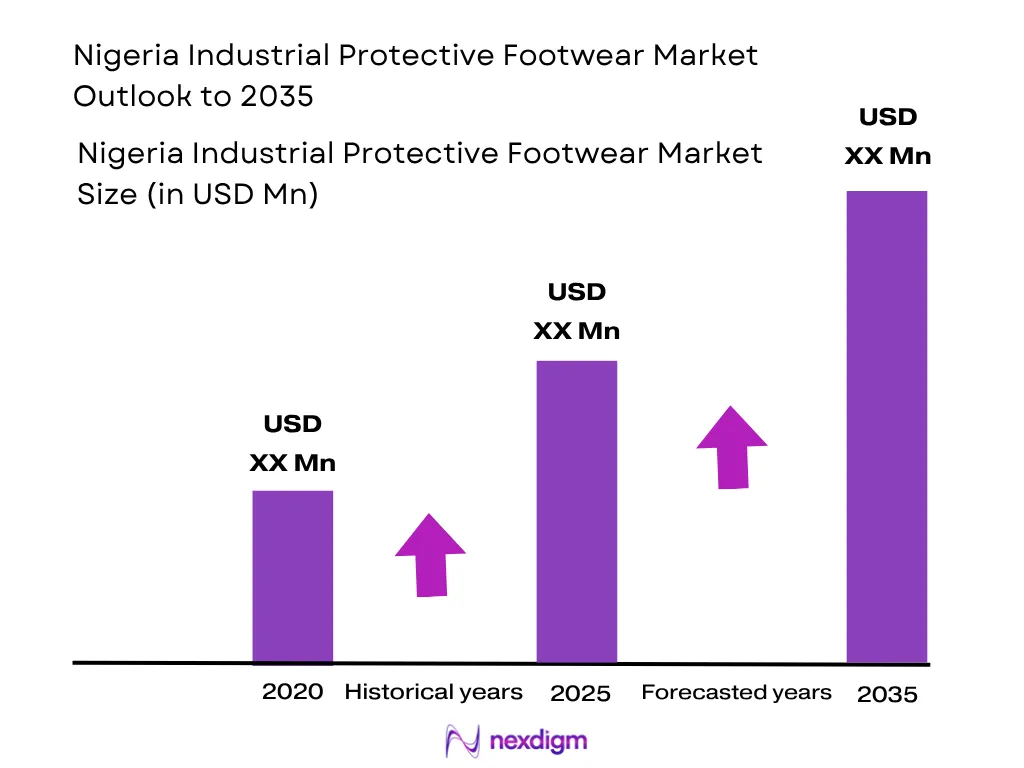
The Nigeria Industrial Protective Footwear Market is valued at USD ~ million, based on published market commentary that identifies safety footwear as a major Nigerian footwear sub-segment. The broader Nigerian footwear market is valued at USD ~ billion, while Yikodeen, a local safety-footwear manufacturer, received USD ~ million growth investment to scale production. Demand is driven by construction, oil & gas, manufacturing and workplace safety compliance, with Nigeria’s oil and condensate output rising from 552.8 million barrels to 578.5 million barrels across the latest two reported annual NUPRC datasets.
Lagos, Ogun, Rivers, Delta, Bayelsa and Akwa Ibom dominate demand because they concentrate Nigeria’s industrial employment, ports, construction projects, manufacturing estates and oil-field operations. Lagos recorded NGN ~ billion IGR in the earlier NBS state revenue dataset, while Lagos GDP was projected at NGN ~ trillion in the latest state economic update. Delta, Akwa Ibom, Bayelsa and Rivers produced 99.90 million, 60.32 million, 53.28 million and 50.84 million barrels of crude oil and condensate respectively across the cited NUPRC-based state production window, supporting demand for rig boots, S3 boots and oil-resistant soles.
Market Segmentation
By Product Type
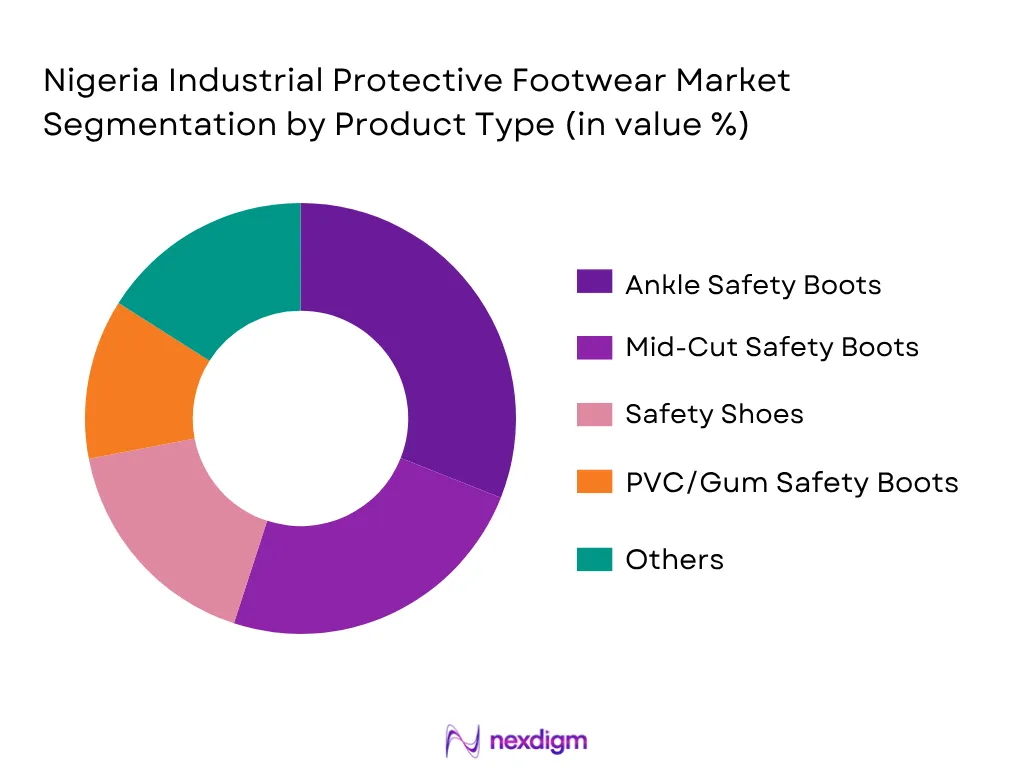
Nigeria Industrial Protective Footwear Market is segmented by product type into safety shoes, ankle safety boots, mid-cut safety boots, high-leg or rig boots, PVC/gum boots and chemical/electrical hazard boots. Recently, steel-toe ankle and mid-cut safety boots hold the dominant market share under this segmentation due to their fit across construction, manufacturing, facility maintenance, oil-servicing yards and logistics operations. These boots are more versatile than rig boots, less expensive than premium chemical-resistant footwear and more acceptable for daily industrial use in hot Nigerian worksites. Their usage is reinforced by employer obligations under the Factories Act, which requires suitable protective clothing and footwear where workers face injurious, wet or offensive substances.
By End-Use Industry
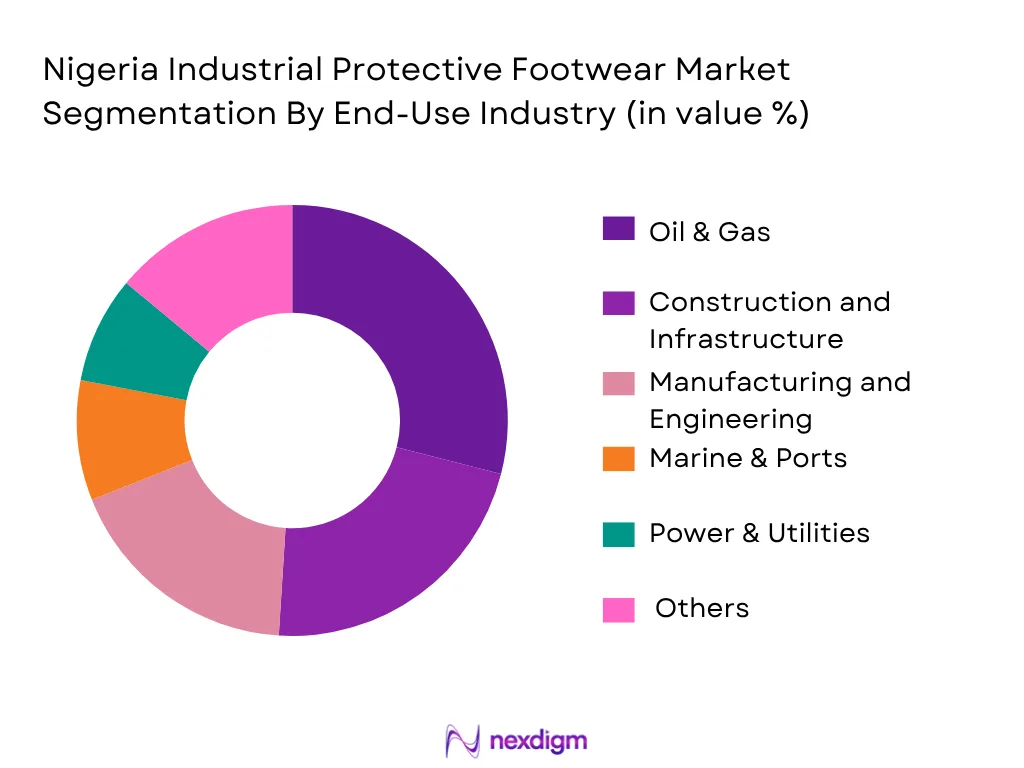
Nigeria Industrial Protective Footwear Market is segmented by end-use industry into oil & gas, construction, manufacturing, power & utilities, mining & quarrying, marine & ports, logistics & warehousing and agriculture/agro-processing. Recently, oil & gas dominates the market because upstream, midstream, refinery, marine-support and contractor operations require high-specification footwear such as rig boots, slip-resistant soles, oil-resistant soles, heat-resistant outsoles and chemical-resistant boots. Nigeria remains a major African oil producer, with NUPRC reporting total crude oil and condensate output of 578.5 million barrels in the latest annual report. Construction and manufacturing follow because large industrial employers increasingly standardize PPE issuance through HSE budgets, while informal sites still rely on lower-cost dealer purchases.
Competitive Landscape
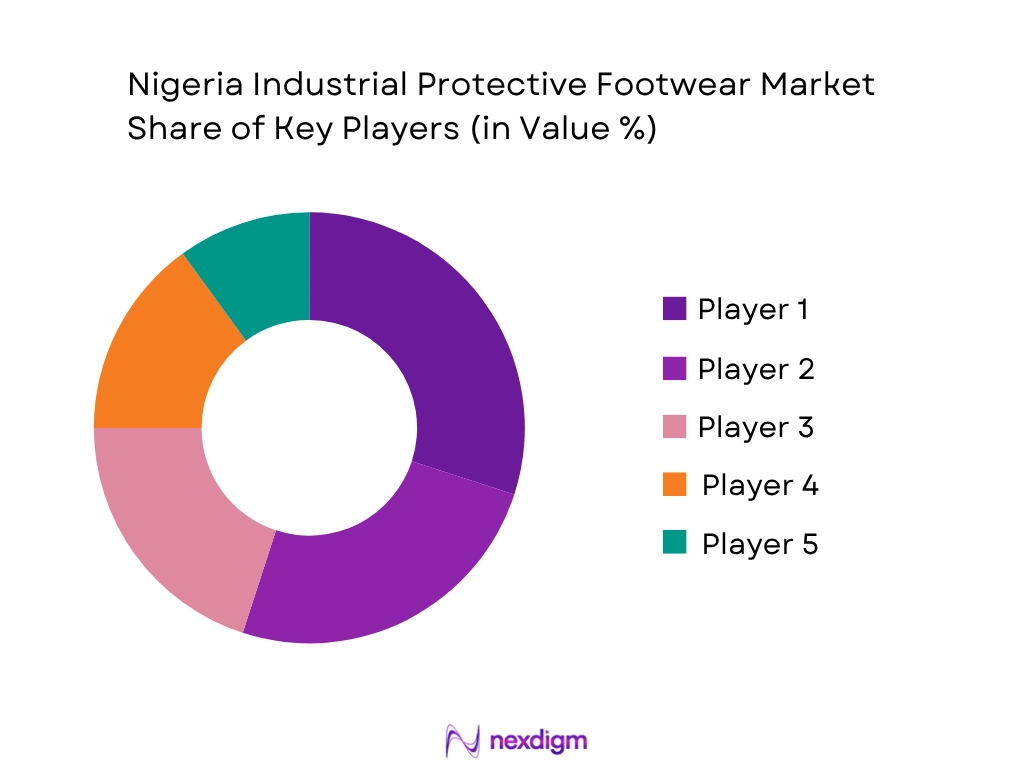
The Nigeria Industrial Protective Footwear Market is fragmented but strategically concentrated around a small group of local manufacturers, industrial PPE distributors and international safety-footwear brands. Yikodeen is the most visible local manufacturing player, while Safety Jogger, Red Wing and uvex compete through importers and distributors. Industrial distribution platforms such as GZ Industrial Supplies and Industries Safety Nigeria influence brand visibility, product availability and project-based procurement across Lagos, Port Harcourt, Abuja and industrial corridors.
| Company | Establishment Year | Headquarters | Market Role | Key Footwear Range | Target Industries | Certification/Positioning | Nigeria Route-to-Market | Market-Specific Strength |
| Yikodeen Company Limited | 2016 | Lagos, Nigeria | ~ | ~ | ~ | ~ | ~ | ~ |
| GZ Industrial Supplies Nigeria | Not publicly specified | Lagos, Nigeria | ~ | ~ | ~ | ~ | ~ | ~ |
| Industries Safety Nigeria Limited | 2000 | Lagos, Nigeria | ~ | ~ | ~ | ~ | ~ | ~ |
| Safety Jogger | 2000 | Belgium | ~ | ~ | ~ | ~ | ~ | ~ |
| Red Wing Shoes | 1905 | Red Wing, Minnesota, USA | ~ | ~ | ~ | ~ | ~ | ~ |
Nigeria Industrial Protective Footwear Market Analysis
Growth Drivers
Workplace Safety Compliance
Workplace safety compliance is a direct demand driver for the Nigeria Industrial Protective Footwear Market because protective footwear is not discretionary in factories, ports, fabrication yards, oil-service bases, construction sites and processing plants where workers face wet floors, falling objects, sharp materials, chemicals, heat and machinery hazards. Nigeria’s working-age industrial exposure is large: the World Bank reports Nigeria’s GDP at USD 252.26 billion, GDP per capita at USD 1,084.2, inflation at 33.2, and real GDP growth at 4.1 in the latest available macro dataset, creating a large but cost-sensitive employer base that must still procure safety footwear for compliant operations. The National Bureau of Statistics reported labour-force participation at 79.5 and employment-to-population ratio at 76.1 in the latest labour-force release, while informal employment remained at 93, which matters because formal employers, registered factories and large contractors become the main structured buyers for certified steel-toe boots, S1P/S3 footwear, PVC gumboots and slip-resistant safety shoes. NSITF also reported 5,592 occupational safety and health activities across workplaces in a one-year safety programme, reflecting active institutional attention to workplace-risk prevention. For protective footwear suppliers, this means demand is strongest where buyers need auditable PPE issuance records, site induction compliance, injury-prevention controls and documentation for HSE inspections. The market impact is specific: certified footwear gains relevance where procurement teams must prove that workers received suitable boots before entering production floors, oil installations, warehouses, terminals and construction sites.
Oil & Gas Rig Operations
Oil & gas rig operations are a major growth driver for the Nigeria Industrial Protective Footwear Market because upstream and support operations require footwear with oil-resistant soles, anti-slip outsoles, high-leg protection, heat resistance, chemical resistance and puncture protection. The Nigerian Upstream Petroleum Regulatory Commission reports that hydrocarbons are extracted from 323 developed fields across onshore and offshore terrains, connected to 265 production processing stations and 31 export terminals. This operating footprint creates recurring demand for rig boots, S3 boots, gumboots and specialist protective footwear for drilling crews, maintenance contractors, marine-support workers, pipeline teams and terminal workers. NUPRC also reported total crude oil and condensate production of 578,521,740 barrels, including 482,819,991 barrels of crude oil and 95,701,748 barrels of condensate, with average daily liquid output of 1,580,369 barrels per day. The IMF stated that Nigeria’s growth acceleration was driven mainly by increased hydrocarbon output and vibrant services, reinforcing the link between oil-sector activity and industrial support services. For footwear suppliers, the implication is practical: rig activity increases boot replacement needs because soles degrade faster under hydrocarbon exposure, wet decks, mud, heat, metal surfaces and chemical spills. Corporate oil and gas buyers also tend to specify safety classes, sole grip, water resistance and durability more tightly than informal construction buyers, making the segment more attractive for certified and premium industrial protective footwear.
Market Challenges
Counterfeit Boots
Counterfeit boots remain a market-specific challenge because industrial protective footwear only creates safety value when the toe cap, outsole, midsole, upper material and sole bonding meet the promised specification. In Nigeria, the issue is amplified by a large trade economy and cost pressure. The World Bank reports inflation at 33.2 in the latest Nigeria macro dataset, while GDP per capita stands at USD 1,084.2, creating procurement pressure among SMEs, informal contractors and individual workers to select cheaper boots even when certification is unclear. The Standards Organisation of Nigeria introduced a Product Authentication Mark in 2024 to help verify product source and quality, showing that substandard-product control is a live regulatory issue. The challenge is especially acute for safety footwear because counterfeit steel-toe or fake S3/S5-labelled boots may appear visually acceptable but fail under compression, puncture, oil exposure or slip conditions. The Nigeria Industrial Protective Footwear Market is therefore affected in two ways: genuine brands lose trust and volume to fake alternatives, while end users may experience higher injury risk despite appearing PPE-compliant on paper. NSITF’s report of 5,592 workplace safety and health activities also underlines the enforcement environment that pushes employers to procure PPE, but counterfeit products weaken the effectiveness of that compliance spend. For legitimate suppliers, the strategic response is traceable distribution, certification documentation, batch verification, branded packaging controls and direct B2B supply to HSE-led procurement teams. Sources: World Bank Nigeria Data; SON Product Authentication Mark report; NSITF safety activity report.
Low-Cost Imports
Low-cost imports are a structural challenge for Nigeria Industrial Protective Footwear Market because they intensify price competition against local manufacturers and certified premium brands. World Integrated Trade Solution data, based on UN Comtrade, shows Nigeria imported 23,035 pairs of footwear under HS 640391 from the world, with China supplying 17,991 pairs, Italy 2,699 pairs, the United Arab Emirates 899 pairs, Bangladesh 592 pairs and the United States 337 pairs in the latest available trade year. The same dataset records import value of USD 1,077.99 thousand for this leather-upper, rubber/plastic-sole footwear category, with China alone accounting for USD 841.96 thousand. NBS foreign-trade data also shows total imports at ₦16,590.51 billion in the latest fourth-quarter goods-trade release, highlighting Nigeria’s dependence on imported goods across categories. For industrial protective footwear, the market-specific problem is not imports themselves but the mix of low-cost, inconsistent-quality, uncertified or poorly documented products entering dealer channels. These products compete aggressively with S1P, S3, S5, SRC and EH-certified footwear, especially among construction subcontractors, informal factory buyers and individual workers. The result is margin pressure, reduced willingness to pay for certified boots, and difficulty for local manufacturers to scale unless buyers prioritize durability, compliance and after-sales traceability.
Opportunities
Local Production
Local production is a strong opportunity in the Nigeria Industrial Protective Footwear Market because industrial buyers need reliable supply, faster replenishment and footwear adapted to Nigerian worksite conditions. The macro case is supported by Nigeria’s industrial base: UN national-accounts data reports manufacturing gross value added of ₦32,276,309,138,446 and construction gross value added of ₦16,292,348,590,261 in the latest Nigeria dataset, both of which represent large user bases for safety boots, gumboots and puncture-resistant footwear. World Bank data also shows Nigeria’s GDP at USD 252.26 billion and GDP growth at 4.1, creating a large operating environment for domestic industrial supply chains. On the demand side, NUPRC’s 323 developed hydrocarbon fields, 265 production processing stations and 31 export terminals create repetitive institutional requirements for rig boots and safety footwear. Local manufacturing can serve these buyers better when import clearance delays, currency volatility and distributor stockouts affect imported SKUs. The opportunity is not just import substitution; it is specification alignment. Nigerian-made protective boots can be designed around heat, mud, oil exposure, long shifts, rough terrain and affordability, while still targeting steel-toe, anti-slip, anti-puncture and oil-resistant requirements. Local producers can also compete for corporate and government-linked tenders by offering shorter lead times, local after-sales support, batch consistency and better replacement-cycle planning for large industrial employers.
Corporate Tender Programs
Corporate tender programs are a forward-looking opportunity for the Nigeria Industrial Protective Footwear Market because large buyers increasingly procure PPE through vendor registration, technical specifications, bulk delivery schedules and HSE documentation. The opportunity is supported by Nigeria’s capital-project and industrial activity base. The Federal Government budget analysis records capital expenditure of ₦9.99 trillion in the latest approved budget structure, while a later budget speech places capital expenditure at ₦26.08 trillion in the current fiscal framework, indicating continued public-project activity that can translate into contractor PPE demand. NUPRC reports 578,521,740 barrels of crude oil and condensate production and 2.511 TCF of associated and non-associated gas production, supporting tender demand from oil and gas operators, servicing companies, terminal operators and EPC contractors. NBS GDP reporting also shows construction and manufacturing as continuing contributors to real activity, with Q4 construction growth and manufacturing growth reported in the official GDP release. For footwear suppliers, tender programs create an opportunity to move beyond walk-in dealer sales into recurring B2B contracts for steel-toe boots, S3 boots, PVC gumboots, electrical hazard boots and high-leg rig boots. Winning these programs requires product certification, sample testing, proof of stock, delivery reliability, multi-location logistics, warranty handling and clear SKU documentation. This favours organized manufacturers, authorized distributors and brands that can support compliance-heavy procurement rather than opportunistic low-cost import trading.
Future Outlook
The Nigeria Industrial Protective Footwear Market is expected to expand steadily as employers formalize PPE procurement, industrial buyers shift from generic low-cost boots to certified footwear and local manufacturing gains policy and investor support. The forecasted CAGR for the period is positioned at 5.5%, benchmarked to the published Nigeria protective footwear growth outlook. Growth will be supported by construction activity, oil & gas maintenance, port logistics, manufacturing recovery and the replacement cycle for worn-out boots. Over the long term, the market will move from price-led procurement to specification-led procurement. Steel-toe boots will remain volume leaders, but composite toe, S3, S5, SRC slip-resistant, EH, HRO and chemical-resistant boots will gain share among oil & gas contractors, power utilities, ports and heavy manufacturing. Local manufacturing will become more important as naira volatility, import clearance delays and bulk tender timelines push buyers toward shorter supply chains.
Major Players
- Yikodeen Company Limited
- Industries Safety Nigeria Limited
- GZ Industrial Supplies Nigeria
- Knoxx Equipment Nigeria
- Supprium Nigeria Limited
- Future Concerns Nigeria Limited
- Think Safety Limited
- Gibadi.com Limited
- Jash Supplies Nigeria
- Safety Jogger
- Red Wing Shoes
- Bata Industrials
- uvex Safety
- Vaultex
- Mallcom India Limited
Key Target Audience
- Industrial protective footwear manufacturers
- PPE importers and authorized distributors
- Oil & gas companies and EPC contractors
- Construction and infrastructure development companies
- Manufacturing companies and industrial plant operators
- Marine, ports and logistics operators
- Investments and venture capitalist firms
- Government and regulatory bodies, including Federal Ministry of Labour and Employment, Standards Organisation of Nigeria, Nigerian Upstream Petroleum Regulatory Commission, Nigerian Content Development and Monitoring Board, Nigerian Ports Authority and Lagos State Safety Commission
Research Methodology
Step 1: Identification of Key Variables
The initial phase involves constructing an ecosystem map covering safety footwear manufacturers, importers, PPE distributors, industrial buyers, oil & gas contractors, construction companies and regulatory stakeholders. Variables include product type, safety class, toe protection, sole construction, end-use industry, channel structure, import exposure, local production and replacement cycle.
Step 2: Market Analysis and Construction
The second phase compiles historical and current market indicators for Nigeria Industrial Protective Footwear Market. This includes evaluating published safety footwear market references, PPE demand drivers, oil & gas activity, construction activity, manufacturing demand and distributor-level product availability to construct the market model.
Step 3: Hypothesis Validation and Expert Consultation
Market hypotheses are validated through structured discussions with PPE suppliers, HSE managers, procurement teams, safety footwear dealers and industrial distributors. These consultations help verify product dominance, tender requirements, average selling prices, common safety standards, replacement frequency and buyer preferences across Nigeria’s industrial corridors.
Step 4: Research Synthesis and Final Output
The final phase synthesizes secondary research, supplier checks, product benchmarking, market sizing and expert validation. The output is refined through top-down and bottom-up triangulation, ensuring that segmentation, competitive positioning, market outlook and recommendations reflect practical procurement realities in Nigeria Industrial Protective Footwear Market.

- Executive Summary
- Research Methodology (Market Definitions and Assumptions, Product Inclusion and Exclusion, Industrial Protective Footwear Taxonomy, Primary Interviews with HSE Managers and PPE Distributors, Procurement Channel Mapping, Import-Local Supply Split, Dealer Checks, SKU Price Benchmarking, End-User Demand Validation, Top-Down Sizing, Bottom-Up Sizing, Data Triangulation, Limitations and Forecast Assumptions)

- Definition and Scope
- Overview Genesis
- Evolution of Industrial Safety Footwear Adoption in Nigeria
- Business Cycle
- Supply Chain and Value Chain Analysis
- Local Manufacturing vs Imported Footwear Structure
- Industrial PPE Procurement Flow
- Demand Concentration by Industrial Corridor
- Role of HSE Compliance in Safety Footwear Replacement
- Product Certification and Quality Significance

- Growth Drivers (Workplace Safety Compliance, Oil & Gas Rig Operations, Construction Site Expansion, Manufacturing Workforce Growth, Industrial Accident Prevention, Corporate HSE Audits)
- Market Challenges (Counterfeit Boots, Low-Cost Imports, FX Volatility, Weak Enforcement in Informal Sites, Comfort Issues in Humid Worksites)
- Opportunities (Local Production, Corporate Tender Programs, Safety Jogger/Red Wing/uvex Premiumization, Composite Toe Adoption, Female Safety Footwear, Digital B2B Procurement)
- Trends (EN ISO Certified Products, Lightweight Composite Toe, Anti-Slip SRC Soles, PU/PU Dual Density, Bulk Tendering, Online PPE Marketplaces)
- Government Regulation (Factories Act, Employer PPE Obligation, Nigerian Content Policies, Import Duties, SONCAP/Quality Compliance, HSE Site Audits)
- SWOT Analysis (Local Manufacturing Strength, Import Dependence Weakness, Industrial Workforce Opportunity, Counterfeit Product Threat)
- Stakeholder Ecosystem (Manufacturers, Importers, Distributors, HSE Consultants, EPC Contractors, IOCs, Government Agencies, Online Retailers)
- Porter’s Five Forces (Supplier Concentration, Buyer Tender Power, Import Competition, Counterfeit Substitution, Brand Rivalry)
- PESTLE Analysis (Industrial Policy, Naira Volatility, Safety Culture, E-Commerce, PPE Regulation, Waste and Material Sustainability)
- Supply Chain Risk Analysis (Leather, PU, Rubber, PVC, Toe Cap Imports, Port Clearance, Warehousing, Distributor Credit Cycles)
- Pricing and Margin Stack Analysis (Factory Gate, Import Landed Cost, Distributor Margin, Dealer Margin, Tender Discounting, VAT/Logistics)

- By Value (2020-2025)
- By Volume (2020-2025)
- By Average Selling Price (2020-2025)
- By Replacement Demand (2020-2025)
- By New Industrial Workforce Demand (2020-2025)
- By Imported vs Locally Manufactured Footwear (2020-2025)
- By Institutional Tender vs Retail/Dealer Sales (2020-2025)

- By Product Type (In Value%)
Safety Shoes
Ankle Safety Boots
Mid-Cut Safety Boots
High-Leg/Rig Boots
PVC/Gum Safety Boots
Chemical-Resistant Boots
Electrical Hazard Boots - By Toe Protection Type (In Value%)
Steel Toe Cap
Composite Toe Cap
Alloy Toe Cap
Soft Toe Industrial Footwear - By Safety Standard/Class (In Value%)
SB
S1
S1P
S2
S3
S5
SRC Slip Resistance
ESD/EH/HRO/WRU Certified Footwear - By Upper Material (In Value%)
Full-Grain Leather
Split Leather
Nubuck Leather
PVC
Rubber
PU-Coated Synthetic
Textile-Mesh Hybrid - By Sole Construction (In Value%)
PU Single Density
PU/PU Dual Density
PU/Rubber
Nitrile Rubber
PVC Sole
Anti-Puncture Midsole
Heat-Resistant Outsole - By End-Use Industry (In Value%)
Oil & Gas
Construction
Manufacturing
Power & Utilities
Mining & Quarrying
Marine & Ports
Logistics & Warehousing
Agriculture & Agro-Processing
Waste Management & Sanitation
Security & Defense - By Buyer Type (In Value%)
Large Enterprises
EPC Contractors
SMEs
Government Agencies
Facility Management Companies
Informal Contractors
Individual Workers - By Sales Channel (In Value%)
Direct Institutional Sales
Authorized PPE Distributors
Industrial Safety Stores
Online Marketplaces
Project Tenders
Dealer/Wholesale Markets
Brand-Owned Distribution - By Price Positioning (In Value%)
Economy Imported Boots
Mid-Market Certified Boots
Premium International Brands
Locally Manufactured Industrial Boots
Tender-Specific Bulk SKUs - By Region/Industrial Corridor (In Value%)
Lagos Industrial Axis
Rivers/Port Harcourt Oil & Gas Axis
Delta–Bayelsa–Akwa Ibom Niger Delta Axis
Ogun Manufacturing Belt
Abuja/North-Central Construction Axis
Kano–Kaduna Industrial Axis
Onne/Apapa/Tin Can Port Corridors

- Market Share of Major Players by Value/Volume (Local Manufacturers, Import Brands, Distributor-Led Brands, Online Retail SKUs), by Product Category (Safety Shoes, Safety Boots, Rig Boots, Gumboots, Chemical-Resistant Boots, Electrical Hazard Boots)
- Cross Comparison Parameters (Product Portfolio by Safety Class, Toe Cap Material, Sole Technology, Certification Coverage, Local Manufacturing/Assembly Capability, Industrial End-Use Focus, Distributor and Branch Network, Bulk Tender Fulfilment Capability)
- SWOT Analysis of Major Players (Local Capacity, Brand Equity, Import Exposure, Corporate Account Penetration)
- Pricing Analysis by SKU Band (Economy Steel-Toe, Mid-Market S1P/S3, Premium S3/S5, Oil & Gas Rig Boots, Electrical Hazard Boots)
- Channel Benchmarking (Direct B2B, Safety Stores, Online Marketplaces, Regional Dealers, Oil & Gas Procurement Vendors)
- Product Benchmarking (Slip Resistance, Puncture Resistance, Water Resistance, Heat Resistance, Chemical Resistance, Comfort, Weight, Warranty)
- Detailed Profiles of Major Companies
Yikodeen Company Limited
Industries Safety Nigeria Limited
GZ Industrial Supplies Nigeria
Knoxx Equipment Nigeria
Supprium Nigeria Limited
Future Concerns Nigeria Limited
Think Safety Limited
Gibadi.com Limited
Jash Supplies Nigeria
Safety Jogger
Red Wing Shoes
Bata Industrials
uvex Safety
Vaultex
Mallcom India Limited

- Market Demand and Utilization (Daily Wear Rate, Shift Length, Replacement Cycle, Multi-Site PPE Consumption)
- Purchasing Power and Budget Allocation (HSE Budget, Project PPE Allowance, Tender-Based Procurement, Worker Self-Purchase)
- Regulatory and Compliance Requirements (Site Induction, Safety Audit, Client-Mandated PPE, Incident Reporting)
- Needs, Desires and Pain Point Analysis (Durability, Comfort, Anti-Slip Performance, Heat Management, Fit Availability, Sole Life)
- Decision-Making Process (HSE Manager, Procurement Team, Project Manager, Finance Approval, Dealer Recommendation)
- Replacement Behavior (Sole Wear, Toe Cap Damage, Water Ingress, Odor, Stitch Failure, Chemical Exposure)
- Brand Switching Triggers (Price Increase, Stockouts, Failed Certification, Comfort Complaints, Tender Loss)
- Procurement KPIs (Cost per Pair, Cost per Worker, Warranty Claims, Injury Reduction, Delivery Lead Time, Compliance Pass Rate)

- By Value (2026-2035)
- By Volume (2026-2035)
- By Average Selling Price (2026-2035)
- By Replacement Demand (2026-2035)
- By Locally Manufactured vs Imported Footwear (2026-2035)
- By Certified vs Non-Certified Footwear (2026-2035)
- By Institutional Tender vs Dealer/Retail Sales (2026-2035)


 Request a Sample
 Ask for Customization
 Get a Quote
 Enquire Now