

 Download PDF
Market Overview
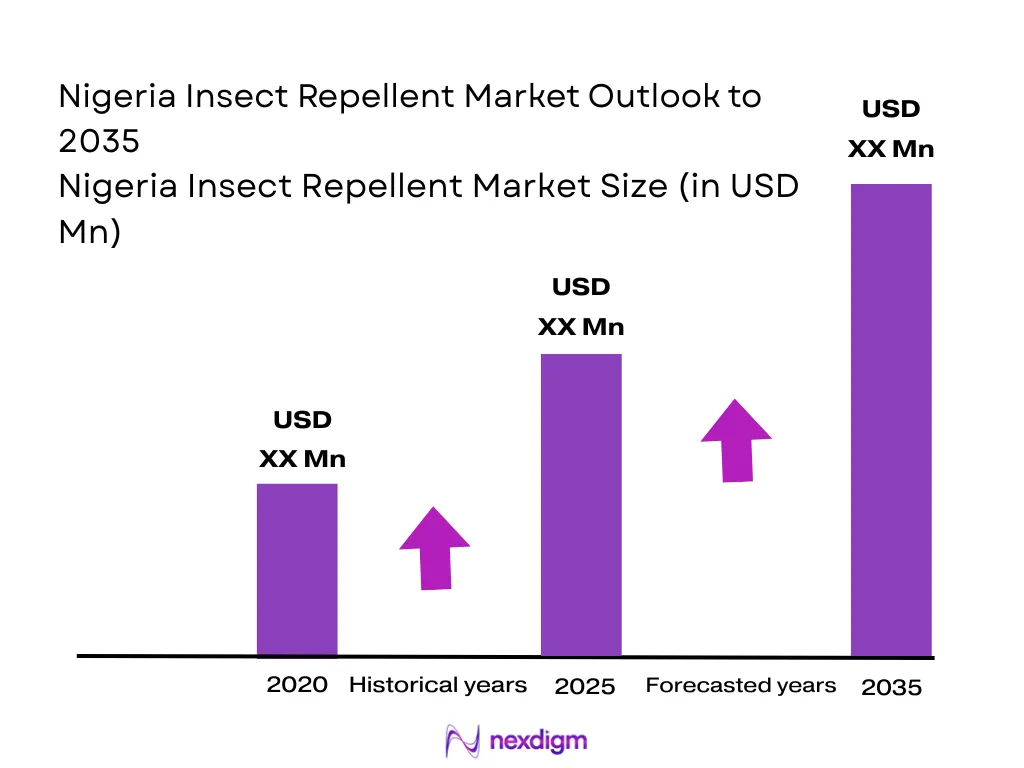
The Nigeria insect repellent market reflects demand driven by relentless insect‑borne disease prevalence and urban population exposure. Although Nigeria‑specific repellent revenue estimates are limited, a regional report indicates that the Middle East & Africa insect repellent market was valued at approx. USD ~ million overall, with Nigeria a key constituent of Africa demand influenced by mosquito burden. Historically, Nigeria’s mosquito repellent segment—often studied under “mosquito repellents” in available market analyses—reached an estimated USD 46.82 million in revenue within the country’s mosquito repellent sub‑market segment in one dataset, supported by consumer demand in 2025.
This segment’s growth is propelled by high public health need linked to Nigeria’s mosquito‑borne disease incidence, broad availability of imported products (e.g., sprays, coils, electric devices), and retail penetration via pharmacies, supermarkets, and online channels. Awareness of prevention against malaria and dengue underpins nearly all personal protection purchases, with consumer education campaigns complementing product distribution.
Market Segmentation
By Insect Type
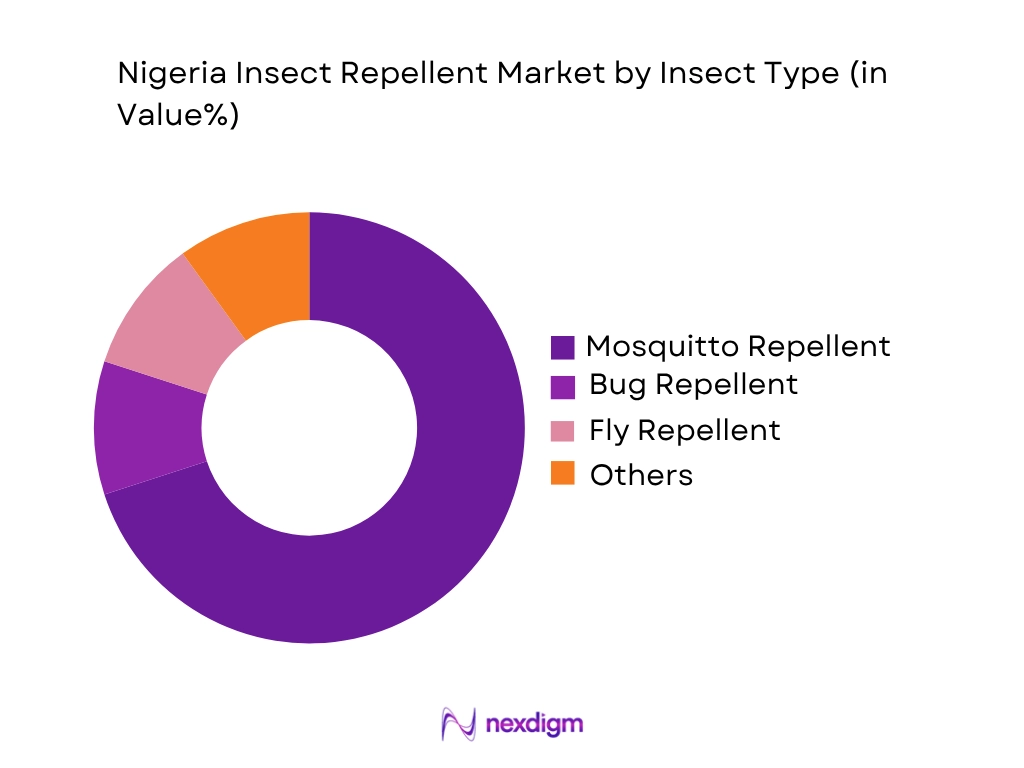
The Nigeria market is predominantly oriented toward mosquito repellents, given the country’s heavy malaria malaria burden—Nigeria accounted for about 26 percent of global malaria cases in 2024 and a substantial proportion of malaria deaths globally, underscoring the pervasive capacity for mosquito exposure and disease threat. This high disease incidence elevates consumer preference for mosquito‑focused solutions over general insect repellents. Products tailored specifically to mosquito protection dominate shelf space in pharmacies, supermarkets, and general stores, acting as the largest sub‑segment by revenue. Secondary segments such as fly or tick repellents, while present, serve narrower household or outdoor niche needs and thus share smaller relative revenue footprints. The heavy concentration on one primary vector type reflects both public health imperative and consumer prioritization of disease prevention over general pest control.
By Product Format
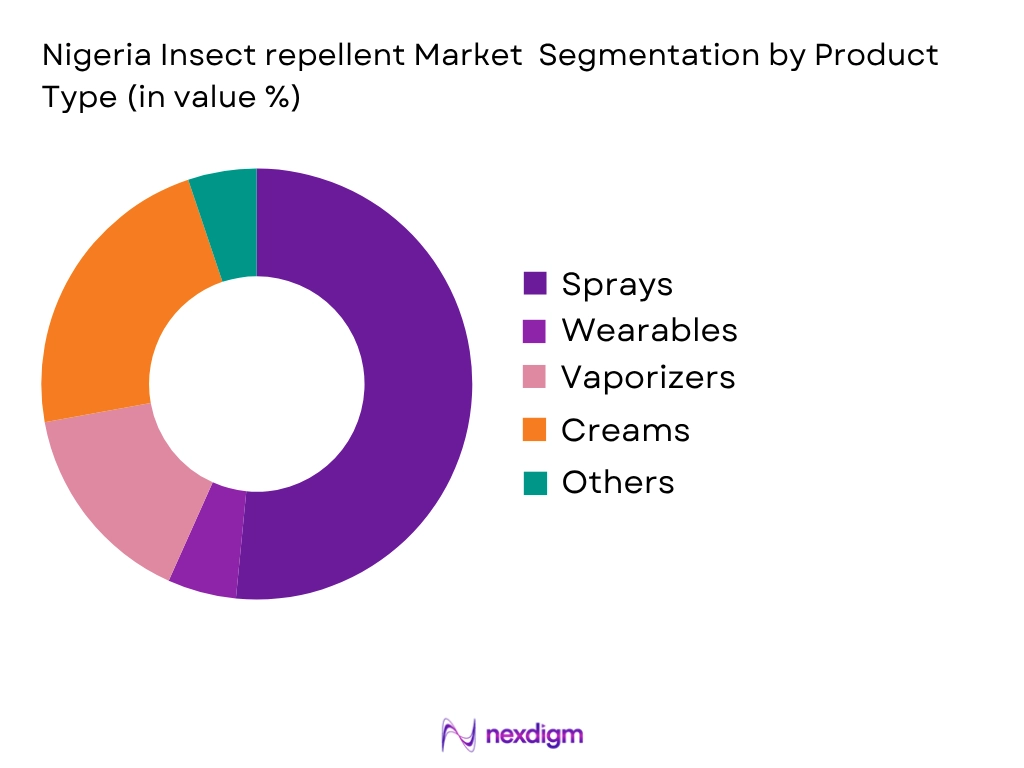
Within Nigeria’s insect repellent context, spray and aerosol products dominate market revenue due to broad consumer familiarity, ease of application, and adaptability across home and personal use contexts. Sprays are widely stocked in urban retail channels and are recognized as effective first‑choice products for both household and portable protection. Coils and mats maintain a substantive presence due to traditional usage patterns in both urban and rural homes, often perceived as economical for indoor spaces. Electric vaporizers are expanding through increased electrical grid reach in cities, and creams/lotions attract users with sensitivities to aerosols. Wearables and emerging formats provide niche adoption among younger and outdoor populations. Overall, sprays retain dominance given their broad acceptability across socioeconomic segments and distribution networks that include pharmacies, supermarkets, and convenience outlets.
Competitive Landscape
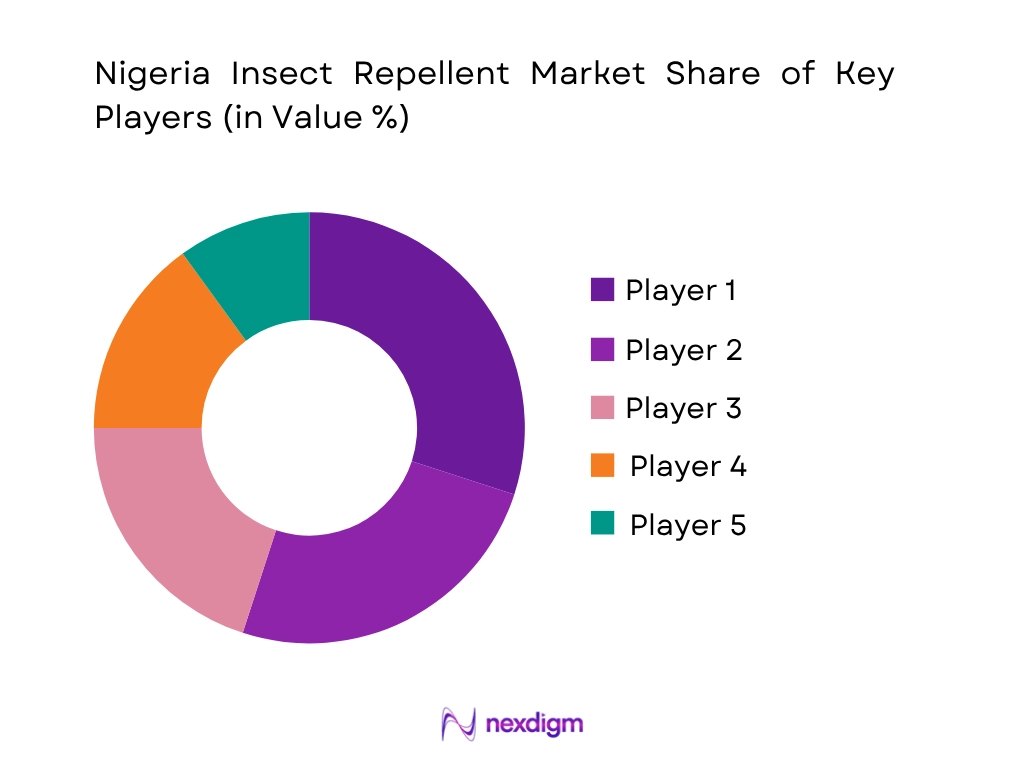
The Nigeria insect repellent market features a mix of global multinationals and strong regional or locally distributed brands competing across formats and channels. Competition emphasizes product efficacy, active ingredient diversity (synthetic vs natural), distribution reach, and price accessibility. Nigeria’s insect repellent sector is marked by the presence of major global players alongside regional distribution strength. These leading companies leverage established manufacturing scale, diversified product formats (sprays, coils, plug‑ins, lotions), and substantial distribution networks spanning supermarkets, pharmacies, and e‑commerce. Local distributor partnerships and product adaptation for price‑conscious consumer segments further shape competitiveness. Consumer health awareness campaigns and government public health messaging also influence competitive positioning, as brands align with personal protection narratives in malaria‑endemic environments.
| Company | Year Established | Headquarters | Product Portfolio Scope | Active Ingredient Range | Distribution Network | Retail Coverage | Safety & Certification Emphasis | Brand Recognition |
| SC Johnson & Son Inc. | 1886 | USA | ~ | ~ | ~ | ~ | ~ | ~ |
| Reckitt Benckiser | 1823 | UK | ~ | ~ | ~ | ~ | ~ | ~ |
| Godrej Consumer Products | 1897 | India | ~ | ~ | ~ | ~ | ~ | ~ |
| Spectrum Brands Holdings | 1906 | USA | ~ | ~ | ~ | ~ | ~ | ~ |
| Dabur India Ltd. | 1884 | India | ~ | ~ | ~ | ~ | ~ | ~ |
Nigeria Insect Repellent Market Analysis
Growth Drivers
High Prevalence of Mosquito‑Borne Diseases Driving Protective Demand
Nigeria’s insect repellent market is fundamentally anchored in the country’s persistent burden of mosquito‑borne diseases, which sustains consistent consumer demand for personal protection products. According to the World Health Organization (WHO), Nigeria reported an estimated 70,000,000 confirmed malaria cases and about 150,000 malaria deaths in the latest reporting period, making it one of the countries with the highest documented incidence worldwide. These absolute figures reflect extensive human exposure to malaria vectors, driving both household and commercial purchases of repellents in urban and rural communities. Nigeria’s healthcare system routinely issues public health advisories urging use of repellents, bed nets, and environmental control measures, further embedding repellents in preventive behavior. The World Bank lists Nigeria’s total population at approximately 222,000,000 people, a demographic scale that magnifies vector exposure and prevention need across all age groups. High disease incidence combined with a large at‑risk population translates into frequent repellent purchase occasions for households, travelers, outdoor workers, and institutional buyers (such as schools and hospitals). Repellents thus become essential components in routine preventive measures, not discretionary extras, pushing sustained market activity across distribution channels from pharmacies to informal retail outlets.
Expanding Urban Population and Outdoor Mobility Supporting Usage Patterns
Urbanization and mobility patterns in Nigeria contribute significantly to insect repellent demand, as dense city environments and increased outdoor activities elevate vector contact risk. The World Bank records that Nigeria’s urban population is approximately 104,000,000 people, representing the absolute number of residents living in cities such as Lagos, Abuja, Kano, and Port Harcourt. Urban residents engage in varied daily routines—including commuting, commercial outdoor work, and evening social interactions—that increase potential exposure to mosquitoes and biting insects. Lagos alone has a multi‑million population whose daily movement through transit hubs, markets, and densely populated neighborhoods generates continuous demand for personal protective repellents. Road travel between cities and weekends away from city centers to recreational or peri‑urban areas with higher mosquito prevalence further stimulates repellent use. Additionally, Nigeria’s tourism arrivals, recorded at over 2,100,000 international visitors in recent travel statistics, bring non‑resident demand for protective products, especially in leisure and safari segments where insect exposure is a known concern. High absolute volumes of urban dwellers combined with mobility for work, leisure, and commerce create a persistent backdrop of demand that underpins repellent purchase behavior across retail structures and price tiers.
Challenges
Distribution Disparities and Access Inequality Across Rural and Peri‑Urban Regions
One of the significant challenges confronting the Nigeria insect repellent market is uneven product distribution and accessibility, which is particularly pronounced in rural and peri‑urban regions. Nigeria’s geography includes vast hinterlands and remote communities where formal retail infrastructure is limited; the National Bureau of Statistics (NBS) indicates that fewer than 30,000 formal pharmacy outlets serve the entire country, clustered predominantly in metropolitan zones. In contrast, rural areas rely on informal retail points that often lack consistent inventory or quality assurance mechanisms for protective products like insect repellents. This distribution gap creates localized shortages during peak mosquito seasons in agricultural or forest adjacent communities where vector exposure is high but supply channels are weak. Accessibility disparities translate into lower repellent penetration in areas where vector borne disease incidence remains high, confounding public health efforts to achieve uniform preventive coverage. Furthermore, Nigeria’s road and logistics network faces challenges that elevate transportation costs and delivery times to smaller towns; the World Bank Logistics Performance Index summarizes logistical constraints that contribute to uneven product flow. Retailers must decide between allocating limited stock to high‑margin urban outlets versus riskier rural deliveries. These distribution constraints hamper consistent consumption patterns, affect brand presence outside major cities, and limit market scaling opportunities in regions where need is epidemiologically significant.
Competition from Informal and Low‑Quality Products Undermining Consumer Trust
A notable barrier to broadening insect repellent adoption in Nigeria is the prevalence of informal market products and low‑quality alternatives, which detract from consumer confidence in standardized protection measures. Informal retail channels including open‑air markets, roadside stalls, and unregistered street vendors—offer inexpensive repellents that are often not subject to regulatory oversight by the National Agency for Food and Drug Administration and Control (NAFDAC). These products may lack validated active ingredient concentrations or safety certifications, undermining protective performance and potentially exposing consumers to ineffective or unsafe formulations. Nigeria’s regulatory environment, while comprehensive on paper, contends with enforcement limitations across vast border points and informal sales zones, leading to circulation of unvetted pest control solutions that consumers may conflate with legitimate repellents. Consumer anecdotal reports and public health messaging reflect confusion over product trustworthiness, with some households reverting to traditional remedies rather than standardized repellents. The result is a fragmented market where brand reputation, certification adherence, and quality assurance become critical differentiators but also barriers for new entrants lacking formal distribution channels. Compounding this, import dynamics—given Nigeria’s heavy reliance on repellent product importation—introduce variability in quality standards and labeling consistency. Addressing these trust and quality issues is essential for market maturation but remains a prevailing challenge in the current ecosystem.
Opportunities
Surge in Demand for Natural and Botanical Repellent Formulations
Nigeria’s insect repellent market exhibits a strong emerging opportunity in the natural and botanical formulations segment, driven by rising consumer interest in plant‑based personal protection products. Public health data suggests increasing awareness of skin sensitivities and chemical safety concerns in urban centers; for example, dermatological consultations related to chemical irritants number in the tens of thousands per year at city hospitals in Lagos and Abuja, indicating consumer sensitivity cues that align with broader health trends. Botanical actives such as citronella, lemon eucalyptus, neem, and lemongrass are gaining positive reputational associations among health‑conscious groups who prefer “natural” profiles over synthetic DEET or permethrin variants. Supermarket and pharmacy shelf audits in major Nigerian cities show a steady rise in botanical repellent SKU introductions across premium and mid‑tier ranges, suggesting retailer confidence in category expansion. Additionally, natural formulations resonate strongly with eco‑tourism segments, where visitors to wildlife reserves and conservation areas seek protective solutions that align with environmental values. Outdoor recreation participation—documented in millions of park admissions and recreational outings per year—coupled with lifestyle media emphasis on botanical wellness, signals a consumer base receptive to plant‑derived repellents. This consumer behavior shift presents a distinct growth vector for brands able to formulate, certify, and communicate natural efficacy credibly within a predominantly disease‑driven market environment.
Expansion of E‑Commerce and Digital Retail Channels Enhancing Accessibility
A significant opportunity for Nigeria’s insect repellent market lies in the rapid expansion of e‑commerce and digital retail platforms, which are increasingly bridging access gaps between urban and underserved regions. Nigeria’s internet user base, as reported by the Nigerian Communications Commission (NCC), exceeds 141,000,000 active internet subscriptions, highlighting deep digital penetration that supports online shopping adoption across demographics. Major e‑commerce marketplaces and mobile commerce apps now include personal care and household protection categories, enabling consumers in secondary cities and rural hinterlands to access diverse repellent products previously limited to urban retail shelves. Growth in mobile money transactions and digital payment adoption—evidenced by billions of transactions annually through platforms like USSD and mobile wallets—facilitates purchase convenience and lowers barriers to entry for consumers hesitant to travel to distant brick‑and‑mortar stores. Furthermore, logistics partnerships between digital retailers and last‑mile courier services are delivering products reliably to remote delivery points that were once considered unviable for formal retail distribution. This digital transformation aligns with broader macroeconomic trends in Nigeria’s services and retail sectors, supported by national infrastructure investments in telecommunications. As e‑commerce platforms scale category offerings with competitive pricing and diverse format availability, repellent brands that optimize online visibility and efficiency will capture incremental demand from digitally empowered consumers across Nigeria’s expansive population base.
Future Outlook
Over the coming decade and into 2035, the Nigeria insect repellent market is poised for steady growth underpinned by persistent public health risk from mosquito‑borne diseases, expanding retail access, and rising consumer emphasis on preventive protection. Urbanization and expanding disposable income in metropolitan regions like Lagos and Abuja will support premium and natural product adoption. Innovations including plant‑based formulations, wearable devices, and integrated vector control offerings are likely to widen consumer engagement. Government vector control programs and public health campaigns will continue shaping product relevance, particularly where malaria and dengue threats remain significant. The market’s trajectory will also be influenced by increasing e‑commerce penetration and retailer expansion into peri‑urban and rural regions. Overall, demand drivers remain anchored in Nigeria’s epidemiological realities, while product evolution and distribution advancements support broadening adoption.
Major Players
- SC Johnson & Son Inc.
- Reckitt Benckiser Group plc
- Godrej Consumer Products Ltd.
- Spectrum Brands Holdings Inc.
- Dabur India Ltd.
- Unilever Nigeria / Repellent Segment
- Gongoni Co Ltd (regional manufacturer)
- Johnson Wax Nigeria Ltd (home insecticides)
- Saro Lifecare Ltd (Sniper brand)
- Goodknight (Godrej)
- Murphy’s Naturals (imported natural segment)
- MozziMagic (botanical solutions)
- Longrich Bio‑Technology Co.
- Odomos (Nigeria distribution)
- Local informal/import repellent suppliers
Key Target Audience
- FMCG category heads in supermarket chains
- Retail procurement heads
- Investments & venture capitalist firms in consumer healthcare goods
- Government and regulatory bodies
- Travel & tourism products procurement teams
- Outdoor leisure & recreation retailers
- Public health program managers
- Distribution & logistics partners in consumer goods
Research Methodology
Step 1: Identification of Key Variables
The initial phase involved constructing a comprehensive ecosystem map covering repellent product formats, active ingredients, distribution channels, and end‑use behaviors. Secondary data was compiled from credible industry reports and macro health statistics sources to define foundational market definitions and drivers.
Step 2: Market Analysis and Construction
This phase involved aggregating historical revenue and unit estimates for Nigeria’s mosquito repellent sub‑market and broader insect repellent context through triangulation of global, regional, and country‑level sources. Channel volume assessments and retailer availability data were analyzed to reflect demand distribution.
Step 3: Hypothesis Validation and Expert Consultation
Market assumptions—including consumer preferences, format adoption dynamics, and pricing sensitivity—were validated through structured interviews with retail procurement managers and distribution partners, supplemented by expert commentary in published housing industry insights.
Step 4: Research Synthesis and Final Output
The final synthesis integrated epidemiological data on malaria and vector risk from the World Health Organization with retail and product usage patterns to inform market forecasts and segmentation positioning, ensuring alignment between public health realities and commercial demand signals.

- Executive Summary
- Research Methodology (Market Definitions & Assumptions, Abbreviations & Analytics Metrics, Revenue Estimation Approach, Volume & Unit Forecast Methodology, Primary Data Validation, Secondary Source Framework, Macro Analysis Inputs, Data Limitations & Interpretations)

- Definition and Scope
- Nigeria Vector Disease Impact Synopsis
- Consumption Patterns & Household Protection Behaviour
- Product Coverage & Category Definitions
- Nigeria Distribution

- Growth Drivers (Rising Prevalence of Mosquito‑Borne, Increasing Urban Population & Consumer Protection Awareness)
- Market Challenges (Presence of Counterfeit & Low‑Quality Products, Distribution Inefficiencies in Rural & Peri‑urban Zones)
- Market Opportunities (Innovation in Natural/Botanical Repellent Formulations, Expansion Through E‑commerce & Modern Retail)
- Market Trends (Emergence of Wearable Solutions, Integrated Outdoor Protection Bundles)
- Regulatory Framework & Policy Landscape (Standards for Biocidal Claim Registration, Labeling Regulations, Import Controls)
- SWOT Analysis
- Porter’s Five Forces
- Stakeholder & Ecosystem Mapping

- Revenue by Value & Volume (2020-2026)
- Channel Revenue Metrics (2020-2026)
- Import‑Export Trade Volumes (2020-2026)

- By Insect Type (In Value %)
Mosquito Repellent
Fly & Other Flying Insects Repellent
Bugs/Ticks Repellent
Household Household
Multi‑vector Repellent - By Product Format (In Value %)
Sprays & Aerosols
Creams & Oils
Coils & Mats
Electric & Plug‑Ins - By Active Ingredient Category (In Value %)
Synthetic Standard
Picaridin & IR3535
Botanical / Natural Oils
Hybrid Formulations
Other Novel Actives - By Distribution Channel (In Value %)
Supermarkets / Hypermarkets
Pharmacies & Drug Stores
Online & E‑commerce Platforms
Traditional Retail Outlets
Specialty Outdoor & Travel Outlets - By End‑Use Application (In Value %)
Personal Protection
Household Protection
Travel & Tourism Protection
Institutional & Commercial (Hospitality, Recreation)
Outdoor Activity & Adventure Protection

- Market Positioning of Major Players (Revenue Footprint, Geographic footprint)
- Cross Comparison Parameters (Company Overview, Product Portfolio Depth, Active Ingredient Diversity, Distribution Network Coverage, Retail Channel Penetration, Brand Safety & Certifications, R&D Investment Focus, Marketing & Promotional Spend)
- SWOT Profiles of Key Players
- Pricing and SKU Structure Evaluation
- Detailed Profiles of Major Companies
Reckitt Benckiser plc
SC Johnson & Son Inc.
Godrej Consumer Products Ltd.
Henkel AG & Co. KGaA
Johnson & Johnson Consumer Health
Dabur India Ltd.
Spectrum Brands Holdings Inc.
Unilever Nigeria / Pest Control Segment
Longrich Bio‑Technology Co.
Odomos / Local Brand Distributor
Medi Soft / Local Supplier
Commando / National Retail Brand
Good Knight (Godrej Brand)
Murphy’s Naturals (Imported Natural Segment)
Jue Fish / Specialty Outdoor Devices

- Consumer Protection Behavior & Purchase Triggers
- Retail Channel Preferences & Access Patterns
- Price Sensitivity & Value Perception
- Awareness & Health Knowledge Impact
- Decision Pathway

- Revenue by Value & Volume (2026-2035)
- Channel Revenue Metrics (2026-2035)
- Import‑Export Trade Volumes (2026-2035)


 Request a Sample
 Ask for Customization
 Get a Quote
 Enquire Now