

 Download PDF
Market Overview
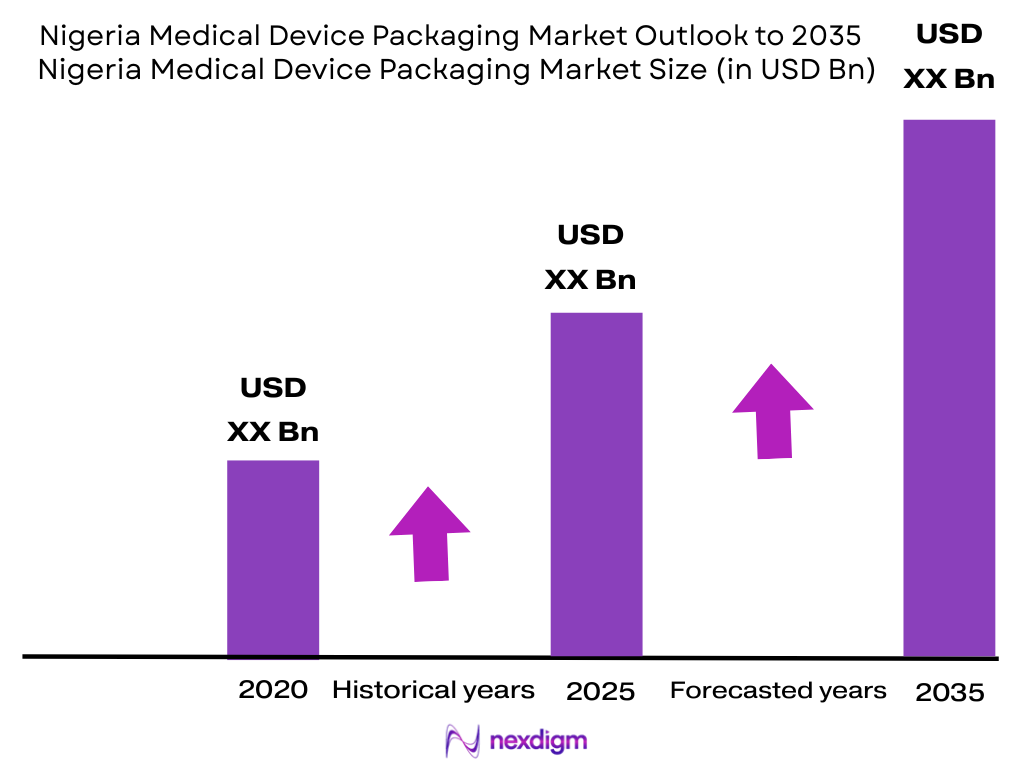
The Nigeria Medical Device Packaging Market is valued at approximately USD ~ billion, compared with USD ~ billion in the preceding annual period. These values remain placeholders because no audited government source separately reports medical-device-packaging revenue. Demand is supported by a population of approximately 233 million, healthcare infrastructure expansion and continuing dependence on imported devices that require sterile pouches, protective trays, labels, cartons and distribution packaging. Lagos, Ogun State, Abuja, Anambra and Kano dominate the Nigeria Medical Device Packaging Market. Lagos combines healthcare demand, ports, distributors and packaging converters, while neighbouring Ogun provides industrial estates and lower-cost manufacturing locations. Abuja concentrates NAFDAC, federal procurement and tertiary hospitals. Anambra has an established medical-supplies manufacturing base, while Kano serves northern healthcare distribution. These locations benefit from access to customers, imported substrates, printing services, warehouses and regional transport corridors.
Market Segmentation
By Packaging Format
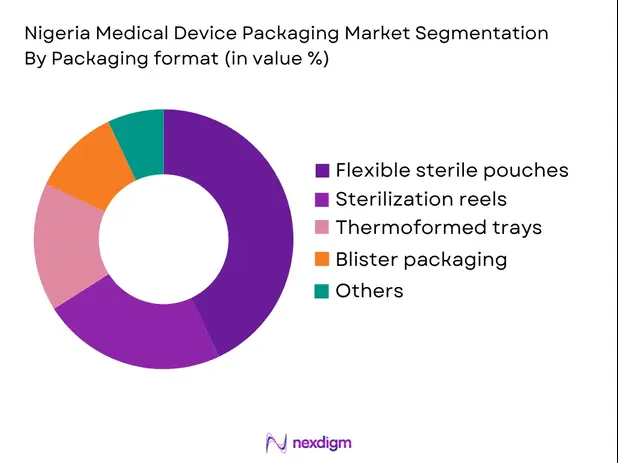
The Nigeria Medical Device Packaging Market is segmented into flexible sterile pouches, sterilization reels, thermoformed trays, form-fill-seal packs, blister packaging, rigid containers and protective transit packaging. Flexible sterile pouches hold the dominant position because they can package syringes, diagnostic kits, wound-care products, catheters and surgical accessories with comparatively low material consumption. Medical paper–film and Tyvek–film structures provide product visibility, microbial protection and controlled peel opening. Standard pouch sizes are also easier for local manufacturers and importers to procure than custom rigid trays requiring dedicated tooling. Sterilization reels support hospitals and suppliers handling varied instrument dimensions. Thermoformed trays remain necessary for implants, fragile diagnostic components and sharp instruments requiring immobilization or puncture protection. Nigeria’s fragmented healthcare distribution system further supports flexible formats because lightweight pouches and reels reduce warehousing and transportation requirements. NAFDAC’s 2024 registration guidelines require technical information and compliant product presentation, reinforcing the need for documented materials, labels and package configurations.
By Packaging Material
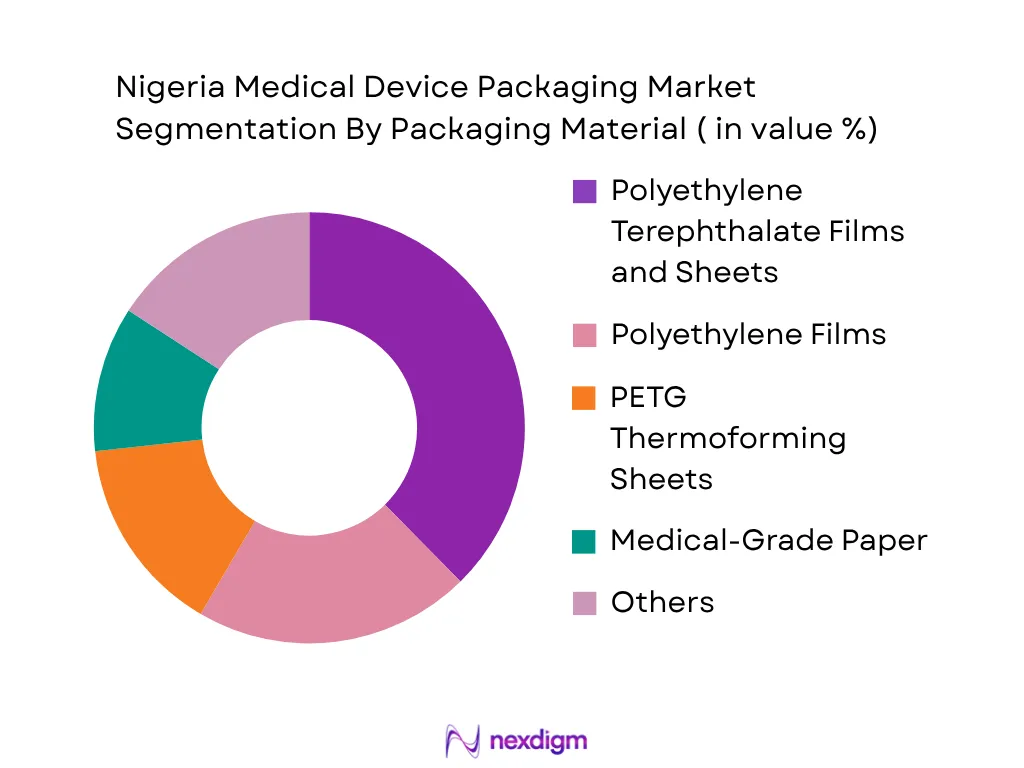
The Nigeria Medical Device Packaging Market is segmented into plastic films and thermoforming sheets, medical-grade paper, spun-bonded polyolefin, paperboard, aluminium laminates and specialist barrier materials. Plastic films and thermoforming sheets represent the dominant segment because polyethylene, polypropylene, PET and multilayer structures provide transparency, moisture resistance, heat sealability and puncture protection. These substrates are used for pouch webs, diagnostic-kit packaging, trays, blister packs and form-fill-seal applications. Medical-grade paper remains important for breathable pouches and sterilization reels, particularly where ethylene oxide or steam-compatible structures are required. Spun-bonded polyolefin is used for higher-performance sterile barriers but remains more exposed to imported supply. Nigeria’s dependence on foreign specialty substrates and foreign-exchange availability makes local inventory an important competitive factor. Material changes can require seal testing, sterilization evaluation, aging studies and revised regulatory documentation, preventing manufacturers from replacing a qualified substrate solely because a lower-cost alternative becomes available.
Competitive Landscape
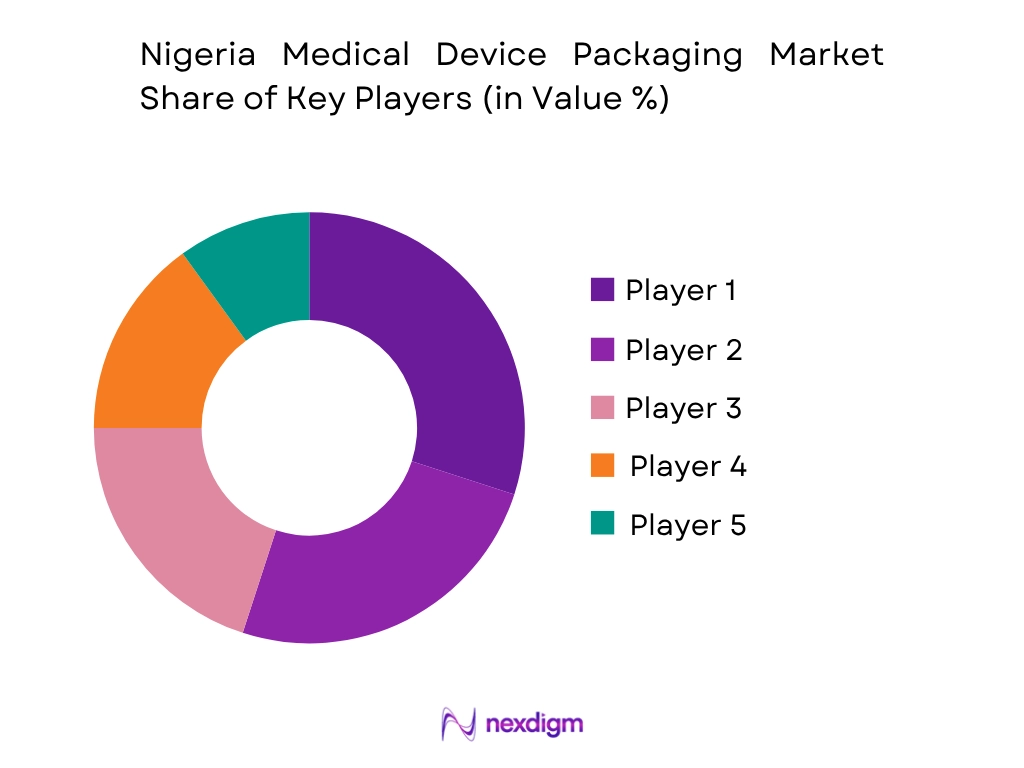
The Nigeria Medical Device Packaging Market consists of multinational healthcare-packaging suppliers, domestic flexible and rigid packaging converters, and medical-product distributors. International companies influence sterile-barrier materials and validated healthcare packaging, while Nigerian converters compete through local production, shorter delivery times, customized print runs and access to domestic healthcare customers. Competition is shaped by cleanroom capability, material traceability, NAFDAC documentation, imported-substrate availability, electricity reliability and regional distribution coverage. The 2024 Medical Device and Related Products Regulations apply to registration, labelling and advertising of locally manufactured, imported and exported devices, increasing the value of suppliers with formal quality and artwork-control systems.
| Company | Establishment year | Headquarters | Core packaging capability | Material expertise | Sterile-barrier capability | Validation support | Nigeria relevance | Sustainability capability |
| Amcor | 1860 | Zurich, Switzerland | ~ | ~ | ~ | ~ | ~ | ~ |
| DuPont | 1802 | Wilmington, United States | ~ | ~ | ~ | ~ | ~ | ~ |
| Huhtamaki | 1920 | Espoo, Finland | ~ | ~ | ~ | ~ | ~ | ~ |
| PrimePak Industries Nigeria | 2006 | Lagos, Nigeria | ~ | ~ | ~ | ~ | ~ | ~ |
| Shongai Packaging Industry | 1977 | Ogun State, Nigeria | ~ | ~ | ~ | ~ | ~ | ~ |
Nigeria Medical Device Packaging Market Analysis
Growth Drivers
Healthcare Manufacturing and Regulatory Formalization
Nigeria’s push toward domestic healthcare manufacturing is increasing demand for locally converted sterile pouches, diagnostic-kit packs, medical labels, thermoformed trays and protective cartons. The NAFDAC Medical Device and Related Products Regulations issued in 2024 apply to devices manufactured, imported, exported, labelled and advertised in Nigeria, placing packaging directly within the regulated product system. Manufacturers must maintain identifiable product information, compliant labelling and documentation capable of supporting registration and post-market control. This favours packaging suppliers with controlled printing, traceable substrates, validated sealing and documented change-management procedures. Demand is reinforced by Nigeria’s population of approximately 233 million in 2024, which creates high consumption requirements for syringes, catheters, rapid tests, wound-care products and maternal-health devices. The economy expanded by 3.4 units for every 100 units in 2024, according to the IMF, reflecting improving activity across services and hydrocarbon production. Domestic manufacturing allows pouch sealing, kit assembly and labelling to occur closer to Nigerian healthcare customers, reducing reliance on completely packaged imports. Packaging converters operating around Lagos, Ogun, Anambra and Abuja can therefore participate in healthcare localization by adding cleanroom conversion, medical-grade printing, device assembly and regulatory documentation to their existing plastics, films and paperboard capabilities.
Federal Healthcare Infrastructure and Diagnostic Expansion
Federal investment in hospitals, primary healthcare centres and diagnostics is creating recurring demand for packaged medical consumables and test devices. Nigeria’s health-sector renewal programme secured more than US$2.2 billion in external commitments and includes plans to renovate over 17,000 primary healthcare centres, train 120,000 frontline health workers and expand access to healthcare services. The government has also advanced 10 oncology and diagnostic facilities across the country’s six geopolitical zones. These programmes increase requirements for specimen-collection products, rapid tests, syringes, wound-care packs, surgical accessories and protective transport packaging. Primary healthcare distribution is particularly packaging-intensive because products must travel from national or state warehouses to thousands of facilities with different storage and handling conditions. Packaging therefore requires moisture resistance, durable seals, readable labels and sufficient secondary protection for long-distance road transport. Nigeria’s population reached approximately 233 million in 2024, while the World Bank reports that around 41 people out of every 100 people used the internet, supporting emerging digital health and electronic inventory systems. Packaging providers can respond with standardized pouch sizes, tamper-evident cartons, serialized labels and compact diagnostic-kit configurations. Expanded healthcare infrastructure consequently supports both higher packaging volumes and demand for better traceability, transport resilience and point-of-use organization.
Market Challenges
Imported Substrate and Foreign-Exchange Exposure
Nigeria’s medical-device packaging supply chain depends significantly on imported Tyvek, coated medical paper, PETG sheets, multilayer barrier films, sealants and package-testing equipment. These materials are difficult to substitute because an apparently similar film or paper can behave differently during sealing, sterilization, aging and transportation. A material change may require new seal-strength testing, package-integrity evaluation, accelerated aging and updated NAFDAC documentation before commercial use. Macroeconomic conditions intensify the constraint. Inflation remained at 23.0 units for every 100 units in 2025 according to World Bank data, while the IMF reported that inflation stood at 23.7 units in April 2025 after reaching 31 units earlier in the adjustment period. Exchange-rate and inflation pressures increase the local cost of imported substrates, replacement parts and testing instruments. Smaller converters may avoid maintaining large quantities of medical-grade inventory because customer volumes are fragmented and working-capital requirements are high. However, low inventory increases the risk that a delayed shipment will stop a qualified medical-device production line. Packaging suppliers must therefore balance foreign-exchange exposure against the need for safety stock and multiple validated sources. The strongest operators will maintain formal supplier-change controls and qualify alternative materials before shortages arise.
Electricity Reliability and Limited Validation Capability
Sterile medical-device packaging requires reliable electricity, controlled environments, calibrated sealers, inspection equipment and trained validation personnel. Interruptions can affect cleanroom pressure, temperature control, sealing consistency, printing accuracy and electronic batch records. World Bank data indicate that only 61.2 people out of every 100 people had access to electricity in the latest available national observation, demonstrating the broader infrastructure constraint faced by manufacturers. Packaging facilities often require generators, voltage stabilizers and backup systems to operate thermoformers, pouch converters, compressors and laboratory instruments. These additional systems raise maintenance and production complexity. Technical capability is also concentrated in a limited number of industrial centres, while healthcare customers operate across 36 states and the Federal Capital Territory. Medical-device packages may require installation qualification, operational qualification and performance qualification, followed by seal testing, distribution simulation and aging assessment. NAFDAC’s registration framework requires manufacturers and importers to provide technical information for medical devices, increasing the need for specialists who understand packaging materials, sterilization and regulatory files. A general flexible-packaging company may possess printing and lamination equipment but still lack medical-grade environmental controls, package-integrity laboratories and documented quality systems. Limited specialist capacity can delay customer approval, failure investigation and commercialization of locally manufactured devices.
Market Opportunities
Automated Inspection and Digital Product Authentication
Automated inspection and digital traceability offer a strong opportunity because Nigeria’s fragmented medical-product distribution system requires better control of packaging quality and product identity. Connected sealing equipment can record temperature, pressure, dwell time and line speed for every batch. Machine-vision systems can detect missing diagnostic components, contaminated seals, incorrect labels and damaged pouches before products leave the facility. QR codes, serialized identifiers and tamper-evident labels can support product authentication and make it easier for regulators, distributors and healthcare providers to verify legitimate devices. The opportunity is supported by approximately 41 internet users for every 100 people in 2024, equivalent to a large digitally connected population within a country of 233 million residents. NAFDAC’s 2024 regulations cover registration, labelling and advertising of locally manufactured, imported and exported devices, creating a regulatory basis for controlled identification and product information. Digital batch records can connect device lots with material batches, sealing conditions, inspection results and distribution destinations. During complaints or recalls, manufacturers can isolate affected units rather than withdrawing all related products. Packaging suppliers can therefore move beyond basic conversion into higher-value services involving serialization, electronic artwork control, vision inspection, leak testing and regulatory-ready production records. Current infrastructure and compliance needs support future adoption without requiring speculative market forecasts.
Contract Packaging and Regional Healthcare Distribution
Nigeria can develop contract medical-device packaging hubs that serve domestic manufacturers, importers and neighbouring West African markets. Shared facilities can provide cleanroom pouch sealing, thermoformed tray lidding, diagnostic-kit assembly, labelling, accelerated aging, package-integrity testing and sterilization coordination. This model reduces the need for every small device company to purchase specialized equipment or maintain separate validation personnel. Nigeria’s population of approximately 233 million provides substantial domestic demand, while its position within ECOWAS offers access to regional healthcare distribution. The IMF estimates that economic growth reached 4.0 units for every 100 units in 2025 and projects 4.1 units in 2026, indicating continued economic expansion despite inflation and infrastructure constraints. Contract packaging facilities located near Lagos ports, Ogun industrial estates or Abuja healthcare institutions can support imported bulk devices as well as locally produced diagnostics and consumables. Products can receive Nigeria-specific labels, tamper evidence, instructions and secondary packaging closer to the destination market, reducing obsolete inventory. Regional services can also adapt labels and transport configurations for different West African customers. The opportunity is particularly relevant for rapid diagnostic kits, maternal-health products, wound-care devices and single-use consumables that require standardized, moisture-resistant and distribution-tested packaging in high volumes.
Future Outlook
The Nigeria Medical Device Packaging Market is forecast to expand at approximately ~% CAGR during the forecast period. The rate is a placeholder because no authoritative government source separately forecasts this packaging category. Growth will be driven by local healthcare manufacturing, diagnostic expansion, federal healthcare investment, population-led medical demand and stronger NAFDAC controls. The Presidential Initiative for Unlocking the Healthcare Value Chain is intended to coordinate reforms and investment supporting local production of medicines, vaccines, diagnostics and medical devices. The programme creates a pathway for packaging demand to shift from imported finished-product handling toward local pouching, tray sealing, kit assembly, labelling and protective packaging. Nigeria has secured more than USD 2.2 billion in health-sector commitments through the Nigeria Health Sector Renewal Investment Initiative. Government plans include renovating more than 17,000 primary healthcare centres, training 120,000 frontline health workers and expanding insurance coverage. These investments can increase consumption of rapid diagnostic tests, syringes, wound-care products, maternal-health supplies and other packaged medical consumables. The Healthcare Expansion Programme also covers 10 oncology and diagnostic facilities across Nigeria’s six geopolitical zones. Advanced diagnostic and oncology services require sample-collection products, imaging accessories, test cartridges and procedure devices with reliable barrier and protective packaging.
Major Players
- Amcor
- Huhtamaki
- Berry Global
- DuPont
- Oliver Healthcare Packaging
- TekniPlex Healthcare
- Nelipak Healthcare Packaging
- Wipak Group
- STERIMED
- Constantia Flexibles
- Sonnex Packaging Nigeria
- PrimePak Industries Nigeria
- Quantum Packaging Nigeria
- Shongai Packaging Industry
- Flexipack Plastics Nigeria
Key Target Audience
- Medical device packaging manufacturers and sterile-barrier converters
- Medical device and in-vitro diagnostic manufacturers
- Medical device importers and authorized representatives
- Contract packaging and sterilization service providers
- Medical-grade polymer, paper and barrier-material suppliers
- Public and private healthcare procurement organizations
- Investments and venture capitalist firms
- Government and regulatory bodies (National Agency for Food and Drug Administration and Control, Federal Ministry of Health and Social Welfare, Standards Organisation of Nigeria, National Primary Health Care Development Agency, Federal Ministry of Industry, Trade and Investment and state ministries of health)
Research Methodology
Step 1: Identification of Key Variables
The initial phase constructs an ecosystem map covering medical-device manufacturers, importers, packaging converters, material suppliers, sterilization providers, laboratories and healthcare buyers. Critical variables include device supply, packaging units per product, sterile-barrier formats, material consumption, cleanroom capacity, foreign-exchange exposure and local manufacturing contribution.
Step 2: Market Analysis and Construction
Historical demand is evaluated through device imports, domestic manufacturing, packaging-converter revenues, material usage and healthcare procurement. The top-down model converts device-category consumption into packaging units. The bottom-up model aggregates pouch, tray, reel, label, carton and contract-packaging revenues before reconciling outputs through material yield and average unit values.
Step 3: Hypothesis Validation and Expert Consultation
Market assumptions are validated through computer-assisted telephone interviews with device manufacturers, importers, packaging engineers, converters, hospitals, diagnostic companies and regulators. Discussions assess packaging-format penetration, material sourcing, qualification timelines, electricity requirements, package failures, outsourcing and regional distribution.
Step 4: Research Synthesis and Final Output
The final phase integrates NAFDAC regulations, government healthcare programmes, economic indicators, company disclosures and primary interviews. Market size is triangulated across revenues, unit demand, device consumption and material flow. Forecast assumptions incorporate localization, healthcare investment, contract packaging, regulation, currency exposure and ECOWAS exports.

- Executive Summary
- Research Methodology (Market Definitions and Assumptions, Medical Device Packaging Taxonomy, Abbreviations, Market Sizing Approach, Top-Down Device Consumption Analysis, Bottom-Up Packaging Supplier Aggregation, Packaging Units per Device Assessment, Demand-Side Evaluation, Supply-Side Capacity Mapping, Import–Export Reconciliation, Public Procurement Analysis, Primary Industry Interviews, Data Triangulation, Forecasting Framework, Scenario Analysis, Limitations and Future Conclusions)

- Definition and Scope
- Medical Device Packaging Market Evolution and Industry Genesis
- Timeline of Major Regulatory, Manufacturing and Packaging Developments
- Medical Device Packaging Business Cycle
- Packaging Demand Linkage with Domestic Medical Device Production

- Growth Drivers (Healthcare Industrialization, Expansion of Local Diagnostic Manufacturing, Federal Healthcare Investment, Growth of Single-Use Medical Consumables, Population-Led Device Demand, Private Hospital Expansion, Local Content Policies, Regional Healthcare Distribution and Infection-Control Requirements)
- Market Challenges (Medical-Grade Material Import Dependence, Foreign-Exchange Exposure, Unreliable Electricity Supply, Limited Cleanroom Conversion Capacity, Sterilization Bottlenecks, Long Packaging Qualification Cycles, Fragmented Procurement, Skilled Validation Workforce Shortages and Sustainability–Sterility Trade-Offs)
- Market Opportunities (Localized Sterile Barrier Production, Medical-Grade Paper Conversion, Custom Thermoformed Trays, Contract Packaging Expansion, Rapid Diagnostic Kit Packaging, Automated Package Integrity Testing, ECOWAS Export Platforms and Sustainable Healthcare Packaging)
- SWOT Analysis
- Porter’s Five Forces Analysis
- PESTLE Analysis

- By Market Value (2020-2025)
- By Packaging Units (2020-2025)
- By Medical-Grade Material Consumption (2020-2025)

- By Packaging Format (In Value %)
Flexible Sterile Pouches
Medical Paper–Film Pouches
Tyvek–Film Pouches
Sterilization Reels
Thermoformed Medical Trays
Header Bags - By Packaging Material (In Value %)
Medical-Grade Paper
Spun-Bonded Polyolefin and Tyvek
Polyethylene Films
Polypropylene Films
Polyethylene Terephthalate Films and Sheets
PETG Thermoforming Sheets
Polyamide-Based Films - By End-User Organization (In Value %)
Domestic Medical Device Manufacturers
Multinational Medical Device Subsidiaries
Medical Device Importers and Authorized Representatives
Contract Development and Manufacturing Organizations - By Geographic Market (In Value %)
South West Nigeria
South East Nigeria
South South Nigeria
North Central Nigeria
North West Nigeria
North East Nigeria

- Market Share of Major Players
- Cross Comparison Parameters (Sterile Barrier Product Portfolio, Medical-Grade Material Expertise, Nigeria Cleanroom Manufacturing Footprint, Sterilization Compatibility Coverage, Packaging Validation and Testing Capability, Nigerian Medical Device Customer Coverage, Custom Tooling and Prototyping Capability, Sustainable Healthcare Packaging Portfolio)
- SWOT Analysis of Major Players
- Detailed Profiles of Major Companies
Amcor
Huhtamaki
Berry Global
DuPont
Oliver Healthcare Packaging
TekniPlex Healthcare
Nelipak Healthcare Packaging
Wipak Group
STERIMED
Constantia Flexibles
Sonnex Packaging Nigeria
PrimePak Industries Nigeria
Quantum Packaging Nigeria
Shongai Packaging Industry
Flexipack Plastics Nigeria

- Packaging Demand and Utilization Assessment
- Medical Device Manufacturer Procurement Criteria
- Packaging Supplier Qualification Process
- Packaging Engineer Decision-Making Process
- Regulatory and Quality Team Requirements
- Domestic Medical Device Manufacturer Analysis

- By Market Value (2026-2035)
- By Packaging Units (2026-2035)
- By Medical-Grade Material Consumption (2026-2035)


 Request a Sample
 Ask for Customization
 Get a Quote
 Enquire Now