
 Download PDF
Market Overview
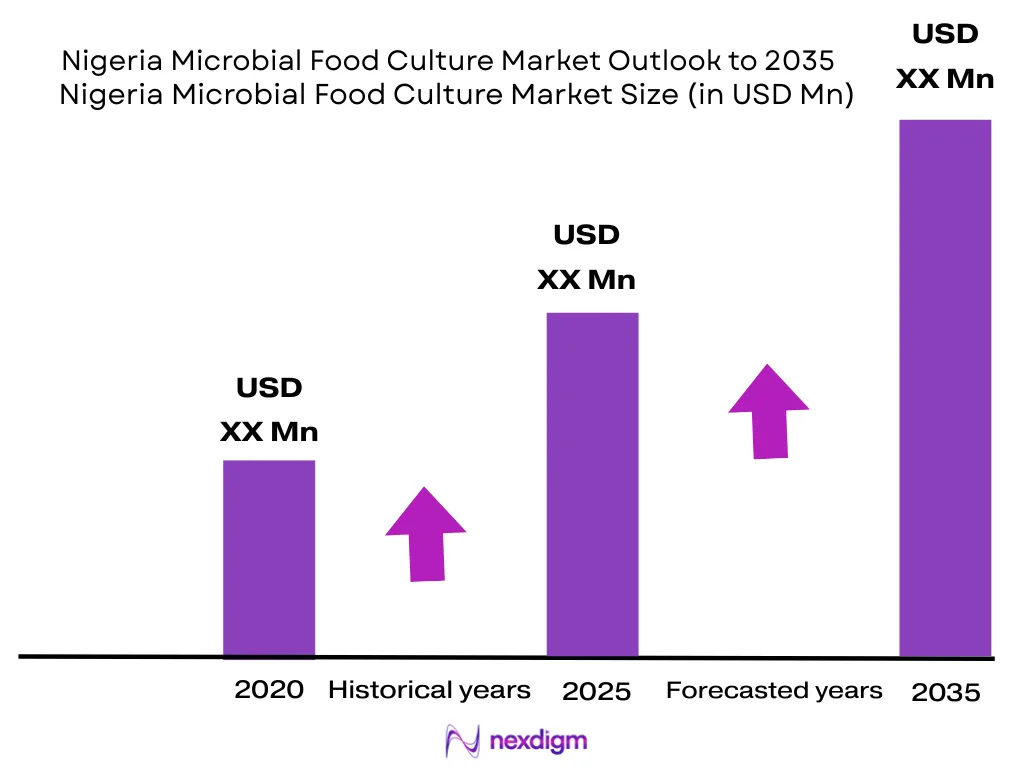
The Nigeria Microbial Food Culture Market is valued at approximately USD ~ million and is forecast to expand at a CAGR of % during 2026–2035. Demand is supported by a population that increased from approximately 228 million to 233 million, alongside economic output moving from nearly USD 363.6 billion to USD 252.26 billion after currency translation effects. Commercial yoghurt, bread, cereal beverages, cassava foods, condiments, probiotics, and traditional fermented products generate recurring culture requirements. Lagos, Ogun State, Abuja, Kano, Kaduna, Ibadan, Port Harcourt, and Onitsha dominate the Nigeria Microbial Food Culture Market because they concentrate food factories, dairy processors, bakeries, beverage companies, ingredient importers, laboratories, and wholesale distribution. Lagos and Ogun benefit from port access and industrial estates, while Kano and Kaduna connect northern dairy and cereal-processing systems. National real output growth increased from the levels recorded in 2023 to 4.1%, supporting broader manufacturing and commercial food activity.
Market Segmentation
By Culture Type
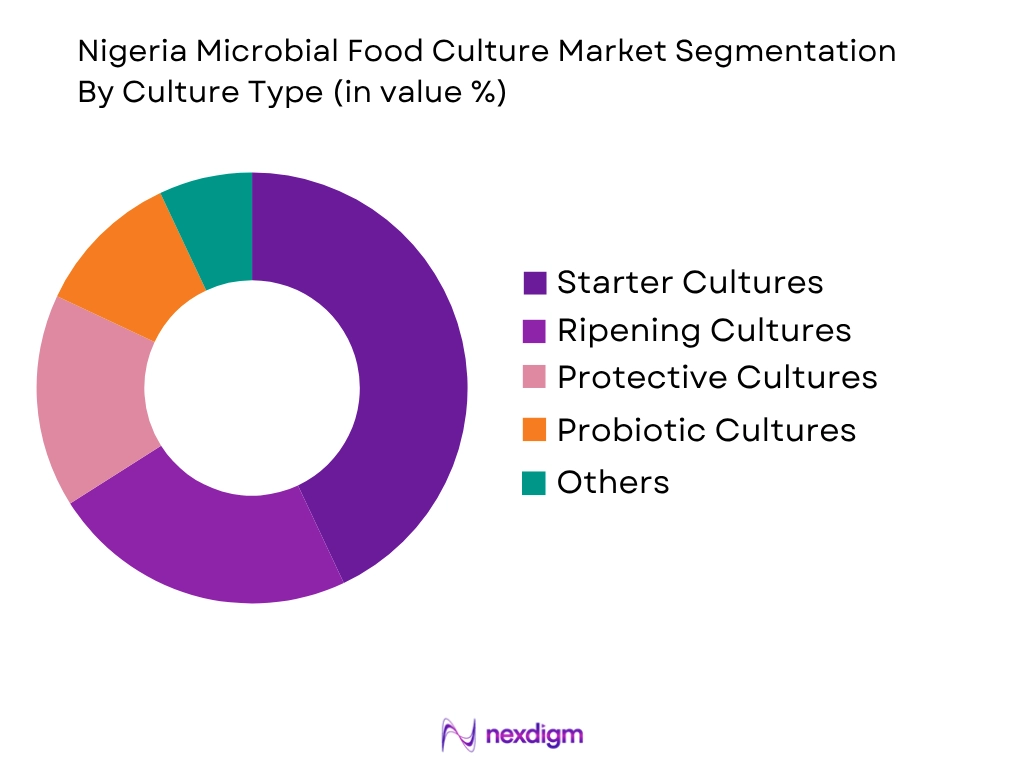
The Nigeria Microbial Food Culture Market is segmented into starter cultures, probiotic cultures, protective cultures, adjunct and ripening cultures, customized mixed cultures, and indigenous microbial cultures. Starter cultures hold the dominant market position because they initiate controlled fermentation in yoghurt, drinking yoghurt, nono, kindirimo, bread, ogi, kunu, garri, fufu, fermented condiments, and selected beverages. Their principal advantage is the ability to standardize acidity, flavour, texture, and processing time across multiple batches. Direct-set cultures also reduce the contamination and variability associated with repeatedly carrying forward traditional starters. Probiotic cultures are gaining relevance in functional dairy and wellness beverages but require strain documentation and viable-count control. Protective cultures remain more specialized and are primarily relevant where processors need additional spoilage management. Indigenous mixed cultures provide a longer-term opportunity because Nigerian cereal, cassava, legume, and dairy fermentations frequently depend on complex communities of lactic acid bacteria, yeasts, and other microorganisms rather than one strain.
By Application
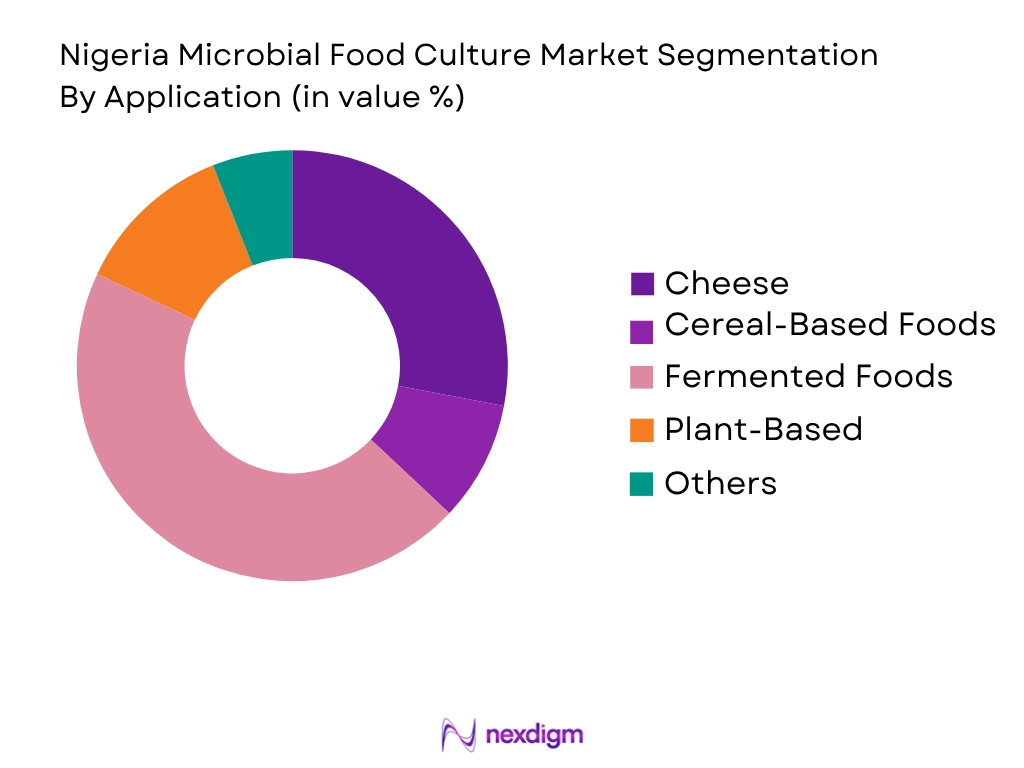
The Nigeria Microbial Food Culture Market is segmented into fermented dairy products, bakery products, traditional cereal foods, cassava-based foods, fermented condiments, fermented beverages, and plant-based functional foods. Fermented dairy products hold the dominant market position because yoghurt and cultured-milk processors use starter cultures during every manufacturing batch. Cultures determine acidification speed, viscosity, flavour, gel formation, and storage stability, making them essential inputs for commercial dairy production. Bakery products also represent a major application because industrial and regional bakeries require yeast for pan bread, Agege-style bread, rolls, pastries, and other products. Traditional cereal and cassava foods involve large fermentation activity, but commercial starter penetration remains less developed because many processors still depend on natural fermentation or back-slopping. Standardized cultures offer considerable potential in ogi, kunu, garri, fufu, iru, and related products by reducing fermentation variability and improving process control without removing familiar sensory characteristics.
Competitive Landscape
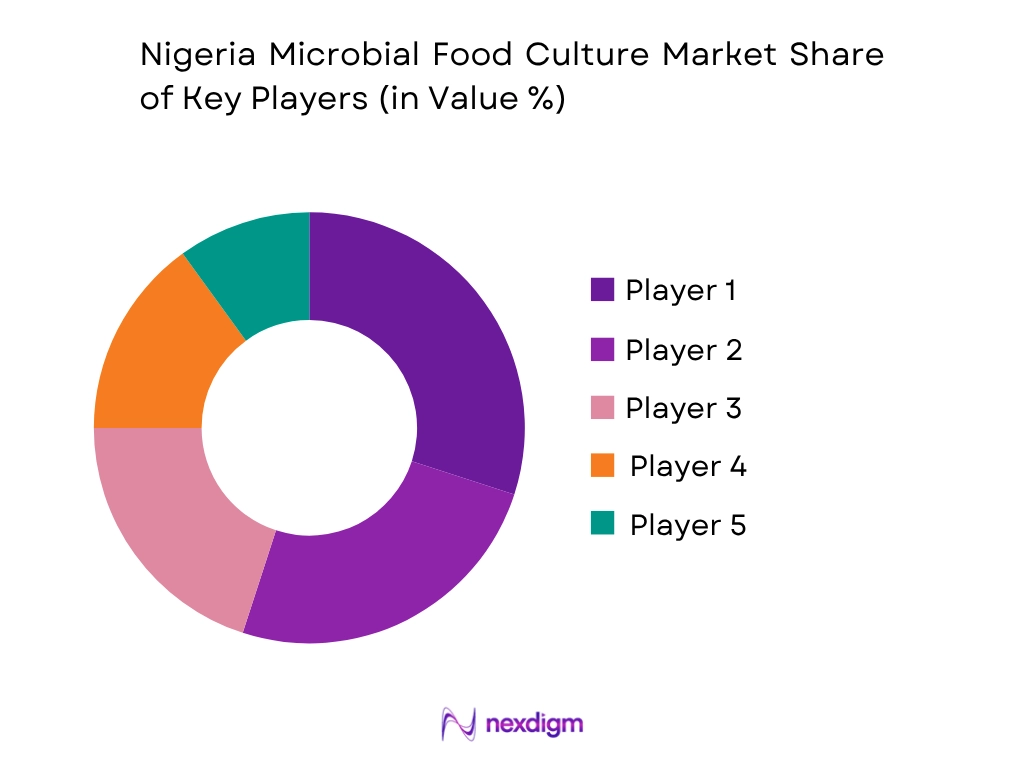
The Nigeria Microbial Food Culture Market includes multinational bioscience companies, global yeast manufacturers, specialist culture suppliers, regional ingredient businesses, and local importers. Novonesis and IFF offer broad fermented-dairy, probiotic, protective, and plant-based culture systems. Lallemand supplies specialty cultures for dairy, meat, and plant-based applications, while Lesaffre and AB Mauri have strong bakery-fermentation capabilities. Competition centres on microbial-strain performance, ambient stability, application coverage, local stock availability, technical assistance, and regulatory documentation.
| Company | Establishment Year | Headquarters | Core Culture Portfolio | Principal Applications | Product Formats | Nigeria Route to Market | Technical Capability | Strategic Differentiation |
| Novonesis | 2024 as merged entity | Lyngby, Denmark | ~ | ~ | ~ | ~ | ~ | ~ |
| International Flavors & Fragrances | 1958 | New York, United States | ~ | ~ | ~ | ~ | ~ | ~ |
| Lallemand | 1915 | Montreal, Canada | ~ | ~ | ~ | ~ | ~ | ~ |
| Lesaffre | 1853 | Marcq-en-Barœul, France | ~ | ~ | ~ | ~ | ~ | ~ |
| AB Mauri | 2004 as current group | Peterborough, United Kingdom | ~ | ~ | ~ | ~ | ~ | ~ |
Nigeria Microbial Food Culture Market Analysis
Growth Drivers
Urbanization and Commercialization of Fermented Foods
Nigeria’s expanding population and urban food-distribution system are increasing demand for standardized microbial cultures used in yoghurt, drinking yoghurt, bread, ogi, kunu, garri, fufu, fermented condiments, and functional beverages. World Bank data placed Nigeria’s population at approximately 233 million people in 2024, creating a substantial base for both traditional and packaged fermented-food consumption. The country’s gross domestic product reached USD 252.26 billion, while gross domestic product per person stood at USD 1,084.2. Commercial processors serving Lagos, Ogun, Abuja, Kano, Kaduna, Ibadan, Port Harcourt, and Onitsha must manufacture products with consistent acidity, flavour, texture, and storage performance across large distribution networks. This requirement favours defined starter cultures over spontaneous fermentation, in which microbial activity varies with raw materials, temperature, water quality, and processing hygiene. Nigeria’s digital connectivity also supports organized food sales and wider product discovery: the World Bank recorded 41 internet users per 100 residents in 2024. Online grocery, social commerce, food delivery, and direct-to-retailer ordering allow yoghurt, bakery, cereal-beverage, and probiotic brands to reach customers beyond conventional supermarket channels. Commercial cultures help these businesses maintain reproducible products as production volumes and delivery distances increase. Dairy processors use lactic acid bacteria to control yoghurt viscosity and acidification, while bakeries require yeast with predictable gas production and dough tolerance. Cereal and cassava processors can use selected cultures to shorten fermentation variability while retaining familiar flavour. Urbanization therefore supports market development through population scale, packaged-food demand, broader retail access, and the gradual conversion of traditional fermentation into controlled commercial processing.
Industrial Food Processing and Standardized Production
Nigeria’s expanding manufacturing and food-processing activity supports recurring demand for starter cultures, baker’s yeast, probiotics, protective cultures, and application-specific microbial blends. The National Bureau of Statistics recorded nominal gross domestic product of ₦52,103,927.13 million in the second quarter of 2024, while real economic activity increased by 3.19 points, compared with 2.51 points in the corresponding period of 2023. Agriculture expanded by 1.41 points during the quarter, providing cassava, maize, sorghum, millet, legumes, milk, fruit, and other substrates used in fermented foods. More recent NBS data showed manufacturing activity increasing by 3.29 points in the first quarter of 2026, indicating continued development of the production base supporting packaged foods. Industrial processors cannot depend on unmanaged fermentation because delayed acidification, weak yeast activity, contamination, or inconsistent flavour can interrupt filling, baking, packaging, and distribution schedules. Defined cultures allow manufacturers to establish repeatable fermentation curves, dosing procedures, and quality specifications. Yoghurt plants require organisms capable of predictable acid formation and texture development. Industrial bakeries need yeast that performs under variations in flour quality, mixing intensity, proofing temperature, and production speed. Processors producing ogi, kunu, garri, fufu, or fermented condiments can use selected strains to improve process consistency and reduce dependence on carried-over starters. NAFDAC recognizes milk and dairy products, beverages, meat products, and other processed foods within its food-manufacturing regulatory framework, increasing the importance of trained personnel, documented processes, and hygienic production. Industrialization therefore drives the microbial food culture market by increasing batch sizes, formalizing quality control, expanding packaged-food output, and converting fermentation from an uncontrolled biological event into a monitored manufacturing stage.
Market Challenges
Import Dependence, Currency Exposure, and Culture Stability
Nigeria’s microbial food culture market is constrained by its dependence on imported proprietary strains and the operational difficulty of maintaining viable microorganisms through international freight, customs clearance, warehousing, and inland delivery. The National Bureau of Statistics recorded total merchandise imports of ₦12,643.23 billion in the first quarter of 2024, including ₦920.54 billion of imported agricultural goods. Imports subsequently reached ₦14,674.05 billion in the third quarter and ₦16,590.51 billion in the fourth quarter, demonstrating the scale and variability of the trade system through which specialist cultures, ingredients, laboratory materials, and processing equipment must move. Frozen starter concentrates require uninterrupted low-temperature storage, while freeze-dried cultures still need protection from heat, humidity, and repeated exposure during handling. Currency volatility can also affect import planning, distributor inventory, and the ability of processors to maintain emergency stocks. A weakened culture may appear physically normal but acidify too slowly or produce inadequate fermentation activity. In yoghurt, this can lead to weak gel formation, whey separation, delayed packaging, or excessive post-acidification. In bread, low yeast activity can affect proofing time, loaf volume, and line throughput. Cereal and cassava fermentations may develop inconsistent acidity or undesirable microbial growth when starter activity is inadequate. Importers must balance the risk of insufficient inventory against viability loss during prolonged storage. The challenge is particularly significant for processors located far from Lagos and other major import and distribution hubs. Effective market participation therefore requires temperature-monitored logistics, insulated delivery, lot rotation, backup power, emergency replacement inventory, and technical teams capable of identifying whether a failure resulted from the culture, raw material, sanitation, temperature, or dosing process.
Limited Specialized Workforce and Fragmented Processing Capacity
Nigeria has extensive labour availability, but controlled microbial fermentation requires specialized competence in food microbiology, dairy science, baking, biotechnology, quality assurance, and process engineering. The National Bureau of Statistics recorded a labour-force participation rate of 77.3 points in the first quarter of 2024, including 74.0 points in urban areas and 82.5 points in rural areas. In the second quarter, the employment-to-population ratio reached 76.1 points, while informal employment accounted for 93 workers out of every 100 employed people. This high level of informality is relevant to microbial food cultures because many processors of ogi, garri, fufu, kunu, iru, ugba, nono, and related foods operate through small enterprises with limited laboratories, refrigeration, dosing equipment, and documented fermentation procedures. NAFDAC’s current framework defines a micro-scale food-manufacturing facility as an enterprise with no more than 5 employees, illustrating the small operating scale of many potential users. Commercial cultures require more than basic production knowledge. Personnel must understand inoculation levels, storage conditions, rehydration, temperature control, pH development, contamination indicators, and culture interactions with raw materials. Dairy staff must distinguish between poor starter activity, antibiotic residues, unsuitable heat treatment, and environmental contamination. Cassava processors need to manage acidification and detoxification, while cereal processors must control mixed bacterial and yeast activity. Smaller businesses may purchase cultures without sufficient technical support and then obtain inconsistent results through improper storage or dosing. Suppliers therefore need to provide small pack sizes, simplified instructions, field trials, training, and remote troubleshooting. The workforce constraint does not indicate a lack of available workers; it reflects an uneven distribution of technical capability between large industrial companies and numerous informal or micro-scale processors.
Market Opportunities
Indigenous Strain Development and Fermentation Technology
Nigeria has a strong opportunity to commercialize microorganisms adapted to local dairy, cereal, cassava, legume, and beverage substrates. Its population of approximately 233 million people, gross domestic product of USD 252.26 billion, and large agricultural economy provide a substantial base for developing cultures for ogi, akamu, garri, fufu, kunu, iru, dawadawa, ugba, nono, kindirimo, palm wine, pito, and burukutu. In the second quarter of 2024, agriculture generated ₦7,941,364.34 million in nominal economic activity and expanded by 1.41 points in real terms, demonstrating the scale of the raw-material system available to food processors. Indigenous fermented foods contain lactic acid bacteria, yeasts, Bacillus species, and mixed microbial communities selected naturally through repeated processing. These organisms can be isolated, identified, screened for safety, and evaluated for acidification, flavour production, heat tolerance, and substrate performance. Commercial starter blends could reduce fermentation variability while preserving sensory characteristics expected by Nigerian consumers. Technology can also improve distribution. Freeze-drying, microencapsulation, protective carriers, and moisture-resistant packaging can produce cultures better suited to warm conditions and extended inland transport. Digital pH meters, temperature sensors, mobile production records, and simplified dosing systems can allow small processors to identify failed fermentation earlier. World Bank data showing 41 internet users per 100 residents in 2024 support the use of mobile training, remote technical assistance, digital batch records, and distributor ordering systems. The opportunity extends beyond replacing traditional methods. Locally validated cultures can enable packaged traditional foods, probiotic cereal beverages, fermented plant proteins, and protective cultures for products distributed without continuous refrigeration. Current population, agricultural-output, digital-access, and manufacturing indicators provide a practical foundation for future market growth without relying on speculative forecasts.
International Collaboration and West African Distribution
International partnerships can accelerate Nigeria’s access to proprietary strain libraries, probiotic documentation, fermentation equipment, freeze-drying systems, biopreservation technology, and industrial application expertise. Nigeria’s merchandise trade reached ₦31,810.59 billion in the first quarter of 2024, comprising ₦19,167.36 billion in exports and ₦12,643.23 billion in imports. In the first quarter of 2025, imports remained substantial at ₦15,426.17 billion, confirming the country’s continued integration with international suppliers of machinery, ingredients, packaging, laboratory equipment, and biological preparations. Partnerships can begin with imported finished cultures and progress toward local inventory, application testing, repacking, blending, quality control, indigenous strain screening, and pilot fermentation. International culture companies can contribute documented dairy strains, yeast systems, protective cultures, phage-management expertise, and probiotic stability methods. Nigerian partners can provide knowledge of local substrates, consumer taste, regulatory procedures, distribution conditions, and traditional fermentation. Collaboration is particularly relevant because Nigeria includes 36 states and the Federal Capital Territory, creating a broad domestic distribution opportunity and a platform for serving neighbouring ECOWAS markets. Local application laboratories in Lagos, Ogun, Abuja, Kano, or Kaduna could test cultures in reconstituted milk, fresh milk, maize, millet, sorghum, cassava, soybean, cowpea, and local beverage formulations before industrial adoption. Partnerships can also address skills constraints through operator training, laboratory exchanges, certification, and remote fermentation monitoring. NAFDAC’s food-hygiene guidance applies across regulatory officers, primary producers, food handlers, establishments, and other stakeholders, creating a framework within which international technology can be adapted to Nigerian production conditions. The strongest opportunity is therefore not simple import resale, but the creation of a West African fermentation platform combining local inventory, technical service, traditional-food expertise, regulatory support, and regional distribution.
Future Outlook
The Nigeria Microbial Food Culture Market is expected to develop during 2026–2035 as food manufacturers shift from variable spontaneous fermentation toward controlled microbial systems. Demand will be supported by yoghurt manufacturing, industrial bread production, cereal and cassava processing, traditional condiment commercialization, functional beverages, and locally adapted plant-based products. Starter cultures are likely to remain the foundation of commercial adoption. Direct-vat inoculation formats can reduce contamination, simplify culture handling, and provide more consistent fermentation than repeated back-slopping. Freeze-dried cultures are particularly relevant to Nigeria because they can offer greater logistics flexibility than deeply frozen concentrates, although they still require controlled storage.Dairy applications will continue to provide recurring demand. Defined yoghurt cultures allow processors to control acidity, texture, flavour, fermentation duration, and post-acidification. Culture systems that perform well with reconstituted milk, local fresh milk, soy bases, and blended dairy formulations will be especially relevant to processors working with variable raw-material supply.
Major Players
- Novonesis
- International Flavors & Fragrances
- dsm-firmenich
- Lallemand
- Lesaffre
- AB Mauri
- Kerry Group
- Sacco System
- CSK Food Enrichment
- Biochem
- Angel Yeast
- AB Biotek
- LB Bulgaricum
- Biena
- Dalton Biotecnologie
Key Target Audience
- Dairy and yoghurt processors
- Industrial bakery and yeast users
- Cereal and cassava food manufacturers
- Traditional condiment and fermented-beverage producers
- Food-ingredient importers and distributors
- Investments and venture capitalist firms
- Private-equity and strategic food-industry investors
- Government and regulatory bodies
Research Methodology
Step 1: Identification of Key Variables
The initial phase involves constructing an ecosystem map covering microbial-culture manufacturers, importers, distributors, dairy processors, bakeries, cereal processors, cassava businesses, traditional food producers, and regulatory authorities. Secondary and proprietary sources are used to define variables such as culture type, dosage, format, application, processor scale, import dependence, ambient stability, and technical-service requirements.
Step 2: Market Analysis and Construction
Historical market information is compiled by culture type, microorganism, application, customer scale, distribution route, and region. The bottom-up analysis evaluates processor numbers, fermentation-batch frequency, culture dosage, and commercial-culture adoption. The top-down assessment reviews food-manufacturing activity, culture imports, supplier revenues, dairy processing, bakery production, and relevant fermented-food categories.
Step 3: Hypothesis Validation and Expert Consultation
Preliminary hypotheses are validated through computer-assisted telephone interviews with culture suppliers, food microbiologists, dairy technologists, bakery specialists, production managers, procurement teams, distributors, and regulatory professionals. These consultations examine purchasing cycles, product trials, storage losses, customer conversion, culture performance, technical barriers, and supplier-selection criteria.
Step 4: Research Synthesis and Final Output
Supply-side and demand-side findings are triangulated to reconcile supplier shipments, distributor inventory, and processor consumption. Segment shares and forecasts are reviewed against application volume, dosage assumptions, import lead times, technical requirements, and expert feedback. The final output provides an internally consistent assessment of competition, demand, market structure, and future opportunities.

- Executive Summary
- Research Methodology (Market Definitions and Assumptions, Product Inclusion and Exclusion Criteria, Abbreviations, Market Sizing Approach, Top-Down Analysis, Bottom-Up Analysis, Culture-Dosage Consumption Model, Dairy and Fermented-Food Output Assessment, Demand-Side Assessment, Supply-Side Assessment, Import-Based Supply Assessment, Primary Industry Interviews, Data Triangulation, Forecasting Framework, Scenario Analysis, Limitations and Future Conclusions)

- Definition and Scope
- Market Evolution and Industry Genesis
- Development of Commercial Food Fermentation in Nigeria
- Transition from Spontaneous Fermentation to Standardized Starter Cultures
- Role of Microbial Cultures in Nigerian Food Manufacturing
- Evolution of Yoghurt, Nono, Kindirimo and Cultured Dairy Applications
- Commercial Development of Ogi, Garri, Fufu, Kunu and Iru

- Growth Drivers (Large Population and Urban Food Demand, Expansion of Packaged Yoghurt Production, Industrial Bakery Growth, Commercialization of Traditional Fermented Foods, Dairy Development Programs, Demand for Functional and Probiotic Foods, Modern Retail Expansion, Food-Safety Standardization)
- Market Challenges (Dependence on Imported Proprietary Strains, Foreign-Exchange Volatility, Electricity and Refrigeration Constraints, Culture Viability Loss, Limited Fermentation Skills, Fragmented Small-Processor Base, Raw-Milk Supply Gaps, Variable Traditional Fermentation Practices)
- Market Opportunities (Commercialization of Indigenous Strains, Standardized Ogi and Kunu Cultures, Cassava Fermentation Systems, Protective Cultures for Ambient Distribution, Probiotic Traditional Foods, Local Culture Blending and Repacking, Dairy Localization, West African Distribution Expansion)
- Market Trends (Direct-Vat Inoculation, Freeze-Dried Culture Adoption, Ambient-Stable Culture Systems, Multi-Strain Blends, Clean-Label Bioprotection, Indigenous Microbiome Screening, Low-Cost Small-Batch Culture Packs, Fermented Plant Proteins, Digital Fermentation Monitoring and Probiotic Fortification)
- SWOT Analysis
- Porter’s Five Forces Analysis
- PESTLE Analysis

- By Market Value (2020-2025)
- By Culture Consumption Volume (2020-2025)
- By Active Microbial Preparation Volume (2020-2025)

- By Culture Type (In Value %)
Starter Cultures
Probiotic Cultures
Protective and Biopreservation Cultures
Adjunct and Ripening Cultures
Aroma and Flavour Development Cultures
Customized Mixed Cultures - By Application (In Value %)
Fermented Dairy Products
Bakery and Sourdough Products
Traditional Cereal-Based Foods
Cassava-Based Fermented Foods
Fermented Condiments
Fermented Beverages - By Distribution Model (In Value %)
Direct Sales by Culture Manufacturers
Authorized Food-Ingredient Distributors
Food-Ingredient Importers
Dairy and Bakery Ingredient Distributors
Application-Solution Providers - By Region (In Value %)
South West
South East
South South
North Central
North West
North East

- Market Share of Major Players (By Value, Culture Volume, Application, Culture Type, Customer Segment and Distribution Model)
- Cross Comparison Parameters (Culture Portfolio Breadth, Microbial-Strain Library Depth, Nigerian Traditional-Food Application Coverage, Culture Format and Ambient-Stability Performance, Local Technical-Support Capability, NAFDAC Documentation Strength, Nigeria Distribution and Inventory Reach, Product Innovation and Customization Capability)
- SWOT Analysis of Major Players
- Detailed Profiles of Major Companies
Novonesis
International Flavors & Fragrances
dsm-firmenich
Lallemand
Lesaffre
AB Mauri
Kerry Group
Sacco System
CSK Food Enrichment
Biochem
Angel Yeast
AB Biotek
LB Bulgaricum
Biena
Dalton Biotecnologie

- Dairy Processor Analysis
- Traditional Cereal-Food Processor Analysis
- Cassava Processor Analysis
- Fermented Condiment Producer Analysis
- Bakery Manufacturer Analysis
- Fermented Beverage Producer Analysis

- By Market Value (2026-2035)
- By Culture Consumption Volume (2026-2035)
- By Active Microbial Preparation Volume (2026-2035)


 Request a Sample
 Ask for Customization
 Get a Quote
 Enquire Now