

 Download PDF
Market Overview
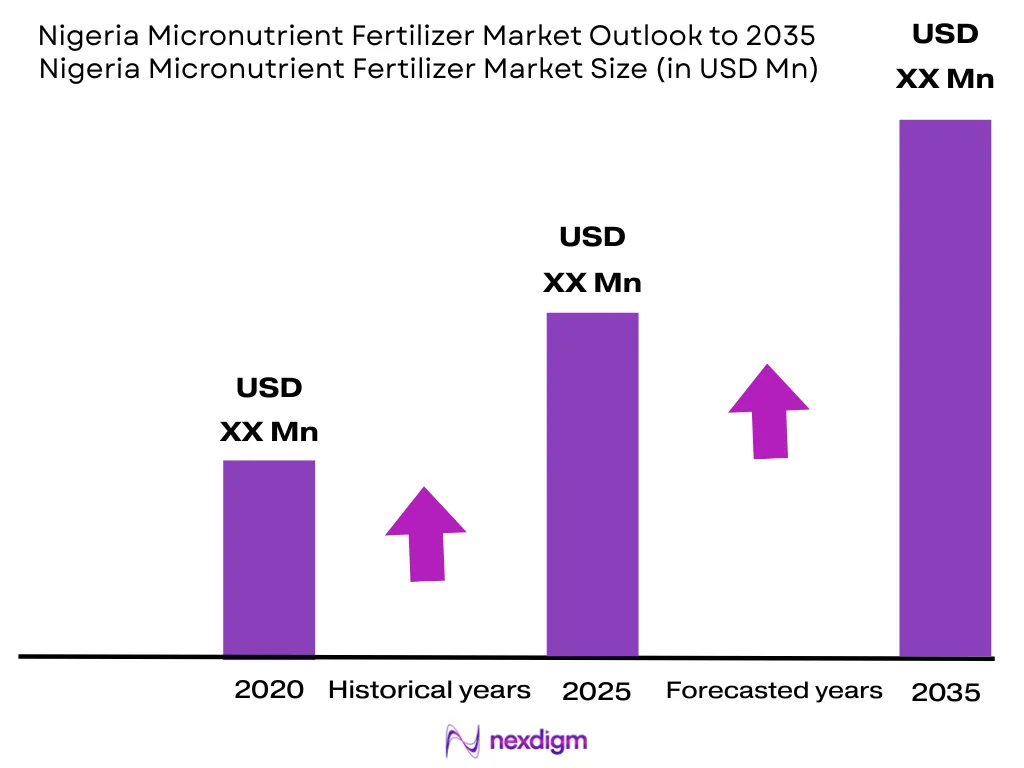
The Nigeria Micronutrient Fertilizer Market is valued at approximately USD ~ Million, supported by increasing demand for crop yield enhancement and soil nutrient management across the country. According to the World Bank, Nigeria’s agricultural sector contributed over NGN ~ trillion to the national economy, while agriculture continues to employ more than 30 million people. Rising cultivation of maize, rice, cassava, soybean, and horticultural crops has increased the need for zinc, boron, iron, and manganese fertilizers. Government-backed fertilizer initiatives, expansion of commercial farming activities, and growing awareness regarding soil micronutrient deficiencies continue to support market development. Increasing pressure on available farmland and the need to improve productivity per hectare have further accelerated the adoption of micronutrient-based nutrient management solutions.
Market Segmentation
By Nutrient Type
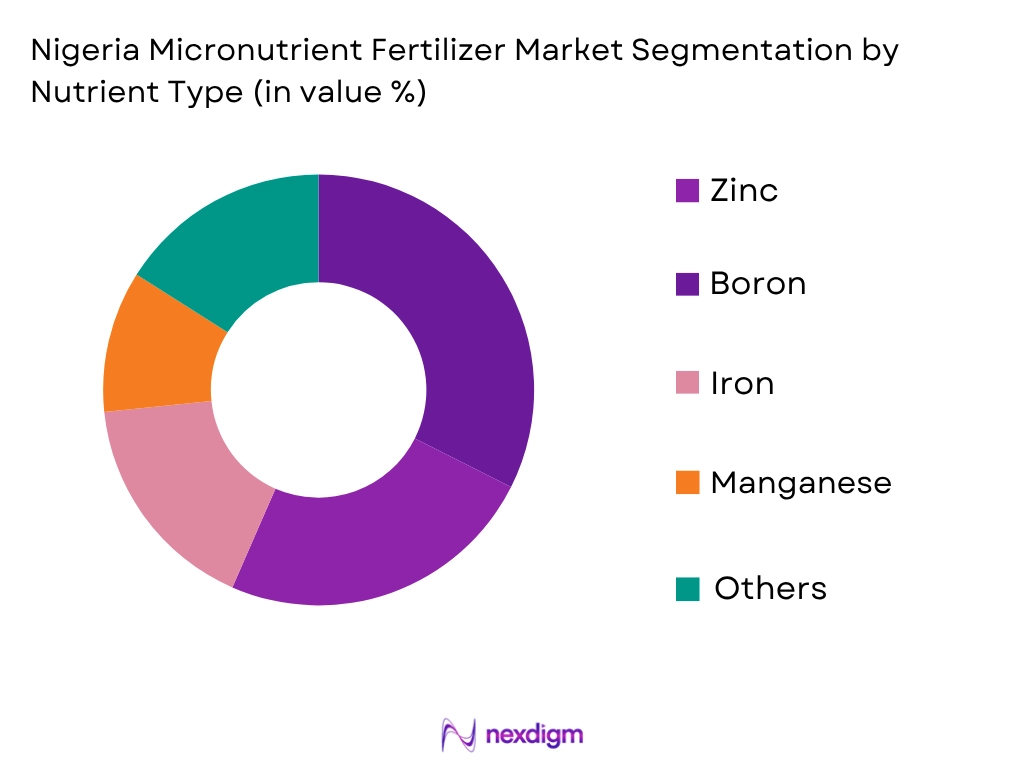
By Micronutrient Type, the Nigeria Micronutrient Fertilizer Market is segmented into Zinc Fertilizers, Boron Fertilizers, Iron Fertilizers, Manganese Fertilizers, and Others. Zinc Fertilizers hold the dominant market share due to the widespread zinc deficiency observed across cultivated soils in Nigeria. Zinc plays a critical role in maize, rice, wheat, and soybean production, which represent some of the country’s most important crops. Increasing efforts to improve crop productivity and nutritional quality have encouraged farmers to incorporate zinc-based nutrient formulations into their fertilization programs. Government-supported soil health initiatives and agronomic recommendations from agricultural extension services have further strengthened adoption. The availability of zinc-enriched blended fertilizers through both public and private distribution channels has also contributed to market leadership. As productivity improvement remains a priority for Nigerian agriculture, zinc fertilizers continue to account for the largest share of micronutrient fertilizer demand.
By Crop Type
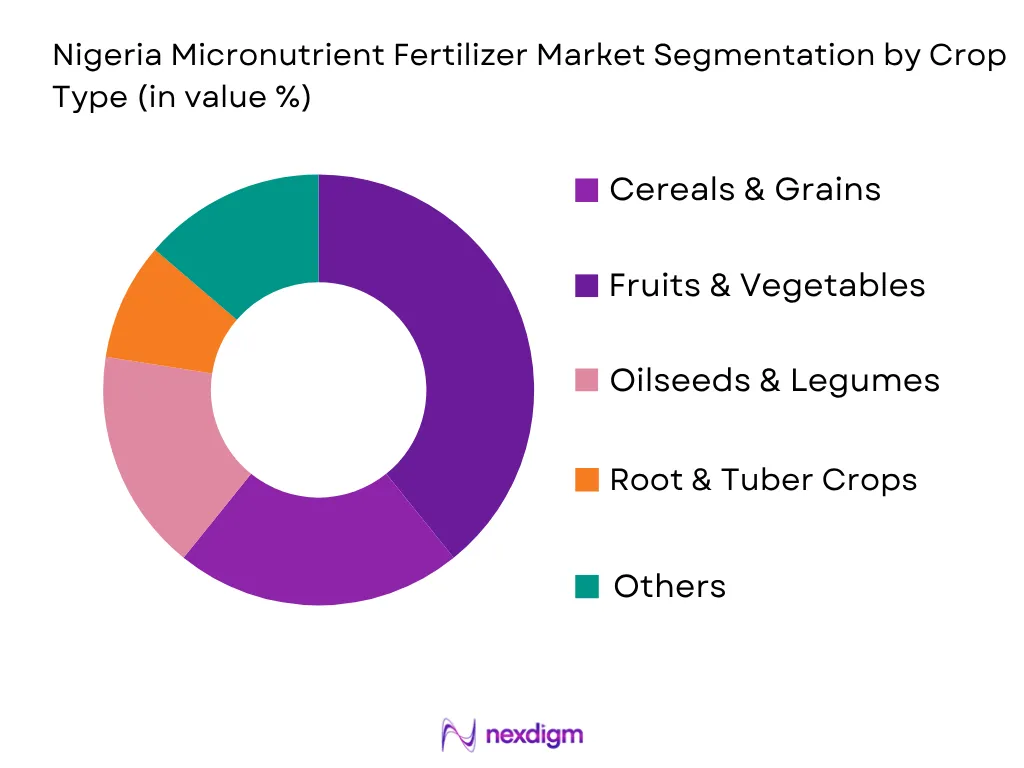
By Crop Type, the market is segmented into Cereals & Grains, Fruits & Vegetables, Oilseeds & Legumes, Root & Tuber Crops, and Others. Cereals & Grains dominate the market due to the extensive cultivation of maize, rice, sorghum, and millet throughout Nigeria. These crops occupy a significant share of cultivated farmland and serve as staple food sources for the country’s rapidly growing population. Continuous cultivation and nutrient depletion have increased the need for balanced fertilization, including micronutrient supplementation. Farmers increasingly recognize the importance of zinc, boron, and iron in improving grain development, yield performance, and resistance to environmental stress. Government food security initiatives aimed at boosting domestic grain production have further supported fertilizer consumption. The widespread acreage under cereal cultivation and the strategic importance of grain self-sufficiency continue to position this segment as the leading consumer of micronutrient fertilizers in Nigeria.
Competitive Landscape
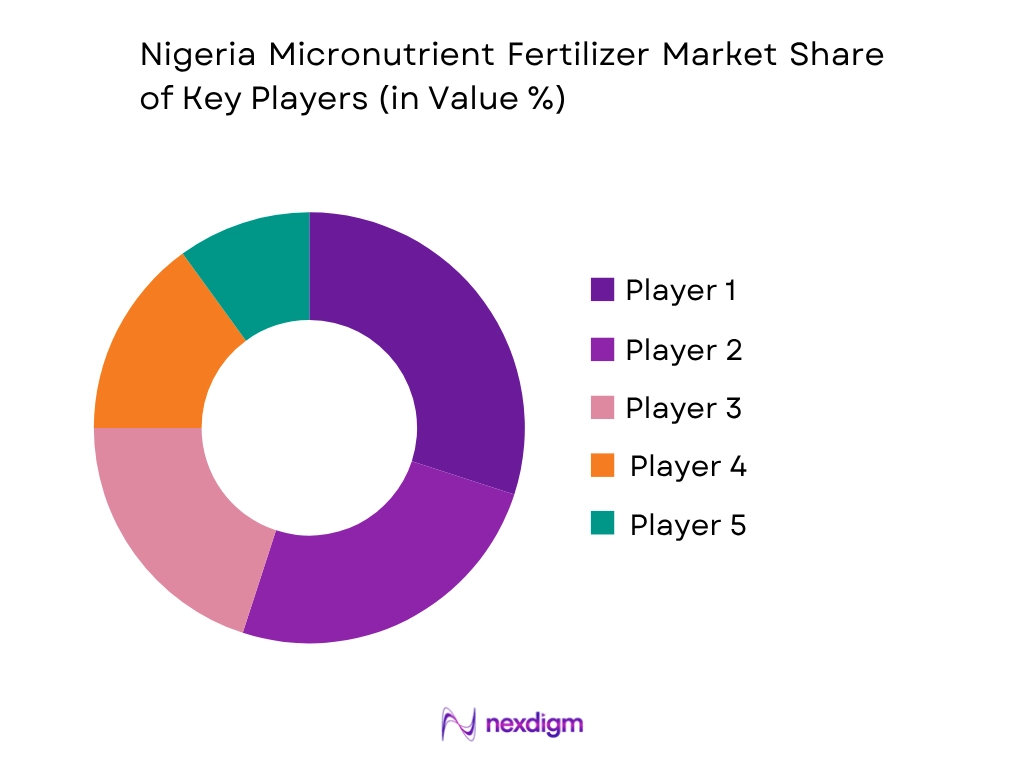
The Nigeria Micronutrient Fertilizer Market remains moderately consolidated with the presence of both multinational agricultural input providers and domestic fertilizer producers. Major companies compete through extensive distribution networks, crop-specific nutrient solutions, strategic dealer partnerships, and product innovation. Market participants increasingly focus on micronutrient-enriched fertilizer blends, agronomic support services, and precision farming solutions to strengthen their competitive position.
| Company | Establishment Year | Headquarters | Product Portfolio | Micronutrient Focus | Crop Focus | Distribution Reach | Blending Capabilit | Dealer Network |
| OCP Africa Nigeria | 2016 | ~ | ~ | ~ | ~ | ~ | ~ | ~ |
| Indorama Eleme Fertilizer | 2016 | ~ | ~ | ~ | ~ | ~ | ~ | ~ |
| Notore Chemical Industries | 2005 | ~ | ~ | ~ | ~ | ~ | ~ | ~ |
| Yara Nigeria | 1905 | ~ | ~ | ~ | ~ | ~ | ~ | ~ |
| UPL Nigeria | 1969 | ~ | ~ | ~ | ~ | ~ | ~ | ~ |
Nigeria Micronutrient Fertilizer Market Analysis
Growth Drivers
Rising Food Production Requirements
Nigeria’s micronutrient fertilizer market is being driven by the country’s growing need to increase agricultural productivity and food production. According to the World Bank, Nigeria’s population exceeded 229 million people, making it the most populous country in Africa and creating substantial pressure on domestic food systems. The Food and Agriculture Organization (FAO) reports that Nigeria cultivates more than 34 million hectares of arable land, while the National Bureau of Statistics recorded agricultural GDP exceeding NGN 19 trillion. Major crops such as maize, rice, sorghum, soybean, cassava, and yam require balanced nutrient management, particularly zinc, boron, iron, and manganese. The Federal Ministry of Agriculture reported annual maize production above 12 million metric tons and rice production exceeding 8 million metric tons. Continuous cultivation has accelerated micronutrient depletion in agricultural soils across northern and central farming belts. The International Institute of Tropical Agriculture has identified widespread deficiencies of zinc and boron in major crop-producing regions. With over 70 million hectares classified as agricultural land and increasing pressure to improve yields from existing farmland, farmers are increasingly adopting micronutrient fertilizers to enhance nutrient uptake, improve crop quality, and sustain productivity. This growing requirement for food security and yield optimization continues to support demand for micronutrient fertilizer products throughout Nigeria.
Expansion of Commercial Agriculture and Fertilizer Programs
Commercial agriculture expansion is another major driver supporting Nigeria’s micronutrient fertilizer market. The Central Bank of Nigeria and the Federal Ministry of Agriculture have continued supporting large-scale farming initiatives through agricultural intervention programs targeting staple crops. Nigeria’s agricultural sector employs more than 36 million people and contributes over NGN 50 trillion to economic activity. The country produces approximately 60 million metric tons of cassava annually, making it one of the world’s largest producers, while maize and rice production continue to expand across Kaduna, Kano, Niger, Benue, and Kebbi states. The Presidential Fertilizer Initiative has improved fertilizer availability through domestic blending operations, increasing awareness regarding balanced crop nutrition. According to the National Fertilizer Quality Control Department, more than 80 blending plants operate across Nigeria, improving access to customized nutrient formulations. Commercial farms cultivating cereals, legumes, vegetables, and export-oriented crops are increasingly utilizing micronutrient-enriched fertilizer blends to maximize productivity and maintain soil fertility. Rising private sector investment in agribusiness, irrigation infrastructure, and mechanized farming further supports nutrient-intensive agricultural practices. These developments encourage farmers to move beyond traditional NPK fertilizer applications and adopt micronutrient products that address specific soil deficiencies, thereby strengthening long-term market demand.
Market Challenges
Limited Soil Testing Infrastructure and Farmer Awareness
A major challenge affecting the Nigeria micronutrient fertilizer market is the limited availability of soil testing infrastructure and inadequate awareness regarding micronutrient deficiencies. Nigeria has more than 34 million hectares of cultivated land, yet access to professional soil testing services remains concentrated in a limited number of agricultural research institutions and state-level extension programs. The Federal Ministry of Agriculture reports that millions of smallholder farmers continue to rely on traditional fertilizer application methods without conducting soil analysis. According to the World Bank, agriculture remains the primary source of livelihood for a large rural population exceeding 100 million people, many of whom operate on small farm sizes. This limits understanding of nutrient imbalances and reduces adoption of specialized micronutrient products. While macronutrient fertilizers such as NPK and urea are widely recognized, knowledge regarding zinc, boron, iron, copper, and manganese deficiencies remains relatively low among small-scale farmers. The National Agricultural Extension and Research Liaison Services has repeatedly highlighted gaps in extension coverage across rural farming communities. As a result, many farmers underapply or completely omit micronutrients, leading to reduced market penetration. Addressing awareness and diagnostic limitations remains critical for broader adoption of micronutrient fertilizer technologies across Nigeria’s agricultural sector.
Dependence on Imported Specialty Micronutrient Inputs
Nigeria’s micronutrient fertilizer market faces challenges arising from dependence on imported specialty raw materials and micronutrient compounds. While domestic fertilizer blending capacity has improved significantly, many chelated micronutrients and specialized nutrient formulations continue to be sourced from international suppliers. According to the National Bureau of Statistics, Nigeria’s imports of agricultural chemical products remain substantial due to limited domestic manufacturing of specialty nutrient ingredients. The country’s foreign exchange fluctuations and logistics constraints create uncertainty in the supply chain for micronutrient fertilizer producers and distributors. The Nigerian Ports Authority manages over 70 million metric tons of cargo annually, yet delays associated with customs processing, transportation bottlenecks, and inland distribution continue to affect agricultural input availability. Major agricultural states located in northern Nigeria often face additional logistics challenges due to long-distance transportation requirements from coastal entry points. Furthermore, imported micronutrient ingredients are subject to international supply chain disruptions that can affect product availability and consistency. Small distributors and retailers operating in remote agricultural regions may experience difficulties maintaining adequate inventory levels. These supply chain limitations can constrain market expansion and reduce the availability of crop-specific micronutrient products, particularly for smallholder farmers operating in underserved agricultural zones.
Market Opportunities
Precision Agriculture and Customized Nutrient Management
The increasing adoption of precision agriculture presents a significant opportunity for Nigeria’s micronutrient fertilizer market. Nigeria possesses more than 70 million hectares of agricultural land, creating substantial demand for technologies that improve nutrient efficiency and crop productivity. The Federal Ministry of Agriculture continues to promote modern farming techniques, including digital agriculture platforms, soil mapping, and nutrient management systems. According to the Nigerian Communications Commission, mobile subscriptions exceed 220 million connections, providing a strong foundation for digital advisory services and precision farming solutions. Agricultural technology companies are increasingly utilizing satellite imagery, geospatial mapping, and soil diagnostics to identify nutrient deficiencies at farm level. These developments enable the application of targeted micronutrient formulations rather than uniform fertilizer programs. Large-scale producers of maize, rice, soybean, vegetables, and cash crops are showing increasing interest in site-specific nutrient recommendations. The International Institute of Tropical Agriculture continues to support soil health initiatives aimed at improving nutrient-use efficiency across major farming regions. As precision agriculture expands, demand for specialized zinc, boron, iron, and manganese products is expected to increase. This trend creates opportunities for manufacturers and distributors to introduce customized micronutrient solutions designed for specific crops, soil conditions, and agroecological zones.
Growth of High-Value Horticulture and Export Crops
The expansion of horticulture and export-oriented agriculture offers considerable growth opportunities for Nigeria’s micronutrient fertilizer market. Nigeria produces more than 12 million metric tons of fruits and vegetables annually, while export crops such as cocoa, sesame, ginger, and cashew continue to gain international importance. According to the Nigerian Export Promotion Council, agricultural exports generated billions of naira in foreign exchange earnings through shipments of non-oil commodities. High-value crops generally require balanced micronutrient nutrition to achieve export-quality standards, improve fruit development, and enhance resistance to environmental stress. Cocoa-growing regions in Ondo, Osun, Ekiti, and Cross River increasingly utilize nutrient management programs to improve bean quality and productivity. Similarly, vegetable producers supplying urban markets in Lagos, Abuja, Kano, and Port Harcourt require micronutrient inputs to maintain crop performance under intensive cultivation systems. The Federal Ministry of Agriculture continues supporting diversification away from oil dependency through expanded agricultural production and export development. Rising investments in irrigation projects, greenhouse farming, and commercial horticulture further strengthen demand for specialized micronutrient fertilizers. As Nigerian producers focus on quality enhancement and export competitiveness, micronutrient fertilizer adoption is expected to become increasingly important within the country’s high-value agricultural segments.
Future Outlook
The Nigeria Micronutrient Fertilizer Market is expected to witness sustained expansion over the forecast period, supported by increasing awareness of soil health management, rising food demand, and government initiatives aimed at improving agricultural productivity. Growing adoption of precision agriculture technologies, blended fertilizer programs, and commercial farming practices will continue to drive demand. Expansion of irrigation infrastructure and increasing investments in agribusiness are expected to further strengthen market prospects. Demand for crop-specific nutrient solutions and specialty micronutrient formulations is likely to increase as farmers focus on maximizing yields from limited arable land.
Major Players
- OCP Africa Nigeria
- Indorama Eleme Fertilizer & Chemicals Ltd.
- Notore Chemical Industries Plc
- Yara Nigeria
- UPL Nigeria
- Golden Fertilizer Company Limited
- Springfield Agro Limited
- BASF Nigeria
- Syngenta Nigeria
- Agricare Fertilizers Limited
- Harvestfield Industries Limited
- Matrix Fertilizers Limited
- TAK Agro Plc
- Jubilant Agri Products Nigeria
- IITA Soil Health Program
Key Target Audience
- Fertilizer Manufacturers
- Micronutrient Fertilizer Distributors
- Commercial Farming Enterprises
- Agribusiness Companies
- Agricultural Cooperatives
- Investments and Venture Capitalist Firms
- Government and Regulatory Bodies
- Agricultural Input Retailers
Research Methodology
Step 1: Identification of Key Variables
The study begins with mapping the complete ecosystem of the Nigeria Micronutrient Fertilizer Market. Secondary research is conducted to identify critical variables including crop acreage, fertilizer consumption patterns, micronutrient deficiencies, agricultural production trends, and distribution infrastructure.
Step 2: Market Analysis and Construction
Historical market trends are evaluated using industry databases, trade statistics, company disclosures, and agricultural indicators. Market sizing is conducted using both top-down and bottom-up approaches while assessing fertilizer demand across crop categories and regions.
Step 3: Hypothesis Validation and Expert Consultation
Preliminary findings are validated through discussions with fertilizer manufacturers, distributors, agronomists, agricultural associations, and industry experts. These consultations help refine assumptions regarding market dynamics, competitive positioning, and demand patterns.
Step 4: Research Synthesis and Final Output
All findings are triangulated using primary and secondary sources to ensure consistency and accuracy. The final report provides a comprehensive assessment of market structure, competition, opportunities, risks, and future growth potential.

- Executive Summary
- Research Methodology (Market Definitions and Assumptions, Abbreviations, Market Sizing Approach, Bottom-Up Analysis, Top-Down Validation, Primary Research Framework, Secondary Research Sources, Industry Expert Interviews, Data Triangulation Model, Limitations and Forecasting Methodology)

- Definition and Scope
- Market Ecosystem and Industry Structure
- Evolution of Micronutrient Fertilizer Usage in Nigeria
- Agricultural Value Chain Analysis
- Supply Chain and Distribution Network Assessment

- Growth Drivers (Food Security Initiatives, Soil Nutrient Deficiency, Rising Crop Productivity Requirements, Fertilizer Subsidy Programs, Commercial Farming Expansion)
- Market Challenges (Farmer Awareness Gap, Limited Soil Testing Infrastructure, Import Dependency, Counterfeit Agricultural Inputs, Distribution Bottlenecks)
- Market Opportunities (Precision Agriculture, Specialty Crop Cultivation, Blended Fertilizer Expansion, Digital Agriculture Platforms, Climate-Smart Farming)
- Market Trends (Customized Crop Nutrition, Water-Soluble Micronutrients, Integrated Nutrient Management, Biofortification Programs, Sustainable Agriculture)
- Government Regulations (Federal Ministry of Agriculture Policies, National Fertilizer Quality Control Act, Presidential Fertilizer Initiative, NAQS Standards, SON Certification Requirements)
- SWOT Analysis
- Stakeholder Ecosystem
- PESTLE Analysis
- Porter’s Five Forces Analysis
- Competition Ecosystem

- By Market Value (2020-2025)
- By Volume Consumption (2020-2025)
- By Average Realized Price (2020-2025)

- By Nutrient Type (In Value %)
Zinc Fertilizers
Boron Fertilizers
Iron Fertilizers
Manganese Fertilizers
Copper Fertilizers
Molybdenum Fertilizers
Chelated Micronutrients
Others - By Crop Type (In Value %)
Cereals & Grains
Oilseeds & Legumes
Fruits & Vegetables
Root & Tuber Crops
Cash Crops
Others - By Form Type (In Value %)
Chelated Micronutrients
Non-Chelated Micronutrients
Liquid Micronutrients
Granular Micronutrients
Powder Micronutrients - By Application Method (In Value %)
Soil Application
Foliar Spray
Fertigation
Seed Treatment - By Region (In Value %)
North Central
North West
North East
South West
South East
South

- Market Share of Major Players (By Value, Volume, Product Portfolio, Crop Coverage, Provincial Presence)
- Cross Comparison Parameters (Product Portfolio Breadth, Micronutrient Formulation Capability, Distribution Network Reach, Regional Presence Across Nigeria, Crop-Specific Product Offering, Blending Capacity, Strategic Partnerships & Dealer Network, Import & Supply Chain Strength)
- SWOT Analysis of Major Players
- Pricing Analysis by Micronutrient Type
- Detailed Profiles of Major Companies
Notore Chemical Industries Plc
Indorama Eleme Fertilizer & Chemicals Ltd.
OCP Africa Nigeria
Golden Fertilizer Company Limited
Matrix Fertilizers Limited
Springfield Agro Limited
Jubilant Agri & Consumer Products Nigeria
IITA Soil Health Program
Yara Nigeria Limited
BASF Nigeria
Syngenta Nigeria
UPL Nigeria
Agricare Fertilizers Limited
TAK Agro Plc
Harvestfield Industries Limited

- Fertilizer Consumption Pattern by Farm Size
- Nutrient Management Practices
- Crop Yield Optimization Requirements
- Purchasing Behaviour Analysis
- Farmer Pain Point Assessment
- Distribution and Accessibility Assessment
- Decision-Making Process Analysis
- Adoption of Modern Fertilization Techniques

- By Market Value (2026-2035)
- By Volume Consumption (2026-2035)
- By Average Realized Price (2026-2035)


 Request a Sample
 Ask for Customization
 Get a Quote
 Enquire Now