

 Download PDF
Market Overview
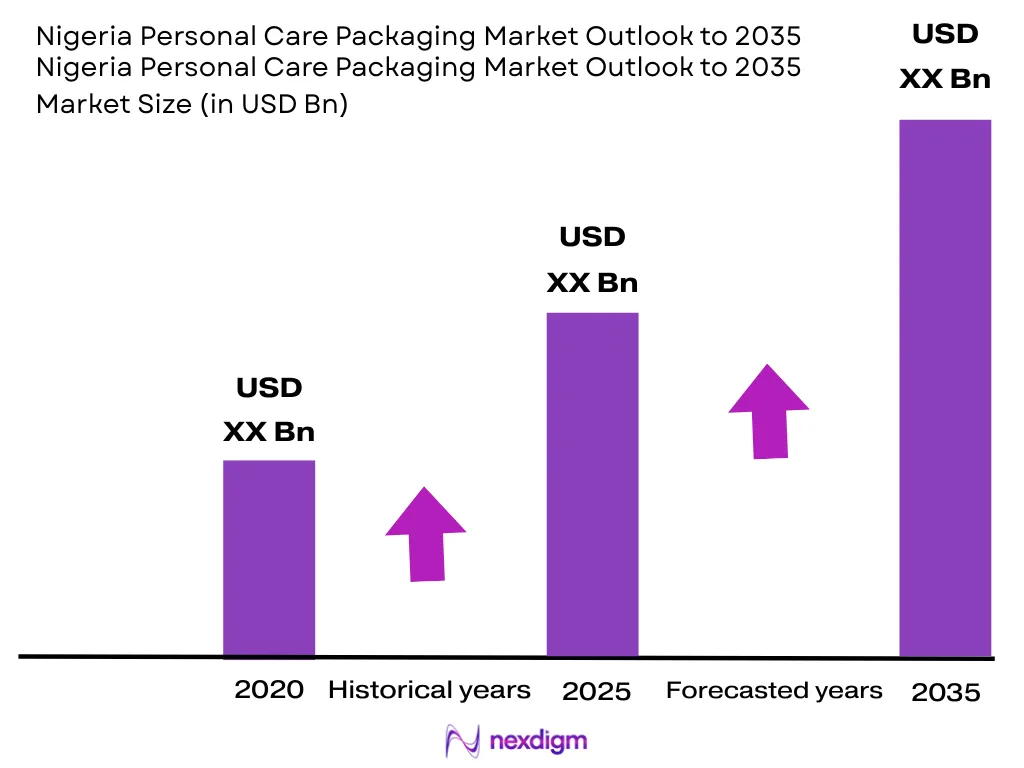
The Nigeria Personal Care Packaging Market was valued at USD ~ Billion in 2024 and is anticipated to expand at a CAGR of ~% during 2026–2035. The market is primarily driven by Nigeria’s distinctive sachet economy, in which multinational and domestic manufacturers alike package soaps, detergents, and personal care products in small, low-cost sachets to serve a population exceeding 220 million people, the large majority of whom remain highly price-sensitive. Nigeria’s beauty and personal care market is led by an estimated 48% combined share held by five companies, Unilever Nigeria, PZ Cussons Nigeria, Johnson & Johnson, Kimberly-Clark, and Hayat Kimya Nigeria, within a market structure that remains moderately fragmented and includes a competitive base of domestic manufacturers. Nigeria’s broader fast-moving consumer goods sector continues to grow at an estimated 5% to 7% annually, supported by population growth and a rising urban middle class, sustaining demand for both affordable sachet-based packaging and, increasingly, premium bottle and refill formats as household incomes rise.
Market Segmentation
By Packaging Format
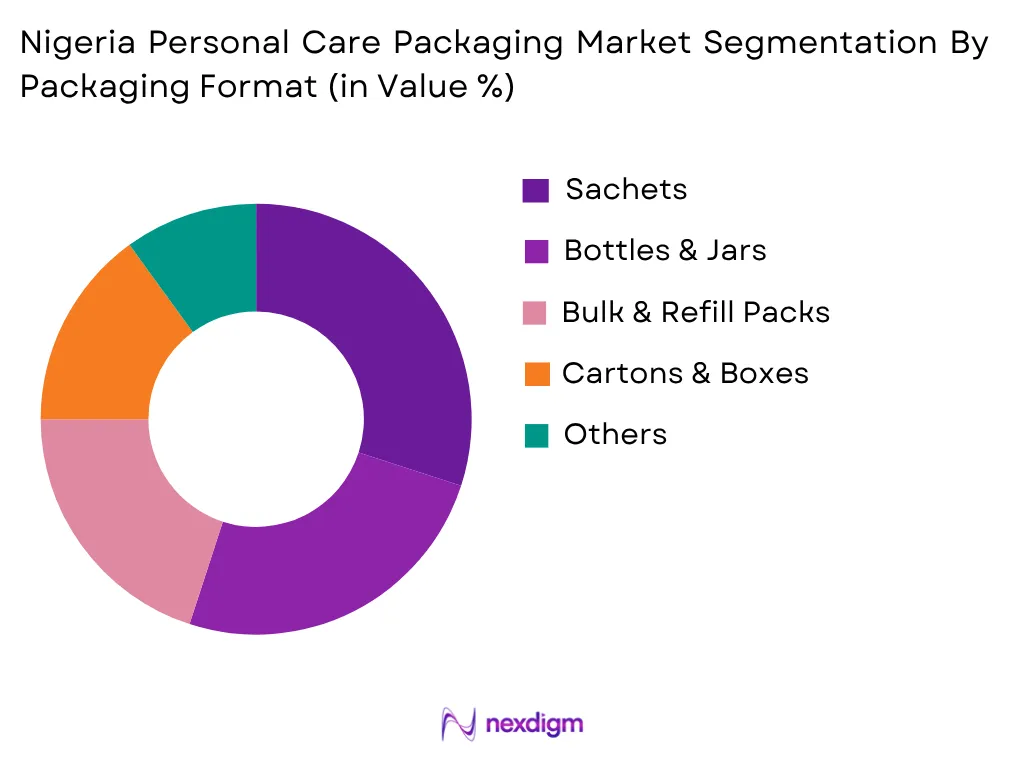
Sachets represent the dominant packaging format in the Nigeria Personal Care Packaging Market, reflecting a deeply entrenched affordability strategy pioneered by manufacturers such as PZ Cussons Nigeria, which capitalizes extensively on sachet packaging to target the low-income households that form the bulk of the country’s consumption base. Unilever Nigeria’s Omo detergent brand, one of the oldest and most recognized household names in the market, illustrates the format’s staying power, having been sold for decades in 35-gram and 50-gram sachets alongside larger 200-, 400-, and 900-gram packs, precisely because Nigeria’s relatively low average household income has favored small, single-use product formats over larger, more expensive packaging. Bottles & Jars and Bulk & Refill Packs represent a smaller but steadily growing category, driven by urban migration and a rising middle class that is increasingly able to afford premium, larger-format packaging, particularly within the bath and shower and skin care categories where brand differentiation and shelf appeal carry greater commercial weight.
By Product Category
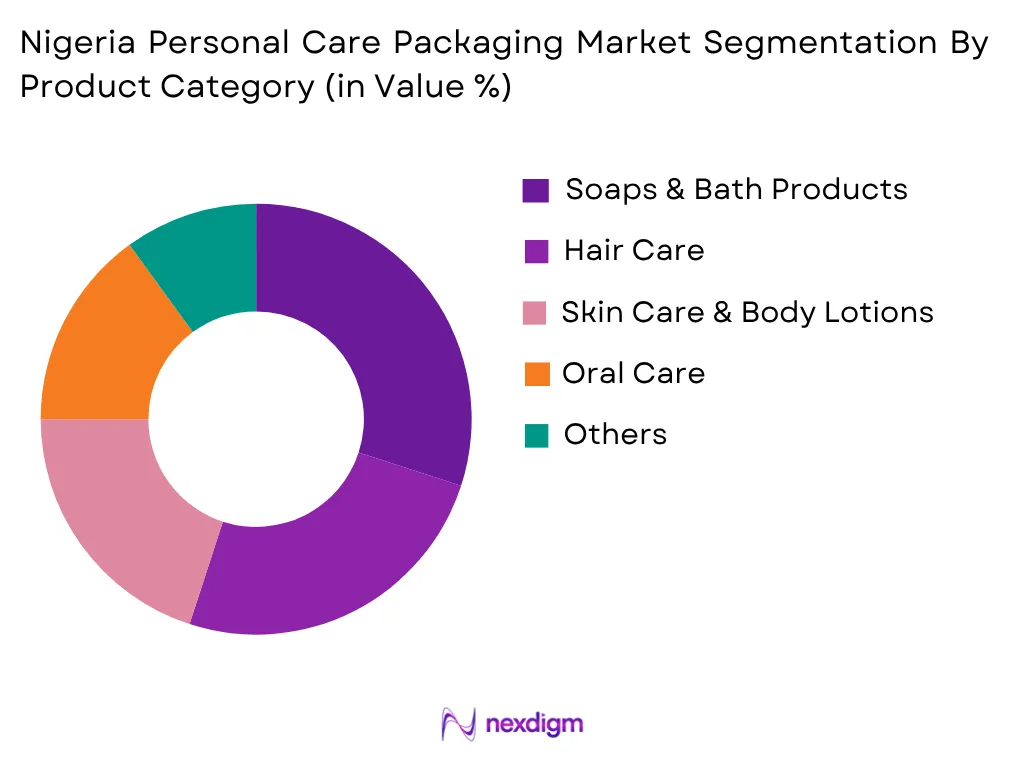
Soaps & Bath Products represent the largest product category in the Nigeria Personal Care Packaging Market, a segment in which PZ Cussons Nigeria holds a market-leading position with a sales share of approximately 25% to 30% through well-established brands including Imperial Leather, Joy, and Premier. Hair Care has historically performed strongly in Nigeria, supported by a growing young working female population that has sustained consistent demand for shampoo, conditioner, and styling product packaging over the past decade. Skin Care & Body Lotions and Oral Care round out the market’s major product categories, with rising dermatological skincare demand identified as a key trend shaping category growth, while multinational players including Unilever Nigeria, Johnson & Johnson, and Kimberly-Clark compete alongside PZ Cussons Nigeria and a growing base of domestic manufacturers across these categories.
Competitive Landscape
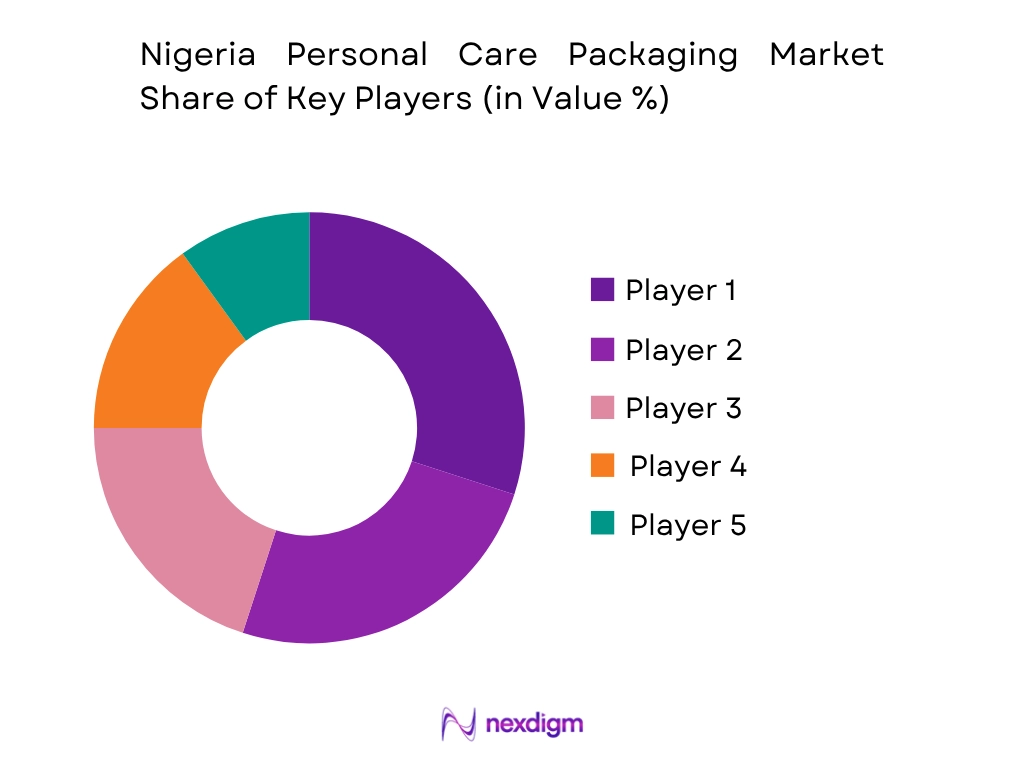
The Nigeria Personal Care Packaging Market is shaped by a small number of dominant multinational FMCG manufacturers with deeply integrated sachet and bottle packaging operations, alongside a growing base of domestic packaging converters and smaller local personal care producers. PZ Cussons Nigeria, the Nigerian subsidiary of the UK-based PZ Cussons group with deep roots in West Africa dating back over a century, and Unilever Nigeria, whose Omo detergent brand remains one of the market’s oldest and most recognized names, together anchor the market’s household and personal care packaging demand through extensive owned and contracted sachet and bottle packaging operations. Nampak Nigeria, part of the pan-African Nampak packaging group, represents a significant dedicated rigid and flexible packaging manufacturer serving Nigeria’s FMCG sector, while domestic converters such as PrimePak Industries Nigeria Ltd and Pack and Roll Converting Industries Limited, both of which also serve Nigeria’s pharmaceutical packaging market, extend their flexible packaging and aluminum foil capabilities to personal care applications as well. Smaller domestic manufacturers, including Eko Supreme Nigeria and Limex Global Industries, have carved out growth in the home and personal care segment on the strength of affordable product offerings, competing alongside multinational players and regional entrants such as Hayat Kimya Nigeria and Wemy Industries for share of Nigeria’s large and price-sensitive consumer base.
| Company | Established | Headquarters | Primary Product Portfolio | Rigid Packaging Portfolio | Manufacturing Presence | Major End-Use Industries | Key Strategic Focus | Certifications & Compliance |
| PZ Cussons Nigeria Plc | 1948 | ~ | ~ | ~ | ~ | ~ | ~ | ~ |
| Unilever Nigeria Plc | 1923 | ~ | ~ | ~ | ~ | ~ | ~ | ~ |
| Nampak Nigeria | 1966 | ~ | ~ | ~ | ~ | ~ | ~ | ~ |
| PrimePak Industries Nigeria Ltd | 2006 | ~ | ~ | ~ | ~ | ~ | ~ | ~ |
| Pack and Roll Converting Industries | 2000 | ~ | ~ | ~ | ~ | ~ | ~ | ~ |
Nigeria Personal Care Packaging Market Analysis
Growth Drivers
Dominance of the Sachet Economy Driving Affordable Packaging Innovation
Nigeria’s personal care packaging market continues to be shaped fundamentally by the country’s sachet economy, in which manufacturers package soaps, detergents, and personal care products into small, affordable units to serve a population exceeding 220 million people, the majority of whom operate on relatively low household incomes. PZ Cussons Nigeria capitalizes extensively on this dynamic through sachet packaging specifically targeting low-income households that form the bulk of consumption, while Unilever Nigeria’s Omo detergent brand has sold successfully in 35-gram and 50-gram sachets for decades precisely because Nigeria’s income distribution has favored small, single-use formats over larger, costlier packaging. This sachetization strategy continues to drive sustained volume demand for flexible packaging converters and film suppliers, even as manufacturers simultaneously invest in larger format packaging to capture Nigeria’s smaller but growing premium consumer segment.
Growth of FMCG Sector and Rising Urban Middle Class
Nigeria’s fast-moving consumer goods sector continues to expand at an estimated 5% to 7% annually, driven by a population exceeding 220 million and a rising middle class with increasing disposable income. Nigeria’s beauty and personal care market remains moderately fragmented, with five companies, Unilever Nigeria, PZ Cussons Nigeria, Johnson & Johnson, Kimberly-Clark, and Hayat Kimya Nigeria, together accounting for an estimated 48% of total market share, leaving meaningful room for domestic manufacturers and regional entrants to compete on price and local market knowledge. Urban migration continues to boost demand within premium personal care segments, while women represent the largest share of the beauty and personal care market, with rising demand for dermatological skincare solutions identified as a key trend supporting continued category growth and corresponding investment in differentiated, higher-quality packaging formats.
Market Challenges
Counterfeit and Substandard Personal Care Products
Nigeria’s personal care packaging market faces significant challenges from counterfeit and substandard products, a concern that leading manufacturers such as PZ Cussons Nigeria have identified as a direct threat to brand equity and consumer trust, addressed in part through quality controls and digital tracking technology. As with Nigeria’s broader consumer goods and pharmaceutical sectors, counterfeiters frequently replicate genuine branding and packaging design closely enough that consumers struggle to distinguish authentic products from fakes, creating pressure on legitimate manufacturers to continuously invest in more sophisticated anti-counterfeit packaging features, including tamper-evident seals and digital authentication technology, simply to protect market share and brand reputation within Nigeria’s large and price-sensitive personal care market.
Currency Depreciation and Import Dependency for Packaging Raw Materials
Nigeria’s personal care packaging manufacturers remain heavily exposed to currency depreciation risk, given that margins hinge significantly on raw material costs, particularly imported plastic resins and other packaging feedstocks affected by naira depreciation. Rising input costs, including fluctuations in palm oil and other raw material inputs used across the personal care manufacturing value chain, combined with persistent inflationary pressure, continue to squeeze margins for both multinational manufacturers and smaller domestic packaging converters. This exposure to imported material costs and currency volatility creates ongoing pricing pressure throughout Nigeria’s personal care packaging value chain, complicating efforts by manufacturers to balance affordability for price-sensitive consumers against rising production costs.
Market Opportunities
Sustainable and Recyclable Packaging Innovation
Nigeria’s broader consumer goods sector is showing early but meaningful movement toward sustainable packaging, illustrated by Nigerian Breweries’ introduction of eco-friendly beverage packaging in January 2025 that achieved a 25% reduction in plastic use, alongside PZ Cussons Nigeria’s own stated sustainability initiatives around recyclable packaging designed to align with shifting consumer preferences. As multinational personal care manufacturers operating in Nigeria increasingly align their packaging strategies with global parent-company sustainability commitments, opportunities are emerging for domestic packaging converters and material suppliers capable of delivering more recyclable and reduced-plastic sachet and bottle formats without compromising the cost structure that Nigeria’s price-sensitive personal care market demands.
Premiumization and Refill Pack Growth Among the Rising Middle Class
Continued urban migration and rising disposable income among Nigeria’s growing middle class are creating sustained opportunity for premium bottle, pump-dispenser, and refill pack formats that extend beyond the traditional sachet model. As demand strengthens within developing personal care categories such as shower gels, men’s deodorants, and premium skin care, packaging suppliers capable of delivering differentiated, higher-quality bottle and container formats stand to capture growing share of Nigeria’s personal care packaging market, complementing rather than replacing the sachet formats that will likely continue to serve the market’s larger, more price-sensitive consumer base for the foreseeable future.
Future Outlook
The Nigeria Personal Care Packaging Market is expected to witness sustained expansion over the forecast period, supported by continued population growth, rising FMCG sector expansion of 5% to 7% annually, and the enduring importance of Nigeria’s sachet economy in serving a large, price-sensitive consumer base. Growing investment in sustainable and reduced-plastic packaging formats, alongside continued premiumization among Nigeria’s rising urban middle class, will further diversify demand across sachets, bottles, and refill pack formats. The market is also likely to benefit from continued anti-counterfeiting investment by leading manufacturers and growing domestic packaging manufacturing capacity, as multinational and local personal care companies alike seek to balance affordability, brand protection, and sustainability across Nigeria’s large and rapidly evolving personal care packaging market.
Major Players
- PZ Cussons Nigeria Plc
- Unilever Nigeria Plc
- Nampak Nigeria
- PrimePak Industries Nigeria Ltd
- Pack and Roll Converting Industries Limited
- Johnson & Johnson
- Kimberly-Clark Corp
- Hayat Kimya Nigeria Ltd
- Wemy Industries Ltd
- UNZA Holdings (Wipro Unza)
- Eko Supreme Nigeria
- Limex Global Industries
- Geeta Plastic
- JFT Packaging Managers Ltd
- Revolution Plastics
Key Target Audience
- Personal Care Packaging Manufacturers and Converters
- Multinational and Domestic FMCG Manufacturers
- Local and Regional Personal Care Producers
- Contract Packaging Organizations
- Retailers and Open Market Distributors
- Investment and Venture Capitalist Firms
- Government and Regulatory Bodies (National Agency for Food and Drug Administration and Control – NAFDAC, Standards Organisation of Nigeria – SON, National Environmental Standards and Regulations Enforcement Agency – NESREA)
- Raw Material Suppliers and Packaging Material Distributors
Research Methodology
Step 1: Identification of Key Variables
The research process begins with identifying the complete ecosystem of the Nigeria Personal Care Packaging Market, including raw material and resin importers, packaging converters, multinational and domestic personal care manufacturers, retailers, and regulatory authorities. Extensive secondary research is conducted using company reports, government publications, trade associations, customs statistics, industry journals, and proprietary databases to determine the variables influencing market demand, pricing, production, consumption, and technological developments.
Step 2: Market Analysis and Construction
Historical market information is collected and analyzed to estimate market size, import volumes, product-wise demand, and pricing trends. A combination of top-down and bottom-up approaches is used to estimate market revenues and validate segment-level performance. Consumption patterns across soaps, hair care, skin care, oral care, and baby care applications are evaluated to establish an accurate representation of the industry.
Step 3: Hypothesis Validation and Expert Consultation
The preliminary findings are validated through Computer-Assisted Telephone Interviews (CATIs) and structured discussions with packaging converters, procurement managers, brand managers, regulatory experts, and senior executives operating within the Nigerian FMCG and personal care industry. These interviews help verify market assumptions, competitive developments, technology adoption trends, pricing dynamics, and future investment opportunities while refining the overall market estimates.
Step 4: Research Synthesis and Final Output
The final stage integrates insights obtained from primary interviews with quantitative information collected through secondary sources. Data triangulation techniques are applied to reconcile differences between supply-side and demand-side estimates, ensuring robust market forecasting. The report is then reviewed through multiple quality assurance checkpoints to deliver a comprehensive analysis covering market size, segmentation, competitive landscape, future outlook, and strategic recommendations for industry stakeholders.

- Executive Summary
- Research Methodology (Market Definitions and Assumptions, Abbreviations, Market Sizing Approach, Top-Down Analysis, Bottom-Up Analysis, Demand-Side Assessment, Supply-Side Assessment, Primary Industry Interviews, Secondary Research Validation, Data Triangulation, Forecasting Framework, Limitations and Future Conclusions)

- Definition and Scope
- Market Evolution and Industry Genesis
- Timeline of Major Industry Developments
- Personal Care Packaging Industry Value Chain Analysis
- Supply Chain Analysis

- Growth Drivers (Dominance of the Sachet Economy, Growth of FMCG Sector and Rising Urban Middle Class, Population Growth and Rising Hygiene Product Consumption, Expansion of Modern Retail and Open Market Distribution, Brand-Driven Packaging Differentiation, Growth in Premium and Refill Pack Formats)
- Market Challenges (Counterfeit and Substandard Personal Care Products, Currency Depreciation and Import Dependency for Raw Materials, High Inflation Impacting Purchasing Power, Fragmented Informal Distribution Channels, Regulatory Compliance and Registration Costs, Limited Domestic Resin and Packaging Material Production)
- Market Opportunities (Sustainable and Recyclable Packaging Innovation, Premiumization and Refill Pack Growth Among Rising Middle Class, Digital Anti-Counterfeit Packaging Technology, Local Packaging Material Manufacturing Investment, Regional West African Export Hub Development, Public-Private Sustainability Partnerships)
- Market Trends (Continued Sachetization for Affordability, Growth of Recyclable and Reduced-Plastic Packaging, Rise of Digital Authentication Features, Premium Bottle and Pump Dispenser Adoption, Local Content and Import-Substitution Packaging Investment, Growing Use of QR Code Consumer Transparency Features)
- Government Regulations (NAFDAC Cosmetic and Personal Care Product Registration, Standards Organisation of Nigeria (SON) Conformity Standards, Mobile Authentication Service (MAS) Requirements, Sachet and Pouch Labeling Requirements, National Environmental Standards and Regulations Enforcement Agency (NESREA), Import Substitution and Local Content Policy)
- Import and Export Analysis (Trade Volume, Major Import Sources, HS Code Analysis, Currency Impact on Landed Costs, Trade Balance)
- Raw Material Availability Analysis (Imported Plastic Resin and Polymer Feedstocks, Imported Aluminum and Metal Feedstocks, Domestic Paperboard and Carton Production, Palm Oil and Local Raw Material Inputs, Regional Petrochemical Supply Chain Access)
- Technology Landscape (Sachet Filling and Sealing Technology, Blow Molding and Injection Molding, Flexographic Printing and Lamination, Anti-Counterfeit and Serialization Technology, Refill and Pump Dispenser Innovation)
- Sustainability Assessment (Recyclable Packaging Material Adoption, Plastic Reduction Initiatives, Local Material Sourcing Initiatives, Waste Reduction in Sachet Packaging, Circular Economy Alignment)
- PESTLE Analysis
- SWOT Analysis
- Porter’s Five Forces Analysis
- Stakeholder Ecosystem
- Competition Ecosystem

- By Market Value (2020-2025)
- By Volume Consumption (2020-2025)
- By Average Selling Price (2020-2025)

- By Material (In Value %)
Plastic Sachets & Pouches
Plastic Bottles & Containers
Paperboard Cartons
Aluminum & Metal Tubes
Glass Containers - By Packaging Format (In Value %)
Sachets
Bottles & Jars
Tubes
Cartons & Boxes
Bulk & Refill Packs - By Product Category (In Value %)
Soaps & Bath Products
Hair Care
Skin Care & Body Lotions
Oral Care
Baby Care - By End User (In Value %)
Multinational FMCG Manufacturers
Local & Regional Personal Care Producers
Contract Packaging Organizations
Retailers & Open Market Traders
Beauty & Cosmetics Brands - By Region (In Value %)
South West
North Central
South South
North West
South East
North East

- Market Share of Major Players (By Value, Volume, Material Type, Product Category, End User)
- Cross Comparison Parameters (Sachet and Flexible Packaging Portfolio, Anti-Counterfeit Technology Capability, Local Manufacturing Presence, Application Technical Support, Manufacturing Capacity, Regulatory Compliance & Certifications, Customer Base, Innovation & New Product Launch Frequency)
- SWOT Analysis of Major Players
- Pricing Analysis by Product Category and SKU
- Production Capacity Analysis
- Manufacturing Footprint Analysis
- Distribution Network Analysis
- Innovation Benchmarking
- Detailed Profiles of Major Companies
PZ Cussons Nigeria Plc
Unilever Nigeria Plc
Nampak Nigeria
PrimePak Industries Nigeria Ltd
Pack and Roll Converting Industries Limited
Johnson & Johnson
Kimberly-Clark Corp
Hayat Kimya Nigeria Ltd
Wemy Industries Ltd
UNZA Holdings (Wipro Unza)
Eko Supreme Nigeria
Limex Global Industries
Geeta Plastic
JFT Packaging Managers Ltd
Revolution Plastics

- Consumption Pattern Analysis (Industrial Usage, Batch Size, Product Category Penetration, Seasonal Demand, Reformulation Activity)
- Purchasing Criteria (Affordability, Regulatory Compliance, Cost Efficiency, Anti-Counterfeit Features, Shelf Appeal, Supply Reliability)
- Procurement and Supplier Selection Analysis
- Anti-Counterfeit Technology Adoption Assessment
- Premium Bottle vs Sachet Packaging Demand
- Product Attribute Preference Analysis (Affordability, Portability, Tamper Evidence, Print Clarity, Seal Integrity, Brand Recognition)
- Sustainability & ESG Influence on Procurement Decisions
- Pain Point Analysis
- Decision-Making Process

- By Market Value (2026-2035)
- By Volume Consumption (2026-2035)
- By Average Selling Price (2026-2035)


 Request a Sample
 Ask for Customization
 Get a Quote
 Enquire Now