

 Download PDF
Market Overview
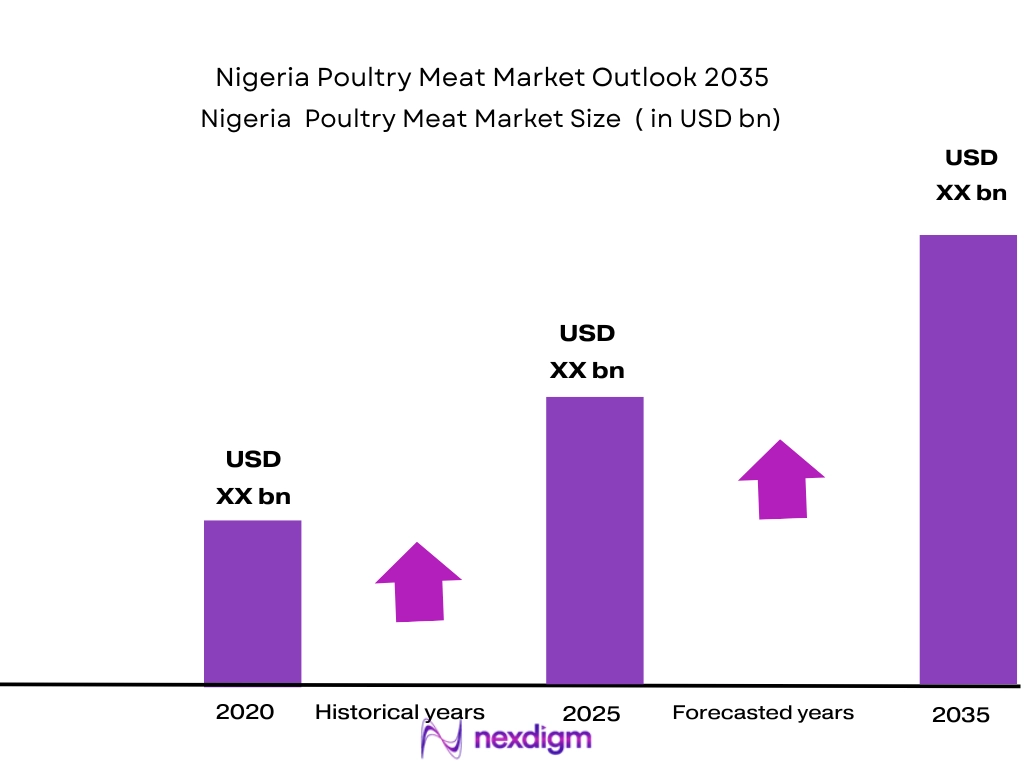
The Nigeria poultry meat market is valued at USD ~ billion, based on a five-year historical analysis, and is forecast to grow at a CAGR of around 3.65% during 2024–2030. Demand is driven by poultry’s role as an affordable animal protein, especially as beef prices remain high and household food budgets stay under pressure. Nigeria’s poultry meat consumption is estimated at 400,000 MT annually, while per-capita consumption remains only 1.5–2.0 kg, indicating significant headroom for formal retail, cold-chain, and processed poultry expansion.
The market is concentrated around Lagos, Ogun, Oyo, Abuja, Kano, Kaduna, Rivers, and Anambra, supported by dense urban demand, foodservice clusters, live-bird markets, and proximity to feed mills and commercial farms. Lagos and Ogun dominate formal poultry meat trade due to large consumer bases, modern retail, quick-service restaurants, and cold-chain access. Nigeria’s population is about 233 million, with urbanization at about 55.03%, creating a large city-based market for packaged, frozen, and ready-to-cook poultry products.
Market Segmentation
By Product Type
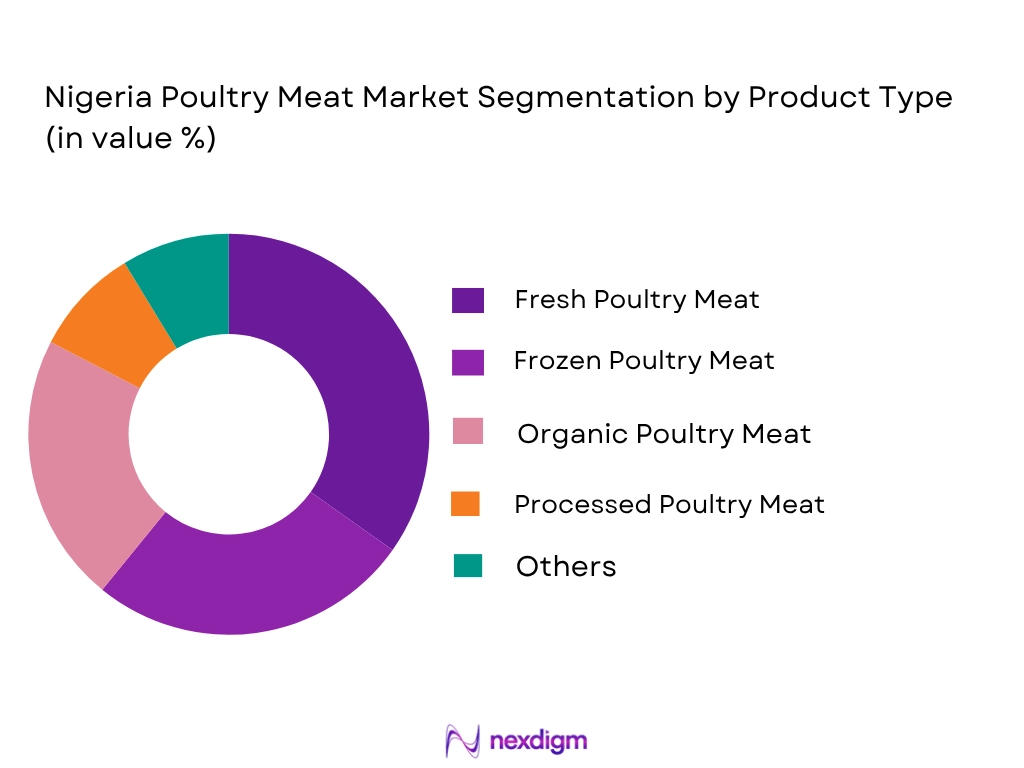
Nigeria poultry meat market is segmented by product type into fresh poultry meat, frozen poultry meat, processed poultry meat, organic/free-range poultry meat, and others. Fresh poultry meat holds the dominant market share due to the country’s strong wet-market culture, consumer preference for visibly fresh chicken, and the continued role of live-bird markets in household purchasing. Many consumers prefer freshly slaughtered poultry because it is perceived as safer, tastier, and easier to inspect before purchase. Fresh poultry is also supported by fragmented small-scale slaughtering, limited cold-chain access outside large cities, and strong demand during festivals, weddings, and family gatherings. However, frozen and processed poultry are expanding in urban areas as supermarkets, restaurants, online meat platforms, and quick-service chains increase demand for standardized cuts, longer shelf life, and hygienic packaging.
By Distribution Channel
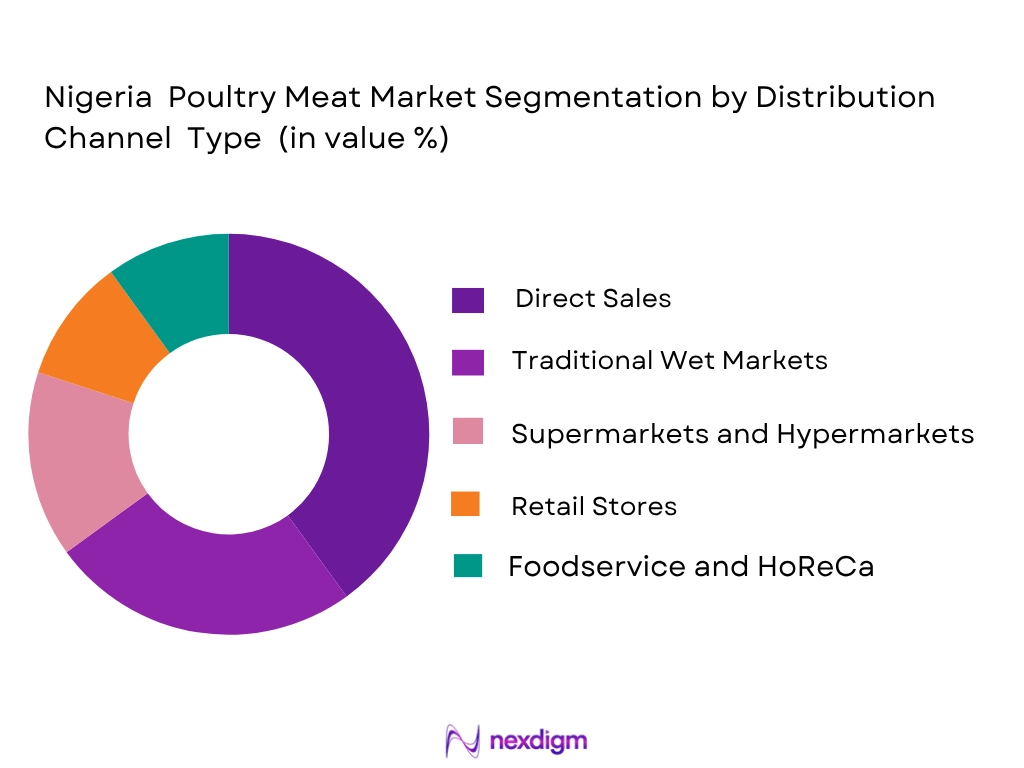
Nigeria poultry meat market is segmented by distribution channel into traditional wet markets, retail stores, supermarkets and hypermarkets, foodservice and HoReCa, online channels, and direct sales. Traditional wet markets dominate because poultry meat purchasing in Nigeria is still highly relationship-driven and price-sensitive. Consumers frequently buy from local butchers, live-bird sellers, and neighborhood vendors who offer flexible quantities and negotiable prices. Wet markets also remain accessible in both urban and semi-urban locations, unlike modern retail chains that are concentrated in major cities. The dominance of traditional channels is further supported by low freezer ownership among some households and limited cold-chain penetration in peri-urban areas. Nevertheless, supermarkets, foodservice buyers, and online channels are gaining traction as formal processors improve packaging, traceability, delivery convenience, and quality assurance.
Competitive Landscape
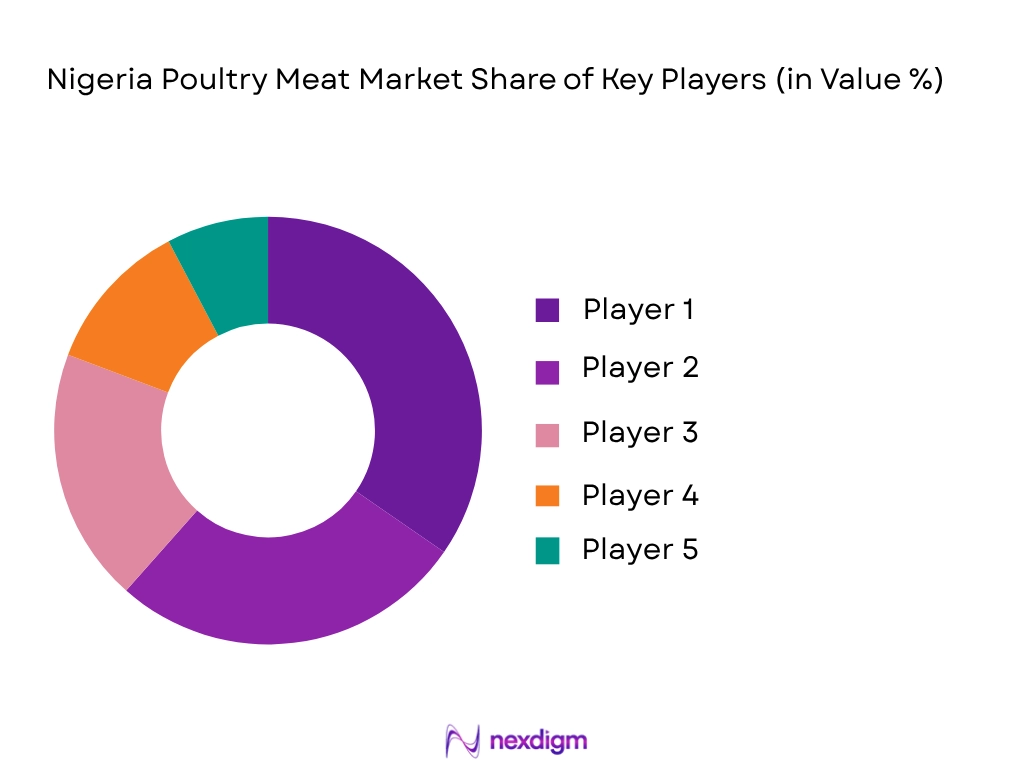
The Nigeria poultry meat market remains fragmented, with a mix of integrated poultry farms, hatcheries, feed companies, processors, cold-chain distributors, and regional aggregators. The competitive structure is shaped by feed-cost management, farm scale, disease-control capability, processing capacity, distribution reach, and access to day-old chicks. Large companies such as CHI Farms, Zartech, Amo Farm, Obasanjo Farms, Tuns Farms, and NatnudO Foods influence commercial supply, while thousands of small and mid-sized producers serve informal channels.
| Company | Establishment Year | Headquarters | Core Business | Poultry Focus | Processing Capability | Distribution Reach | Key Strength | Market Positioning |
| CHI Farms Limited | 1980 | Lagos / Ogun | ~ | ~ | ~ | ~ | ~ | ~ |
| Zartech Limited | 1983 | Ibadan | ~ | ~ | ~ | ~ | ~ | ~ |
| Amo Farm Sieberer Hatchery Ltd. | 2003 | Awe, Oyo State | ~ | ~ | ~ | ~ | ~ | ~ |
| Obasanjo Farms Nigeria Ltd. | 1979 | Ogun State | ~ | ~ | ~ | ~ | ~ | ~ |
| NatnudO Foods | 2014 | Lagos / Ogun | ~ | ~ | ~ | ~ | ~ | ~ |
Nigeria Poultry Meat Market Analysis
Growth Drivers
Rising Population and Increasing Protein Consumption
Nigeria’s large and expanding population is a major driver of poultry meat demand. As the number of consumers grows, the need for affordable and accessible protein sources continues to rise. Poultry meat is widely accepted across income groups because it is relatively affordable, easy to prepare, and suitable for many local dishes. Increasing awareness of protein-rich diets is also supporting higher poultry consumption among households, schools, restaurants, and catering businesses. Chicken is often preferred over more expensive meat options, making it important for daily nutrition. As population growth continues and consumers seek convenient protein sources, poultry meat demand is expected to strengthen across urban and semi-urban areas in Nigeria.
Increasing Demand for Affordable Animal Protein
Poultry meat is gaining importance in Nigeria because it offers a relatively affordable source of animal protein compared with beef, goat meat, and some fish products. Rising food prices have made consumers more selective, increasing demand for meat products that balance nutrition and cost. Chicken is widely used in household meals, street food, restaurants, and festive occasions, which supports stable consumption. Its shorter cooking time and versatility also make it attractive to busy urban consumers. As income levels vary widely across the country, affordability remains a key purchasing factor. This makes poultry meat a practical protein option for many Nigerian households and supports continued market growth.
Market Challenges
High Feed Cost and Input Price Volatility
High feed cost is one of the most serious challenges facing Nigeria’s poultry meat market. Feed ingredients such as maize and soybean meal account for a large share of poultry production expenses, making producers highly exposed to commodity price changes. Fluctuations in fuel, electricity, transport, packaging, vaccines, and veterinary costs further increase operating pressure. When input prices rise, poultry farmers often struggle to maintain margins without increasing consumer prices. However, price-sensitive consumers may reduce purchases when chicken becomes expensive. This creates pressure on both demand and profitability. Smaller farmers are especially vulnerable because they have limited bargaining power and weaker access to efficient feed supply systems.
Disease Outbreaks and Biosecurity Concerns
Disease outbreaks remain a major challenge for Nigeria’s poultry industry. Poultry farms are exposed to risks such as avian influenza, Newcastle disease, and other infections that can reduce flock productivity, cause mortality, and disrupt supply. Weak biosecurity practices, limited veterinary access, poor farm hygiene, and informal poultry movement can increase the spread of disease. Outbreaks can lead to heavy financial losses for farmers through culling, treatment costs, reduced production, and lower consumer confidence. Maintaining strong disease prevention systems requires investment in vaccination, sanitation, monitoring, and staff training. For small and medium poultry farmers, these costs can be difficult to manage, making disease control a critical market challenge.
Opportunities
Expansion of Commercial Poultry Farming
Nigeria has strong potential to expand commercial poultry farming due to rising demand for chicken meat and the need to improve domestic food supply. Larger, more organized poultry farms can improve productivity through better breeds, feed management, vaccination programs, and modern housing systems. Commercial farming also supports more consistent product quality and supply, which is important for retailers, hotels, restaurants, and institutional buyers. Expansion can reduce dependence on informal supply channels and improve market efficiency. Investment in integrated poultry operations, including hatcheries, feed mills, farms, and processing units, can also lower costs and improve competitiveness. As demand grows, commercial poultry farming offers a major opportunity for industry development.
Rising Demand for Processed and Packaged Poultry Meat
Demand for processed and packaged poultry meat is increasing in Nigeria as urban consumers seek convenience, hygiene, and longer shelf life. Products such as frozen chicken portions, sausages, nuggets, marinated chicken, and ready-to-cook packs are becoming more attractive to working households, supermarkets, restaurants, and quick-service outlets. Packaged poultry also helps build consumer trust by offering better labeling, portion control, and perceived quality assurance. As modern retail, cold storage, and online grocery platforms expand, producers have more channels to sell value-added poultry products. This trend allows companies to move beyond raw chicken sales and capture higher margins. It also supports brand development in a competitive market.
Future Outlook
Over the next five years, the Nigeria poultry meat market is expected to grow steadily, supported by urban population growth, affordability of chicken relative to other animal proteins, and expansion of packaged poultry retail. Growth will also be supported by increasing investment in commercial farms, hatcheries, feed efficiency, cold storage, and processing plants. Government attention toward livestock productivity and food security is expected to improve investor confidence, although high feed costs and weak purchasing power will remain limiting factors.
Major Players
- CHI Farms Limited
- Zartech Limited
- Amo Farm Sieberer Hatchery Limited
- Obasanjo Farms Nigeria Limited
- Tuns Farms Nigeria Limited
- Animal Care Services Konsult Nigeria Limited
- Olam Agri Nigeria
- Agrited Nigeria Limited
- Farm Support Group
- NatnudO Foods
- Choice Farms Nigeria Limited
- Funtuna Farms
- Sayed Farms Limited
- Valley Stream British Farm
- Ajanla Farms
Key Target Audience
- Poultry meat producers and integrated poultry farms
- Hatchery operators and breeder farm owners
- Feed mill companies and animal nutrition companies
- Cold-chain logistics and warehousing companies
- Supermarkets, hypermarkets, and modern grocery retailers
- Hotels, restaurants, caterers, and quick-service restaurant chains
- Investments and venture capitalist firms
- Government and regulatory bodies
Research Methodology
Step 1: Identification of Key Variables
The initial phase involves constructing an ecosystem map covering poultry farmers, hatcheries, feed suppliers, processors, distributors, retailers, foodservice buyers, and regulatory bodies in the Nigeria poultry meat market. This step includes desk research using public databases, company information, trade reports, livestock policy documents, and sector-level data to identify variables influencing demand, pricing, supply, and distribution.
Step 2: Market Analysis and Construction
In this phase, historical market information is compiled to assess poultry meat production, consumption, pricing, channel penetration, and product-level demand. The analysis includes reviewing broiler supply cycles, feed-cost movement, cold-chain availability, and consumer purchasing behavior. Revenue estimates are then constructed using demand-side and supply-side indicators.
Step 3: Hypothesis Validation and Expert Consultation
Market hypotheses are validated through interviews with poultry farmers, processors, distributors, feed suppliers, cold-chain operators, foodservice buyers, and retail channel participants. These discussions provide practical insights on operating costs, margins, disease-control issues, price sensitivity, and market expansion potential. The inputs are used to refine segment shares and growth assumptions.
Step 4: Research Synthesis and Final Output
The final phase combines secondary research, industry consultations, and bottom-up market modelling to produce a validated view of the Nigeria poultry meat market. The analysis reviews product segmentation, distribution channels, competitive positioning, regional demand clusters, and forecast outlook. The final output is structured to support strategic planning, investment evaluation, and market-entry decision-making.

- Executive Summary
- Research Methodology (Market Definitions and Assumptions, Abbreviations, Market Sizing Approach, Consolidated Research Approach, Understanding Market Potential Through In-Depth Industry Interviews, Primary Research Approach, Limitations and Future Conclusions)

- Definition and Scope
- Market Dynamics Overview
- Market Genesis
- Major Players and Market Timeline
- Business Cycle and Trends
- Supply Chain and Value Chain Analysis

- Growth Drivers
Rising Population and Increasing Protein Consumption
Growing Urbanization and Changing Food Habits
Increasing Demand for Affordable Animal Protein
Expansion of Quick Service Restaurants and Foodservice Industry
Government Support for Local Poultry Production
Growth of Cold Chain and Retail Infrastructure - Market Challenges
High Feed Cost and Input Price Volatility
Disease Outbreaks and Biosecurity Concerns
Competition from Smuggled and Imported Poultry Products
Weak Cold Chain and Storage Infrastructure
Price Sensitivity Among Consumers
Regulatory and Quality Compliance Challenges - Opportunities
Expansion of Commercial Poultry Farming
Rising Demand for Processed and Packaged Poultry Meat
Growth of Online Meat Delivery Platforms
Increasing Investment in Cold Chain Infrastructure
Rising Demand from Foodservice and QSR Chains
Development of Value-added Poultry Meat Products - Key Trends
Shift Toward Packaged and Hygienic Poultry Meat
Rising Preference for Locally Produced Poultry
Growing Adoption of Modern Poultry Farming Practices
Increasing Demand for Frozen and Ready-to-Cook Poultry Products
Expansion of Poultry Processing Facilities
Focus on Biosecurity and Disease Management - Government Regulations
- SWOT Analysis
- Porter’s Five Forces

- By Value, 2020–2025
- By Volume, 2020–2025
- By Average Price, 2020–2025

- By Product Type (In Value %)
Fresh Poultry Meat
Frozen Poultry Meat
Processed Poultry Meat
Organic Poultry Meat - By Poultry Type (In Value %)
Broiler Chicken
Layer Chicken
Turkey
Duck
Others - By Meat Cut Type (In Value %)
Whole Chicken
Breast Meat
Thigh and Drumstick
Wings
Boneless Cuts
Others - By Processing Type (In Value %)
Raw Poultry Meat
Marinated Poultry Meat
Ready-to-Cook Poultry Meat
Ready-to-Eat Poultry Meat - By Distribution Channel (In Value %)
Direct Sales
Traditional Wet Markets
Retail Stores
Supermarkets and Hypermarkets
Online Channels
Foodservice and HoReCa - By End User (In Value %)
Households
Restaurants and Quick Service Restaurants
Hotels and Catering Services
Food Processing Companies
Institutional Buyers - By Region (In Value %)
North Central Region
North East Region
North West Region
South East Region
South South Region
South West Region
Rest of Nigeria

- Market Share of Major Players by Value/Volume
- Market Share of Major Players by Product Type
- Cross Comparison Parameters (Company Overview, Business Strategies, Recent Developments, Strength, Weakness, Organizational Structure, Revenues, Revenues by Product Type, Number of Touchpoints Distribution Channels, Number of Dealers and Distributors, Margins, Production Plant, Capacity, Unique Value Offering and Others)
- SWOT Analysis of Major Players
- Pricing Analysis Based on Product Categories for Major Players
- Detailed Profiles of Major Companies
CHI Farms Limited
Zartech Limited
Amo Farm Sieberer Hatchery Limited
Obasanjo Farms Nigeria Limited
Tuns Farms Nigeria Limited
Animal Care Services Konsult Nigeria Limited
Olam Agri Nigeria
Agrited Nigeria Limited
Farm Support Group
NatnudO Foods
Choice Farms Nigeria Limited
Funtuna Farms
Sayed Farms Limited
Valley Stream British Farm
Ajanla Farms

- Market Demand and Utilization
- Purchasing Power and Budget Allocations
- Regulatory and Compliance Requirements
- Needs, Desires, and Pain Point Analysis
- Decision-Making Process

- By Value, 2026–2035
- By Volume, 2026–2035
- By Average Price, 2026–2035


 Request a Sample
 Ask for Customization
 Get a Quote
 Enquire Now