
 Download PDF
Market Overview
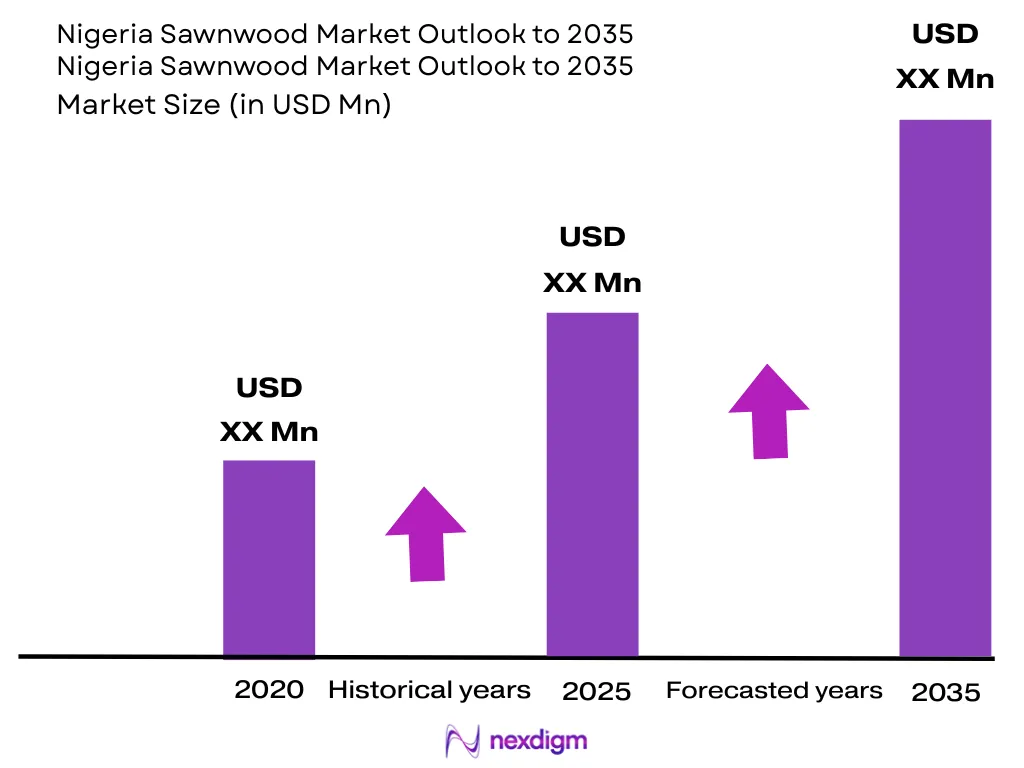
The Nigeria Sawnwood Market was valued at approximately USD ~ Million in 2024, reflecting Africa’s most populous nation’s position as the continent’s largest tropical hardwood timber-consuming economy and one of West Africa’s most significant sawnwood producing and trading markets. According to data published by the Food and Agriculture Organization, the Federal Ministry of Environment, and the Forestry Research Institute of Nigeria (FRIN), Nigeria possesses approximately 9.6 million hectares of forest cover, concentrated in the tropical rainforest belt spanning the South-South and Southwest geopolitical zones, the Guinea savannah woodland of the Middle Belt, and the Sudan and Sahel savannah zones of the far north. The country’s sawnwood market is historically anchored by the exploitation of natural tropical hardwood forests across Edo, Delta, Ondo, Ogun, Cross River, and Imo states, which have supplied commercially valuable species including Iroko, Obeche, Sapele, African Mahogany, Opepe, and Afara to domestic construction, furniture manufacturing, joinery, marine, and export markets for over a century. Demand is primarily driven by a massive and rapidly growing residential construction sector serving Africa’s largest urban population, a vibrant domestic furniture manufacturing industry, expanding commercial real estate development in Lagos, Abuja, and secondary cities, and persistent export demand from European and Asian buyers for premium Nigerian tropical hardwood species.
Market Segmentation
By Wood Species Type
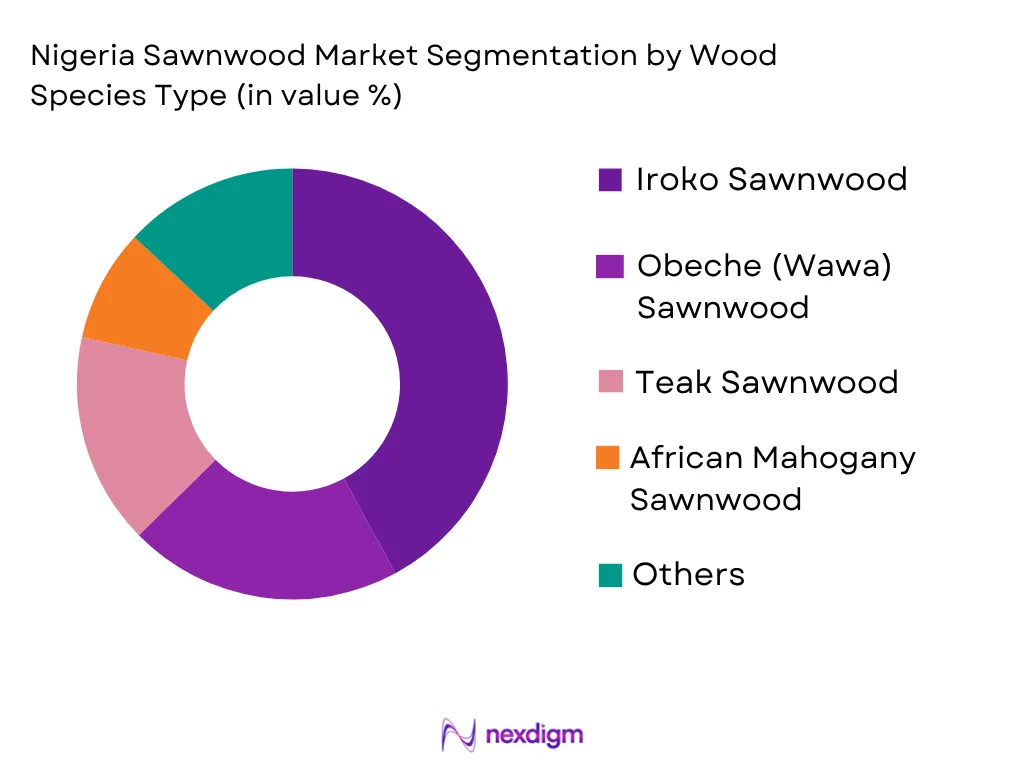
Nigeria Sawnwood Market is segmented by wood species type into Iroko Sawnwood, Obeche (Wawa) Sawnwood, Sapele Sawnwood, African Mahogany Sawnwood, Teak (Plantation) Sawnwood, and Other Commercial Species including Opepe, Afara, Agba, and Gmelina. Iroko Sawnwood holds the highest value position in the market, commanding significant price premiums reflecting its exceptional durability, stability, workability, and widespread specification in high-end furniture, flooring, joinery, marine applications, and premium construction across both domestic and export markets. Iroko, known internationally as African teak and highly regarded in European and Asian markets as a sustainable alternative to Asian teak, is sourced from natural forest concessions primarily in Ondo, Edo, Cross River, and Delta states and is among Nigeria’s most economically important export timber species. The species has faced growing supply constraints arising from decades of intensive harvesting, natural forest degradation, and inadequate regeneration investment, making certified and legally verified Iroko increasingly scarce and valuable in both domestic and international markets. Obeche, locally known as Wawa and also marketed internationally as Samba or Ayous, is the dominant species by volume in the Nigerian market, widely consumed in construction framing, furniture substrate, plywood face veneer, interior joinery, and packaging applications due to its light weight, easy workability, and cost-effectiveness relative to denser hardwood species. Sapele Sawnwood, recognised internationally for its interlocked grain, reddish-brown colour, and attractive figure, commands strong export demand from European furniture manufacturers and joinery specialists, while also serving premium domestic furniture and decorative interior markets. The growing contribution of plantation-grown Teak and Gmelina sawnwood from established plantation programmes in Ondo, Oyo, Ogun, and Cross River states is progressively supplementing natural forest supply, though plantation volumes remain insufficient to compensate for the long-term decline in natural forest timber availability.
By End-Use Industry
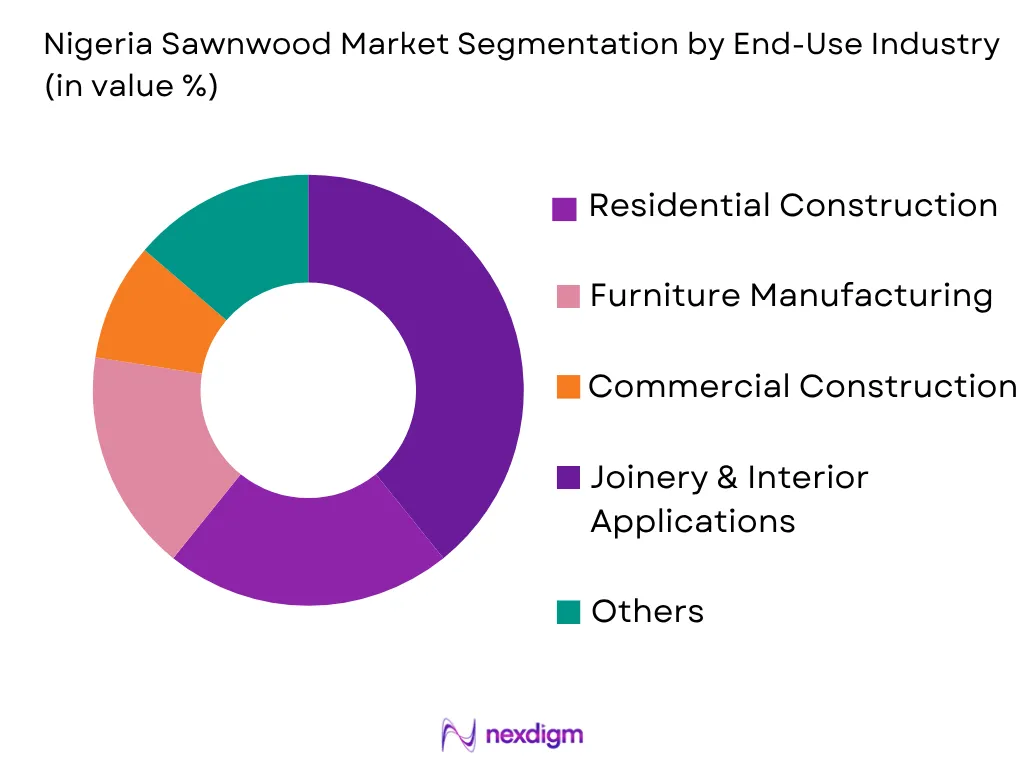
Nigeria Sawnwood Market is segmented by end-use industry into Residential Construction, Commercial Construction, Furniture Manufacturing, Joinery & Interior Applications, Packaging & Pallets, Marine & Boat Building, and Agricultural & Infrastructure Applications. Residential Construction represents the largest and most pervasive end-use segment by volume, driven by the enormous and persistent housing deficit across Nigeria’s rapidly urbanising population centres. According to the Federal Mortgage Bank of Nigeria and the National Housing Fund, Nigeria’s housing deficit is estimated at approximately 28 million units, representing the largest documented housing gap on the African continent and generating immense and structural long-term demand for affordable construction-grade sawnwood across timber-frame, block-and-timber, and mixed-construction housing typologies. Timber is consumed in window and door frames, roof structures, floor joists, ceiling boards, concrete formwork, site hoarding, and interior fitting across millions of annual residential construction projects, from informal self-build homes in peri-urban areas to organised estate developments in Lagos Island, Victoria Island, Lekki, and comparable premium residential districts. Furniture Manufacturing is the second-largest segment by value, underpinned by Nigeria’s large and culturally embedded domestic furniture market, in which solid wood furniture commands strong consumer preference across income levels from low-cost urban households to premium specification interior projects. The Marine and Boat Building segment, while smaller in aggregate volume, is a uniquely significant end-use sector for premium hardwood species including Iroko and Opepe, reflecting Nigeria’s extensive coastline, Niger Delta waterway network, and large artisanal and commercial fishing fleet that requires locally built and maintained wooden vessels.
Competitive Landscape
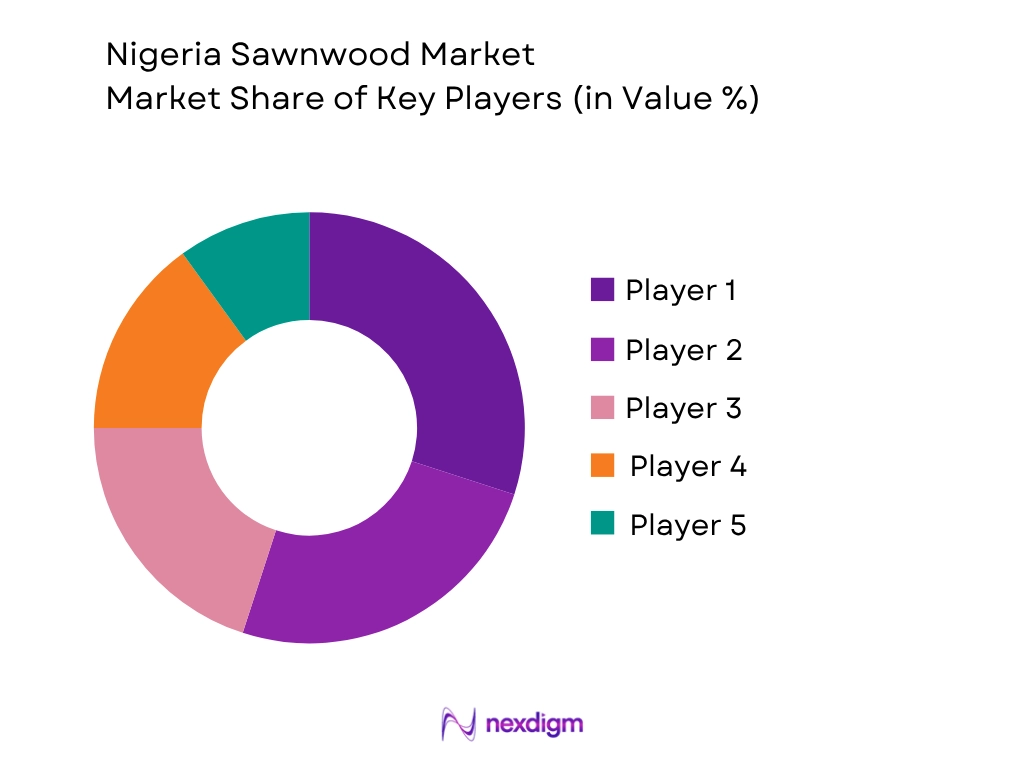
The Nigeria Sawnwood Market is highly fragmented and predominantly unorganised, characterised by a very large number of small-scale and artisanal sawmill operators, chainsaw millers, timber traders, and open-market dealers who collectively account for the majority of domestic sawnwood production and distribution volumes. Organised large-scale sawmill operations are concentrated in the South-South and Southwest timber-producing states, particularly in Edo, Ondo, Delta, Cross River, Imo, and Ogun, where proximity to natural forest resources and established timber trading infrastructure supports higher-volume production. State forestry corporations and timber merchants’ associations play significant roles in organising access to forest concessions, log supply coordination, and timber revenue management at the state level, though enforcement of sustainable harvesting and legal compliance standards remains inconsistent across jurisdictions. A small number of larger organised timber companies with export capabilities and international buyer relationships operate alongside the dominant informal sector. Companies with FSC or other internationally recognised certification credentials represent a very small minority of Nigerian market participants, though growing export market pressure for documented timber legality is driving incremental formalisation within the export-oriented segment of the industry.
| Company | Establishment Year | Headquarters | Plantation Assets | Sawmill Capacity | FSC/PEFC Certification | Export Presence | Product Portfolio | End-Use Focus |
| Edo State Timber Association | 1972 | ~ | ~ | ~ | ~ | ~ | ~ | ~ |
| Stallion Group (Timber Division) | 1964 | ~ | ~ | ~ | ~ | ~ | ~ | ~ |
| Nigeria German Chemicals Plc | 1960 | ~ | ~ | ~ | ~ | ~ | ~ | ~ |
| Iwopin Pulp & Paper Company | 1975 | ~ | ~ | ~ | ~ | ~ | ~ | ~ |
| Lagos Timber & Sawmill Association | 1965 | ~ | ~ | ~ | ~ | ~ | ~ | ~ |
Nigeria Sawnwood Market Analysis
Growth Drivers
Population Growth, Urbanisation, and Housing Deficit-Driven Construction Demand
Nigeria’s sawnwood market is underpinned by the most powerful demographic demand driver of any market in this series, with Africa’s largest population of approximately 220 million people growing at approximately 2.5% annually and projected to reach 400 million by 2050, making Nigeria the world’s third most populous nation within the forecast period. This extraordinary demographic expansion, combined with a rapid urbanisation rate that is transforming Nigeria’s economic geography and concentrating millions of new urban residents in Lagos, Abuja, Kano, Ibadan, Port Harcourt, Benin City, Enugu, and secondary cities, is generating a structural and growing housing deficit estimated at 28 million units by the Federal Mortgage Bank of Nigeria. Housing construction in Nigeria is overwhelmingly timber-intensive, with wood consumed in door and window frames, roof structures, concrete formwork, ceiling boards, floor joists, interior partitioning, and site infrastructure across every segment from self-build informal housing to government estates and premium private developments. The Federal Government’s National Housing Programme and various state-level social housing initiatives, while challenged by funding constraints, have maintained a sustained pipeline of affordable housing construction activity that generates recurring demand for structural sawnwood in timber-producing states and major consumption centres alike. Lagos alone, projected to become the world’s largest city by population by 2100 according to United Nations estimates, generates extraordinary and relentlessly growing construction sector timber demand as the city expands across Lekki peninsula, Epe, Ibeju-Lekki, Badagry, and surrounding peri-urban areas. This demographic demand foundation ensures that Nigeria’s residential construction sector will remain the dominant and most structurally resilient driver of sawnwood market growth throughout and well beyond the forecast period to 2035.
Tropical Hardwood Resource Base and Export Demand for Premium Species
Nigeria’s tropical rainforest belt across the South-South and Southwest geopolitical zones historically supported one of West Africa’s richest and most commercially valuable tropical hardwood timber resources, encompassing highly prized species including Iroko, Sapele, African Mahogany, Opepe, Afara, Utile, and Agba that command significant price premiums in international markets. European furniture manufacturers, joinery specialists, interior designers, and timber merchants in the United Kingdom, France, Germany, Italy, Belgium, and the Netherlands have historically sourced Nigerian tropical hardwood sawnwood and veneer as premium raw materials for high-end furniture, architectural woodwork, marine applications, and specialist construction. Export demand for certified Nigerian hardwood species, particularly Iroko and Sapele, remains active among international buyers seeking documented sustainable alternatives to restricted or depleted Asian tropical hardwood species. The growing global demand for FSC-certified tropical hardwood from responsibly managed African forest sources, driven by EU Timber Regulation and EU Deforestation Regulation compliance requirements in European import markets, creates an incremental market opportunity for Nigerian producers capable of supplying legally verified and certified timber with full chain-of-custody documentation. Nigeria’s large plantation teak programme, with established teak plantations in Ondo, Oyo, Ogun, and other states originally developed during the colonial period and expanded under post-independence forestry programmes, provides a growing supply base of plantation-grown teak sawnwood that can serve both domestic premium markets and international buyers seeking plantation-sourced alternatives to natural forest teak from Southeast Asia.
Market Challenges
Illegal Logging, Forest Governance Deficiencies, and Natural Forest Depletion
Nigeria’s sawnwood market faces a fundamental and long-standing structural challenge arising from decades of illegal logging, inadequate forest governance, weak law enforcement, and sustained overexploitation of natural tropical hardwood forest resources that have progressively depleted the country’s once-abundant timber stocks and created serious long-term supply constraints for the domestic and export sawnwood industry. According to the Food and Agriculture Organization and Nigeria’s National Bureau of Statistics, Nigeria has experienced significant deforestation over the past several decades, driven by unsustainable timber harvesting, agricultural land conversion, charcoal production, and weak enforcement of forest protection regulations. Nigeria’s annual deforestation rate has historically been among the highest in Africa, severely reducing the forest cover available for sustainable commercial timber production. The absence of a functioning national forest inventory, inadequate monitoring of timber concession compliance, corruption in concession allocation processes, and limited resources for forest patrol and law enforcement create systemic conditions that facilitate illegal logging and timber smuggling from both state forest reserves and ungazetted community forests. Chainsaw milling, which is technically illegal under Nigerian forestry regulations but widely practised across timber-producing states, accounts for a substantial proportion of domestic sawnwood production, bypassing formal sawmill registration, log measurement, and royalty payment systems that fund state forestry agency operations. The progressive depletion of high-value commercial timber species from accessible natural forest areas is forcing sawmill operators into increasingly remote and ecologically sensitive forest zones, adding to production costs, transportation challenges, and environmental impact. Reversing these long-term forest governance and resource depletion trends requires sustained institutional reform, community forest management investment, and plantation development that exceeds the capacity of short-term policy interventions.
Naira Depreciation, Energy Costs, and Macroeconomic Instability
Nigeria’s sawnwood market participants face severe and chronic operational challenges arising from the country’s persistent macroeconomic instability, characterised by significant naira depreciation, high and volatile inflation, unreliable electricity supply, elevated fuel costs, and constrained access to affordable formal sector credit. The naira has experienced substantial cumulative depreciation against the US dollar over the past decade, reflecting persistent current account pressures, oil revenue volatility, and monetary policy challenges, significantly increasing the naira cost of imported sawmill equipment, spare parts, kiln-drying technology, treatment chemicals, and lubricants that Nigerian sawmill operators must source from international suppliers. Diesel-powered electricity generation, which the majority of Nigerian sawmills rely upon to substitute for the chronically inadequate national grid supply, represents a major and escalating operating cost that directly affects sawmill profitability, productive capacity, and the economic viability of capital-intensive value-adding processes such as kiln drying, planing, and finger-jointing. High and unpredictable inflation erodes the real purchasing power of construction sector buyers, constrains housing development financing, and creates pricing and margin management challenges throughout the timber supply chain. Limited access to affordable naira-denominated bank credit impedes sawmill recapitalisation, equipment modernisation, and plantation timber investment. The combination of these macroeconomic pressures with the structural challenges of forest resource depletion and infrastructure deficits creates a particularly difficult operating environment for organised sector sawnwood producers seeking to invest in productivity, quality improvement, and export market development within the Nigerian market context.
Market Opportunities
FSC Certification, Legal Timber Frameworks, and Export Market Development
The growing international demand for certified, legally verified tropical hardwood timber from West African sources presents a significant and commercially attractive market development opportunity for Nigerian sawnwood producers capable of investing in FSC chain-of-custody certification, timber legality documentation systems, and compliant forest management practices. European import markets are progressively tightening timber procurement requirements under the EU Deforestation Regulation, which requires importers to conduct due diligence demonstrating that wood products do not originate from illegally harvested or deforestation-linked sources, creating both a compliance challenge and a competitive opportunity for Nigerian operators who can demonstrate legal and sustainable sourcing credentials. Nigerian tropical hardwood species, particularly FSC-certified Iroko, Sapele, and African Mahogany from responsibly managed forest concessions or plantation sources, command substantial price premiums over uncertified alternatives in European markets, providing a compelling financial incentive for investment in certification and forest management improvement. The Voluntary Partnership Agreement framework developed by the European Union with West African timber-producing nations, drawing on the FLEGT VPA model successfully implemented in Ghana, Cameroon, and Ivory Coast, provides a potential policy pathway for Nigeria to develop a credible national timber legality assurance system that could unlock improved market access for Nigerian wood products in the EU and other regulated markets. Community-based forest management programmes, supported by international development funding from the World Bank, DFID, and GIZ, have demonstrated the feasibility of developing legal and sustainable timber supply chains from Nigerian community forests, providing models that could be scaled to strengthen the country’s certified timber export capacity through the forecast period.
Plantation Timber Development and Value-Added Processing Expansion
Nigeria’s established plantation forestry programmes and the opportunity to significantly expand plantation timber production from teak, Gmelina arborea, Neem, and other fast-growing commercial species on degraded and marginal agricultural land represent a strategically critical opportunity for developing a more sustainable, scalable, and internationally compliant domestic sawnwood supply base. The Ondo State Forestry Corporation, Oyo State Forest Reserve System, and plantation programmes established across Cross River, Ogun, Edo, and Kwara states have demonstrated the technical and economic viability of plantation timber production under Nigerian growing conditions, with teak plantations delivering commercially harvestable timber of acceptable quality within rotation cycles of 25 to 35 years for sawlog production. Federal and state government commitment to plantation forestry expansion, supported by international climate finance under REDD+ and Bonn Challenge frameworks to which Nigeria is a signatory, provides a policy foundation for scaling plantation timber investment and progressively reducing pressure on natural forest resources. Value-added processing investment, including establishment of kiln-drying facilities, furniture component manufacturing operations, parquet flooring production units, and export-ready packing and grading infrastructure at major timber trading centres in Lagos, Benin City, Port Harcourt, and Abuja, would enable Nigerian producers to capture significantly greater economic value from domestic timber resources and compete in higher-margin international markets for processed tropical wood products. Nigeria’s large domestic furniture manufacturing sector, growing middle-class consumer demand for quality wood-based interior products, and the country’s proximity to European premium hardwood markets provide multiple reinforcing demand signals for investment in organised, value-added timber processing capabilities.
Future Outlook
The Nigeria Sawnwood Market is expected to witness growth over the forecast period, driven primarily by the country’s extraordinary demographic expansion, persistent housing deficit, accelerating urbanisation, and growing furniture and interior products demand from a rising urban middle class. The fundamental demand drivers are among the most powerful of any market in the global sawnwood sector, with Nigeria’s population and construction activity trajectory ensuring sustained long-term timber consumption growth regardless of short-term macroeconomic volatility. Progressive development of plantation timber resources, particularly teak and Gmelina from expanded state and private plantation programmes, is expected to partially compensate for the long-term decline in natural forest timber availability, stabilising domestic log supply for organised sawmill operations. Investment in FSC certification, timber legality frameworks, and export market development for premium Nigerian hardwood species is anticipated to create new revenue streams and market development opportunities for compliant producers. Gradual improvement in power supply reliability through private generation investment, grid rehabilitation, and off-grid renewable energy adoption at sawmill facilities will incrementally improve processing productivity and cost competitiveness. The formalisation of Nigeria’s timber trading sector, digitisation of royalty collection and log tracking systems, and strengthening of forestry law enforcement are anticipated to improve market transparency and reduce the competitive disadvantage faced by organised sector operators relative to informal chainsaw millers through the forecast period to 2035.
Major Players
- Edo State Timber Association
- Stallion Group (Timber Division)
- Nigeria German Chemicals Plc (Timber Division)
- Iwopin Pulp & Paper Company
- Lagos Timber & Sawmill Association
- Delta State Timber Producers Association
- Ondo State Forestry Corporation
- Cross River State Forestry Commission
- Ogun State Timber Merchants Association
- Afenmai Timber Company (Edo State)
- International Timber Company Nigeria Ltd.
- West African Hardwoods Ltd.
- Tropical Timber Nigeria Ltd.
- Niger Delta Timber & Sawmill Co.
- Nigerian Timber & Plywood Association
Key Target Audience
- Forestry Concession Holders and Timber Plantation Companies
- Sawmill Operators and Wood Processing Enterprises
- Furniture Manufacturing Companies
- Residential and Commercial Construction Companies
- Timber Traders, Open Market Dealers and Building Material Distributors
- Investments and Venture Capitalist Firms
- Government and Regulatory Bodies (Federal Ministry of Environment, Forestry Research Institute of Nigeria (FRIN), State Forestry Commissions and Corporations, Federal Ministry of Housing and Urban Development, National Environmental Standards and Regulations Enforcement Agency (NESREA))
- Timber Exporters, International Tropical Hardwood Buyers and West African Regional Trading Organisations
Research Methodology
Step 1: Identification of Key Variables
The initial phase involves constructing an ecosystem map covering forest concession holders, state forestry corporations, sawmill operators, chainsaw millers, timber traders, open-market dealers, furniture manufacturers, construction companies, and export trading companies operating within the Nigeria Sawnwood Market. Extensive secondary research is conducted using industry associations, trade databases, forestry reports, and government publications including data from the Federal Ministry of Environment, Forestry Research Institute of Nigeria (FRIN), National Bureau of Statistics (NBS), Nigeria Customs Service, and the Food and Agriculture Organization to identify the variables influencing market demand, natural forest supply dynamics, plantation timber development, and export trade flows across Nigeria’s complex and predominantly informal sawnwood market structure.
Step 2: Market Analysis and Construction
This phase focuses on gathering historical information relating to forest concession harvesting volumes, sawnwood production by species and source, domestic consumption across construction and industrial end uses, export performance by species and destination, pricing trends at major timber markets, and plantation timber output from state and private forestry programmes. Market revenues are estimated using a combination of production and trade volume assessments, average market prices at key trading hubs including Lagos, Benin City, and Aba, and end-use consumption modelling calibrated against construction sector activity, population growth, and urbanisation indicators.
Step 3: Hypothesis Validation and Expert Consultation
Market assumptions are validated through structured interviews with timber concession operators, sawmill owners, state forestry commission officials, timber market association leaders, furniture manufacturers, construction contractors, export traders, and international development organisation forestry specialists. These consultations provide operational insights regarding forest resource availability, production economics, trader pricing behaviour, export market conditions, certification programme development, and regulatory enforcement realities, ensuring that market estimates appropriately reflect the informal, fragmented, and data-constrained nature of the Nigerian sawnwood market.
Step 4: Research Synthesis and Final Output
The final stage integrates findings from primary and secondary research to develop market forecasts, segmentation analysis, competitive benchmarking, and strategic recommendations. Given the significant informal sector component of Nigeria’s sawnwood market, data triangulation techniques draw on multiple independent estimation approaches including production-side log harvest assessments, consumption-side construction activity modelling, trade flow analysis, and primary market survey data to generate robust market estimates. The output provides a comprehensive assessment of the Nigeria Sawnwood Market across all species segments, end-use industries, regional markets, and stakeholder perspectives within this dynamically growing but structurally complex West African timber economy.

- Executive Summary
- Research Methodology (Market Definitions and Assumptions, Abbreviations, Market Sizing Approach, Top-Down Analysis, Bottom-Up Analysis, Demand-Side Assessment, Supply-Side Assessment, Primary Industry Interviews, Forestry Sector Validation Framework, Trade Flow Assessment, Data Triangulation, Forecasting Framework, Limitations and Future Conclusions)

- Definition and Scope
- Market Evolution and Industry Genesis
- Timeline of Major Industry Developments
- Forestry and Wood Processing Industry Ecosystem
- Sawnwood Value Chain Analysis

- Growth Drivers (Large Population and Urbanisation-Driven Construction Demand, Tropical Hardwood Forest Resource Base, Furniture Manufacturing Sector Growth, Real Estate Development Expansion, Export Demand for Premium Hardwood Species)
- Market Challenges (Illegal Logging and Forest Governance Deficiencies, Naira Depreciation and Import Cost Exposure, Power Supply Unreliability Impacting Sawmill Operations, Fragmented and Largely Unorganised Sawmill Sector, Infrastructure Deficits Constraining Market Access)
- Market Opportunities (FSC Certification and Legal Timber Export Development, Community Forestry and Plantation Timber Integration, Government Housing Programme Timber Demand, Digital Timber Trading Platform Development, Value-Added Processing and Export Diversification)
- Market Trends (Plantation Teak and Gmelina Utilisation Growth, Depletion of Natural Forest Stocks Driving Species Substitution, Furniture Export Sector Development, Informal Sector Dominance and Gradual Formalisation, Urban Construction Timber Demand Expansion)
- Government Regulations (Forestry Act, National Forest Policy, Forest Law Enforcement and Governance, State-Level Forestry Revenue and Concession Systems, CITES Appendix Listings for Protected Timber Species)
- SWOT Analysis
- Porter’s Five Forces Analysis
- PESTLE Analysis
- Stakeholder Ecosystem
- Competition Ecosystem

- By Market Value (2020-2025)
- By Volume (2020-2025)
- By Average Realized Price (2020-2025)

- By Wood Species Type (In Value %)
Iroko Sawnwood
Obeche (Wawa) Sawnwood
Sapele Sawnwood
African Mahogany Sawnwood
Teak (Plantation) Sawnwood
Other Commercial Wood Species (Opepe, Afara, Agba, Gmelina) - By Product Form (In Value %)
Rough Sawn Lumber
Planed Sawnwood
Kiln-Dried Sawnwood
Treated Sawnwood
Structural Sawn Timber
Appearance Grade Lumber - By End-Use Industry (In Value %)
Residential Construction
Commercial Construction
Furniture Manufacturing
Joinery and Interior Applications
Packaging and Pallets
Marine and Boat Building
Agricultural and Infrastructure Applications - By Distribution Channel (In Value %)
Direct Sales from Sawmills
Timber Traders and Wholesalers
Open Timber Markets and Depots
Building Material Distributors
Export Trading Companies - By Region (In Value %)
Southwest (Lagos, Ogun, Oyo, Osun, Ondo, Ekiti)
South-South (Edo, Delta, Rivers, Cross River, Akwa Ibom, Bayelsa)
Southeast (Anambra, Enugu, Imo, Abia, Ebonyi)
North Central (FCT Abuja, Niger, Kwara, Kogi, Benue, Plateau, Nasarawa)
Northwest and Northeast

- Market Share of Major Players (By Value, Production Volume, Export Volume, Sawmill Capacity)
- Cross Comparison Parameters (Annual Sawnwood Production Capacity, Forest Concession Area, Sawmill Recovery Rate, Kiln Drying Capacity, FSC/PEFC Certified Timber Share, Export Revenue Share, Number of Sawmill Facilities, Species Portfolio)
- SWOT Analysis of Major Players
- Benchmarking Analysis of Major Players
- Pricing Analysis (By Species, Grade, Moisture Content, Thickness, Export vs Domestic Sales)
- Detailed Profiles of Major Companies
Edo State Timber Association
Stallion Group (Timber Division)
Nigeria German Chemicals Plc (Timber Division)
Iwopin Pulp & Paper Company
Lagos Timber & Sawmill Association
Delta State Timber Producers Association
Ondo State Forestry Corporation
Cross River State Forestry Commission
Ogun State Timber Merchants Association
Afenmai Timber Company (Edo State)
International Timber Company Nigeria Ltd.
West African Hardwoods Ltd.
Tropical Timber Nigeria Ltd.
Niger Delta Timber & Sawmill Co.
Nigerian Timber & Plywood Association

- Consumption Pattern Assessment (Consumption Frequency, Product Mix, Industry Demand Share, Volume Utilisation, Seasonal Demand)
- Sawnwood Utilisation by Industry (Residential Construction Usage, Furniture Manufacturing Share, Joinery and Interior Consumption, Packaging Demand, Marine and Agricultural Applications)
- Procurement and Sourcing Analysis (Contract Duration, Supplier Preference, Timber Market Sourcing, Procurement Volume, Lead Time Requirements)
- Buyer Preference Analysis (Species Preference, Grade Preference, Moisture Requirements, Certification Requirements, Delivery Expectations)
- Price Sensitivity Analysis (Price Elasticity, Species-Based Pricing, Regional Price Variations, Volume Discounts, Export vs Domestic Pricing Trends)

- By Market Value (2026-2035)
- By Volume (2026-2035)
- By Average Realized Price (2026-2035)


 Request a Sample
 Ask for Customization
 Get a Quote
 Enquire Now