

 Download PDF
 Download PDF
Market Overview
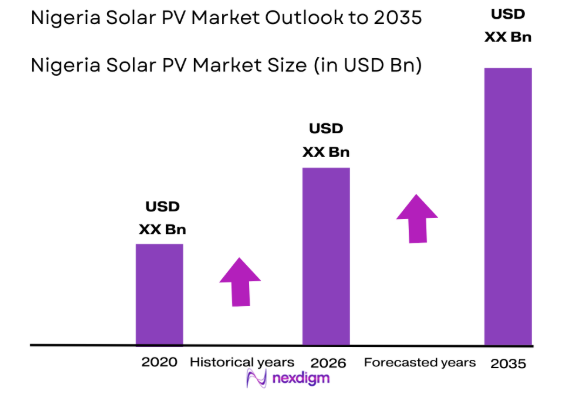
Nigeria Solar PV Market demonstrates a market size of USD ~ billion based on a recent historical assessment, driven primarily by chronic grid instability and rising demand for decentralized power solutions. Increasing diesel generator costs, supportive renewable energy policies, and falling solar module prices have accelerated adoption across residential and commercial sectors. Expansion of mini-grid projects and private sector participation further contribute to steady capital inflows, reinforcing the sector’s economic viability and scalability.
Lagos, Abuja, and Port Harcourt dominate the Nigeria Solar PV Market due to high urban energy demand and frequent power outages that necessitate alternative energy solutions. Northern regions including Kano and Kaduna are witnessing strong uptake due to favorable solar irradiation levels and government-led rural electrification programs. International developers and local EPC firms are increasingly targeting these regions, supported by multilateral funding and infrastructure initiatives that enable broader deployment of solar PV systems across diverse geographic landscapes.
Market Segmentation
By Product Type
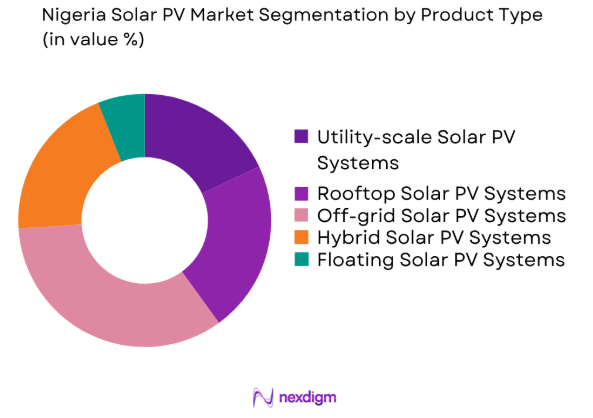
Nigeria Solar PV Market is segmented by product type into utility-scale solar PV systems, rooftop solar PV systems, off-grid solar PV systems, hybrid solar PV systems, and floating solar PV systems. Recently, off-grid solar PV systems has a dominant market share due to factors such as strong rural electrification demand, unreliable grid infrastructure, and government-backed mini-grid initiatives. Increased financing from development agencies and private investors has enabled rapid deployment of decentralized systems, particularly in underserved regions, while affordability improvements have enhanced adoption across residential and small commercial users.
By End User Segment
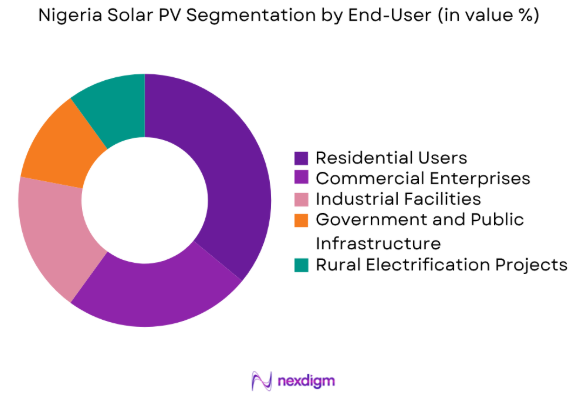
Nigeria Solar PV Market is segmented by end user segment into residential users, commercial enterprises, industrial facilities, government and public infrastructure, and rural electrification projects. Recently, residential users has a dominant market share due to factors such as frequent power outages, increasing electricity tariffs, and rising affordability of small-scale solar systems. Households are increasingly adopting solar PV solutions combined with battery storage to ensure uninterrupted electricity, supported by flexible financing models and widespread distribution networks that enhance accessibility across urban and semi-urban regions.
Competitive Landscape
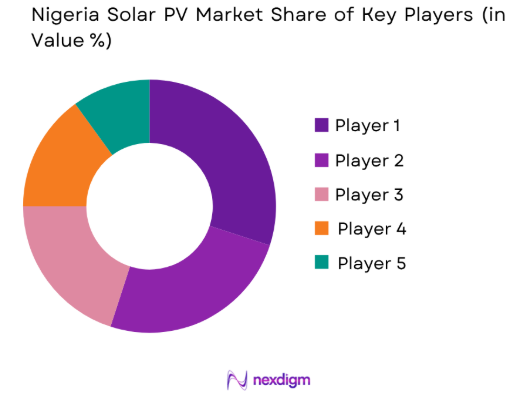
The Nigeria Solar PV Market is moderately fragmented with a mix of local and international players competing across project development, equipment supply, and energy service models. Market consolidation is gradually increasing as larger firms expand through partnerships, acquisitions, and long-term power purchase agreements. Companies focusing on integrated solutions, including storage and energy management systems, are gaining competitive advantage, while financing capabilities and project execution expertise remain key differentiators in securing large-scale contracts.
| Company Name | Establishment Year | Headquarters | Technology Focus | Market Reach | Key Products | Revenue | Project Capacity |
| Arnergy Solar Limited | 2013 | Nigeria | ~ | ~ | ~ | ~ | ~ |
| Daystar Power Group | 2017 | Nigeria | ~ | ~ | ~ | ~ | ~ |
| Luminos Nigeria | 1988 | India | ~ | ~ | ~ | ~ | ~ |
| Starsight Energy | 2015 | Nigeria | ~ | ~ | ~ | ~ | ~ |
| Canadian Solar Inc. | 2001 | Canada | ~ | ~ | ~ | ~ | ~ |
Nigeria Solar PV Market Analysis
Growth Drivers
Rising Demand for Reliable Electricity Supply
The Nigeria Solar PV Market is driven by the growing demand for reliable electricity as the national grid struggles with frequent outages and voltage instability. Solar PV systems offer stable, predictable power, reducing reliance on the unreliable grid. The high cost of diesel for backup generators further strengthens the case for solar adoption, as businesses and households seek to cut operational costs. Urbanization and population growth are increasing energy demand, straining infrastructure. The rise of distributed generation models allows for quicker solar system deployment. Government policies promoting renewable energy are fueling market growth. Solar PV technologies are gaining widespread adoption due to their cost savings, energy security, and environmental benefits.
Declining Cost of Solar PV Technology and Storage Integration
The Nigeria Solar PV Market benefits from reduced costs of solar panels, inverters, and battery storage, making solar energy more accessible. Advances in manufacturing and global supply chain efficiencies have significantly lowered equipment prices, enhancing project feasibility. Battery storage integration ensures continuous power supply, even at night. Financing options like pay-as-you-go and leasing models ease the barrier to entry for residential and small businesses. Increased supplier competition has led to better pricing and improved product quality. Technological innovations are enhancing system efficiency, reducing installation costs, and improving returns. Modular systems offer scalability based on energy needs. International funding supports the rapid expansion of cost-effective solar solutions.
Market Challenges
Inadequate Grid Infrastructure and Transmission Constraints
The Nigeria Solar PV Market faces challenges due to inadequate grid infrastructure, which limits the integration of large-scale solar projects. The transmission network struggles to accommodate additional capacity, causing bottlenecks and inefficiencies. Grid instability creates uncertainty for investors, affecting project timelines. The lack of advanced grid management systems complicates the integration of renewable energy sources. Rural areas also lack proper grid connectivity, making solar expansion difficult without additional infrastructure. Outdated equipment and maintenance issues contribute to frequent power disruptions. The absence of coordinated planning between generation and transmission sectors further reduces system efficiency. Addressing these challenges requires significant capital investment and policy reforms to modernize the grid.
High Initial Capital Requirements and Financing Barriers
The Nigeria Solar PV Market is hindered by high upfront installation costs, which deter potential adopters despite long-term savings. Limited access to affordable financing options remains a major barrier, especially for residential users and small businesses. High interest rates on loans make it difficult for consumers to invest in solar solutions. The lack of developed financing frameworks for renewable energy projects restricts growth. Currency fluctuations and economic instability add financial risks for investors. Many financial institutions lack expertise in evaluating solar projects, leading to cautious lending. The cost of importing solar equipment also increases project expenses. Government subsidies and incentives often fall short of covering initial investment costs.
Opportunities
Expansion of Off-grid and Mini-grid Solar Solutions in Rural Areas
The Nigeria Solar PV Market offers significant opportunities through the expansion of off-grid and mini-grid systems to address electricity access gaps in rural areas. A large portion of the population lacks reliable electricity, creating strong demand for decentralized energy solutions. Mini-grids provide cost-effective and scalable power without the need for extensive grid infrastructure. Government initiatives and international funding are supporting rural electrification efforts, while private sector participation increases with innovative business models for affordable energy solutions. Technological advancements are improving efficiency and reducing costs, making off-grid systems more viable. Mobile payment systems are enabling flexible payment options, and public-private partnerships are accelerating project deployment. This segment presents substantial growth potential for market players in Nigeria.
Integration of Solar PV with Energy Storage and Smart Technologies
The Nigeria Solar PV Market has strong growth potential through integrating solar systems with advanced energy storage and smart grid technologies. Battery storage enhances energy reliability by storing excess power for low-generation periods. Smart technologies like energy management systems and IoT-enabled monitoring improve system performance and efficiency, enabling real-time energy consumption tracking and optimization. Commercial and industrial users are increasingly adopting integrated solutions to cut energy costs and enhance operational efficiency. Hybrid systems combining solar with other energy sources are broadening market opportunities. Technological advancements are lowering system costs and improving scalability. Government policies supporting digitalization and renewable energy are fostering innovation, making this integration key to driving the next growth phase in the solar PV market.
Future Outlook
The Nigeria Solar PV Market is expected to witness sustained growth driven by rising electricity demand, increasing adoption of decentralized energy systems, and continued decline in solar technology costs. Advancements in battery storage and smart energy management systems will enhance system efficiency and reliability. Government support through renewable energy policies and rural electrification programs will further accelerate deployment. Private sector investments and international funding will play a critical role in expanding infrastructure and project execution.
Major Players
- ArnergySolar Limited
- Daystar Power Group
- Luminos Nigeria
- AuxanoSolar Nigeria Limited
- Solar Sister Nigeria
- RensourceEnergy
- StarsightEnergy
- RubitecSolar
- Blue Camel Energy
- Green Village Electricity
- Panasonic Solar Africa
- Canadian Solar Inc.
- JinkoSolarHolding Co., Ltd.
- Trina Solar Limited
- First Solar Inc.
Key Target Audience
- Investments and venture capitalist firms
- Government and regulatory bodies
- Renewable energy developers
- Independent power producers
- Commercial and industrial enterprises
- Residential energy consumers
- Infrastructure development companies
- Financial institutions
Research Methodology
Step 1: Identification of Key Variables
Key variables such as installed capacity, system pricing, and end-user demand patterns were identified. Market drivers, regulatory frameworks, and technology adoption rates were analyzed to define the scope of research. Data points were collected from credible industry sources and government publications.
Step 2: Market Analysis and Construction
The market was constructed using a combination of primary and secondary research methodologies. Industry reports, company filings, and policy documents were evaluated to establish market size and segmentation. Data triangulation ensured consistency across multiple sources.
Step 3: Hypothesis Validation and Expert Consultation
Findings were validated through consultations with industry experts, including solar developers and energy consultants. Feedback was incorporated to refine assumptions and ensure accuracy in market projections. Cross-verification with real-world case studies strengthened the reliability of insights.
Step 4: Research Synthesis and Final Output
All validated data was synthesized into a structured report format. Analytical models were applied to interpret trends and market dynamics. The final output was designed to provide actionable insights for stakeholders and decision-makers.

- Executive Summary
- Research Methodology (Definitions, Scope, Industry Assumptions, Market Sizing Approach, Primary & Secondary Research Framework, Data Collection & Verification Protocol, Analytic Models & Forecast Methodology, Limitations & Research Validity Checks)

- Market Definition and Scope
- Value Chain & Stakeholder Ecosystem
- Regulatory / Certification Landscape
- Sector Dynamics Affecting Demand
- Strategic Initiatives & Infrastructure Growth

- Growth Drivers
Rising Electricity Demand and Power Deficit
Government Renewable Energy Policies and Incentives
Declining Cost of Solar PV Components - Market Challenges
Grid Infrastructure Limitations
High Initial Capital Investment
Policy and Regulatory Uncertainty - Market Opportunities
Expansion of Off-grid and Mini-grid Solutions
Integration with Energy Storage Systems
Private Sector Investments in Solar Projects - Trends
Adoption of Smart Solar Systems and IoT Integration
Growth in Solar-as-a-Service Models
Increased Use of Battery Storage with Solar PV - Government Regulations
- SWOT Analysis of Key Competitors
- Porter’s Five Forces

- By Market Value, 2020-2025
- By Installed Units, 2020-2025
- By Average System Price, 2020-2025
- By System Complexity Tier, 2020-2025

- By System Type (In Value%)
Utility-scale Solar PV Systems
Rooftop Solar PV Systems
Off-grid Solar PV Systems
Hybrid Solar PV Systems
Floating Solar PV Systems - By Platform Type (In Value%)
Residential Solar Installations
Commercial & Industrial Installations
Utility Grid-connected Installations
Mini-grid and Microgrid Platforms
Agricultural Solar Applications - By Fitment Type (In Value%)
Ground-mounted Systems
Rooftop-mounted Systems
Building-integrated Photovoltaics
Portable Solar Systems
Floating Installations - By End User Segment (In Value%)
Residential Users
Commercial Enterprises
Industrial Facilities
Government and Public Infrastructure
Rural Electrification Projects - By Procurement Channel (In Value%)
Direct Purchase from OEMs
Government Tenders and Subsidy Programs
Third-party EPC Contractors
Leasing and Power Purchase Agreements
Distributor and Dealer Networks

- Market Share Analysis
- Cross Comparison Parameters (Technology Efficiency, Installation Cost, Project Scale, Energy Output, Geographic Reach, Levelized Cost of Energy, System Reliability, Storage Integration Capability, Maintenance Requirements, Regulatory Compliance)
- SWOT Analysis of Key Competitors
- Pricing & Procurement Analysis
- Key Players
Arnergy Solar Limited
Daystar Power Group
Luminos Nigeria
Auxano Solar Nigeria Limited
Solar Sister Nigeria
Rensource Energy
Starsight Energy
Rubitec Solar
Blue Camel Energy
Green Village Electricity
Panasonic Solar Africa
Canadian Solar Inc.
JinkoSolar Holding Co., Ltd.
Trina Solar Limited
First Solar Inc.

- Increasing Residential Adoption due to Power Reliability Issues
- Commercial Sector Shift Towards Cost-efficient Energy Solutions
- Industrial Demand for Stable and Scalable Power Supply
- Government-led Rural Electrification Initiatives

- Forecast Market Value, 2026-2035
- Forecast Installed Units, 2026-2035
- Price Forecast by System Tier, 2026-2035
- Future Demand by Platform, 2026-2035


 Request a Sample
 Ask for Customization
 Get a Quote
 Enquire Now