

 Download PDF
Market Overview
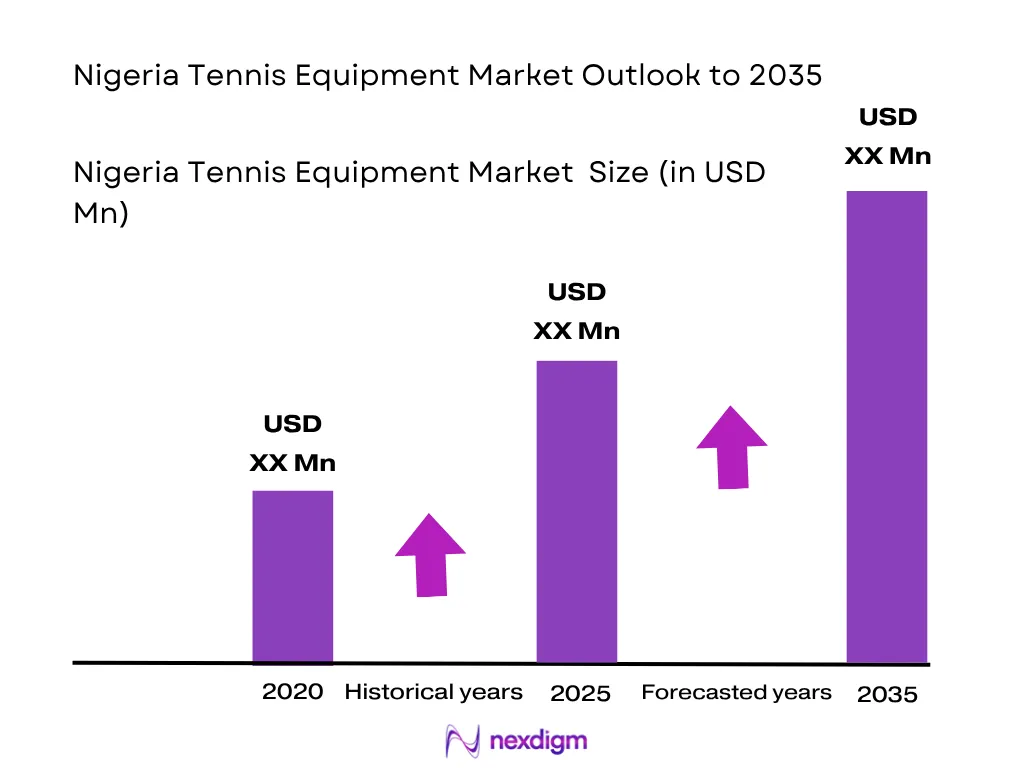
The Nigeria tennis equipment market forms part of the broader racket sports and sports equipment ecosystem valued in related industry studies. The market is growing at a CAGR of 4.28% from 2025, with the market size expected to reach USD ~ million. Nigeria’s racket sports equipment sector, including tennis was forecast to reach approximately USD ~ million in revenue in 2025, reflecting a growing base of equipment sales including racquets, balls, footwear, and accessories. This growth is driven by rising interest in tennis participation, increasing youth engagement, expanding middle-class discretionary spend on sports gear, and a proliferation of online platforms that make imported equipment more accessible to Nigerian consumers.
The Nigeria tennis equipment market is influenced by vibrant urban centers with higher disposable incomes and better sports infrastructure. Cities such as Lagos, Abuja, and Port Harcourt dominate demand because they host the majority of tennis clubs, professional coaching academies, and retail outlets. Lagos’s status as a commercial hub creates concentrated retail presence and promotional events, while Abuja’s political and administrative development programs have spurred investments in sports infrastructure. Port Harcourt’s growing urban population also drives increased participation in organized sports including tennis.
Market Segmentation
By Product Type
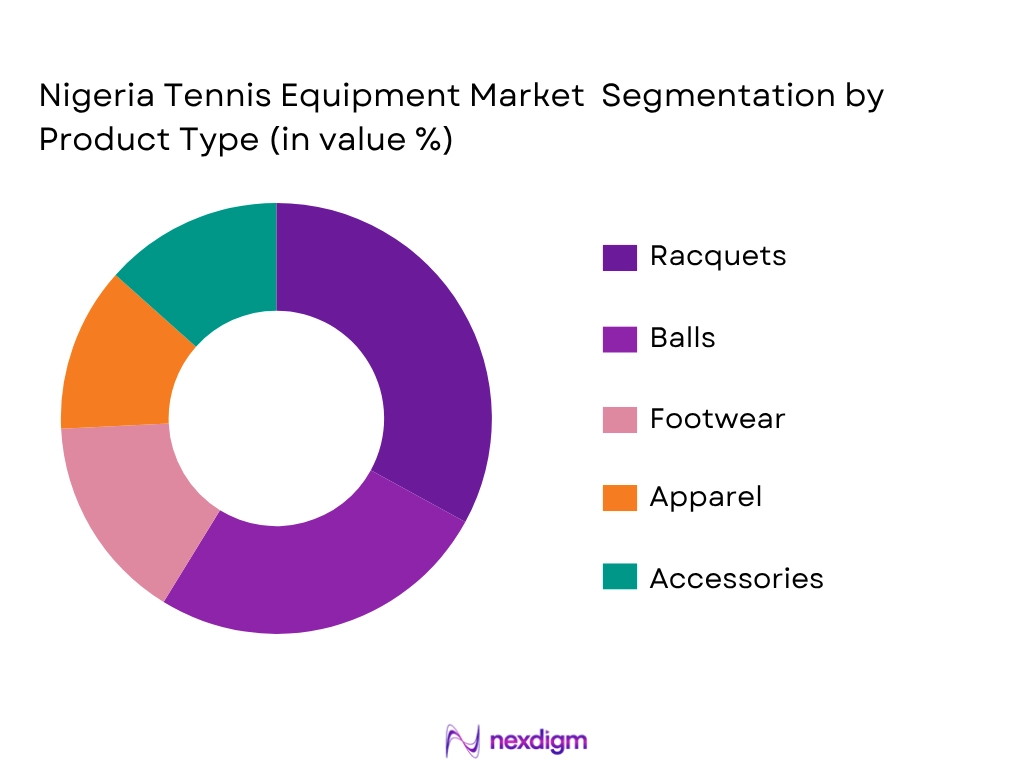
Racquets are the dominant product type in the Nigeria tennis equipment market due to their essential role in play and repeated replacement cycle caused by wear and breakage. Both professional and recreational players in urban centers prioritize quality rackets from well‑known brands, leading to disproportionate sales compared with other categories. International brands like Wilson, Head, and Babolat are particularly sought after for racquets because of performance reputation, which keeps this segment in the lead. Ball purchases follow closely because they wear quickly and must be replaced frequently. Footwear and apparel, while growing, compete with broader sportswear demand and have lower share relative to the core requirement of game equipment.
By Distribution Channel
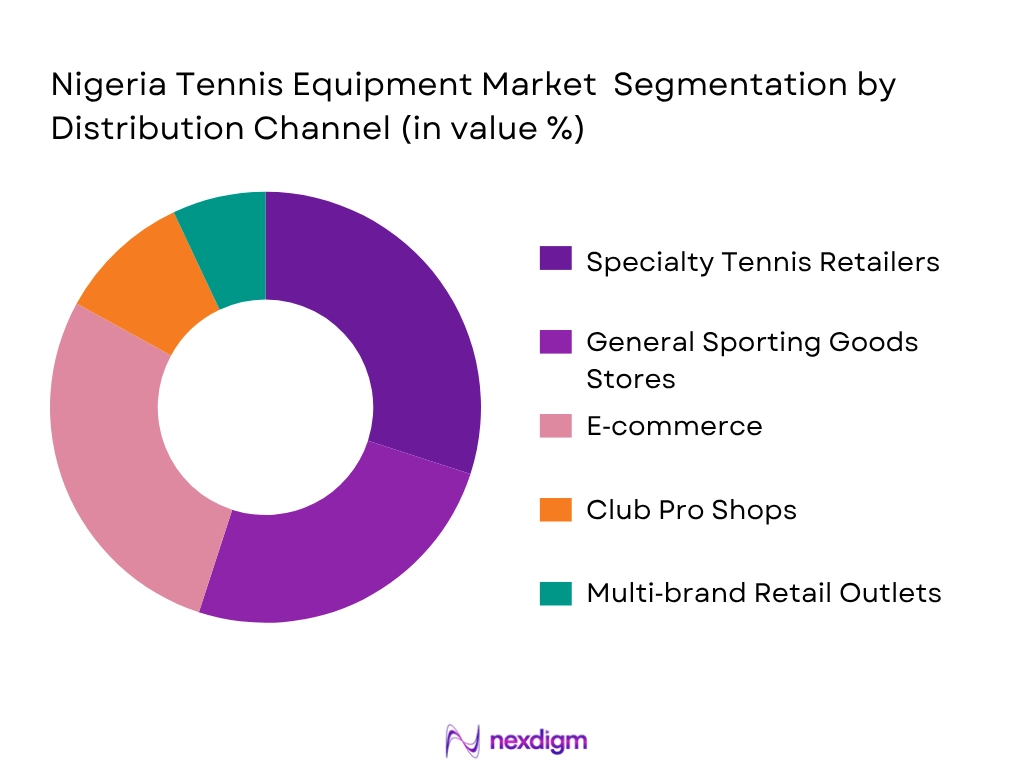
Specialty Tennis Retailers and E‑commerce platforms lead distribution because they offer extensive product ranges and expert guidance. Specialty stores provide focused tennis equipment and fitter services, making them preferred for high‑end purchases. E‑commerce platforms have rapidly grown due to improved online access and consumer willingness to buy imported brands digitally at competitive prices. General sporting goods stores hold strong presence due to established networks in urban markets. Club pro shops maintain niche share where players most frequently access gear.
Competitive Landscape
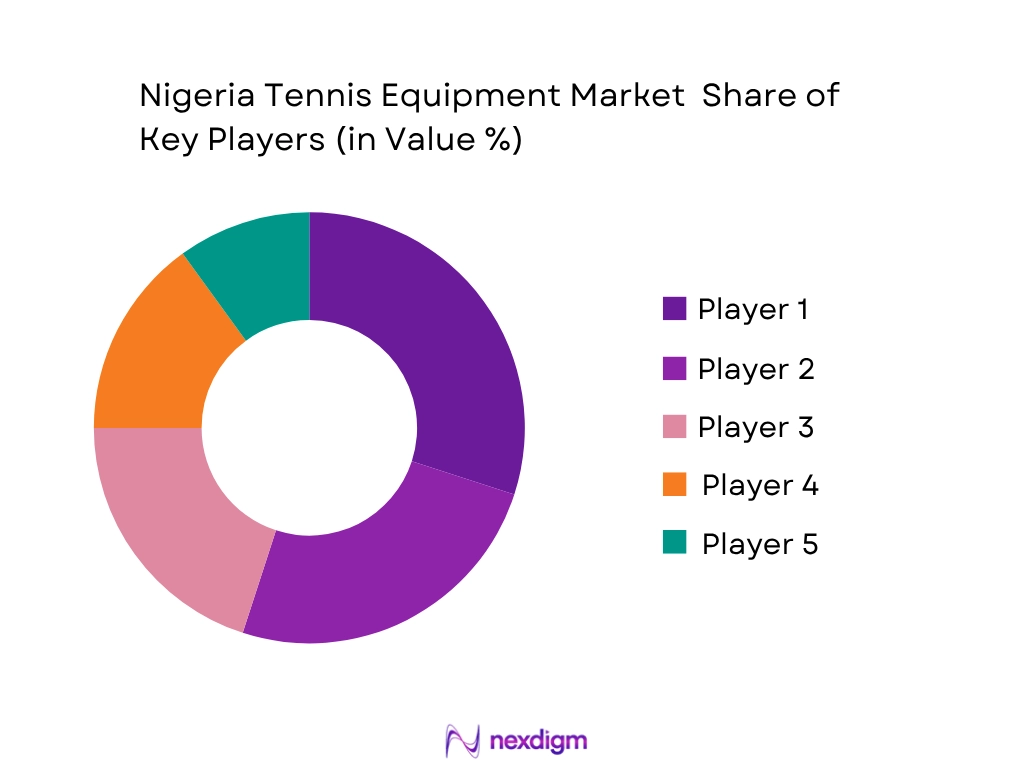
The Nigeria tennis equipment market is characterized by a mix of global branded manufacturers and localized retail import networks. Imported premium equipment from international leaders is widely available through retailers and online platforms, while local brands and distributed imports fill mid‑tier demand. This concentration reflects the global nature of tennis gear manufacturing and Nigeria’s reliance on imports due to limited domestic production capacity. The Nigeria tennis equipment market is influenced by major global brands complemented by local distributors and e‑commerce sellers. International leaders such as Wilson, Head, and Babolat exert strong influence through brand equity, while footwear and apparel brands like Adidas and Nike amplify market demand with lifestyle and performance products. Local importers and specialty shops ensure product accessibility, creating a mixed competitive environment in which global brand reputation competes with distribution reach and price positioning.
| Company | Est. Year | HQ | Product Breadth | Distribution Network | Pricing Tier | Brand Equity | Retail Presence | E‑commerce Capability |
| Wilson Sporting Goods | 1914 | USA | ~ | ~ | ~ | ~ | ~ | ~ |
| Head NV | 1950 | Netherlands | ~ | ~ | ~ | ~ | ~ | ~ |
| Babolat | 1875 | France | ~ | ~ | ~ | ~ | ~ | ~ |
| Yonex Co., Ltd. | 1946 | Japan | ~ | ~ | ~ | ~ | ~ | ~ |
| Adidas AG | 1949 | Germany | ~ | ~ | ~ | ~ | ~ | ~ |
Nigeria Tennis Equipment Market Analysis
Growth Drivers
Tennis Academy Expansion & Youth Participation
Nigeria’s large youth population forms a foundational driver for tennis participation and the corresponding tennis equipment market. With a total population of 2.67 million people and a maintained annual population growth of 2.1 percent, the base of potential young sports participants remains substantial. Youth (ages 15–24) exhibit robust labor force activity with a 62.74 percent participation rate in 2024, indicating high engagement in structured activities including sport programs. This demographic strength is critical for tennis academies, which rely on a large pool of active youth to sustain coaching programmes and recurring equipment needs such as racquets, balls, footwear, and training gear. Initiatives by the Nigeria Tennis Federation to establish centralized player registration systems enhance organized participation and help academies track and nurture talent. These youth‑oriented development programmes generate ongoing demand for tennis equipment across beginner to advanced player segments, underpinning long‑term market engagement through structured academy growth and youth participation incentives.
School Sports Program Integration
Structured sports integration at schools and educational institutions is a key driver for Nigeria’s tennis equipment market because it directly increases routine demand for gear among students. Nigeria’s education system serves millions of learners, and formal inclusion of sports programmes increases procurement of tennis equipment for teams, physical education classes, and inter‑school competitions. The Federal Ministry of Youth and Sports Development, through events like the Central Bank of Nigeria Junior Tennis Tournament, reflects concerted efforts toward youth athletic exposure, with organized senior and junior competitions drawing broad student participation at venues such as Lagos Lawn Tennis Club and Moshood Abiola National Stadium in Abuja. Organized school sports programmes typically require bulk‑scale purchases of essential equipment (racquets, practice balls, nets, and coaching aids), which drives recurring procurement by institutions rather than individual consumers. Given Nigeria’s large population of school‑aged children and youth, this structured integration of tennis into school activities makes the educational sector a substantial conduit for equipment sales and sustained market demand.
Market Challenges
Import Dependence & Foreign Exchange Volatility
Nigeria’s reliance on imported sports and recreational equipment, including tennis gear, presents a significant challenge for the market due to currency and foreign exchange volatility. In 2024, the value of Nigeria’s imports of toys, games, and sports requisites, which encompass items such as tennis racquets and balls, totalled USD 21.74 million, illustrating that a meaningful portion of tennis equipment is sourced from overseas suppliers. This import reliance exposes importers and retailers to fluctuations in the naira/dollar exchange rate, which impact the landed cost of equipment and, in turn, consumer pricing. Nigeria’s macroeconomic context in 2024 featured elevated inflation of 33.2 percent, followed by a moderated but still high rate in 2025, affecting purchasing power and the cost structure of imported goods. When exchange rates weaken or inflation remains elevated, importers absorb either increased costs or pass them on to end buyers, which can suppress demand especially for high‑value categories such as premium racquets and footwear. This structural dependence on foreign supplies limits market stability and makes competitive pricing difficult in a price‑sensitive consumer base.
Limited Domestic Manufacturing Capacity
The lack of significant domestic production of tennis equipment in Nigeria constrains the supply ecosystem and limits the market’s ability to achieve cost competitiveness and supply resilience. Unlike countries with established sports manufacturing sectors, Nigeria has minimal capacity to produce key tennis gear locally, resulting in near‑total reliance on imported items for racquets, balls, shoes, and accessories. This structural limitation means that even basic equipment must be brought in through international trade channels, which involves logistics costs, tariffs, and currency exposure. As of 2024, data shows that imports of sports and recreational equipment remain modest in absolute value (USD 21.74 million) but are distributed across multiple categories, indicating fragmented demand serviced by imports rather than local industry. The absence of localized production inhibits the potential for vertically integrated supply chains that could reduce lead times and lower prices for domestic consumers. Additionally, lack of manufacturing means lost opportunities for employment and skills development within Nigeria’s industrial base, further weakening sectoral growth prospects and limiting the ability to meet rising domestic demand with home‑grown solutions.
Opportunities
Local Assembly & Branding
Developing local assembly lines and domestic branding for tennis equipment presents a strategic opportunity to strengthen Nigeria’s sports gear ecosystem and reduce reliance on imported products. Currently, the majority of tennis equipment sold in Nigeria enters through international trade channels, reflected in the USD 21.74 million value of imported toys, games, and sports requisites, a category that includes tennis gear, recorded in 2024. With Nigeria’s population exceeding 232 million people, creating localized assembly operations could harness this large consumer base while mitigating foreign exchange risk and tariff exposure. Local production hubs could focus on assembly of racquets, stringing services, manufacturing of accessories, and branded apparel tailored to regional preferences. Establishing Nigerian brands would also enable cost efficiencies through reduced shipping expenses and localized labor, making equipment more affordable for a price‑sensitive market. Furthermore, this shift could generate employment opportunities and foster skills related to product assembly and quality control, contributing to broader economic activity beyond the immediate sports segment. By building a local manufacturing and assembly foundation, Nigeria can capture more value within its economy while meeting growing consumer demand for accessible tennis gear.
Smart/Connected Tennis Equipment Adoption
Technological innovation in sports equipment, including smart and connected tennis gear, offers a notable opportunity for market differentiation and growth within Nigeria’s tennis equipment segment. Connected sensors embedded in racquets and wearable tech allow players to track swing dynamics, shot speed, and performance analytics, enhancing training outcomes. Even in developing markets, increasing internet penetration, which stood at 41 percent of the population in 2024, enables broader adoption of tech‑enabled products among enthusiasts willing to integrate digital insights into their game. With Nigeria’s young, tech‑engaged population and growth in mobile connectivity, tennis players are increasingly receptive to products that offer performance tracking and data‑driven improvement. The expansion of e‑commerce and digital platforms further facilitates access to these advanced products, enabling consumers to explore smart gear without traditional retail constraints. Integrating technology into tennis equipment not only elevates the player experience but also creates premium segments within the market, offering suppliers opportunities to introduce differentiated offerings that command value beyond traditional gear. This capability can attract digitally savvy players and academies aiming to leverage data in training, stimulating demand for higher‑value tennis equipment categories
Future Outlook
The Nigeria tennis equipment market is expected to experience steady growth underpinned by increasing youth participation, expanding e‑commerce penetration, and rising consumer interest in healthy lifestyles. Continued investments in sports infrastructure and targeted government support for athletic development may further stimulate demand for tennis gear. The longer‑term landscape favors enhanced accessibility through digital channels and potential localized value chain improvements. Over the longer horizon, market expansion will be linked to broader improvements in disposable income and sustained efforts to develop structured tennis programs. Growth in grassroots schools and club programs will drive consistent demand for core equipment categories such as racquets and balls, making the market attractive for both established global brands and emerging local players.
Major Players
- Wilson Sporting Goods
- Head NV
- Babolat
- Yonex Co., Ltd.
- Adidas AG
- Nike Inc.
- Dunlop Sport
- Tecnifibre
- Prince Global Sports
- Asics Corporation
- Slazenger Ltd
- Decathlon (multiple sub‑brands)
- Local Sports Gear Importers (Nigeria)
- Academy Licensed Private Labels
- E‑commerce Exclusive Brands
Key Target Audience
- Tennis gear importers and distributors
- Sports retail chains & specialty stores
- Investments and venture capitalist firms
- Government and regulatory bodies
- Development (National Sports Commission)
- Sports facility developers and tennis club operators
- E‑commerce platforms and marketplaces
- Brand management and licensing firms
- Tennis coaching academies & performance training centers
Research Methodology
Step 1: Market Definition and Variable Identification
The initial phase establishes the scope of the Nigeria tennis equipment market, including equipment definitions (racquets, balls, footwear, apparel, accessories) and key demand drivers. This step integrates secondary data from industry reports and trade analysis to identify core market variables influencing sales and consumption.
Step 2: Data Compilation and Market Estimation
Historical and current market size data are compiled from verified secondary sources and import statistics. Sales volumes and revenue figures for key segments are analysed, and frameworks like top‑down triangulation ensure consistency between product type and distribution channel metrics.
Step 3: Expert Validation and Hypothesis Testing
Market hypotheses regarding demand trends and distribution dynamics are validated through expert interviews with importers, retail chain managers, and sports gear distributors active in Nigeria. Insights on consumer preferences and regional demand patterns help refine underlying assumptions.
Step 4: Forecasting and Synthesis
A bottom‑up forecasting model projects future market growth using historical trends, economic indicators, and participation rates. Outputs are synthesized to ensure that market estimates, segment projections, and competitive landscape evaluations form a cohesive analytical narrative.

- Executive Summary
- Research Methodology (Market Definitions and Assumptions, Scope Boundaries, Basket Price Estimation, Volume Estimation Logic, Africa‑specific Adjustments, Primary & Secondary Data Mix, Field Validation Approach, Triangulation Protocol)

- Market Definition and Delineation
- Historical Genesis and Market Evolution
- Role of Tennis Federations and Institutional Framework
- Nigeria Tennis Value Chain
- Distribution Structure and Channel Flow
- Product KPI Benchmarks (Durability, Performance, Warranty)
- Import vs. Domestic Sourcing Analysis

- Growth Drivers (Tennis Academy Expansion & Youth Participation, School Sports Program Integration, Professional Circuit Exposure & Sponsorship Activation, Digital Retail Penetration & Online Equipment Sales, Urban Affluence & Middle-Class Sports Engagement)
- Market Challenges (Import Dependence & Foreign Exchange Volatility, Limited Domestic Manufacturing Capacity, Regional Distribution Inefficiencies, Seasonal Demand Fluctuations, Price Sensitivity Among Recreational Players)
- Opportunities (Local Assembly & Branding, Smart/Connected Tennis Equipment Adoption (Sensors, Tracking Apps), Academy and Club Bulk Procurement Programs, Sponsorship Tie-ups with Nigerian Tennis Federation, Product Bundling & Performance Fit Services)
- Trends (E‑commerce & Omnichannel Retail Growth, Social Tennis Events & Community-Led Engagement, Sustainability Initiatives in Apparel & Accessories, Digital Coaching Integration, Youth-Oriented Performance Gear)
- Regulatory Environment (Customs Duties & Import Tariff Implications (Racquets, Balls, Footwear), Product Safety & Certification Standards (National Sports Equipment Guidelines), Advertising & Endorsement Compliance, Local Content and Labeling Requirements)
- SWOT Analysis (Strengths, Weaknesses, Opportunities, Threats of the Nigeria tennis equipment market)
- Stakeholder Ecosystem (Interactions among Importers, Local Assemblers, Retailers, E‑commerce Platforms, Tennis Academies, Clubs, Coaches, and Nigerian Tennis Federation)
- Porter’s Five Forces (Competitive Rivalry among Local & Imported Brands, Supplier Power – Racquet/Strings/Footwear Providers, Buyer Power – Clubs, Academies, and Retailers, Threat of New Entrants – Niche Sports Tech Startups & E‑commerce Brands, Threat of Substitutes – Informal/Low-Cost Equipment and DIY Alternatives)

- By Retail Value (2020-2025)
- By Volume (2020-2025)
- By Average Selling Price Trends (2020-2025)
- By Growth Rates & CAGR Analysis (2020-2025)
- By Per Capita Tennis Equipment Spend (2020-2025)
- By Elasticity of Demand Estimates (2020-2025)

- By Product Type (In Value%)
Racquets (Graphite / Aluminum)
Strings
Grips
Balls
Footwear
Apparel
Accessories - By Distribution Channel (In Value%)
Organized Sports Stores
Specialty Tennis Retailers
E‑commerce Platforms
Club Pro Shops
General Sporting Goods Outlets - By Consumer Type (In Value%)
Professional Athletes
Amateur Players
Youth/Academy Students
Casual Recreational Players - By Price Tier (In Value%)
Premium
Mid‑Tier
Economy - By Purchase Trigger (In Value%)
Performance Upgrade
Replacement Cycle
Coaching Requirement
Academy Procurement

- Market Share Analysis by Value and Volume (Market shares of top international and local brands, volume vs retail value comparison, market concentration by product type and region)
- Cross Comparison Parameters (Company Overview, Price Positioning, Retail Footprint, Import Dependency %, SKU Breadth, Brand Loyalty Score, Dealer Network, Marketing Reach, After‑Sales Service, Warranty Terms, Online Penetration, Sponsorship / Academy Tie‑ups, Distribution Coverage, Customer Satisfaction Index)
- Competitive Intensity Mapping (Market concentration, fragmentation, and regional dominance; international vs local players; barriers to entry and new entrant pressure)
- Channel and Tier Level Competition Dynamics (Competition dynamics across premium, mid-range, and economy tiers; e-commerce vs offline retail vs academy procurement, regional differences in penetration)
- SWOT of Major Players (Strengths, Weaknesses, Opportunities, Threats for private labels, local assemblers, e-commerce brands, and academy-linked private labels)
- Pricing & Promotional Benchmarking (Average Selling Prices and SKU-level pricing for major brands, price positioning of premium vs standard products, discounting practices during tournaments or academy procurement; promotions on e-commerce platforms vs offline stores)
- Detailed profiles of Major Players
Wilson Sporting Goods
Head NV
Babolat
Yonex Co., Ltd.
Prince Global Sports
Tecnifibre
Dunlop Sport
Slazenger Ltd
Nike Inc.
Adidas AG
Asics Corporation
Decathlon
Local Assemblers/Retail Brands
Academy‑Backed Private Labels
E‑commerce Exclusive Brands

- Demand and Utilization (Sales breakdown by end-user type: recreational players vs professional athletes, academy/club bulk procurement, school sports programs, urban vs regional consumption patterns)/
- Consumer Demographics and Purchasing Behavior (Age distribution, income segmentation, gender split, frequency of purchases, channel preference)
- Budget and Price Sensitivity (Pricing tier, consumer spending patterns on racquets, balls, footwear, apparel, seasonal and tournament-driven demand spikes)
- Needs, Desires and Pain Points (Comfort, durability, and performance requirements, brand perception and aspirational buying, limited availability in regional markets, fitting services, counterfeit or low-quality imports)
- Decision-Making Process (Coach recommendations, academy/club guidance, peer reviews, online research, role of professional endorsements, demo events, and product trials at tournaments)

- By Retail Value (2020-2025)
- By Volume (2020-2025)
- By Average Selling Price Trends (2020-2025)
- By Growth Rates & CAGR Analysis (2020-2025)


 Request a Sample
 Ask for Customization
 Get a Quote
 Enquire Now