

 Download PDF
Market Overview
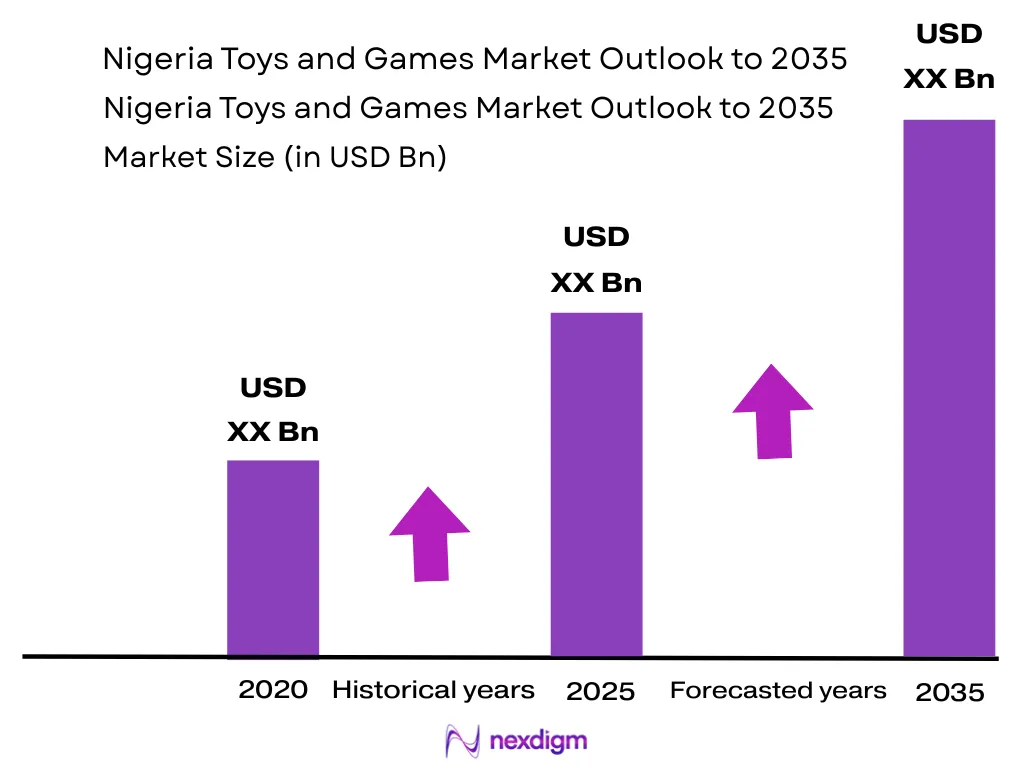
The Nigeria Toys and Games market is valued at USD ~ billion, according to revenue estimates from a market analysis platform. This reflects significant consumer spend on a mix of traditional toys, board games, action figures, and electronic games amid rising middle‑class demand. Growth over 2023 has been supported by increased retail distribution, expanding e‑commerce availability, and demographic drivers such as a large youth population with rising consumption capacity. Import activity underpins product availability, with total imports of toys, games and sports requisites reaching USD ~ million, reflecting Nigeria’s reliance on foreign toy supplies to meet domestic demand. These dynamics, combined with expanding online channels and urban retail penetration, have catalysed market scale and diversification across product categories. In Nigeria, Lagos and Abuja emerge as dominant demand hubs for toys and games due to a combination of population density, higher disposable income pools, and more developed retail environments.
Market Segmentation
By Product Type
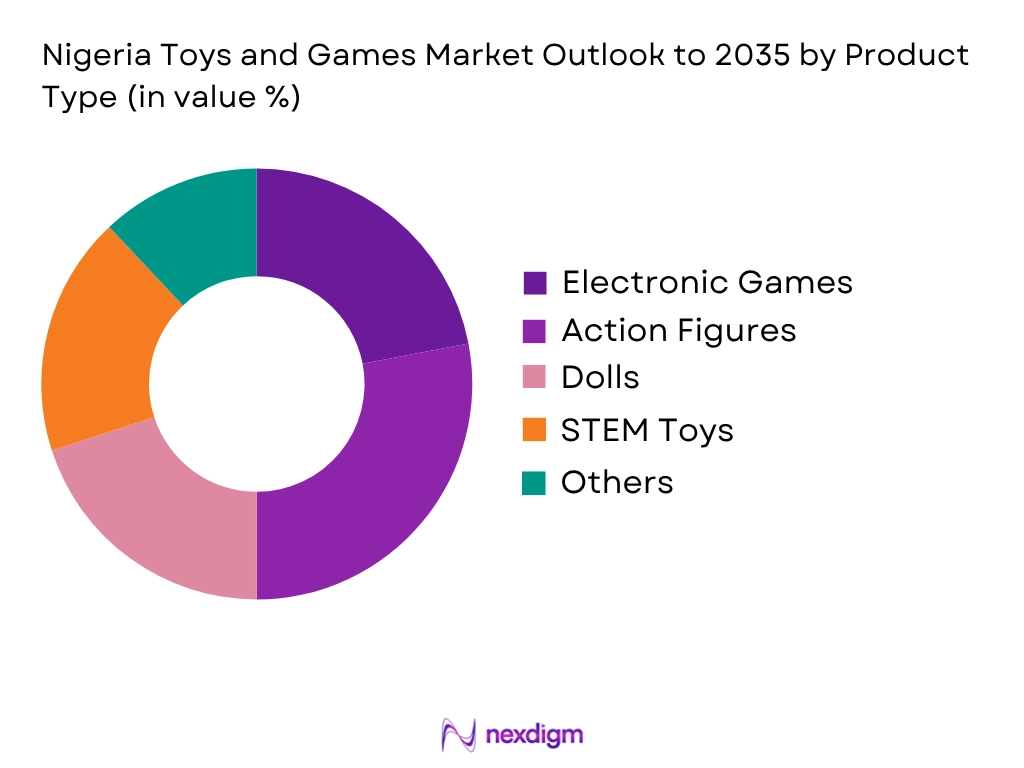
The Nigeria Toys and Games market is segmented into action figures, dolls & plush toys, educational & STEM toys, electronic games, and traditional/board games. Among these, action figures lead the market share in 2024 owing to their cultural appeal and strong association with popular media franchises, cartoons, and superhero IPs that resonate with children and collectors alike. These products are highly visible in retail channels, benefit from global marketing support by licensors, and are commonly included in gifting occasions, which sustains their prominence. Additionally, action figures often sit at a mid‑price range that appeals to Nigeria’s emerging middle class, balancing aspirational branding with affordable spending levels. The product’s versatility — appealing both to children and adult collectors — also broadens its consumer base compared with more niche categories.
By Distribution Channel
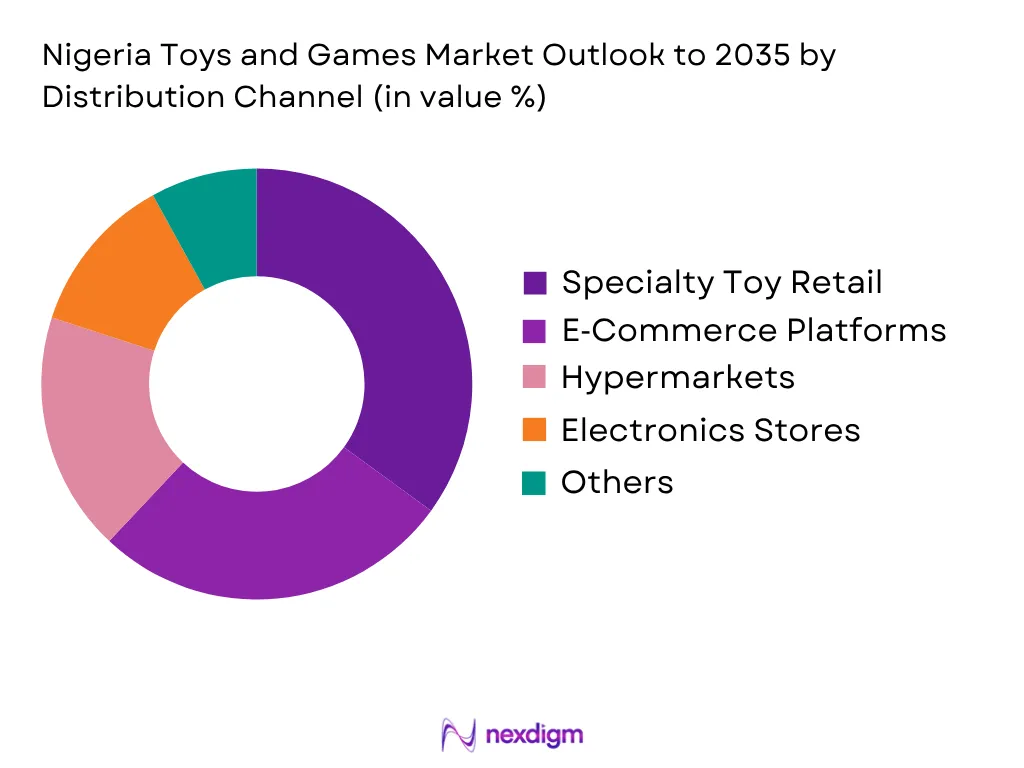
Nigeria’s toys and games market segmented by distribution reveals specialty toy retailers hold the largest share in 2024. These outlets capitalise on curated assortments, brand partnerships, and consumer trust to offer a wide range of toy products, including action figures, licensed merchandise, and educational toys. Specialty stores benefit from deeper product knowledge, organised retail spaces, and promotional activities that build family‑oriented footfall. Coupled with rising urban retail investment, these stores embed toy categories into mainstream retail journeys, often supported by experiential in‑store displays that encourage purchase decisions. E‑commerce channels expand reach beyond major urban centres, offering convenience and broad product access to consumers nationwide. However, specialty toy stores maintain customer preference for tactile discovery and immediate fulfilment. These dynamics highlight how channel presence and consumer engagement shape product penetration and revenue concentration across market segments.
Competitive Landscape
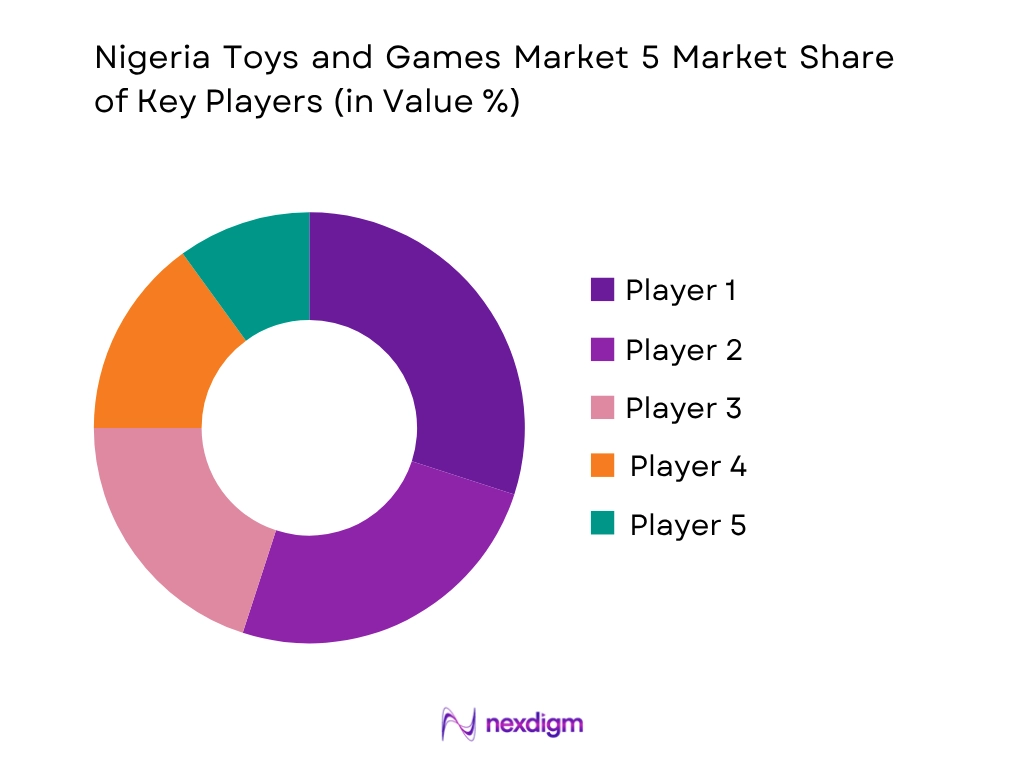
The Nigeria Toys and Games industry is characterised by a blend of international toy brands, local distributors, and multi‑product retailers. Global licensors and brands benefit from strong IP recognition, while Nigerian retail chains and e‑commerce platforms leverage local market access. Import activity from key supplying nations, especially China and the USA, shapes product availability and cost structures, reinforcing competition between foreign product offerings and emerging local toy assortments. Distribution partnerships and seasonal promotions further intensify competitive positioning.
| Player Name | Established | Headquarters | Brand Licensing Portfolio | Retail Footprint Scale | Import Network Strength | E‑Commerce Presence | Distribution Reach |
| LEGO Group | 1932 | Denmark | ~ | ~ | ~ | ~ | ~ |
| Mattel, Inc. | 1945 | USA | ~ | ~ | ~ | ~ | ~ |
| Hasbro, Inc. | 1923 | USA | ~ | ~ | ~ | ~ | ~ |
| Spin Master | 1994 | Canada | ~ | ~ | ~ | ~ | ~ |
| Simba Toys | 1982 | Germany | ~ | ~ | ~ | ~ | ~ |
Nigeria Toys and Games Market
Growth Drivers
Rising Total Population and Large Youth Cohort Boosts Base Consumer Demand
Nigeria’s overall population reached approximately 232,679,478 people as of the most recent demographic data, marking it as the largest population in Africa. This unusually large population base includes a substantial youth segment that directly influences demand for toys and games, as household consumption on leisure and child‑oriented products increases with family size. Household final consumption expenditure (aggregate spend on goods and services including leisure products) totals N310,548,257,163,140 Nigerian currency units, of which a significant portion represents non‑essentials in urban households’ budgets. Urban growth and internal migration trends concentrate family units in cities such as Lagos, Abuja and Port Harcourt, where disposable incomes and retail accessibility further stimulate consumption of entertainment and developmental play products. Given that over 40 percent of Nigerians are under the age of 15 — a demographic with high play product propensity — demand for toys, board games, and digital play formats is anchored in fundamental population dynamics that reinforce consistent baseline demand from family‑oriented spending clusters.
Household Final Consumption Expenditure Supports Discretionary Retail Spending
Nigeria’s macroeconomic accounts show final consumption expenditure of N310,548,257,163,140 in national currency units, reflecting broad household spending on goods and services beyond necessities. Household final consumption (estimated at N286,089,473,269,313) represents the core driver for discretionary purchases of toys, games, and entertainment products, particularly in urban centres where retail formats and distribution networks are expanding. Even in the context of elevated inflation (consumer price inflation reached 33.2 percent according to official data), families allocate parts of their retainable budgets to educational toys, board games, and digital gaming gadgets due to rising middle‑class aspirations and growing awareness of developmental play. As household consumption remains the principal component of GDP calculations, this broad expenditure base supports consumer retail sectors where toys and games sit alongside discretionary purchases such as clothing and electronics — helping cushion these categories against volatility in food and essential goods pricing. Elevated import activity of leisure categories into Nigeria also signals underlying retailer confidence in household consumption trends.
Market Challenges
High Consumer Price Inflation Constrains Discretionary Toy Purchases
Nigeria’s economic environment is marked by notably high consumer price inflation, which stood at 33.2 percent in 2024 — a level that significantly erodes purchasing power, particularly among lower and middle‑income households. High inflation means that essentials such as food and housing consume larger portions of household budgets, leaving less real income available for discretionary spending on toys and games. Many families allocate up to two‑thirds of their household spend on essentials amid elevated price levels, creating a constraint on non‑essential categories such as entertainment products. This macroeconomic pressure is particularly impactful for imported toys and games — whose retail pricing is directly influenced by transport and foreign exchange costs — thereby amplifying affordability challenges for everyday consumers. Additionally, inflation‑induced volatility often leads households to postpone or reduce discretionary purchases in favour of essential needs, especially in lower‑income segments where per‑capita income (GDP per capita around USD 1,084.2) remains limited compared with global peers. These conditions require retailers and producers to adapt pricing strategies and portfolio mixes to maintain volume demand in inflationary environments.
Underdeveloped Retail Infrastructure Limits Market Reach
Nigeria’s retail and logistics infrastructure remains unevenly developed, especially outside major urban hubs, posing a key challenge to widespread distribution of toys and games. Reliable secondary source listings indicate that while major cities like Lagos and Abuja host organised retail chains, smaller cities and rural areas often lack formal retail presence, limiting access for families. In 2023, electricity access was recorded at 61.2 percent of the population, and unreliable power supplies compound distribution inefficiencies for electronic toys and digital play products that require display, storage, or operational power. Moreover, only about 39 percent of Nigerians used the Internet as of the latest data, which restricts e‑commerce penetration — a channel that could otherwise bridge physical retail gaps by enabling broader product availability. These infrastructure limitations, including transport bottlenecks and inconsistent energy supplies, inflate distribution costs and reduce economies of scale for toy retailers seeking national coverage. As a result, adoption of mass merchandising and national logistics networks remains slower than in more developed retail markets, constraining both competitive entry and sustained consumer access across Nigeria’s geographic and demographic spectrum.
Market Opportunities
Expanding Digital Access and Mobile Penetration
Digital connectivity in Nigeria, even if still developing, provides a foundation for extended access to toys, games, and interactive content. While overall Internet usage was around 39 percent of the population, this represents a large user base given Nigeria’s total population size of over 232 million people. Mobile access and digital engagement create incremental opportunities for e‑commerce sales, digital game distribution, and online marketing for toy products, especially among younger demographics clustered in urban and peri‑urban centres. Increased digital interaction supports retail strategies that combine physical retail presence with online visibility, enabling brands to tap into consumer shopping behaviours beyond in‑store visits. In addition, social media and mobile gaming proliferation among youth segments reinforce interest in digital games and app‑linked toy formats that blend physical and virtual engagement. Nigeria’s sizeable population base and developing digital economy thus offer scope for retailers to scale omnichannel strategies that bypass some of the limitations of traditional retail infrastructure, while leveraging mobile outreach and online transactions to deepen market penetration and consumer discovery of diverse play products.
Strong Youth and Future Workforce Potential Bolsters Long‑Term Consumer Base
Nigeria’s demographic momentum, underscored by an annual population growth rate of around 2.1 percent, positions it as one of the fastest‑growing populations globally, creating a consistent pipeline of younger consumers for toys and games. A large youth cohort contributes to sustained baseline demand for play‑oriented products as households include children in purchasing decisions from infancy through adolescence. This growing demographic scale underpins opportunities for educational and developmental toy categories, as well as digital game formats tailored to customer age progression. Retailers and manufacturers can align future product innovations with generational demand shifts, leveraging a stable base of young consumers whose life‑long product engagement patterns begin with early play and expand to interactive and competitive gaming. Nigeria’s demographic growth also coincides with increasing urbanisation and rising aspirations among middle‑income segments, suggesting that investments targeting educational toys, STEM kits, and hybrid digital‑physical game products can yield long‑term relevance and repeat demand as family incomes evolve alongside population growth.
Future Outlook
The Nigeria Toys and Games market is expected to continue expanding through to 2035, driven by ongoing urbanisation, rising disposable income, and a growing youth demographic with enhanced purchasing access through both physical and digital retail channels. Increasing interest in educational and interactive play, combined with e‑commerce proliferation, is anticipated to diversify demand across digital games, STEM toys, and traditional entertainment products. The market’s evolving consumer base and importing dynamics are poised to support long‑term expansion and product innovation.
Major Players
- LEGO Group
- Mattel, Inc.
- Hasbro, Inc.
- Spin Master
- Simba Toys
- ToyRio Nigeria
- Jumia (Toys & Games Division)
- Konga (Toys Segment)
- SLOT Nigeria (Games & Toys)
- Electronic Stores Chain (Nigeria)
- Educational Toys Supplier Nigeria
- Board Game & Hobby Stores
- Import Distributors (Nigeria)
- Local Toy Manufacturers Collective
- Specialty Retail Toy Outlets
Key Target Audience
- Retail Chain Category Heads – Toys & Games
- National Toy Import Distributors
- Specialty Toy Store Buyers
- Investments & Venture Capitalist Firms
- Retail Real Estate Investors
- National Consumer Goods Regulatory Bodies
- e‑Commerce Platform Decision Makers
- Children’s Entertainment Event Organisers
Research Methodology
Step 1: Identification of Key Variables
The initial stage delineated the ecosystem of Nigeria’s toys and games market, including market definitions, major stakeholders (manufacturers, importers, retailers), and macro drivers such as demographic trends and import data. Secondary sources, including international trade datasets and industry forecasts, were compiled to establish baseline metrics.
Step 2: Market Analysis and Construction
Historical and current revenue figures were evaluated from multiple secondary data points to assess category penetration, product preferences, and channel performance. Import volumes and distribution data were analysed to contextualise supply structures and consumption patterns.
Step 3: Hypothesis Validation and Expert Consultation
Market assumptions were scrutinised via qualitative inputs from industry practitioners and distributors, reinforcing understanding of retail dynamics, counterfeit product challenges, and cultural influences affecting play and purchase behaviour.
Step 4: Research Synthesis and Final Output
Data were triangulated to validate segmentation results and revenue distribution across channels and product types. Competitive benchmarks were assembled to offer comprehensive insights for strategic decision making and future scenario mapping.

- Executive Summary
- Research Methodology (Market Definitions and Assumptions, Abbreviations, Market Sizing & Forecasting Approach, Consolidated Research Framework, In‑Depth Expert Interviews Approach, Nigeria Household Demand Analysis Method, Retail & E‑Commerce Channel Mapping, Limitations and Future Research Conclusions)

- Definition and Scope of Toys & Games Market
- Genesis and Evolution of Play Culture in Nigeria
- Informal Play & Traditional Toys Influence (Cultural Context)
- Influence of Digital Gaming and Mobile Penetration on Product Preferences
- Retail Landscape Overview (Formal vs Informal Channels)

- Growth Drivers (Youth Population & Family Consumption Dynamics, Rising Smartphone & Internet Adoption Impact on Games Demand, Increased Focus on Educational and STEM‑Oriented Toys)
- Market Challenges (High Import Reliance and Exchange Rate Risks, Counterfeit Toys and Quality Compliance Issues, Retail Infrastructure & Distribution Constraints)
- Market Opportunities (Expansion of Online Channels and E‑Commerce Penetration, Local Manufacturing & Indigenous Toy Innovation, Partnerships with Schools & Educational Institutions)
- Market Trends (Growing Demand for Interactive & Digital Play, Rising Preference for Licensed Entertainment Toys, Increasing After‑School & Leisure Spending)
- SWOT Analysis
- Porter’s Five Forces Analysis

- Total Market Revenue (2020-2025)
- Spend per Capita on Toys & Games (2020-2025)
- Household Consumption Contribution to Market Demand (2020-2025)

- By Product Type (In Value %)
Action Figures & Collectibles
Dolls & Plush Toys
Traditional/Games & Puzzles
Electronic & Video Game Products
Educational & STEM Toys - By Age Group (In Value %)
Infants & Toddlers
Children (3–8 Years)
Pre‑teens (9–12 Years)
Teens & Adults (Collectibles, Board Games) - By Distribution Channel (In Value %)
Specialty Toy Stores
Department & Hypermarket Channels
E‑Commerce & Online Marketplaces
Informal Retail (Open Markets, Street Retail)
Electronics & Games Stores - By Region (In Value %)
Lagos & Western Nigeria
Abuja & Federal Capital Territory
Port Harcourt & Southern Nigeria
Northern Nigeria
Eastern Nigeria

- Market Share of Top Players by Value & Volume Cross Comparison Parameters (Company Overview; Product Portfolio Breadth; Retail Footprint & Channel Mix; Distribution Network Scale; Brand Licensing & IP Partnerships; Counterfeit Mitigation Strategy; Pricing Strategy & SKU Bands; Quality & Safety Compliance Scores; Consumer Loyalty & Engagement; E‑Commerce Integration; Innovation Velocity & New Launch Index; Geographic Coverage; Educational Toy Portfolio; After‑Sales Service Quality)
- Player Positioning Matrix (Premium vs Mass vs Value)
- Product Pricing & SKU Mapping by Key Competitors
- Strategic Initiatives and Recent Developments
- Detailed Profiles of Major Companies
Spin Master
LEGO Group
Hasbro, Inc.
Mattel, Inc.
Bandai Namco
Simba Toys
ToyRio Nigeria
Konga Toys Division
Jumia Toys & Games Segment
SLOT Nigeria
VIVO Nigeria
Local Manufacturers Collective Nigeria
Educational Play Solutions Nigeria
Nigeria Games Guilds & Distributors
Board Game Cafés & Hobby Stores

- Household Consumption Trends and Leisure Spend
- Parenting & Youth Play Behavior Insights
- Price Sensitivity & Purchasing Patterns
- Cultural Preferences & Traditional Toy Influence
- Decision Making Process & Brand Priorities

- Total Market Revenue Outlook & Drivers (2026-2035)
- Product & Channel Revenue Forecasts (2026-2035)
- Retail Transformation Impact Metrics (2026-2035)


 Request a Sample
 Ask for Customization
 Get a Quote
 Enquire Now