
 Download PDF
Market Overview
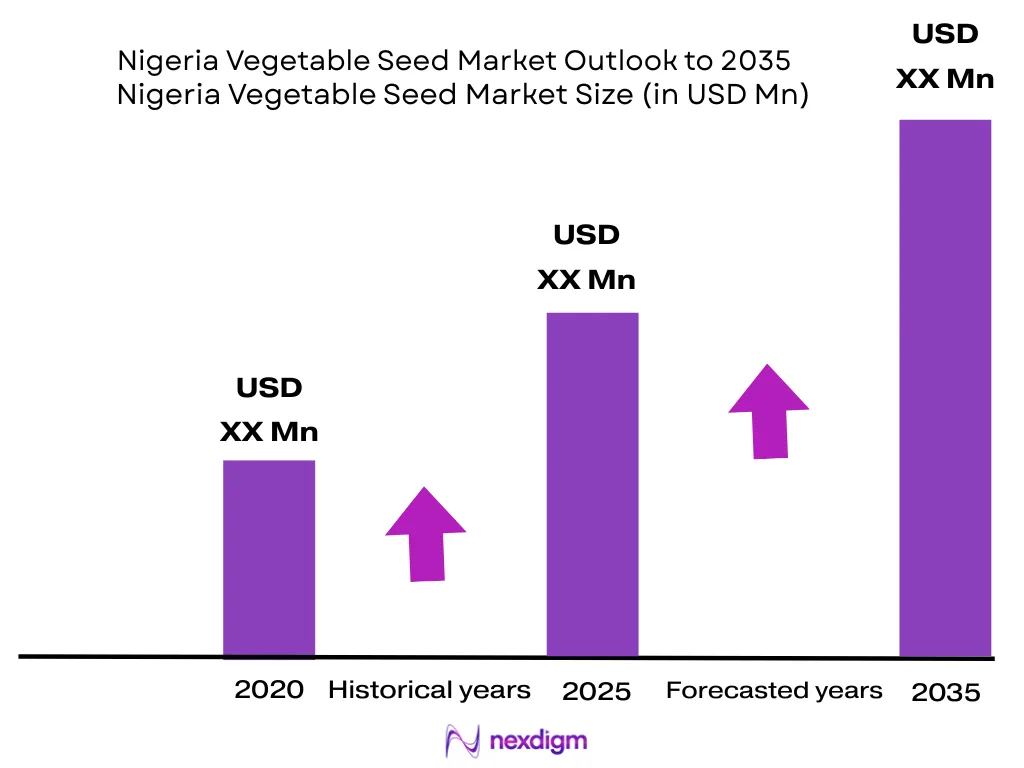
The Nigeria Vegetable Seed Market is valued at USD ~ million, based on a five-year historical analysis and triangulation of Africa vegetable seed demand, Nigeria’s regional contribution and commercial seed scope. Vegetable production moved from 16.45 million tonnes to 16.33 million tonnes, while Nigeria remained Africa’s largest vegetable-seed geography. Demand is driven by tomato, onion, pepper, okra, leafy greens, cucurbits, dry-season irrigation and smallholder commercialisation. Kano, Kaduna, Plateau, Nasarawa, Lagos, Ogun, Oyo, Sokoto, Kebbi and Abuja dominate the Nigeria Vegetable Seed Market because they combine dry-season vegetable farming, irrigation belts, wholesale demand, agro-dealer networks and seed-company presence. Kano and Kaduna anchor tomato, onion and pepper demand; Plateau supports temperate vegetables; Nasarawa and Abuja supply urban markets; Lagos and Ogun drive leafy green, okra, pepper and peri-urban vegetable demand.
Market Segmentation
By Breeding Technology
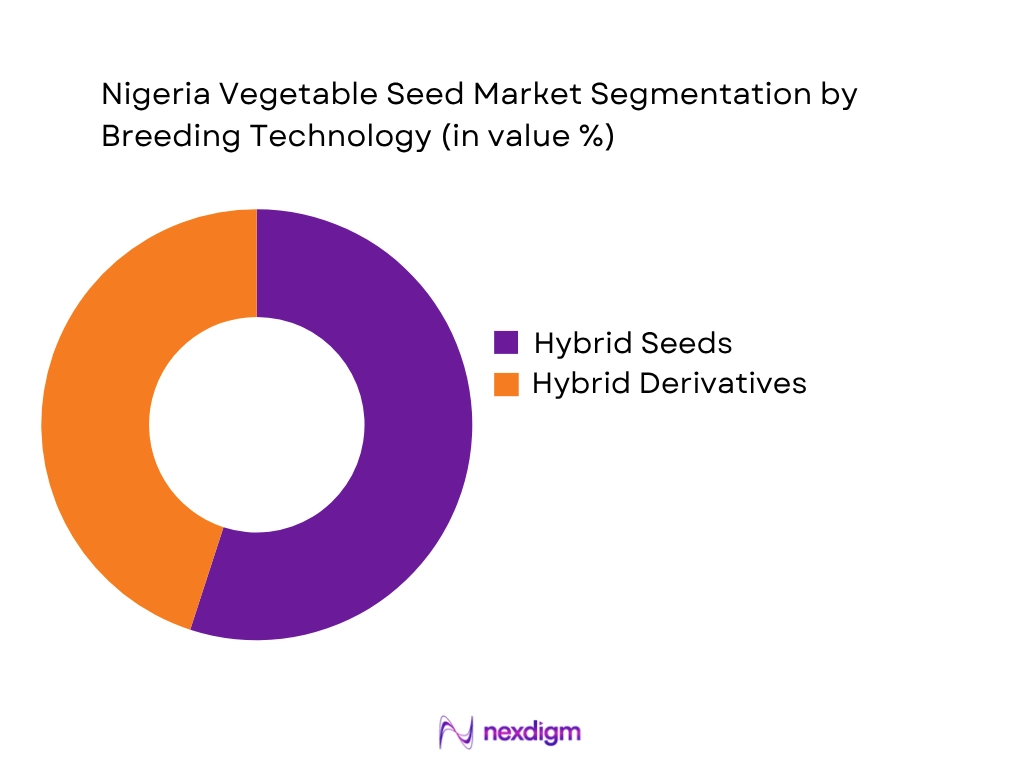
Nigeria Vegetable Seed Market is segmented by breeding technology into open-pollinated varieties and hybrid seeds. Recently, open-pollinated varieties and hybrid derivatives have a dominant market share in Nigeria under the breeding technology segmentation because most vegetable growers are smallholders who prioritize affordability, local seed access and familiarity with traditional varieties. OP seeds are widely used in okra, amaranthus, celosia, pumpkin leaf, ewedu, spinach, local eggplant, indigenous vegetables and some pepper crops. These varieties are sold through agro-dealers, rural input shops, local markets and informal channels. Hybrid seeds are gaining stronger adoption in tomato, onion, pepper, cabbage, cucumber and watermelon, especially among commercial farms and dry-season irrigated producers. However, high seed cost, counterfeit risks, weak extension support and farmer credit constraints keep OP seeds dominant in broad market access.
By Cultivation Mechanism
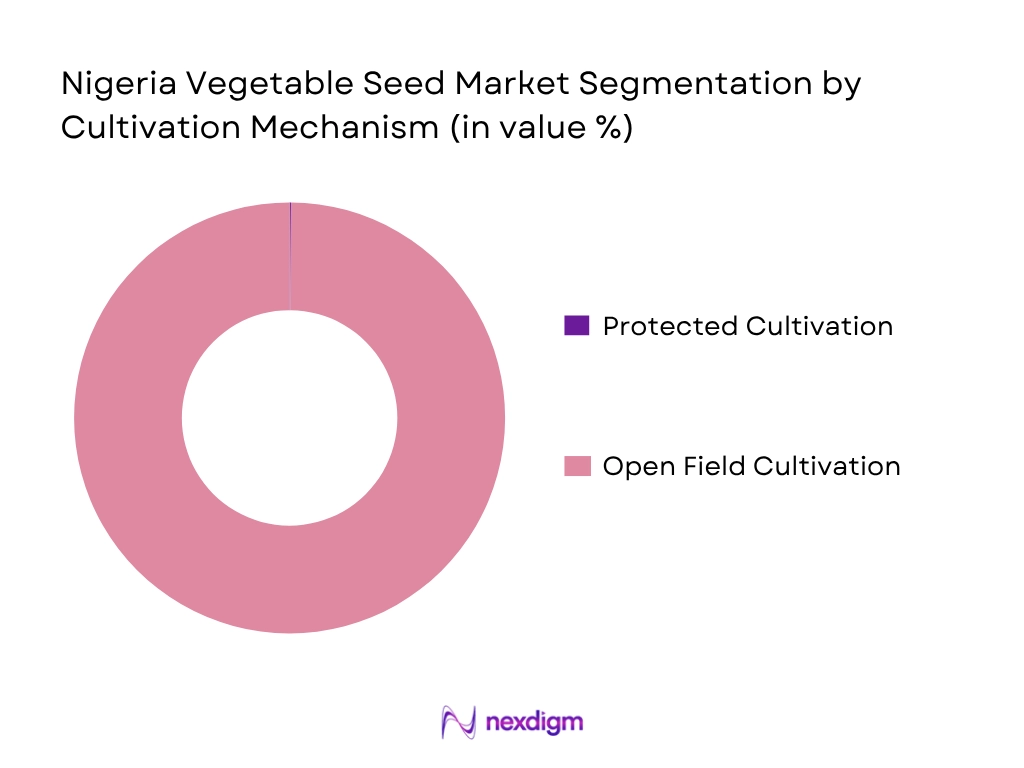
Nigeria Vegetable Seed Market is segmented by cultivation mechanism into open field cultivation and protected cultivation. Recently, open field cultivation has a dominant market share in Nigeria under cultivation mechanism segmentation because most vegetables are produced by smallholder and semi-commercial farmers across rainfed and irrigated systems. Tomato, onion, pepper, okra, leafy greens, cabbage, watermelon, cucumber and indigenous vegetables are widely grown in open fields across the North West, North Central, South West and Middle Belt. Irrigated dry-season systems in Kano, Kaduna, Sokoto, Kebbi, Jigawa, Plateau and Nasarawa create recurring demand for tomato, onion and pepper seeds. Protected cultivation remains small but strategically relevant around Lagos, Abuja, Kano and peri-urban commercial clusters. It is used for tomato, cucumber, lettuce, herbs and seedling production, but high capital cost and technical requirements limit broader adoption.
Competitive Landscape
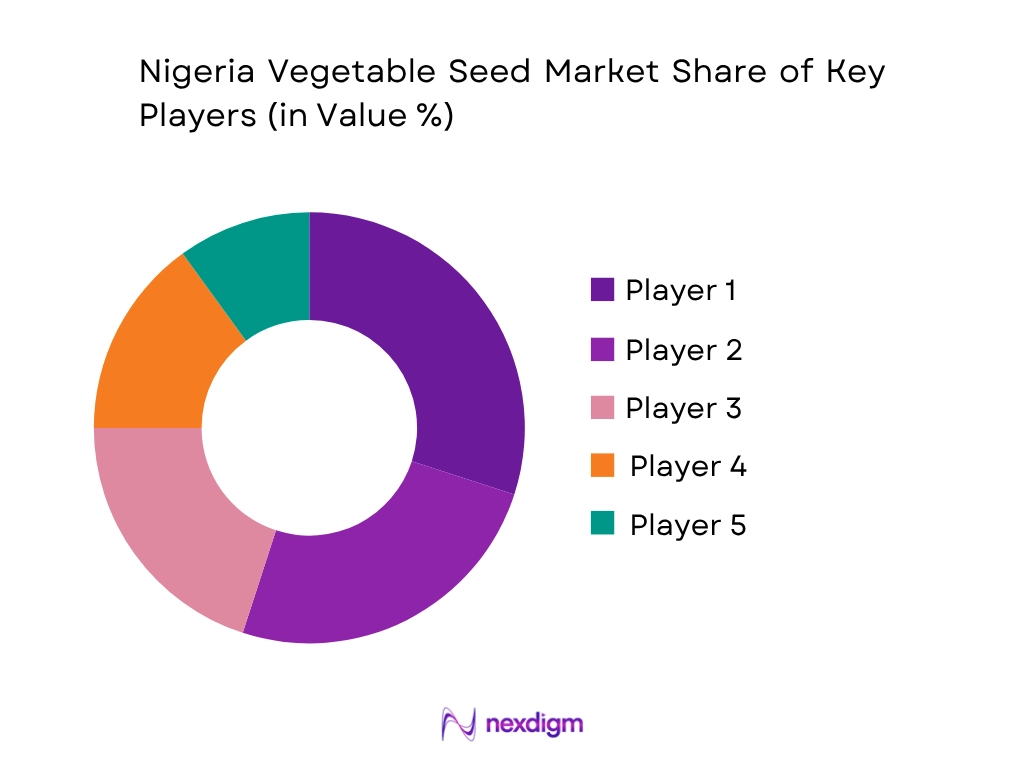
The Nigeria Vegetable Seed Market is fragmented, with multinational tropical vegetable seed suppliers, regional African seed companies, domestic certified seed firms and agro-dealer-led distributors competing for farmer access. East-West Seed, Technisem/Novalliance, Syngenta, Bayer/Seminis and Premier Seed Nigeria are among the key players influencing hybrid, improved OP and certified seed channels. Competition is shaped by tomato-pepper-onion portfolio breadth, NASC certification, anti-counterfeit protection, agro-dealer depth, smallholder pack sizes, demonstration farms and tropical disease-resistance traits.
| Company | Establishment Year | Headquarters | Key Nigeria Vegetable Seed Focus | Main Crop Families | Distribution Strength | Certification/Compliance Capability | Seed Technology Focus | Market Positioning |
| East-West Seed | 1982 | Nonthaburi, Thailand | ~ | ~ | ~ | ~ | ~ | ~ |
| Technisem / Novalliance | 1985 | Longué-Jumelles, France | ~ | ~ | ~ | ~ | ~ | ~ |
| Syngenta Nigeria | 2000 | Basel, Switzerland / Nigeria operations | ~ | ~ | ~ | ~ | ~ | ~ |
| Bayer CropScience / Seminis | 1863 | Leverkusen, Germany | ~ | ~ | ~ | ~ | ~ | ~ |
| Premier Seed Nigeria | 1990s | Zaria, Kaduna State, Nigeria | ~ | ~ | ~ | ~ | ~ | ~ |
Nigeria Vegetable Seed Market Analysis
Growth Drivers
Large Tomato Production Base Supports Hybrid and Certified Seed Demand
Nigeria Vegetable Seed Market is supported by tomato’s large production base, which creates recurring demand for hybrid, open-pollinated, treated and certified seed lots. NAERLS/Federal Ministry of Agriculture’s national wet-season report is an official agricultural performance assessment covering 36 states and the FCT, with fieldwork by 58 scientists and collaboration with state ADPs and agriculture ministries. It provides the operating basis for crop planning, pest assessment and seed-use decisions. World Bank data shows Nigeria’s population at 232,679,478, GDP at USD 252.26 billion, and GDP per capita at USD 1,084.2, supporting a large domestic fresh-vegetable consumption base.
Agro-Dealer and Certified Seed Systems Support Formal Seed Adoption
Nigeria Vegetable Seed Market is driven by the gradual formalization of seed distribution through NASC registration, seed certification and digital verification. NASC’s official portal lists the Nigerian Seed Roadmap Dashboard 2024 and the NRSM dashboard final visual 2024, indicating continued institutional tracking of seed-sector development. Seed Tracker also supports seed-production monitoring, certification and availability visibility for regulators, producers and buyers. This is market-specific because vegetable growers rely heavily on agro-dealers for tomato, pepper, onion, okra and leafy-green seeds. World Bank data records Nigeria’s population at 232,679,478, internet use at 41 individuals per 100 people, and GDP growth at 4.1, supporting digital seed authentication and wider certified seed access.
Market Challenges
Flooding and Climate Shocks Disrupt Vegetable Seed Planning
Nigeria Vegetable Seed Market faces climate-linked volatility because floods disrupt nursery cycles, field establishment and seed replacement decisions for tomato, pepper, okra, onion and leafy vegetables. FAO-linked reporting states that Nigeria lost 855,629 metric tonnes of food to flooding during the wet-season farming period, and that this loss could have fed 8.5 million people for six months. Reuters also reported flooding across 29 of Nigeria’s 36 states and destruction of over 1.5 million hectares of cropland. World Bank data shows Nigeria’s population at 232,679,478 and inflation at 33.2, intensifying the effect of crop losses on farmer seed-purchase decisions.
Counterfeit and Low-Quality Seeds Weaken Farmer Confidence
Nigeria Vegetable Seed Market is constrained by counterfeit, poorly labelled and low-quality seed circulation, especially in smallholder channels where farmers buy tomato, pepper, okra, onion and leafy-green seeds from informal outlets. NASC SeedCodex states that the National Agricultural Seeds Council has revamped infrastructure for testing, registration, release, production, marketing, distribution, certification, quality control, supply and use of seeds in Nigeria. Seed Tracker provides traceability across the seed supply chain, but the transition from informal seed use to certified seed remains operationally difficult. World Bank data shows GDP per capita of USD 1,084.2, inflation of 33.2, and population of 232,679,478, making farmer losses from poor germination commercially serious.
Market Opportunities
Digital Seed Authentication Creates Opportunity for Certified Vegetable Seed Brands
Nigeria Vegetable Seed Market has an opportunity in certified and digitally authenticated seed packs because vegetable farmers need stronger assurance against fake seed and low germination. Seed Tracker is described as a digital tool adopted by NASC to provide end-to-end transparency and traceability throughout the seed supply chain, improving confidence in quality seeds. NASC SeedCodex also positions Nigeria’s platform as an e-certificate system for agro-input regulation covering testing, certification, distribution and compliance. This supports branded tomato, pepper, onion, cucumber, cabbage and okra seeds with QR-based verification. World Bank data shows internet use at 41 individuals per 100 people and GDP growth at 4.1, supporting gradual digital adoption in agro-dealer networks.
Seedling and Dry-Season Vegetable Clusters Create Scope for Improved Varieties
Nigeria Vegetable Seed Market has an opportunity in dry-season irrigated vegetables and seedling-nursery systems because growers need reliable seeds for tomato, onion, pepper, cabbage, cucumber and watermelon under variable rainfall. NAERLS reports that the national agricultural performance survey covered all 36 states and the FCT, using structured questionnaires, checklists, field visits, focus groups, key-informant interviews and archival observation to assess crop performance, pests, diseases and postharvest conditions. This supports region-specific seed planning across northern irrigation belts and peri-urban vegetable clusters. World Bank data shows Nigeria’s GDP at USD 252.26 billion, population at 232,679,478, and GDP per capita at USD 1,084.2, supporting future demand for improved, locally adapted vegetable seed varieties.
Future Outlook
The Nigeria Vegetable Seed Market is expected to grow at around 6.0% CAGR during 2026–2035, supported by certified seed formalisation, hybrid tomato adoption, dry-season irrigation, urban fresh-produce demand, agro-dealer expansion and processing tomato investment. Over the next phase, demand will shift toward tomato, onion, pepper, okra, cabbage, cucumber, watermelon and leafy-green seeds with stronger heat tolerance, disease resistance, germination reliability and marketable output. Nigeria’s tomato value chain remains a priority because it is a major crop with large post-harvest losses, limited processing and growing interest in paste import substitution. Seed companies that support processing tomato varieties, dry-season seed packs and seedling nurseries will gain stronger commercial relevance. The market will remain dual-structured. Open-pollinated seeds will continue serving smallholders, indigenous vegetables and affordability-driven channels. Hybrid seeds will grow faster in commercial tomato, pepper, onion, watermelon, cabbage and cucumber production. Digital seed authentication, NASC seed labels, demonstration plots, farmer advisory and agro-dealer training will become critical because counterfeit and low-quality seeds remain major barriers to formal seed adoption.
Major Players
- East-West Seed Nigeria
- Technisem / Novalliance
- Syngenta Nigeria
- Bayer CropScience / Seminis
- BASF Vegetable Seeds / Nunhems
- Rijk Zwaan
- Enza Zaden
- Sakata Seed
- HM.CLAUSE
- Bejo Seeds
- Pop Vriend Seeds
- Premier Seed Nigeria
- Value Seeds
- Maslaha Seeds
- Seed Co Nigeria
Key Target Audience
- Vegetable Seed Manufacturers
- Hybrid Vegetable Seed Breeding Companies
- Certified Seed Producers
- Commercial Vegetable Growers
- Agro-Dealers and Rural Input Retailers
- Tomato Processors and Contract Farming Companies
- Investments and Venture Capitalist Firms
- Government and Regulatory Bodies
Research Methodology
Step 1: Identification of Key Variables
The initial phase involves constructing an ecosystem map encompassing all major stakeholders within the Nigeria Vegetable Seed Market. This includes seed breeders, certified seed producers, importers, agro-dealers, distributors, commercial farmers, smallholders, irrigation-cluster farmers, nurseries and regulators. The primary objective is to identify variables such as crop family, seed certification status, hybrid adoption, pack size, dealer reach and informal seed substitution.
Step 2: Market Analysis and Construction
In this phase, historical data is compiled and analysed for vegetable production, tomato-chain demand, seed-company presence, certified seed channels, OP seed usage and hybrid adoption. The market is constructed through top-down validation from Africa vegetable seed benchmarks and bottom-up modelling using crop area, seed rate, seed replacement behaviour, grower type and distribution channel.
Step 3: Hypothesis Validation and Expert Consultation
Market hypotheses are validated through structured interviews with seed companies, agro-dealers, distributors, commercial growers, tomato processors, nursery operators and farmer groups. These consultations provide insights into farmer buying behaviour, counterfeit seed risk, pack-size preference, hybrid adoption, dry-season demand and crop-specific performance expectations.
Step 4: Research Synthesis and Final Output
The final phase integrates secondary data, primary insights, company portfolio mapping and bottom-up crop-demand modelling into a validated market report. The output is cross-checked across market size, segmentation, competitive landscape, regulatory framework and future outlook to provide a business-focused view of the Nigeria Vegetable Seed Market.

- Executive Summary
- Research Methodology (Market Definitions and Assumptions, Vegetable Seed Taxonomy, Hybrid/Open-Pollinated/Heirloom/Organic/Untreated Seed Classification, Market Sizing Approach, Top-Down Seed Revenue Validation, Bottom-Up Crop Area-to-Seed Requirement Model, Primary Interviews with Seed Companies/Distributors/Agro-Dealers/Smallholders/Commercial Growers/Nursery Operators, NASC Seed Certification Validation, Seed Company Registry Mapping, Limitations and Future Conclusions)

- Definition and Scope
- Overview Genesis
- Evolution of Vegetable Seed Industry in Nigeria
- Timeline of Major Players
- Business Cycle
- Supply Chain and Value Chain Analysis

- Growth Drivers (Vegetable Production Growth, Tomato Value Chain Demand, Hybrid Adoption, Irrigated Dry-Season Farming, Smallholder Commercialisation, Urban Fresh Produce Demand)
- Market Challenges (Counterfeit Seeds, Informal Seed Use, Price Sensitivity, Climate Variability, Pest Pressure, Distribution Fragmentation, Import Constraints)
- Opportunities (Certified Seed Expansion, Hybrid Tomato and Onion, Local Seed Production, Seed Enhancement, Digital Traceability, Processing Vegetable Seeds)
- Trends (Hybridisation, Certified Seed Formalisation, Small Pack Premiumisation, Digital Verification, Nursery-Based Production, Climate-Resilient Breeding)
- SWOT Analysis
- Porter’s Five Forces
- PESTLE Analysis

- By Value (2020-2025)
- By Volume (2020-2025)
- By Average Realization per Kilogram/Thousand Seeds (2020-2025)

- By Crop Family (In Value %)
Tomato Seeds
Onion Seeds
Pepper and Chilli Seeds
Okra Seeds - By Distribution Channel (In Value %)
Direct-to-Farm Sales
Seed Companies and Regional Distributors
Agro-Dealers and Rural Input Retailers
Cooperatives and Farmer Groups
Development Programmes and NGO Channels - By End User (In Value %)
Smallholder Farmers
Commercial Vegetable Growers
Irrigated Dry-Season Farmers
Protected-Crop Operators
Seedling Nurseries - By Region (In Value %)
North West
North Central
South West
North East
South East

- Market Share of Major Players (Commercial Vegetable Seed Revenue, Crop-Family Share, Hybrid Share, Certified Seed Share, Regional Presence)
- Cross Comparison Parameters (Hybrid Tomato-Pepper-Onion Portfolio Breadth, NASC Certification and Seed Label Compliance Capability, Agro-Dealer Network Coverage, Nigeria-Specific Disease-Resistance Trait Depth, Smallholder Pack-Size Strategy, Local Seed Multiplication Footprint, Seed Authentication and Anti-Counterfeit Capability, Regional Demonstration and Extension Support)
- SWOT Analysis of Major Players (Breeding Strength, Import Dependence, Channel Dependence, Local Adaptation, Innovation Pipeline, Price Positioning)
- Detailed Profiles of Major Companies
East-West Seed Nigeria
Technisem / Novalliance
Syngenta Nigeria
Bayer CropScience / Seminis
BASF Vegetable Seeds / Nunhems
Rijk Zwaan
Enza Zaden
Sakata Seed
HM.CLAUSE
Bejo Seeds
Pop Vriend Seeds
Premier Seed Nigeria
Value Seeds
Maslaha Seeds
Seed Co Nigeria

- Smallholder Farmer Analysis
- Commercial Vegetable Grower Analysis
- Irrigated Dry-Season Farmer Analysis
- Processing Grower Analysis
- Protected-Crop Operator Analysis

- By Value (2026-2035)
- By Volume (2026-2035)
- By Average Realization per Kilogram/Thousand Seeds (2026-2035)


 Request a Sample
 Ask for Customization
 Get a Quote
 Enquire Now