

 Download PDF
 Download PDF
Market Overview
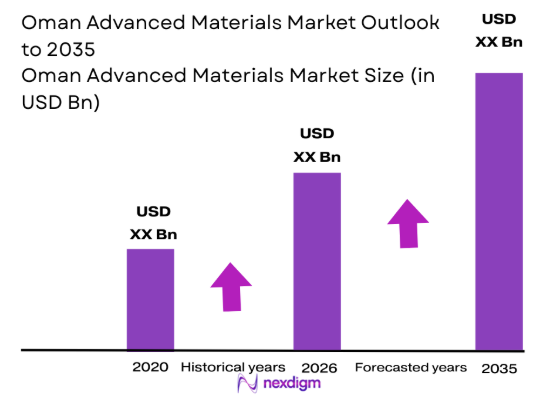
Based on a recent historical assessment, the Oman Advanced Materials market recorded a value of USD ~ Billion, supported by expanding petrochemical processing capacity, aerospace component manufacturing activities, and large scale industrial infrastructure projects. Demand for high performance polymers, engineered composites, advanced ceramics, and nanomaterials continues to rise as industries require lightweight, corrosion resistant, and thermally stable materials. Industrial diversification programs, foreign direct investment in manufacturing, and collaborations with global materials technology companies further strengthen the adoption of advanced materials across energy, construction, and high technology manufacturing sectors.
Muscat serves as the primary center for advanced materials demand due to the presence of petrochemical complexes, industrial manufacturing facilities, and engineering companies that require high performance materials for equipment and infrastructure. Sohar and Duqm also play major roles because these industrial zones host refineries, logistics hubs, export oriented manufacturing plants, and port based heavy industries. Access to industrial free zones, transport infrastructure, and energy processing facilities encourages companies operating in these cities to adopt advanced materials for structural engineering, chemical processing, and advanced manufacturing applications.
Market Segmentation
By Product Type
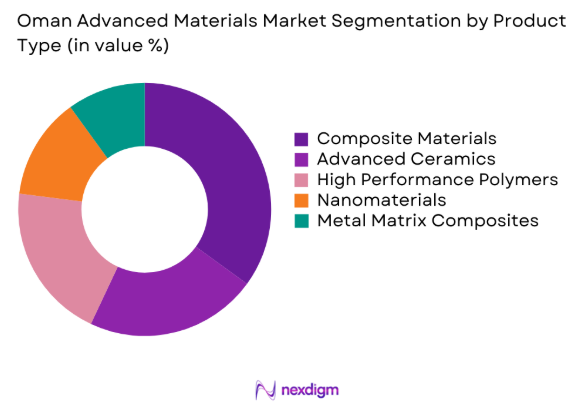
Oman Advanced Materials market is segmented by product type into composite materials, advanced ceramics, high performance polymers, nanomaterials, and metal matrix composites. Recently, composite materials has a dominant market share due to factors such as demand patterns, brand presence, infrastructure availability, or consumer preference. Composite materials are widely used in aerospace structures, petrochemical pipelines, industrial storage systems, and infrastructure engineering because they offer superior strength to weight ratios and corrosion resistance compared with conventional metals. Energy companies increasingly utilize composite piping and structural components to extend operational lifespans in corrosive refinery environments. Aerospace manufacturers also rely heavily on carbon fiber composites to produce lightweight aircraft components that improve fuel efficiency and structural durability. The expansion of petrochemical infrastructure and export oriented industrial manufacturing zones therefore significantly increases demand for composite materials capable of delivering performance reliability in extreme operational environments.
By End User Industry
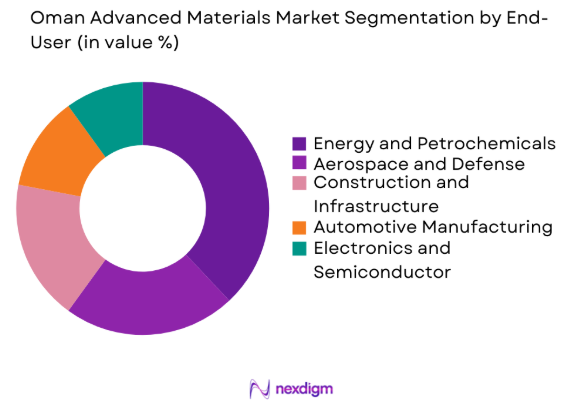
Oman Advanced Materials market is segmented by end user industry into aerospace and defense, energy and petrochemicals, automotive manufacturing, electronics and semiconductor production, and construction and infrastructure. Recently, energy and petrochemicals has a dominant market share due to factors such as demand patterns, brand presence, infrastructure availability, or consumer preference. Oman’s hydrocarbon processing sector requires materials capable of withstanding high pressure chemical exposure and temperature fluctuations common in refinery and petrochemical facilities. Advanced polymers specialty coatings composite piping and ceramic components enhance equipment durability and operational reliability in these industrial environments. The expansion of refining capacity petrochemical complexes and export oriented chemical manufacturing clusters continues to increase demand for engineered materials designed for corrosion resistance thermal stability and long term operational efficiency.
Competitive Landscape
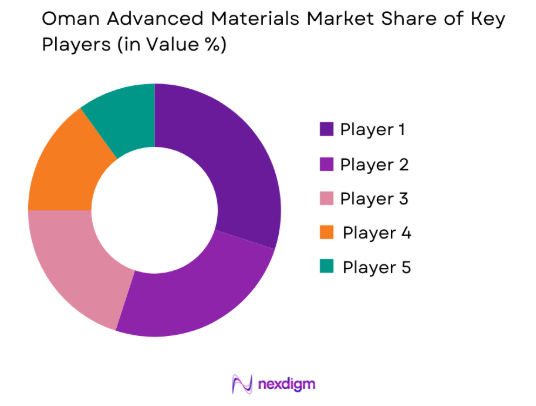
The Oman Advanced Materials market shows moderate consolidation with global materials technology companies dominating innovation, production capacity, and industrial supply chains. Major international corporations supply advanced composites, specialty polymers, and engineered materials to energy infrastructure projects, aerospace manufacturing, and industrial construction activities across Oman. Strategic partnerships between global materials manufacturers and regional industrial engineering firms support technology transfer, supply chain reliability, and expansion of advanced materials usage within manufacturing and energy sectors.
| Company Name | Establishment Year | Headquarters | Technology Focus | Market Reach | Key Products | Revenue | Advanced Materials Portfolio |
| BASF SE | 1865 | Germany | ~ | ~ | ~ | ~ | ~ |
| 3M Company | 1902 | United States | ~ | ~ | ~ | ~ | ~ |
| Toray Industries | 1926 | Japan | ~ | ~ | ~ | ~ | ~ |
| Solvay SA | 1863 | Belgium | ~ | ~ | ~ | ~ | ~ |
| Mitsubishi Chemical Group | 1933 | Japan | ~ | ~ | ~ | ~ | ~ |
Oman Advanced Materials Market Analysis
Growth Drivers
Expansion of Petrochemical and Energy Processing Infrastructure
Oman’s industrial development strategy increasingly emphasizes refinery expansion, petrochemical production facilities, and hydrocarbon export infrastructure, generating strong demand for advanced materials that perform reliably in chemically aggressive and high temperature environments. Refineries, storage systems, offshore platforms, pipelines, and chemical processing plants require specialized materials capable of maintaining durability under corrosion, pressure variations, and thermal stress. Advanced composites, engineered polymers, and ceramic materials provide superior resistance to chemical exposure and mechanical degradation, making them essential for petrochemical equipment manufacturing and maintenance operations. Energy companies invest in these materials to reduce equipment failures, limit maintenance shutdowns, and extend infrastructure lifespan. Government industrial diversification initiatives further support refinery and petrochemical cluster development across major industrial zones.
Growth of Aerospace Manufacturing and Lightweight Engineering Applications
Aerospace engineering industries increasingly require lightweight structural materials that maintain mechanical strength, durability, and thermal stability during flight operations and high stress environmental conditions. Aircraft turbine components, fuselage structures, and satellite systems rely heavily on advanced composites, high performance polymers, and engineered ceramics that reduce structural weight while preserving performance reliability. Carbon fiber composites improve fuel efficiency because lighter aircraft structures lower energy consumption during flight. Aerospace manufacturers therefore invest in advanced materials capable of withstanding aerodynamic stress, vibration, pressure fluctuations, and extreme temperatures. Regional aviation infrastructure expansion and aircraft maintenance activities also increase demand for advanced materials used in component manufacturing and repair operations across modern aerospace supply chains.
Market Challenges
Limited Domestic Production Capabilities for Advanced Materials Manufacturing
Despite increasing industrial demand, Oman has limited domestic manufacturing infrastructure dedicated to producing advanced materials such as carbon fiber composites, engineered ceramics, nanomaterials, and specialty polymers. Consequently, many industrial companies depend heavily on imported advanced materials sourced from suppliers in Europe, North America, and East Asia. This reliance raises procurement costs because transportation logistics, import duties, and global supply chain disruptions influence material availability and pricing. Industrial manufacturers may also experience project delays when specialized materials required for petrochemical equipment, aerospace components, or infrastructure projects must be imported. The absence of local processing plants restricts technology transfer, workforce skill development, and research initiatives. Establishing advanced materials facilities requires substantial capital investment, advanced engineering expertise, and complex production infrastructure.
High Cost of Advanced Materials and Complex Processing Technologies
Advanced materials frequently require complex fabrication processes, specialized precursor chemicals, and sophisticated manufacturing technologies, which significantly increase production costs compared with traditional engineering materials such as steel, aluminum, or conventional polymers. Carbon fiber composites, ceramic matrix materials, and nanostructured polymers rely on advanced production techniques including chemical vapor deposition, precision polymerization, controlled temperature curing, and multilayer composite fabrication. These processes demand specialized equipment, advanced laboratory infrastructure, and highly skilled engineering personnel, raising operational expenditures for manufacturers. Industrial buyers in energy, aerospace, and manufacturing sectors therefore assess cost effectiveness carefully before adopting advanced materials for large scale applications. In many infrastructure projects, conventional materials remain attractive due to lower procurement and processing costs.
Opportunities
Development of Advanced Materials for Renewable Energy Infrastructure
Renewable energy infrastructure including solar power facilities, wind turbine systems, and energy storage technologies increasingly relies on advanced materials capable of maintaining durability, efficiency, and performance in harsh environmental conditions. Solar mounting structures, turbine blades, battery enclosures, and grid components require lightweight and corrosion resistant materials that can withstand high temperature desert climates. Composite materials, advanced polymers, and protective coatings improve structural strength and thermal stability in systems exposed to sand, ultraviolet radiation, and extreme temperature fluctuations. Expansion of renewable energy projects across the region therefore increases demand for materials used in solar photovoltaic infrastructure, wind energy equipment, and energy storage systems. Engineering companies collaborate with advanced materials manufacturers to improve system longevity and operational efficiency.
Expansion of Advanced Materials Research and Industrial Innovation Ecosystems
Scientific research institutions, industrial technology centers, and engineering laboratories are increasingly focused on developing next generation advanced materials that support aerospace engineering, renewable energy systems, high performance electronics, and automated manufacturing technologies. Investments in research infrastructure, advanced testing laboratories, and collaborative innovation programs are accelerating the development of specialized materials suited to regional industrial requirements. Innovation hubs encourage experimentation with nanotechnology, composite engineering, additive manufacturing materials, and advanced polymer systems designed to enhance durability, conductivity, thermal stability, and structural strength. Partnerships between research organizations, industrial manufacturers, and global technology firms further accelerate commercialization of advanced materials technologies. Expanding advanced manufacturing adoption continues increasing demand for specialized materials research capabilities across multiple industries.
Future Outlook
The Oman Advanced Materials market is expected to experience steady expansion driven by industrial diversification initiatives and increasing adoption of high performance materials across manufacturing sectors. Growth in renewable energy infrastructure aerospace engineering and petrochemical processing will strengthen demand for advanced composites polymers and engineered ceramics. Government supported industrial zones and international technology partnerships are likely to enhance local manufacturing capabilities. Continuous progress in nanotechnology materials science and lightweight engineering will further expand advanced material applications across multiple industries.
Major Players
- BASF SE
- 3M Company
- Toray Industries Inc.
- Solvay SA
- Mitsubishi Chemical Group
- Arkema SA
- Evonik Industries AG
- Dow Inc.
- Hexcel Corporation
- SGL Carbon SE
- Morgan Advanced Materials
- Huntsman Corporation
- Ceram TecGmbH
- Showa Denko Materials
- DuPont de Nemours Inc.
Key Target Audience
- Aerospace and defense manufacturers
- Petrochemical manufacturing companies
- Renewable energy infrastructure developers
- Automotive component manufacturers
- Industrial materials distributors
- Construction and engineering firms
- Investments and venture capitalist firms
- Government and regulatory bodies
Research Methodology
Step 1: Identification of Key Variables
Key variables influencing the Oman Advanced Materials market including industrial production levels advanced manufacturing adoption infrastructure investment and technology innovation were analyzed to understand demand patterns across major industrial sectors.
Step 2: Market Analysis and Construction
Industry supply chains materials technology development and end user consumption trends were evaluated to construct a detailed framework describing advanced materials production distribution and application across Oman’s industrial ecosystem.
Step 3: Hypothesis Validation and Expert Consultation
Materials scientists manufacturing executives industrial engineers and supply chain specialists were consulted to validate research assumptions and confirm industrial demand patterns influencing advanced materials adoption.
Step 4: Research Synthesis and Final Output
Quantitative industry data qualitative insights and expert consultation findings were integrated to produce a comprehensive research report describing market structure competitive dynamics technological innovation and long term industry outlook.

- Executive Summary
- Research Methodology (Definitions, Scope, Industry Assumptions, Market Sizing Approach, Primary & Secondary Research Framework, Data Collection & Verification Protocol, Analytic Models & Forecast Methodology, Limitations & Research Validity Checks)

- Market Definition and Scope
- Value Chain & Stakeholder Ecosystem
- Regulatory / Certification Landscape
- Sector Dynamics Affecting Demand
- Strategic Initiatives & Infrastructure Growth

- Growth Drivers
Expansion of Advanced Manufacturing Capabilities
Rising Demand for Lightweight and High Strength Materials
Government Industrial Diversification Programs - Market Challenges
Limited Domestic Production Infrastructure for Advanced Materials
High Capital Requirements for Materials Processing Facilities
Dependence on Imported Raw Material Inputs - Market Opportunities
Development of Advanced Materials for Renewable Energy Infrastructure
Expansion of Aerospace Component Manufacturing
Strategic Partnerships with Global Materials Technology Firms - Trends
Growing Use of Nanomaterials in Industrial Applications
Adoption of Lightweight Composite Materials in Engineering
Integration of Advanced Materials in Energy Infrastructure - Government Regulations
- SWOT Analysis of Key Competitors
- Porter’s Five Forces

- By Market Value, 2020-2025
- By Installed Units, 2020-2025
- By Average System Price, 2020-2025
- By System Complexity Tier, 2020-2025

- By System Type (In Value%)
Composite Materials
Advanced Ceramics
High Performance Polymers
Nanomaterials
Metal Matrix Composites - By Platform Type (In Value%)
Industrial Manufacturing Platforms
Aerospace and Defense Platforms
Energy Infrastructure Platforms
Automotive Engineering Platforms
Electronics and Semiconductor Platforms - By Fitment Type (In Value%)
Structural Integration Materials
Thermal Management Materials
Protective Coating Materials
Lightweight Engineering Materials
Conductive and Functional Materials - By End User Segment (In Value%)
Aerospace and Defense Industry
Energy and Petrochemical Industry
Automotive Manufacturing Sector
Electronics and Semiconductor Industry
Construction and Infrastructure Sector - By Procurement Channel (In Value%)
Direct Industrial Procurement
Government Infrastructure Contracts
OEM Manufacturing Supply Agreements
Industrial Distribution Networks
Strategic Supplier Partnerships

- Market Share Analysis
- Cross Comparison Parameters (Material Technology Portfolio, End Use Industry Focus, Production Capacity, R&D Investment, Global Distribution Network)
- SWOT Analysis of Key Competitors
- Pricing & Procurement Analysis
- Key Players
3M Company
BASF SE
DuPont de Nemours Inc.
Toray Industries Inc.
Hexcel Corporation
Solvay SA
Arkema SA
SGL Carbon SE
Morgan Advanced Materials
CeramTec GmbH
Showa Denko Materials Co. Ltd.
Huntsman Corporation
Evonik Industries AG
Dow Inc.
Mitsubishi Chemical Group

- Growing Use of Composite Materials in Aerospace and Defense Manufacturing
- Energy Sector Demand for High Temperature and Corrosion Resistant Materials
- Automotive Manufacturing Adoption of Lightweight Structural Materials
- Electronics Sector Utilization of Conductive and Functional Nanomaterials

- Forecast Market Value, 2026-2035
- Forecast Installed Units, 2026-2035
- Price Forecast by System Tier, 2026-2035
- Future Demand by Platform, 2026-2035


 Request a Sample
 Ask for Customization
 Get a Quote
 Enquire Now