

 Download PDF
 Download PDF
Market Overview
Oman’s AI infrastructure market reached approximately USD ~ million based on a recent historical assessment, driven by sovereign digital transformation programs, hyperscale-ready data center investments, and government-backed AI adoption initiatives. Expansion of cloud zones, national data platforms, and AI compute clusters is accelerating demand for GPU servers, high-performance storage, and advanced networking systems. Public sector modernization in energy, logistics, and smart governance is further stimulating procurement of scalable AI-ready infrastructure across ministries and state-owned enterprises.
Muscat dominates AI infrastructure deployment due to concentration of government agencies, telecom landing stations, and enterprise headquarters enabling low-latency connectivity and data gravity advantages. Duqm and Sohar are emerging through free-zone industrialization and subsea cable proximity supporting hyperscale data center positioning and edge compute use cases for logistics and energy operations. Regional partnerships with Gulf and Asian cloud providers reinforce Oman’s positioning as a neutral data hub bridging Middle East, Africa, and South Asia digital traffic corridors.
Market Segmentation
By Product Type
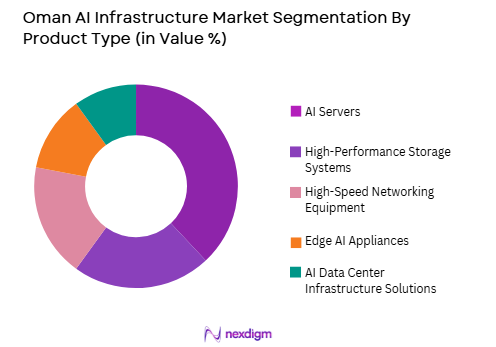
Oman AI Infrastructure Market is segmented by product type into AI servers, high-performance storage systems, high-speed networking equipment, edge AI appliances, and AI data center infrastructure solutions. Recently, AI servers have a dominant market share due to factors such as concentrated demand for GPU-accelerated compute in government analytics platforms, oil and gas optimization workloads, and hyperscale cloud zones established by telecom operators. Procurement patterns prioritize rack-scale GPU clusters and integrated AI server nodes to support national AI programs, autonomous operations, and large-scale data processing across sectors.
By Deployment Environment
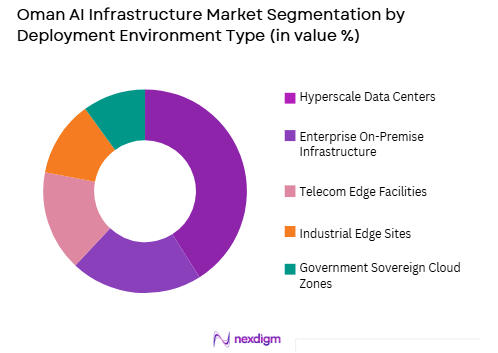
Oman AI Infrastructure Market is segmented by deployment environment into hyperscale data centers, enterprise on-premise infrastructure, telecom edge facilities, industrial edge sites, and government sovereign cloud zones. Recently, hyperscale data centers have a dominant market share due to factors such as national cloud localization policies, international cloud region launches, and submarine cable connectivity attracting regional workloads. Large-scale AI training clusters and shared national platforms are primarily hosted in carrier-neutral facilities in Muscat and coastal economic zones, reinforcing hyperscale environments as the core AI infrastructure backbone.
Competitive Landscape
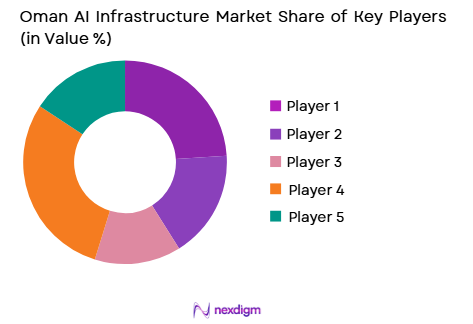
Oman’s AI infrastructure market is moderately consolidated, led by global compute and networking vendors working through telecom operators and government digital authorities. Market influence is shaped by hyperscale partnerships, sovereign cloud initiatives, and national data platform deployments. Technology leadership is concentrated among GPU server providers, data center integrators, and telecom-cloud alliances, with regional system integrators supporting localization, compliance, and deployment across energy, logistics, and public sector AI programs.
| Company Name | Establishment Year | Headquarters | Technology Focus | Market Reach | Key Products | Revenue | Oman Market Entry Mode |
| NVIDIA | 1993 | USA | ~ | ~ | ~ | ~ | ~ |
| Hewlett Packard Enterprise | 2015 | USA | ~ | ~ | ~ | ~ | ~ |
| Dell Technologies | 1984 | USA | ~ | ~ | ~ | ~ | ~ |
| Huawei | 1987 | China | ~ | ~ | ~ | ~ | ~ |
| Cisco | 1984 | USA | ~ | ~ | ~ | ~ | ~ |
Oman AI Infrastructure Market Analysis
Growth Drivers
National Digital Transformation and Sovereign AI Programs
Oman’s AI infrastructure market expansion is fundamentally driven by state-led digital transformation strategies that prioritize sovereign data control, national AI capability development, and secure compute localization across public sector domains. Government entities are deploying national data platforms, AI analytics centers, and digital twin environments for energy, logistics, and urban planning, which require high-density GPU clusters, AI storage fabrics, and secure networking architectures. Sovereign cloud frameworks mandate in-country processing for sensitive workloads, accelerating hyperscale-grade infrastructure procurement by telecom operators and national cloud providers. Public investment programs support AI adoption in oilfield optimization, smart ports, and e-government services, creating sustained demand for scalable AI compute capacity and high-availability data center environments. Cross-ministerial data integration initiatives are expanding AI workloads beyond pilot stages into production-scale deployments, increasing infrastructure density requirements. National cybersecurity frameworks and data residency mandates are encouraging replacement of foreign-hosted AI workloads with domestic infrastructure. Strategic partnerships with global cloud and AI vendors are transferring technology and deployment expertise into local facilities, strengthening domestic capability. Workforce digitalization and AI upskilling programs are generating institutional readiness to utilize large-scale AI platforms, reinforcing infrastructure utilization growth. The convergence of sovereign policy, sectoral AI adoption, and hyperscale cloud localization is therefore structurally anchoring long-term infrastructure demand across Oman’s digital economy.
Hyperscale Connectivity and Regional Data Hub Positioning
Oman’s geographic positioning along major submarine cable routes and its policy of digital neutrality are enabling the country to emerge as a regional data transit and hosting hub, significantly accelerating AI infrastructure investment. Multiple subsea cable landings and terrestrial fiber corridors are providing low-latency connectivity to Gulf, African, and South Asian markets, making Oman attractive for hyperscale cloud and AI compute deployments. Telecom operators and free-zone authorities are establishing carrier-neutral data center campuses designed for high-power AI clusters and cloud regions, drawing international workloads into local infrastructure. The presence of hyperscale-ready facilities is encouraging multinational enterprises to place AI training and inference operations within Oman to optimize latency and regulatory compliance. Energy-intensive AI data centers benefit from access to stable power and emerging renewable integration strategies in coastal economic zones. Regional disaster recovery and sovereign backup requirements from neighboring countries are also being hosted in Oman, increasing infrastructure density. International cloud providers entering through joint ventures and partnerships are standardizing hyperscale architecture and operational practices locally. Logistics and maritime digitalization initiatives in ports such as Duqm and Sohar are further anchoring edge-to-core AI infrastructure demand. The cumulative effect of connectivity advantage, neutral policy environment, and hyperscale campus development is positioning Oman as a strategic AI infrastructure node within transcontinental digital corridors.
Market Challenges
Limited Domestic AI Talent and Integration Expertise
Oman’s AI infrastructure expansion faces structural constraints due to limited availability of specialized talent in AI systems engineering, data center operations, and large-scale compute integration, affecting deployment velocity and utilization efficiency. Advanced AI clusters require expertise in GPU orchestration, high-speed networking, cooling optimization, and AI workload scheduling, skills that remain scarce within the local workforce. Dependence on expatriate specialists and foreign system integrators increases project costs and creates knowledge transfer gaps that slow localization objectives. Public sector entities procuring AI infrastructure often encounter challenges translating policy mandates into technically optimized deployments due to limited in-house architectural capability. Enterprise adoption is similarly constrained by shortages in AI DevOps, data engineering, and infrastructure automation competencies needed to operationalize AI platforms. Training programs are expanding but remain insufficient relative to the pace of infrastructure rollouts, creating underutilized capacity risks. Maintenance and lifecycle management of high-performance AI hardware also require specialized vendor-certified engineers, which are limited domestically. Universities and technical institutes are still scaling curricula aligned to AI infrastructure engineering rather than application-level AI skills alone. This talent bottleneck affects both deployment timelines and long-term operational resilience of AI facilities. Without accelerated workforce development and localization strategies, infrastructure investments may face delayed scaling and reduced economic spillover within Oman’s digital ecosystem.
High Capital Intensity and Power Infrastructure Constraints
AI infrastructure deployment in Oman is challenged by high upfront capital requirements and the need for power-dense data center environments capable of supporting energy-intensive GPU clusters and cooling systems. Hyperscale AI facilities require substantial investment in land, grid connectivity, redundancy systems, and advanced thermal management, raising financial barriers for local operators and new entrants. Financing models for AI data centers are still maturing in the domestic market, with limited specialized investment vehicles and long payback horizons deterring private capital participation. Power availability and grid resilience in certain industrial zones constrain large-scale AI cluster deployment, particularly where renewable integration and backup capacity remain under development. Cooling requirements in Oman’s hot climate significantly increase operational expenditure and engineering complexity compared with temperate regions. Energy pricing structures and grid upgrade timelines directly influence site selection and expansion pace for AI infrastructure providers. Import dependence for advanced hardware components exposes projects to supply chain volatility and cost fluctuations. Smaller enterprises and public institutions face affordability constraints in accessing dedicated AI infrastructure, reinforcing reliance on shared hyperscale environments. Regulatory approvals and permitting for high-capacity data centers can also extend project timelines. These combined capital and power challenges necessitate coordinated energy, finance, and digital infrastructure planning to sustain Oman’s AI infrastructure growth trajectory.
Opportunities
Green AI Data Centers and Renewable-Integrated Compute Infrastructure
Oman’s expanding renewable energy portfolio and commitment to sustainable industrial development create a significant opportunity to position the country as a hub for green AI infrastructure powered by solar and wind resources. Coastal economic zones with access to renewable generation can host energy-intensive AI data centers with lower carbon intensity, attracting global cloud providers seeking sustainable compute locations. Integration of renewable power purchase agreements and energy storage systems can stabilize electricity supply for hyperscale AI clusters while reducing long-term operating costs. Green certification and sustainability compliance are increasingly critical for multinational enterprises selecting AI hosting locations, favoring markets with clean energy pathways. Oman’s land availability and industrial planning frameworks support development of large-scale renewable-powered data center campuses. Waste-heat recovery and advanced cooling innovations can further enhance energy efficiency in AI facilities under desert conditions. Government incentives for renewable integration and sustainable infrastructure can reduce capital barriers for green AI projects. Positioning AI compute exports as a sustainable digital service could differentiate Oman within regional data hosting competition. Collaboration between energy developers and digital infrastructure operators can accelerate deployment of renewable-integrated AI campuses. This convergence of clean energy strategy and AI infrastructure demand presents a long-term competitive advantage for Oman in sustainable digital economy positioning.
Regional Sovereign Cloud and AI Service Export Platform
Oman’s neutral geopolitical positioning and strong cross-regional connectivity enable the country to develop a sovereign AI and cloud hosting platform serving neighboring regions lacking secure domestic infrastructure capacity. Governments and enterprises in parts of Africa and South Asia increasingly require sovereign or compliant AI processing environments without dependence on major geopolitical blocs, creating demand for neutral hosting jurisdictions. Oman can provide compliant data residency, disaster recovery, and AI compute services through hyperscale and sovereign cloud facilities, generating export revenue from digital infrastructure services. Regional organizations seeking politically neutral data hosting locations can colocate AI workloads in Oman to balance regulatory and geopolitical considerations. Telecom operators and cloud providers can extend Oman-hosted AI platforms to regional markets through subsea connectivity. Managed AI infrastructure and sovereign cloud services can become a new export sector aligned with national diversification goals. Public-private partnerships can structure shared sovereign AI facilities accessible to multiple regional clients. Regulatory frameworks emphasizing neutrality, security, and compliance can strengthen trust in Oman-hosted AI environments. This positioning supports development of Oman as a trusted AI infrastructure gateway across Middle East, Africa, and South Asia digital ecosystems. Leveraging connectivity, neutrality, and sovereign capability demand can transform Oman from a domestic AI adopter into a regional AI infrastructure exporter.
Future Outlook
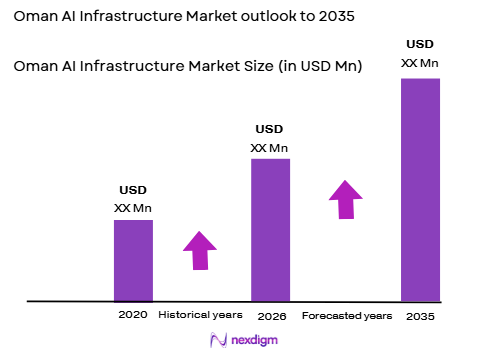
Oman’s AI infrastructure market is expected to expand steadily over the next five years as sovereign cloud deployment, hyperscale data center construction, and AI adoption across energy and logistics sectors accelerate infrastructure demand. Renewable-powered data centers and regional connectivity projects will reinforce Oman’s role as a digital transit and compute hub. Government localization policies and international cloud partnerships will deepen domestic AI capacity. Enterprise AI deployment maturity and edge computing growth in industrial zones will further diversify infrastructure investment across the country.
Major Players
- Oman Data Park
- Equinix
- Ooredoo Oman
- Omantel
- Cloud Acropolis
- Data amount
- Gulf Data Hub
- Huawei Technologies Oman
- Cisco Systems Oman
- Dell Technologies Oman
- IBM Oman
- Microsoft Oman
- Oracle Oman
- Schneider Electric Oman
- Vertiv Oman
Key Target Audience
- Telecom operators
- Hyperscale cloud providers
- Energy and utilities companies
- Logistics and port operators
- Industrial conglomerates
- Investments and venture capitalist firms
- Government and regulatory bodies
- Data center developers
Research Methodology
Step 1: Identification of Key Variables
Key market variables such as AI server shipments, hyperscale data center capacity, sovereign cloud deployments, and national AI program investments were identified across Oman’s digital infrastructure ecosystem. Demand drivers across energy, logistics, telecom, and public sector AI adoption were mapped to infrastructure requirements. Supply-side variables including vendor presence, connectivity assets, and power infrastructure availability were also defined.
Step 2: Market Analysis and Construction
Primary and secondary data were synthesizedto construct the Oman AI infrastructure market model, integrating procurement patterns, hyperscale project announcements, and sectoral AI deployment trends. Infrastructure categories were segmented by product and deployment environment to estimate relative market shares. Competitive positioning and ecosystem roles of vendors and operators were analyzed to define market structure.
Step 3: Hypothesis Validation and Expert Consultation
Assumptions regarding infrastructure demand growth, hyperscale expansion, and sovereign AI adoption were validated through consultations with regional digital infrastructure experts, telecom stakeholders, and data center specialists. Cross-verification with policy frameworks and investment programs ensured alignment with national digital transformation priorities. Sensitivity checks were applied to infrastructure deployment scenarios.
Step 4: Research Synthesis and Final Output
Validated insights were synthesized into a structured market narrative covering segmentation, competitive landscape, and strategic outlook for Oman’s AI infrastructure sector. Quantitative estimates were aligned with infrastructure deployment evidence and policy direction. The final report integrates demand drivers, constraints, and opportunities shaping AI infrastructure development in Oman’s emerging digital economy.

- Executive Summary
- Research Methodology (Definitions, Scope, Industry Assumptions, Market Sizing Approach, Primary & Secondary Research Framework, Data Collection & Verification Protocol, Analytic Models & Forecast Methodology, Limitations & Research Validity Checks)

- Market Definition and Scope
- Value Chain & Stakeholder Ecosystem
- Regulatory / Certification Landscape
- Sector Dynamics Affecting Demand
- Strategic Initiatives & Infrastructure Growth

- Growth Drivers
National AI and digital economy strategies under Vision 2040
Adoption of AI in energy, logistics, and public services sectors
Expansion of data center and cloud infrastructure capacity - Market Challenges
Limited domestic AI engineering and data science talent
High capital and operational cost of AI compute infrastructure
Dependence on imported AI hardware and platforms - Market Opportunities
AI deployment in oil and gas operational optimization
Development of national AI research and innovation hubs
Regional AI service delivery and data hosting positioning - Trends
Integration of GPU and accelerated computing in data centers
Growth of edge AI for industrial and smart city use cases
Shift toward hybrid AI infrastructure deployment models - Government regulations
National AI governance and data management frameworks
Critical infrastructure and cybersecurity compliance policies
Technology localization and digital economy incentives - SWOT analysis
- Porters five forces

- By Market Value 2020-2025
- By Installed Units 2020-2025
- By Average System Price 2020-2025
- By System Complexity Tier 2020-2025

- By System Type (In Value%)
AI Compute Infrastructure
AI Storage and Data Platforms
AI Networking Infrastructure
AI Development and Training Platforms
AI Inference and Deployment Systems - By Platform Type (In Value%)
On-Premise AI Infrastructure
Cloud AI Infrastructure
Hybrid AI Platforms
Edge AI Infrastructure
High Performance Computing AI Clusters - By Fitment Type (In Value%)
Greenfield AI Data Centers
Retrofitted Data Center AI Upgrades
Edge AI Node Deployments
Research and Innovation Clusters
Enterprise AI Infrastructure Integration - By End User Segment (In Value%)
Government and Smart City Programs
Energy and Oil & Gas Operators
Telecom and Digital Service Providers
Financial Services Institutions
Academic and Research Organizations - By Procurement Channel (In Value%)
Direct OEM and Vendor Procurement
System Integrators and AI Integrators
Government Digital Initiatives
Telecom and Cloud Partnerships
Public–Private Technology Programs

- Market Share Analysis
- Cross Comparison Parameters (AI Compute Performance, GPU and Accelerator Portfolio, Data Center Tier and Scale, Hybrid and Edge AI Deployment Capability, AI Software and Framework Ecosystem, Industry-Specific AI Solutions, Managed AI Services Scope, Energy Efficiency and Cooling Design, Regional Support and Partnerships, Sovereign AI and Data Compliance)
- SWOT Analysis of Key Competitors
- Pricing & Procurement Analysis
- Key Players
NVIDIA
AMD
Intel
Hewlett Packard Enterprise
Dell Technologies
Lenovo
IBM
Oracle
Microsoft
Google
Amazon Web Services
Huawei
Alibaba Cloud
Ooredoo
Omantel

- Government entities deploying AI for smart governance services
- Oil and gas operators using AI for predictive operations
- Telecom firms enabling AI-driven digital platforms
- Universities building AI research and compute facilities

- Forecast Market Value, 2026-2035
- Forecast Installed Units, 2026-2035
- Price Forecast by System Tier, 2026-2035
- Future Demand by Platform, 2026-2035


 Request a Sample
 Ask for Customization
 Get a Quote
 Enquire Now