

 Download PDF
 Download PDF
Market Overview
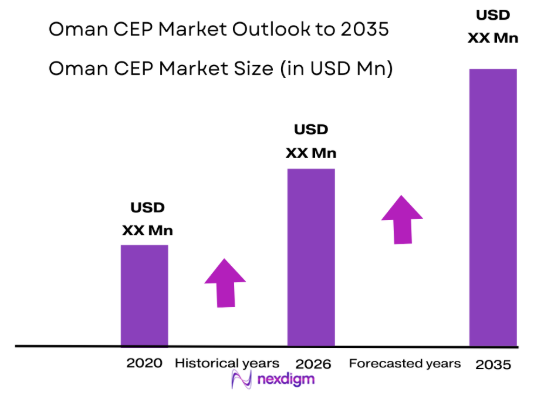
Based on a recent historical assessment, the Oman CEP Market generated approximately USD ~ million in revenue, supported by expanding e-commerce transactions, rising domestic parcel volumes, and cross-border trade activity handled through logistics networks. Increasing adoption of digital shopping platforms, expanding courier networks, and investments in logistics infrastructure have strengthened parcel delivery capacity. Growth in online retail orders, international shipping requirements, and government support for logistics sector development continue driving demand for courier, express, and parcel delivery services.
Muscat serves as the central logistics hub for courier and parcel operations due to concentration of commercial activity, e-commerce fulfillment centers, and national distribution facilities. Sohar and Salalah also play significant roles due to major seaport infrastructure supporting international trade flows and cargo transshipment activities. These cities attract logistics investments because of industrial zones, free trade areas, and port connectivity. Strong transportation infrastructure and strategic geographic location enable Oman to function as an important regional logistics gateway.
Market Segmentation
By Service Type
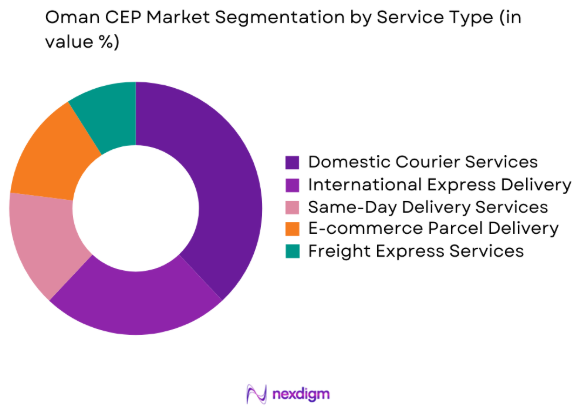
Oman CEP Market is segmented by product type into Domestic Courier Services, International Express Delivery, Same-Day Delivery Services, E-commerce Parcel Delivery, and Freight Express Services. Recently, Domestic Courier Services has a dominant market share due to factors such as rising online retail transactions, increasing urban parcel shipments, and strong nationwide delivery infrastructure. Rapid expansion of local e-commerce platforms, mobile commerce adoption, and domestic retail logistics demand have increased parcel volumes within the country. Courier companies continue expanding local delivery fleets, sorting hubs, and digital shipment tracking systems to handle increasing order fulfillment requirements. Domestic logistics routes connect major urban centers including Muscat, Sohar, and Salalah, enabling fast and efficient parcel movement. Businesses increasingly depend on reliable local delivery services to support online order fulfillment, retail distribution, and document transportation, strengthening the importance of domestic courier networks within the overall CEP ecosystem.
By End User Industry
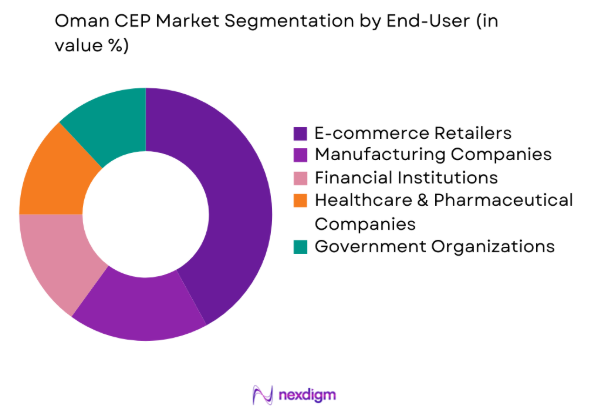
Oman CEP Market is segmented by product type into E-commerce Retailers, Manufacturing Companies, Financial Institutions, Healthcare & Pharmaceutical Companies, and Government Organizations. Recently, E-commerce Retailers has a dominant market share due to factors such as rising online consumer spending, increasing digital marketplace activity, and expanding retail logistics networks. Online retail platforms depend heavily on courier services to ensure fast delivery, order tracking, and efficient reverse logistics. Growth in mobile shopping applications, digital payments, and cross-border online purchases continues generating higher parcel shipment volumes across Oman. Logistics providers invest in automated sorting systems, warehouse networks, and route optimization technologies to handle increasing e-commerce shipments efficiently. Retailers require integrated courier networks capable of managing large daily parcel volumes while maintaining delivery speed and reliability. These factors significantly strengthen the role of the e-commerce sector in driving CEP market demand.
Competitive Landscape
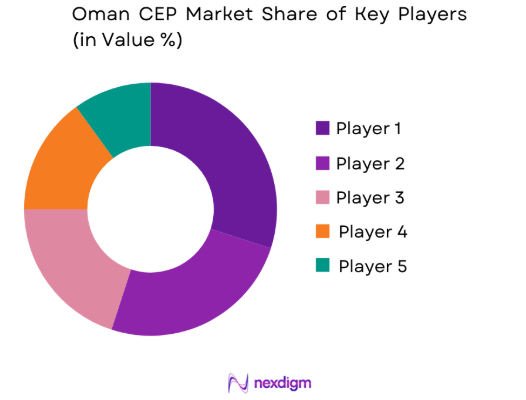
The Oman CEP Market is moderately consolidated with a mix of international logistics corporations and regional courier operators competing for parcel delivery contracts and ecommerce logistics partnerships. Global companies benefit from established logistics networks, advanced parcel tracking technologies, and strong international shipping capabilities. Regional logistics firms compete through domestic delivery coverage, flexible pricing models, and localized customer relationships. Increasing parcel volumes and e-commerce growth encourage investments in automated sorting hubs, digital logistics platforms, and fleet expansion.
| Company Name | Establishment Year | Headquarters | Technology Focus | Market Reach | Key Products | Revenue | Delivery Network Coverage |
| DHL Express | 1969 | Germany | ~ | ~ | ~ | ~ | ~ |
| FedEx | 1971 | USA | ~ | ~ | ~ | ~ | ~ |
| UPS | 1907 | USA | ~ | ~ | ~ | ~ | ~ |
| Aramex | 1982 | UAE | ~ | ~ | ~ | ~ | ~ |
| Asyad Express | 2016 | Oman | ~ | ~ | ~ | ~ | ~ |
Oman CEP Market Analysis
Growth Drivers
Expansion of E-commerce and Digital Retail Logistics Demand
The rapid expansion of online retail activity across Oman significantly increases demand for courier express and parcel delivery services as consumers rely more on digital marketplaces and mobile commerce platforms to purchase products such as electronics, apparel, groceries, and household goods. E-commerce companies require efficient logistics networks capable of managing rising order volumes while maintaining fast delivery speeds and reliable shipment tracking. Retailers therefore invest in partnerships with courier providers to support last-mile delivery operations and customer satisfaction. Logistics companies respond by expanding vehicle fleets, automated parcel sorting facilities, and digital tracking systems that improve delivery management. Growth in digital payments and cross-border e-commerce purchases further increases parcel shipment volumes handled by courier networks across Oman.
Government Investments in Logistics Infrastructure and Transportation Networks
Oman’s investments in logistics infrastructure and transportation networks significantly support growth in the courier express and parcel delivery sector by strengthening connectivity between commercial centers, industrial zones, ports, and international shipping gateways. National economic diversification initiatives promote logistics sector expansion and position Oman as a regional trade hub linking Asia, Africa, and Europe. Modern port facilities at Sohar and Salalah enable efficient handling of international cargo and parcel shipments. Logistics zones near these ports provide warehousing, distribution, and customs clearance services that support courier operations. Expansion of highway networks improves domestic delivery efficiency across cities and industrial regions. Digital customs platforms also streamline cross-border parcel processing, reducing shipment delays and improving logistics network performance.
Market Challenges
High Operational Costs and Last-Mile Delivery Complexity Across Urban and Remote Regions
Courier express and parcel service providers operating in Oman face rising operational cost pressures due to the complexity of managing last-mile deliveries across dense urban centers and widely dispersed rural regions. Urban deliveries require high fleet utilization, advanced routing technologies, and substantial labor resources to handle growing parcel volumes from e-commerce and commercial shipments. Serving remote locations involves long travel distances with lower parcel density, increasing transportation expenses and operational inefficiencies. Logistics companies must maintain large vehicle fleets, sorting hubs, and distribution facilities to ensure timely deliveries nationwide. Rising fuel prices and vehicle maintenance costs further increase operating expenditures. Continuous investments in automation technologies and delivery infrastructure are also required to maintain service reliability across expanding delivery networks.
Cross-Border Shipment Delays and Regulatory Compliance Requirements
International parcel shipments within the Oman CEP Market face operational challenges related to customs clearance procedures, regulatory documentation requirements, and cross-border shipping compliance obligations that can delay international deliveries. Courier companies handling global shipments must follow strict customs rules covering product classification, import documentation, duties, and shipping declarations. Missing documentation or regulatory inconsistencies often lead to shipment delays, inspections, and higher administrative workload. Cross-border e-commerce parcels arriving from multiple suppliers require efficient customs processing systems to manage high shipment volumes. Logistics providers must coordinate with customs authorities, freight forwarders, and international shipping partners to ensure smooth delivery operations. Differences in shipping regulations across trading partners further complicate international logistics, increasing operational complexity for courier companies managing cross-border parcel deliveries.
Opportunities
Adoption of Automated Parcel Sorting Facilities and Smart Logistics Technologies
Rapid parcel volume growth within Oman creates major opportunities for courier companies to adopt advanced logistics technologies such as automated parcel sorting systems, artificial intelligence based route optimization software, and smart warehouse management platforms that improve delivery efficiency across the CEP supply chain. Automated sorting facilities significantly increase parcel handling capacity by enabling faster classification, routing, and loading processes while reducing manual handling requirements. Logistics operators benefit from improved operational efficiency, lower labor costs, and faster delivery times when automation is integrated into distribution hubs. Artificial intelligence driven route optimization tools help companies analyze traffic patterns, parcel density, and delivery routes to improve fleet efficiency. Smart logistics technologies also support real time shipment tracking that enhances delivery transparency.
Expansion of Same-Day Delivery and On-Demand Logistics Services for Urban Consumers
Growing consumer expectations for faster order fulfillment create strong opportunities for logistics providers to expand same-day delivery and on-demand courier services across major cities in Oman. Urban consumers increasingly demand rapid delivery for online purchases including groceries, electronics, and everyday consumer products ordered through digital platforms. Retailers therefore seek logistics partners capable of providing ultra-fast delivery solutions that reduce fulfillment time and improve customer satisfaction. Courier companies are investing in urban distribution hubs, micro-fulfillment facilities, and advanced delivery management technologies to support quick parcel movement. Real-time shipment tracking and mobile coordination platforms enable efficient route planning and flexible delivery scheduling. Growing partnerships between e-commerce retailers and logistics providers further increase demand for rapid delivery networks across urban markets.
Future Outlook
The Oman CEP Market is expected to experience sustained growth driven by increasing e-commerce penetration, infrastructure investments, and logistics sector modernization initiatives. Expansion of smart logistics technologies and automated parcel handling facilities will significantly improve delivery efficiency. Government support for logistics sector development and regional trade connectivity will strengthen international parcel flows. Rising consumer expectations for faster delivery and integrated digital logistics services will further accelerate CEP industry expansion across Oman.
Major Players
- DHL Express
- FedEx
- UPS
- Aramex
- AsyadExpress
- SMSA Express
- NaqelExpress
- ShipaDelivery
- Fetchr
- iMileDelivery
- Kuehne + Nagel
- DB Schenker
- CEVA Logistics
- DTDC Express
- SkyNetWorldwide Express
Key Target Audience
- Logistics and supply chain companies
- E-commerce companies
- Retail and supermarket chains
- Manufacturing and export companies
- Healthcare and pharmaceutical distributors
- Transportation infrastructure developers
- Investments and venture capitalist firms
- Government and regulatory bodies
Research Methodology
Step 1: Identification of Key Variables
The research process begins by identifying the most important market variables including parcel shipment volumes, logistics infrastructure, e-commerce adoption levels, and courier network expansion across Oman. These variables form the foundation for analyzing market structure and operational dynamics.
Step 2: Market Analysis and Construction
Market structure is constructed by evaluating courier service providers, logistics infrastructure development, and cross-border shipping flows within the national logistics ecosystem. Industry data, government publications, and logistics sector reports are analyzed to estimate market dynamics.
Step 3: Hypothesis Validation and Expert Consultation
Preliminary findings are validated through consultations with logistics industry professionals, courier operators, and supply chain experts. Their insights help refine assumptions related to parcel shipment growth, infrastructure development, and competitive dynamics within the CEP sector.
Step 4: Research Synthesis and Final Output
All validated data sources are integrated into a structured analytical framework that evaluates market segmentation, growth drivers, competitive positioning, and long-term logistics sector trends. The final output presents a comprehensive evaluation of the Oman CEP Market.

- Executive Summary
- Research Methodology (Definitions, Scope, Industry Assumptions, Market Sizing Approach, Primary & Secondary Research Framework, Data Collection & Verification Protocol, Analytic Models & Forecast Methodology, Limitations & Research Validity Checks)

- Market Definition and Scope
- Value Chain & Stakeholder Ecosystem
- Regulatory / Certification Landscape
- Sector Dynamics Affecting Demand
- Strategic Initiatives & Infrastructure Growth

- Growth Drivers
Rapid Expansion of E-commerce and Online Retail Logistics Demand
Government Investments in Logistics Infrastructure and Free Zones
Rising Cross-Border Trade and International Parcel Shipments - Market Challenges
High Operational Costs Associated with Last-Mile Delivery
Limited Domestic Air Cargo Connectivity for Express Shipments
Operational Complexity in Serving Remote Geographic Locations - Market Opportunities
Expansion of Automated Parcel Locker Networks
Adoption of AI-driven Delivery Route Optimization Systems
Growth of Same-day and On-demand Delivery Services - Trends
Increasing Adoption of Digital Shipment Tracking Platforms
Expansion of Smart Warehousing and Automated Sorting Facilities
Growing Integration of E-commerce Platforms with Courier Networks - Government Regulations
- SWOT Analysis of Key Competitors
- Porter’s Five Forces

- By Market Value, 2020-2025
- By Installed Units, 2020-2025
- By Average System Price, 2020-2025
- By System Complexity Tier, 2020-2025

- By System Type (In Value%)
Domestic Parcel Delivery Services
International Courier Services
Express Document Delivery
E-commerce Parcel Logistics
Bulk Cargo and Freight Express - By Platform Type (In Value%)
Ground Transportation Networks
Air Cargo Logistics Platforms
Integrated Multimodal Delivery Networks
Digital Delivery Management Platforms
Automated Parcel Sorting Systems - By Fitment Type (In Value%)
In-house Logistics Operations
Third-party Logistics Integration
Franchise Delivery Networks
Partnered Courier Aggregation Platforms
Contract-based Delivery Solutions - By End User Segment (In Value%)
E-commerce Retailers
Manufacturing and Industrial Companies
Healthcare and Pharmaceutical Distributors
Financial and Legal Services Firms
Government and Public Sector Institutions - By Procurement Channel (In Value%)
Direct Corporate Contracts
Government Logistics Tenders
E-commerce Marketplace Partnerships
Third-party Logistics Providers
Digital Courier Booking Platforms

- Market Share Analysis
- Cross Comparison Parameters (Delivery Network Coverage, Technology Integration, Service Speed, Pricing Strategy, Cross-border Logistics Capability)
- SWOT Analysis of Key Competitors
- Pricing & Procurement Analysis
- Key Players
DHL Express
FedEx
UPS
Aramex
Asyad Express
SMSA Express
Naqel Express
Shipa Delivery
iMile Delivery
Fetchr
DTDC Express
SkyNet Worldwide Express
Kuehne + Nagel
DB Schenker
CEVA Logistics

- E-commerce retailers increasingly depend on CEP networks for rapid order fulfillment and delivery efficiency
- Manufacturing exporters utilize courier services for document dispatch and small cargo shipments across international markets
- Healthcare distributors rely on express logistics for timely delivery of pharmaceutical products and medical supplies
- Government agencies and financial institutions require secure courier networks for confidential document transportation

- Forecast Market Value, 2026-2035
- Forecast Installed Units, 2026-2035
- Price Forecast by System Tier, 2026-2035
- Future Demand by Platform, 2026-2035


 Request a Sample
 Ask for Customization
 Get a Quote
 Enquire Now