
 Download PDF
 Download PDF
Market Overview
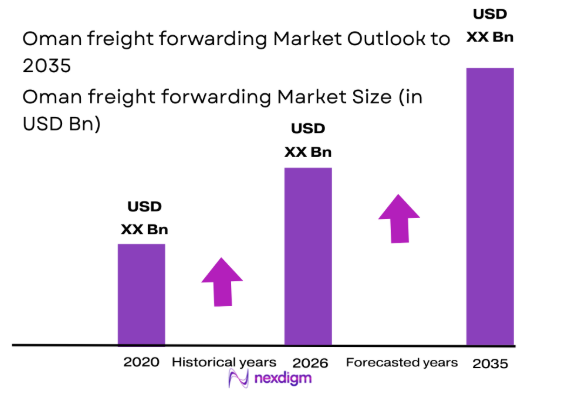
The Oman freight forwarding market demonstrates steady expansion supported by growing international trade activity and increasing logistics infrastructure investments across ports, airports, and industrial zones. Based on a recent historical assessment, freight forwarding and logistics services in Oman generated approximately USD ~ billion in economic value, according to logistics sector statistics published by the Oman Ministry of Transport and the World Bank logistics performance assessments. Rising maritime trade through major ports and expanding re-export operations continue strengthening freight forwarding demand across the country.
Muscat, Sohar, and Salalah dominate freight forwarding activities due to their strategic port infrastructure and global maritime connectivity linking Asia, Africa, and Europe trade routes. Sohar Port functions as a major industrial logistics hub supporting manufacturing exports and container shipments, while Salalah Port serves as a key transshipment gateway connecting global shipping lanes. Muscat International Airport further strengthens air cargo forwarding networks, enabling rapid cargo movement and supporting international trade operations across the Sultanate’s logistics ecosystem.
Market Segmentation
By Transport Mode
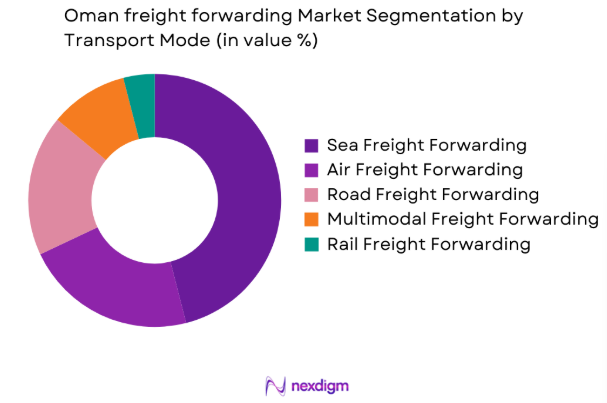
Oman Freight Forwarding market is segmented by transport mode into air freight forwarding, sea freight forwarding, road freight forwarding, rail freight forwarding, and multimodal freight forwarding. Recently, sea freight forwarding has a dominant market share due to strong maritime trade volumes handled through major ports including Sohar Port and Salalah Port. The country’s geographic position along global shipping routes enables large scale container shipments and transshipment activities supporting industrial exports, oil related cargo, and consumer goods imports. Port infrastructure expansion and deepwater terminals allow large container vessels to operate efficiently, increasing maritime cargo throughput. Sea freight also provides cost advantages for high volume shipments compared with air transportation. Manufacturing companies, construction contractors, and retail importers rely heavily on maritime cargo movement due to predictable transit schedules and integrated port logistics services. Port-based logistics zones further strengthen sea freight operations by offering warehousing, cargo consolidation, and customs clearance services near terminals. Shipping alliances and international freight operators increasingly establish regional operations within Oman’s ports to support global logistics networks. These combined factors enable maritime freight forwarding services to maintain dominance within the national freight forwarding market.
By End User Industry
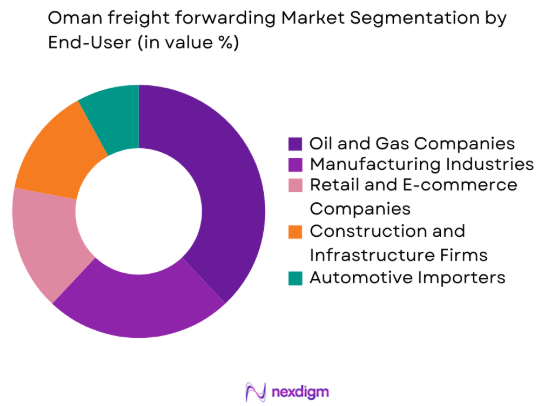
Oman Freight Forwarding market is segmented by end user industry into oil and gas companies, manufacturing industries, retail and e-commerce companies, construction and infrastructure firms, and automotive importers. Recently, oil and gas companies hold the dominant market share due to the sector’s extensive equipment transportation requirements and continuous export shipments of energy products through maritime terminals. Energy companies require specialized logistics services capable of handling oversized project cargo, drilling equipment, and heavy machinery shipments supporting upstream and downstream operations. Freight forwarders also manage export documentation, port handling coordination, and international shipping arrangements for petroleum products and industrial materials. Industrial logistics demand further increases as energy infrastructure projects require regular cargo deliveries across supply chains connecting global suppliers with Omani production facilities. Construction contractors working within oil and gas projects also depend on freight forwarding companies for equipment and materials transportation. Port connectivity near major industrial zones allows efficient movement of cargo directly from maritime terminals to project sites. As a result, the oil and gas sector remains the most significant customer base for freight forwarding companies operating across Oman’s logistics industry.
Competitive Landscape
The Oman freight forwarding market features a mix of global logistics companies and regional logistics providers competing through service portfolio expansion, port connectivity, and international shipping networks. Global freight forwarders maintain strong positions due to their extensive international cargo networks and integrated logistics capabilities, while regional firms compete through localized expertise, customs brokerage services, and domestic distribution networks supporting national trade flows.
| Company Name | Establishment Year | Headquarters | Technology Focus | Market Reach | Key Products | Revenue | Logistics Specialization |
| DHL Global Forwarding | 1969 | Germany | ~ | ~ | ~ | ~ | ~ |
| Kuehne + Nagel | 1890 | Switzerland | ~ | ~ | ~ | ~ | ~ |
| DB Schenker | 1872 | Germany | ~ | ~ | ~ | ~ | ~ |
| DSV | 1976 | Denmark | ~ | ~ | ~ | ~ | ~ |
| Aramex | 1982 | UAE | ~ | ~ | ~ | ~ | ~ |
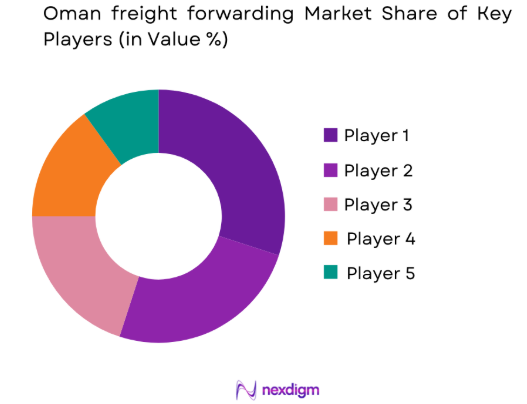
Oman freight forwarding Market Analysis
Growth Drivers
Expansion of Strategic Port Infrastructure and Global Maritime Connectivity
Oman has expanded maritime infrastructure through deepwater ports, industrial terminals, and logistics free zones that support international cargo movement across Asia, Europe, and Africa trade corridors. Major ports such as Sohar Port and Salalah Port handle rising container volumes and transshipment operations, enabling freight forwarders to manage large scale cargo flows efficiently. Expanded port facilities accommodate ultra large container vessels, increasing shipping capacity and strengthening Oman’s position in global maritime logistics networks. Logistics zones near ports provide warehousing, customs clearance, and cargo consolidation services supporting international supply chains. Government investments in road connectivity and logistics infrastructure improve cargo transport between industrial zones, airports, and ports, while modern terminals support growing exports of petrochemicals, metals, and manufactured goods.
Rising Regional Re Export Trade and Cross Border Logistics Activity
Oman is increasingly emerging as a regional logistics gateway supporting re export trade between Gulf countries, Africa, and South Asia through integrated shipping networks and efficient cargo handling infrastructure at major ports. Freight forwarding companies manage large volumes of re export cargo including electronics, machinery, automotive components, and industrial materials that move through Omani ports before reaching regional markets. The country’s strategic location along international shipping routes enables logistics providers to use Oman as a consolidation hub connecting multiple continents. Free trade zones with simplified customs procedures allow faster cargo movement and support efficient regional distribution. Freight forwarders also coordinate multimodal transport linking maritime shipping with regional trucking networks across GCC markets.
Market Challenges
Volatility in Global Freight Rates and Shipping Capacity Cycles
Freight forwarding companies operating in Oman face operational uncertainty due to fluctuations in global shipping rates, container availability, and maritime freight capacity across international trade routes. Global shipping markets often experience rate volatility influenced by fuel costs, vessel supply, geopolitical disruptions, and changes in international trade demand. Freight forwarders must frequently adjust pricing strategies and service agreements to manage shifting freight rate environments that affect profitability and logistics planning. Sudden increases in shipping costs or shortages of containers create challenges for companies coordinating shipments for exporters, importers, and industrial clients. Long term logistics contracts may also become financially misaligned when freight costs rise unexpectedly, increasing operational risks for freight forwarding providers.
Dependence on International Trade Volumes and External Economic Conditions
The Oman freight forwarding market is strongly connected to global trade flows and international economic conditions, making logistics demand sensitive to fluctuations in manufacturing output, commodity prices, and cross border trade volumes. Cargo volumes handled by freight forwarding companies depend heavily on industrial production, energy exports, and consumer demand across key trading partners linked through maritime shipping networks. Economic slowdowns or geopolitical disruptions along global trade corridors can significantly reduce cargo shipments passing through Omani ports and logistics facilities. Freight forwarders may face lower cargo throughput and revenue pressure during periods of weak global trade, particularly in sectors such as construction materials, machinery, and energy exports. Maintaining operational resilience in such conditions remains challenging.
Opportunities
Development of Integrated Logistics Zones and Free Trade Distribution Centers
Oman is steadily expanding logistics free zones and industrial logistics parks to strengthen its position as a regional distribution hub supporting international trade and freight forwarding activities. Integrated logistics zones near major ports and airports provide warehousing, cargo consolidation, customs processing, and distribution facilities that allow freight forwarders to manage end to end supply chain services efficiently. These logistics parks attract global shipping companies, manufacturers, and regional distribution centers that depend on reliable freight forwarding networks. Favorable investment policies and simplified customs procedures encourage international logistics firms to establish operations in these zones. Proximity to maritime terminals enables faster cargo handling and efficient multimodal transportation coordination across global shipping routes and regional distribution networks.
Adoption of Digital Freight Platforms and Smart Logistics Technologies
Freight forwarding companies increasingly adopt digital logistics technologies such as freight management platforms, automated cargo tracking systems, and advanced data analytics tools to enhance logistics efficiency and supply chain visibility across international shipping operations. Digital freight platforms allow customers to monitor shipments, manage shipping documents, and coordinate logistics services through integrated online systems that improve transparency within global freight networks. Forwarders implementing smart logistics technologies benefit from faster booking procedures, real time cargo monitoring, and improved logistics planning capabilities. Automation of customs documentation, shipment scheduling, and warehouse management reduces administrative delays and increases operational efficiency. Integration between shipping lines, port authorities, trucking networks, and customs agencies further strengthens coordination across complex multimodal transportation systems.
Future Outlook
The Oman freight forwarding market is expected to experience sustained expansion driven by increasing international trade volumes, logistics infrastructure development, and integration with global maritime transport networks. Continued investment in port modernization, logistics parks, and digital freight platforms will strengthen cargo handling capabilities across the Sultanate. Regional trade growth and expanding re-export activities will further increase freight forwarding demand. Government initiatives aimed at transforming Oman into a regional logistics hub will support long-term sector development.
Major Players
- DHL Global Forwarding
- Kuehne + Nagel
- DB Schenker
- DSV
- Agility Logistics
- Aramex
- Maersk Logistics & Services
- Expeditors International
- UPS Supply Chain Solutions
- Bolloré Logistics
- CEVA Logistics
- Nippon Express
- Hellmann Worldwide Logistics
- Al Madina Logistics
- BahwanLogistics
Key Target Audience
- Logistics and supply chain companies
- Shipping and maritime transport companies
- E-commerce and retail companies
- Manufacturing and industrial exporters
- Oil and gas companies
- Transportation infrastructure developers
- Investments and venture capitalist firms
- Government and regulatory bodies
Research Methodology
Step 1: Identification of Key Variables
Initial research identifies core logistics indicators including freight volumes, port throughput capacity, international trade activity, and logistics infrastructure investment. These variables form the basis for evaluating freight forwarding demand across maritime, air, and multimodal transportation networks within Oman.
Step 2: Market Analysis and Construction
Primary and secondary data sources including government trade databases, port authority statistics, and logistics industry reports are analyzed to construct the freight forwarding market model and understand sector structure and service segmentation.
Step 3: Hypothesis Validation and Expert Consultation
Industry experts, logistics operators, and supply chain specialists are consulted to validate assumptions regarding cargo flow patterns, freight forwarding demand, and infrastructure utilization across Oman’s logistics ecosystem.
Step 4: Research Synthesis and Final Output
All quantitative data, qualitative insights, and industry expert perspectives are consolidated into a comprehensive research framework to generate reliable market forecasts, strategic insights, and competitive analysis.

- Executive Summary
- Research Methodology (Definitions, Scope, Industry Assumptions, Market Sizing Approach, Primary & Secondary Research Framework, Data Collection & Verification Protocol, Analytic Models & Forecast Methodology, Limitations & Research Validity Checks)

- Market Definition and Scope
- Value Chain & Stakeholder Ecosystem
- Regulatory / Certification Landscape
- Sector Dynamics Affecting Demand
- Strategic Initiatives & Infrastructure Growth

- Growth Drivers
Expansion of Port Infrastructure and Maritime Trade Corridors
Rising Regional Re-export and Logistics Hub Strategy
Growth of E-commerce and Cross-border Trade Logistics - Market Challenges
Volatility in Global Freight Rates and Shipping Cycles
Port Congestion and Customs Clearance Delays
High Dependence on International Trade Flows - Market Opportunities
Development of Integrated Logistics Zones
Digital Freight Platforms and Smart Logistics Technologies
Expansion of GCC Regional Trade Corridors - Trends
Growth of Multimodal Transport Networks
Adoption of Digital Freight Management Platforms
Expansion of Free Trade Zones and Logistics Parks - Government Regulations
- SWOT Analysis of Key Competitors
- Porter’s Five Forces

- By Market Value, 2020-2025
- By Installed Units, 2020-2025
- By Average System Price, 2020-2025
- By System Complexity Tier, 2020-2025

- By System Type (In Value%)
Air Freight Forwarding
Sea Freight Forwarding
Road Freight Forwarding
Rail Freight Forwarding
Multimodal Freight Forwarding - By Platform Type (In Value%)
Port-based Logistics Platforms
Airport Cargo Platforms
Inland Container Depots
Integrated Logistics Parks
Digital Freight Platforms - By Fitment Type (In Value%)
Direct Shipper Contracts
Third-Party Logistics Integration
Freight Consolidation Services
Door-to-Door Delivery Solutions
Customs Brokerage Integrated Services - By End User Segment (In Value%)
Oil and Gas Companies
Manufacturing and Industrial Firms
Retail and E-commerce Companies
Construction and Infrastructure Companies
Automotive and Machinery Importers - By Procurement Channel (In Value%)
Direct Logistics Contracts
Government Tender Procurement
Third-Party Logistics Partnerships
Digital Freight Marketplaces
Freight Broker Networks

- Market Share Analysis
- Cross Comparison Parameters (Service Portfolio, Global Network Reach, Port Connectivity, Customs Brokerage Capability, Digital Logistics Integration)
- SWOT Analysis of Key Competitors
- Pricing & Procurement Analysis
- Key Players
DHL Global Forwarding
Kuehne + Nagel
DB Schenker
DSV
Agility Logistics
Aramex
Maersk Logistics & Services
Expeditors International
UPS Supply Chain Solutions
Bolloré Logistics
CEVA Logistics
Nippon Express
Hellmann Worldwide Logistics
Al Madina Logistics
Bahwan Logistics

- Oil and gas exporters rely heavily on international freight forwarding services
- Manufacturing industries depend on efficient cargo consolidation and shipping networks
- Retail and e-commerce businesses demand faster cross-border logistics services
- Infrastructure developers require large-scale project cargo forwarding solutions

- Forecast Market Value, 2026-2035
- Forecast Installed Units, 2026-2035
- Price Forecast by System Tier, 2026-2035
- Future Demand by Platform, 2026-2035


 Request a Sample
 Ask for Customization
 Get a Quote
 Enquire Now