

 Download PDF
 Download PDF
Market Overview
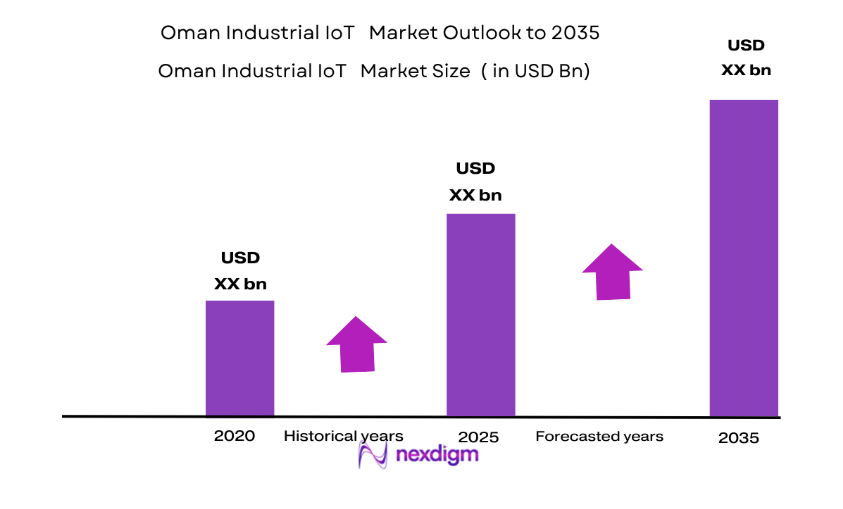
The Oman Industrial IoT market is witnessing substantial growth, driven by the increasing adoption of connected devices in various industries, including manufacturing, oil & gas, and healthcare. The market is expected to reach USD ~ billion, as industries recognize the potential of IoT solutions in enhancing operational efficiency, reducing downtime, and enabling predictive maintenance. As businesses strive for digital transformation, the deployment of Industrial IoT systems has become a priority, providing opportunities for both established players and new entrants to capitalize on this demand.
Oman has emerged as a key player in the regional industrial IoT market due to its strategic position in the Middle East, rich natural resources, and government support for technological advancements. Major cities such as Muscat and Salalah are seeing a surge in industrial IoT applications, with investments in smart infrastructure, energy efficiency, and automation projects. The government’s vision for economic diversification and modernization of the oil and gas sector through automation and digitalization is contributing to the dominance of these regions in the market.
Market Segmentation
By Product Type:
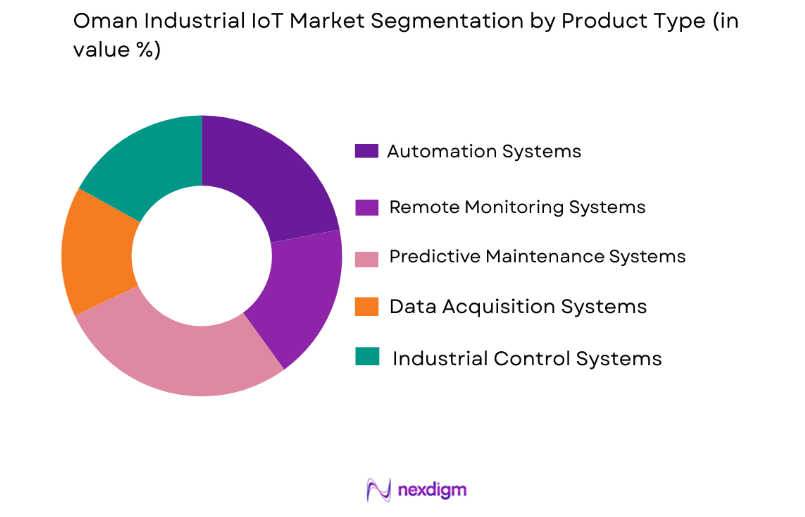
The Oman Industrial IoT market is segmented by product type into automation systems, remote monitoring systems, predictive maintenance systems, data acquisition systems, and industrial control systems. Recently, predictive maintenance systems have dominated the market share due to their ability to reduce operational downtime and improve equipment reliability. This dominance is driven by increasing demand from manufacturing and oil & gas industries, where downtime can lead to significant financial losses. Predictive maintenance systems allow companies to detect potential failures before they occur, resulting in improved operational efficiency and cost savings.
By End-User Industry:
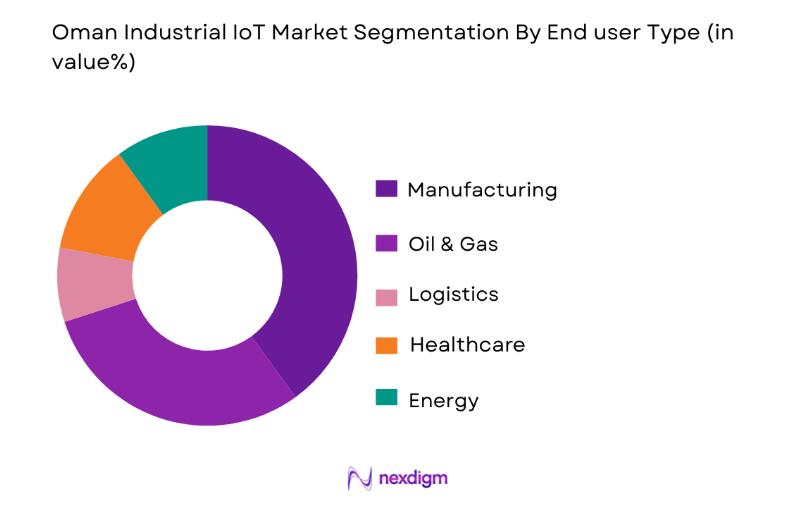
The market is also segmented by end-user industry, including manufacturing, oil & gas, healthcare, logistics, and energy. Manufacturing has emerged as the dominant sub-segment, driven by the increasing need for automation, real-time monitoring, and data analysis to improve productivity and reduce costs. In particular, the shift towards smart factories and Industry 4.0 is accelerating the adoption of industrial IoT solutions in the manufacturing sector. As companies continue to invest in automated solutions for production lines and supply chains, manufacturing remains the leading industry in the Oman industrial IoT market.
Competitive Landscape
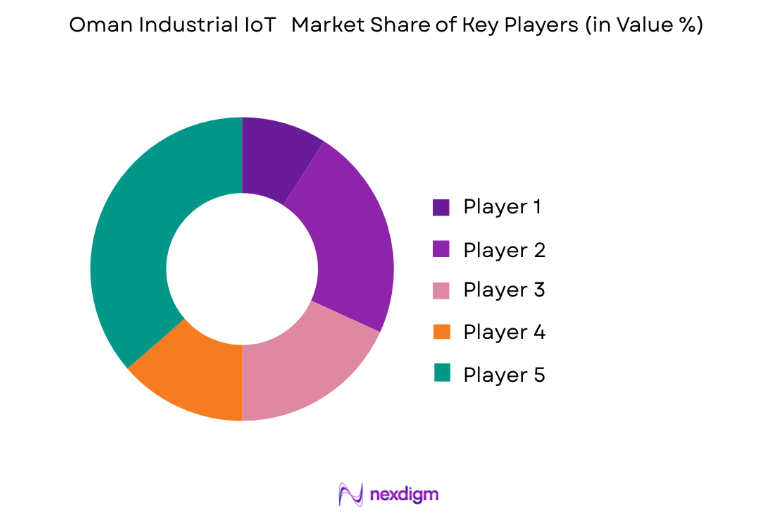
The Oman Industrial IoT market is highly competitive, with several major players leading the market. These companies are focusing on expanding their product offerings and strengthening their market position through strategic partnerships and acquisitions. The market is characterized by rapid technological advancements, with innovations in connectivity, automation, and artificial intelligence playing a crucial role in driving market growth. The influence of major players such as Siemens, Honeywell, and Schneider Electric is expected to further consolidate the market in the coming years.
| Company Name | Establishment Year | Headquarters | Technology Focus | Market Reach | Key Products | Revenue | Additional Parameter |
| Siemens | 1847 | Germany | ~ | ~ | ~ | ~ | ~ |
| Honeywell | 1906 | USA | ~ | ~ | ~ | ~ | ~ |
| Schneider Electric | 1836 | France | ~ | ~ | ~ | ~ | ~ |
| ABB | 1988 | Switzerland | ~ | ~ | ~ | ~ | ~ |
| Rockwell Automation | 1903 | USA | ~ | ~ | ~~ | ~ | ~ |
Oman Industrial IoT Market Analysis
Growth Drivers
Government Initiatives:
Government initiatives aimed at diversifying Oman’s economy and boosting the adoption of digital technologies play a critical role in driving the industrial IoT market. The Oman Vision 2040, which emphasizes digital transformation across key sectors like manufacturing, healthcare, and energy, is accelerating the adoption of smart technologies. As the government allocates funding for infrastructure development and promotes the use of IoT solutions, businesses are increasingly incorporating these technologies into their operations to improve efficiency and competitiveness. The government’s efforts to reduce dependence on oil and gas by fostering technology-driven sectors are expected to continue fueling market growth, as industries invest in automation, predictive maintenance, and remote monitoring systems. This strategy enhances Oman’s position as a regional leader in industrial IoT adoption.
Industry Demand for Operational Efficiency:
The increasing pressure on industries to improve operational efficiency and reduce costs is another significant growth driver for the market. With the rising need for sustainable practices, businesses in manufacturing, oil & gas, and energy are seeking ways to optimize production processes, minimize downtime, and lower energy consumption. Industrial IoT solutions offer real-time monitoring, predictive analytics, and automation, enabling companies to streamline operations, reduce waste, and enhance productivity. In the oil & gas sector, for instance, IoT technologies such as remote monitoring systems are helping companies track equipment performance and detect potential failures, thus avoiding costly downtime and maximizing operational uptime. These technological advancements are driving the demand for industrial IoT solutions across Oman, contributing to market expansion.
Market Challenges
High Initial Investment:
One of the major challenges in the adoption of industrial IoT solutions is the high initial investment required for implementation. The cost of deploying IoT systems, including sensors, software, and infrastructure, can be significant, especially for small and medium-sized enterprises (SMEs). These businesses may find it difficult to justify the upfront costs, even though the long-term benefits of improved efficiency and reduced operational costs are evident. As a result, many SMEs in Oman may be hesitant to adopt industrial IoT solutions, limiting market penetration. Although the potential for cost savings and improved productivity is high, the initial capital expenditure remains a barrier for widespread adoption.
Lack of Skilled Workforce:
Another challenge facing the Oman Industrial IoT market is the shortage of skilled professionals capable of managing and maintaining IoT systems. As the adoption of IoT technologies increases, there is a growing demand for engineers and technicians with expertise in IoT, data analytics, and automation. However, the current workforce in Oman lacks the necessary skills, which hinders the successful implementation and management of IoT solutions. The shortage of qualified personnel poses a significant barrier to the widespread adoption of industrial IoT, as businesses may struggle to find or train the right talent to support the technologies. Overcoming this challenge will require substantial investments in education and training programs to build a skilled workforce.
Opportunities
Smart Manufacturing Adoption:
The growing trend of smart manufacturing presents a major opportunity for the Oman Industrial IoT market. As industries increasingly shift towards automation and digitalization, the demand for IoT-based smart factories is on the rise. These factories utilize connected devices, data analytics, and automation to enhance operational efficiency, improve product quality, and reduce waste. Oman’s manufacturing sector, particularly in industries such as chemicals, automotive, and food processing, is embracing these technologies to remain competitive in the global market. By integrating IoT solutions, manufacturers can optimize production processes, track inventory in real-time, and enable predictive maintenance. This trend toward smart manufacturing is expected to drive the growth of the industrial IoT market in Oman, providing opportunities for both local and international technology providers.
Industrial IoT in Oil & Gas:
The oil and gas industry in Oman is another area where industrial IoT solutions can create substantial opportunities. With Oman being one of the largest oil producers in the Middle East, the sector’s adoption of IoT technologies for remote monitoring, predictive maintenance, and asset management is expected to grow. IoT-enabled devices allow companies in the oil & gas industry to monitor pipeline conditions, track equipment performance, and predict maintenance needs, which can reduce operational costs and improve safety. The ability to implement real-time monitoring and data analytics in oil fields, refineries, and distribution networks will enhance operational efficiency and reduce downtime, making the oil and gas sector a key driver for the adoption of industrial IoT in Oman.
Future Outlook
The Oman Industrial IoT market is expected to witness significant growth over the next five years, driven by technological advancements, government initiatives, and increasing demand for operational efficiency across various industries. The market will see continued adoption of smart technologies, especially in manufacturing, oil & gas, and energy sectors, as businesses strive for automation and digital transformation. Furthermore, the government’s support for innovation and digitalization will create a favorable environment for market growth. As IoT technologies become more affordable and accessible, the market is expected to expand, with opportunities for both local and international players.
Major Players
- Siemens
- Honeywell
- Schneider Electric
- ABB
- Rockwell Automation
- Emerson Electric
- GE Digital
- Cisco
- Mitsubishi Electric
- SAP
- Huawei
- Dell Technologies
- Intel
- Bosch
- Parker Hannifin
Key Target Audience
- Investments and venture capitalist firms
- Government and regulatory bodies
- Industrial IoT solution providers
- System integrators
- Manufacturers
- Energy companies
- Oil & Gas firms
- Technology developers
Research Methodology
Step 1: Identification of Key Variables
The first step in the research methodology is identifying the key variables that impact the Oman Industrial IoT market. This includes understanding the market dynamics, technological trends, and regulatory factors. The analysis of variables is critical to establish the foundation for data collection and analysis.
Step 2: Market Analysis and Construction
In this step, the market is analyzed in terms of value, volume, and segmentation. Data from primary and secondary sources is used to construct a comprehensive view of the market’s current state and future potential.
Step 3: Hypothesis Validation and Expert Consultation
Market hypotheses are validated through consultations with industry experts, including manufacturers, technology providers, and policymakers. This ensures that the findings are accurate and reflect the current trends in the Oman Industrial IoT market.
Step 4: Research Synthesis and Final Output
The final step involves synthesizing the collected data, expert insights, and market analysis into a cohesive report. This report includes conclusions, market forecasts, and actionable insights for stakeholders in the Oman Industrial IoT market.

- Executive Summary
- Research Methodology (Definitions, Scope, Industry Assumptions, Market Sizing Approach, Primary & Secondary Research Framework, Data Collection & Verification Protocol, Analytic Models & Forecast Methodology, Limitations & Research Validity Checks)

- Market Definition and Scope
- Value Chain & Stakeholder Ecosystem
- Regulatory / Certification Landscape
- Sector Dynamics Affecting Demand

- Growth Drivers
Government Support for Smart Manufacturing
Increased Adoption of Automation Technologies
Rising Demand for Predictive Maintenance Solutions - Market Challenges
High Initial Investment Costs
Data Security and Privacy Concerns
Integration and Interoperability Issues - Market Opportunities
Emerging Demand for Smart Factories
Development of IoT-enabled Supply Chain Solutions
Rising Interest in Sustainable IoT Solutions - Trends
Integration of AI and Machine Learning in IoT Solutions
Growth of 5G Connectivity for Industrial IoT
Expansion of Industrial IoT in Emerging Sectors - Government Regulations
- SWOT Analysis of Key Competitors

- By Market Value, 2020-2025
- By Installed Units, 2020-2025
- By Average System Price, 2020-2025
- By System Complexity Tier, 2020-2025

- By System Type (In Value%)
Automation Systems
Remote Monitoring Systems
Predictive Maintenance Systems
Data Acquisition Systems
Industrial Control Systems - By Platform Type (In Value%)
Cloud Platforms
Edge Computing Platforms
Hybrid Platforms
On-premise Platforms
Mobile Platforms - By Fitment Type (In Value%)
Embedded Solutions
Retrofit Solutions
Integrated Solutions
Modular Solutions
Cloud-based Solutions - By EndUser Segment (In Value%)
Manufacturing
Oil & Gas
Utilities
Transportation
Healthcare

- Market Share Analysis
- CrossComparison Parameters (System Type, Platform Type, EndUser Segment, Procurement Channel, Fitment Type)
- SWOT Analysis of Key Competitors
- Pricing & Procurement Analysis
- Porter’s Five Forces
- Key Players
Honeywell
Siemens
Schneider Electric
Rockwell Automation
Emerson Electric
ABB
GE Digital
Cisco
Mitsubishi Electric
SAP
Huawei
Dell Technologies
Intel
Bosch
Parker Hannifin

- Growing Demand from the Manufacturing Sector
- Increasing Adoption in Oil & Gas for Remote Monitoring
- Rising Investment in Smart Healthcare Solutions
- Utilization of IoT in Transportation and Logistics

- Forecast Market Value, 2026-2035
- Forecast Installed Units, 2026-2035
- Price Forecast by System Tier, 2026-2035
- Future Demand by Platform, 2026-2035


 Request a Sample
 Ask for Customization
 Get a Quote
 Enquire Now