

 Download PDF
Market Overview
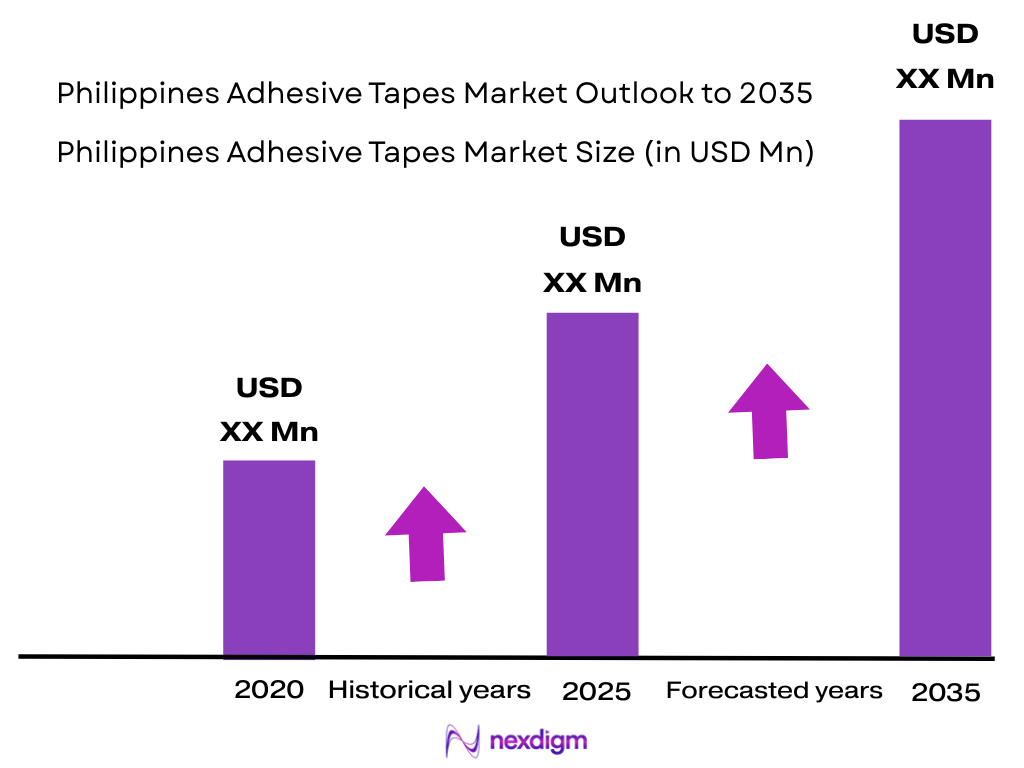
The Philippines Adhesive Tapes Market is supported by the country’s expanding manufacturing, electronics, packaging, construction and logistics activities. The country’s total external trade reached USD 200.87 billion, while imports stood at USD 127.60 billion and exports at USD 73.27 billion in the latest full-year trade statistics. Electronic products generated USD 39.09 billion in export earnings, demonstrating the scale of an adhesive-intensive manufacturing ecosystem. Separately, imports of HS 391910 self-adhesive tapes reached USD 52.55 million, equivalent to 13.23 million kg, indicating substantial tape consumption and import dependence.
The Philippines Adhesive Tapes Market is concentrated around Metro Manila, CALABARZON and Central Luzon, where packaging, electronics, manufacturing, construction, logistics and industrial facilities create overlapping demand. Construction value reached PHP 563.89 billion, with CALABARZON contributing PHP 118.37 billion, Metro Manila PHP 112.84 billion, and Central Luzon PHP 76.50 billion. Electronics provides another important demand base: electronic products generated USD 39.09 billion in export earnings, while manufactured goods generated USD 58.39 billion, reinforcing the importance of industrial adhesive applications in these clusters.
Market Segmentation
By Adhesive Technology
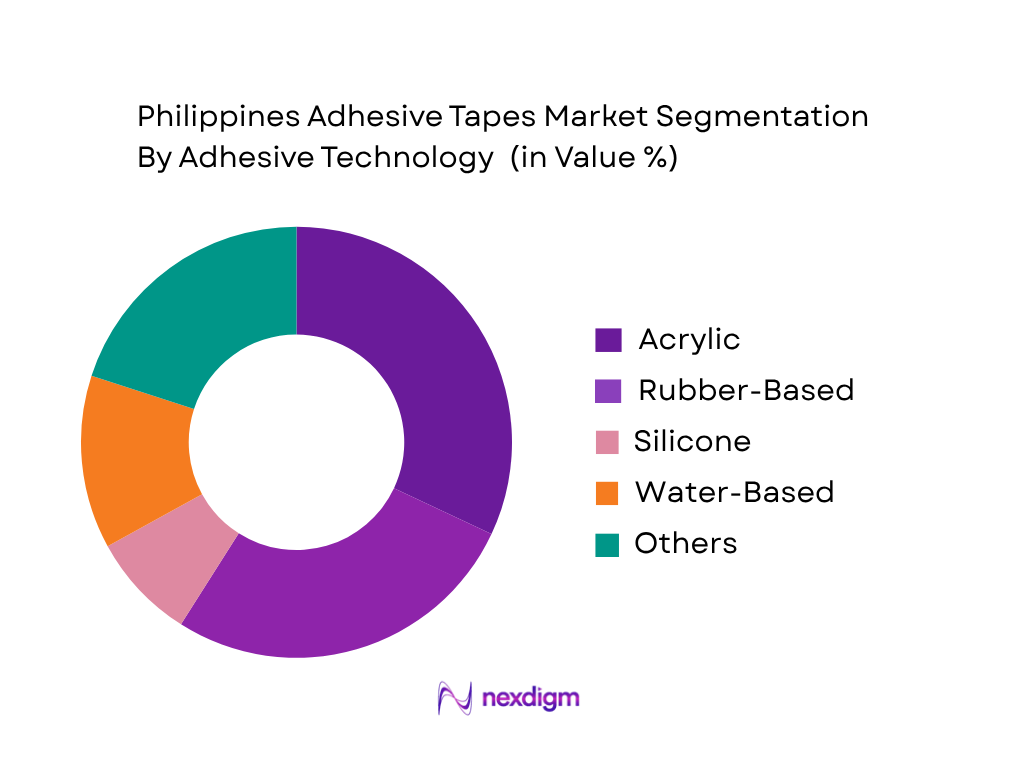
Acrylic adhesive tapes are expected to represent the dominant technology segment because of their broad suitability across packaging, electronics, automotive, construction, signage and industrial assembly. Acrylic systems provide strong adhesion, weathering resistance, aging stability and compatibility with multiple substrates, making them suitable for applications where tapes must maintain performance under temperature and humidity fluctuations. Their relevance is strengthened by the Philippines’ electronics and manufacturing ecosystem: electronic products generated USD 39.09 billion of exports, while manufactured goods generated USD 58.39 billion. Construction also represented PHP 563.89 billion of activity, supporting demand for mounting, bonding, insulation and façade applications. Acrylic technology can therefore address both high-volume packaging requirements and higher-value industrial applications. The technology is also well suited to double-sided and foam constructions, allowing manufacturers to replace mechanical fasteners with lightweight bonding solutions.
By End-Use Industry
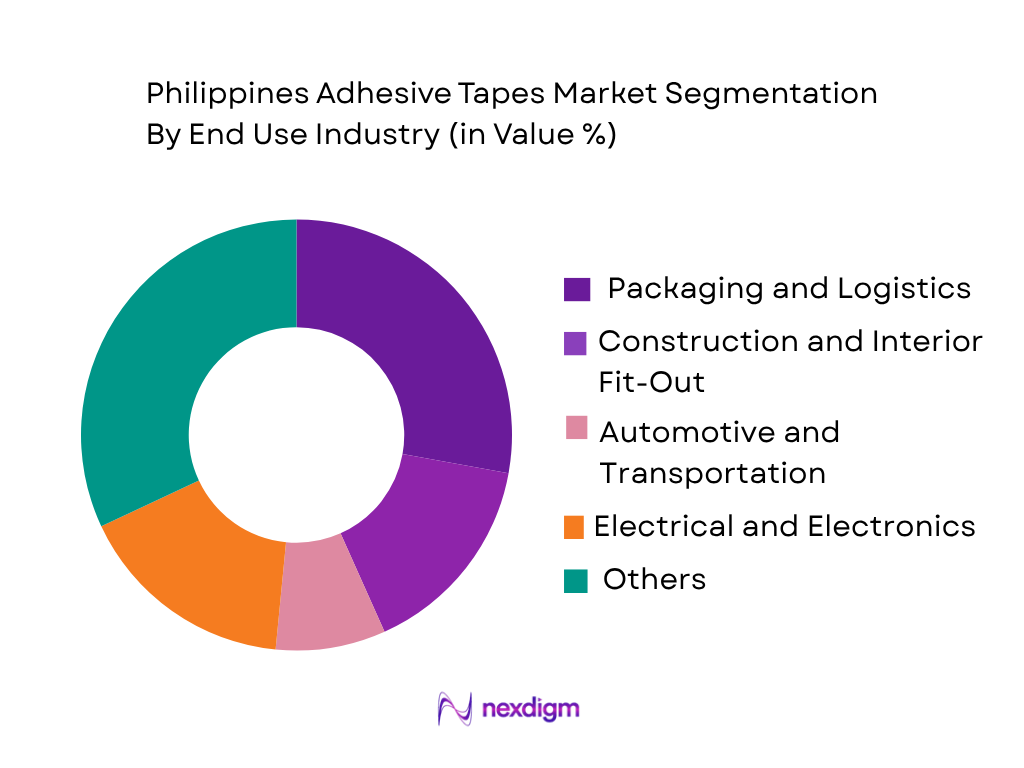
Packaging and logistics are positioned as the leading end-use segment because adhesive tapes are embedded in carton sealing, parcel preparation, palletization, bundling, labeling, splicing and warehouse operations. The country’s merchandise trade reached USD 200.87 billion, creating a substantial flow of manufactured products requiring packaging and shipment. Total imports reached USD 127.60 billion, while exports reached USD 73.27 billion, reinforcing the need for packaging materials throughout domestic distribution and international trade. E-commerce fulfilment further increases requirements for efficient carton closure and parcel handling. Packaging demand also overlaps with food and beverage, consumer products, electronics and industrial goods, widening the addressable application base. The importance of industrial activity is reinforced by manufactured exports of USD 58.39 billion, while electronic products alone generated USD 39.09 billion. This combination of trade intensity, manufacturing output and logistics activity gives packaging and logistics tapes a broad and recurring consumption base.
Competitive Landscape
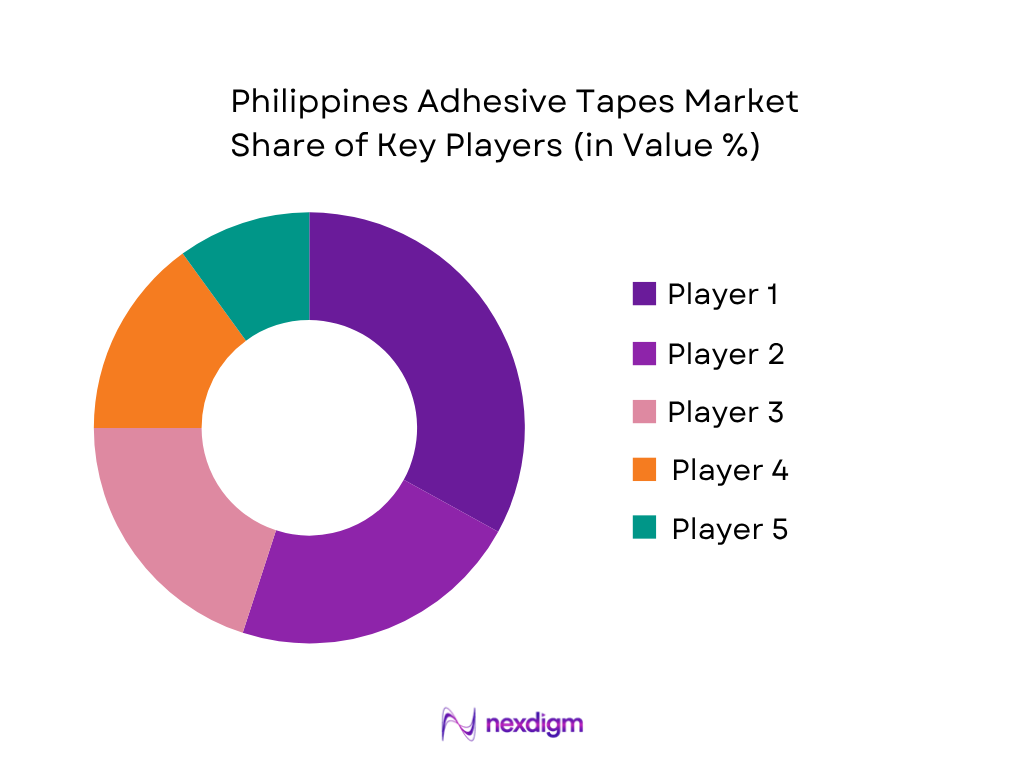
The Philippines Adhesive Tapes Market is characterized by a combination of global adhesive-material manufacturers, specialized tape producers, regional suppliers, local distributors and converting companies. 3M, Nitto Denko, tesa, Avery Dennison and LINTEC are among the important companies positioned across industrial, electronics, packaging, automotive and specialty adhesive applications. Competitive differentiation increasingly depends on technical qualification, electronics-grade performance, application engineering, die-cutting, product customization, distribution availability and the ability to serve multinational OEMs.
| Company | Established | Headquarters | Core Adhesive/Tape Strength | Key Application Exposure | Philippines Market Position | Financial Indicator |
| 3M Company | 1902 | St. Paul, Minnesota, USA | ~ | ~ | ~ | ~ |
| Nitto Denko Corporation | 1918 | Osaka, Japan | ~ | ~ | ~ | ~ |
| tesa SE | 1896 | Norderstedt, Germany | ~ | ~ | ~ | ~ |
| Avery Dennison Corporation | 1935 | Mentor, Ohio, USA | ~ | ~ | ~ | ~ |
| LINTEC Corporation | 1934 | Tokyo, Japan | ~ | ~ | ~ | ~ |
Philippines Adhesive Tapes Market Analysis
Growth Drivers
Manufacturing Expansion and Electronics Assembly
The Philippines Adhesive Tapes Market is strongly supported by the country’s manufacturing and electronics ecosystem, where tapes are used for component mounting, insulation, masking, splicing, protection and assembly. Philippine Statistics Authority data show that manufacturing gross value added reached PHP 3.92 trillion at constant 2018 prices in 2024, compared with PHP 3.78 trillion in 2023, demonstrating continued expansion of the industrial production base. Electronics remained the country’s largest export commodity group, generating USD 39.09 billion in export earnings in 2024, according to PSA. Manufactured-goods exports reached USD 58.39 billion, creating demand for industrial, electronics-grade, double-sided and precision adhesive tapes throughout production and packaging operations. The country’s total external trade also reached USD 200.87 billion, reinforcing the scale of manufacturing and trade-linked activity requiring packaging, labeling and protective tape solutions. Semiconductor and electronics assembly is particularly relevant because production environments require tapes with controlled adhesion, clean removal, dimensional stability and resistance to temperature and chemicals. Continued investment in electronics manufacturing therefore provides a structurally important demand base for higher-performance adhesive tapes across assembly, component protection and downstream logistics applications.
Packaging Consumption, E-Commerce Fulfilment and Logistics Development
Packaging and logistics represent another important demand engine for the Philippines Adhesive Tapes Market because carton sealing, bundling, palletizing, labeling and parcel fulfilment consume tapes across virtually every merchandise category. PSA reported USD 200.87 billion in total external trade in goods in 2024, including USD 73.27 billion of exports and USD 127.60 billion of imports. Domestic trade activity was also substantial: the Philippines recorded 30.00 million tons of domestic trade in 2024, compared with 27.66 million tons in 2023, with 99.9% of commodities transported through water-based coastwise channels. This extensive movement of goods increases requirements for secondary packaging, transit protection and warehouse handling. The country’s manufacturing base further reinforces this demand, with manufactured-goods exports reaching USD 58.39 billion and electronic-product exports reaching USD 39.09 billion. Packaging tapes consequently serve both domestic distribution and export-oriented supply chains. Growth in organized warehousing, parcel fulfilment and digitally enabled commerce also supports demand for pressure-sensitive carton-sealing and labeling solutions, while higher-value electronics and industrial shipments create opportunities for specialty tapes that provide stronger adhesion, cleaner application and improved protection during transportation.
Market Challenges
Imported Tape Dependency and Polymer/Adhesive Feedstock Exposure
Import dependence remains a structural challenge for the Philippines Adhesive Tapes Market because domestic demand is supplied partly through imported finished tapes, master rolls, adhesive materials and specialty chemical inputs. PSA reported total Philippine imports of USD 127.60 billion in 2024 against exports of USD 73.27 billion, highlighting the country’s substantial dependence on international supply chains. Total external trade reached USD 200.87 billion, exposing tape distributors and converters to international freight, foreign-exchange movements and supplier availability. This is particularly relevant for advanced acrylic, silicone, specialty rubber and electronics-grade systems, where qualified raw materials and finished products may originate from overseas production hubs. The challenge extends beyond finished tapes because adhesive formulations depend on polymers, resins, tackifiers, backing films, release liners and specialty additives. Manufacturing gross value added nevertheless reached PHP 3.92 trillion at constant 2018 prices in 2024, indicating that the downstream industrial customer base is expanding faster than the availability of some specialized domestic tape capabilities. Consequently, suppliers may face longer replenishment cycles and greater inventory requirements when serving electronics, automotive and industrial customers. Building local converting, slitting and die-cutting capabilities can reduce some exposure, but high-specification adhesive chemistry remains dependent on international supply networks.
Humidity and Tropical Conditions with Technical Qualification Barriers
The Philippines’ tropical operating environment creates demanding conditions for adhesive tapes, particularly where products are exposed to high humidity, elevated temperatures, condensation or outdoor weathering. This creates technical requirements around peel adhesion, shear strength, aging stability, liner performance and substrate compatibility. The challenge becomes more significant as tape applications move from commodity packaging toward electronics, automotive, HVAC, construction and industrial assembly. The scale of the underlying construction and industrial environment illustrates the breadth of potential exposure: PSA recorded 180,341 approved construction projects and 42.84 million square meters of approved floor area in 2024, while the value of approved construction reached PHP 563.89 billion. Non-residential construction alone represented PHP 250.86 billion, supporting demand for mounting, insulation, sealing and bonding tapes in commercial and industrial facilities. Electronics manufacturing adds even stricter qualification requirements because adhesive failure can affect component reliability and production yields. Imported products must also be qualified against customer-specific specifications, increasing technical barriers for new entrants. Suppliers therefore need application engineering, substrate testing, humidity and temperature validation, and consistent quality control.
Market Opportunities
Advanced Electronics Tapes and High-Performance Acrylic Systems
The Philippines Adhesive Tapes Market has significant potential to move toward higher-value electronics and industrial bonding solutions as the country’s electronics manufacturing base expands. Electronic products generated USD 39.09 billion in Philippine export earnings in 2024, while manufactured-goods exports reached USD 58.39 billion, according to PSA. These production activities require increasingly specialized adhesive technologies for component attachment, insulation, shielding, temporary protection, thermal management, display assembly and semiconductor-related processing. High-performance acrylic systems are particularly suited to applications requiring durable adhesion, aging resistance and stable performance across demanding temperature and humidity conditions. Advanced double-sided and acrylic foam constructions can also replace mechanical fastening in selected assemblies while supporting lightweight product designs. Semiconductor and electronics applications create additional opportunities for precision die-cut tapes, clean-removal products, protective films and process tapes. The country’s large trade ecosystem, with USD 200.87 billion in total external merchandise trade in 2024, provides an extensive manufacturing and logistics environment in which these technologies can be deployed. Opportunity therefore lies not simply in increasing tape consumption but in upgrading the product mix toward engineered adhesive systems. Local technical converting, slitting and die-cutting could further improve responsiveness to electronics OEM requirements and reduce dependence on imported finished formats.
Sustainable Packaging Tapes, Specialty Converting and Functional Tape Solutions
Sustainability-oriented packaging tapes, low-VOC adhesive systems and specialized converting represent attractive avenues for future development of the Philippines Adhesive Tapes Market. The country’s manufacturing sector generated PHP 3.92 trillion in gross value added at constant 2018 prices in 2024, while total construction activity reached PHP 563.89 billion, creating a broad industrial base for specialized adhesive solutions. Packaging demand is supported by substantial merchandise flows, with total external trade reaching USD 200.87 billion and imports reaching USD 127.60 billion in 2024. This creates opportunities for sustainable BOPP and paper-based carton-sealing tapes, reduced-material constructions and adhesive systems designed to support easier packaging recovery. Specialty converting can address customer-specific dimensions, narrow-width formats, die-cut components and application-ready tape assemblies for electronics, HVAC, construction and industrial users. Functional tapes can extend beyond basic bonding into insulation, thermal management, surface protection and electrical applications. HVAC foil tapes are relevant to expanding commercial and industrial construction, while low-VOC and water-based systems can support customers seeking lower-emission production processes. The combination of substantial industrial output, construction activity and trade throughput provides a current demand foundation for suppliers to introduce differentiated tape constructions rather than competing solely in commodity packaging tapes.
Future Outlook
The Philippines Adhesive Tapes Market is expected to move toward higher-value and application-specific products as electronics manufacturing, packaging, construction, industrial automation and transportation applications expand. Demand is likely to shift from commodity carton and masking tapes toward double-sided acrylic tapes, foam tapes, electronics-grade tapes, thermal-management tapes, die-cut components and specialty bonding systems.
The country’s electronics export base provides an important long-term application platform, while construction activity and manufacturing investment broaden demand beyond packaging. Local converting, slitting and die-cutting can also reduce lead-time dependence on imported finished products and allow suppliers to respond to OEM-specific specifications. Sustainability requirements are expected to increase interest in low-VOC, water-based and bio-based adhesive technologies.
Major Players
- 3M Company
- Nitto Denko Corporation
- tesa SE
- Avery Dennison Corporation
- LINTEC Corporation
- Saint-Gobain
- Scapa Group
- Intertape Polymer Group
- H.B. Fuller Company
- Berry Global
- Lohmann GmbH & Co. KG
- Shurtape Technologies
- Mactac
- Juneau Industrial Corporation
- Nichiban Co., Ltd.
Key Target Audience
- Adhesive Tape Manufacturers and Converters
- Packaging and Carton-Manufacturing Companies
- Electronics and Semiconductor Manufacturers
- Automotive and Transportation Component Manufacturers
- Construction, HVAC and MEP Contractors
- Investments and Venture Capitalist Firms (Private Equity Funds, Venture Capital Firms, Strategic Investors)
- Government and Regulatory Bodies (Department of Trade and Industry, Board of Investments, Philippine Economic Zone Authority, Department of Environment and Natural Resources)
- Industrial Procurement and Supply-Chain Organizations
Research Methodology
Step 1: Identification of Key Variables
The initial phase maps the Philippines Adhesive Tapes Market ecosystem across adhesive manufacturers, tape producers, converters, distributors, importers and industrial end users. Variables include adhesive chemistry, backing material, tape construction, application, end-use industry, import dependence and local converting capacity. Trade classifications and industrial-sector indicators are incorporated to establish the market boundary.
Step 2: Market Analysis and Construction
Historical market information is compiled through trade statistics, industrial production indicators, construction activity, electronics exports and company disclosures. Import and export data are reconciled with domestic manufacturing and distributor information to identify apparent consumption. Application-level demand is subsequently allocated across packaging, electronics, construction, automotive, HVAC and other end-use industries.
Step 3: Hypothesis Validation and Expert Consultation
Market hypotheses are validated through interviews with adhesive manufacturers, distributors, tape converters, procurement professionals and industrial users. Discussions focus on adhesive technology adoption, specification requirements, import lead times, OEM qualification, application failure points and purchasing criteria. Technical inputs are used to challenge and refine the bottom-up market model.
Step 4: Research Synthesis and Final Output
The final analysis triangulates supply-side company information with demand-side consumption indicators and trade statistics. Company portfolios are mapped against adhesive technology, backing material, tape construction and application. Competitive benchmarking incorporates financial performance, distribution capabilities, technical support, R&D strength and Philippines-specific market positioning.

- Executive Summary
- Research Methodology (Market Definitions and Assumptions, Adhesive Tape Market Boundary, HS-Code Mapping, Top-Down Market Sizing, Bottom-Up Consumption Modeling, Demand-Side Assessment, Supply-Side Assessment, Import–Export Reconciliation, Primary Industry Interviews, Distributor Validation, OEM Application Mapping, Data Triangulation, Forecasting Framework, Sensitivity Analysis, Research Limitations)

- Definition and Scope
- Market Evolution and Industrial Development
- Philippines Adhesive Tape Industry Ecosystem
- Adhesive Tape Value Chain Analysis
- Domestic Manufacturing, Converting and Import Supply Structure
- Raw Material-to-Tape Conversion Flow
- Import Dependency and Regional Supply-Chain Linkages

- Market Growth Drivers (Manufacturing Expansion, Electronics Assembly, Packaging Consumption, E-Commerce Fulfilment, Construction Activity, Industrial Automation, Automotive Production, Logistics Development)
- Market Challenges (Imported Tape Dependency, Polymer and Adhesive Feedstock Exposure, Foreign Exchange Exposure, Humidity and Tropical Conditions, Commodity Price Competition, Technical Qualification Barriers, Limited Advanced Converting Capacity)
- Market Opportunities (Advanced Electronics Tapes, High-Performance Acrylic Systems, Sustainable Packaging Tapes, EV and Battery Applications, HVAC Foil Tapes, Low-VOC Adhesives, Specialty Converting, Functional Tapes)
- Market Trends (Lightweight Bonding, Automation-Compatible Tapes, Sustainable Backings, Solvent Reduction, Specialty Electronics Tapes, Premiumization, Local Converting, Application-Specific Customization)
- Regulatory Framework (Chemical Management, Product Safety, Environmental Compliance, Import Requirements, Packaging Requirements, Workplace Safety)
- SWOT Analysis
- Porter’s Five Forces Analysis
- PESTLE Analysis Stakeholder

- By Market Value (2020-2025)
- By Tape Consumption Volume (2020-2025)
- By Average Selling Price (2020-2025)
- By Domestic Production, Imports and Exports (2020-2025)
- By Industrial Consumption Volume (2020-2025)

- By Adhesive Technology (in value%)
Acrylic Adhesive Tapes
Rubber-Based Adhesive Tapes
Silicone Adhesive Tapes
Water-Based Adhesive Tapes
Solvent-Based Adhesive Tapes
Hot-Melt Adhesive Tapes
Reactive Adhesive Tapes - By Tape Construction (in value%)
Single-Sided Tapes
Double-Sided Tapes
Transfer Tapes
Foam Tapes
Filament-Reinforced Tapes
Masking Tapes
Protective Surface Tapes
Electrical Insulation Tapes
Thermal Management Tapes
Specialty Functional Tapes - By Product Format (in value%)
Jumbo Rolls
Slit Rolls
Narrow-Width Industrial Rolls
Die-Cut Adhesive Components
Adhesive Sheets
Laminated Tape Constructions
Custom-Converted Tape Components - By End-Use Industry (in value%)
Packaging and Logistics
Construction and Interior Fit-Out
Automotive and Transportation
Electrical and Electronics
HVAC and MEP
Healthcare and Pharmaceuticals
Industrial Manufacturing
Aerospace and Defense
Furniture and Interiors
Food and Beverage
Marine and Specialty Applications - By Application (in value%)
Carton Sealing and Case Closing
Mounting and Permanent Bonding
Splicing and Web Joining
Masking and Surface Protection
Electrical Insulation and Wire Management
Lamination and Composite Bonding
Label and Graphic Applications
Packaging Reinforcement
HVAC Insulation and Sealing

- Market Share of Major Players (By Value, Volume, Adhesive Technology, Tape Construction, End-Use Industry, Distribution Channel)
- Cross Comparison Parameters (Adhesive Technology Breadth, Tape Construction Portfolio, Electronics-Grade Tape Capability, Local Distribution Reach, Converting and Die-Cutting Capability, OEM Qualification Capability, Product Customization Capability, Financial Strength and R&D Investment)
- Pricing and Positioning Analysis (Commodity Tapes, Industrial Tapes, Premium Specialty Tapes, Electronics-Grade Tapes, Customized Tape Components)
- SWOT Analysis of Major Players
- Detailed Profiles of Major Companies
3M Company
Nitto Denko Corporation
tesa SE
Avery Dennison Corporation
LINTEC Corporation
Saint-Gobain
Scapa Group
Intertape Polymer Group
H.B. Fuller Company
Berry Global
Lohmann GmbH & Co. KG
Shurtape Technologies
Mactac
Tesa Tape Asia Pacific
Juneau Industrial Corporation

- Packaging and Logistics End-User Assessment
- Construction and Interior End-User Assessment
- Electronics and Semiconductor End-User Assessment
- Automotive End-User Assessment
- Industrial Manufacturing End-User Assessment
- Healthcare and Pharmaceutical End-User Assessment
- Purchasing Behaviour Analysis

- By Market Value (2026-2035)
- By Tape Consumption Volume (2026-2035)
- By Average Selling Price (2026-2035)
- By Domestic Production, Imports and Exports (2026-2035)
- By Industrial Consumption Volume (2026-2035)


 Request a Sample
 Ask for Customization
 Get a Quote
 Enquire Now