

 Download PDF
Market Overview
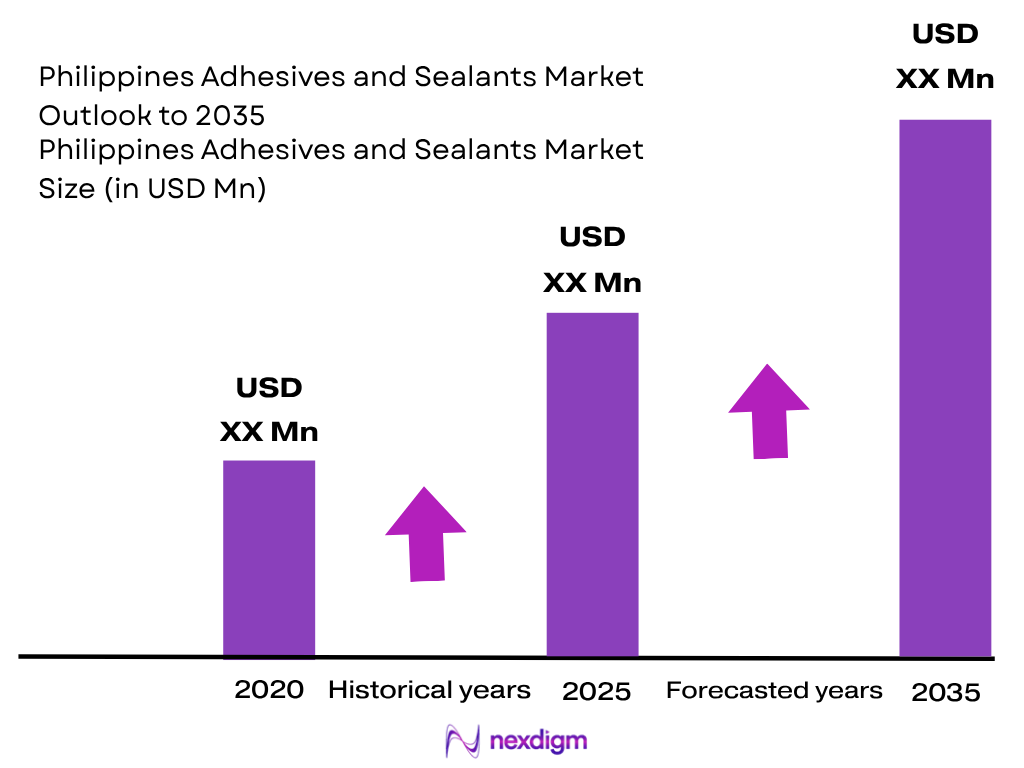
The Philippines Adhesives and Sealants Market is estimated at USD ~[XX] million in 2024, with the forecast CAGR for 2026–2035 estimated at ~[XX]%. Demand is supported by construction, packaging, automotive, furniture, electronics and industrial manufacturing applications. Official Philippine data show that approved construction reached 180,341 permits in 2024, while construction value reached PHP 563.89 billion, providing a substantial downstream base for structural adhesives, tile adhesives, flooring systems, glazing products and construction sealants.
The market is also linked to manufacturing activity. Philippine manufacturing gross value added reached PHP 4.146 trillion in 2024, while food-product manufacturing reached PHP 2.229 trillion, supporting demand for packaging, labeling, carton sealing and production-line bonding applications. Industry-specific market research identifies paper and packaging, construction, woodworking, consumer/DIY, automotive and transportation among the principal application areas, with water-based technology and paper and packaging identified as leading segments.
The Philippines market is concentrated around Luzon, particularly Metro Manila and the surrounding industrial corridor, because major manufacturing, construction, distribution and commercial activities are clustered in the region. CALABARZON is particularly relevant for automotive and industrial adhesive demand, while Metro Manila remains a major distribution and construction center. Philippine construction data show NCR construction gross value added of approximately PHP 352.44 billion in 2024, while national construction GVA reached approximately PHP 2.047 trillion at current prices.
Market Segmentation
By Adhesives Technology
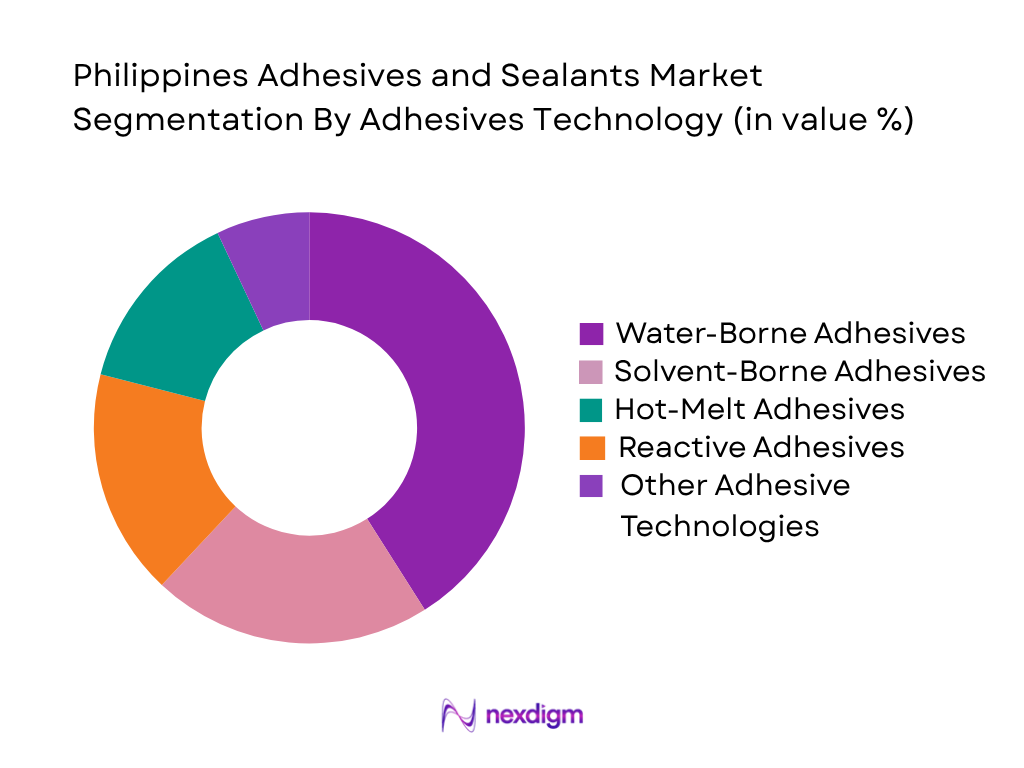
The Philippines Adhesives and Sealants Market is segmented by adhesive technology into water-borne adhesives, solvent-borne adhesives, reactive adhesives, hot-melt adhesives and other technologies. Water-borne adhesives represent the leading technology category in available Philippines-specific market research because of their suitability for packaging, woodworking and general industrial applications, together with lower VOC characteristics compared with many solvent-based formulations. Demand is reinforced by the country’s packaging and food-manufacturing ecosystem. Food-product manufacturing generated approximately PHP 2.229 trillion in gross value added in 2024, creating a broad downstream requirement for carton sealing, labeling, lamination and packaging conversion. Water-borne formulations are also relevant to furniture, paper conversion and selected construction applications where application convenience and environmental considerations are increasingly important. Hot-melt adhesives remain relevant to high-speed packaging and assembly operations because they provide rapid setting, while reactive technologies serve applications requiring stronger durability and resistance. Solvent-based systems continue to be used where substrate compatibility, moisture resistance and specific performance characteristics are required. The resulting technology mix therefore reflects both high-volume packaging requirements and specialized industrial applications.
By Application Type
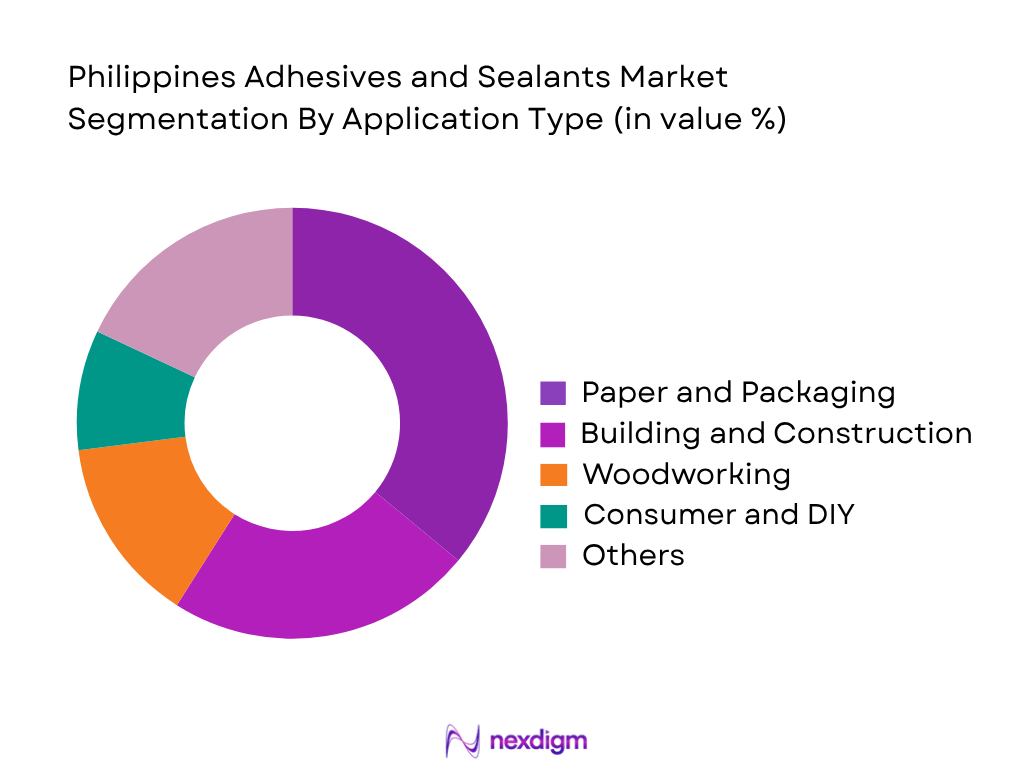
The Philippines Adhesives and Sealants Market is segmented by application into paper and packaging, building and construction, woodworking, consumer and DIY, automotive and transportation, leather and footwear, assembly and other industrial applications. Paper and packaging is identified as the leading application in Philippines-specific market research, supported by the country’s expanding packaging requirements and e-commerce-related demand. Construction represents another major demand center, with approved construction reaching 180,341 projects in 2024 and construction value reaching PHP 563.89 billion. Automotive applications provide an additional specialized demand base: CAMPI and TMA members recorded 467,252 vehicle sales in 2024, compared with 429,807 units in 2023, supporting requirements for bonding, glazing, interior assembly, sealing and repair. Woodworking and furniture applications use adhesives for panel assembly, joinery and laminating, while footwear and leather manufacturing requires bonding formulations compatible with leather, rubber, textiles and synthetic materials. Electronics and industrial assembly applications increasingly require specialized formulations for component attachment, encapsulation and durable bonding. Consequently, application demand spans high-volume packaging and construction uses as well as technically demanding industrial applications.
Competitive Landscape
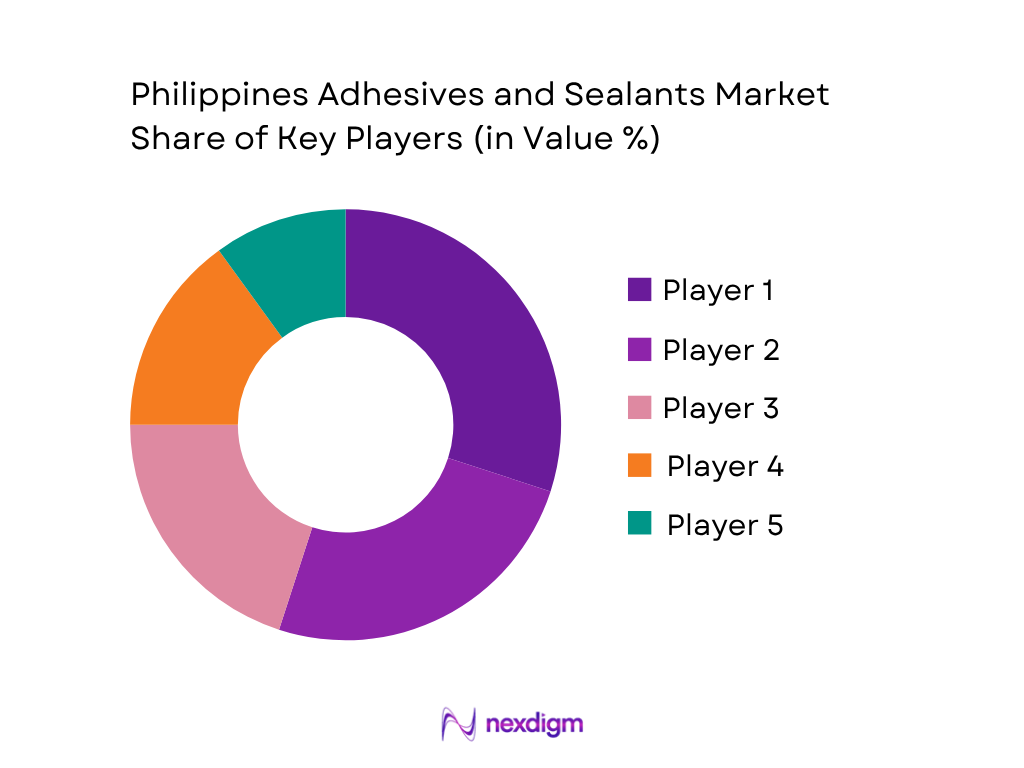
The Philippines Adhesives and Sealants Market has a moderately competitive structure involving multinational adhesive and chemical manufacturers, specialized regional suppliers, distributors and domestic companies. Competition is influenced by product formulation, technical service, distribution reach, application support, certification and the ability to supply different resin and technology categories. Available market research identifies Henkel, Sika, 3M, H.B. Fuller and Bostik among the major companies active in the Philippines automotive adhesives and sealants space.
| Company | Establishment | Headquarters | Key Product Focus | Technology Coverage | Major Applications | Philippines Presence | Distribution Model | Quality / Certification Focus |
| Henkel | 1876 | Düsseldorf, Germany | ~ | ~ | ~ | ~ | ~ | ~ |
| Sika | 1910 | Baar, Switzerland | ~ | ~ | ~ | ~ | ~ | ~ |
| 3M | 1902 | Saint Paul, USA | ~ | ~ | ~ | ~ | ~ | ~ |
| H.B. Fuller | 1887 | St. Paul, USA | ~ | ~ | ~ | ~ | ~ | ~ |
| Bostik | 1889 | Paris, France | ~ | ~ | ~ | ~ | ~ | ~ |
Philippines Adhesives and Sealants Market Analysis
Growth Drivers
Expansion of Construction and Infrastructure Activity
The Philippines Adhesives and Sealants Market is directly supported by construction activity because tile fixing, flooring, insulation, glazing, roofing, façade assembly, waterproofing and joint sealing require adhesive and sealant systems across residential, commercial and infrastructure projects. The Philippine Statistics Authority recorded PHP 563.89 billion in total construction value in 2024, compared with PHP 515.30 billion in 2023, while the number of approved construction projects reached 180,341. Non-residential construction alone represented PHP 250.86 billion, including PHP 112.42 billion from commercial buildings, creating recurring requirements for structural bonding and sealing products. Residential construction reached PHP 248.65 billion, supporting demand for tile adhesives, wood adhesives, sanitary sealants and general-purpose bonding products. Construction activity remained relevant in 2025, when the total value of approved construction increased to PHP 601.42 billion and floor area reached 45.24 million square meters. The broader economy also recorded 5.7 real GDP growth in 2024, while construction was among the major contributors to annual economic expansion. These indicators establish a substantial downstream base for continued adhesive and sealant consumption across building materials, interiors, glazing, waterproofing and industrial construction applications.
Growth of Manufacturing, Packaging and Industrial Production
Manufacturing expansion provides another important demand foundation for the Philippines Adhesives and Sealants Market because adhesives are embedded in packaging conversion, food processing, electronics, furniture, automotive components, consumer products and industrial assembly. Philippine Statistics Authority national accounts place industry output at PHP 7.324 trillion at current prices in 2024, compared with PHP 6.856 trillion in 2023. Manufacturing was also a major component of national economic activity, while the sector recorded 2.5 growth during 2025. Within fourth-quarter 2025 manufacturing, food-product manufacturing increased 6.2, while computer, electronic and optical product manufacturing increased 11.1, creating application requirements for packaging adhesives, labels, laminates, assembly bonding and specialized electronic bonding systems. The Philippines’ digital economy additionally reached PHP 2.25 trillion in 2024 and supported 11.30 million workers, reinforcing demand for electronics-related manufacturing and packaging infrastructure. The country’s real GDP expanded 5.7 in 2024, according to the Philippine Statistics Authority, indicating continued economic activity across downstream industries. As manufacturing becomes more diversified, demand can broaden from conventional packaging adhesives toward hot-melt, reactive, pressure-sensitive, polyurethane, epoxy, acrylic and silicone technologies serving higher-performance industrial applications.
Market Challenges
Dependence on Imported Chemical Feedstocks and International Supply Chains
The Philippines Adhesives and Sealants Market faces supply-chain exposure because many adhesive and sealant formulations depend on petrochemical-derived resins, polymers, solvents, additives, curing agents and specialty chemicals that are sourced through international trade. This creates exposure to movements in global chemical availability, freight conditions, exchange rates and regional manufacturing disruptions. The country’s economic structure illustrates the scale of external trade dependence: the Philippine Statistics Authority continues to track substantial imports of goods and industrial inputs as part of national accounts and trade statistics. Manufacturing remained a major economic activity, with industry output reaching PHP 7.324 trillion in 2024, meaning disruptions in chemical inputs can affect a broad manufacturing base rather than only adhesive producers. The challenge is particularly relevant for polyurethane, epoxy, acrylic, silicone and specialty reactive systems requiring specialized raw materials. In addition, the Philippine economy recorded a 5.7 real GDP growth rate in 2024, increasing activity across manufacturing, construction and consumer industries that consume chemical inputs. Global supply interruptions can therefore affect inventory availability and lead times for domestic formulators and distributors. Producers increasingly require diversified sourcing, safety stocks, local warehousing and supplier qualification to manage continuity risks.
Environmental Compliance and Formulation Requirements
Environmental and product-compliance requirements present a structural challenge for the Philippines Adhesives and Sealants Market as manufacturers increasingly need formulations that meet performance requirements while reducing volatile organic compounds, hazardous substances and workplace exposure. The challenge affects solvent-based adhesives particularly because formulation changes can require investment in laboratory development, production equipment, testing and customer validation. At the same time, the market serves demanding applications in construction, packaging, automotive, electronics and industrial assembly where adhesion strength, curing speed, temperature resistance and durability cannot be compromised. The Philippine economy recorded PHP 23.23 trillion in GDP in 2025, while manufacturing contributed 2.5 growth during the year, indicating continued industrial activity and a growing requirement for compliant industrial materials. In 2024, GDP expanded 5.7, while inflation was recorded at 3.2, creating an operating environment in which manufacturers must balance regulatory compliance with input and operating pressures. Low-VOC water-based, hot-melt, reactive and solvent-reduced technologies can require new formulation expertise and application testing. Smaller manufacturers may face greater difficulty because compliance, certification, quality-control procedures and technical-service capabilities require specialized personnel and capital investment.
Market Opportunities
Expansion of Water-Based, Hot-Melt and High-Performance Adhesive Technologies
The transition toward lower-emission and application-specific adhesive systems creates an opportunity for suppliers in the Philippines Adhesives and Sealants Market to expand water-based, hot-melt, reactive and other high-performance technologies. This opportunity is supported by the scale of downstream manufacturing and construction activity. Total construction value reached PHP 563.89 billion in 2024 and increased to PHP 601.42 billion in 2025, while construction floor area reached 45.24 million square meters in 2025. Manufacturing also remains a significant economic base, with industry output reaching PHP 7.324 trillion in 2024. These conditions create opportunities for adhesive suppliers to replace conventional bonding systems with formulations offering faster curing, improved durability, lower emissions and greater process efficiency. Packaging converters can adopt hot-melt and water-based systems for carton sealing, labeling and corrugated-board applications, while construction manufacturers can expand specialized tile, flooring, insulation and façade bonding products. Electronics manufacturing provides another opportunity for precision adhesives because computer, electronic and optical product manufacturing grew 11.1 in the fourth quarter of 2025. Suppliers that combine formulation performance with technical support, automated dispensing compatibility and application-specific product development can address increasingly specialized requirements across Philippine industrial customers.
Localization of Specialty Adhesive Manufacturing and Regional Supply Capabilities
Localization represents an opportunity for the Philippines Adhesives and Sealants Market because expanding domestic manufacturing and construction activity creates a broader customer base for locally formulated products, technical services and application-specific solutions. Industry output reached PHP 7.324 trillion in 2024, while the country’s manufacturing sector recorded 2.5 growth in 2025. Construction activity also reached PHP 601.42 billion in 2025, following PHP 563.89 billion in 2024. These figures indicate a substantial domestic industrial ecosystem capable of supporting greater local formulation, packaging, warehousing and technical-service operations. Regional concentration further provides opportunities to establish distribution and application-support hubs around major industrial economies such as the National Capital Region, CALABARZON and Central Luzon. The Philippine Statistics Authority reported that these three economies together represented 57.1 of national GDP in 2025, creating a concentrated base of industrial, construction and commercial activity. Local production can reduce dependence on long international supply chains for selected adhesive and sealant grades while enabling faster customer customization and technical assistance. Opportunities are particularly relevant for packaging adhesives, construction sealants, woodworking systems, automotive bonding products and industrial assembly formulations where shorter lead times and application support can influence procurement decisions.
Future Outlook
The Philippines Adhesives and Sealants Market is positioned for continued demand from construction, packaging, automotive, electronics, furniture and industrial manufacturing. Construction activity provides a broad requirement for bonding and sealing systems, while manufacturing creates recurring demand for packaging and assembly adhesives. Automotive demand is particularly relevant because CAMPI and TMA members recorded 467,252 vehicle sales in 2024, the highest level reported by those groups. Future product development is expected to emphasize water-based, low-VOC, fast-curing, high-strength and application-specific formulations. Sustainable packaging, lightweight vehicle construction, electronics assembly and advanced construction systems provide additional areas for product differentiation.
Major Players
- Henkel Philippines Inc.
- Sika Philippines Inc.
- H.B. Fuller Philippines
- 3M Philippines
- Bostik Philippines Inc.
- Dow Chemical Philippines Inc.
- BASF Philippines Inc.
- Ashland Philippines Inc.
- Pidilite Industries Philippines
- MAPEI Philippines
- Soudal Philippines
- Arkema Philippines
- Momentive Performance Materials Philippines
- Avery Dennison Philippines
- Royal Adhesives & Sealants
Key Target Audience
- Adhesives and Sealants Manufacturers
- Packaging Converters and FMCG Manufacturers
- Construction Material Manufacturers and Contractors
- Automotive OEMs and Component Manufacturers
- Electronics and Electrical Manufacturers
- Furniture, Woodworking, Footwear and Leather Manufacturers
- Investments and Venture Capitalist Firms
- Government and Regulatory Bodies (Department of Trade and Industry, Department of Environment and Natural Resources, Environmental Management Bureau, Food and Drug Administration Philippines)
Research Methodology
Step 1: Identification of Key Variables
The initial stage involves mapping the Philippines Adhesives and Sealants ecosystem across manufacturers, resin suppliers, importers, distributors, industrial buyers and downstream end-use industries. Product type, resin chemistry, adhesive technology, application, consumption volume, production, imports, exports and distribution channels are identified as core market variables.
Step 2: Market Analysis and Construction
Historical market information is compiled through a combination of secondary research, trade statistics, industry databases, company disclosures and sector-level economic indicators. Construction, manufacturing, packaging, automotive and industrial activity are assessed to establish the demand environment supporting adhesives and sealants.
Step 3: Hypothesis Validation and Expert Consultation
Market hypotheses are validated through discussions with manufacturers, distributors, formulators, packaging converters, construction companies and industrial users. Interviews focus on procurement practices, technology preferences, application requirements, supplier selection, import dependence and changing demand for water-based, reactive and specialty formulations.
Step 4: Research Synthesis and Final Output
The final stage combines top-down and bottom-up findings to validate market estimates, segmentation structures and competitive positioning. Company-level information is cross-checked against application demand, trade activity and end-use industry indicators before the final Philippines Adhesives and Sealants Market outlook is prepared.

- Executive Summary
- Research Methodology (Market Definition and Scope, Philippines Adhesives and Sealants Market Classification, Adhesive and Sealant Product Mapping, Resin-Level Assessment, Technology-Level Assessment, Application-Level Demand Analysis, End-Use Industry Assessment, Production Capacity Mapping, Domestic Manufacturing Assessment, Import and Export Trade Analysis, Raw Material Supply Assessment, Demand-Side Assessment, Supply-Side Assessment, Top-Down Market Sizing, Bottom-Up Market Sizing, Primary Industry Interviews, Data Triangulation, Forecasting Framework, Market Share Validation, Limitations and Future Conclusions)

- Definition and Scope
- Philippines Adhesives and Sealants Industry Evolution and Development of Domestic Adhesive Manufacturing, Formulation Technology and Industrial Application Infrastructure
- Adhesives and Sealants Value Chain Analysis
- Adhesives and Sealants Supply Chain Analysis
- Resin Manufacturers, Chemical Feedstock Suppliers, Adhesive Formulators, Sealant Manufacturers, Distributors, Industrial OEMs, Construction Material Manufacturers, Packaging Converters, End-Use Industries
- Adhesive Integration Across Packaging, Building and Construction, Automotive, Transportation, Woodworking and Joinery, Footwear and Leather, Electronics, Healthcare and Consumer Applications
- Sealant Integration Across Building and Construction, Automotive, Infrastructure, Electronics, Glass and Fenestration, Industrial Assembly and General Engineering Applications

- Growth Drivers (Expansion of Packaging and FMCG Manufacturing, Infrastructure and Construction Development, Automotive and Transportation Manufacturing, Growth of E-Commerce and Corrugated Packaging, Expansion of Electronics and Electrical Manufacturing, Furniture and Woodworking Production, Shipbuilding and Marine Industry Development, Increasing Demand for High-Performance Bonding Systems)
- Market Challenges (Volatility in Petrochemical Feedstock Prices, Import Dependency for Specialty Chemicals and Monomers, Environmental and Chemical Compliance Requirements, Fragmented Regional Distribution Infrastructure, Technology and Formulation Capability Gaps, Supply Chain Disruptions Across Island Regions, Performance Limitations of Low-Cost Formulations, Skilled Application and Technical-Service Requirements)
- Market Opportunities (Water-Borne and Low-VOC Adhesive Expansion, High-Performance Automotive and Transportation Bonding, Electronics and Electrical Adhesive Applications, Sustainable Packaging Adhesives, Bio-Based Adhesive Formulations, Construction Sealant and Structural Bonding Expansion, Renewable Energy Adhesive Applications, Localization of Specialty Resin and Adhesive Production)
- Market Trends (Shift Toward Water-Borne Adhesives, Low-VOC Formulation Adoption, Hot-Melt Adhesive Expansion, Reactive Adhesive Technology Development, Silicone and MS Polymer Sealant Adoption, Lightweight Automotive Bonding, Sustainable Packaging Solutions, High-Performance Electronics Bonding, Bio-Based Adhesive Development, Digital and Automated Adhesive Dispensing)
- Government Regulations and Standards (Food and Drug Administration Philippines Adhesive and Food-Contact Requirements, Department of Environment and Natural Resources Chemical Regulations, Environmental Management Bureau Requirements, Occupational Safety and Health Standards, Construction Product Standards, Automotive Component Standards, Packaging Requirements, Hazardous Chemical Handling Regulations, Product Safety and Labeling Requirements)
- SWOT Analysis
- Porter’s Five Forces Analysis
- PESTLE Analysis
- Stakeholder Ecosystem
- Competition Ecosystem

- By Market Value (2020-2025)
- By Market Volume (2020-2025)
- By Adhesives Consumption Volume (2020-2025)
- By Sealants Consumption Volume (2020-2025)
- By Domestic Production Volume (2020-2025)
- By Import Volume (2020-2025)
- By Export Volume (2020-2025)
- By Average Selling Price (2020-2025)

- By Adhesives Resin Type (In Value %)
Polyurethane Adhesives
Epoxy Adhesives
Acrylic Adhesives
Silicone Adhesives
Cyanoacrylate Adhesives
VAE / EVA Adhesives
Polyvinyl Acetate Adhesives
Other Adhesive Resins - By Adhesives Technology (In Value %)
Water-Borne Adhesives
Solvent-Borne Adhesives
Reactive Adhesives
Hot-Melt Adhesives
UV-Cured Adhesives
Pressure-Sensitive Adhesives - By Sealants Resin Type (In Value %)
Silicone Sealants
Polyurethane Sealants
Acrylic Sealants
Epoxy Sealants
Polysulfide Sealants
MS Polymer Sealants
Other Sealant Resins - By Application Type (In Value %)
Paper and Packaging
Building and Construction
Woodworking and Joinery
Automotive and Transportation
Footwear and Leather
Electronics and Electrical
Healthcare and Medical
General Industrial Assembly
Consumer and Household Applications - By End-Use Industry (In Value %)
Packaging Industry
Construction Industry
Automotive Industry
Furniture and Woodworking Industry
Footwear and Leather Industry
Electronics and Electrical Industry
Healthcare Industry
Industrial Manufacturing Industry
Marine and Shipbuilding Industry
Renewable Energy Industry - By Distribution Channel (In Value %)
Direct Industrial Sales
Authorized Distributors
Specialty Chemical Distributors
Construction Material Dealers
Hardware and Building Material Retailers
Modern Trade and Retail Chains
E-Commerce and Online Industrial Platforms
Dealer and Distributor Networks - By Region (In Value %)
Luzon
Visayas
Mindanao
Metro Manila
CALABARZON

- Market Share of Major Players (By Philippines Revenue, Adhesives Sales Volume, Sealants Sales Volume, Resin Portfolio, Technology Portfolio, End-Use Industry Exposure, Production Capacity, Distribution Network Coverage, Regional Presence, Industrial Customer Coverage, Product Certification Coverage, R&D and Application-Laboratory Capability)
- Cross Comparison Parameters (Adhesives and Sealants Revenue, Adhesive Resin Portfolio Breadth, Sealant Resin Portfolio Breadth, Production and Formulation Capacity, Technology Portfolio Coverage, Packaging and Construction Application Coverage, Automotive and Electronics Application Capability, Distribution Network Reach)
- SWOT Analysis of Major Players
- Competitive Positioning Matrix
- Adhesive Product Portfolio and Application Benchmarking
- Sealant Product Portfolio and Application Benchmarking
- Resin Formulation and Adhesive Technology Assessment
- Detailed Profiles of Major Companies
Henkel Philippines Inc.
Sika Philippines Inc.
H.B. Fuller Philippines
3M Philippines
Bostik Philippines Inc.
Dow Chemical Philippines Inc.
BASF Philippines Inc.
Ashland Philippines Inc.
Pidilite Industries Philippines
MAPEI Philippines
Soudal Philippines
Arkema Philippines
Momentive Performance Materials Philippines
Avery Dennison Philippines
Royal Adhesives & Sealants

- Packaging Converter Adhesive Procurement Assessment
- Corrugated Box Manufacturer Adhesive Requirement Analysis
- Flexible Packaging Adhesive Application Assessment
- Building and Construction Adhesive Procurement Analysis
- Tile and Flooring Adhesive Requirement Assessment
- Automotive and Transportation OEM Bonding and Sealant Requirement Analysis
- Automotive Component Manufacturer Adhesive Assessment
- Electronics and Electrical Bonding Requirement Analysis
- Furniture and Woodworking Adhesive Procurement Assessment

- By Market Value (2026-2035)
- By Market Volume (2026-2035)
- By Adhesives Consumption Volume (2026-2035)
- By Sealants Consumption Volume (2026-2035)
- By Adhesives Resin Type (2026-2035)
- By Adhesives Technology (2026-2035)
- By Sealants Resin Type (2026-2035)
- By Application Type (2026-2035)
- By End-Use Industry (2026-2035)
- By Region (2026-2035)


 Request a Sample
 Ask for Customization
 Get a Quote
 Enquire Now