
 Download PDF
Market Overview
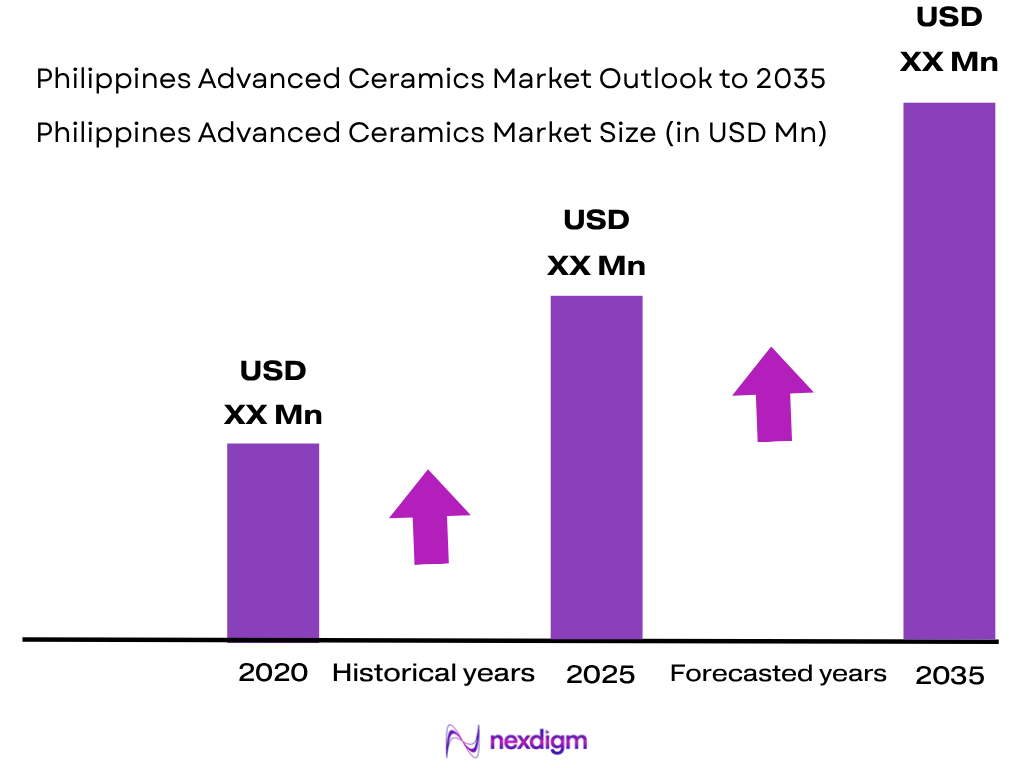
The Philippines Advanced Ceramics Market is valued at ~USD ~ million in 2025, compared with ~USD ~ million in 2024, supported by demand from electronics manufacturing, semiconductor-related activities, medical devices, automotive components, telecommunications and industrial equipment. The market is additionally influenced by the country’s expanding electronics manufacturing base and requirements for high-temperature, wear-resistant, electrically insulating and thermally conductive materials. Increasing adoption of precision ceramic components in electronic assemblies and industrial applications is strengthening demand for advanced ceramic materials and components.
Metro Manila, Calabarzon and Central Luzon represent the principal demand centers for the Philippines Advanced Ceramics Market because they concentrate electronics manufacturing, semiconductor assembly, industrial facilities, healthcare infrastructure, automotive activities and logistics networks. The Philippines recorded ~USD ~ billion of electronics exports in 2024, while the country’s manufacturing sector continued to support demand for specialized components. Calabarzon is particularly relevant because of its concentration of electronics, automotive and industrial manufacturing facilities, while Metro Manila provides major commercial, healthcare and technology demand.
Market Segmentation
By Material Type
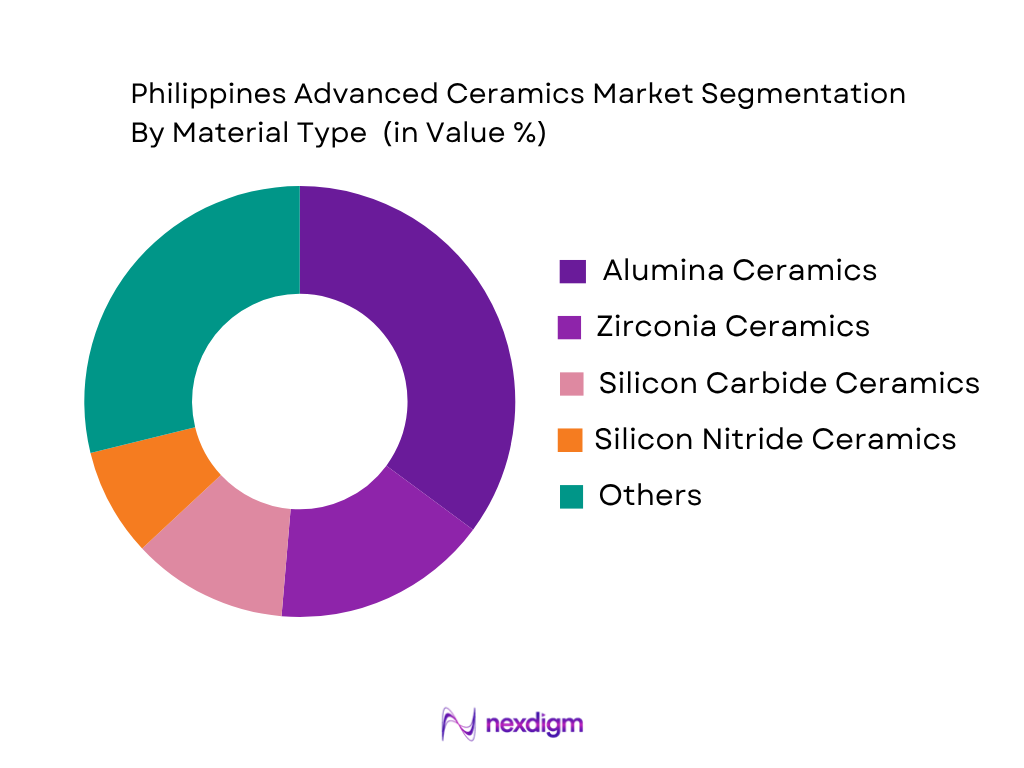
The Philippines Advanced Ceramics Market is segmented by material type into alumina, zirconia, silicon carbide, silicon nitride, aluminum nitride, boron carbide and other advanced ceramics. Alumina is expected to represent the dominant segment because of its broad utilization across electronic substrates, electrical insulation, wear-resistant components, laboratory equipment and industrial applications. Its combination of hardness, electrical insulation, chemical stability and thermal resistance allows it to serve applications where conventional plastics and metals have performance limitations. Alumina also benefits from established processing technologies, including pressing, extrusion, machining and sintering, making it comparatively suitable for component manufacturers and industrial users. Zirconia has stronger relevance in dental and medical applications, while silicon carbide and aluminum nitride are increasingly important for high-temperature and thermal-management applications. The Philippines’ electronics and semiconductor ecosystem provides an important demand base for alumina substrates and insulating components, while industrial machinery and medical-device applications broaden its addressable usage. Consequently, alumina remains the key material category across multiple end-use industries.
By Application
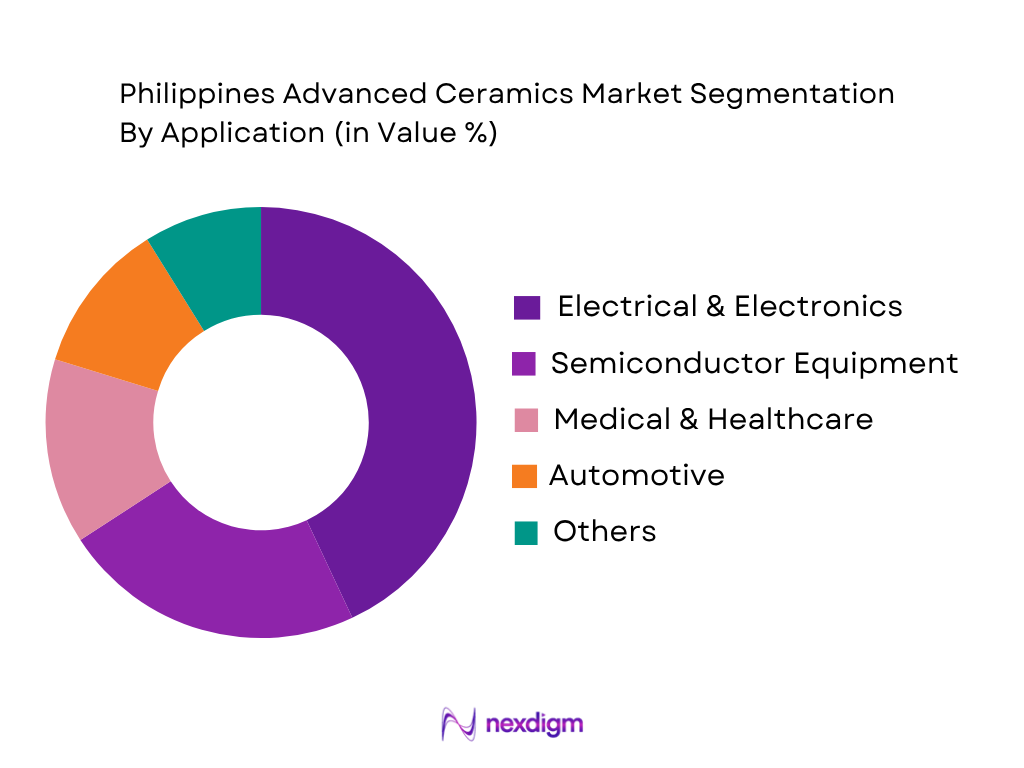
The Philippines Advanced Ceramics Market is segmented by application into electrical and electronics, semiconductor equipment, medical and healthcare, automotive, aerospace and defense, energy and power, industrial machinery and telecommunications. Electrical and electronics represents the leading application because advanced ceramics provide electrical insulation, dimensional stability, thermal management and resistance to chemical and mechanical degradation. The Philippines has an established electronics manufacturing and semiconductor assembly ecosystem, generating demand for ceramic substrates, insulating components, precision ceramic parts and thermal-management materials. Ceramic materials are particularly relevant where electronic components operate under elevated temperatures or require controlled dielectric characteristics. Semiconductor equipment applications additionally require high-purity and wear-resistant ceramic components capable of maintaining dimensional accuracy during demanding manufacturing processes. Medical applications provide another specialized demand stream through zirconia dental components, implant-related ceramics and medical instruments. Automotive electronics, industrial automation and telecommunications equipment further broaden application opportunities. Increasing component miniaturization and higher power density are also encouraging the use of ceramics with superior thermal and electrical performance compared with conventional materials.
Competitive Landscape
The Philippines Advanced Ceramics Market is characterized by international advanced-material manufacturers supplying specialized ceramics, ceramic components, substrates and engineered products to electronics, semiconductor, medical, automotive and industrial customers. Competition is shaped by material purity, manufacturing precision, thermal performance, customization capability, qualification requirements and technical support rather than by commodity-scale ceramic production alone. International suppliers with broad material portfolios and specialized processing capabilities are positioned to serve high-value applications, while distributors and local industrial channels provide access to Philippine end users.
| Company | Establishment | Headquarters | Core Advanced Ceramic Materials | Key Applications | Manufacturing Capability | Customization Capability | Philippine Market Relevance |
| Kyocera Corporation | 1959 | Kyoto, Japan | ~ | ~ | ~ | ~ | ~ |
| CoorsTek, Inc. | 1910 | Colorado, USA | ~ | ~ | ~ | ~ | ~ |
| CeramTec GmbH | 1903 | Plochingen, Germany | ~ | ~ | ~ | ~ | ~ |
| Morgan Advanced Materials | 1856 | Windsor, UK | ~ | ~ | ~ | ~ | ~ |
| Saint-Gobain Ceramics | 1665 | Courbevoie, France | ~ | ~ | ~ | ~ | ~ |
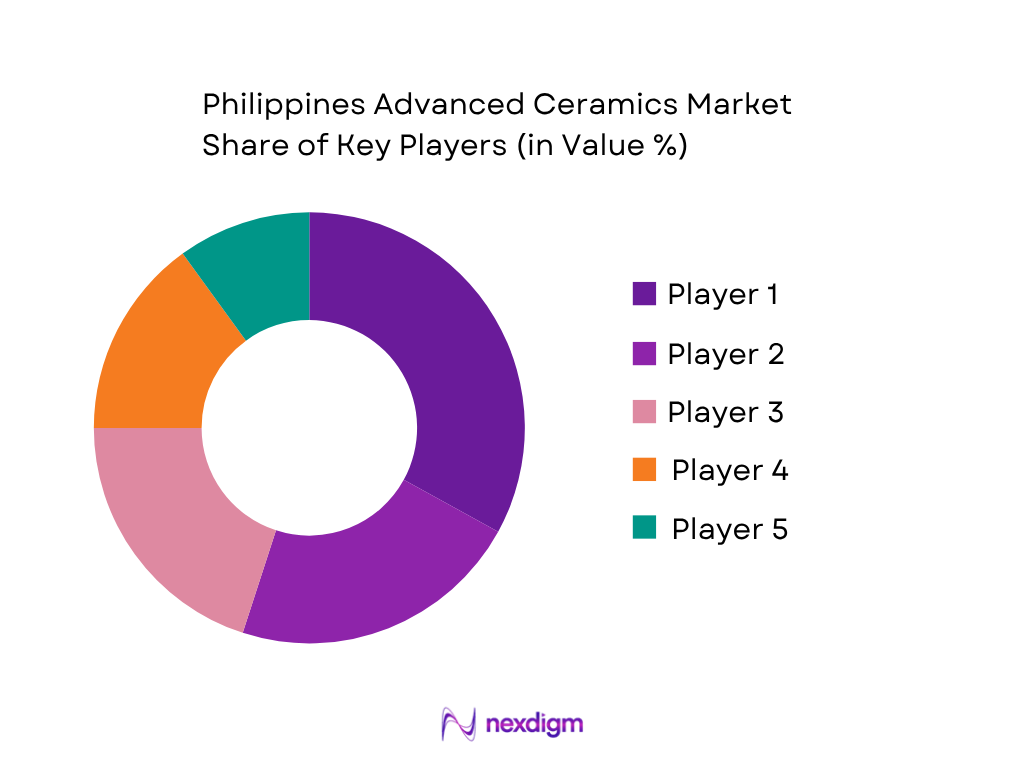
Philippines Advanced Ceramics Market Analysis
Growth Drivers
Electronics Manufacturing Expansion
Electronics manufacturing is a principal demand catalyst for advanced ceramics in the Philippines because ceramic substrates, insulators, packages, carriers and precision components are used across semiconductor assembly, testing, power electronics and electronic modules. The Philippine Statistics Authority reported USD 39.09 billion in electronic-product exports in 2024, compared with USD 73.27 billion in total merchandise exports, demonstrating the scale of the electronics manufacturing ecosystem that can consume advanced ceramic components. Electronic products also generated USD 20.63 billion of exports during the first half of 2024, while electronic-product imports reached USD 27.38 billion for the full year, indicating substantial movement of electronic production inputs and finished components through the domestic supply chain. World Bank data show Philippine GDP at USD 461.67 billion in 2024, with real economic growth of 5.6, supporting continued industrial and investment activity. The concentration of electronics production creates demand for alumina, aluminum nitride, silicon carbide and other ceramics requiring electrical insulation, thermal stability and dimensional precision. As manufacturers expand semiconductor, electronic assembly and testing operations, the requirement for ceramic components is strengthened across production equipment and finished electronic assemblies.
Semiconductor Ecosystem Development
Expansion of semiconductor-related manufacturing provides a direct structural driver for advanced ceramics because semiconductor fabrication, assembly, testing and equipment applications require materials capable of tolerating high temperatures, electrical loads, chemical exposure and demanding dimensional specifications. The Philippine Statistics Authority recorded USD 39.09 billion in electronic-product exports in 2024, with electronic products representing the country’s leading export commodity group. Electronic-product imports simultaneously reached USD 27.38 billion, while imports of raw materials and intermediate goods totaled USD 46.47 billion, reflecting the scale of imported production inputs supporting Philippine manufacturing. The country’s total merchandise trade reached USD 200.87 billion in 2024, establishing a large trade-linked industrial base for semiconductor and electronics supply chains. World Bank data place Philippine GDP at USD 461.67 billion in 2024 and real GDP growth at 5.6, providing a supportive macroeconomic environment for industrial investment. These conditions reinforce applications for alumina ceramic components, aluminum-nitride thermal-management parts, silicon-carbide components and ceramic fixtures used in semiconductor processing and electronics manufacturing. Continued integration into regional semiconductor supply chains therefore creates additional opportunities for specialized ceramic component suppliers and domestic precision-processing capabilities.
Market Challenges
High Import Dependence
Dependence on imported advanced ceramic materials, components and specialized processing inputs remains a structural challenge because the Philippines has a substantial electronics manufacturing base but comparatively limited domestic production of highly engineered ceramic materials. The Philippine Statistics Authority recorded USD 127.60 billion of merchandise imports in 2024, against USD 73.27 billion of exports, while imports of raw materials and intermediate goods reached USD 46.47 billion. Electronic products alone accounted for USD 27.38 billion of imports, demonstrating the country’s extensive reliance on internationally sourced manufacturing inputs and technology-related products. China supplied USD 32.83 billion of Philippine merchandise imports, while Japan supplied USD 10.11 billion, highlighting the importance of external Asian supply networks. For advanced ceramics, this environment can expose domestic users to international logistics disruptions, longer qualification cycles and dependence on overseas suppliers for specialized grades, powders, substrates and precision-fabricated components. The challenge is particularly relevant for semiconductor equipment, medical ceramics and thermal-management applications where material consistency and qualification are critical. World Bank data show Philippine GDP reached USD 461.67 billion in 2024, meaning the domestic industrial base is substantial, but its sophisticated manufacturing supply chains remain closely connected to imported intermediate products.
Specialized Processing Requirements
Advanced ceramics require highly controlled powder preparation, forming, sintering, machining, metallization and inspection processes, making production substantially more technically demanding than conventional ceramic manufacturing. This challenge is relevant in the Philippines because advanced-ceramic applications connected to electronics and semiconductor production require tight dimensional control and consistent thermal, electrical and mechanical properties. Philippine electronic-product exports reached USD 39.09 billion in 2024, while electronic-product imports reached USD 27.38 billion, indicating a large industrial ecosystem in which component quality and manufacturing precision are critical. Imports of capital goods totaled USD 35.73 billion, according to the Philippine Statistics Authority, reflecting the importance of machinery and production equipment within the domestic manufacturing structure. World Bank data show the economy expanded by 5.6 in 2024, supporting continued industrial activity but also increasing the need for technically capable suppliers that can meet demanding production specifications. Ceramic machining can require diamond tooling, controlled grinding, specialized inspection and process-specific expertise, particularly for alumina, zirconia, silicon carbide and silicon nitride. Limited availability of these capabilities can increase qualification times and make local manufacturers dependent on overseas processing for high-value components.
Market Opportunities
Semiconductor Ceramic Components
The Philippines provides a substantial opportunity for semiconductor-oriented ceramic components because its electronics export base creates an established downstream environment for electrically insulating, thermally stable and chemically resistant materials. Philippine electronic-product exports totaled USD 39.09 billion in 2024, while the country’s first-half electronic-product exports reached USD 20.63 billion. Electronic products also generated USD 27.38 billion of imports during the year, illustrating the scale of the broader electronics supply chain. This ecosystem supports opportunities for alumina components, aluminum-nitride substrates, silicon-carbide parts, ceramic packages, wafer-handling components, semiconductor equipment fixtures and thermal-management components. World Bank data recorded Philippine GDP at USD 461.67 billion in 2024, alongside real GDP growth of 5.6, supporting an environment in which manufacturing activity and industrial investment can expand. The opportunity is particularly relevant where manufacturers seek localized suppliers capable of producing precision ceramic components closer to electronics assembly and testing operations. Development of domestic ceramic processing can also reduce dependence on imported components and shorten supply chains for qualified parts. The combination of a large electronics export base, extensive intermediate-goods imports and continued economic expansion provides a current industrial foundation for deeper advanced-ceramic participation in semiconductor-related manufacturing.
Thermal Management Materials
Thermal-management ceramics represent an opportunity because electronics, semiconductor equipment and power-electronics systems increasingly require materials that combine electrical insulation with efficient heat dissipation. Aluminum nitride and silicon carbide are particularly relevant for high-temperature and high-power applications, while alumina remains important for electrical insulation and structural components. The Philippine Statistics Authority recorded USD 39.09 billion in electronic-product exports in 2024 and USD 27.38 billion in electronic-product imports, confirming the scale of the electronics ecosystem requiring advanced component technologies. Machinery and transport equipment imports reached USD 11.36 billion, while capital-goods imports totaled USD 35.73 billion, demonstrating significant movement of industrial equipment and production assets through the country. World Bank data show Philippine GDP of USD 461.67 billion in 2024 and real growth of 5.6, supporting continued industrial utilization of electronics and equipment. These conditions create opportunities for locally processed aluminum-nitride substrates, ceramic heat spreaders, insulated power modules and silicon-carbide thermal components. Building domestic capability around precision machining, metallization and ceramic joining could allow Philippine suppliers to serve electronics manufacturers while reducing reliance on imported thermal-management components.
Future Outlook
The Philippines Advanced Ceramics Market is expected to progress through increasing electronics manufacturing, semiconductor-related investment, industrial automation and demand for high-performance components. Growth in thermal-management requirements should support aluminum nitride and silicon carbide applications, while alumina is positioned to retain broad utilization across electronics and industrial components. Medical and dental applications are expected to create additional opportunities for zirconia-based ceramics. The development of higher-value manufacturing activities should also increase demand for precision ceramic components rather than conventional ceramic products.
Major Players
- Kyocera Corporation
- CoorsTek, Inc.
- CeramTec GmbH
- Morgan Advanced Materials
- Saint-Gobain Ceramics
- 3M
- Tosoh Corporation
- Murata Manufacturing Co., Ltd.
- NGK Insulators, Ltd.
- Niterra Co., Ltd.
- CUMI International Limited
- Coorstek KK
- Rauschert Group
- McDanel Advanced Ceramic Technologies
- Ceradyne, Inc.
Key Target Audience
- Electronics and Semiconductor Manufacturers
- Advanced Ceramic Component Manufacturers and Processors
- Medical Device and Dental Product Manufacturers
- Automotive Component Manufacturers
- Industrial Machinery and Equipment Manufacturers
- Investments and Venture Capitalist Firms (Industrial Technology Funds, Advanced Materials Investors, Venture Capital Funds)
- Government and Regulatory Bodies (Department of Trade and Industry, Board of Investments, Philippine Economic Zone Authority, Department of Science and Technology)
- Energy, Power and Telecommunications Equipment Manufacturers
Research Methodology
Step 1: Identification of Key Variables
The initial stage involves mapping the Philippines Advanced Ceramics ecosystem across material suppliers, ceramic processors, component manufacturers, distributors and end-use industries. Variables include material consumption, application demand, import dependency, manufacturing capacity, technology adoption, component requirements and end-user procurement patterns.
Step 2: Market Analysis and Construction
Historical market information is compiled across advanced ceramic materials, products, applications and end-use industries. The assessment combines import-export flows, manufacturing activity, electronics production, industrial demand and company-level operating indicators to construct the market baseline and identify demand concentrations.
Step 3: Hypothesis Validation and Expert Consultation
Market hypotheses are validated through discussions with advanced ceramic manufacturers, electronics companies, semiconductor suppliers, medical-device manufacturers, industrial component users and distributors. Expert inputs are used to validate material selection, application penetration, procurement practices, qualification requirements and competitive positioning.
Step 4: Research Synthesis and Final Output
The final stage integrates top-down and bottom-up findings to establish the market structure, competitive landscape, segmentation outlook and future demand assessment. Company-level information and application-level evidence are cross-checked against industry indicators to strengthen the consistency of the final Philippines Advanced Ceramics Market analysis.

- Executive Summary
- Research Methodology (Market Definition and Scope, Advanced Ceramic Classification, Product and Application Mapping, Market Sizing Framework, Top-Down Assessment, Bottom-Up Assessment, Demand-Side Analysis, Supply-Side Analysis, Import–Export Validation, Primary Industry Interviews, Secondary Data Validation, Data Triangulation, Forecasting Framework, Scenario Analysis, Research Limitations)

- Definition and Scope
- Advanced Ceramics Industry Evolution and Technology Development
- Philippines Advanced Ceramics Ecosystem Mapping
- Advanced Ceramics Value Chain Analysis
- Supply Chain Analysis
- Domestic Production Versus Import Dependency
- Local Ceramic Manufacturing and Processing Infrastructure

- Growth Drivers (Electronics Manufacturing Expansion, Semiconductor Ecosystem Development, Medical Device Manufacturing, Automotive Electronics Growth, Industrial Automation, Renewable Energy Deployment)
- Market Challenges (High Import Dependence, Limited Domestic Advanced Ceramic Production, Specialized Processing Requirements, High Precision Machining Requirements, Skilled Technical Workforce Constraints, Raw Material Supply Dependency, Qualification Complexity)
- Market Opportunities (Semiconductor Ceramic Components, Thermal Management Materials, EV Ceramic Components, Medical Ceramics, Advanced Ceramic Substrates, Ceramic Membranes, Energy Storage Applications, Domestic Processing Capacity)
- Market Trends (Electronics Miniaturization, High-Thermal-Conductivity Ceramics, Ceramic-Based Semiconductor Components, EV Electrification, Medical Implant Innovation, High-Purity Ceramic Materials, Precision Ceramic Manufacturing)
- SWOT Analysis
- Porter’s Five Forces Analysis
- PESTLE Analysis

- By Market Value (2020-2025)
- By Volume Consumption (2020-2025)
- By Domestic Production (2020-2025)
- By Import Volume (2020-2025)
- By Export Volume (2020-2025)

- By Material Type (In Value %)
Alumina
Zirconia
Silicon Carbide
Silicon Nitride
Aluminum Nitride
Titanium Carbide
Boron Carbide
Other Advanced Ceramics - By Product Type (In Value %)
Ceramic Components
Ceramic Substrates
Ceramic Coatings
Ceramic Powders
Ceramic Fibers
Ceramic Tubes and Rods
Ceramic Plates and Sheets
Ceramic Seals and Bearings - By Application (In Value %)
Electrical and Electronics
Semiconductors
Medical and Healthcare
Automotive
Aerospace and Defense
Energy and Power
Industrial Machinery
Telecommunications - By Manufacturing Process (In Value %)
Dry Pressing
Injection Molding
Tape Casting
Extrusion
Hot Pressing
Cold Isostatic Pressing
Slip Casting
Reaction Bonding
Sintering - By End-Use Industry (In Value %)
Electronics and Semiconductor Manufacturing
Automotive Manufacturing
Medical Device Manufacturing
Aerospace and Defense
Power Generation and Electrical Equipment
Industrial Equipment and Machinery
Telecommunications

- Market Share of Major Players (By Value, Volume, Material Type, Product Type, Application, End-Use Industry)
- Cross Comparison Parameters (Advanced Ceramic Material Portfolio, Product and Component Portfolio Breadth, Manufacturing Process Capability, Precision Machining Capability, Material Purity Grades, Thermal and Electrical Performance Portfolio, Application-Specific Customization Capability, Regional Distribution and Technical Support Reach)
- SWOT Analysis of Major Players
- Detailed Profiles of Major Companies
Kyocera Corporation
CoorsTek Inc.
CeramTec GmbH
Morgan Advanced Materials plc
Saint-Gobain Ceramics
3M
Coorstek KK
Tosoh Corporation
Murata Manufacturing Co., Ltd.
NGK Insulators, Ltd.
Niterra Co., Ltd.
CUMI International Limited
Ceradyne, Inc.
Rauschert Group
McDanel Advanced Ceramic Technologies

- Electronics Manufacturer Requirements
- Semiconductor Equipment Requirements
- Medical Device Manufacturer Requirements
- Automotive Manufacturer Requirements
- Industrial Buyer Requirements

- By Market Value (2026-2035)
- By Volume Consumption (2026-2035)
- By Domestic Production (2026-2035)
- By Import Volume (2026-2035)
- By Export Volume (2026-2035)


 Request a Sample
 Ask for Customization
 Get a Quote
 Enquire Now