
 Download PDF
 Download PDF
Market Overview
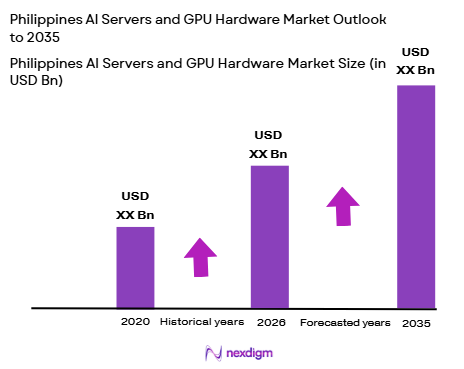
The Philippines AI servers and GPU hardware market is anchored within the national data center and AI infrastructure ecosystem, valued at approximately USD ~ billion based on a recent historical assessment of accelerated computing deployments. Growth is driven by hyperscale cloud expansion, enterprise AI adoption, and high-performance computing demand across telecom, finance, healthcare, and digital services sectors. Investments in AI-ready data centers, GPU clusters, and machine learning infrastructure are expanding localized compute capacity supporting generative AI, analytics, and automation workloads.
Metro Manila dominates AI server and GPU infrastructure concentration due to hyperscale data center presence, enterprise IT clusters, and international connectivity through major subsea cable systems. Cebu is emerging as a secondary AI compute location supported by regional data center investment and IT-BPM sector demand for AI workloads. The Philippines benefits from regional AI infrastructure ecosystems in Singapore and Malaysia, enabling cross-border cloud-AI integration and positioning the country as a growing node within Southeast Asia accelerated computing networks.
Market Segmentation
By Hardware Type
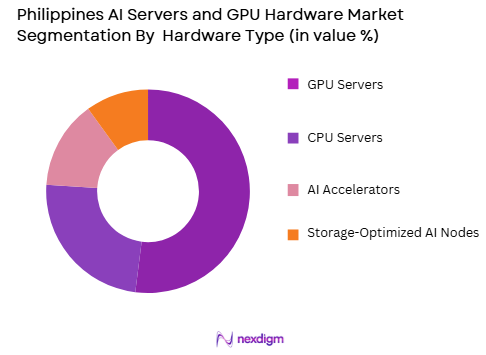
Philippines AI Servers and GPU Hardware market is segmented by hardware type into GPU servers, CPU servers, AI accelerators, and storage-optimized AI nodes. Recently, GPU servers has a dominant market share due to factors such as deep learning workload demand, hyperscale AI cluster deployment, and enterprise generative AI adoption. GPU-accelerated systems provide parallel processing capabilities essential for training and inference of machine learning models, making them the preferred architecture for AI infrastructure across telecom, finance, and digital platform companies. Hyperscale cloud providers and data center operators deploy GPU clusters to support AI services and high-performance computing applications, while enterprises increasingly procure GPU-enabled servers for on-premise AI workloads and analytics.
By End-Use Industry
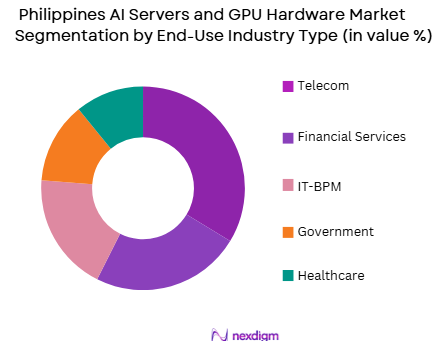
Philippines AI Servers and GPU Hardware market is segmented by end-use industry into telecom, financial services, healthcare, government, and IT-BPM. Recently, telecom has a dominant market share due to factors such as network AI optimization, edge AI deployment, and large-scale data analytics requirements. Telecom operators process massive network traffic and customer data requiring AI-driven optimization, fraud detection, and predictive maintenance models supported by GPU infrastructure. The IT-BPM sector also drives AI compute demand for automation and language processing workloads, but telecom infrastructure ownership and large data volumes position it as the primary investor in AI servers and accelerated computing systems across the Philippines digital ecosystem.
Competitive Landscape
The Philippines AI servers and GPU hardware market is shaped by global semiconductor and server vendors supplying accelerated computing platforms to hyperscale data centers, telecom operators, and enterprise clients. Market influence is concentrated among GPU technology leaders and enterprise server manufacturers with strong regional distribution partnerships. Cloud providers and colocation operators drive infrastructure procurement, while local system integrators enable deployment and customization. Competition centers on GPU performance, AI framework compatibility, and scalable cluster architecture capabilities.
| Company Name | Establishment Year | Headquarters | Technology Focus | Market Reach | Key Products | Revenue | AI Compute Specialization |
| NVIDIA | 1993 | USA | ~ | ~ | ~ | ~ | ~ |
| AMD | 1969 | USA | ~ | ~ | ~ | ~ | ~ |
| Intel | 1968 | USA | ~ | ~ | ~ | ~ | ~ |
| Dell Technologies | 1984 | USA | ~ | ~ | ~ | ~ | ~ |
| HPE | 1939 | USA | ~ | ~ | ~ | ~ | ~ |
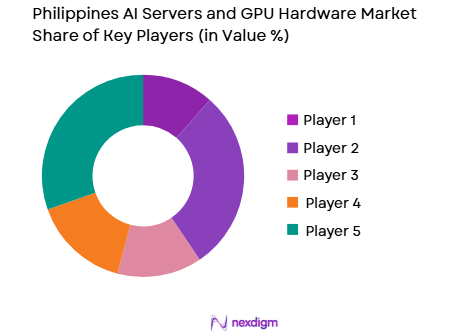
Philippines AI Servers and GPU Hardware Market Analysis
Growth Drivers
Enterprise and Hyperscale Adoption of Generative AI Infrastructure
The rapid emergence of generative artificial intelligence applications across Philippine enterprises and digital platforms is driving substantial demand for high-performance AI servers and GPU hardware capable of supporting large-scale model training and inference workloads. Organizations in telecom, finance, e-commerce, and IT-BPM sectors are deploying AI models for automation, customer analytics, language processing, and decision support systems requiring parallel processing architectures. Hyperscale cloud providers expanding AI service offerings in Southeast Asia are investing in GPU-dense data centers serving Philippine enterprise customers through regional availability zones. Generative AI workloads demand massive computational throughput and memory bandwidth, positioning GPU clusters as essential infrastructure. Philippine enterprises adopting AI solutions increasingly procure on-premise GPU servers to ensure data control, performance reliability, and regulatory compliance. AI-enabled automation and analytics initiatives generate continuous compute requirements across business processes. Data center operators are integrating liquid-cooled GPU racks and high-density power infrastructure to support accelerated computing deployments. Software ecosystems including AI frameworks and developer platforms are optimized for GPU acceleration, reinforcing hardware demand. Rising AI talent availability and digital innovation programs further stimulate enterprise adoption. As generative AI transitions from experimentation to production across industries, accelerated computing infrastructure becomes foundational to Philippine digital competitiveness.
Expansion of AI-Ready Data Centers and Cloud Regions in the Philippines
The construction of AI-ready hyperscale and colocation data centers within the Philippines is significantly increasing local demand for AI servers and GPU hardware supporting national digital sovereignty and low-latency compute access. Data center developers are designing facilities with high power density, advanced cooling, and scalable rack configurations suitable for GPU clusters and high-performance computing systems. Telecom operators and cloud providers are deploying localized AI compute capacity to reduce dependence on overseas infrastructure and improve performance for domestic enterprises. Government digitalization strategies encourage domestic data processing capabilities for sensitive sectors including finance, healthcare, and public services. AI workloads involving real-time analytics, video processing, and natural language systems benefit from local compute proximity. Regional cloud expansion in Southeast Asia is complemented by in-country facilities serving Philippine demand. Enterprises migrating workloads to hybrid cloud environments require AI-optimized servers within national data centers. The IT-BPM industry increasingly adopts AI automation platforms requiring local GPU infrastructure. Investments in fiber connectivity and subsea cables enhance interconnection between Philippine data centers and regional cloud hubs. As AI-capable data center capacity expands nationwide, procurement of AI servers and GPU hardware accelerates across providers and enterprises.
Market Challenges
High Cost and Power Intensity of GPU Infrastructure Deployment
AI servers and GPU hardware deployments in the Philippines face substantial economic barriers due to high acquisition costs of advanced accelerators, specialized cooling systems, and power-dense data center infrastructure required for sustained operation. Modern AI GPUs and high-performance servers represent significant capital expenditure beyond conventional enterprise IT budgets, limiting adoption among smaller organizations. Accelerated computing clusters require high electrical capacity and thermal management systems including liquid cooling and redundant power infrastructure, increasing facility costs. Electricity prices and grid reliability challenges in the Philippines further raise operational expenses of GPU-intensive workloads. Import dependence for semiconductor hardware exposes buyers to currency fluctuations and supply chain costs. Data center operators must invest heavily in power distribution upgrades and environmental controls to support AI clusters. Rapid hardware obsolescence cycles create financial risk for long-term investment decisions. Skilled personnel for AI infrastructure management and optimization remain limited domestically. Enterprises struggle to justify return on investment for large-scale AI hardware without mature AI use cases. These cost and energy constraints slow broader diffusion of AI server infrastructure despite strong demand potential.
Dependence on Global Semiconductor Supply Chains and Import Constraints
The Philippines AI servers and GPU hardware market relies almost entirely on imported semiconductor components and server platforms, creating vulnerability to global supply chain disruptions, export controls, and geopolitical trade restrictions affecting advanced computing technologies. Leading AI GPUs and accelerators are produced by a limited number of global manufacturers subject to international technology regulations and allocation priorities favoring major markets. Import lead times and logistics costs affect availability and deployment schedules for Philippine data center and enterprise projects. Currency exchange volatility impacts procurement affordability for local buyers. Absence of domestic advanced semiconductor manufacturing limits supply resilience and customization capability. Global demand surges for AI chips periodically create shortages affecting smaller markets. Enterprises depend on regional distributors and integrators for hardware access, adding intermediated costs. Compliance requirements and licensing for advanced computing equipment complicate procurement processes. Technology lifecycle updates are dictated by global vendors rather than local innovation cycles. These structural supply dependencies constrain national AI infrastructure expansion autonomy.
Opportunities
Development of National AI Infrastructure and Sovereign Compute Capacity
The strategic importance of artificial intelligence capabilities is driving Philippine initiatives toward establishing domestic AI infrastructure and sovereign compute capacity across government and critical sectors, creating significant demand for AI servers and GPU hardware. Public sector digital transformation programs require secure AI processing for citizen services, healthcare analytics, and national security applications. Establishing government-owned or nationally controlled AI compute clusters reduces dependence on foreign cloud infrastructure. National research institutions and innovation centers require high-performance computing resources for AI development. Defense and cybersecurity applications demand sovereign AI processing environments. Educational and workforce development initiatives expand AI experimentation infrastructure needs. Public-private partnerships for AI infrastructure deployment stimulate domestic data center growth. Localized AI processing supports compliance with data sovereignty and privacy regulations. National digital competitiveness strategies prioritize domestic compute capability. Regional leadership ambitions in ASEAN AI innovation encourage infrastructure investment. These policy and strategic drivers create long-term market opportunities for AI hardware deployment within the Philippines.
AI Adoption Across IT-BPM and Multilingual Digital Services Industries
The Philippines’ globally significant IT-BPM sector is rapidly integrating artificial intelligence technologies including natural language processing, speech recognition, and automation platforms requiring GPU-accelerated computing infrastructure, creating strong domestic demand for AI servers. Multilingual customer service, content moderation, and business process automation applications rely on large language models and speech AI systems optimized on GPU clusters. Service providers are transitioning from labor-intensive operations to AI-augmented delivery models requiring scalable compute resources. Domestic deployment of AI infrastructure enables data privacy compliance for international clients. Training and inference of language models tailored to Philippine languages and accents require local compute capacity. AI-driven analytics platforms enhance operational efficiency across outsourcing services. Global clients increasingly require AI-enabled service capabilities from Philippine providers. Data center operators are targeting IT-BPM demand segments with AI-ready facilities. Workforce reskilling toward AI operations and model management expands enterprise infrastructure needs. As IT-BPM evolves into AI-enabled digital services, the Philippines AI servers and GPU hardware market gains a major structural growth driver.
Future Outlook
The Philippines AI servers and GPU hardware market is expected to expand significantly as AI adoption accelerates across enterprises and public sector organizations. Hyperscale and colocation data center expansion will increase domestic accelerated computing capacity. Government initiatives supporting national AI infrastructure and digital sovereignty will stimulate hardware deployment. IT-BPM and telecom sectors will remain primary adopters of GPU clusters and AI servers. Advancements in AI chip performance and energy efficiency will further drive infrastructure investment nationwide.
Major Players
- NVIDIA
- AMD
- Intel
- Dell Technologies
- HPE
- Lenovo
- Supermicro
- Cisco Systems
- Huawei
- Inspur
- ASUS
- Gigabyte
- Quanta Cloud Technology
- Foxconn
- Tyan
Key Target Audience
- Telecom operators
- Cloud service providers
- Data center operators
- IT-BPM companies
- Financial institutions
- Healthcare networks
- Investments and venture capitalist firms
- Government and regulatory bodies
Research Methodology
Step 1: Identification of Key Variables
AI hardware deployment scale, data center capacity, enterprise AI adoption intensity, and sectoral compute demand were identified as core variables. Semiconductor supply availability and technology evolution factors were mapped. End-use AI workload characteristics were defined.
Step 2: Market Analysis and Construction
Market structure was constructed by analyzing AI infrastructure investments, server procurement patterns, and data center expansion trends. Hardware segmentation across GPU, CPU, and accelerator platforms was modeled. Industry adoption scenarios were assessed.
Step 3: Hypothesis Validation and Expert Consultation
Assumptions regarding AI workload growth, hardware demand, and infrastructure constraints were validated through industry technology analysis and ecosystem benchmarking. Vendor strategies and regional AI infrastructure trends were incorporated. Demand drivers were cross-verified.
Step 4: Research Synthesis and Final Output
All quantitative and qualitative insights were synthesized into a comprehensive model describing segmentation, competition, and growth dynamics. Strategic opportunities and constraints were evaluated. Final outputs integrated technology, infrastructure, and industry adoption factors.

- Executive Summary
- Research Methodology (Definitions, Scope, Industry Assumptions, Market Sizing Approach, Primary & Secondary Research Framework, Data Collection & Verification Protocol, Analytic Models & Forecast Methodology, Limitations & Research Validity Checks)

- Market Definition and Scope
- Value Chain & Stakeholder Ecosystem
- Regulatory / Certification Landscape
- Sector Dynamics Affecting Demand
- Strategic Initiatives & Infrastructure Growth

- Growth Drivers
Rising enterprise adoption of AI analytics and automation workloads
Expansion of hyperscale and colocation data center capacity in Philippines
Increasing demand for GPU compute from telecom and cloud providers - Market Challenges
High capital cost of advanced GPUs and AI server infrastructure
Dependence on imported semiconductor and accelerator hardware
Power density and cooling constraints in existing data center facilities - Market Opportunities
Localization of AI cloud infrastructure for national data sovereignty
AI adoption in financial services, healthcare, and public sector analytics
Growth of AI-enabled telecom network optimization and automation - Trends
Shift toward GPU-dense and liquid-cooled AI server architectures
Adoption of AI-as-a-service platforms requiring dedicated GPU clusters
Integration of AI accelerators in telecom and edge cloud nodes - Government regulations
Data privacy and sovereignty requirements influencing local AI compute
National digital transformation and cloud adoption policies
Public sector AI capability and supercomputing initiatives - SWOT analysis
- Porters five forces

- By Market Value, 2020-2025
- By Installed Units, 2020-2025
- By Average System Price, 2020-2025
- By System Complexity Tier, 2020-2025

- By System Type (In Value%)
GPU-Accelerated AI Servers
AI Training Clusters
AI Inference Servers
High-Density GPU Racks
Edge AI Servers - By Platform Type (In Value%)
Hyperscale Data Centers
Enterprise Data Centers
Telecom Cloud Infrastructure
Research and Academic HPC
Government Computing Platforms - By Fitment Type (In Value%)
New AI Infrastructure Deployment
Data Center GPU Upgrades
Integrated AI Appliance Systems
Modular GPU Expansion Units
Cloud-Managed AI Hardware - By End User Segment (In Value%)
Cloud Service Providers
Telecommunications Operators
Financial Services Institutions
Healthcare and Life Sciences Organizations
Government and Defense Agencies - By Procurement Channel (In Value%)
Direct OEM Procurement
Global Distributor Supply
Cloud Service Bundled Hardware
System Integrator Deployment
Public Sector Tenders

- Market Share Analysis
- Cross Comparison Parameters (GPU Performance Density, AI Training Throughput, Inference Latency Optimization, Energy Efficiency per TFLOP, Cooling and Thermal Design, Interconnect Bandwidth, Scalability Architecture, Rack Power Density, AI Software Stack Compatibility, Deployment Flexibility)
- SWOT Analysis of Key Competitors
- Pricing & Procurement Analysis
- Key Players
NVIDIA Philippines
AMD Philippines
Intel Philippines
Supermicro Philippines
Dell Technologies Philippines
Hewlett Packard Enterprise Philippines
Lenovo Philippines
Cisco Systems Philippines
Huawei Technologies Philippines
Inspur Philippines
ASUS Philippines
Gigabyte Technology Philippines
Quanta Cloud Technology Philippines
Fujitsu Philippines
NEC Philippines

- Cloud providers expanding GPU clusters for AI services and analytics
- Telecom operators deploying AI infrastructure for network automation
- Financial and healthcare sectors adopting AI compute for data modeling
- Government agencies investing in sovereign AI and HPC capacity

- Forecast Market Value, 2026-2035
- Forecast Installed Units, 2026-2035
- Price Forecast by System Tier, 2026-2035
- Future Demand by Platform, 2026-2035


 Request a Sample
 Ask for Customization
 Get a Quote
 Enquire Now