

 Download PDF
Market Overview
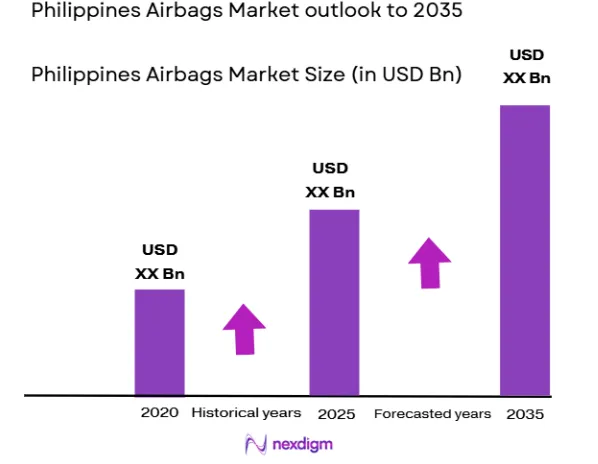
The Philippines Airbags market reached approximately USD ~ billion based on a recent historical assessment, supported by data from national automotive associations and import-export trade records. The market expansion is driven by increasing vehicle production, stricter safety regulations, and growing consumer awareness regarding crash protection systems. Rising integration of advanced safety technologies by automotive manufacturers and government mandates on vehicle safety compliance continue to significantly influence demand across passenger and commercial vehicle segments.
Metro Manila, Cebu, and Calabarzon dominate the Philippines Airbags market due to concentrated automotive assembly facilities and high vehicle density in these regions. Strong presence of OEM partnerships, better distribution infrastructure, and higher purchasing power contribute to regional dominance. Additionally, proximity to logistics hubs and industrial zones enhances supply chain efficiency, while increasing urban traffic congestion drives demand for enhanced vehicle safety features in densely populated cities.
Market Segmentation
By Product Type
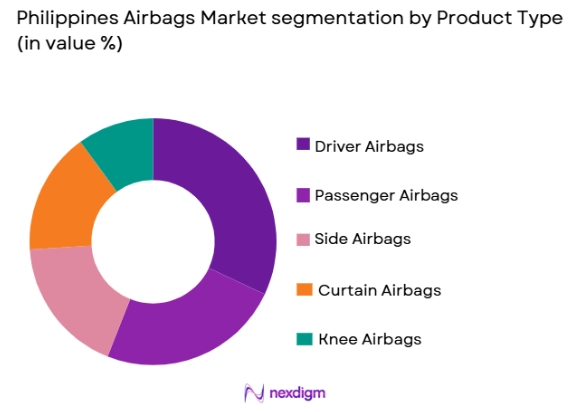
Philippines Airbags market is segmented by product type into driver airbags, passenger airbags, side airbags, curtain airbags, and knee airbags. Recently, driver airbags has a dominant market share due to factors such as mandatory regulatory compliance, universal installation across vehicle categories, and cost-effective integration into both entry-level and mid-range vehicles. Automakers prioritize driver airbags as a baseline safety feature, ensuring widespread adoption. Additionally, strong OEM mandates and consistent demand from fleet operators further reinforce its dominance in the market landscape.
By Vehicle Type
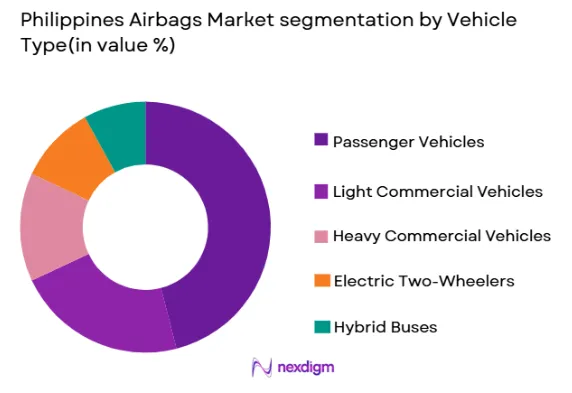
Philippines Airbags market is segmented by vehicle type into passenger vehicles, light commercial vehicles, heavy commercial vehicles, electric vehicles, and hybrid vehicles. Recently, passenger vehicles has a dominant market share due to factors such as high ownership rates, urban mobility trends, and growing middle-class purchasing power. Increasing demand for personal mobility and government incentives for safer vehicles contribute to higher adoption of airbags in this segment compared to commercial categories.
Competitive Landscape
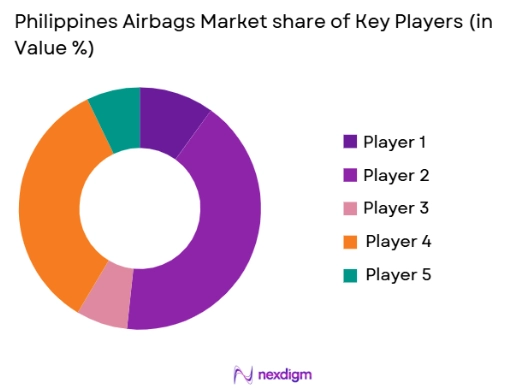
The Philippines Airbags market is moderately consolidated, with global automotive safety suppliers dominating through strong OEM partnerships and technological expertise. International companies leverage economies of scale and advanced R&D capabilities, while local players focus on assembly and distribution. Competitive dynamics are shaped by product innovation, compliance with safety regulations, and pricing strategies aligned with emerging vehicle segments.
| Company Name | Establishment Year | Headquarters | Technology Focus | Market Reach | Key Products | Revenue (USD Billion) | Local Manufacturing Presence |
| Autoliv Philippines Inc | 1995 | Sweden | ~ | ~ | ~ | ~ | ~ |
| ZF Passive Safety Systems | 1915 | Germany | ~ | ~ | ~ | ~ | ~ |
| Joyson Safety Systems | 2018 | USA | ~ | ~ | ~ | ~ | ~ |
| Hyundai Mobis | 1977 | South Korea | ~ | ~ | ~ | ~ | ~ |
| Toyoda Gosei | 1949 | Japan | ~ | ~ | ~ | ~ | ~ |
Philippines Airbags Market Analysis
Growth Drivers
Rising Automotive Safety Regulations and Compliance Requirements
Increasing enforcement of vehicle safety standards has significantly accelerated the adoption of airbags across the Philippines automotive sector. Government agencies are mandating minimum safety requirements, compelling manufacturers to integrate airbags as standard features even in entry-level vehicles. This regulatory push ensures consistent demand across passenger and commercial vehicle segments. Automotive companies are investing heavily in compliance technologies to meet both domestic and international safety norms. As road safety concerns intensify due to urban congestion, policymakers are emphasizing occupant protection systems. This has led to a surge in OEM contracts with global airbag manufacturers. Consumer awareness regarding safety ratings is also rising, influencing purchasing decisions. Insurance companies are further incentivizing safer vehicles through premium adjustments. These combined factors are driving sustained growth in the airbag market.
Expansion of Automotive Manufacturing and Vehicle Ownership Growth
The continuous expansion of automotive assembly plants and increasing vehicle ownership rates are major contributors to the growth of the Philippines Airbags market. Urbanization and rising disposable incomes are enabling more consumers to purchase vehicles equipped with advanced safety features. Automotive manufacturers are scaling production capacities to meet domestic demand, which directly increases airbag installation volumes. The entry of global OEMs into the Philippines market is enhancing technological integration and supply chain efficiency. Growing demand for ride-sharing and logistics services is further boosting vehicle sales. This creates additional demand for airbags across fleet vehicles. Government initiatives supporting local automotive production are strengthening industry capabilities. Increased financing options are making vehicles more accessible to consumers. All these factors collectively drive consistent growth in the airbags market.
Market Challenges
High Cost of Advanced Airbag Systems and Integration Complexity
The high cost associated with advanced airbag systems poses a significant challenge for widespread adoption in the Philippines market. Multi-stage airbags and sensor-integrated systems require sophisticated manufacturing processes and electronic components. This increases the overall vehicle cost, particularly impacting entry-level and budget vehicle segments. Manufacturers often face trade-offs between affordability and safety feature integration. Import dependency for critical components further escalates costs due to tariffs and logistics expenses. Limited local production capabilities also hinder cost optimization. Additionally, integration complexity in older vehicle models makes retrofitting airbags technically challenging. Consumers in price-sensitive segments may prioritize cost over safety features. This creates uneven adoption across vehicle categories. As a result, cost remains a key barrier to market expansion.
Dependence on Imported Components and Supply Chain Vulnerabilities
The Philippines Airbags market heavily relies on imported components, exposing it to global supply chain disruptions. Key materials such as sensors, inflators, and electronic control units are sourced from international suppliers. Any disruptions in global trade or logistics directly impact production timelines and inventory availability. Currency fluctuations also influence import costs, affecting overall pricing strategies. Limited domestic manufacturing capabilities restrict the ability to localize production. Natural disasters and geopolitical tensions further exacerbate supply chain risks. Delays in component delivery can halt vehicle assembly processes. This dependency reduces operational flexibility for manufacturers. Companies are increasingly seeking diversification strategies to mitigate risks. However, supply chain vulnerabilities remain a persistent challenge in the market.
Opportunities
Growth of Electric Vehicles and Integration of Advanced Safety Systems
The increasing adoption of electric vehicles presents a significant opportunity for the Philippines Airbags market. Electric vehicles require advanced safety systems due to unique structural designs and battery-related risks. Manufacturers are integrating innovative airbag technologies tailored to electric platforms. This includes adaptive deployment systems and enhanced crash detection sensors. Government support for electric mobility is accelerating adoption rates. As EV penetration increases, demand for specialized airbags will rise. OEMs are forming partnerships with safety technology providers to enhance product offerings. This creates opportunities for technological differentiation. Additionally, premium EV models often include multiple airbag configurations. This trend is expected to expand across mid-range EV segments. The shift toward electric mobility will significantly boost market growth.
Expansion of Aftermarket Safety Upgrades and Retrofit Solutions
The growing demand for aftermarket safety upgrades offers a strong opportunity for market expansion in the Philippines. Older vehicles without modern safety features are increasingly being retrofitted with airbag systems. Rising consumer awareness regarding road safety is driving demand for such upgrades. Automotive service providers are expanding their offerings to include airbag installations and maintenance. Fleet operators are also investing in retrofitting to enhance passenger safety and comply with regulations. Technological advancements are making retrofit solutions more feasible and cost-effective. Government initiatives promoting vehicle safety improvements further support this trend. This creates a parallel revenue stream beyond OEM installations. As vehicle lifecycles extend, aftermarket demand will continue to grow. The segment holds significant long-term potential.
Future Outlook
The Philippines Airbags market is expected to witness steady growth driven by increasing vehicle safety awareness and regulatory enforcement. Advancements in smart airbag technologies and integration with electronic safety systems will enhance product adoption. Expansion of electric vehicles and local manufacturing capabilities will further support market development. Demand from urban centers and fleet operators is projected to remain strong, reinforcing consistent market expansion over the next five years.
Major Players
- Autoliv Philippines Inc
- ZF Passive Safety Systems Philippines
- Joyson Safety Systems Philippines
- Hyundai Mobis Philippines
- Toyoda Gosei Philippines Corporation
- Denso Philippines Corporation
- Continental Automotive Philippines
- Aisin Philippines Corporation
- Takata Philippines Corporation
- Nihon Plast Philippines Inc
- Ashimori Industry Philippines
- Daicel Safety Systems Philippines
- Tokai Rika Philippines
- Nissin Kogyo Philippines
- TRW Automotive Philippines
Key Target Audience
- Automotive OEM manufacturers
- Vehicle component distributors
- Fleet management companies
- Ride-sharing service providers
- Logistics and transportation firms
- Insurance companies
- Investments and venture capitalist firms
- Government and regulatory bodies
Research Methodology
Step 1: Identification of Key Variables
Key market variables such as production volume, safety regulations, and vehicle ownership trends were identified through industry databases and government publications to establish a comprehensive analytical framework.
Step 2: Market Analysis and Construction
Data from automotive associations, trade statistics, and company reports were analyzed to construct market size estimates and segmentation, ensuring consistency across multiple data sources.
Step 3: Hypothesis Validation and Expert Consultation
Industry experts, OEM representatives, and supply chain stakeholders were consulted to validate assumptions and refine insights related to demand patterns and technological adoption.
Step 4: Research Synthesis and Final Output
All findings were synthesized into a structured format, ensuring accuracy, consistency, and relevance, while aligning with industry standards and analytical rigor for final reporting.

- Executive Summary
- Research Methodology (Definitions, Scope, Industry Assumptions, Market Sizing Approach, Primary & Secondary Research Framework, Data Collection & Verification Protocol, Analytic Models & Forecast Methodology, Limitations & Research Validity Checks)

- Market Definition and Scope
- Value Chain & Stakeholder Ecosystem
- Regulatory / Certification Landscape
- Sector Dynamics Affecting Demand
- Strategic Initiatives & Infrastructure Growth

- Growth Drivers
Increasing vehicle ownership and urban mobility demand
Stringent vehicle safety regulations and compliance mandates
Rising awareness regarding passenger safety and accident prevention
Expansion of automotive manufacturing and assembly facilities
Technological advancements in smart airbag deployment systems - Market Challenges
High cost of advanced airbag systems impacting adoption rates
Limited awareness in rural and semi urban regions
Supply chain disruptions affecting component availability
Integration challenges in low cost vehicle segments
Dependence on imported components and technologies - Market Opportunities
Growth in electric and hybrid vehicle safety integration
Expansion of aftermarket safety upgrades
Partnerships with global safety technology providers - Trends
Adoption of multi stage and adaptive airbag systems
Integration of AI based crash detection sensors
Shift toward lightweight and eco friendly materials
Increasing focus on pedestrian protection airbags
Expansion of side curtain airbags in mid range vehicles - Government Regulations & Defense Policy
Implementation of mandatory vehicle safety standards
Alignment with global automotive safety norms
Incentives for local automotive manufacturing and safety compliance - SWOT Analysis
- Stakeholder and Ecosystem Analysis
- Porter’s Five Forces Analysis
- Competition Intensity and Ecosystem Mapping

- By Market Value, 2020-2025
- By Installed Units, 2020-2025
- By Average System Price, 2020-2025
- By System Complexity Tier, 2020-2025

- By System Type (In Value%)
Driver Airbags
Passenger Airbags
Side Airbags
Curtain Airbags
Knee Airbags - By Platform Type (In Value%)
Passenger Vehicles
Light Commercial Vehicles
Heavy Commercial Vehicles
Electric Vehicles
Hybrid Vehicles - By Fitment Type (In Value%)
OEM Installed Systems
Aftermarket Installations
Retrofit Safety Systems
Modular Integration Systems
Integrated Vehicle Safety Suites - By EndUser Segment (In Value%)
Individual Vehicle Owners
Fleet Operators
Ride Sharing Companies
Logistics and Transport Firms
Government and Public Transport Authorities - By Procurement Channel (In Value%)
Direct OEM Contracts
Authorized Dealers
Third Party Distributors
Online Automotive Platforms
Government Procurement Programs - By Material / Technology (in Value %)
Single Stage Airbag Systems
Dual Stage Airbag Systems
Smart Sensor Integrated Airbags
Lightweight Fabric Airbags
Advanced Electronic Control Units

- Market structure and competitive positioning
- Market share snapshot of major players
- Cross Comparison Parameters (Product Portfolio, Technology Integration, Pricing Strategy, OEM Partnerships, Aftermarket Presence, Regional Reach, Manufacturing Capability, Innovation Pipeline, Regulatory Compliance, Supply Chain Strength)
- SWOT Analysis of Key Players
- Pricing & Procurement Analysis
- Key Players
Autoliv Philippines Inc
ZF Passive Safety Systems Philippines
Joyson Safety Systems Philippines
Hyundai Mobis Philippines
Toyoda Gosei Philippines Corporation
Denso Philippines Corporation
Continental Automotive Philippines
Aisin Philippines Corporation
Takata Philippines Corporation
Nihon Plast Philippines Inc
Ashimori Industry Philippines
Daicel Safety Systems Philippines
Tokai Rika Philippines
Nissin Kogyo Philippines
TRW Automotive Philippines

- Rising demand from private vehicle owners prioritizing safety features
- Fleet operators investing in safety to reduce liability risks
- Public transport authorities adopting advanced safety compliance systems
- Growing adoption among ride sharing platforms for passenger safety assurance

- Forecast Market Value, 2026-2035
- Forecast Installed Units, 2026-2035
- Price Forecast by System Tier, 2026-2035
- Future Demand by Platform, 2026-2035


 Request a Sample
 Ask for Customization
 Get a Quote
 Enquire Now