
 Download PDF
Market Overview
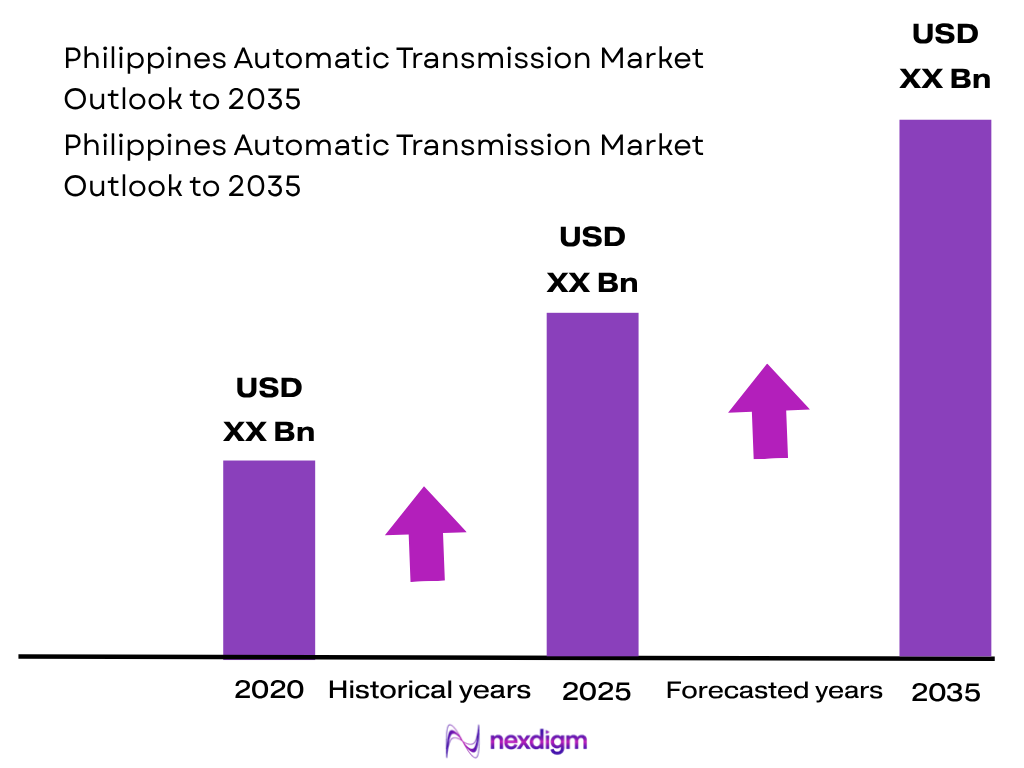
The Philippines Automatic Transmission Market is valued at approximately ~USD XX billion, based on the requested placeholder valuation. Demand is supported by expanding new-vehicle activity, with CAMPI-TMA reporting 467,252 vehicles sold in the latest annual observation compared with 429,807 vehicles in the preceding observation. Passenger-car sales increased from 109,264 units to 120,770 units, while commercial-vehicle sales expanded from 320,543 units to 346,482 units, supporting automatic transmission installation and aftermarket demand.
Metro Manila, CALABARZON and Central Luzon form the principal demand and supply clusters for the Philippines Automatic Transmission Market because they combine dense vehicle populations, dealerships, workshops, logistics infrastructure and automotive manufacturing. CALABARZON has 16.93 million residents, NCR has 14.00 million, and Central Luzon has 12.99 million. Laguna is additionally home to Toyota Motor Philippines’ manufacturing operation, which produced 60,098 locally manufactured vehicles in the latest reported annual period and operates a 60,000-unit annual production-capacity plant.
Market Segmentation
By Transmission Type
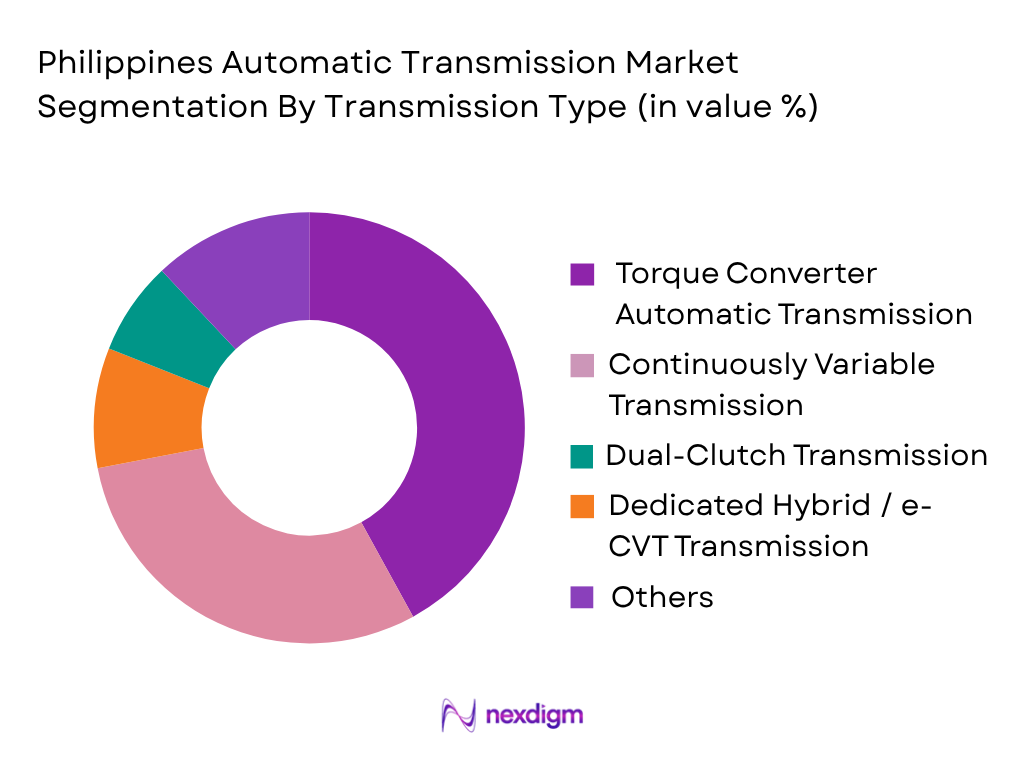
The Philippines Automatic Transmission Market is segmented into torque-converter automatic transmissions, continuously variable transmissions, dual-clutch transmissions, automated manual transmissions, dedicated hybrid and e-CVT systems, heavy-duty fully automatic transmissions and electric reduction drives. Torque-converter automatic transmissions hold the dominant modeled market share because they are extensively used across SUVs, pickups, MPVs, commercial vehicles and established passenger-vehicle platforms. Their ability to handle different torque requirements, combined with familiarity among local dealers and repair networks, supports their installed base. CVTs form the second major category because Japanese manufacturers have a strong position in the Philippines and use CVT technology extensively in passenger cars, compact SUVs and crossovers. The continuing strength of Toyota, Mitsubishi, Nissan, Suzuki and Honda also maintains demand for Japanese-developed automatic drivetrain technologies. Hybrid e-CVT and dedicated hybrid systems are becoming more relevant as electrified vehicles expand, while battery-electric models create a separate market for single-speed reduction gearsets. The transmission mix is therefore transitioning gradually rather than shifting away from conventional automatic systems immediately.
By Vehicle Type
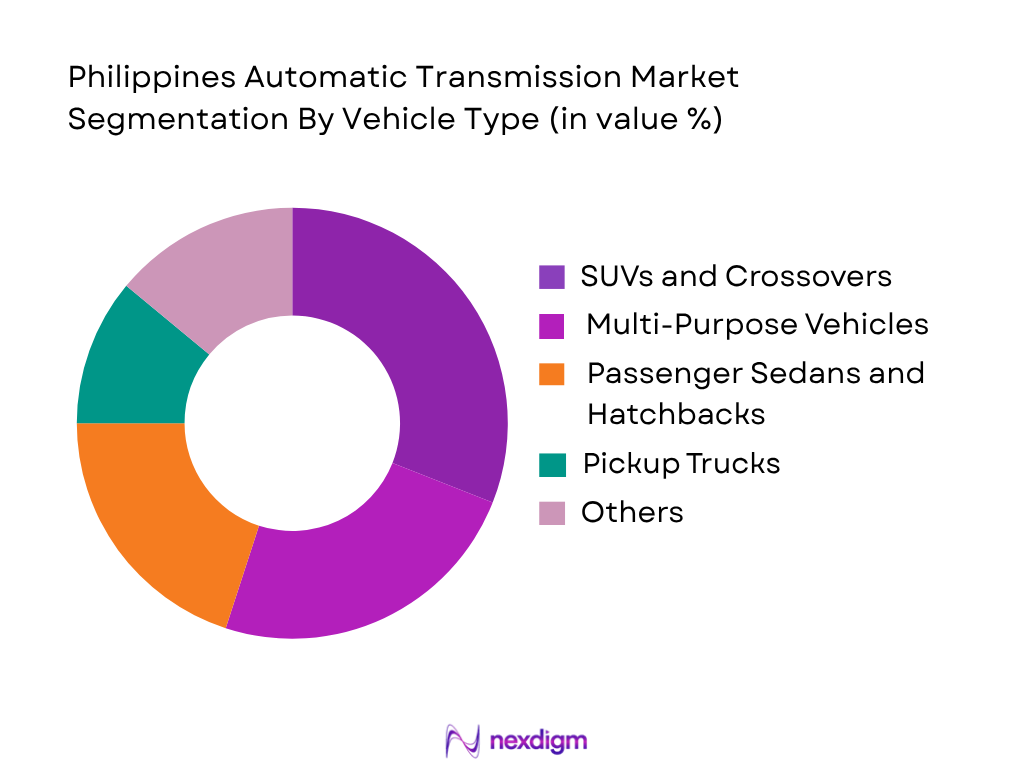
The Philippines Automatic Transmission Market is segmented by vehicle type into SUVs and crossovers, MPVs, passenger sedans and hatchbacks, pickup trucks, light commercial vehicles, medium and heavy commercial vehicles, buses and public utility vehicles, and electric vehicles. SUVs and crossovers hold the dominant modeled market share, reflecting strong Filipino demand for higher ground clearance, flexible passenger capacity, family utility and suitability for mixed urban and provincial road conditions. Commercial-oriented vehicle categories are especially significant in the national automotive market: CAMPI-TMA recorded 346,482 commercial vehicles sold compared with 120,770 passenger cars in the latest full-year dataset. SUVs, crossovers and pickups generally employ torque-converter automatics, CVTs or DCTs depending on brand and powertrain. MPVs are another major category because of family and fleet applications. Passenger sedans remain important, particularly for CVTs, while commercial vehicles support heavy-duty automatic and automated technologies. Electrified vehicles currently represent a smaller drivetrain base but are creating a new application segment for e-CVTs and electric reduction drives.
Competitive Landscape
The Philippines Automatic Transmission Market is characterized by global drivetrain suppliers integrated into Japanese, Korean, European and commercial-vehicle platforms sold or assembled locally. Aisin and JATCO benefit from the strong position of Japanese vehicle platforms, Hyundai Transys participates across automatic, DCT and hybrid architectures, ZF has broad exposure to premium, SUV and commercial applications, while Allison specializes in fully automatic commercial-vehicle transmissions. Competition increasingly centers on OEM fitment, CVT capability, hybridization, electric-drive readiness, ASEAN supply-chain reach and aftermarket technical support.
| Company | Establishment Year | Headquarters | Core Transmission Technology | Philippines Application Relevance | Hybrid Capability | EV Drivetrain Capability | ASEAN Supply Relevance | Aftermarket / Diagnostic Capability |
| Aisin Corporation | 1965 | Kariya, Aichi, Japan | ~ | ~ | ~ | ~ | ~ | ~ |
| JATCO Ltd. | 1999 | Fuji, Shizuoka, Japan | ~ | ~ | ~ | ~ | ~ | ~ |
| Hyundai Transys Inc. | 1994 | Seosan, South Korea | ~ | ~ | ~ | ~ | ~ | ~ |
| ZF Friedrichshafen AG | 1915 | Friedrichshafen, Germany | ~ | ~ | ~ | ~ | ~ | ~ |
| Allison Transmission Holdings Inc. | 1915 | Indianapolis, USA | ~ | ~ | ~ | ~ | ~ |
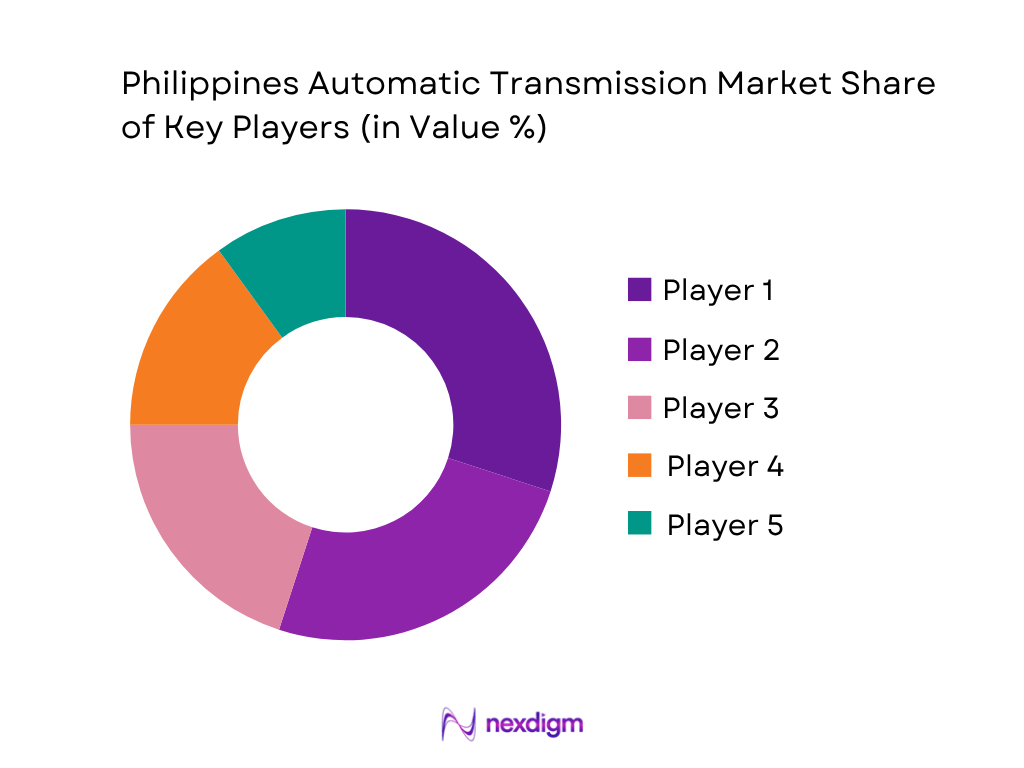
Philippines Automatic Transmission Market Analysis
Growth Drivers
Rising New-Vehicle Sales and Expanding Automatic-Equipped Vehicle Base
The Philippines Automatic Transmission Market is being driven by sustained expansion in new passenger and commercial vehicle demand, which directly increases factory-fit requirements for torque-converter automatics, CVTs, DCTs and hybrid transmission systems. According to CAMPI and TMA data reported through the Philippine News Agency, vehicle sales reached 467,252 units in 2024, compared with 429,807 units in 2023. Passenger-car sales reached 120,770 units, while commercial-vehicle sales totaled 346,482 units, indicating a substantial addressable base for automatic drivetrain installations across SUVs, MPVs, pickups and utility vehicles. The Philippine Statistics Authority also reported 14.56 million registered motor vehicles in 2024, up from 14.27 million in the preceding annual observation, expanding the installed base requiring transmission fluids, valve bodies, torque converters, electronic controls and replacement assemblies. Macroeconomic conditions support this automotive demand base: World Bank data place Philippine GDP at USD 461.62 billion in 2024 and GDP per capita at USD 3,984.8. The IMF separately reported Philippine nominal GDP at PHP 26,432 billion for 2024. These vehicle and macroeconomic indicators collectively support continued demand for automatic drivetrain systems across OEM, replacement and service channels.
Growth of Hybrid and Electric Vehicle Registrations Broadens Automatic Drivetrain Demand
Electrified vehicle adoption is creating an additional growth engine for the Philippines Automatic Transmission Market by expanding demand beyond conventional automatic gearboxes into e-CVTs, dedicated hybrid transmissions, reduction gears and integrated electric-drive units. Philippine Statistics Authority data sourced from the Land Transportation Office recorded 17,590 registered hybrid vehicles in 2024, compared with 6,155 units in 2023, while registered electric vehicles reached 6,697 units, compared with 1,359 units previously. The transition continued into 2025: the Department of Energy reported 29,715 electric vehicles registered from January to July 2025, already exceeding the 24,286 electric vehicles registered during full-year 2024 under its broader EV classification. This expansion is important because hybrid vehicles retain sophisticated transmission functions through power-split e-CVTs, dedicated hybrid gearboxes and electrified clutch systems, while BEVs create demand for reduction gears, differentials, bearings and e-drive assemblies. The macroeconomic environment provides additional capacity for adoption, with World Bank data showing Philippine GDP at USD 461.62 billion in 2024 and the IMF reporting USD 113.3 billion in gross international reserves. Increasing electrified registrations therefore broaden the addressable drivetrain technology mix while preserving demand for conventional automatic systems across the much larger ICE vehicle base.
Market Challenges
High Dependence on Imported Transmission Assemblies and Drivetrain Components
Import dependence remains a major structural challenge for the Philippines Automatic Transmission Market because complete transmissions, precision drivetrain components, electronic control modules and many specialized replacement parts continue to be sourced through international supply chains. The Philippine Statistics Authority recorded USD 127.60 billion of merchandise imports in 2024, including USD 11.36 billion of transport equipment imports. Imports from Japan reached USD 10.11 billion, South Korea supplied USD 9.63 billion, Indonesia supplied USD 10.64 billion, and China supplied USD 32.83 billion, highlighting the country’s exposure to Asian manufacturing networks that also serve the automotive industry. The Board of Investments and Bureau of Customs specifically initiated work in 2024 to streamline customs procedures for imported motor-vehicle parts, demonstrating the operational importance of imported components to domestic assemblers and distributors. This dependence affects automatic transmissions particularly strongly because CVT pulleys and belts, torque converters, clutch modules, valve bodies, planetary gears, sensors and transmission control units require precision manufacturing capabilities. Macroeconomic scale does not remove this supply constraint: World Bank data show Philippine GDP of USD 461.62 billion in 2024, while PSA recorded a merchandise trade deficit of USD 54.33 billion. Greater domestic component depth is therefore needed to reduce drivetrain supply vulnerability.
Rapid Drivetrain Electrification Creates Technology and Aftermarket Capability Gaps
The transition toward hybrid and battery-electric vehicles presents a technology challenge because the Philippines’ transmission aftermarket must increasingly service both conventional hydraulic gearboxes and newer electrified drivetrain architectures. PSA data show 17,590 hybrid vehicles and 6,697 electric vehicles registered in 2024, compared with 6,155 hybrids and 1,359 EVs in the preceding annual observation. The Department of Energy subsequently recorded 29,715 EV registrations from January through July 2025, demonstrating that drivetrain diversity is increasing rapidly. Traditional workshops accustomed to torque-converter automatics and basic CVT maintenance must therefore develop capabilities in high-voltage systems, electronic power-split transmissions, integrated motor-generators, electric reduction units and advanced mechatronic controls. The challenge is amplified by the scale of the legacy fleet: PSA reported 14.56 million registered vehicles in 2024, including 11.45 million gasoline-powered vehicles and 3.08 million diesel-powered vehicles. Service networks must consequently support older ICE transmissions while simultaneously investing in hybrid and EV diagnostic readiness. The broader economy provides a large service market, with World Bank data placing GDP at USD 461.62 billion and GDP per capita at USD 3,984.8 in 2024. Managing this dual technology base increases training, equipment, inventory and technical-support requirements across the automatic transmission aftermarket.
Market Opportunities
Localization of Transmission Components and Precision Drivetrain Manufacturing
The Philippines has a clear future opportunity to increase local production of transmission components, housings, gears, shafts, bearings, electronic modules and electric-drive subassemblies as vehicle manufacturing and supporting industries deepen. Current industrial indicators provide a foundation for this opportunity. Philippine automotive assemblers sold 467,252 vehicles in 2024, while the national registered vehicle base reached 14.56 million units, providing sufficient OEM and aftermarket demand to justify greater component localization. The Board of Investments identifies motor-vehicle parts and components as eligible manufacturing activities and allows qualifying new vehicle-manufacturing projects involving at least PHP 200 million of new investment under applicable industry frameworks. At the same time, PSA recorded USD 11.36 billion of transport-equipment imports in 2024, illustrating the scale of imported automotive products that creates room for import substitution in technically feasible component categories. Transmission localization can initially focus on housings, machined gears, shafts, seals, cooling components and selected electronics before progressing toward complete assemblies. The macroeconomic base supports industrial investment: World Bank data place Philippine GDP at USD 461.62 billion in 2024, while IMF data put nominal GDP at PHP 26,432 billion. These current indicators support future expansion of local drivetrain manufacturing, supplier development and ASEAN-oriented transmission component production.
Hybrid e-CVT, Electric Reduction Gear and E-Drive Systems Create New Technology Opportunities
The expansion of electrified mobility creates a forward-looking opportunity for drivetrain suppliers to participate in hybrid e-CVTs, dedicated hybrid transmissions, electric reduction gears, integrated e-axles, differentials and associated control electronics. Current registration data already establish the basis for this opportunity without relying on future projections. PSA recorded 17,590 hybrid vehicles and 6,697 electric vehicles in 2024, while the Department of Energy reported that registered EVs reached 29,715 units during January–July 2025 under its updated EV monitoring framework. The DOE also stated that 24,286 EVs were registered during full-year 2024, reflecting the broader vehicle classifications covered in its regulatory dataset. These figures indicate that drivetrain suppliers increasingly need portfolios spanning conventional AT, CVT, hybrid power-split and fully electric reduction systems. The opportunity is reinforced by industrial policy: the Board of Investments recognizes manufacturing and assembly of electric and alternative-fuel vehicles as eligible activities and explicitly includes motor-vehicle parts and components within its manufacturing-development framework. Macroeconomic capacity further supports investment in these technologies, with World Bank data placing Philippine GDP at USD 461.62 billion in 2024 and the IMF reporting USD 113.3 billion in gross reserves. Suppliers that develop hybrid transmission, reduction-gear, e-drive and diagnostic capabilities can therefore address a progressively broader Philippine drivetrain ecosystem.
Future Outlook
The Philippines Automatic Transmission Market is forecast to expand at approximately ~X.X% CAGR during 2026–2035, using the requested placeholder forecast. Market development will increasingly involve a coexistence of conventional torque-converter automatics and CVTs with hybrid e-CVTs, dedicated hybrid transmissions and electric reduction-drive technologies. Conventional automatic transmissions should remain important because the Philippines continues to add substantial volumes of ICE-powered passenger cars, SUVs, MPVs, pickups and commercial vehicles. The latest CAMPI-TMA annual sales reached 467,252 units, creating a continuing stream of factory-fitted automatic transmissions and a growing future aftermarket base.
Hybridization will broaden the technology mix rather than immediately eliminate conventional transmission demand. Philippine Statistics Authority data sourced from the Land Transportation Office show registered hybrid vehicles rising from 6,155 units to 17,590 units, while registered electric vehicles increased from 1,359 units to 6,697 units between the latest two annual observations. These additions create demand for e-CVTs, power-split systems, integrated electric drivetrains and single-speed reduction gearsets.
Major Players
- Aisin Corporation – Automatic / CVT / Hybrid and e-Axle Systems
- JATCO Ltd. – CVT / Automatic / Electrified Transmission Systems
- Hyundai Transys Inc. – Automatic / DCT / Hybrid Transmissions
- ZF Friedrichshafen AG – Automatic / Hybrid / Electrified Drivetrain Systems
- BorgWarner Inc. – DCT / Hybrid / Electrified Drivetrain Systems
- Magna International – DCT / Hybrid Transmission / E-Drive Systems
- Schaeffler AG – Hybrid Transmission / E-Mobility Systems
- Valeo SE – Torque Converter / Clutch / Electrified Transmission Systems
- GKN Automotive – eDrive / Integrated Electric Drivetrain Systems
- Dana Incorporated – Spicer / Commercial and Electrified Drivetrain Systems
- Allison Transmission Holdings Inc. – Fully Automatic Commercial Vehicle
- Transmissions
- Punch Powertrain N.V. – CVT / DCT / Dedicated Hybrid Transmissions
- Toyota Motor Corporation – Automatic / Hybrid e-CVT / Power-Split Transmission Systems
- Honda Motor Co., Ltd. – CVT / e Electrified Drivetrain Systems
- Mitsubishi Motors Corporation – CVT / Automatic / Plug-in Hybrid Drivetrain Systems
Key Target Audience
- Automatic Transmission and Electrified Drivetrain Manufacturers
- Passenger Vehicle, SUV, MPV and Commercial Vehicle OEMs
- Automotive Tier-1 and Tier-2 Component Manufacturers
- Vehicle Importers, Authorized Distributors and Dealer Groups
- Transmission Remanufacturers, Parts Distributors and Automotive Service Networks
- Fleet, Ride-Hailing, Rental, Logistics and Public Utility Vehicle Operators
- Investments and Venture Capitalist Firms
- Government and Regulatory Bodies (Department of Trade and Industry, Board of Investments, Department of Transportation, Land Transportation Office, Department of Energy, Bureau of Customs)
Research Methodology
Step 1: Identification of Key Variables
The initial phase involves developing an ecosystem map encompassing transmission manufacturers, passenger and commercial vehicle OEMs, Philippine assemblers, vehicle importers, component manufacturers, dealerships and aftermarket participants. Extensive secondary research is used to identify critical variables including transmission architecture, vehicle type, propulsion system, local assembly, CBU imports, hybridization, electrification, replacement cycles and transmission service requirements.
Step 2: Market Analysis and Construction
Historical market analysis combines top-down automotive indicators with bottom-up vehicle-platform mapping. New vehicle sales, vehicle production, registrations, local assembly and import activity are assessed alongside model-level transmission fitment. Each major passenger car, SUV, MPV, pickup and commercial platform is mapped to torque-converter AT, CVT, DCT, hybrid transmission or electric reduction-drive architecture to construct market estimates.
Step 3: Hypothesis Validation and Expert Consultation
Market hypotheses are validated through computer-assisted telephone interviews and structured discussions with vehicle distributors, drivetrain suppliers, parts manufacturers, transmission specialists, fleet operators and automotive service providers. These consultations assess actual transmission fitment patterns, replacement behavior, common failure points, CVT and DCT service requirements, aftermarket parts availability, hybrid adoption and the readiness of workshops for increasingly electronic drivetrain systems.
Step 4: Research Synthesis and Final Output
The final stage triangulates top-down automotive indicators with bottom-up platform and transmission data. Findings are reconciled across OEM fitment, locally assembled vehicles, imported vehicles, aftermarket requirements and electrified drivetrain adoption. This process produces an integrated assessment of conventional automatics, CVTs, DCTs, hybrid transmissions, heavy-duty automatic systems and electric reduction drives within the Philippines Automatic Transmission Market.

- Executive Summary
- Research Methodology (Market Definition and Scope, Philippines Automatic Transmission Taxonomy, Transmission Architecture Classification, Vehicle Powertrain Mapping, OEM Platform and Transmission Fitment Mapping, Passenger and Commercial Vehicle Application Assessment, SUV and MPV Transmission Assessment, Hybrid and Electric Drivetrain Mapping, Transmission Component and Sub-System Assessment, Local Assembly and CBU Import Dependency Assessment, Aftermarket and Remanufacturing Assessment, Market Sizing Framework)

- Definition and Scope
- Philippines Automatic Transmission Industry Evolution and Technology Development
- Automatic Transmission Manufacturing and Assembly Process
- Automatic Transmission Value Chain Analysis
- Philippines Automatic Transmission Supply Chain Analysis
- Transmission Component, Mechatronics and Drivetrain Ecosystem Analysis
- Philippines Automatic Transmission Import Dependency and Localization Assessment
- OEM Transmission Fitment Architecture and Aftermarket Service Framework

- Growth Drivers (Increasing Automatic Transmission Penetration, Expansion of SUV and Crossover Demand, Strong MPV and Passenger Vehicle Demand, Increasing CVT Fitment in Japanese Vehicle Platforms, Growth of Hybrid Vehicle Registrations, Expansion of Locally Assembled Vehicle Production, Increasing Urban Mobility Demand, Growth of Fleet and Ride-Hailing Applications)
- Market Challenges (High Dependence on Imported Transmission Assemblies, Limited Domestic Precision Drivetrain Manufacturing, Dependence on ASEAN and Japanese Supply Chains, Advanced CVT and DCT Repair Complexity, Transmission Mechatronics Diagnostic Constraints, Skilled Technician Availability, Counterfeit and Non-OEM Replacement Parts, EV Substitution of Conventional Multi-Speed Transmissions)
- Market Opportunities (Hybrid e-CVT and Dedicated Hybrid Transmissions, Localized Transmission Component Manufacturing, Electric Reduction Gear Units, Integrated E-Axles, CVT Remanufacturing and Repair, Commercial Vehicle Automatic Transmissions, Transmission Electronics and Diagnostics, ASEAN Drivetrain Supply-Chain Integration)
- Market Trends (CVT Expansion in Mass-Market Passenger Cars, Multi-Speed Torque-Converter Adoption in SUVs and Pickups, Hybrid e-CVT Growth, Electrified DCT Development, Shift-by-Wire Systems, Integrated Mechatronics, Electric Reduction Drive Adoption, Software-Controlled Drivetrain Optimization)
- Regulatory and Standards Landscape (Department of Trade and Industry Automotive Policies, Board of Investments Automotive Development Programs, Comprehensive Automotive Resurgence Strategy Program, Comprehensive Motor Vehicle Development Program, Electric Vehicle Industry Development Act, Department of Energy EV Classification Framework, Land Transportation Office Vehicle Registration Requirements, Bureau of Customs Vehicle Import Regulations, ASEAN Automotive Trade Framework)
- SWOT Analysis
- Porter’s Five Forces Analysis
- PESTLE Analysis
- Stakeholder Ecosystem
- Competition Ecosystem

- By Market Value (2020-2025)
- By Automatic Transmission Installation Volume (2020-2025)
- By New Vehicle Automatic Transmission Fitment Volume (2020-2025)
- By Locally Assembled Vehicle Transmission Volume (2020-2025)
- By CBU Imported Vehicle Transmission Volume (2020-2025)
- By Passenger Vehicle Transmission Volume (2020-2025)
- By Commercial Vehicle Transmission Volume (2020-2025)
- By Average Selling Price (2020-2025)
- By Hybrid Transmission Volume (2020-2025)
- By Electric Reduction Gear and E-Drive Volume (2020-2025)

- By Transmission Type (In Value %)
Torque Converter Automatic Transmission
Continuously Variable Transmission
Dual-Clutch Transmission
Automated Manual Transmission
Dedicated Hybrid Transmission
Electronic Continuously Variable Transmission
Hybrid Dual-Clutch Transmission
Planetary Power-Split Hybrid Transmission
Heavy-Duty Fully Automatic Transmission
Electric Single-Speed Reduction Gear
Multi-Speed Electric Vehicle Transmission
Other Automatic Drivetrain Architectures - By Vehicle Type (In Value %)
Passenger Sedans
Hatchbacks and Compact Cars
SUVs and Crossovers
Multi-Purpose Vehicles
Pickup Trucks
Light Commercial Vehicles
Medium Commercial Vehicles
Heavy Commercial Vehicles
Buses and Coaches
Public Utility Vehicles
Fleet and Rental Vehicles
Electric Passenger Vehicles
Electric Commercial Vehicles - By Propulsion Type (In Value %)
Petrol Internal Combustion Vehicles
Diesel Internal Combustion Vehicles
Mild Hybrid Vehicles
Full Hybrid Vehicles
Plug-in Hybrid Vehicles
Battery Electric Vehicles
Range-Extended Electric Vehicles
Alternative-Fuel Commercial Vehicles - By Gear Configuration (In Value %)
Single-Speed Electric Reduction Gear
4-Speed Automatic Transmission
5-Speed Automatic Transmission
6-Speed Automatic Transmission
7-Speed Automatic Transmission
8-Speed Automatic Transmission
9-Speed Automatic Transmission
10-Speed Automatic Transmission
Variable-Ratio CVT
Power-Split e-CVT
Multi-Speed Electrified Transmission - By Sales Channel (In Value %)
OEM Factory-Fitted Transmission
Tier-1 Direct Supply
Authorized OEM Replacement Channel
Authorized Automotive Dealer Networks
Transmission Specialist Workshops
Independent Automotive Aftermarket
Remanufactured and Reconditioned Transmission Suppliers
Independent Repair Garages
Automotive Parts Distributors
Online Automotive Parts Platforms
Fleet Maintenance and Service Contracts - By Region (In Value %)
National Capital Region
Metro Manila
CALABARZON
Laguna Automotive Manufacturing Cluster
Batangas Automotive and Logistics Cluster
Central Luzon
Clark–Subic Corridor
Central Visayas
Metro Cebu
Western Visayas
Metro Davao
Northern Mindanao
Other Philippines

- Market Share of Major Players (By Revenue, Installation Volume, Transmission Type, Vehicle Type, Propulsion Type, OEM Fitment, Local Assembly Platform, Aftermarket Presence)
- Cross Comparison Parameters (Philippines OEM Fitment and Local Assembly Footprint, Automatic Transmission Architecture Breadth, CVT and DCT Technology Capability, Hybrid e-CVT and Dedicated Hybrid Transmission Capability, Electric Reduction Gear and E-Axle Capability, Passenger Commercial and Public Utility Vehicle Application Coverage, Philippines and ASEAN Supply Localization Capability, Aftermarket Remanufacturing Diagnostics and Technical Support Network)
- SWOT Analysis of Major Players
- Competitive Positioning Matrix
- Product and Technology Portfolio Benchmarking
- Pricing and Distribution Network Benchmarking
- Market Entry Strategy Assessment
- Detailed Profiles of Major Companies
Aisin Corporation – Automatic / CVT / Hybrid and e-Axle Systems
JATCO Ltd. – CVT / Automatic / Electrified Transmission Systems
Hyundai Transys Inc. – Automatic / DCT / Hybrid Transmissions
ZF Friedrichshafen AG – Automatic / Hybrid / Electrified Drivetrain Systems
BorgWarner Inc. – DCT / Hybrid / Electrified Drivetrain Systems
Magna International – DCT / Hybrid Transmission / E-Drive Systems
Schaeffler AG – Hybrid Transmission / E-Mobility Systems
Valeo SE – Torque Converter / Clutch / Electrified Transmission Systems
GKN Automotive – eDrive / Integrated Electric Drivetrain Systems
Dana Incorporated – Spicer / Commercial and Electrified Drivetrain Systems
Allison Transmission Holdings Inc. – Fully Automatic Commercial Vehicle Transmissions
Punch Powertrain N.V. – CVT / DCT / Dedicated Hybrid Transmissions
Toyota Motor Corporation – Automatic / Hybrid e-CVT / Power-Split Transmission Systems
Honda Motor Co., Ltd. – CVT / e Electrified Drivetrain Systems
Mitsubishi Motors Corporation – CVT / Automatic / Plug-in Hybrid Drivetrain Systems

- Buyer Segmentation
- OEM Procurement Behaviour
- Supplier Selection Criteria
- Buyer Pain Points
- Technology Adoption Assessment
- Replacement and Repurchase Behaviour

- By Market Value (2026-2035)
- By Automatic Transmission Installation Volume (2026-2035)
- By New Vehicle Automatic Transmission Fitment Volume (2026-2035)
- By Locally Assembled Vehicle Transmission Volume (2026-2035)
- By CBU Imported Vehicle Transmission Volume (2026-2035)
- By Passenger Vehicle Transmission Volume (2026-2035)
- By Commercial Vehicle Transmission Volume (2026-2035)
- By Average Selling Price (2026-2035)
- By Hybrid Transmission Volume (2026-2035)
- By Electric Reduction Gear and E-Drive Volume (2026-2035)


 Request a Sample
 Ask for Customization
 Get a Quote
 Enquire Now