
 Download PDF
Market Overview
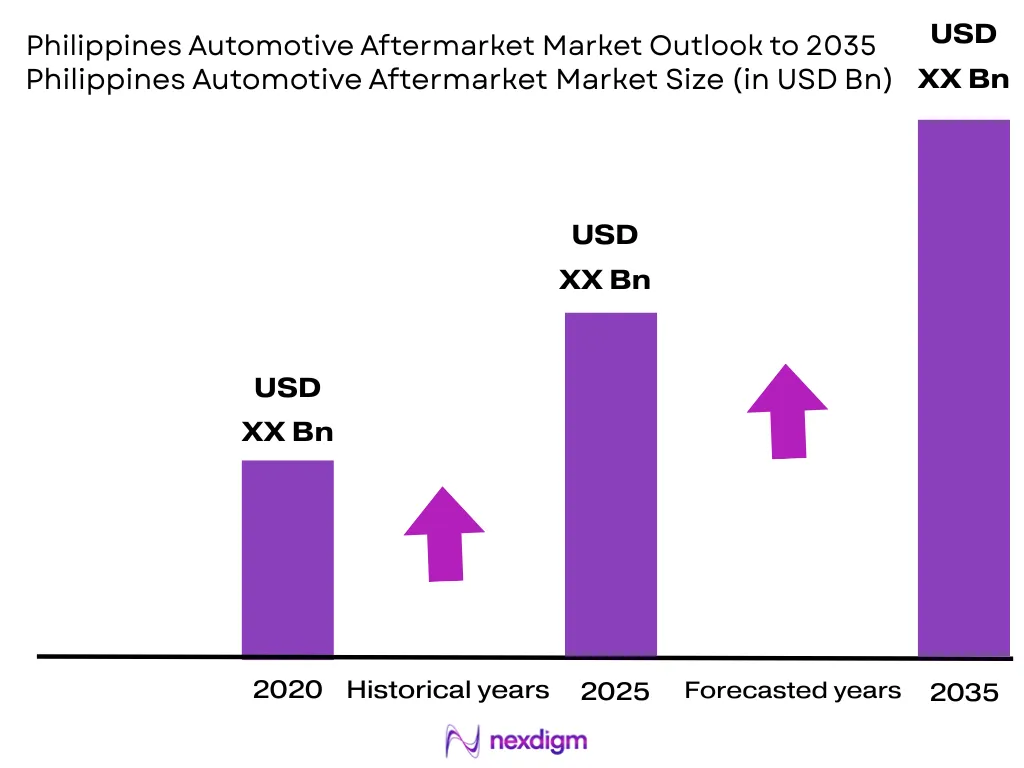
The Philippines Automotive Aftermarket Market is valued at approximately ~ billion, compared with ~ billion in the preceding reporting period. Demand is supported by registered vehicles increasing from 14.27 million to 14.56 million, including 11.45 million gasoline-powered units. New automotive sales also increased from 429,807 units to 467,252 units, enlarging the future pool of vehicles requiring tires, batteries, lubricants, filters, brakes, mechanical repairs and diagnostic services.
Metro Manila, CALABARZON, Central Luzon, Cebu and Davao dominate the Philippines Automotive Aftermarket Market because they combine dense vehicle populations, automotive dealerships, repair workshops, parts warehouses and commercial fleets. Makati recorded per-capita economic output of PHP 3,889,202, while the national household population reached 112.33 million. Metro Manila benefits from intensive taxi, transport-network and delivery activity, whereas CALABARZON concentrates automotive assembly, component manufacturing and regional distribution infrastructure.
The Philippines automotive aftermarket comprises replacement components and services required after a vehicle enters operation. It covers preventive maintenance, mechanical repairs, tires, batteries, lubricants, electrical systems, collision repair, air-conditioning services, motorcycle servicing, public utility vehicle maintenance, vehicle accessories and digitally enabled diagnostics.
Market Segmentation
By Aftermarket Offering
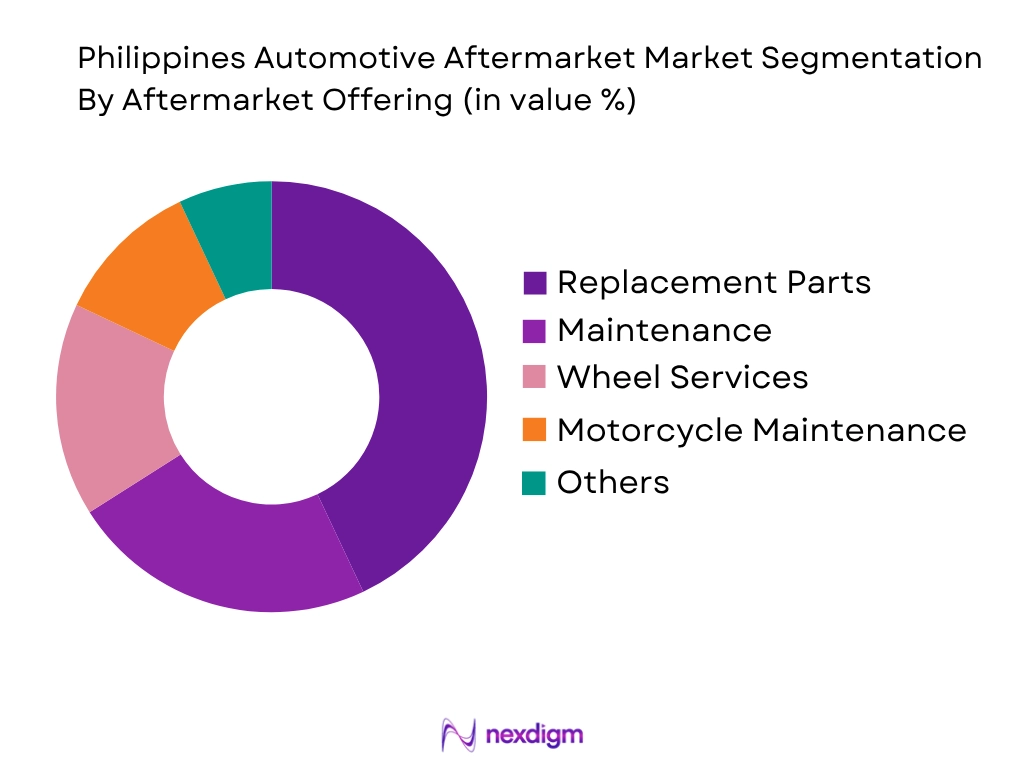
The Philippines Automotive Aftermarket Market is segmented into replacement parts, maintenance and mechanical repair, tires and wheel services, batteries and electrical services, lubricants and fluids, motorcycle services, collision repair, and accessories and car care. Replacement parts hold the dominant market share, because nearly every scheduled service, breakdown repair or collision job requires components or consumables.
The country’s 14.56 million registered vehicles create recurring demand for filters, brake products, batteries, tires, suspension components, belts, hoses, cooling parts and electrical items. Replacement-parts demand is also supported by extended vehicle retention and a wide price architecture covering genuine, original-equipment-supplier, branded aftermarket, economy, locally fabricated, reconditioned and surplus components. Independent workshops commonly source several alternatives for the same application, allowing owners to align repair decisions with vehicle age and available budget. Frequent motorcycle usage and intensive commercial operation of taxis, jeepneys and delivery vehicles further increase unit replacement volumes.
By Vehicle Type
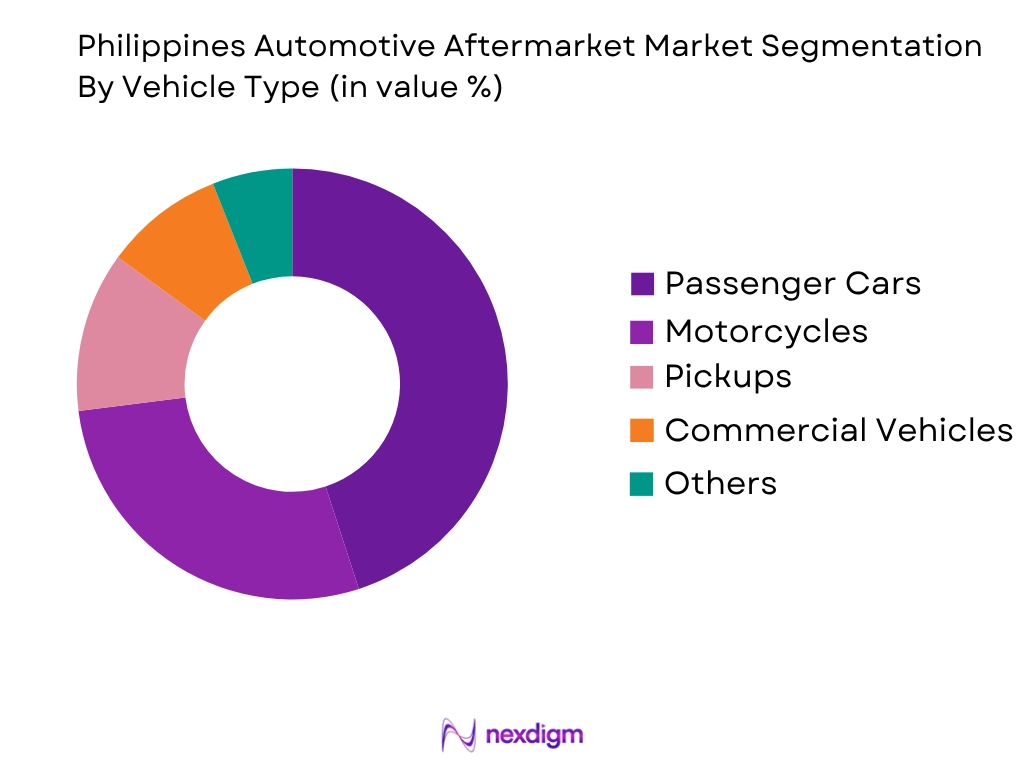
The Philippines Automotive Aftermarket Market is segmented into passenger cars and SUVs, motorcycles and scooters, pickups and Asian utility vehicles, light commercial vehicles, jeepneys and public utility vehicles, heavy commercial vehicles, and buses and specialized vehicles. Passenger cars and SUVs hold the dominant revenue share, supported by higher component content, larger repair invoices and widespread household and corporate usage.
Passenger vehicles require periodic oil changes, filters, brake servicing, tires, batteries, suspension repairs, air-conditioning maintenance and electronic diagnosis. Their increasing technical sophistication also expands expenditure on sensors, control modules and advanced driver-assistance components. Motorcycles generate a greater number of low-value service transactions, but passenger cars generally produce higher revenue per repair order. Pickups and utility vehicles are also strategically important because they support family transportation, construction, agriculture and small-business logistics. Meanwhile, jeepneys, taxis and delivery fleets generate concentrated demand through high daily mileage and downtime-sensitive maintenance requirements.
Competitive Landscape
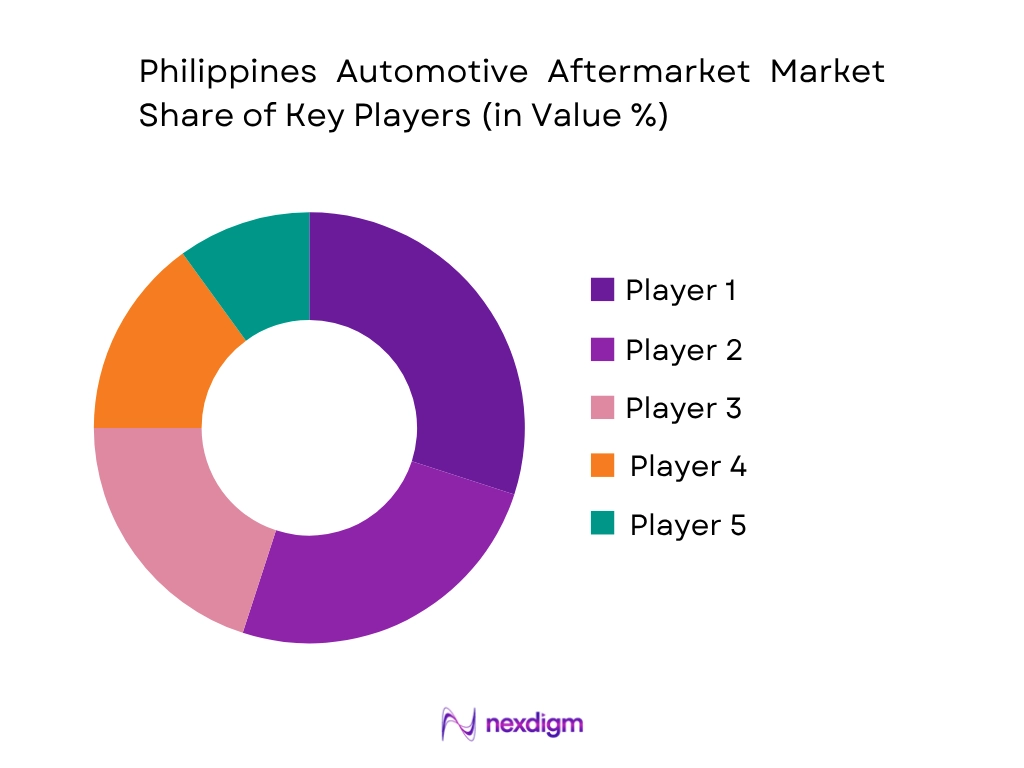
The Philippines Automotive Aftermarket Market is fragmented between workshop chains, fuel-station service networks, tire and battery specialists, automotive retailers and thousands of independent garages. Rapidé and Motech compete through organized multi-brand service formats, while Petron Car Care Center and Shell Helix Oilchange+ leverage fuel and lubricant ecosystems. Motolite holds a strong position in battery manufacturing, distribution and roadside replacement. Competition is increasingly based on branch accessibility, service standardization, parts availability, technician capability and digital booking.
| Company | Establishment Year | Headquarters | Business Model | Core Aftermarket Offering | Network Position | Vehicle Coverage | Digital Capability | Market-Specific Strength |
| Rapidé Auto Service Experts | 1998 | Metro Manila, Philippines | ~ | ~ | ~ | ~ | ~ | ~ |
| Motech Automotive Philippines | 1977 heritage | Metro Manila, Philippines | ~ | ~ | ~ | ~ | ~ | ~ |
| Petron Car Care Center | 1990s | Mandaluyong, Philippines | ~ | ~ | ~ | ~ | ~ | ~ |
| Shell Helix Oilchange+ | 2010s | Taguig, Philippines | ~ | ~ | ~ | ~ | ~ | ~ |
| Motolite | 1919 | Santa Maria, Bulacan, Philippines | ~ | ~ | ~ | ~ | ~ | ~ |
Philippines Automotive Aftermarket Market Analysis
Growth Drivers
Expanding Vehicle Parc and High-Intensity Road Mobility
The continued expansion of the Philippines’ operating vehicle base is a primary driver of replacement-parts consumption and workshop activity. Philippine Statistics Authority data show that registered motor vehicles increased from 14.27 million units in 2023 to 14.56 million units in 2024, adding approximately 290,000 vehicles to the serviceable parc. Gasoline-powered vehicles accounted for 11.45 million units, ensuring sustained demand for engine oils, filters, spark plugs, batteries, cooling components, belts, hoses and fuel-system parts. The fleet also contains large motorcycle, utility-vehicle, public-transport and commercial-vehicle populations that experience intensive operating conditions. Motorcycles used for commuting, food delivery and courier services require frequent replacement of tires, chains, sprockets, brake components and lubricants, while taxis, transport-network vehicles, jeepneys and delivery vans generate high annual mileage and downtime-sensitive maintenance needs. The national road system reinforces this demand. The Department of Public Works and Highways recorded 35,664.45 kilometres of national roads, including 21,548.37 kilometres of concrete roads and 13,868.80 kilometres of asphalt roads. In addition, the department completed 399 kilometres of road sections and 79 bridges as of May 2024, improving connectivity and enabling greater intercity vehicle movement. Expanding road access increases vehicle utilization in provincial cities and logistics corridors, but it also exposes vehicles to congestion, heat, flooding, uneven road surfaces and extended travel distances. These conditions accelerate brake, tire, suspension, battery and cooling-system wear. The macroeconomic environment further supports mobility-linked demand. The Philippine economy expanded by 5.7% in 2024, supported by household consumption, services and public investment. The IMF subsequently projected real GDP growth of approximately 4.1% in 2026, while the national population was estimated at 115.299 million people. A large and growing population increases demand for personal transport, commercial deliveries and public mobility. Aftermarket activity benefits from both newly registered vehicles entering scheduled maintenance cycles and older vehicles migrating from authorized dealerships to independent workshops after warranties expire. Consequently, vehicle-parc expansion produces a cumulative aftermarket effect rather than a one-time sales opportunity, supporting recurring demand across Metro Manila, CALABARZON, Central Luzon, Cebu, Davao and secondary provincial markets.
Growth of Trade, Delivery, Public Transport and Commercial Fleet Utilization
Increasing commercial mobility is strengthening the Philippines automotive aftermarket by creating concentrated demand from vehicles that operate for longer hours than privately owned cars. The wholesale and retail trade, including repair of motor vehicles and motorcycles, remained a leading contributor to national economic activity during 2025. Philippine Statistics Authority data show that this industry expanded by 6.4% in the first quarter, 5.1% in the second quarter, 5.0% in the third quarter and 4.6% in the fourth quarter of 2025. For the full year, wholesale and retail trade and motor-vehicle repair grew by 5.2%, demonstrating the continuing scale of commercial activity linked to vehicle usage, parts distribution and maintenance services. Household transport expenditure also expanded by 11.2% in the second quarter of 2025, indicating intensive spending on mobility, fuel, fares and vehicle operation. Delivery motorcycles, vans, taxis, transport-network vehicles and logistics trucks operate under stop-start traffic conditions that increase brake wear, battery cycling, engine idling, cooling-system stress and tire replacement. Public utility vehicles have similarly demanding operating patterns because they complete repeated routes, carry multiple passengers and depend on daily availability for operator income. The country’s automotive sales base is also feeding future commercial aftermarket demand. New vehicle sales increased from 429,807 units in 2023 to 467,252 units in 2024, adding vehicles that will progressively require preventive maintenance, replacement components and collision repair. Road infrastructure development is widening the operational footprint of fleets. DPWH’s national network covers more than 35,600 kilometres, while road and bridge projects continue to connect industrial estates, ports, urban centers and agricultural areas. The Philippines’ archipelagic structure creates an additional aftermarket requirement because commercial operators depend on vehicles at both ends of inter-island shipping routes. Warehousing and distribution businesses therefore require regional stocks of tires, batteries, filters, brake products and drivetrain components in Luzon, Visayas and Mindanao. Macroeconomic indicators provide a continuing demand base despite slower overall growth. GDP expanded by 4.4% in 2025, while services grew by 5.9% and household final consumption increased by 3.8% in the fourth quarter. Commercial fleets generally cannot defer essential repairs without disrupting revenue-generating operations. This makes preventive maintenance contracts, mobile servicing, roadside assistance and same-day parts delivery attractive opportunities for organized aftermarket operators.
Market Challenges
Increasing Technical Complexity of Electric, Hybrid and Connected Vehicles
The transition toward electrified and electronically sophisticated vehicles is creating a technical challenge for independent workshops, parts distributors and provincial repair businesses. Philippine Statistics Authority data show that registered electric vehicles increased from 1,359 units in 2023 to 6,697 units in 2024, while registered hybrid vehicles rose from 6,155 units to 17,590 units. Department of Energy records subsequently identified 29,715 electric vehicles registered from January to July 2025, indicating that the population requiring specialized support was expanding rapidly. These vehicles introduce traction batteries, high-voltage wiring, battery-management systems, inverters, onboard chargers, electric compressors, regenerative braking and dedicated thermal-management circuits. Traditional workshops equipped mainly for gasoline and diesel repairs cannot safely service these systems without insulated tools, personal protective equipment, voltage-testing devices, secure isolation areas and formal shutdown procedures. The challenge also extends beyond electric propulsion. New gasoline, diesel and hybrid models increasingly incorporate electronic control units, cameras, radar sensors, digital instrument clusters and software-based fault management. Collision repairs, wheel alignments, windscreen replacements and suspension work may therefore require sensor calibration or electronic initialization before a vehicle can be returned to service. The Department of Energy updated EV recognition guidelines in 2025 under the Electric Vehicle Industry Development Act, strengthening the formal framework for recognizing vehicles and charging technologies. The agency also reaffirmed that EVs and charging stations must comply with national safety requirements. These measures support orderly market development but increase the compliance and technical expectations placed on service operators. Charging infrastructure is also widening, with accredited charging-station providers listed through the DOE’s official EV framework into 2026. The macroeconomic environment can make capability investment difficult for smaller businesses. The Philippine economy expanded by 4.4% in 2025, below the preceding year’s growth, while the IMF projected 4.1% growth in 2026 and consumer-price growth of 4.3%. Workshops must therefore finance equipment, software subscriptions and technician training during a period of moderated economic expansion. Businesses that cannot upgrade may outsource complex repairs to dealerships or specialist centers, extending turnaround times and reducing their share of higher-value work.
Uneven Technical Skills and Limited Advanced Workshop Capability
The availability of technicians trained in vehicle electronics, hybrid systems, high-voltage safety and advanced diagnostics remains a significant constraint on the Philippines automotive aftermarket. The country’s repair ecosystem includes authorized workshops, organized service chains, fuel-station service centers, motorcycle shops, independent garages and informal mechanics. This structure provides broad geographic access, but technical standards and equipment capability differ materially between Metro Manila, major regional cities and rural municipalities. The workload is substantial: workshops must support 14.56 million registered vehicles, including 11.45 million gasoline-powered units, thousands of hybrid and electric vehicles, and large populations of motorcycles and public utility vehicles. Technicians therefore need to maintain conventional engines, transmissions and diesel systems while learning battery diagnostics, electronic fault tracing, sensor calibration and software-controlled repairs. TESDA’s manufacturing-sector skills assessment identified automotive servicing for hybrid vehicles as an emerging technical requirement in 2024, alongside electrical maintenance, robotics, firmware development and sensor-related competencies. The same assessment documented gaps in available programs, assessment facilities and qualified personnel for several advanced manufacturing and maintenance occupations. In response, TESDA and Honda opened a training facility in July 2024 for motorcycle and automotive maintenance and repair services. TESDA also conducted international benchmarking on EV training in February 2024 to improve domestic capability. These actions confirm both the demand for new skills and the limited availability of mature training pathways. Existing qualifications illustrate the time required to develop technicians: Automotive Servicing NC I involves 156 training hours, Automotive Servicing NC II requires 676 hours, Automotive Servicing NC III requires 526 hours, and motorcycle or small-engine servicing can require 278 hours. Training alone does not create immediate productivity because graduates need supervised workshop experience and exposure to multiple vehicle brands. The challenge is more acute outside Luzon’s major industrial corridors, where diagnostic tools, replacement electronic modules and specialist trainers are less accessible. The national economy grew by 5.7% in 2024 and 4.4% in 2025, while vehicle registrations continued to increase, creating a faster-growing technical workload. Without wider certification, shared diagnostic centers and manufacturer-supported training, complex repairs may remain concentrated among dealerships and a small number of organized chains.
Market Opportunities
EV Diagnostics, Battery Services and Technology-Enabled Repair Networks
The current expansion of electrified mobility creates a future growth opportunity for aftermarket companies that establish high-voltage, battery and electronic-service capability before a larger number of vehicles exit manufacturer warranty. Registered electric vehicles increased from 1,359 units in 2023 to 6,697 units in 2024, while hybrid registrations increased from 6,155 units to 17,590 units. The Department of Energy subsequently recorded 29,715 electric-vehicle registrations from January to July 2025, confirming that electrified mobility was moving beyond a limited early-adopter segment. These vehicles will eventually require independent maintenance for tires, suspension, cooling systems, air conditioning, low-voltage batteries, charging ports, electronic modules and collision components. Workshops can prepare by establishing high-voltage service bays, battery state-of-health testing, thermal imaging, charging-system diagnosis and insulated repair procedures. The opportunity extends to used-vehicle dealers, leasing companies and fleet operators that require independent verification of battery condition before purchasing, selling or returning an electrified vehicle. The Electric Vehicle Industry Development Act provides the regulatory foundation for broader adoption, while DOE recognition rules create a framework for identifying compliant vehicles and charging systems. Charging infrastructure development also supports the serviceable base. The DOE continued publishing accredited EV charging-station providers through June 2026, indicating a widening formal network that aftermarket operators can support through charging-fault diagnosis and preventive equipment maintenance. Technical services can be integrated with digital inspection reports, electronic repair authorization and cloud-based service histories, improving customer trust and enabling remote review by fleet managers or insurers. Present macroeconomic indicators provide the commercial foundation without relying on speculative future volumes. The Philippines had a population of 115.299 million people, GDP growth of 5.7% in 2024, and continued services-sector expansion during 2025. The automotive and motorcycle repair component of wholesale and retail trade grew by 5.2% over the full year of 2025. Organized operators that combine traditional maintenance with EV, hybrid and ADAS capability can spread equipment costs across multiple vehicle technologies. This approach is more resilient than establishing an EV-only workshop because gasoline vehicles still account for 11.45 million registered units and will remain central to workshop demand.
Provincial Parts Distribution, Mobile Repair and Fleet-Service Expansion
The Philippines’ archipelagic geography and uneven workshop distribution create a strong opportunity for regional warehousing, mobile repair and digitally coordinated parts fulfilment. The country’s national road network covers 35,664.45 kilometres, while the operating parc includes 14.56 million registered vehicles spread across Luzon, Visayas and Mindanao. A centralized Metro Manila supply model can create long lead times for workshops in provincial cities and island communities, particularly when components must move through ports, ferries and multiple regional distributors. Aftermarket businesses can reduce this constraint by establishing inventory hubs in CALABARZON, Central Luzon, Cebu, Davao and Northern Mindanao. Regional facilities can prioritize fast-moving products such as batteries, tires, filters, brake pads, motorcycle drivetrain parts, belts, hoses and cooling components, while long-tail products remain available through centralized electronic catalogues. Vehicle-model and VIN-based lookup systems can reduce ordering errors, which are especially costly when parts must be returned across islands. The opportunity also includes mobile service vehicles that provide battery replacement, tire fitting, diagnostics and minor repairs at homes, offices, transport terminals and fleet depots. Commercial users have a strong incentive to adopt these services because vehicle downtime interrupts delivery routes, passenger operations and daily income. The wholesale and retail trade and motor-vehicle repair industry expanded by 5.2% during 2025, while household transport expenditure increased by 11.2% in the second quarter. Registered vehicles increased by approximately 290,000 units between 2023 and 2024, adding demand outside the largest urban markets. Road development is improving provincial access, with DPWH completing 399 kilometres of road sections and 79 bridges as of May 2024. The agency’s Mindanao road program also covers seven road subprojects totaling 152.61 kilometres, together with work involving approximately 300 kilometres of national highways. These improvements support greater commercial movement and vehicle use but also increase maintenance requirements along logistics corridors. A hybrid network combining national procurement, regional warehouses, affiliated independent workshops and mobile technicians can extend organized aftermarket services without requiring a fully owned branch in every municipality.
Future Outlook
The Philippines Automotive Aftermarket Market is forecast to expand at approximately % CAGR during the forecast period. Growth will be supported by vehicle-parc expansion, extended ownership periods, motorcycle dependence, commercial-fleet utilization and the gradual transition toward hybrid and electric mobility. Conventional gasoline and diesel vehicles will continue to generate most replacement demand, while electric vehicles will expand the need for high-voltage diagnostics, thermal-management services, electronic components and battery support.
Registered vehicles increased to 14.56 million, compared with 14.27 million in the preceding period. Gasoline-powered vehicles accounted for 11.45 million units, indicating that internal-combustion maintenance will remain central for many years. Filters, spark plugs, engine oils, cooling systems, fuel components and emission-related products will therefore continue to represent substantial revenue pools. New vehicle sales reached 467,252 units, compared with 429,807 units previously. These newer vehicles will initially be serviced through authorized networks, but a growing proportion will migrate toward independent workshops after warranties and prepaid maintenance packages expire. This creates a delayed but predictable aftermarket pipeline. Electrification will create new technical categories. Registered electric vehicles reached 24,286 units, while registrations increased to 29,715 units during the first seven months of the following period. The country also had 109 accredited electric-vehicle charging stations at the end of the reporting year. Workshops will require insulated tools, battery isolation procedures, diagnostic software and training in regenerative braking, onboard charging and high-voltage cooling systems.
Major Players
- Rapidé Auto Service Experts
- Motech Automotive Philippines
- Petron Car Care Center
- Shell Helix Oilchange+
- Blade Auto Center
- Bosch Car Service Philippines
- Bridgestone B-Select Philippines
- Goodyear Autocare Philippines
- Michelin TYREPLUS Philippines
- Yokohama Tire Sales Philippines
- Motolite
- Philippine Batteries Incorporated
- Ziebart Philippines
- Tire King and Rubber Products
- PartsPro
Key Target Audience
- Automotive parts and component manufacturers
- Automotive parts importers, distributors and auto-supply retailers
- Independent workshop chains and automotive franchise operators
- Tire, battery, lubricant and automotive specialty retailers
- Taxi, transport-network, public utility and logistics fleet operators
- Automotive e-commerce and workshop-technology providers
- Investments and venture capitalist firms
- Government and regulatory bodies (Department of Transportation, Land Transportation Office, Department of Energy, Department of Trade and Industry, Board of Investments, Bureau of Philippine Standards and Environmental Management Bureau)
Research Methodology
Step 1: Identification of Key Variables
The initial phase constructs an ecosystem map covering vehicle distributors, component manufacturers, parts importers, wholesalers, auto-supply stores, workshops, fleet operators and digital platforms. Critical variables include registered vehicle parc, vehicle age, propulsion type, service frequency, component replacement intervals, workshop throughput and distribution margins.
Step 2: Market Analysis and Construction
Historical vehicle registrations, automotive sales, parts imports, workshop activity and fleet utilization are compiled. Top-down analysis assesses total maintenance and replacement expenditure, while bottom-up analysis calculates demand from vehicle populations, replacement cycles, service visits and average repair-order structures.
Step 3: Supply-Side Assessment
Workshop chains, fuel-station service networks, battery manufacturers, tire centers, distributors and online sellers are evaluated according to network scale, service-bay capacity, SKU breadth, warehouse reach and customer composition. Company evidence is used to reconstruct organized-market activity and benchmark fragmented independent operations.
Step 4: Demand-Side Assessment
Vehicle owners and fleet operators are assessed by vehicle type, age, annual usage, warranty status, location and service-channel preference. The analysis examines authorized-versus-independent repair behavior, genuine-versus-aftermarket parts selection, motorcycle maintenance patterns and commercial-fleet downtime requirements.

- Executive Summary
- Research Methodology (Market Definitions and Assumptions, Abbreviations, Automotive Aftermarket Boundary, Vehicle Parc–Based Market Modeling, Top-Down Analysis, Bottom-Up Analysis, Demand-Side Assessment, Supply-Side Assessment, Component Replacement-Rate Modeling, Workshop Throughput Assessment, Parts Import and Distribution Analysis, Primary Industry Interviews, Data Triangulation, Forecasting Framework, Limitations and Future Conclusions)

- Definition and Scope
- Market Evolution and Industry Genesis
- Timeline of Major Industry Developments
- Automotive Aftermarket Business Cycle
- Vehicle Parc and Replacement Demand Ecosystem
- Passenger Car, Utility Vehicle and Motorcycle Aftermarket Structure

- Growth Drivers (Large Registered Vehicle Parc, Motorcycle Mobility, Extended Vehicle Retention, Public Utility Transport Demand, E-Commerce Delivery Growth, Road Infrastructure Expansion)
- Market Challenges (Import Dependency, Counterfeit Parts, Technician Shortage, Traffic-Induced Wear, Archipelagic Logistics, Workshop Fragmentation)
- Market Opportunities (EV Servicing, Motorcycle Networks, PUV Modernization, Fleet Contracts, Digital Procurement, Provincial Expansion)
- Market Trends (Digitalization, Electrification, Workshop Formalization, Omnichannel Retailing, Mobile Services, Parts Traceability)
- Government Regulations (LTO Registration, Motor Vehicle Inspection, Product Standards, EVIDA Compliance, Emission Testing, Environmental Management)
- SWOT Analysis
- Porter’s Five Forces Analysis
- PESTLE Analysis
- Stakeholder Ecosystem

- By Market Value (2020-2025)
- By Replacement Parts Revenue (2020-2025)
- By Maintenance and Mechanical Repair Revenue (2020-2025)

- By Aftermarket Offering (In Value %)
Replacement Parts
Preventive Maintenance Services
Mechanical Repair Services
Tires and Wheel Services
Batteries and Automotive Electrical Services
Lubricants and Fluid Replacement - By Vehicle Type (In Value %)
Passenger Cars
Sports Utility Vehicles
Asian Utility Vehicles
Pickup Trucks
Light Commercial Vehicles
Heavy Commercial Vehicles - By Service Provider Type (In Value %)
Authorized Dealer Workshops
Independent Multi-Brand Workshop Chains
Independent Standalone Repair Shops
Vehicle Brand–Specialist Workshops
Fast-Fit and Quick-Service Centers
Fuel Station–Based Service Centers - By Geographic Market (In Value %)
National Capital Region
CALABARZON
Central Luzon
Central Visayas
Davao Region
Western Visayas

- Market Share of Major Players (By Aftermarket Revenue, Parts Revenue, Service Revenue, Tire Revenue, Distribution Reach)
- Cross Comparison Parameters (Service Center and Workshop Network Coverage, Passenger Car–SUV–Pickup–Motorcycle–PUV Vehicle Coverage, Tire–Battery–Lubricant–Mechanical Service Portfolio, Automotive SKU Availability and Inventory Fill Rate, Metro Manila–Luzon–Visayas–Mindanao Distribution Capability, OEM–OES–Aftermarket–Surplus–Private-Label Parts Mix, EV–Hybrid–ADAS Diagnostic and Repair Readiness, Fleet Contract Portfolio and Workshop Throughput)
- SWOT Analysis of Major Players
- Pricing Analysis by SKU and Service Category
- Detailed Profiles of Major Companies
Rapidé Auto Service Experts
Motech Automotive Philippines
Petron Car Care Center
Shell Helix Oilchange+
Blade Auto Center
Bosch Car Service Philippines
Bridgestone B-Select Philippines
Goodyear Autocare Philippines
Michelin TYREPLUS Philippines
Yokohama Tire Sales Philippines
Motolite
Philippine Batteries Incorporated
Ziebart Philippines
Tire King and Rubber Products
PartsPro

- Individual Vehicle Owner Demand Analysis
- Passenger Car Owner Maintenance Behavior
- SUV, Pickup and Utility Vehicle Owner Analysis
- Motorcycle Owner Demand Analysis
- Tricycle Operator Demand Analysis

- By Market Value (2026-2035)
- By Replacement Parts Revenue (2026-2035)
- By Maintenance and Mechanical Repair Revenue (2026-2035)


 Request a Sample
 Ask for Customization
 Get a Quote
 Enquire Now