
 Download PDF
Market Overview
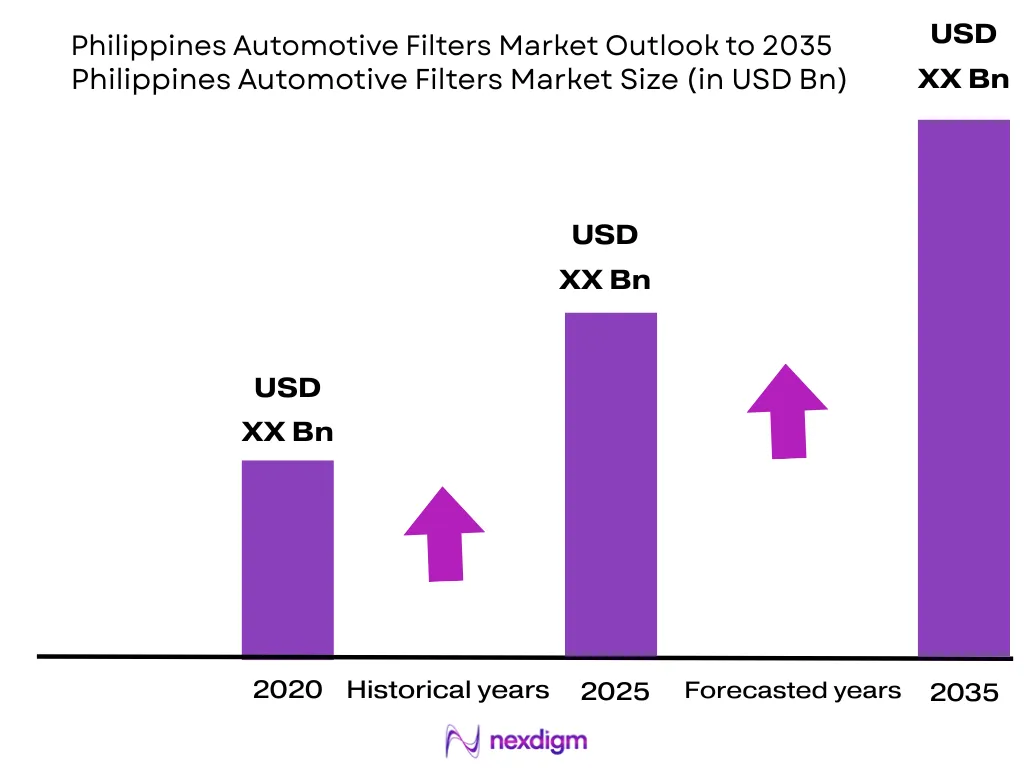
The Philippines Automotive Filters Market is valued at approximately ~ billion, compared with ~ billion in the preceding reporting period. Demand is supported by the country’s large registered vehicle population, expanding passenger-vehicle sales, intensive motorcycle usage, ageing public utility vehicles, and commercial fleets. Economic output expanded by 5.7%, while transportation and storage activity grew across several regional economies, supporting freight, delivery, public transport, construction, and recurring vehicle-maintenance requirements. Metro Manila, CALABARZON, Central Luzon, Metro Cebu, Metro Davao, and Northern Mindanao dominate the Philippines Automotive Filters Market because they combine large vehicle populations, dealership networks, parts warehouses, industrial estates, ports, logistics fleets, and independent workshops. Metro Manila leads passenger, taxi, ride-hailing, and delivery demand; CALABARZON supports automotive assembly and supplier activity; Central Luzon benefits from Clark–Subic logistics; Cebu and Davao function as major regional distribution and commercial-vehicle servicing hubs. The Philippines automotive filters market covers filtration products installed in passenger cars, sport utility vehicles, multipurpose vehicles, pickups, vans, trucks, buses, jeepneys, motorcycles, tricycles, construction machinery, agricultural equipment, hybrid vehicles, and battery-electric vehicles. Its core products include engine-air filters, oil filters, fuel filters, cabin-air filters, transmission filters, hydraulic filters, coolant filters, crankcase ventilation filters, diesel particulate filters, gasoline particulate filters, diesel exhaust fluid filters, battery-cooling filters, and thermal-management filtration products.
Market Segmentation
By Filter Type
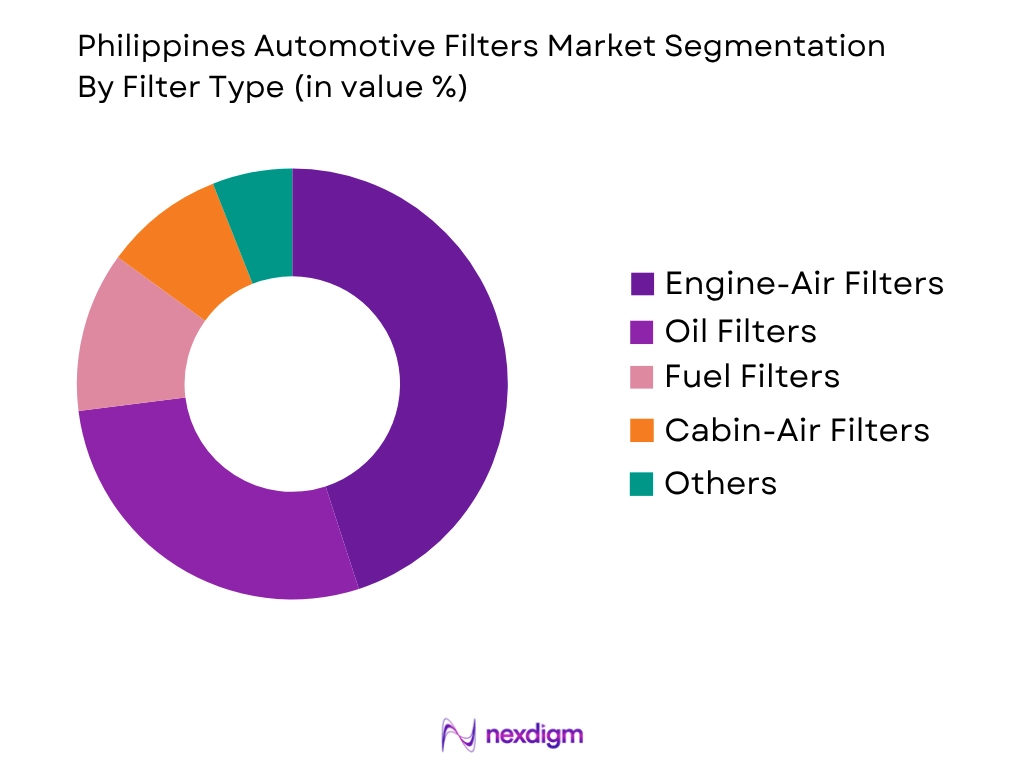
By filter type, the Philippines Automotive Filters Market is segmented into engine-air filters, oil filters, fuel filters, cabin-air filters, motorcycle filters, transmission and hydraulic filters, emission-control filters, and electric-vehicle filtration products. Engine-air filters hold the dominant market share because the country operates a broad mix of passenger vehicles, motorcycles, jeepneys, trucks, buses, construction machinery, and agricultural equipment exposed to dust, humidity, road debris, and congested operating conditions. Vehicles using provincial roads, construction corridors, quarrying sites, farms, and urban streets require effective intake protection to prevent abrasive contaminants from reaching cylinders, turbochargers, airflow sensors, and combustion chambers. Motorcycles and tricycles add substantial unit demand because they commonly use paper, foam, or reusable air-filter elements requiring regular cleaning or replacement. Commercial fleets also favour high-capacity air filters because restricted airflow can reduce engine performance and raise fuel consumption. These conditions support cellulose, synthetic-blend, foam, and nanofibre products across multiple price tiers.
By Vehicle Type
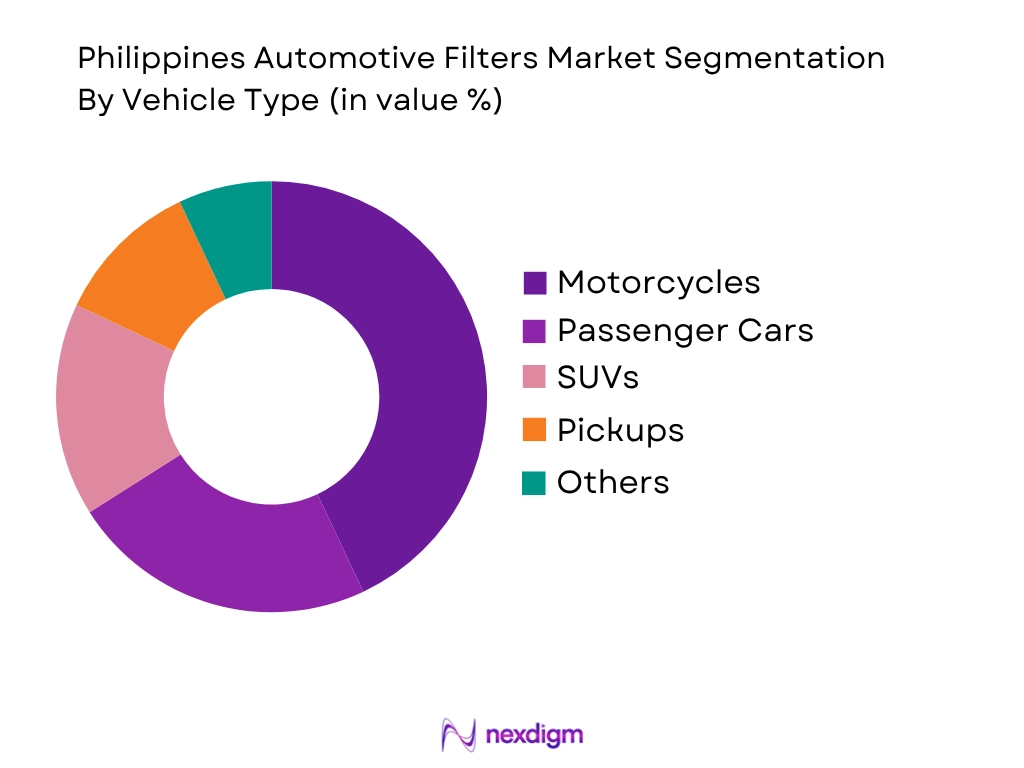
By vehicle type, the Philippines Automotive Filters Market is segmented into passenger cars, SUVs and multipurpose vehicles, motorcycles and tricycles, pickups and light commercial vehicles, trucks, public utility vehicles, buses, off-highway equipment, and electric or hybrid vehicles. Motorcycles and tricycles hold the dominant unit share because they are widely used for personal mobility, delivery work, provincial transport, and income-generating services. Their comparatively affordable acquisition and operating requirements have made them essential across urban and rural areas. Motorcycles require engine-air filters, oil filters or strainers, fuel screens, and occasionally transmission or final-drive filtration. Daily usage by delivery riders, commuters, and tricycle operators increases replacement frequency. Passenger cars and SUVs generate greater value per vehicle because they use larger and more numerous filters, including cabin, transmission, fuel, and emission-system products. Trucks, buses, and modern public utility vehicles generate the highest average filtration expenditure through diesel fuel-water separation, heavy-duty oil filtration, crankcase ventilation, and emission-system maintenance.
Competitive Landscape
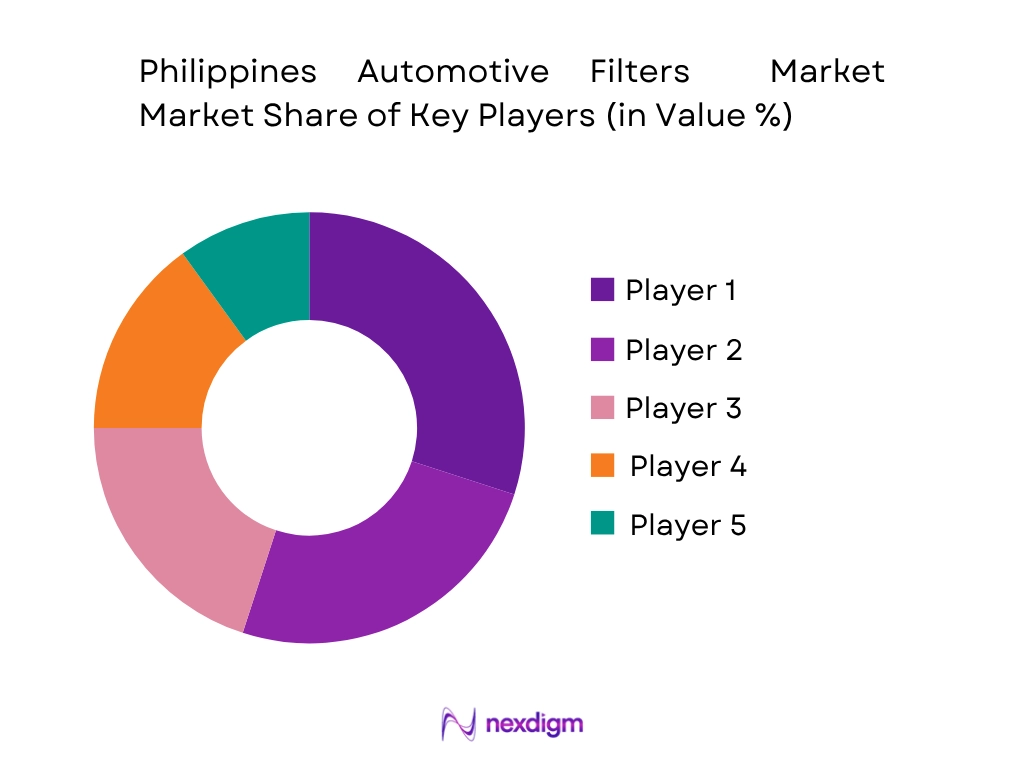
The Philippines Automotive Filters Market is fragmented across multinational filtration groups, Japanese aftermarket brands, European automotive suppliers, heavy-duty specialists, authorised dealer parts, local distributors, and private-label importers. MANN+HUMMEL, Bosch, DENSO, Donaldson, and Sakura compete through broad vehicle fitment, product recognition, technical quality, and established distributor relationships. Japanese-oriented brands benefit from the large installed base of Japanese passenger cars, utility vehicles, trucks, and motorcycles. Heavy-duty suppliers compete in trucks, buses, construction equipment, generators, and mining applications, while general aftermarket companies target independent garages and retail parts stores. Competition depends heavily on price, product authenticity, fitment accuracy, provincial availability, dealer relationships, and workshop recommendations.
| Company | Established | Headquarters | Core Filter Portfolio | Vehicle Coverage | Philippine Channel Position | Media Capability | Heavy-Duty Capability | EV Readiness |
| MANN+HUMMEL | 1941 | Ludwigsburg, Germany | ~ | ~ | ~ | ~ | ~ | ~ |
| Robert Bosch | 1886 | Gerlingen, Germany | ~ | ~ | ~ | ~ | ~ | ~ |
| DENSO | 1949 | Kariya, Japan | ~ | ~ | ~ | ~ | ~ | ~ |
| Donaldson Company | 1915 | Bloomington, United States | ~ | ~ | ~ | ~ | ~ | ~ |
| Sakura Filter | 1973 | Jakarta, Indonesia | ~ | ~ | ~ | ~ | ~ | ~ |
Philippines Automotive Filters Market Analysis
Growth Drivers
Expanding Vehicle Utilisation and Recurring Preventive Maintenance
The Philippines Automotive Filters Market is supported by rising vehicle utilisation across passenger cars, multipurpose vehicles, pickups, motorcycles, tricycles, delivery vans, jeepneys, buses, and freight trucks. The Philippine economy expanded by 5.7% in 2024, while services grew by 6.7% and industry by 5.6%, strengthening household mobility, retail distribution, construction activity, and commercial transport. Transportation and storage expanded by 5.6% during the first quarter and 6.3% during the third quarter, indicating sustained movement of passengers and goods. Frequent urban congestion increases engine operating hours relative to distance travelled, accelerating lubricant degradation and loading of oil, air, and cabin filters. Provincial travel, unpaved roads, construction corridors, and agricultural activity expose intake systems to dust and debris. Motorcycles and tricycles add substantial replacement volume because many operate daily for commuting, delivery, and income-generating transport. Modern diesel vehicles also require cleaner fuel for high-pressure common-rail injectors, increasing the importance of fine-micron fuel filters and water separation. As workshops handle a broader mix of ageing and newer vehicles, demand is expanding for engine-air filters, oil filters, fuel filters, cabin filters, transmission elements, crankcase filters, and complete maintenance kits. The country’s large mobility base therefore produces recurring filter transactions even where individual owners delay non-essential repairs.
Growth of Logistics, Delivery, Public Transport, and Regional Commerce
Expansion of logistics, e-commerce fulfilment, food delivery, public transport, construction, and inter-island commerce is increasing the operating intensity of commercial vehicles and motorcycles. These applications generate higher filter consumption than low-mileage household vehicles because engines operate for longer hours and are exposed to stop-start traffic, heat, road dust, fuel contamination, and variable maintenance conditions. Regional economic data show that transportation and storage expanded by 11.6% in MIMAROPA and 9.6% in Bicol during 2024, reflecting stronger passenger and freight movement outside Metro Manila. Construction activity in MIMAROPA increased by 19.1%, creating additional utilisation of trucks, pickups, generators, excavators, loaders, and hydraulic equipment. These assets require engine-air, oil, fuel-water, hydraulic, coolant, crankcase, and transmission filtration. Commercial operators also place greater value on vehicle availability because breakdowns disrupt deliveries, passenger services, and infrastructure schedules. The Philippines’ archipelagic structure intensifies this requirement: fleets operating between ports, warehouses, cities, and provincial markets must remain dependable despite varying road and weather conditions. Filter suppliers can address this demand through fleet-specific service intervals, regional warehouses, mobile servicing, automatic replenishment, water-in-fuel detection, and high-capacity media. Economic growth of 5.7% in 2024 provides a supportive macroeconomic base for continued trade, logistics, construction, tourism, and commercial mobility.
Market Challenges
Import Dependence, Counterfeit Products, and Fragmented Distribution
The Philippines Automotive Filters Market depends substantially on imported finished filters, filter media, activated carbon, moulded housings, valves, seals, adhesives, and metal components. This exposes distributors to shipping delays, port congestion, currency movements, and long replenishment periods. The country’s island geography further complicates distribution because products imported through major gateways must be transported to provincial warehouses and workshops across Luzon, Visayas, and Mindanao. Maintaining availability is difficult because the vehicle parc contains Japanese, Korean, American, European, Chinese, Indian, locally assembled, and imported used platforms. Each model may require different filter dimensions, bypass settings, gasket designs, media grades, or engine-code references. Counterfeit and unverified online products increase technical risk because external packaging may resemble established brands even when internal media, valves, springs, and seals do not meet required specifications. An incorrect oil filter may leak or bypass improperly, while an unsuitable diesel filter may restrict fuel or fail to remove water. The Land Transportation Office issued show-cause orders against 1,046 vehicle dealers in 2024 for registration-related non-compliance, illustrating the wider administrative complexity surrounding vehicle documentation and market oversight. Organised suppliers therefore need digital fitment catalogues, authenticity codes, regional stock points, technician training, and disciplined long-tail inventory management to protect product quality and service reliability.
Electric-Vehicle Transition and Declining Combustion Filter Content
The transition toward electric mobility creates a structural challenge for suppliers concentrated in engine-air, oil, fuel, crankcase, and exhaust-filtration products. Battery-electric vehicles do not require combustion-air filters, engine-oil filters, petrol or diesel fuel filters, crankcase separators, or conventional tailpipe particulate filters. The Electric Vehicle Industry Development Act requires a coordinated national strategy for EV adoption, charging infrastructure, local manufacturing, research, and workforce development. The Comprehensive Roadmap for the Electric Vehicle Industry targets at least 2.45 million electric vehicles and 20,400 charging stations, with a national policy direction toward 50% EV adoption on Philippine roads by 2040. Although these targets extend beyond the immediate period, current investment decisions by filter suppliers must account for future reductions in conventional filter content per vehicle. Companies must maintain broad inventories for the existing petrol, diesel, motorcycle, jeepney, and commercial fleet while developing cabin-air filters, battery-cooling filters, high-voltage vent membranes, electric-drive lubrication filters, desiccants, and thermal-management filtration. This creates simultaneous legacy-product and new-technology investment requirements. The challenge is particularly significant for suppliers dependent on routine oil-change transactions. Portfolio diversification, EV fitment databases, technician training, and partnerships with vehicle assemblers will become necessary to offset the progressive contraction of traditional engine-filter demand.
Market Opportunities
Flood-Resistant Fuel Filtration and Severe-Duty Protection
Frequent heavy rainfall, flooding, tropical humidity, poor road drainage, and variable fuel-handling conditions create a specialised opportunity for fuel-water separation and severe-duty filtration. Water entering diesel fuel can damage high-pressure pumps and injectors, promote corrosion, reduce lubrication, and cause sudden engine failure. Pickups, trucks, buses, jeepneys, construction machinery, agricultural equipment, and standby generators are particularly exposed because they may operate through flooded streets, provincial roads, depots, farms, and remote worksites. Euro 4 fuel and vehicle requirements increase the technical sensitivity of modern engines because cleaner combustion systems rely on precise injection and lower contaminant levels. The government required the availability of Euro 4 fuels and compliance by new vehicles, with Euro 4 products containing lower sulphur than earlier fuels. This supports demand for hydrophobic media, primary and secondary diesel filters, high-capacity fuel-water separators, drain bowls, water-in-fuel sensors, sealed filter housings, and post-flood maintenance kits. Current economic activity provides a broad installed base for these products: national GDP expanded by 5.7% in 2024, industry grew by 5.6%, and construction expanded strongly in several regional economies. Suppliers can convert these operating conditions into future growth through technician education, fleet inspection programmes, emergency replacement kits, mobile servicing, and performance claims based on water-separation efficiency, micron rating, flow capacity, and corrosion resistance.
Motorcycle, Public Utility Vehicle, and Connected Fleet Solutions
The country’s heavy dependence on motorcycles, tricycles, jeepneys, buses, and delivery fleets creates an opportunity for application-specific filter kits and digitally managed maintenance. Motorcycles used for commuting, food delivery, courier work, and tricycle operations require regular air-filter cleaning or replacement, oil filtration, fuel strainers, and engine servicing. Public utility vehicles and commercial fleets require broader packages including diesel fuel-water separators, oil filters, engine-air elements, crankcase filters, cabin filters, and emission-system components. The government’s public-transport modernisation and electric-vehicle programmes will gradually introduce newer diesel, hybrid, and electric platforms that require more accurate fitment and technical support than traditional vehicles. Current transport activity supports this opportunity: transportation and storage expanded by 6.3% during the third quarter of 2024, while regional growth reached 11.6% in MIMAROPA and 9.6% in Bicol. Suppliers can develop motorcycle maintenance bundles, cooperative procurement programmes for public utility vehicles, kilometre-based fleet contracts, mobile service units, and automatic workshop replenishment. Connected restriction sensors, water-in-fuel detection, oil-condition monitoring, and digital maintenance records can help operators replace filters according to actual duty cycles. Battery-electric fleets will also create demand for cabin filtration, battery-cooling filters, high-voltage vent systems, and thermal-management fluid filtration, allowing suppliers to build recurring revenue beyond conventional engine products.
Future Outlook
The Philippines Automotive Filters Market is forecast to expand at approximately ~ CAGR during the forecast period. Growth will be supported by increasing motorisation, continued motorcycle usage, urban delivery fleets, public utility vehicle modernisation, construction, infrastructure development, and rising demand for preventive maintenance. The market will remain replacement-led because the country operates a large and diverse vehicle population spanning new models, older vehicles, motorcycles, traditional jeepneys, modern public utility vehicles, imported platforms, and locally assembled units. Vehicle-age diversity will support broad demand across premium, mid-tier, and economy product categories. The economy recorded full-year growth of 5.7%, while gross national income per capita reached USD 4,470, compared with USD 4,320 in the preceding period. These indicators support gradual expansion in vehicle ownership, commercial activity, and maintenance expenditure, although affordability will remain a central purchasing consideration.
Major Players
- MANN+HUMMEL
- Robert Bosch
- DENSO
- MAHLE
- Donaldson Company
- Parker Hannifin
- Atmus Filtration Technologies
- Hengst Filtration
- UFI Filters
- Sogefi Filtration
- Sakura Filter
- VIC Filters
- JS Asakashi
- Baldwin Filters
- K&N Engineering
Key Target Audience
- Automotive filter and filtration-module manufacturers
- Vehicle manufacturers, assemblers, motorcycle producers, and importers
- Automotive and motorcycle parts importers, distributors, and retailers
- Authorised dealerships, independent garages, and motorcycle workshops
- Jeepney, bus, logistics, delivery, taxi, and transport-network fleets
- Filter-media, activated-carbon, housing, seal, and monitoring-sensor suppliers
- Investments and venture capitalist firms
- Government and regulatory bodies (Department of Transportation, Land Transportation Office, Department of Environment and Natural Resources, Department of Energy, Department of Trade and Industry, Board of Investments, and Land Transportation Franchising and Regulatory Board)
Research Methodology
Step 1: Identification of Key Variables
The first phase constructs an ecosystem map covering filter manufacturers, importers, vehicle assemblers, distributors, dealerships, independent workshops, motorcycle repair shops, fleet operators, regulators, and recyclers. Critical variables include vehicle population, motorcycle penetration, vehicle age, filter content, replacement intervals, propulsion type, road conditions, and sales channel.
Step 2: Market Analysis and Construction
Historical vehicle registrations, new-vehicle sales, motorcycle activity, fleet utilisation, public transport modernisation, and workshop transactions are compiled. Top-down analysis examines filtration revenue within the broader automotive aftermarket, while bottom-up analysis applies vehicle cohorts, filter quantities, replacement frequency, and average selling values.
Step 3: Supply-Side Assessment
Manufacturers and suppliers are evaluated by product portfolio, regional warehousing, vehicle fitment, motorcycle coverage, Euro 4 capability, heavy-duty products, media technology, private-label activity, and provincial distribution. Catalogues, importer listings, product registrations, retail evidence, and company disclosures support supply reconstruction.
Step 4: Demand-Side Assessment
Passenger owners, motorcycle riders, tricycle operators, jeepney cooperatives, transport-network drivers, logistics fleets, bus companies, construction operators, authorised dealers, and independent workshops are assessed by annual mileage, maintenance frequency, channel preference, downtime sensitivity, and price tier.

- Executive Summary
- Research Methodology (Market Definitions and Assumptions, Automotive Filter Market Boundary, Abbreviations, Market Sizing Approach, Top-Down Analysis, Bottom-Up Analysis, Vehicle Parc–Based Demand Modelling, Filter Content per Vehicle, Replacement Interval Assessment, OEM Installation Assessment, Aftermarket Sell-Out Assessment, Fleet Maintenance Assessment, Import and Local Assembly Assessment, Primary Industry Interviews, Data Triangulation, Forecasting Framework, Limitations and Future Conclusions)

- Definition and Scope
- Market Evolution and Industry Genesis
- Timeline of Major Industry Developments
- Automotive Filtration Technology Evolution
- Passenger Vehicle, Motorcycle and Commercial Vehicle Filtration Ecosystem
- Jeepney, Bus and Public Utility Vehicle Filtration Ecosystem

- Growth Drivers (Motorisation, Motorcycle Usage, Commercial Fleet Expansion, PUV Modernisation, Preventive Maintenance, Cabin Air Quality)
- Market Challenges (EV Transition, Import Dependence, Counterfeit Products, Fitment Complexity, Flood Exposure, Price Sensitivity)
- Market Opportunities (Premium Cabin Filtration, Motorcycle Filters, Fleet Contracts, EV Thermal Management, Local Assembly, Digital Fitment)
- Market Trends (Digital Fitment, Motorcycle E-Commerce, Premium Cabin Filters, Fleet Monitoring, Hybridisation, Sustainable Design)
- Government Regulations (Euro 4 Standards, Vehicle Registration, Emission Testing, EVIDA, Product Safety, Waste Management)
- SWOT Analysis
- Porter’s Five Forces Analysis
- PESTLE Analysis

- By Market Value (2020-2025)
- By Filter Unit Sales (2020-2025)
- By Original Equipment Revenue (2020-2025)


- Market Share of Major Players (By Value, Unit Volume, Filter Type, Vehicle Application, Sales Channel)
- Cross Comparison Parameters (Engine Air–Oil–Fuel–Cabin–Motorcycle–Emission Filter Portfolio Breadth, Passenger–SUV–Motorcycle–Jeepney–Commercial–Off-Highway Vehicle Coverage, Japanese–Korean–American–European–Chinese Platform Fitment Capability, Filtration Efficiency–Pressure Drop–Dirt-Holding Capacity–Humidity Resistance Performance, Luzon–Visayas–Mindanao Distributor–Garage–Motorcycle Shop Network Reach, Synthetic–Nanofibre–Activated Carbon–Foam Media Capability, Euro 4–Common-Rail–DPF–Fuel-Water Separation Capability, EV Battery Cooling–Digital Fitment–Local Assembly–Sustainable Product Readiness)
- SWOT Analysis of Major Players
- Detailed Profiles of Major Companies
MANN+HUMMEL
Robert Bosch
DENSO
MAHLE
Donaldson Company
Parker Hannifin
Atmus Filtration Technologies
Hengst Filtration
UFI Filters
Sogefi Filtration
Sakura Filter
VIC Filters
JS Asakashi
Baldwin Filters
K&N Engineering

- Individual Passenger Car Owner Analysis
- SUV and Pickup Owner Analysis
- Motorcycle and Scooter Owner Analysis
- Tricycle Operator Analysis
- Hybrid Vehicle Owner Analysis

- By Market Value (2026-2035)
- By Filter Unit Sales (2026-2035)
- By Original Equipment Revenue (2026-2035)


 Request a Sample
 Ask for Customization
 Get a Quote
 Enquire Now