

 Download PDF
Market Overview
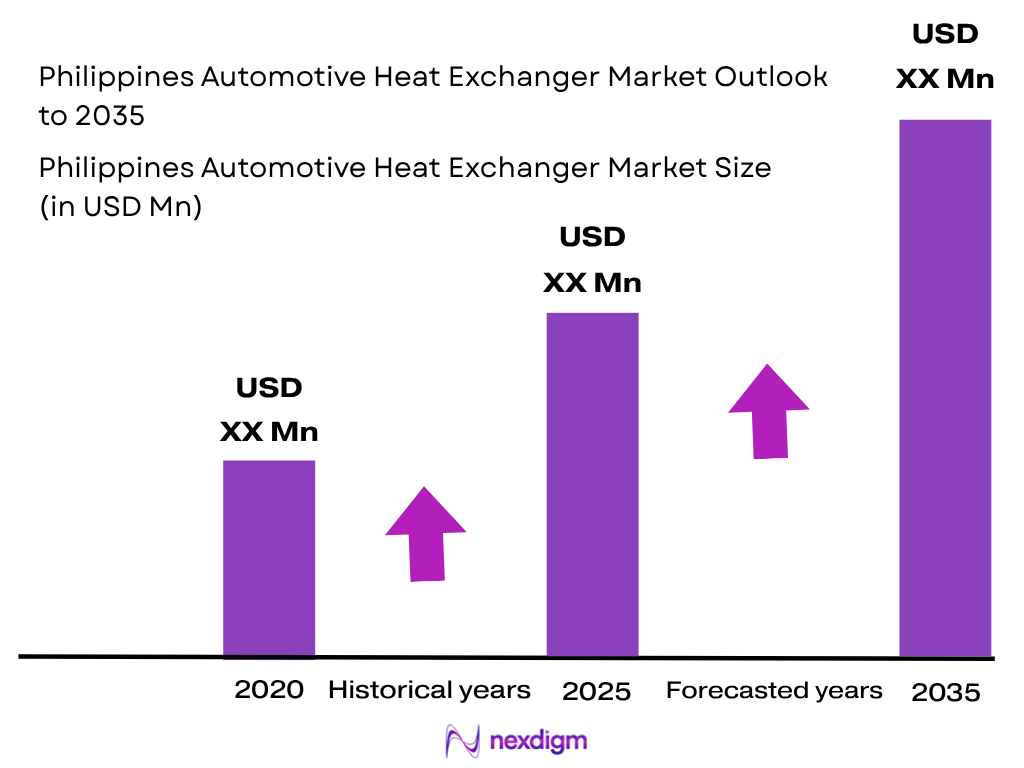
The Philippines Automotive Heat Exchanger Market is valued at ~USD XX million in 2024, with a forecast ~XX% CAGR during 2026–2035. Market demand is underpinned by an expanding vehicle base: industry sales increased from 429,807 vehicles in the preceding full year to 467,252 vehicles in the latest full year, including 346,482 commercial vehicles and 120,770 passenger cars. This expanding installed base supports radiators, condensers, intercoolers, oil coolers and HVAC component demand.
Metro Manila, Laguna, Cavite and Batangas form the principal demand and supply cluster for the Philippines Automotive Heat Exchanger Market. Metro Manila concentrates vehicle ownership, dealerships, fleets and aftermarket workshops, while Laguna hosts major automotive production and component operations, including DENSO Philippines’ Calamba facility manufacturing radiators and automotive air-conditioning products. CALABARZON is also a major industrial region, supported by Laguna, Cavite and Batangas and a regional economy valued at PHP 3.27 trillion on a constant-price basis.
Market Segmentation
By Heat Exchanger Type
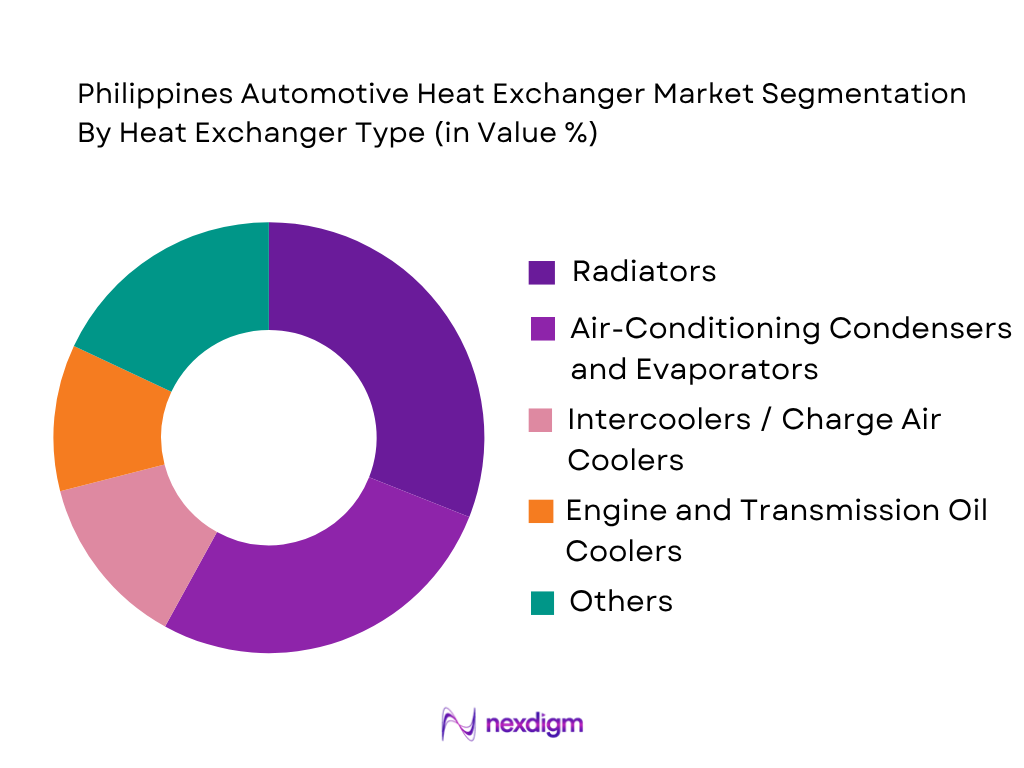
The Philippines Automotive Heat Exchanger Market is segmented into radiators, air-conditioning condensers and evaporators, intercoolers, oil coolers, HVAC heat exchangers, EGR coolers and electrified-vehicle cooling systems. Radiators represent the dominant modeled subsegment, supported by the country’s large ICE vehicle population and particularly strong commercial-vehicle demand. Commercial vehicles accounted for 346,482 of 467,252 CAMPI-TMA vehicle sales in the latest full-year industry data, demonstrating the importance of utility vehicles, pickups and other working vehicles that require robust engine thermal control. Tropical temperatures, congested urban driving and long-distance commercial operations increase cooling-system utilization. Air-conditioning heat exchangers form another major category because cabin cooling is essential across passenger vehicles, utility vehicles and public transport. Over time, battery chillers and low-temperature cooling circuits are expected to gain relevance as electrified powertrains expand.
By Vehicle Type
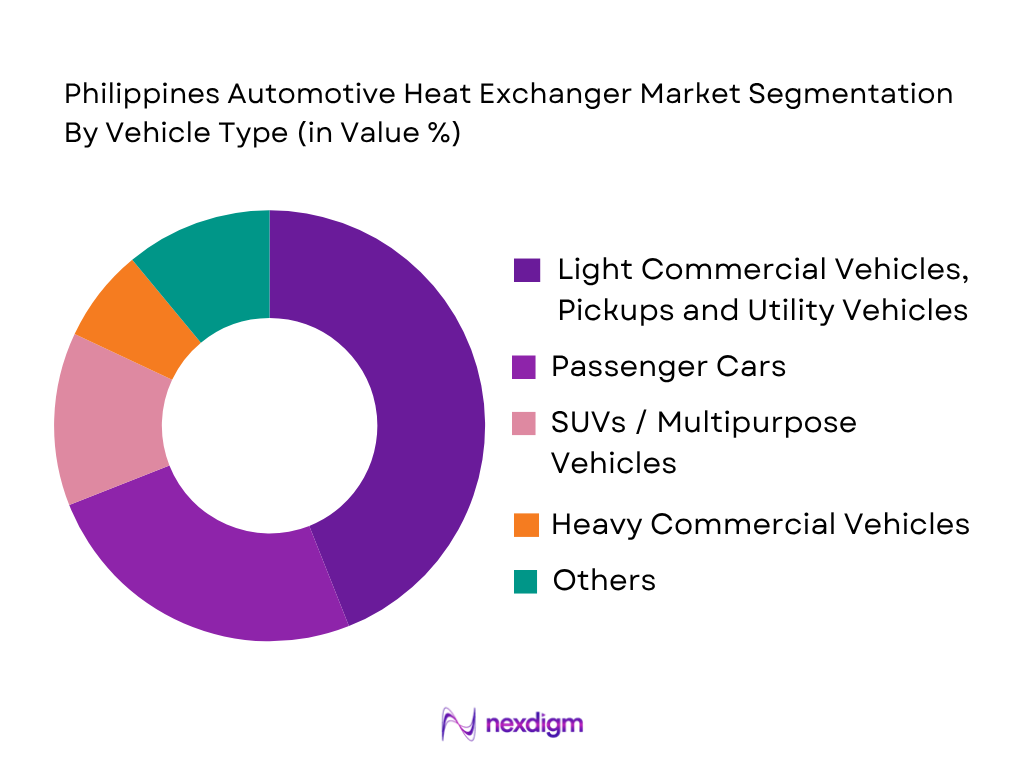
The Philippines Automotive Heat Exchanger Market is segmented into passenger cars, light commercial vehicles, SUVs and multipurpose vehicles, heavy commercial vehicles, buses, public utility vehicles, hybrids and battery-electric vehicles. Light commercial vehicles, pickups and utility vehicles dominate modeled heat-exchanger demand, reflecting the unusually strong commercial orientation of Philippine new-vehicle sales. CAMPI-TMA reported 346,482 commercial vehicles against 120,770 passenger cars in the latest full-year results. Earlier industry data also showed light commercial vehicles as the principal component of commercial-vehicle sales, reflecting the popularity of pickups, SUVs and utility platforms. These vehicles commonly operate under intensive urban, provincial and logistics conditions and employ radiators, condensers, charge-air coolers and transmission coolers. Electrified vehicles currently represent a smaller thermal-component pool but are strategically important because each platform introduces battery, motor and power-electronics temperature-control requirements.
Competitive Landscape
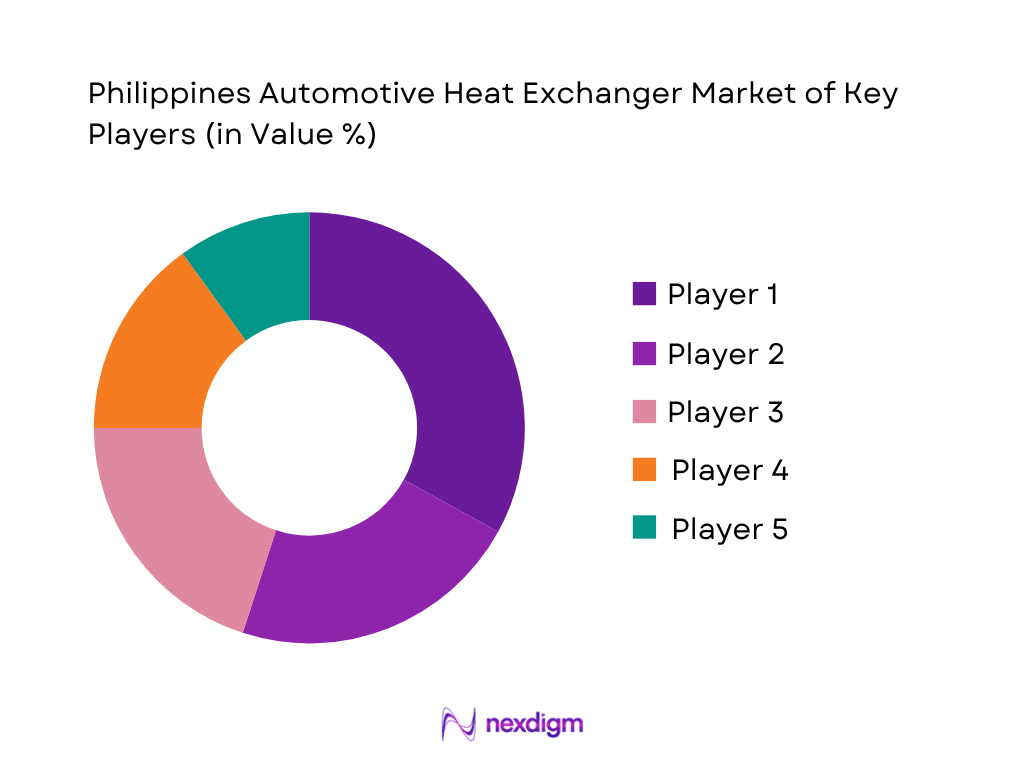
The Philippines Automotive Heat Exchanger Market combines a relatively small domestic manufacturing base with extensive participation by international Tier-1 suppliers and aftermarket brands. DENSO has a particularly strong local position because its Calamba facility directly manufactures radiators and automotive air-conditioning products and operates design engineering activities in the Philippines. Other international suppliers participate through OEM supply chains, ASEAN manufacturing networks and replacement-parts distribution. Competitive differentiation increasingly depends on aluminium brazing, OEM compatibility, tropical-climate durability, EV thermal capability and aftermarket availability.
| Company | Establishment Year | Headquarters | Heat Exchanger Portfolio | Philippines / Local Footprint | OEM Integration | EV Thermal Capability | ASEAN Manufacturing Reach | Aftermarket Presence |
| DENSO Corporation | 1949 | Kariya, Japan | ~ | ~ | ~ | ~ | ~ | ~ |
| MAHLE GmbH | 1920 | Stuttgart, Germany | ~ | ~ | ~ | ~ | ~ | ~ |
| Valeo | 1923 | Paris, France | ~ | ~ | ~ | ~ | ~ | ~ |
| Hanon Systems | 1986 | Daejeon, South Korea | ~ | ~ | ~ | ~ | ~ | ~ |
| Modine Manufacturing | 1916 | Racine, USA | ~ | ~ | ~ | ~ | ~ | ~ |
Philippines Automotive Heat Exchanger Market Analysis
Growth Drivers
Rising New Vehicle Sales
Rising new vehicle sales are strengthening demand for the Philippines Automotive Heat Exchanger Market because every additional passenger car, utility vehicle, pickup, van, truck, or bus entering the national fleet adds factory-installed cooling hardware and subsequently enlarges the replacement base for radiators, condensers, evaporators, intercoolers, transmission coolers, oil coolers, and related thermal components. Philippine automotive assemblers represented by CAMPI and TMA sold an exact 467,252 vehicles in 2024, compared with 429,807 vehicles in 2023, according to industry figures reported by the Philippine News Agency. Of the 2024 total, 346,482 units were commercial vehicles and 120,770 units were passenger cars, while December alone generated 42,044 vehicle sales. The commercial-vehicle volume is particularly important for heat exchanger suppliers because pickups, utility vehicles, vans, trucks, and multipurpose vehicles generally operate with substantial engine, transmission, air-conditioning, and charge-air cooling requirements. The demand base is considerably larger when existing vehicles are included. Philippine Statistics Authority data, sourced from the Land Transportation Office, show that registered motor vehicles reached 14.56 million units in 2024, compared with 14.27 million units in 2023. The active fleet included approximately 11.45 million gasoline-powered vehicles and 3.08 million diesel-powered vehicles, both of which depend extensively on conventional engine cooling and cabin air-conditioning systems. These figures translate directly into market-specific heat exchanger demand because every ICE platform normally requires a radiator and condenser, while diesel and turbocharged commercial platforms can additionally employ intercoolers, oil coolers, EGR coolers, and transmission cooling systems.
Growing Hybrid and Electric Vehicle Adoption
Growing hybrid and electric vehicle adoption is changing both the quantity and technical composition of demand in the Philippines Automotive Heat Exchanger Market, because electrified powertrains require thermal-management hardware beyond the radiator-and-condenser architecture of conventional vehicles. Philippine Statistics Authority data based on Land Transportation Office registrations show that the number of registered electric vehicles reached exactly 6,697 units in 2024, compared with 1,359 units in 2023, while registered hybrid vehicles reached 17,590 units, compared with 6,155 units one year earlier. The combined pool of registered electric and hybrid vehicles therefore reached 24,287 vehicles, creating a measurable installed base requiring battery, power-electronics, electric-motor, refrigerant, and cabin thermal-management technologies. The relevance to automotive heat exchangers is direct. Battery-electric platforms require battery cooling plates, coolant-to-refrigerant chillers, low-temperature radiators, condensers, and thermal modules to control temperatures during driving and charging. Hybrid vehicles are thermally more complex in another way because they retain combustion-engine cooling while adding battery and electrical-system temperature control, potentially increasing the number of thermal circuits per vehicle.
Market Challenges
High Dependence on Imported Thermal Components
High dependence on imported automotive and transport equipment creates a structural challenge for the Philippines Automotive Heat Exchanger Market because domestic demand is substantially larger and more diversified than the country’s localized thermal-component manufacturing footprint. Philippine Statistics Authority trade data show that the country imported USD 127.60 billion of goods in 2024, while transport equipment imports alone reached USD 11.36 billion, making transport equipment one of the country’s largest import commodity groups. Total Philippine external merchandise trade reached USD 200.87 billion, highlighting the economy’s deep integration with overseas supply chains. For automotive heat exchangers, this dependence matters because imported vehicles and assemblies bring a large variety of radiator cores, condensers, evaporators, intercoolers, oil coolers, EGR coolers, battery chillers, pumps, valves, and integrated thermal modules designed to platform-specific standards. The domestic service market must therefore source replacements compatible with Japanese, Korean, Chinese, European, and American vehicles rather than relying on a small standardized component set.
Increasing Technical Complexity of EV Thermal Systems
Increasing technical complexity associated with hybrid and electric vehicles presents a major challenge for the Philippines Automotive Heat Exchanger Market because the thermal-management function is shifting from mechanically straightforward engine cooling toward interconnected electronic, refrigerant, and liquid-cooling circuits. PSA data show that registered electric vehicles reached 6,697 units in 2024, while registered hybrids reached 17,590 units. Only one year earlier, those respective fleets stood at 1,359 EVs and 6,155 hybrids, illustrating how quickly workshops, distributors, and component suppliers are being required to adapt to new thermal architectures. This change is occurring while the conventional installed base remains enormous: approximately 11.45 million gasoline-powered vehicles and 3.08 million diesel-powered vehicles were registered in 2024. The market must therefore maintain competence across two fundamentally different technology bases at the same time. ICE vehicles depend on radiators, engine coolant circuits, condensers, intercoolers, transmission coolers, oil coolers and, in many diesel platforms, EGR cooling. Battery-electric vehicles eliminate several engine-related heat exchangers but introduce battery cooling plates, refrigerant chillers, inverter and power-electronics coolers, electric-motor cooling, electrically controlled pumps, coolant manifolds and sophisticated heat-pump systems.
Market Opportunities
EV Battery Cooling Systems
EV battery cooling systems represent a strong future opportunity for the Philippines Automotive Heat Exchanger Market because current registration data already establish a growing domestic base of electrified vehicles requiring specialized liquid and refrigerant thermal management. Philippine Statistics Authority figures sourced from the Land Transportation Office record exactly 6,697 registered electric vehicles in 2024, compared with 1,359 units in 2023, while registered hybrids increased from 6,155 vehicles to 17,590 vehicles. The combined electrified fleet therefore reached 24,287 registered vehicles in 2024. These are current operating-fleet figures rather than future projections, yet they provide a concrete foundation for future battery-thermal-system demand. An EV battery pack must operate within controlled temperature limits during driving, charging, and prolonged exposure to ambient heat. This creates demand for aluminium battery cooling plates, coolant-to-refrigerant chillers, low-temperature radiators, condensers, thermal manifolds, electronic pumps and valves. Plug-in and full hybrids add further opportunities because they combine battery cooling with conventional engine and cabin HVAC requirements.
Localized Aluminium Heat Exchanger Manufacturing and ASEAN Supply
Localized aluminium heat exchanger manufacturing presents a future growth opportunity because the Philippines already combines a large domestic vehicle market, significant imported transport-equipment demand, an established automotive industrial policy, and active trade with ASEAN markets. CAMPI-TMA members recorded 467,252 vehicle sales in 2024, including 346,482 commercial vehicles and 120,770 passenger cars, demonstrating a sizeable annual flow of vehicles requiring radiators, condensers, evaporators, intercoolers and other thermal components. The installed fleet is considerably larger at 14.56 million registered motor vehicles, creating an aftermarket base that can absorb locally produced replacement cooling components in addition to OEM applications. At present, Philippine trade data highlight substantial reliance on external supply: transport equipment imports reached exactly USD 11.36 billion in 2024 out of USD 127.60 billion in total imports. This import intensity provides a commercial rationale for deeper localization of selected components where domestic volumes, manufacturing skills and regional demand justify investment. Aluminium heat exchangers are particularly relevant because the Board of Investments explicitly recognizes aluminium radiators, evaporators and condensers within the automotive parts and components eligible for industrial development.
Future Outlook
The Philippines Automotive Heat Exchanger Market is expected to evolve from an engine-cooling-focused industry toward a broader vehicle thermal-management market. Growth in new vehicle sales will sustain demand for conventional radiators, condensers, intercoolers and oil coolers, while electrification will progressively increase requirements for battery chillers, cooling plates and power-electronics heat exchangers. Local automotive industrial policy provides additional support for component localization. The Comprehensive Automotive Resurgence Strategy program was designed to promote vehicle and automotive-parts manufacturing, strategic component production and participation in ASEAN supply chains.
Electrification will reshape component architecture rather than eliminate heat exchanger demand. The Philippines’ Comprehensive Roadmap for the Electric Vehicle Industry covers BEVs, HEVs and PHEVs and establishes the broader policy framework for vehicle and charging-system transition. As this transition develops, suppliers capable of supporting both traditional and electrified platforms will be better positioned than manufacturers concentrated exclusively on engine cooling. Opportunities will also emerge around lightweight aluminium construction, compact coolant modules and integrated HVAC-battery thermal systems. Local manufacturing clusters in CALABARZON could provide a foundation for greater component localization, particularly where suppliers can connect to Toyota, Mitsubishi and other automotive production ecosystems.
Major Players
- DENSO Corporation
- MAHLE GmbH
- Valeo
- Hanon Systems
- Modine Manufacturing Company
- T.RAD Co., Ltd.
- Sanden Corporation
- Marelli
- Dana Incorporated
- BorgWarner
- Nissens Automotive
- Koyorad
- Yinlun Group
- AKG Group
- Tokyo Radiator Manufacturing Co., Ltd.
Key Target Audience
- Automotive Heat Exchanger and Thermal Management Manufacturers
- Passenger and Commercial Vehicle OEMs
- Automotive Tier-1 and Tier-2 Component Suppliers
- Automotive Aftermarket Distributors and Service Networks
- Electric Vehicle and Battery-System Manufacturers
- Commercial Fleet and Public Utility Vehicle Operators
- Investments and Venture Capitalist Firms
- Government and Regulatory Bodies (Department of Trade and Industry, Board of Investments, Department of Energy, Land Transportation Office)
Research Methodology
Step 1: Identification of Key Variables
The initial phase develops an ecosystem map of the Philippines Automotive Heat Exchanger Market covering vehicle manufacturers, assemblers, Tier-1 suppliers, component importers, distributors, workshops and fleet operators. Key variables include vehicle sales, registered fleet composition, propulsion type, heat exchanger fitment per vehicle, component replacement cycles, automotive production, imports, climate-related thermal loads and OEM-versus-aftermarket demand.
Step 2: Market Analysis and Construction
Historical automotive indicators are compiled to construct bottom-up and top-down market models. Vehicle sales and fleet data are mapped against radiators, condensers, oil coolers, intercoolers, HVAC systems and electrified-vehicle cooling applications. Domestic component manufacturing and imported-product availability are incorporated to assess the supply structure, while replacement rates are applied to the relevant installed vehicle categories.
Step 3: Hypothesis Validation and Expert Consultation
Market hypotheses are validated through computer-assisted telephone interviews with heat exchanger suppliers, automotive component distributors, OEM procurement professionals, authorized service networks, independent workshops and fleet maintenance operators. Discussions focus on product mix, replacement patterns, supplier relationships, component compatibility, EV thermal requirements and geographic demand concentration. Responses are used to test and refine assumptions developed during secondary research.
Step 4: Research Synthesis and Final Output
Primary findings are triangulated with government, industry association, trade and company information. Top-down demand indicators are compared against bottom-up component calculations and supplier-level observations to identify inconsistencies. The final research framework integrates market segmentation, competitive positioning, technology transition, aftermarket dynamics, localization potential and future demand drivers to create a validated assessment of the Philippines Automotive Heat Exchanger Market.

- Executive Summary
- Research Methodology (Market Definition and Scope, Automotive Thermal Management Ecosystem Mapping, Heat Exchanger Demand Model, Vehicle Sales and Registration Analysis, Local Vehicle Assembly Assessment, Automotive Component Import Analysis, Top-Down Market Sizing, Bottom-Up Component Demand Estimation, OEM and Aftermarket Demand Assessment, Primary Interviews with Distributors and Workshops, Supplier Validation, Data Triangulation, Forecasting Framework, Research Limitations)

- Definition and Scope
- Automotive Heat Exchanger Industry Evolution
- Philippines Automotive Thermal Management Ecosystem
- Automotive Heat Exchanger Value Chain Analysis
- Supply Chain Analysis
- Domestic Vehicle Assembly and Imported Vehicle Ecosystem
- Role of Heat Exchangers Across ICE, Hybrid and Electric Vehicle Platforms

- Growth Drivers (Rising New Vehicle Sales, Expansion of Commercial and Utility Vehicle Fleet, High Automotive Air-Conditioning Utilization, Growing Hybrid and Electric Vehicle Adoption, Large Replacement Parts Demand, Expansion of Vehicle Assembly and Automotive Component Localization)
- Market Challenges (High Dependence on Imported Thermal Components, Limited Domestic Heat Exchanger Manufacturing Scale, Fragmented Automotive Aftermarket, Counterfeit and Low-Quality Replacement Components, Raw Material and Aluminium Supply Volatility, Increasing Technical Complexity of EV Thermal Systems)
- Market Opportunities (EV Battery Cooling Systems, Hybrid Vehicle Thermal Management, Localized Aluminium Heat Exchanger Manufacturing, Integrated Thermal Management Modules, Commercial Vehicle Cooling Solutions, Regional ASEAN Automotive Component Exports)
- Market Trends (Shift Toward Aluminium Heat Exchangers, Increasing Hybrid Vehicle Thermal Complexity, Compact Multi-Circuit Cooling Modules, Higher-Efficiency Automotive HVAC Systems, Electrically Controlled Cooling Systems, Expansion of Digital Automotive Parts Distribution)
- Government Regulations and Industry Programs (Comprehensive Automotive Resurgence Strategy Program, Motor Vehicle Development Program, Electric Vehicle Industry Development Act, Comprehensive Roadmap for the Electric Vehicle Industry, Vehicle Import Regulations, Automotive Parts Localization Policies, Vehicle Emission Standards, Bureau of Customs Component Import Requirements)
- SWOT Analysis
- Porter’s Five Forces Analysis
- PESTLE Analysis

- By Market Value (2020-2025)
- By Heat Exchanger Unit Demand (2020-2025)
- By OEM Installation Demand (2020-2025)
- By Aftermarket Replacement Demand (2020-2025)
- By Passenger and Commercial Vehicle Thermal System Demand (2020-2025)
- By ICE and Electrified Vehicle Thermal System Demand (2020-2025)

- By Heat Exchanger Type (In Value %)
Radiators
Air Conditioning Condensers
Evaporators
Intercoolers / Charge Air Coolers
Engine Oil Coolers
Transmission Oil Coolers
EGR Coolers
Battery Cooling Heat Exchangers
Power Electronics Cooling Heat Exchangers
HVAC Heat Exchangers - By Vehicle Type (In Value %)
Passenger Cars
Utility Vehicles
Sport Utility Vehicles
Light Commercial Vehicles
Pickup Trucks
Heavy Commercial Vehicles
Buses and Public Utility Vehicles
Electric Vehicles
Hybrid Electric Vehicles - By Propulsion Type (In Value %)
Gasoline Internal Combustion Engine Vehicles
Diesel Internal Combustion Engine Vehicles
Hybrid Electric Vehicles
Plug-in Hybrid Electric Vehicles
Battery Electric Vehicles - By Material Type (In Value %)
Aluminium Heat Exchangers
Copper-Brass Heat Exchangers
Steel Heat Exchangers
Multi-Material Heat Exchangers
Advanced Lightweight Alloy Heat Exchangers - By Sales Channel (In Value %)
OEM Supply
Authorized Dealership and Service Centres
Independent Automotive Workshops
Automotive Parts Distributors
Fleet Maintenance Networks
Online Automotive Parts Channels - By Application (In Value %)
Engine Cooling
Cabin Air Conditioning and HVAC
Turbocharger and Charge-Air Cooling
Transmission Cooling
Battery Thermal Management
Power Electronics and Electric Motor Cooling

- Market Share of Major Players (By Heat Exchanger Type, Vehicle Segment, OEM Supply, Aftermarket Presence, Thermal Technology Capability)
- Cross Comparison Parameters (Product Portfolio Breadth, Radiator and Condenser Manufacturing Capability, OEM Supply Relationships, EV Battery Thermal Management Capability, Aluminium Brazing and Lightweighting Expertise, Philippines Aftermarket Distribution Strength, Regional ASEAN Manufacturing Footprint, Integrated Thermal Module R&D Capability)
- SWOT Analysis of Major Players
- Detailed Profiles of Major Companies
DENSO Corporation
MAHLE GmbH
Valeo
Hanon Systems
Modine Manufacturing Company
T.RAD Co., Ltd.
Sanden Corporation
Marelli
DANA Incorporated
BorgWarner
Nissens Automotive
Koyorad
Yinlun Group
AKG Group
Tokyo Radiator Manufacturing Co., Ltd.

- Vehicle Fleet Demand Assessment
- Vehicle Usage and Cooling Load Analysis
- Automotive Air-Conditioning Usage Analysis
- Replacement Cycle Assessment
- Workshop and Service Network Analysis
- OEM versus Aftermarket Demand Assessment
- Vehicle Age and Thermal Component Replacement Analysis
- Commercial Fleet Thermal Management Analysis

- By Market Value (2026-2035)
- By Heat Exchanger Unit Demand (2026-2035)
- By OEM Installation Demand (2026-2035)
- By Aftermarket Replacement Demand (2026-2035)
- By Passenger and Commercial Vehicle Thermal System Demand (2026-2035)
- By ICE and Electrified Vehicle Thermal System Demand (2026-2035)


 Request a Sample
 Ask for Customization
 Get a Quote
 Enquire Now