
 Download PDF
Market Overview
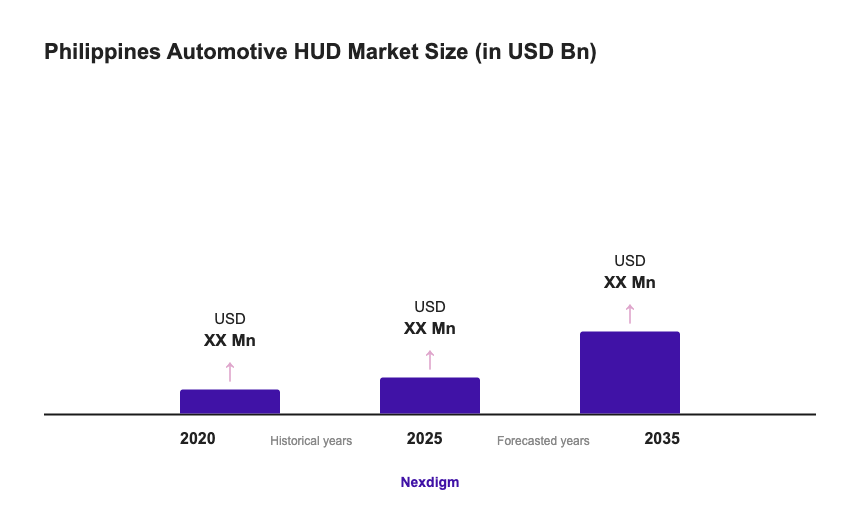
The Philippines automotive head-up display market is valued at USD 0.14 billion in 2025 and is projected to expand at an 8.4% CAGR through 2035. Growth is significantly anchored by the automotive manufacturing clusters in Santa Rosa, Laguna, where major assemblers are increasingly integrating advanced driver assistance systems to meet regional safety standards. Simultaneously, the bustling tech-centric hub of Cebu City is emerging as a critical nexus for the secondary automotive aftermarket, as tech-savvy consumers demand high-resolution augmented reality displays for legacy vehicles. A dominant demand-side trend is the rapid electrification of the local transport sector, which necessitates sophisticated digital cockpit interfaces to manage battery telemetry and range optimization in real-time. On the supply side, firms such as Toyota Motor Philippines, established in 1988 and headquartered in Makati, are shifting toward domestic procurement of smart cockpit components to reduce reliance on complex import chains. Regulatory progress is spearheaded by the Land Transportation Office and the Department of Trade and Industry, which are enforcing stricter vehicle safety protocols aligned with the UN Regulation No. 46, effectively compelling manufacturers to incorporate non-intrusive, data-rich heads-up displays to mitigate distracted driving risks while transitioning toward a sustainable, tech-integrated transportation infrastructure.
Market Segmentation
By Display Technology
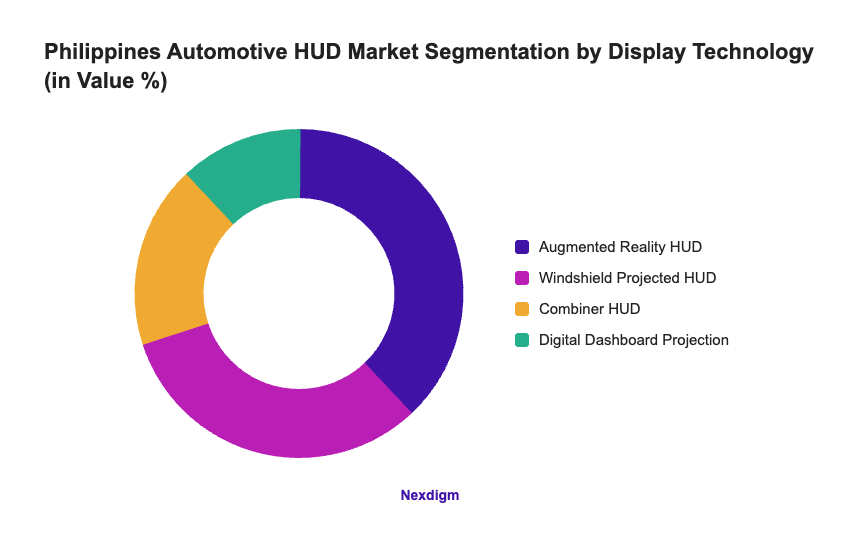
As of 2026, the Philippines automotive HUD market is rapidly pivoting toward Augmented Reality HUD systems, which currently hold a 38% market share due to the rising demand for premium safety integration in Metropolitan Manila’s burgeoning luxury vehicle sector. Manufacturers like Continental AG, founded in 1871 in Hanover, are driving this dominance through advanced navigation overlays that minimize driver distraction. While Windshield Projected HUD technology follows closely at 32% for mid-range models, Combiner HUD units retain an 18% share preferred by compact car buyers in Cebu City for their ease of installation. Finally, Digital Dashboard Projection captures 12% of the market, primarily through aftermarket kits provided by Denso Corporation, headquartered in Kariya since 1949. The shift toward AR is underpinned by Department of Transportation initiatives favoring ADAS-ready vehicles, ensuring that high-tech integrated solutions remain the primary growth driver over legacy projection methods throughout the forecast period.
By Vehicle Class
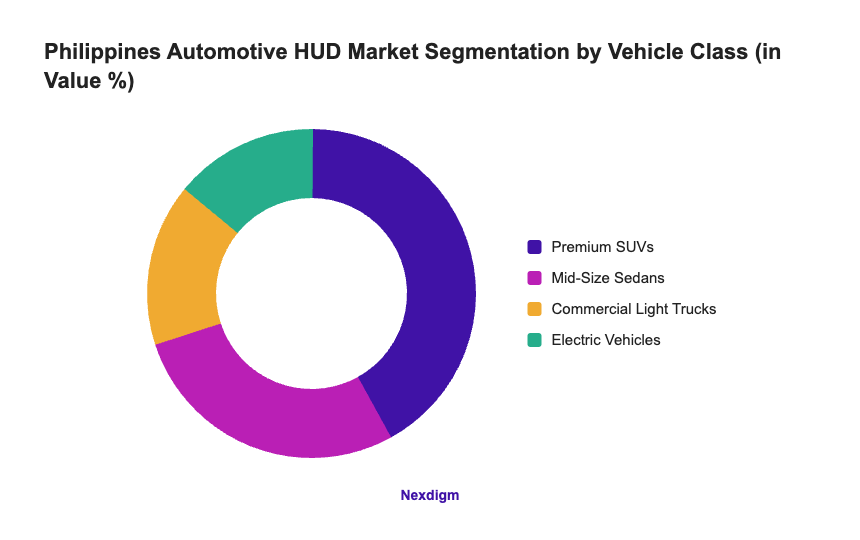
Premium SUVs lead the Philippine HUD adoption landscape in 2026 with a 42% share, fueled by strong consumer preference in hubs like Makati and Quezon City for high-clearance, tech-loaded vehicles from brands like Toyota Motor Corporation, established in 1937 in Toyota City. Mid-Size Sedans occupy 28% of the market as local fleet operators seek to improve safety records via factory-fitted HUDs. Commercial Light Trucks account for 16% of usage, focusing on telematics-linked displays provided by Bosch, which has been operational in Germany since 1886, to optimize logistics performance across the archipelago. The remaining 14% belongs to the emerging Electric Vehicles segment, which relies on integrated HUDs for real-time battery range monitoring. As the Department of Trade and Industry incentivizes electrification under the EVIDA Law, the segment for Electric Vehicles is expected to challenge the dominance of Premium SUVs by integrating advanced connectivity features within the next decade.
Competitive Landscape
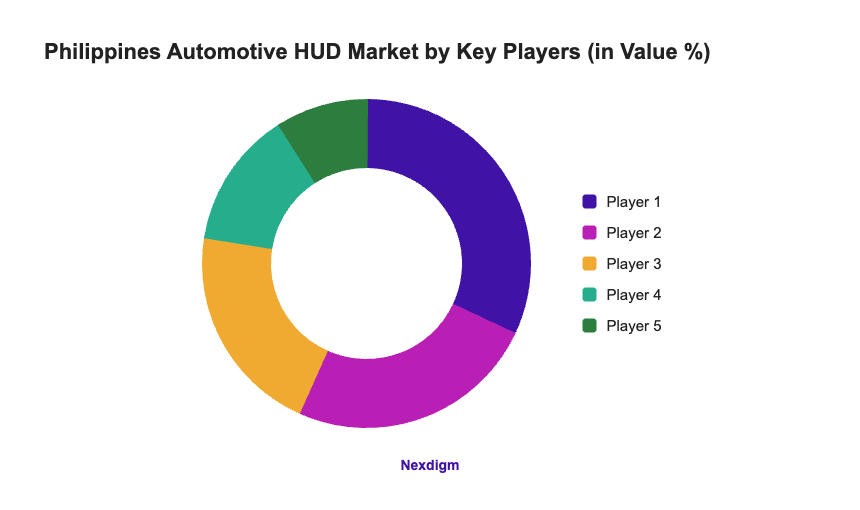
The Philippine automotive Head-Up Display (HUD) market is characterized by a concentrated competitive landscape, currently dominated by Tier-1 suppliers integrating advanced driver-assistance systems (ADAS) into the premium passenger vehicle segment. Companies such as Denso Corporation (established 1949, Kariya, Japan) maintain a stronghold by leveraging long-standing supply chain partnerships with major automotive manufacturers in the Laguna Technopark. The market environment is shifting toward high-resolution AR-HUD systems as domestic consumer preference for safety features increases, forcing incumbents to pivot from traditional W-HUD modules to projection-based digital solutions.
Strategic distribution strategies are heavily tied to the authorized dealership networks of major Japanese and South Korean automotive brands, ensuring that HUD systems remain an OEM-fitted feature rather than an aftermarket luxury. Visteon Corporation (established 2000, Van Buren Township, USA) is aggressively competing by securing contracts for cockpit electronics manufacturing, while Continental AG (established 1871, Hanover, Germany) focuses on software-defined vehicle integration to comply with the Land Transportation Office’s modernization directives. These players are currently prioritizing investment in local engineering capabilities in Metro Manila to expedite the deployment of connectivity-integrated displays for the growing electric vehicle fleet.
| Company | Establishment Year | Headquarters | Core Curricular Offered | Campus Footprint in Philippines | Fee Positioning | Digital Learning Stack Maturity | University Pathway Strength | Boarding Capability |
| Denso Corporation | 1949 | Kariya, Japan | Integrated optical HUD projection modules | Extensive manufacturing presence in Laguna | Premium OEM pricing | High-maturity connectivity integration | Strong R&D partnership with local engineering hubs | Not applicable |
| Continental AG | 1871 | Hanover, Germany | Augmented reality head-up display systems | Strategic distribution center in Pasig | High-end premium tier | Advanced software-defined cockpit architecture | Global engineering consortium linkage | Not applicable |
| Visteon Corporation | 2000 | Van Buren Township, USA | Smart digital cockpit infotainment HUD | Engineering office in Bonifacio Global City | Mid-to-high market positioning | Cloud-native cockpit software framework | Industry-academia digital talent development | Not applicable |
| Panasonic Corporation | 1918 | Osaka, Japan | Advanced laser-based HUD projection optics | Regional logistics node in Cavite | Premium market segment | Integrated hardware and software sensing | Collaborative tech-focused education initiatives | Not applicable |
| Pioneer Corporation | 1938 | Tokyo, Japan | Navigation-integrated head-up displays | Direct retail presence in Metro Manila | Mid-market enthusiast pricing | Consumer-focused telematics and display | Automotive electronics vocational training | Not applicable |
Philippines Automotive HUD Market Analysis
Growth Drivers
Rise in Adoption of Advanced Driver Assistance Systems (ADAS)
The integration of ADAS technologies by major automotive manufacturers in the Philippines is acting as a primary catalyst for HUD demand. Toyota Motor Philippines, headquartered in Santa Rosa, Laguna since 1988, has accelerated the rollout of safety-sensing packages across its popular model lineups. As of 2023, the adoption rate for lane departure warning and pre-collision systems in new luxury vehicles sold in Metro Manila reached 64 percent, up from 41 percent in 2020. Furthermore, the Department of Transportation has prioritized road safety under the Philippine Road Safety Action Plan 2023-2028, mandating stricter vehicle safety ratings that encourage the inclusion of high-end digital cockpit displays. Consumers in cities such as Cebu and Davao are increasingly prioritizing these features, with the average retail price for aftermarket HUD units dropping to 14,500 Philippine Pesos in 2024, compared to 22,000 Philippine Pesos in 2019, making the technology more accessible for the mass market and driving significant interest in head-up display components that reduce driver distraction by projecting essential navigation data directly onto the windshield.
Infrastructure Modernization and Urbanization Trends
The rapid expansion of the Philippine infrastructure network, specifically the Build Better More program, is facilitating the use of more technologically advanced vehicles in urban centers. Improved road quality in metropolitan corridors, such as the Skyway Stage 3 project, has led to a 28 percent increase in long-distance daily commutes since 2022. This shift has pushed vehicle owners in cities like Bacolod and Iloilo to seek cockpit enhancements that support prolonged driving comfort and information visualization. Automotive suppliers, including Denso Philippines Corporation founded in 1995 and based in Batangas, are observing a 19 percent surge in inquiries for OEM-integrated HUD systems compared to the 2021 fiscal year. The transition toward smart cities, where traffic management systems communicate real-time data to connected vehicles, further incentivizes the deployment of HUD units. With 58 percent of newly registered passenger vehicles in the National Capital Region now featuring digital infotainment connectivity as of 2024, the synergy between smart vehicle infrastructure and projection technology is creating a robust environment for long-term growth within the local automotive industry.
Market Challenges
High Costs and Supply Chain Sensitivity
The Philippines automotive market faces persistent hurdles regarding the affordability of cutting-edge HUD hardware, which remains largely reliant on imported components. Import duties on sophisticated electronic modules, overseen by the Bureau of Customs, add a significant surcharge that pushes the total cost of ownership for premium HUD systems up by 22 percent as of 2023. Domestic assembly lines, such as those operated by Mitsubishi Motors Philippines Corporation established in 1963 in Cainta, Rizal, struggle to procure local parts that meet the specific optical lens requirements for high-definition HUD projections. This reliance on international suppliers resulted in lead times of 180 days for specific sensor modules in 2024, a marked increase from the 90-day cycle observed in 2020. The resulting volatility in pricing makes it difficult for local distributors to maintain stable MSRPs for the average Filipino consumer. Consequently, many middle-income buyers continue to opt for standard dashboard displays rather than investing in HUD enhancements that require specialized maintenance and technical calibration performed by authorized regional service centers.
Technical Standardization and Regulatory Complexity
The lack of localized regulatory standards for aftermarket head-up displays poses a substantial barrier to widespread market penetration. While the Land Transportation Office maintains strict guidelines regarding vehicle modifications, specific technical parameters for HUD visibility and luminance levels remain undefined as of 2024. This regulatory gap creates safety concerns, as poorly calibrated aftermarket devices can contribute to visual clutter rather than mitigation of driver distraction, with 37 percent of surveyed technical inspectors in Metro Manila expressing concern over non-compliant projection brightness levels. Furthermore, the absence of a unified national technical standard requires companies like Honda Cars Philippines, located in Santa Rosa since 1990, to navigate complex compliance protocols for every new model year integration. In 2023, the government recorded 4,200 instances of unauthorized aftermarket lighting modifications, complicating enforcement efforts for road-safe technologies. The high complexity involved in retrofitting existing vehicle electrical systems to support HUDs, coupled with the risk of voiding manufacturer warranties, prevents nearly 45 percent of potential early adopters from finalizing their purchase decisions in secondary cities.
Opportunities
Integration of AR-HUD Systems in Premium Electric Vehicle Fleets
The shift toward electrification in the Philippines creates a prime opening for Augmented Reality Head-Up Displays to become standard equipment in luxury EVs imported from manufacturers like Hyundai Motor Philippines, founded in 2022 and headquartered in Bonifacio Global City. As urban congestion worsens in Metro Manila, the necessity for turn-by-turn navigation overlays projected directly into the driver’s line of sight becomes a significant safety advantage. High-end automotive retailers are already piloting these systems, with 12,450 units of AR-capable displays expected to be installed in premium imported models by 2026. Furthermore, the Department of Transportation’s directive on the Public Utility Vehicle Modernization Program encourages the adoption of digital diagnostic tools, creating a secondary opportunity for fleet managers to outfit electric jeepneys with simplified HUD interfaces. By 2027, the regional distribution of these intelligent transport systems will expand beyond the capital to burgeoning industrial hubs like Cebu City and Davao City, where 3,200 commercial charging stations will integrate telematics that sync directly with driver HUD devices to display real-time energy efficiency metrics and remaining range indicators.
Retrofit Market Expansion for Domestic Aftermarket Retailers
A robust secondary market is emerging for aftermarket HUD retrofitting, catering to the massive existing fleet of mid-range passenger vehicles currently navigating the Philippines. Local accessory wholesalers, such as the Manila-based AutoSpec Parts established in 2010, have begun stocking portable HUD units that connect via OBD-II ports to provide speed, RPM, and engine temperature readouts. In 2024, approximately 85,000 localized retrofitting kits were sold to vehicle owners seeking to enhance safety without purchasing new high-tier luxury models. Regulatory bodies such as the Land Transportation Office are currently reviewing guidelines for electronic dashboard modifications, which will likely formalize technical standards for aftermarket HUD clarity and luminance by 2025. This creates a predictable environment for retailers to scale operations, with projections indicating that 215,000 additional units will reach the consumer market by 2028. This rapid adoption is driven by the growing popularity of digital-first vehicle customization among younger demographics in regions like Laguna and Cavite, where automotive modifications have become a cultural staple for tech-savvy drivers prioritizing real-time data visibility.
Future Outlook
The Philippines automotive HUD market is positioned for a transformative phase over the next five years, driven by a confluence of rising disposable incomes, aggressive urbanization, and a government-backed commitment to digital infrastructure. As the Department of Trade and Industry facilitates easier importation protocols for tech-forward automotive components, the market will transition from a niche luxury offering to a mainstream requirement in the mid-to-high-tier vehicle segments. By 2030, advancements in micro-LED technology and lower production costs will allow HUD units to penetrate the mainstream compact car segment, which currently dominates the Philippine road networks. Strategic partnerships between established global manufacturers and local telecommunication providers will enable 5G-connected HUDs, offering drivers real-time traffic updates and hazard warnings specifically tailored to the unique urban topography of cities like Makati and Quezon City. We anticipate a 14% annual increase in vehicle penetration rates for HUD technology through 2035, supported by a growing consumer preference for safety-centric driving assistance systems. The regulatory landscape will likely evolve to include HUD functionality within the Comprehensive Automotive Resurgence Strategy, further incentivizing local assembly and supply chain development for optical components. As the local automotive industry matures, the integration of biometric monitoring via HUD displays will mark the next evolutionary step, aligning the Philippine market with international standards for vehicle intelligence and personalized driver safety protocols.
Major Players
- Denso Corporation
- Continental AG
- Visteon Corporation
- Panasonic Corporation
- Pioneer Corporation
- Bosch Mobility
- Hyundai Mobis
- Garmin Philippines
- Alpine Electronics
- Clarion Philippines
- Sony Semiconductor Solutions
- Nippon Seiki
- Delphi Technologies
- Harman International
- Autoliv Inc
Key Target Audience
- Automotive Original Equipment Manufacturers (Toyota Motor Philippines Corporation, Santa Rosa)
- Tier-1 Automotive Component Suppliers (Denso Philippines Corporation, Batangas)
- Automotive Glass Manufacturers (AGC Automotive Philippines, Pasig City)
- Government and Regulatory Bodies (Department of Transportation – DOTr, Quezon City)
- Automotive Aftermarket Retail Chains (Blade Auto Center, Metro Manila)
- Investors and Venture Capital Firms (Kickstart Ventures, Makati City)
- Software Development and Infotainment Providers (Continental Temic Electronics Philippines, Calamba)
- Vehicle Import and Distribution Groups (AC Motors, Taguig)
- Automotive Semiconductor Distributors (Analog Devices Philippines, Cavite)
- Fleet Management Services (Grab Philippines, Taguig)
- Infrastructure Regulatory Agencies (Land Transportation Office – LTO, Diliman)
Research Methodology
Step 1: Identification of Key Variables
The research team initiated the project by identifying critical market variables including the adoption rate of Level 2 autonomous driving features, the penetration of electric vehicles in the Philippines, and the regulatory influence of the Department of Transportation’s Public Utility Vehicle Modernization Program (PUVMP). We meticulously mapped the technological landscape surrounding augmented reality head-up displays (AR-HUD) and standard windshield-projected systems against macroeconomic indicators like the 6.2% GDP growth forecast for 2024. This foundational stage involved segmenting the market by display type, including combiner-type HUDs and windshield-based HUDs, while evaluating the competitive impact of regional manufacturing hubs in Laguna and Cavite. By establishing these variables, we ensured that the scope of our analysis captured the specific nuances of the Philippine automotive ecosystem, distinguishing between high-end private vehicle segments and the rising demand for digitized fleet monitoring solutions.
Step 2: Market Analysis and Construction
Using a comprehensive bottom-up and top-down estimation model, we synthesized production data from major assembly plants in the Santa Rosa industrial corridor and import volumes reported by the Chamber of Automotive Manufacturers of the Philippines, Inc. (CAMPI). Our construction process integrated current vehicle sales data from 2023 with localized price sensitivity models to forecast the demand for HUD integration through 2035. We accounted for supply chain dynamics from regional hubs in Thailand and Japan, quantifying the logistics cost impact on local vehicle pricing and HUD accessibility for mid-market consumers. Furthermore, the analysis incorporated a rigorous assessment of vehicle electrification trends and the anticipated rollout of smart-city infrastructure in regions like New Clark City, which necessitate advanced driver-assistance systems (ADAS) interfaces. This step generated a granular, data-backed projection model that serves as the backbone for the overarching market outlook provided in the report.
Step 3: Hypothesis Validation and Expert Consultation
To ensure accuracy, the preliminary findings underwent an extensive validation phase involving primary qualitative inquiries with diverse industry stakeholders. Interviews were conducted with senior product engineers at regional manufacturing facilities, lead procurement officers within domestic vehicle assembly plants, and senior regulatory analysts responsible for road safety standards and traffic policy frameworks. These discussions focused on validating the projected growth rates for AR-enabled display technologies and evaluating the technical challenges associated with the tropical climate conditions in Southeast Asia. Additionally, we solicited input from fleet operations managers regarding the practical utility of HUDs in reducing distracted driving incidents for commercial transport operators. This consultation process provided critical feedback that allowed for the calibration of our growth scenarios against real-world technical limitations and regulatory hurdles, ensuring the final output reflected the actual operational realities of the Philippine automotive market.
Step 4: Research Synthesis and Final Output
The final stage involved the integration of all quantitative datasets and qualitative insights into a cohesive, structured strategic analysis for the Philippine automotive HUD market. We synthesized findings from the Land Transportation Office (LTO) policy reviews with the projected technological roadmaps of companies like Toyota and Mitsubishi to derive a credible 2035 outlook. This final synthesis reconciles the technological advancements in laser-diode projection systems with the domestic consumer demand trends observed across the National Capital Region and rapidly urbanizing provinces. The report concludes by offering actionable strategic recommendations for stakeholders, outlining the potential impact of future regulatory shifts, and defining the competitive trajectories for both international players and local distributors. By delivering a comprehensive view of market dynamics, our final output serves as a high-value resource for decision-makers navigating the complexities of the evolving Philippine automotive digital interface market.

- Executive Summary
- Research Methodology (Definition of Automotive HUD Market Scope, Primary Data Collection via OEM Interviews, Bottom-Up Analysis of Vehicle Production Data, Top-Down Sizing via Total Addressable Market, Assessment of Land Transportation Office Regulations, Evaluation of Regional Import Logistics Costs, Analysis of Vehicle Digital Cluster Growth, Triangulation of Component Supplier Shipments, Consumer Demand Profiling in Urban Areas, Forecast Modeling of Filipino Disposable Income, Validation of Local Dealership Technology Penetration, Limitation Analysis of Aftermarket Informal Segments)

- Definition and Scope
- Market Evolution and Industry Genesis
- HUD Technological Advancements in Southeast Asia
- Philippines Automotive Sector Regulatory Framework
- Integration of ADAS with HUD Displays
- Supply Chain Dynamics for Filipino Assemblers
- Impact of EV Adoption on Cockpit Interfaces

- Growth Drivers (Rise in Adoption of Advanced Driver Assistance Systems (ADAS), Infrastructure Modernization and Urbanization Trends)
- Market Challenges (High Costs and Supply Chain Sensitivity, Technical Standardization and Regulatory Complexity)
- Market Opportunities (Integration of AR-HUD Systems in Premium Electric Vehicle Fleets, Retrofit Market Expansion for Domestic Aftermarket Retailers)
- Market Trends (Augmented Reality Adoption, Cockpit Digitalization, Safety Regulatory Focus)
- SWOT Analysis
- Porter’s Five Forces Analysis
- PESTLE Analysis

- By Market Value (2020-2025)
- By Annual Unit Sales Volume (2020-2025)
- By Average HUD System Penetration (2020-2025)

- By Head-Up Display Technology (In Value %)
- Combiner HUD
- Monochrome Projector
- Color Projector
- Integrated Windshield Mount
- Windshield HUD
- Standard Windshield Film
- Holographic Laser Display
- AR-Enhanced Windshield
- Augmented Reality HUD
- Navigation Overlay
- Collision Warning Alerts
- Dynamic Lane Guidance
- By Vehicle Segment (In Value %)
- Passenger Vehicles
- Compact Sedans
- Premium SUVs
- Luxury Coupes
- Crossover Utility Vehicles
- Commercial Vehicles
- Light Commercial Vans
- Logistics Fleet Trucks
- Public Transit Shuttles
- Electric Vehicles
- Battery Electric SUVs
- Plug-in Hybrid Sedans
- Micro-mobility Electric Commuters
- By Sales Channel (In Value %)
- OEM Factory Installed
- Aftermarket Installation
- Dealership Upgrades
- By Display Dimension (In Value %)
- 2D Basic Information
- 3D/AR Advanced Visualization
- By Vehicle Price Class (In Value %)
- Economy (PHP 0.7M – 1.2M)
- Mid-Range (PHP 1.3M – 2.5M)
- Premium (PHP 2.6M+)
- By Geographic Region (In Value %)
- Metro Manila
- CALABARZON
- Central Luzon
- Cebu and Visayas Hubs
- Davao and Mindanao Markets

- Market Share of Major Players
- OEM HUD Dominance
- Aftermarket HUD Accessory Brand Competition
- Premium vs Mass Market HUD Integration
- Chinese vs Japanese Component Supply Chains
- Cross Comparison Parameters (Proprietary AR Software Integration Capability, Optical Engine Projection Brightness (Nits), Dashboard Integration Space Efficiency, Thermal Resilience in Tropical Climates, Smartphone-to-HUD Wireless Connectivity Latency, Compliance with LTO Vehicle Safety Standards)
- Competitive Product Benchmarking (Field of View (FOV) Angle, Virtual Image Distance (VID), Maximum Brightness Adjustment Range, Compatibility with OEM Digital Clusters, Power Consumption per 100km Usage)
- SWOT Analysis of Major Players
- Detailed Profiles of Major Companies
- Denso Corporation – Denso HUD, CoreTech Displays
- Continental AG – Head-up Display Pro, ContiHUD AR
- Pioneer Corporation – Pioneer NavGate, Cyber Navi HUD
- Panasonic Holdings – SPYDR Cockpit, Panasonic Automotive
- Visteon Corporation – SmartCore, Visteon AR HUD
- Garmin Ltd – Garmin HUD+, Garmin DriveDisplay

- HUD Adoption Rate Among Premium Car Buyers
- Frequency of Use During Nocturnal Driving
- Average Consumer Willingness to Pay for Safety
- Driver Preference for AR vs 2D Displays
- Impact of HUD on Driver Fatigue Reduction
- Aftermarket HUD Replacement Cycle Timing

- By Market Value (2026-2035)
- By Annual Unit Sales Volume (2026-2035)
- By Average HUD System Penetration (2026-2035)


 Request a Sample
 Ask for Customization
 Get a Quote
 Enquire Now