
 Download PDF
Market Overview
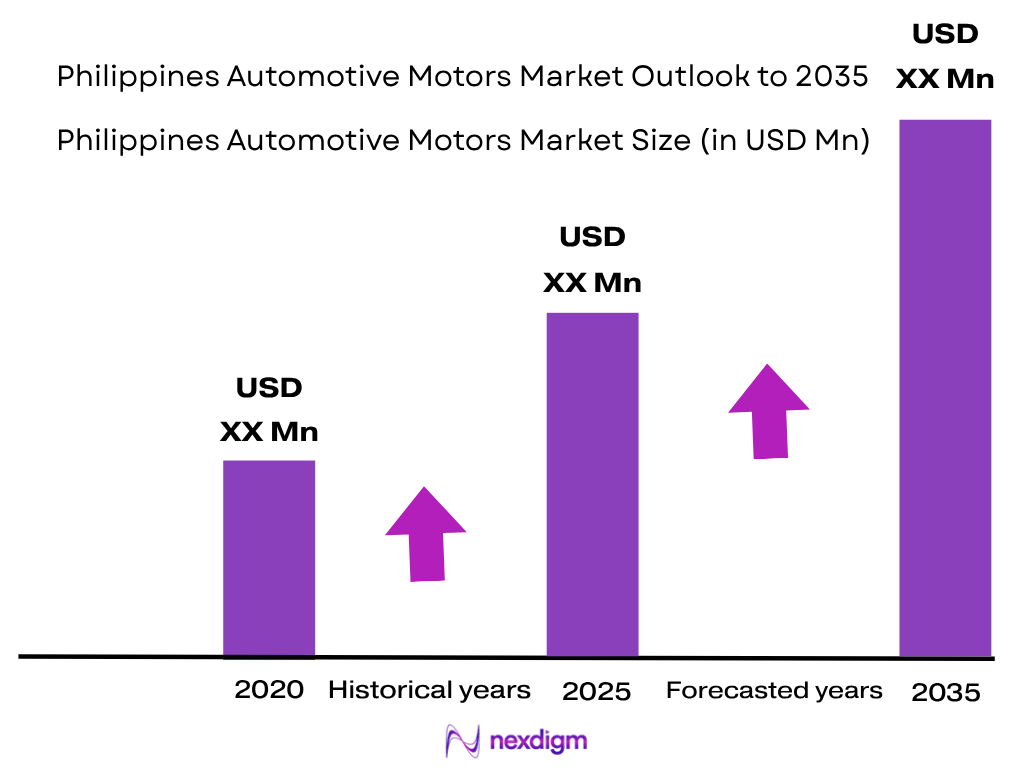
The Philippines Automotive Motors Market is valued at approximately ~USD XX million, based on historical market assessment. Demand is supported by expanding vehicle sales, local assembly, replacement of starter and auxiliary motors, and emerging electrified powertrains. New motor-vehicle sales increased from 429,807 units to 467,252 units, while locally assembled vehicle production increased from 110,350 units to 124,230 units, strengthening requirements for OEM-fitted and aftermarket automotive motors across passenger and commercial vehicles.
Metro Manila and CALABARZON dominate the Philippines Automotive Motors Market because they concentrate vehicle ownership, dealerships, workshops, component manufacturers and vehicle assembly operations. Laguna, Cavite and Batangas form the country’s principal automotive manufacturing corridor, supporting Toyota, Mitsubishi and major Tier-1 suppliers. Vehicle production expanded from 110,350 units to 124,230 units, while total industry sales increased from 429,807 units to 467,252 units, reinforcing automotive-motor demand across these manufacturing and consumption hubs.
Market Segmentation
By Motor Type
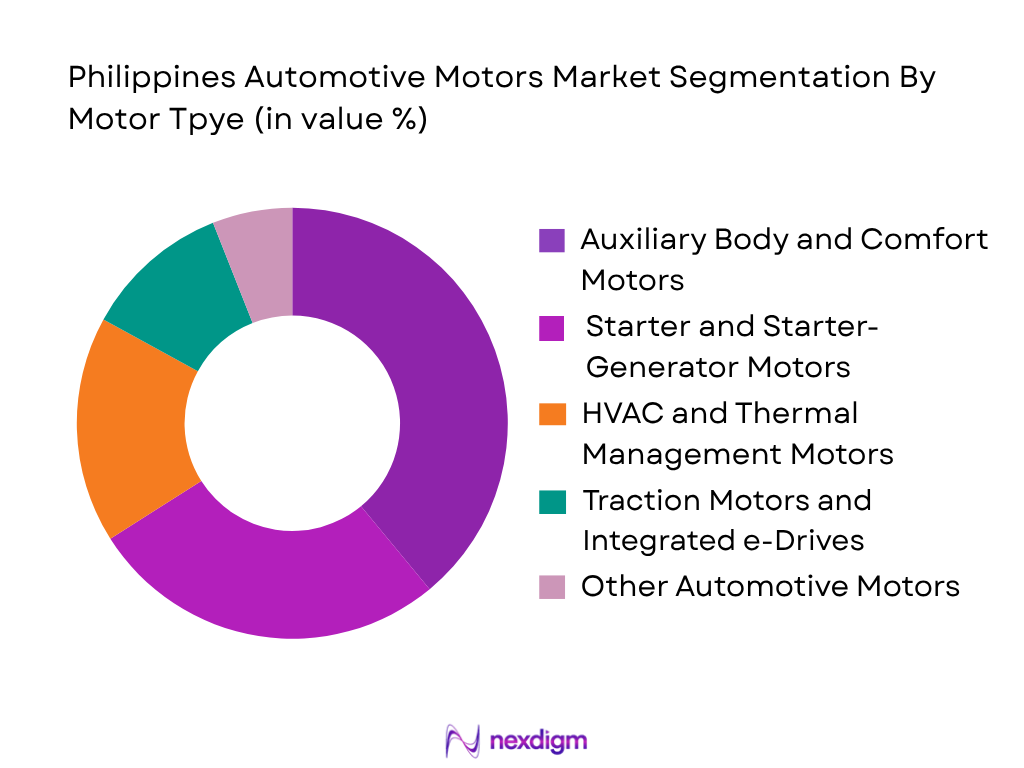
The Philippines Automotive Motors Market is segmented into auxiliary body and comfort motors, starter and starter-generator motors, HVAC and thermal-management motors, traction motors and integrated e-drives, and other automotive motors. Auxiliary body and comfort motors hold the dominant share because the country’s large installed base of passenger cars, SUVs, multi-purpose vehicles, pickups and commercial vehicles requires numerous low-voltage motors for power windows, wipers, electric steering, fuel delivery, seating and other convenience functions. These motors also generate recurring replacement demand as vehicles age. Starter motors remain important because internal-combustion vehicles continue to form the core operating vehicle population. HVAC and cooling motors have particular relevance under tropical operating conditions, where cabin cooling and engine thermal management are essential. Traction motors currently represent a smaller portion of demand but are strategically important as hybrid vehicles, battery electric vehicles, electric jeepneys and other e-PUV platforms enter the market. The segment is therefore developing from a predominantly auxiliary-motor market toward a mixed low- and high-voltage motor ecosystem.
By Vehicle Type
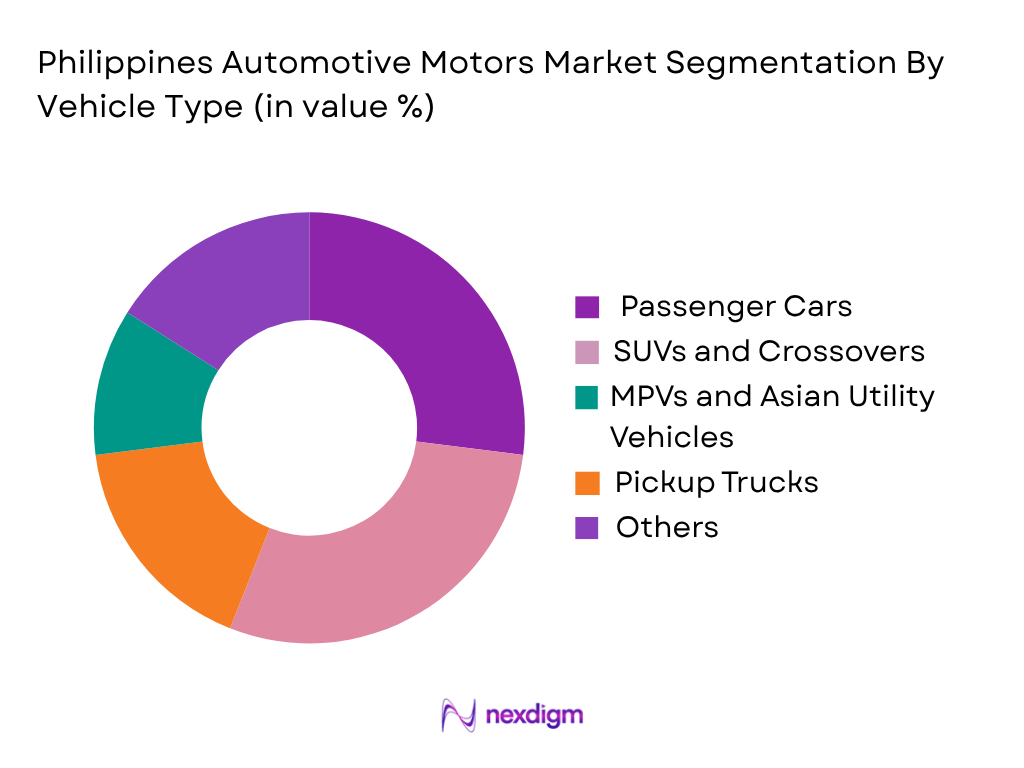
The Philippines Automotive Motors Market is segmented into passenger cars, SUVs and crossovers, multi-purpose and Asian utility vehicles, pickup trucks, light commercial vehicles, public utility vehicles, and medium and heavy commercial vehicles. Passenger cars and SUVs collectively dominate automotive-motor demand because they represent a substantial portion of new vehicle purchases and contain numerous auxiliary motors supporting comfort, safety and thermal-management functions. SUVs and crossovers are particularly important as manufacturers expand feature content through electrically adjustable seats, power tailgates, electronic steering, sophisticated HVAC systems and other motorized functions. Multi-purpose vehicles and pickups also form a major demand base because of their widespread household and commercial use. Public utility vehicles create a distinctive Philippine-specific opportunity as modernization introduces electronically controlled systems and electric propulsion. Electric jeepneys and minibuses expand the addressable market from conventional starter and auxiliary motors into traction motors, electric compressors, coolant pumps and other electrified components, gradually changing the vehicle-type composition of automotive-motor demand.
Competitive Landscape
The Philippines Automotive Motors Market combines locally established Japanese component manufacturers with global automotive-electrical and electrified-powertrain suppliers. DENSO, Mitsuba and Nidec benefit from manufacturing and industrial links within the Philippine automotive and electronics ecosystem, while Bosch and Mitsubishi Electric contribute broad automotive electrical capabilities. Competition is increasingly influenced by local manufacturing depth, OEM relationships, auxiliary-motor portfolios, electrification capability, aftermarket availability and integration with ASEAN automotive supply chains.
| Major Player | Establishment Year | Headquarters | Core Motor Capability | Philippines Manufacturing / Supply Position | Traction Motor Capability | Auxiliary Motor Coverage | OEM Application Coverage | Electrification Readiness |
| DENSO Corporation | 1949 | Kariya, Japan | ~ | ~ | ~ | ~ | ~ | ~ |
| Mitsuba Corporation | 1946 | Kiryu, Japan | ~ | ~ | ~ | ~ | ~ | ~ |
| Nidec Corporation | 1973 | Kyoto, Japan | ~ | ~ | ~ | ~ | ~ | ~ |
| Robert Bosch GmbH | 1886 | Gerlingen, Germany | ~ | ~ | ~ | ~ | ~ | ~ |
| Mitsubishi Electric Corporation | 1921 | Tokyo, Japan | ~ | ~ | ~ | ~ | ~ |
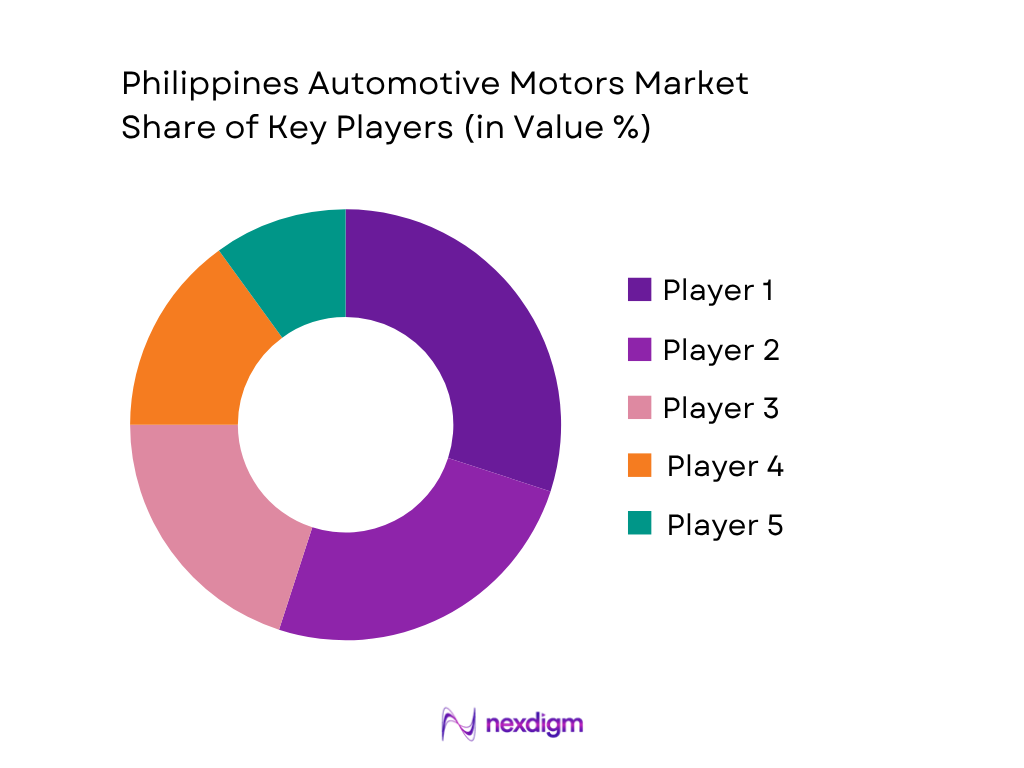
Philippines Automotive Motors Market Analysis
Growth Drivers
Expanding Vehicle Sales and Commercial Vehicle Base Supporting Motor Demand
The Philippines Automotive Motors Market is being supported by the continued expansion of the country’s vehicle base, which directly increases requirements for starter motors, cooling-fan motors, HVAC blower motors, electric power-steering motors, window motors, wiper motors, pumps and other auxiliary systems. The Chamber of Automotive Manufacturers of the Philippines and Truck Manufacturers Association recorded 467,252 vehicle sales in 2024, including 120,770 passenger cars and 346,482 commercial vehicles, compared with 429,807 total vehicles in 2023. CAMPI-TMA members subsequently sold 463,646 vehicles in 2025, including 92,924 passenger cars and 370,722 commercial vehicles, keeping the annual inflow of vehicles into the operating parc at a substantial level. This is particularly relevant to automotive motors because each newly operating vehicle introduces several electromechanical systems requiring eventual service or replacement, while commercial vehicles add higher-utilization applications. The World Bank reported Philippine GDP at USD 461.62 billion in 2024 and GDP per capita at USD 3,984.8, providing macroeconomic context for expanding mobility, automotive servicing and component consumption. Sources: Chamber of Automotive Manufacturers of the Philippines, Truck Manufacturers Association, Philippine News Agency and World Bank.
Established Automotive-Electronics and Component Manufacturing Base
The Philippines has an established electronics and automotive-component manufacturing ecosystem that supports the development of locally produced automotive motors, controllers, wiring systems and related electromechanical assemblies. Philippine Statistics Authority data show that exports of ignition wiring sets and other wiring sets used in vehicles, aircraft and ships reached USD 2.43 billion in 2024, while exports classified as machinery and transport equipment reached USD 2.18 billion. These established export flows demonstrate an industrial base capable of meeting international specifications for vehicle electrical components and integrating with regional automotive supply chains. Domestic trade data further show that machinery and transport equipment worth PHP 308.23 billion moved between Philippine regions during 2024, indicating substantial internal industrial and distribution activity. CALABARZON remains particularly relevant because major vehicle assemblers, electronics producers and component factories operate across Laguna, Cavite and Batangas. The World Bank recorded Philippine GDP at USD 461.62 billion in 2024, while GDP per capita reached USD 3,984.8. These manufacturing, trade and macroeconomic fundamentals provide a platform for deeper localization of starter motors, auxiliary motors, electric pumps and eventually higher-value electric-drive components. Sources: Philippine Statistics Authority, Board of Investments and World Bank.
Market Challenges
Dependence on Imported Transport Equipment and Advanced Motor Components
Import dependence remains a significant challenge for the Philippines Automotive Motors Market, particularly for advanced traction motors, permanent magnets, motor controllers, power semiconductors and specialized OEM-grade electromechanical assemblies. Philippine Statistics Authority data show that transport-equipment imports reached USD 11.36 billion in 2024. Imports of transport equipment from ASEAN countries alone reached USD 6.18 billion, while transport-equipment imports from APEC economies reached USD 10.11 billion. During the first six months of 2025, transport-equipment imports reached USD 6.51 billion, after increasing by USD 1.28 billion compared with the corresponding period. The country’s overall import bill also increased from USD 127.60 billion in 2024 to USD 133.57 billion in 2025, highlighting continuing exposure to overseas industrial supply chains. In January 2026 alone, transport-equipment imports were valued at USD 877.92 million. For automotive-motor suppliers, this means changes in external component availability can influence OEM production and aftermarket availability. The World Bank recorded Philippine GDP at USD 461.62 billion in 2024, demonstrating that this supply dependence exists within a sizeable but globally interconnected economy. Sources: Philippine Statistics Authority and World Bank.
Limited High-Voltage EV Servicing and Specialized Automotive Motor Skills
The transition from conventional 12V automotive motors toward high-voltage traction motors, motor-generators, inverters and battery thermal-management systems is creating a specialized workforce challenge for the Philippines Automotive Motors Market. TESDA formally prioritized development of electric-vehicle qualifications through Board Resolution 2024-06 and issued competency standards for Hybrid Electric Vehicles High Voltage System Servicing in April 2024, demonstrating that the required occupational skill framework is still developing alongside vehicle electrification. TESDA’s current registered-program database identifies only 3 specifically listed training providers/programs under its electric-vehicle course search: Pure Battery Propelled Electric Vehicle Servicing Level II in Pasay, Battery Electric Vehicle servicing in Cavite, and Hybrid Electric Vehicles High Voltage System Servicing in Laguna. The skills requirement is becoming more important as Department of Energy data show 472 recognized EV models in the country as of March 2026. The charging ecosystem has also expanded to 258 accredited EV charging-station providers and 1,569 charging points, increasing the number of electrified vehicles and systems requiring qualified technical support. World Bank data place Philippine GDP at USD 461.62 billion in 2024. Sources: TESDA, Department of Energy and World Bank.
Market Opportunities
EV Traction Motors and Integrated Electric-Drive Systems
Electric-vehicle adoption is creating a forward-looking opportunity for traction motors, integrated e-drives, motor controllers, electric pumps and thermal-management motors in the Philippines. The Department of Energy reported 292 recognized battery electric vehicle models, 37 hybrid electric vehicle models, 38 light electric vehicle models and 22 plug-in hybrid electric vehicle models as of March 2024. The supporting charging ecosystem included 27 EV charging-station operator providers, 17 service providers and 15 suppliers, with operator activities associated with 289 new jobs and PHP 1.49 billion in investment at that time. The ecosystem has subsequently expanded considerably: DOE reported 104 accredited EVCS providers in November 2024, 125 providers in March 2025, and 258 providers with 1,569 charging points in March 2026. DOE also listed 472 recognized EV models in March 2026. These current indicators establish an expanding installed technology base from which future demand for traction motors and electrified auxiliary systems can develop without relying on forecast statistics. Philippine GDP reached USD 461.62 billion in 2024, according to the World Bank. Sources: Department of Energy and World Bank.
Localization of Auxiliary Motors, Motor Components and ASEAN-Oriented Production
Local production of auxiliary automotive motors and related electrical components represents a significant opportunity because the Philippines already combines vehicle assembly, automotive parts manufacturing and substantial regional trade in transport equipment. Philippine Statistics Authority data show USD 2.43 billion of exports from ignition wiring sets and other vehicle-related wiring sets in 2024, alongside USD 2.18 billion of machinery and transport-equipment exports. This existing electrical-component manufacturing base can support expansion into starter motors, blower motors, cooling motors, power-window motors, electric pumps, motor housings, winding assemblies and motor-control electronics. At the same time, transport-equipment imports reached USD 11.36 billion in 2024, including USD 6.18 billion sourced from ASEAN economies, demonstrating the scale of automotive products circulating through regional supply chains and the potential addressable pool for localized substitution. Domestic movement of machinery and transport equipment reached PHP 308.23 billion in 2024, further showing significant internal distribution demand. The Board of Investments’ automotive development framework specifically covers production of strategic vehicle parts and OEM-standard components. With Philippine GDP at USD 461.62 billion in 2024, deeper motor localization can serve domestic assemblers, aftermarket distributors and ASEAN-oriented component exports. Sources: Philippine Statistics Authority, Board of Investments and World Bank.
Future Outlook
The Philippines Automotive Motors Market is expected to expand at approximately ~X.X% CAGR during 2026–2035, supported by rising vehicle ownership, local automotive production, replacement demand and progressive electrification. The market will develop through parallel demand for conventional low-voltage motors and newer high-voltage traction systems. Auxiliary motors will remain fundamental because the country’s expanding operating vehicle population requires recurring replacement of starter, blower, cooling, window, wiper, pump and steering motors. Rising electrical content per vehicle will further increase the number of motorized functions installed in passenger vehicles, SUVs and multi-purpose vehicles.
Electrification will create a second growth layer. Implementation of the Electric Vehicle Industry Development Act and the Comprehensive Roadmap for the Electric Vehicle Industry provides an institutional framework for expanding electric mobility, charging infrastructure and local EV industry development. Traction motors, motor controllers, inverters, electric compressors and battery thermal-management systems will consequently become more important within the automotive component ecosystem. Public utility vehicle modernization represents a particularly market-specific opportunity. Electric jeepneys and minibuses require fundamentally different propulsion architectures from traditional diesel PUVs, opening demand for traction motors, integrated electric drives, regenerative systems and high-voltage auxiliary components. High daily utilization also creates requirements for robust motor cooling, maintenance and technical support.
Major Players
- DENSO Philippines Corporation
- Mitsuba Philippines Corporation
- Nidec Corporation / Nidec Philippines
- Robert Bosch Inc. Philippines
- Valeo SE
- Mitsubishi Electric Corporation
- Hitachi Astemo Ltd.
- BorgWarner Inc.
- ZF Friedrichshafen AG
- MAHLE GmbH
- Continental AG
- Schaeffler AG
- SEG Automotive Germany GmbH
- Hyundai Mobis Co., Ltd.
- Brose Fahrzeugteile SE & Co. KG
Key Target Audience
- Automotive Electric Motor Manufacturers
- Passenger Vehicle and Commercial Vehicle OEMs
- Electric Vehicle and e-PUV Manufacturers
- Automotive Tier-1 and Powertrain System Suppliers
- Automotive Parts Importers, Distributors and Aftermarket Networks
- Automotive Component Manufacturers and Exporters
- Investments and Venture Capitalist Firms
- Government and Regulatory Bodies (Department of Trade and Industry, Board of Investments, Department of Energy, Land Transportation Office, Department of Transportation, Department of Science and Technology)
Research Methodology
Step 1: Identification of Key Variables
The initial phase involves constructing an ecosystem map covering vehicle assemblers, automotive motor manufacturers, Tier-1 suppliers, EV manufacturers, component exporters, distributors, workshops and fleet operators within the Philippines Automotive Motors Market. Critical variables include motor type, vehicle category, propulsion architecture, local production, OEM fitment, aftermarket replacement and electrification. Desk research is used to identify relationships between vehicle sales, domestic production, automotive component manufacturing, operating vehicle population and motor content per vehicle. Separate variables are established for conventional auxiliary motors and emerging high-voltage traction systems.
Step 2: Market Analysis and Construction
Historical market demand is constructed by evaluating vehicle production, vehicle sales, registrations, automotive component activity, imports and replacement requirements. Motor demand is mapped across passenger cars, SUVs, MPVs, pickups, commercial vehicles and public utility vehicles. The bottom-up framework evaluates average motor content by vehicle and application, while the top-down framework assesses broader automotive-sector activity. OEM and aftermarket requirements are separated to avoid overlap, and the results are triangulated to establish the market structure and segmentation.
Step 3: Hypothesis Validation and Expert Consultation
Market hypotheses are validated through computer-assisted telephone interviews and structured discussions with automotive component suppliers, vehicle assemblers, parts distributors, workshops, fleet operators and electrification specialists. These interactions test assumptions concerning procurement, replacement frequency, motor applications, local sourcing and technology adoption. Expert inputs are particularly important for assessing auxiliary-motor replacement, public utility vehicle requirements, EV traction systems and the capability of Philippine automotive suppliers to participate in localized motor and power-electronics manufacturing.
Step 4: Research Synthesis and Final Output
The final phase integrates secondary research, primary interviews, automotive production indicators, vehicle-demand patterns and motor-level application mapping. Findings are cross-validated through top-down and bottom-up approaches to reduce duplication between motor categories and sales channels. The resulting analysis establishes the Philippines Automotive Motors Market across motor types, vehicle categories, OEM demand, aftermarket replacement and electrified propulsion. It also evaluates competitive positioning, localization potential, EV transition and strategic opportunities within the Philippine automotive supply chain.

- Executive Summary
- Research Methodology (Market Definition and Scope, Philippines Automotive Motor Taxonomy, Traction and Auxiliary Motor Classification, Vehicle Parc Assessment, New Vehicle Registration Assessment, Local Vehicle Assembly Mapping, CBU and CKD Vehicle Assessment, Electric Vehicle Population Assessment, Public Utility Vehicle Electrification Mapping, Motor Content per Vehicle Assessment, Automotive Component Trade Mapping, OEM and Aftermarket Demand Assessment, Market Sizing Framework)

- Definition and Scope
- Philippines Automotive Motors Industry Evolution and Technology Development
- Automotive Motor Manufacturing and Assembly Process
- Automotive Motor Value Chain Analysis
- Philippines Automotive Motor Supply Chain Analysis
- Rotor, Stator, Magnet, Copper Winding, Motor Housing and Electronic Control Ecosystem Analysis
- Philippines Automotive Motor Manufacturing Footprint and Localization Assessment
- OEM Procurement, Distributor, Workshop and Automotive Motor Service Framework

- Growth Drivers (Expansion of Passenger and Commercial Vehicle Demand, Growth of Locally Assembled Vehicles, Large Automotive Replacement Base, Increasing Electric Vehicle Adoption, Public Utility Vehicle Modernization, Expansion of Automotive Component Manufacturing, Rising Motor Content per Vehicle, Growth of Logistics and Delivery Fleets)
- Market Challenges (Dependence on Imported Traction Motors and High-Value Components, Fragmented Automotive Aftermarket, Limited Domestic High-Voltage Motor Manufacturing, Permanent Magnet and Power Electronics Import Exposure, Automotive-Grade Qualification Requirements, EV Technician Skill Gaps, Counterfeit Replacement Components, Charging and Service Infrastructure Constraints)
- Market Opportunities (EV Traction Motor Assembly, e-PUV Motor Systems, Integrated e-Drive Localization, Auxiliary Motor Manufacturing, Electric Jeepney Powertrains, Electric Commercial Vehicle Motors, Motor Remanufacturing, Automotive Component Export Expansion)
- Market Trends (Permanent Magnet Traction Motors, Integrated Motor-Inverter-Reducer Systems, Brushless Auxiliary Motors, Electrified Thermal Management, Electric Jeepney Drivetrains, Hybrid Motor-Generator Systems, Smart Pumps and Actuators, Higher Electrical Content per Vehicle)
- Regulatory and Standards Landscape (Electric Vehicle Industry Development Act, Comprehensive Roadmap for the Electric Vehicle Industry, Department of Energy EV Policies, Board of Investments Automotive Incentives, Comprehensive Automotive Resurgence Strategy, Vehicle Type Approval, Land Transportation Office Registration Requirements, Philippine National Standards for Electric Vehicles)
- SWOT Analysis
- Porter’s Five Forces Analysis
- PESTLE Analysis
- Stakeholder Ecosystem
- Competition Ecosystem

- By Market Value (2020-2025)
- By Automotive Motor Unit Demand (2020-2025)
- By Traction Motor Demand Volume (2020-2025)
- By Auxiliary Motor Demand Volume (2020-2025)
- By OEM-Fitted Automotive Motor Volume (2020-2025)
- By Aftermarket Replacement Motor Volume (2020-2025)

- By Motor Type (In Value %)
Traction Motors
Starter Motors
Starter-Generator Motors
HVAC Blower Motors
Radiator and Condenser Fan Motors
Power Window Motors
Wiper Motors
Power Seat Motors
Electric Power Steering Motors
Fuel Pump Motors
Electric Water Pump Motors
Electronic Throttle Motors
Electric Compressor Motors
Door and Tailgate Motors
Other Auxiliary Automotive Motors - By Vehicle Type (In Value %)
Passenger Cars
SUVs and Crossovers
Asian Utility Vehicles
Multi-Purpose Vehicles
Pickup Trucks
Light Commercial Vehicles
Public Utility Jeepneys
Taxis and Transport Network Vehicles
Buses and Coaches
Medium and Heavy Commercial Vehicles
Electric Public Utility Vehicles
Special Purpose Vehicles - By Propulsion Type (In Value %)
Gasoline Internal Combustion Engine Vehicles
Diesel Internal Combustion Engine Vehicles
Mild Hybrid Electric Vehicles
Full Hybrid Electric Vehicles
Plug-In Hybrid Electric Vehicles
Battery Electric Vehicles
Range-Extended Electric Vehicles
Fuel Cell Electric Vehicles - By Application Type (In Value %)
Vehicle Propulsion
Engine Starting and Start-Stop
HVAC and Cabin Airflow
Engine Cooling
Battery Thermal Management
Electric Power Steering
Power Windows
Windshield Wipers
Powered Seating
Fuel Delivery
Electronic Throttle Control
Coolant Circulation
Electric Air Conditioning Compressors
Powered Doors and Tailgates
Other Body and Comfort Applications - By Sales Channel (In Value %)
OEM Direct Supply
Tier-1 Automotive System Integration
Authorized Vehicle Dealerships
Independent Automotive Parts Distributors
Automotive Electrical Parts Specialists
Independent Workshops and Repair Shops
Fleet Maintenance Networks
Public Utility Vehicle Service Networks
Online Automotive Parts Channels
EV Powertrain and Technical Service Specialists - By Region (In Value %)
National Capital Region
CALABARZON
Central Luzon
Central Visayas
Davao Region
Northern Mindanao
Ilocos Region
Western Visayas
Other Luzon
Other Visayas
Other Mindanao

- Market Share of Major Players (By Revenue, Unit Volume, Traction Motors, Auxiliary Motors, Vehicle Type, Propulsion Type, OEM Channel, Aftermarket Channel)
- Cross Comparison Parameters (Traction and Auxiliary Automotive Motor Portfolio Breadth, Philippines Manufacturing and CALABARZON Localization Footprint, EV Motor-Inverter-Reducer and e-Axle Integration Capability, Passenger-AUV-Pickup-PUV-Commercial Vehicle Application Coverage, 12V-24V-48V and High-Voltage Architecture Coverage, OEM Assembly and Automotive Component Export Relationships, Aftermarket Distribution-Technical Service and Replacement Motor Coverage, e-PUV Electrification and ASEAN Supply Chain Readiness)
- SWOT Analysis of Major Players
- Competitive Positioning Matrix
- Product and Technology Portfolio Benchmarking
- Pricing and Distribution Network Benchmarking
- Market Entry Strategy Assessment
- Detailed Profiles of Major Companies
DENSO Philippines Corporation
Mitsuba Philippines Corporation
Nidec Corporation / Nidec Philippines
Robert Bosch Inc. Philippines
Valeo SE
Mitsubishi Electric Corporation
Hitachi Astemo Ltd.
BorgWarner Inc.
ZF Friedrichshafen AG
MAHLE GmbH
Continental AG
Schaeffler AG
SEG Automotive Germany GmbH
Hyundai Mobis Co., Ltd.
Brose Fahrzeugteile SE & Co. KG

- Automotive Motor Buyer Segmentation
- OEM and Aftermarket Procurement Behaviour
- Supplier and Distributor Selection Criteria
- Automotive Motor Buyer Pain Points
- Motor Technology and Electrification Adoption Assessment
- Replacement and Repurchase Behaviour

- By Market Value (2026-2035)
- By Automotive Motor Unit Demand (2026-2035)
- By Traction Motor Demand Volume (2026-2035)
- By Auxiliary Motor Demand Volume (2026-2035)
- By OEM-Fitted Automotive Motor Volume (2026-2035)
- By Aftermarket Replacement Motor Volume (2026-2035)


 Request a Sample
 Ask for Customization
 Get a Quote
 Enquire Now