

 Download PDF
 Download PDF
Market Overview
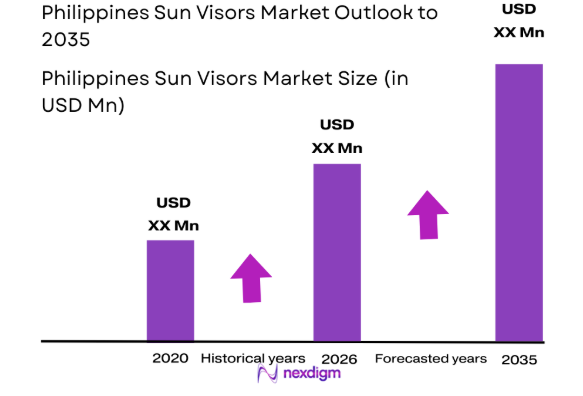
The Philippines Sun Visors market has experienced significant growth, driven by increasing demand for automotive accessories in both passenger and commercial vehicle segments. The market size is estimated to reach USD ~ million, supported by the expansion of the automotive industry in the Philippines. Rising vehicle sales and evolving consumer preferences for vehicle comfort and safety have fueled the demand for sun visors, making them a critical component in the automotive supply chain.
The Philippines, particularly cities like Manila, Cebu, and Davao, has become a central hub for automotive production and sales, contributing significantly to the growth of the sun visors market. This growth is supported by favorable government policies, a rising middle-class population, and a robust automotive manufacturing ecosystem. The increasing number of vehicles on the road, including electric vehicles, further drives the demand for high-quality, functional sun visors across the region.
Market Segmentation
By Product Type
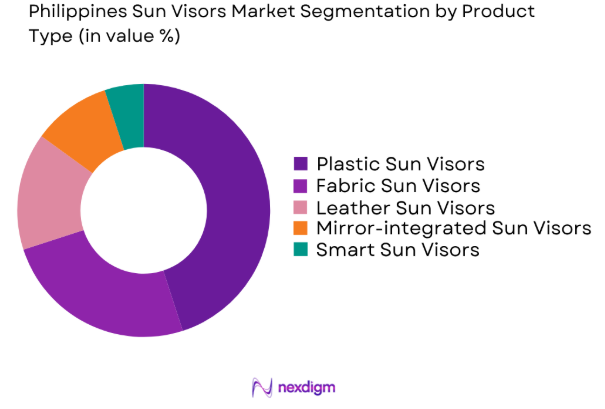
The Philippines Sun Visors market is segmented by product type into plastic, fabric, leather, mirror-integrated, and smart sun visors. Plastic sun visors hold the dominant market share due to their cost-effectiveness and widespread use in both economy and mid-range vehicles. They are favored for their ease of manufacturing and durability, making them a preferred choice for mass-market production. The availability of plastic in various finishes and its ability to be molded into different designs further contributes to its dominance.
By Platform Type
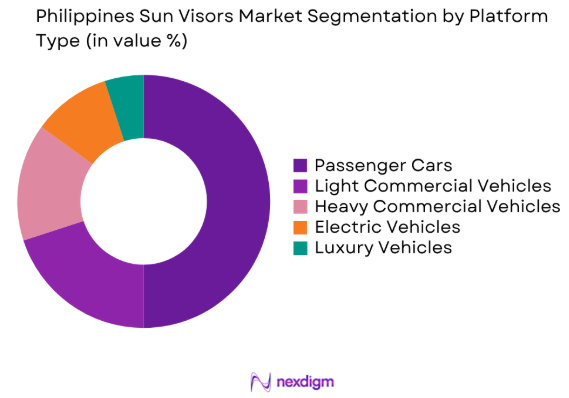
The Philippines Sun Visors market is segmented by platform type into passenger cars, light commercial vehicles, heavy commercial vehicles, electric vehicles, and luxury vehicles. Passenger cars dominate the market due to their high volume in both local production and consumer demand. The increasing number of passenger vehicles on the road, coupled with their cost-effectiveness, drives significant demand for sun visors. This segment continues to benefit from the growing middle-class population and rising disposable income in the Philippines.
Competitive Landscape
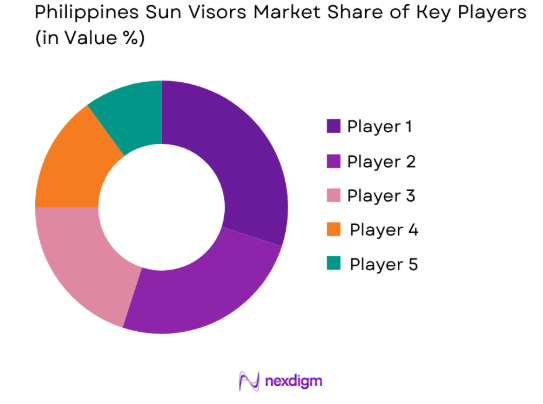
The Philippines Sun Visors market is characterized by a competitive landscape dominated by a mix of global and regional players. These companies influence the market through their innovations in sun visor designs, manufacturing techniques, and the integration of advanced features like smart technologies and UV protection. Market consolidation is evident as major players leverage their established supply chains and resources to cater to both OEMs and the aftermarket sector. The market is driven by the need for cost-effective solutions, while also adopting cutting-edge technologies in response to consumer demand for enhanced vehicle interiors.
| Company Name | Establishment Year | Headquarters | Technology Focus | Market Reach | Key Products | Revenue | Additional Market-Specific Parameter |
| Autoliv | 1997 | Sweden | ~ | ~ | ~ | ~ | ~ |
| Lear Corporation | 1917 | USA | ~ | ~ | ~ | ~ | ~ |
| Valeo | 1923 | France | ~ | ~ | ~ | ~ | ~ |
| Magna International | 1957 | Canada | ~ | ~ | ~ | ~ | ~ |
| Yanfeng Automotive | 2000 | China | ~ | ~ | ~ | ~ | ~ |
Philippines Sun Visors Market Analysis
Growth Drivers
Increasing Demand for Customization
One of the key growth drivers in the Philippines Sun Visors market is the increasing consumer demand for customization in vehicle interiors. Consumers are seeking more personalized features, including sun visors with integrated technology such as mirrors, LED lights, and UV protection. The demand for premium and custom-designed sun visors has surged, particularly in luxury vehicles and electric vehicles (EVs). This trend is driven by a desire for enhanced comfort, aesthetics, and functionality in vehicles, particularly among middle and high-income segments. The rising middle class in the Philippines is contributing to this demand, as consumers have more disposable income to invest in customized vehicle interiors, which is benefiting manufacturers of high-quality sun visors.
Rising Adoption of Electric Vehicles (EVs)
The growing adoption of electric vehicles in the Philippines is another major growth driver for the sun visors market. EVs are often equipped with advanced interior components, and the demand for innovative features such as smart sun visors is increasing. As automakers focus on enhancing the overall driving experience in EVs, the integration of advanced sun visors with features like UV protection, glare reduction, and connectivity has gained popularity. With the government’s increasing support for EV adoption and incentives for manufacturers, the rising penetration of electric vehicles is expected to continue driving demand for high-tech sun visors tailored for electric vehicle models.
Market Challenges
High Manufacturing Costs
A significant challenge in the Philippines Sun Visors market is the high manufacturing costs, particularly for advanced sun visors that feature new materials or smart technology. The cost of raw materials such as UV-resistant plastics, leather, and electronic components, along with the complex manufacturing processes, drives up production expenses. These elevated costs often result in higher retail prices, which may discourage price-sensitive consumers, especially in the mass-market segment. Smaller manufacturers also face difficulties competing with larger players who benefit from economies of scale, making it challenging for them to offer competitive pricing while maintaining profit margins. This cost disparity may limit market access for smaller or new entrants, affecting overall market dynamics.
Supply Chain Constraints
The Philippines Sun Visors market faces significant supply chain constraints due to disruptions in global supply networks. The COVID-19 pandemic, coupled with geopolitical factors, has resulted in shortages of raw materials and delays in the manufacturing process. Critical components required for sun visor production, such as plastics, fabrics, and electronic parts, have become increasingly difficult to source. Furthermore, delays in material procurement and rising transportation costs have exacerbated these challenges, leading to extended production timelines. These issues not only increase the cost of production but also heighten the risk of supply shortages, which in turn drives up prices and affects the availability of products in the market.
Opportunities
Shift Toward Eco-friendly Materials
As environmental sustainability becomes more important to both consumers and manufacturers, there is a growing opportunity in the Philippines Sun Visors market to adopt eco-friendly materials. Consumers are increasingly seeking products made from sustainable resources, prompting automotive manufacturers to incorporate recycled plastics, organic fabrics, and bio-based materials into their vehicle components. This shift aligns with the global trend toward greener products and sustainable manufacturing practices. In the Philippines, manufacturers have an opportunity to innovate by developing sun visors that not only enhance functionality but also meet the rising consumer demand for environmentally responsible automotive products. This trend could provide a competitive edge for companies focused on eco-friendly designs in the market.
Integration of Smart Technology
The integration of smart technology in sun visors presents another major opportunity in the Philippines Sun Visors market. Consumers are increasingly looking for vehicle interiors that offer more than just basic functionality. Features such as touch-sensitive controls, adaptive lighting, and connectivity with other vehicle systems are becoming more popular. This trend is particularly prominent in luxury vehicles and electric vehicles, where advanced technology is a key selling point. As automakers look to enhance the overall driving experience, the demand for smart sun visors with features like ambient lighting, touch controls, and even heads-up displays is expected to grow, creating opportunities for manufacturers to innovate.
Future Outlook
The Philippines Sun Visors market is expected to grow steadily in the coming years, driven by increasing consumer demand for vehicle customization, technological advancements, and the growing adoption of electric vehicles. The integration of smart technologies and eco-friendly materials will be key drivers of innovation, offering opportunities for manufacturers to cater to the evolving needs of consumers. Additionally, regulatory support for sustainability and the automotive industry’s shift toward greener solutions will further stimulate market growth, ensuring a favorable environment for new entrants and established players alike.
Major Players
- Autoliv
- Lear Corporation
- Valeo
- Magna International
- Yanfeng Automotive
- Faurecia
- Adient
- Toyota Boshoku
- JCI
- Hyundai Mobis
- Delphi Technologies
- TRW Automotive
- BorgWarner
- DENSO
- ZF Friedrichshafen
Key Target Audience
- Investments and venture capitalist firms
- Government and regulatory bodies
- Automotive manufacturers
- Vehicle customization service providers
- Automotive parts suppliers
- Aftermarket automotive retailers
- Electric vehicle manufacturers
- Automotive technology firms
Research Methodology
Step 1: Identification of Key Variables
Key market variables such as product types, consumer preferences, and technological advancements are identified through primary and secondary research.
Step 2: Market Analysis and Construction
Detailed market size estimation, segmentation, and analysis of key trends are conducted based on collected data.
Step 3: Hypothesis Validation and Expert Consultation
Industry experts and key stakeholders provide insights to validate hypotheses and ensure accuracy in market projections.
Step 4: Research Synthesis and Final Output
The research findings are synthesized into a comprehensive report, detailing market dynamics, opportunities, and challenges.

- Executive Summary
- Research Methodology (Definitions, Scope, Industry Assumptions, Market Sizing Approach, Primary & Secondary Research Framework, Data Collection & Verification Protocol, Analytic Models & Forecast Methodology, Limitations & Research Validity Checks)

- Market Definition and Scope
- Value Chain & Stakeholder Ecosystem
- Regulatory / Certification Landscape
- Sector Dynamics Affecting Demand
- Strategic Initiatives & Infrastructure Growth

- Growth Drivers
Increasing Consumer Demand for Customization
Government Initiatives Promoting Electric Vehicles
Advancements in Smart Vehicle Technology - Market Challenges
High Manufacturing Costs of High-tech Sun Visors
Supply Chain Constraints for Raw Materials
Lack of Standardization in Fitment and Design - Market Opportunities
Surge in Demand for Sustainable Sun Visor Materials
Potential Growth in EV Sun Visor Solutions
Increasing Adoption of Advanced Driver Assistance Systems (ADAS) - Trends
Integration of UV Protection Technology
Shift Towards Eco-friendly Manufacturing
Growing Interest in Multifunctional Sun Visors - Government Regulations
- SWOT Analysis of Key Competitors
- Porter’s Five Forces

- By Market Value, 2020-2025
- By Installed Units, 2020-2025
- By Average System Price, 2020-2025
- By System Complexity Tier, 2020-2025

- By System Type (In Value%)
Plastic Sun Visors
Fabric Sun Visors
Leather Sun Visors
Mirror-integrated Sun Visors
Smart Sun Visors - By Platform Type (In Value%)
Passenger Cars
Light Commercial Vehicles
Heavy Commercial Vehicles
Electric Vehicles
Luxury Vehicles - By Fitment Type (In Value%)
OEM Sun Visors
Aftermarket Sun Visors
Hybrid Fitment Sun Visors
Modular Sun Visors
Integrated Sun Visors - By End User Segment (In Value%)
Automobile Manufacturers
Automotive Aftermarket Retailers
OEM Suppliers
Vehicle Customization Centers
Automotive Repair and Maintenance Service Providers - By Procurement Channel (In Value%)
Direct Procurement
Dealer Networks
Online Bidding Platforms
Third-party Distributors
Private Sector Procurement

- Market Share Analysis
- Cross Comparison Parameters (Material Type, Fitment Type, Platform Type, End User Segment, Procurement Channel, System Complexity, Price Tier, Product Type, Distribution Channel, Sales Channel)
- SWOT Analysis of Key Competitors
- Pricing & Procurement Analysis
- Key Players
Autoliv
Lear Corporation
Valeo
Magna International
Adient
Yanfeng Automotive Trim Systems
Gentherm
Toyota Boshoku
Faurecia
BorgWarner
Kongsberg Automotive
Schaeffler
Jiangsu Tongyu Automotive
Tata AutoComp Systems
Grupo Antolin

- Growing Demand in Electric Vehicle Segment
- Shifting Preferences Among Luxury Vehicle Owners
- Increased Vehicle Customization
- Rising Popularity of Smart Vehicle Technologies

- Forecast Market Value, 2026-2035
- Forecast Installed Units, 2026-2035
- Price Forecast by System Tier, 2026-2035
- Future Demand by Platform, 2026-2035


 Request a Sample
 Ask for Customization
 Get a Quote
 Enquire Now