
 Download PDF
Market Overview
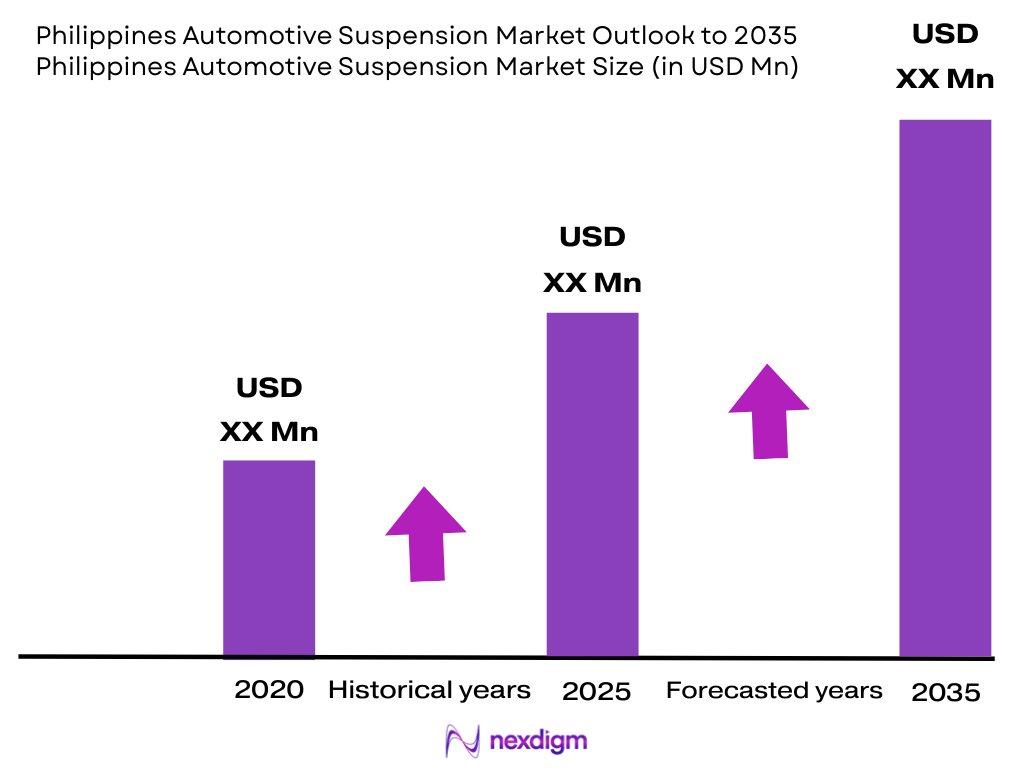
The Philippines Automotive Suspension Market is valued at approximately USD ~ million, supported by expanding vehicle sales, high road usage and recurring component replacement. New motor-vehicle sales increased from 429,807 units in the preceding annual benchmark to 467,252 units in the latest benchmark, including 346,482 commercial vehicles and 120,770 passenger vehicles. This expanding installed base supports demand for shock absorbers, struts, springs, control arms, bushings and heavy-duty suspension system. Metro Manila, CALABARZON, Central Luzon, Cebu and Davao dominate the Philippines Automotive Suspension Market because they combine vehicle density, dealerships, workshops, parts distribution, manufacturing and commercial fleets. NCR’s constant-price economy increased from approximately PHP 6.6 trillion to PHP 6.94 trillion, while CALABARZON remained the country’s principal industrial region. Laguna, Cavite and Batangas are especially important because they host automotive assembly, components manufacturing and extensive supplier networks supporting OE and replacement suspension demand.
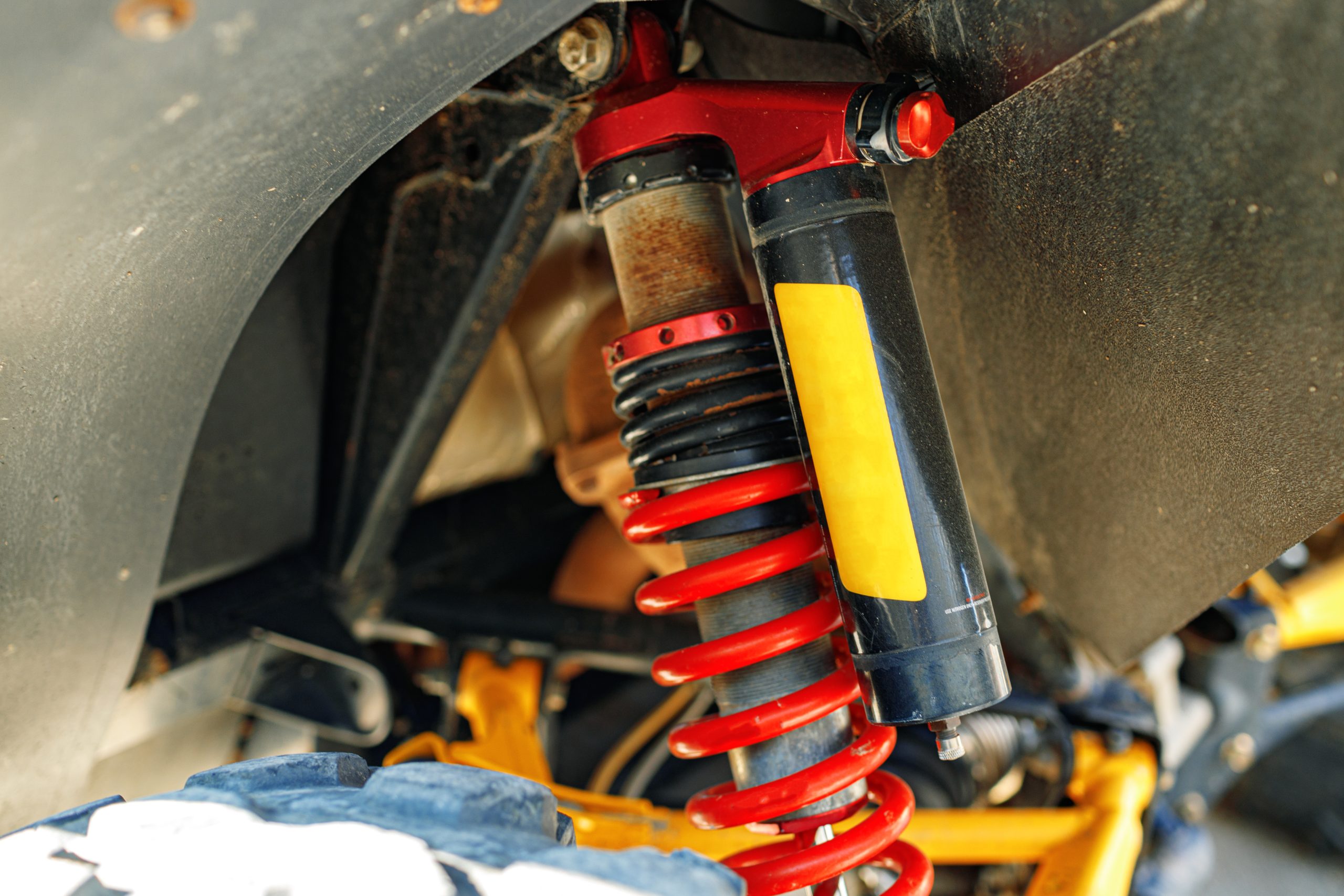
The Philippines suspension industry is primarily an aftermarket-driven market with an emerging local manufacturing and electrification layer. Road conditions, vehicle age, high commercial-vehicle utilisation and the popularity of MPVs, SUVs and pickups create repeated demand for conventional dampers and chassis components. DPWH’s national road database continues to identify paved, gravel and road-condition categories across the national network, making road quality a direct input into suspension deterioration, alignment loss, bushing wear and shock-absorber replacement analysis.
Market Segmentation
By Vehicle Type
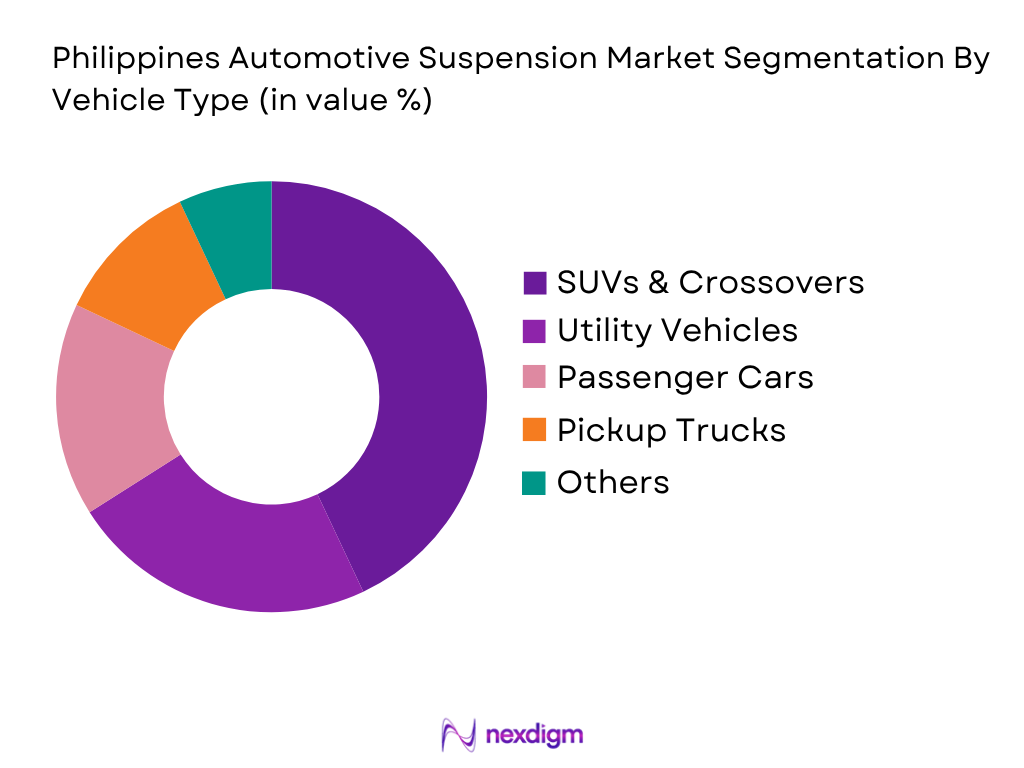
The Philippines Automotive Suspension Market is segmented into passenger cars, SUVs and crossovers, MPVs and utility vehicles, pickup trucks, and commercial/public utility vehicles. SUVs, MPVs and utility-oriented vehicles collectively represent the most important suspension-demand pool, reflecting the Philippine market’s preference for vehicles capable of carrying passengers and cargo while operating across mixed urban and provincial roads. Commercial vehicles accounted for 346,482 units out of 467,252 CAMPI-TMA sales in the latest base benchmark, highlighting the importance of load-bearing vehicle applications. These vehicles generally require stronger dampers, higher spring rates, reinforced bushings and more durable control arms than compact passenger cars. Pickups further contribute through rear leaf-spring systems and heavy-duty shock absorbers. Jeepneys, vans, delivery fleets and utility vehicles create particularly intensive replacement cycles because of daily mileage, passenger loads and stop-start operation.
By Suspension Technology
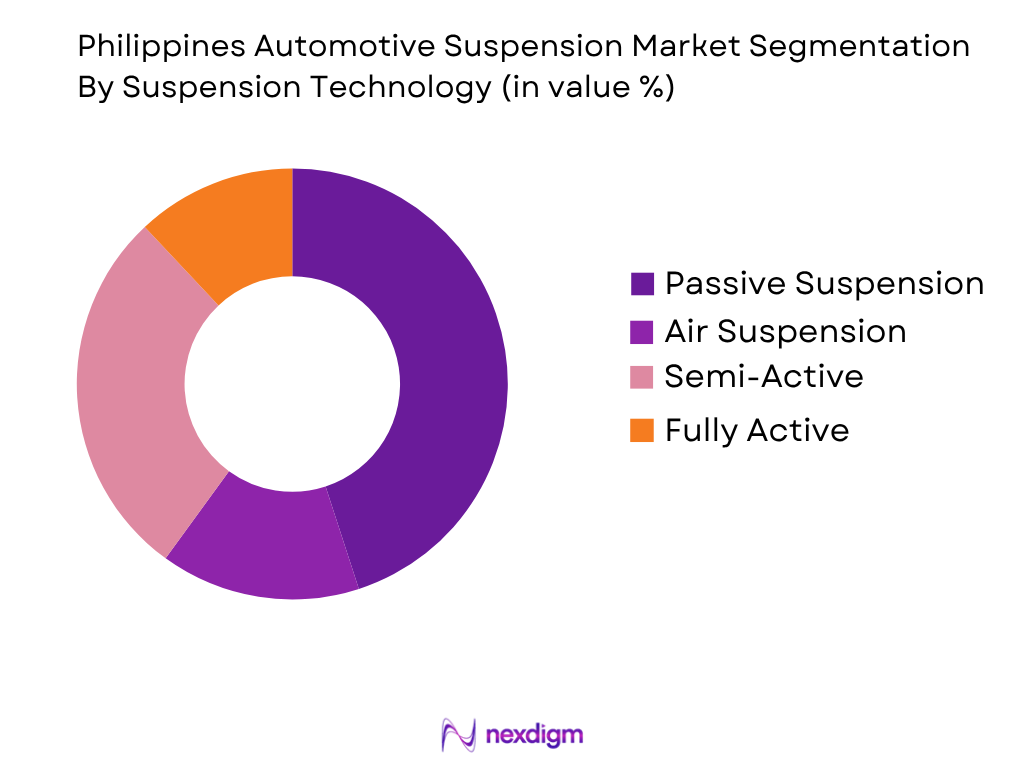
The Philippines Automotive Suspension Market is segmented into passive suspension, semi-active/electronic suspension, air suspension and fully active suspension. Passive suspension dominates because the country’s installed vehicle parc primarily consists of conventional passenger cars, MPVs, SUVs, pickups, jeepneys and commercial vehicles using hydraulic shocks, struts, coil springs and leaf springs. These systems are comparatively easy to maintain through the country’s large independent workshop ecosystem and have wide aftermarket availability. Electronic damping and air suspension remain concentrated in premium European vehicles, selected high-end SUVs and newer EV platforms. Their contribution should progressively increase as electrified and premium vehicles enter the fleet. HL Mando, ZF and other global chassis suppliers already commercialise electronic and EV-specific suspension technologies, indicating the direction of future technology adoption.
Competitive Landscape
The Philippines Automotive Suspension Market combines international OE suppliers, Japanese shock-absorber specialists, European premium suspension companies and heavy-duty aftermarket brands. KYB has particularly strong relevance because Japanese vehicles constitute a major portion of the Philippine fleet, while Monroe provides broad light-vehicle and commercial-vehicle ride-control coverage. ZF participates through SACHS, LEMFÖRDER and related chassis products, BILSTEIN addresses premium and performance applications, and HL Mando increasingly competes around electronically controlled and EV suspension technologies.
| Major Player | Establishment Year | Headquarters | Core Suspension Portfolio | Key Philippine Vehicle Relevance | Electronic Suspension Capability | Heavy-Duty Capability | Aftermarket Position | EV Readiness |
| KYB Corporation | 1919 | Tokyo, Japan | ~ | ~ | ~ | ~ | ~ | ~ |
| ZF Friedrichshafen AG | 1915 | Friedrichshafen, Germany | ~ | ~ | ~ | ~ | ~ | ~ |
| Tenneco / Monroe | 1999 current structure | Northville, USA | ~ | ~ | ~ | ~ | ~ | ~ |
| thyssenkrupp BILSTEIN | 1873 | Ennepetal, Germany | ~ | ~ | ~ | ~ | ~ | ~ |
| HL Mando Corporation | 1962 heritage | Seongnam, South Korea | ~ | ~ | ~ | ~ | ~ | ~ |
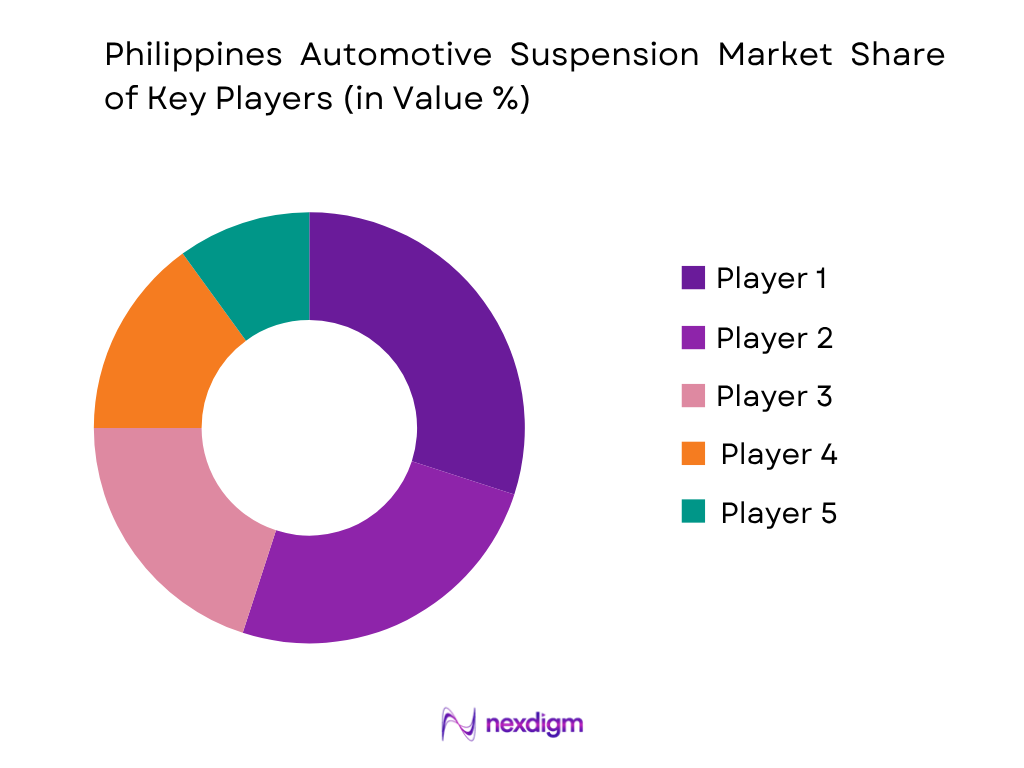
Philippines Automotive Suspension Market Analysis
Growth Drivers
Expanding Vehicle Base, Utility-Vehicle Demand and Intensive Road Mobility
The Philippines Automotive Suspension Market is being supported by a steadily expanding vehicle base and the country’s strong preference for multipurpose, commercial and utility-oriented vehicles that place comparatively high loads on suspension components. Philippine automotive assemblers recorded 467,252 new vehicles sold in 2024, compared with 429,807 units in 2023; within the latest total, 346,482 units were commercial vehicles and 120,770 units were passenger cars. This sales structure is directly relevant to suspension demand because SUVs, MPVs, vans, pickups and light commercial vehicles typically use larger dampers, higher-capacity springs, reinforced control arms and more durable bushings than small passenger cars. Pickups and commercial vehicles also introduce substantial demand for leaf springs and heavy-duty rear dampers because their suspensions must accommodate variable payloads. The addressable mobility base is supported by a population of 112,729,484 people in 2024, according to the Philippine Statistics Authority, with CALABARZON alone accommodating 16.93 million people, NCR 14.00 million, and Central Luzon 12.99 million. These densely populated regions generate large volumes of personal mobility, deliveries, ride-hailing, public utility transportation and commercial freight movements, all of which increase accumulated suspension cycles. Macroeconomic conditions also support vehicle utilisation and automotive servicing. The International Monetary Fund recorded Philippine real GDP growth of 5.7 units for every 100 units of economic output in 2024, driven by public consumption and investment, while gross fixed capital formation expanded by 6.3 units per 100 units. The Philippine Statistics Authority subsequently recorded full-year economic growth of 4.4 units per 100 units in 2025, while first-quarter output expanded by another 2.8 units per 100 units in 2026. Importantly for automotive suspension demand, wholesale and retail trade and repair of motor vehicles and motorcycles was one of the principal contributors to first-quarter 2026 economic expansion. Every new annual vehicle cohort enlarges the future replacement pool for shocks, struts, control arms, stabiliser links, ball joints and bushings. High-mileage MPVs, pickups, vans and public transport units further compress replacement intervals because passenger and cargo loads create additional spring deflection and damper work. Consequently, suppliers with wide Japanese, Korean, American and emerging Chinese vehicle coverage, together with strong stocks of OE-equivalent shocks and chassis parts, are positioned to benefit from the Philippines’ expanding mobility ecosystem.
Road Infrastructure Expansion and High Suspension Replacement Intensity
Continuing road development is another important growth driver because it simultaneously expands motor-vehicle accessibility and increases total kilometres travelled across the Philippines. The Department of Public Works and Highways reported completion of 1,788 kilometres of newly paved roads, 941 kilometres of road widening and 1,673 kilometres of road rehabilitation under its infrastructure programme during 2024. Road-network expansion improves access between Metro Manila, CALABARZON, Central Luzon and provincial commercial centres, enabling greater movement of passenger vehicles, delivery vans, buses, pickups and heavy commercial vehicles. Increased road use ultimately translates into additional shock-absorber compression cycles, suspension-joint movement and spring loading even as individual road sections improve. At the same time, the country still contains a highly varied road environment, ranging from modern expressways to secondary provincial roads, mountainous routes, flood-exposed streets and sections undergoing rehabilitation. DPWH’s national-road database explicitly tracks concrete, asphalt, gravel and road-condition categories, making road quality a material variable in suspension replacement modelling. Repeated encounters with potholes, broken pavement, construction transitions and uneven road surfaces transmit vertical impact loads through tyres into wheel bearings, ball joints, lower control arms, bushings, struts and dampers. For heavier SUVs and pickups, these impacts can also accelerate bushing deformation and alignment changes. Flooding introduces an additional Philippines-specific operating challenge because water and road debris can contaminate exposed suspension joints and accelerate corrosion of steel control arms, brackets and subframes. The overall economic environment sustains this road-use intensity. The Philippine population reached 112,729,484 people in 2024, while IMF data show real GDP expanded by 5.7 units per 100 units of output during the same period and gross fixed capital formation advanced by 6.3 units per 100 units, reflecting continuing infrastructure and investment activity. The IMF also reported national employment growth of 1.4 units per 100 workers in 2024, supporting commuting and household mobility, while the World Bank reported GNI per capita of USD 4,470 in 2024. More households participating in formal employment and commerce increase private and public transport utilisation. For suspension suppliers, the result is a broad recurring aftermarket that is not dependent solely on new-vehicle sales. Passenger-car struts, SUV dampers, pickup shocks, commercial leaf springs, ball joints and stabiliser links all benefit from an operating environment where vehicles frequently experience mixed road quality and high annual utilisation. Products engineered with stronger piston rods, improved seals, heavy-duty bushings and corrosion protection can be differentiated specifically around Philippine road and climate conditions rather than sold as generic regional replacements.
Market Challenges
Import Dependence, Broad Vehicle Diversity and Counterfeit-Product Exposure
The Philippines Automotive Suspension Market faces significant supply-chain complexity because the national vehicle parc combines Japanese, Korean, American, European and rapidly expanding Chinese brands, while a substantial portion of replacement shocks, struts, control arms, bushings and electronic suspension components is imported. The country recorded 467,252 new vehicle sales in 2024, of which 346,482 units were commercial vehicles, adding another sizeable annual cohort of vehicle platforms and model-specific suspension fitments. A suspension distributor therefore cannot rely on a small set of high-volume SKUs: front and rear shock lengths, damper valving, spring rates, mounting geometry, control-arm dimensions and electronic connectors differ by model, body style, drivetrain and trim level. Japanese pickups and MPVs may require heavy-duty passive dampers and leaf springs, European premium vehicles can require adaptive dampers or air springs, while newer Chinese EVs may use platform-specific multi-link components and electronically integrated chassis hardware. This broad fitment requirement creates substantial inventory-management pressure for distributors and provincial retailers, particularly where individual low-volume models generate limited annual turnover. Incorrect substitution is also a safety problem because a visually similar damper can have materially different damping characteristics or dimensions. The operating environment increases the cost of poor-quality products: repeated pothole and rough-road impacts can quickly expose weak welds, inferior seals, inconsistent bushing compounds or poorly heat-treated springs. The macroeconomic setting explains why price sensitivity remains an important market constraint even while demand expands. World Bank data indicate Philippine GNI per capita reached USD 4,470 in 2024, substantially below levels in higher-income Asian automotive markets, while the Philippine population reached 112,729,484 people. IMF data recorded real GDP growth of 5.7 units per 100 units of output in 2024, but inflation averaged 3.2 units per 100 consumer-price units, meaning consumers still had to balance vehicle maintenance with broader household expenditures. This environment creates a sizeable market for economy replacement parts and increases the commercial incentive for unverified or counterfeit products to enter distribution channels. Such products can be particularly problematic for safety-critical suspension parts including ball joints, tie-linked chassis components and dampers because premature failure directly affects wheel control and braking stability. Suppliers seeking to build share therefore need product authentication, QR-based verification, digital fitment catalogues and stronger provincial inventory systems. Warranty-backed OE-equivalent suspension can occupy a valuable middle position between expensive authorised-dealer components and low-cost products with uncertain durability.
Rough-Road Wear, Flood Exposure and Rising Diagnostic Complexity
Philippine operating conditions create a technical challenge because suspension systems must withstand uneven road surfaces, seasonal flooding, high vehicle loads and increasingly sophisticated electronic architectures at the same time. DPWH reported 1,788 kilometres of newly paved roads, 941 kilometres of widening and 1,673 kilometres of rehabilitation during 2024, demonstrating both the scale of infrastructure investment and the continuing requirement to upgrade significant sections of the network. Where pavement deterioration, construction transitions or potholes remain, each wheel impact imposes high instantaneous loads on shock absorbers, strut mounts, control-arm bushings, ball joints and stabiliser links. Flood-exposed roads add water, mud and abrasive contaminants around suspension joints and damper shafts, potentially accelerating corrosion and seal degradation. These effects are especially important for pickups, MPVs, jeepneys and commercial vehicles carrying heavy passenger or cargo loads. The challenge is becoming more complex as EV adoption increases. Department of Energy data show that the Philippines had 60,906 registered electric vehicles in 2025, while the country had 258 accredited EV charging-station providers by April 2026. Separate DOE industry data identify 38,363 registered electric SUVs and 7,797 electric cars/sedans within the relevant EV dataset, demonstrating that heavier electric SUVs already represent an important component of the electrified fleet. Battery packs increase curb weight and change axle loading, requiring precisely matched springs and dampers; installing conventional parts with incorrect calibration can compromise pitch control, wheel contact and ride behaviour. Electronic suspension further introduces ride-height sensors, electronically adjustable dampers and chassis-control interfaces that require diagnostic scanners and software-compatible replacement parts. Workshop capability is therefore becoming a meaningful constraint. An independent garage accustomed to replacing conventional shocks must increasingly understand electronic fault codes, ride-height calibration, wheel alignment following multi-link repairs and EV-specific lifting procedures. The macroeconomic context underlines the importance of developing this technical capability. IMF data show Philippine GDP expanded by 5.7 units per 100 units in 2024, while fixed investment expanded by 6.3 units per 100 units, and the population stood near 112.9 million in the IMF’s corresponding demographic benchmark. In 2026, the Philippine Statistics Authority reported that motor-vehicle and motorcycle repair was among the key contributors to first-quarter economic expansion. Suspension companies therefore face a market where demand exists, but successful participation increasingly requires installer education, correct fitment databases, electronic diagnostic support and components validated against both rough-road conditions and newer EV architectures.
Market Opportunities
EV-Specific Suspension and Electronic Chassis Systems
Electrification provides one of the clearest future-growth opportunities for the Philippines Automotive Suspension Market because the current installed EV population is already large enough to create an emerging future replacement pipeline. Department of Energy information reported 60,906 registered electric vehicles in 2025, while the number of accredited EV charging-station providers reached 258 by April 2026. DOE industry data further identify 38,363 registered electric SUVs and 7,797 electric cars and sedans, highlighting the strong presence of heavier SUV architectures in the electric-vehicle parc. These current operating numbers are directly relevant to suspension engineering. EV battery packs raise vehicle mass, change axle loading and lower the centre of gravity; suspension suppliers must therefore provide vehicle-specific spring rates, damper curves and bushing characteristics rather than simply repurpose conventional internal-combustion components. Electric SUVs are particularly attractive because their combination of substantial battery mass, larger body structures and Philippine mixed-road usage creates higher requirements for shock capacity and structural durability. Quieter electric drivetrains also expose suspension-generated NVH that an internal-combustion engine can partially mask, increasing the importance of low-friction dampers, refined top mounts, elastomer bushings and accurate wheel control. The policy framework strengthens this opportunity. The Electric Vehicle Industry Development Act provides the national framework for EV utilisation, manufacturing, charging infrastructure and industry development, while the Department of Energy’s Comprehensive Roadmap for the Electric Vehicle Industry requires regular updates covering EVs, charging stations, manufacturing, research and development and human resources. DOE records also show 912 registered charging stations as of March 2025, demonstrating that supporting infrastructure is already developing alongside vehicle adoption. The Philippine macroeconomic base supports gradual investment in this technology transition: IMF data record 5.7 units of real GDP growth per 100 units of output in 2024, while gross fixed capital formation grew by 6.3 units per 100 units; population was approximately 112.9 million, providing a large eventual mobility market. For suspension manufacturers, the opportunity extends beyond replacement shocks. Electronic dampers, lightweight aluminium control arms, reinforced EV springs, premium suspension bushings, ride-height sensors and vehicle-motion-control components can become new revenue categories. Independent service networks can also develop dedicated EV suspension diagnostics and alignment capability. Companies that establish EV fitment data before the fleet ages significantly can secure early workshop relationships and brand recognition, creating a defensible position as electric SUVs, cars and public-utility vehicles move into routine maintenance cycles.
Local Component Manufacturing, PUV Modernisation and Provincial Aftermarket Expansion
A second substantial opportunity lies in combining suspension-component localisation with organised fleet and provincial aftermarket development. The Philippines already possesses an automotive manufacturing and parts ecosystem supported by the Board of Investments, which identifies automotive assembly and parts/components manufacturing as strategic industrial activities. This provides a base for localisation of mechanically achievable suspension products such as coil springs, leaf springs, stamped brackets, rubber bushings, stabiliser links and selected control-arm assemblies before progression into more complex dampers and electronic systems. Current market volumes provide a meaningful domestic demand foundation: industry vehicle sales reached 467,252 units in 2024, including 346,482 commercial vehicles, meaning the annual fleet entering future suspension-replacement cycles is heavily weighted toward vehicles requiring robust load-bearing systems. Public utility vehicle modernisation creates an additional local-content pathway because modern jeepneys and electric PUVs need suspension capable of continuous passenger loading, frequent stop-start duty and, for electric variants, additional battery mass. Standardised fleet suspension packages could incorporate heavy-duty dampers, reinforced springs, bushings and scheduled inspection intervals, reducing unscheduled downtime for operators. Provincial aftermarket development is equally important. The 2024 Census recorded 16.93 million people in CALABARZON, 14.00 million in NCR and 12.99 million in Central Luzon, while Central Visayas alone had 6,640,875 residents. Suspension demand is therefore not limited to Metro Manila: major vehicle and logistics populations exist throughout Luzon, Cebu and Mindanao, yet specialised product availability can become progressively thinner outside the primary distribution hubs. Suppliers that create regional warehouses, franchise workshop networks and digital ordering systems can capture unmet demand while reducing lead times for vehicle-specific components. Road infrastructure continues to extend addressable provincial mobility: DPWH completed 1,788 kilometres of paving, 941 kilometres of widening and 1,673 kilometres of road rehabilitation during 2024, improving the practical movement of private cars, buses, delivery fleets and commercial vehicles across regional corridors. The macroeconomic environment supports this geographic broadening. IMF data show real GDP expanded by 5.7 units per 100 units in 2024, supported in part by public consumption and investment, while the World Bank reports Philippine GNI per capita reached USD 4,470 during the same period. Rather than treating price sensitivity solely as a constraint, suspension suppliers can use tiered portfolios: locally manufactured heavy-duty components for fleets and PUVs, OE-equivalent Japanese/Korean applications for mainstream buyers, and premium electronic parts for EV and luxury vehicles. Local production combined with provincial distribution can reduce import dependency, shorten replenishment times and create products specifically validated for Philippine road, load and climate conditions.
Future Outlook
The Philippines Automotive Suspension Market is expected to expand at approximately ~ CAGR during 2026–2035. Future development will be driven by expansion of the installed vehicle parc, continuing utility-vehicle demand, commercial-fleet mileage, road-condition-related replacement and progressive electrification. The market should remain strongly aftermarket-oriented, but suspension content per vehicle will increase as electronic dampers, more sophisticated multi-link architectures and EV-specific components become more common. The automotive demand base remains substantial. Industry sales reached 467,252 vehicles, compared with 429,807 vehicles in the preceding benchmark. Commercial vehicles represented the majority of these transactions, reinforcing future replacement demand for higher-load suspension components. Even if annual vehicle sales fluctuate, every new cohort ultimately adds to the installed base requiring dampers, bushings, ball joints and springs. Road infrastructure improvement creates a nuanced outlook rather than eliminating suspension replacement. DPWH reported 1,788 kilometres of newly paved roads, 941 kilometres of road widening and 1,673 kilometres of rehabilitated roads across its recent infrastructure programme. Better roads reduce severe impact loading, but expansion of the road network and improved connectivity also facilitate greater vehicle utilisation and freight movement, increasing cumulative mileage across passenger and commercial fleets. Electrification should gradually shift the product mix toward higher-content suspension. Philippine EV policy under EVIDA supports development of cleaner transport, charging infrastructure and EV-industry capabilities. Battery-powered passenger vehicles and modern electric public-utility vehicles require springs and dampers calibrated around battery weight, while quieter drivetrains increase sensitivity to suspension-generated noise and vibration. Macroeconomic development also supports long-term automotive servicing. Philippine GDP expanded by 5.7% in 2024, while the population reached 112,729,484 people in the PSA benchmark. Transportation and storage remained an important economic activity, and wholesale/retail trade including motor-vehicle repair continues to contribute materially to national output.
Major Players
- KYB Corporation
- ZF Friedrichshafen AG / SACHS
- Tenneco / Monroe Ride Solutions
- thyssenkrupp BILSTEIN
- HL Mando Corporation
- BWI Group
- Astemo Ltd. / SHOWA–TOKICO
- Gabriel / MAT Holdings
- Sogefi Group
- BENTELER International
- Magna International
- TEIN Inc.
- Eibach
- Fox Factory Holding Corp.
- ARB / Old Man Emu
Key Target Audience
- Automotive Suspension and Chassis Component Manufacturers
- Vehicle Manufacturers and Local Automotive Assemblers
- Automotive Spare Parts Importers and Distributors
- Automotive Dealer and Workshop Networks
- Jeepney, PUV and Commercial Fleet Operators
- Logistics, Delivery and Corporate Fleet Owners
- Investments and Venture Capitalist Firms
- Government and Regulatory Bodies (Department of Transportation, Land Transportation Office, Department of Trade and Industry, Board of Investments, Department of Public Works and Highways, Bureau of Philippine Standards)
Research Methodology
Step 1: Identification of Key Variables
The initial phase involves creating a comprehensive ecosystem map of the Philippines Automotive Suspension Market covering vehicle manufacturers, local assemblers, global suspension suppliers, importers, distributors, independent workshops, public-utility fleets and commercial operators. Core variables include vehicle population, annual new-vehicle additions, vehicle type, road conditions, suspension architecture, component replacement frequency and regional aftermarket concentration. Official transport, industrial and road-infrastructure information is combined with manufacturer product data to establish the relationship between vehicle usage and suspension demand. The analysis separately assesses passenger cars, SUVs, MPVs, pickups, jeepneys, commercial vehicles and emerging EV platforms.
Step 2: Market Analysis and Construction
The top-down methodology evaluates automotive parts and vehicle-service activity before isolating suspension and chassis components. The bottom-up model estimates shocks, struts, springs, control arms, ball joints and bushings required across each relevant vehicle category, using the installed vehicle base and replacement cycles as primary demand inputs. New-vehicle sales of 467,252 units provide an additional annual cohort for future replacement modelling. Road-condition exposure and usage intensity are layered into the analysis so that private passenger cars, heavily loaded utility vehicles and high-mileage commercial fleets do not receive identical replacement assumptions.
Step 3: Hypothesis Validation and Expert Consultation
Market hypotheses are validated through computer-assisted telephone interviews with suspension-parts distributors, automotive importers, dealer workshops, independent garages, commercial-fleet maintenance managers and jeepney/PUV operators. Primary consultations validate shock-absorber replacement intervals, road-condition effects, customer price sensitivity, Japanese versus alternative product-origin preferences, counterfeit-product concerns, provincial inventory availability, heavy-duty suspension requirements and emerging EV service capability. The resulting data are used to refine bottom-up market estimates.
Step 4: Research Synthesis and Final Output
The final stage triangulates primary interviews with government statistics, automotive-sales data, DPWH road information, BOI industrial-policy information and global supplier disclosures. Market demand is consolidated by vehicle type, technology, component, region and sales channel. Forecast scenarios incorporate vehicle additions, infrastructure improvement, SUV and commercial-vehicle demand, PUV modernisation, electrification and component localisation. Separate scenarios are applied to conventional passive suspension and higher-value electronic or EV suspension to prevent technology mix changes from being obscured by aggregate unit growth.

- Executive Summary
- Research Methodology (Market Definitions and Assumptions, Abbreviations, Suspension Market Boundary, Top-Down Market Sizing, Bottom-Up Vehicle-Parc Modelling, Vehicle Registration Assessment, Suspension Units per Vehicle, Replacement-Cycle Modelling, Local Vehicle Assembly Assessment, Imported Vehicle Assessment, Road-Condition Assessment, Passenger Vehicle Assessment, Jeepney and PUV Assessment, Commercial Fleet Assessment, EV Suspension Assessment, Distributor and Workshop Interviews, Demand-Side Assessment, Supply-Side Assessment, Data Triangulation, Forecasting Framework, Scenario Analysis, Limitations and Future Conclusions)

- Definition and Scope
- Market Evolution and Industry Genesis
- Evolution of Automotive Suspension Technology
- Philippines Vehicle-Parc Ecosystem
- Passenger Vehicle Suspension Ecosystem

- Growth Drivers (Vehicle-Parc Expansion, SUV and MPV Demand, Road-Condition Replacement, PUV Utilisation, Pickup Demand, Commercial Fleet Activity, Local Assembly, EV Adoption)
- Market Challenges (Import Dependency, Price Sensitivity, Counterfeit Parts, Road Damage, SKU Fragmentation, Workshop Capability, Electronic Complexity, Local Manufacturing Scale)
- Market Opportunities (Localisation, Heavy-Duty Suspension, PUV Modernisation, EV Suspension, Fleet Maintenance, Provincial Distribution, Digital Fitment, Premium Replacement)
- Market Trends (Electrification, PUV Modernisation, SUV Growth, Heavy-Duty Replacement, E-Commerce, Digital Fitment, Premiumisation, Electronic Suspension)
- SWOT Analysis
- Porter’s Five Forces Analysis
- PESTLE Analysis

- By Market Value (2020-2025)
- By Suspension Component Units (2020-2025)
- By Shock Absorber and Strut Units (2020-2025)

- By Suspension Technology (In Value %)
Passive Suspension Systems
Semi-Active Suspension Systems
Fully Active Suspension Systems
Air Suspension Systems
Adaptive Air Suspension - By Vehicle Type (In Value %)
Compact Passenger Cars
Sedans
Hatchbacks
Crossovers
SUVs - By Demand Type (In Value %)
Original Equipment Fitment
Original Equipment Service Replacement
Independent Aftermarket Replacement
Wear-and-Tear Replacement
Accident Repair Demand - By Region (In Value %)
National Capital Region
CALABARZON
Central Luzon
Central Visayas
Western Visayas

- Market Share of Major Players by Market Value
- Cross Comparison Parameters (Philippines Vehicle-Make and Model SKU Coverage, Passenger–SUV–Pickup–PUV–Commercial Vehicle Portfolio, Shock–Strut–Spring–Chassis Component Breadth, Rough-Road–Flood–Heavy-Duty Durability Capability, Philippines Distributor–Retailer–Workshop Reach, Local Inventory and Provincial Parts Availability, OE-Equivalent Quality–Warranty–Product Authentication, EV–Electronic Suspension–Future Platform Readiness)
- SWOT Analysis of Major Players
- Detailed Profiles of Major Companies
ZF Friedrichshafen AG / SACHS
KYB Corporation
Tenneco / Monroe Ride Solutions
thyssenkrupp BILSTEIN
HL Mando Corporation
BWI Group
Astemo Ltd. / SHOWA–TOKICO
Gabriel / MAT Holdings
Sogefi Group
BENTELER International
Magna International
TEIN Inc.
Eibach
Fox Factory Holding Corp.
ARB / Old Man Emu

- Ride Comfort Preference
- Rough-Road Durability Requirement
- Ground-Clearance Requirement
- Passenger Load Requirement
- Commercial Payload Requirement

- By Market Value (2026-2035)
- By Suspension Component Units (2026-2035)
- By Shock Absorber and Strut Units (2026-2035)


 Request a Sample
 Ask for Customization
 Get a Quote
 Enquire Now