
 Download PDF
Market Overview
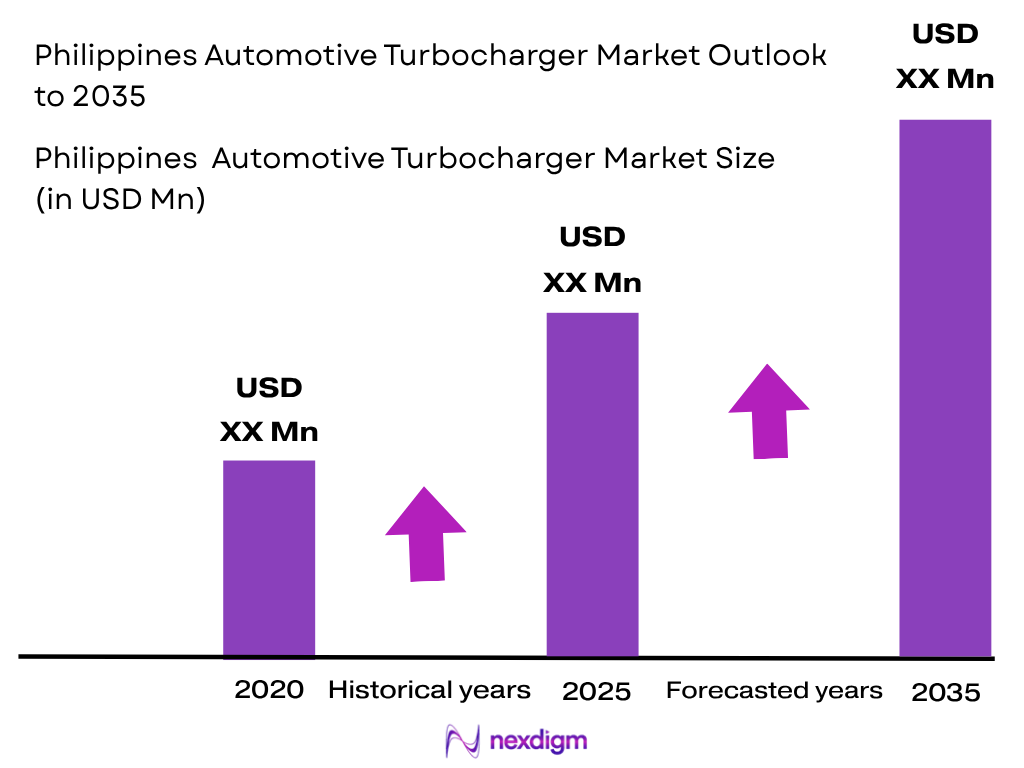
The Philippines Automotive Turbocharger Market is valued at approximately USD ~ billion, supported by the country’s large installed vehicle base, continued commercial-vehicle demand and growing use of turbocharged diesel and gasoline engines. The broader automotive market provides an important demand foundation: CAMPI and TMA members sold 429,807 vehicles in 2023, increasing to 467,252 units in 2024, with commercial vehicles reaching 346,482 units in 2024. The Land Transportation Office also recorded 14.56 million registered vehicles in 2024, including 3.08 million diesel vehicles, supporting a sizeable turbocharger-relevant installed base.
Demand is concentrated around Metro Manila, CALABARZON, Central Luzon, Cebu and Davao, where vehicle ownership, commercial transportation, logistics, industrial activity and automotive service infrastructure are strongest. Metro Manila acts as the country’s principal automotive distribution and repair hub, while CALABARZON and Central Luzon benefit from manufacturing, warehousing, logistics and industrial corridors. Cebu provides a major Visayas distribution and commercial center, while Davao serves as an important Mindanao transport and agricultural-logistics hub. The national vehicle base increased from 14.27 million registered vehicles in 2023 to 14.56 million in 2024, reinforcing the importance of these established automotive clusters.
Market Segmentation
By Vehicle Type
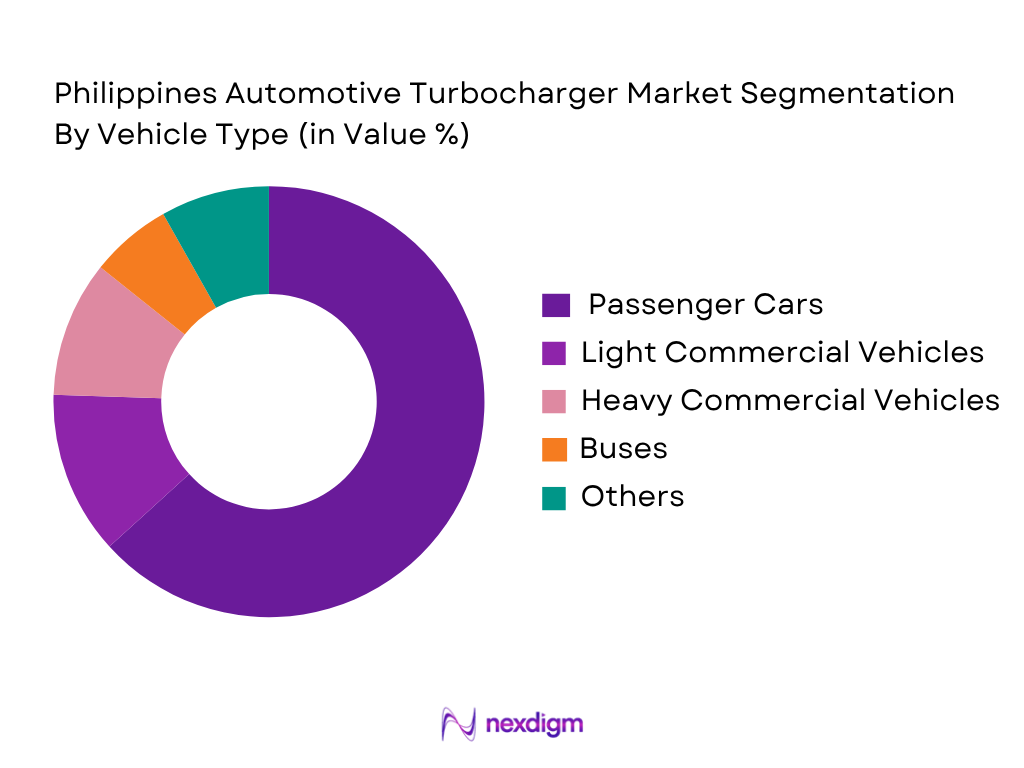
The Philippines Automotive Turbocharger Market is segmented by vehicle type into passenger cars, SUVs and MPVs, pickup trucks, light commercial vehicles, medium-duty trucks, heavy-duty trucks and buses. Light commercial vehicles and pickup/SUV applications represent the dominant demand pool because commercial vehicles accounted for 346,482 units of CAMPI-TMA sales in 2024, compared with 320,543 units in 2023. Within the commercial-vehicle ecosystem, diesel-powered pickups, vans, trucks and fleet vehicles require turbocharging to deliver higher torque and load-carrying capability while maintaining relatively compact engine configurations. The extensive use of commercial vehicles for logistics, construction, distribution, agriculture and intercity transportation also increases operating hours and turbocharger exposure. Passenger vehicles contribute through the increasing adoption of downsized turbocharged gasoline engines and turbo-diesel configurations, but commercial applications generate particularly attractive replacement demand because high utilization accelerates component wear.
By Sales Channel
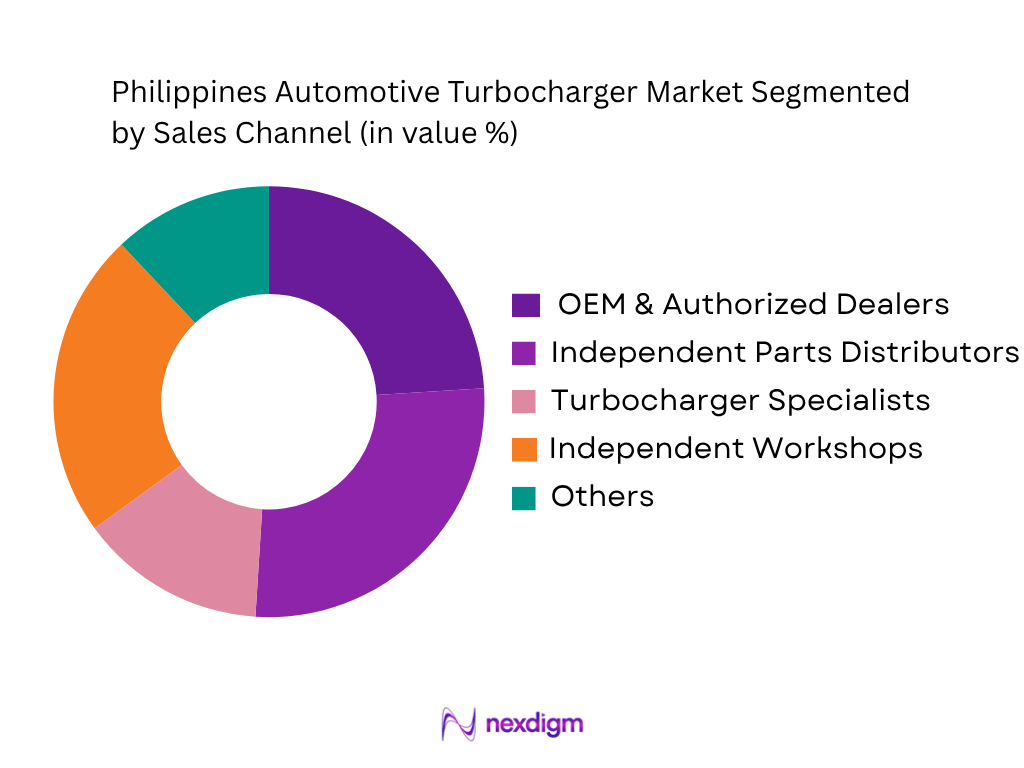
The Philippines Automotive Turbocharger Market is segmented by sales channel into OEM and authorized dealer channels, independent automotive-parts distributors, turbocharger specialists, independent workshops, commercial fleet service centers and online automotive-parts platforms. Independent distributors and specialist workshops account for the dominant aftermarket position because turbocharger replacement is frequently triggered by component failure in vehicles outside their original warranty period. These channels provide broader coverage of older diesel vehicles and offer consumers alternatives between genuine OEM, OEM-equivalent, aftermarket and remanufactured units. Workshops also influence purchasing decisions by diagnosing boost loss, oil leakage, shaft play, actuator faults and other turbocharger-related symptoms before recommending replacement. OEM channels remain particularly important for newer passenger vehicles and commercial fleets seeking manufacturer-certified components and warranty protection. Online channels are expanding product discovery and price comparison, but technical fitment requirements mean that workshop confirmation remains important for many purchases. Commercial fleets additionally favor distributors capable of supplying multiple part numbers and providing rapid replacement availability.
Competitive Landscape
The Philippines Automotive Turbocharger Market contains a combination of global turbocharger manufacturers, OEM suppliers, aftermarket distributors and specialist repair businesses. Garrett Motion, BorgWarner, Cummins Technologies/Holset, IHI Corporation and Mitsubishi Heavy Industries/ Mitsubishi Turbocharger and Engine America are among the principal international technology and brand references relevant to the market. Their competitive positioning is shaped by OEM relationships, turbocharger technology, vehicle application coverage, aftermarket availability, service support and brand recognition. The broad vehicle ecosystem provides an important installed base: CAMPI-TMA members recorded 467,252 vehicle sales in 2024, while the LTO reported 3.08 million registered diesel vehicles.
| Company | Establishment | Headquarters | Turbocharger Portfolio | Key Vehicle Applications | Aftermarket Reach | Technology Focus | Philippines Relevance |
| Garrett Motion | ~1936 | Rolle, Switzerland | ~ | ~ | ~ | ~ | ~ |
| BorgWarner | ~1928 | Auburn Hills, USA | ~ | ~ | ~ | ~ | ~ |
| Cummins Technologies / Holset | ~1919 | Columbus, USA | ~ | ~ | ~ | ~ | ~ |
| IHI Corporation | ~1853 | Tokyo, Japan | ~ | ~ | ~ | ~ | ~ |
| Mitsubishi Heavy Industries | ~1884 | Tokyo, Japan | ~ | ~ | ~ | ~ | ~ |
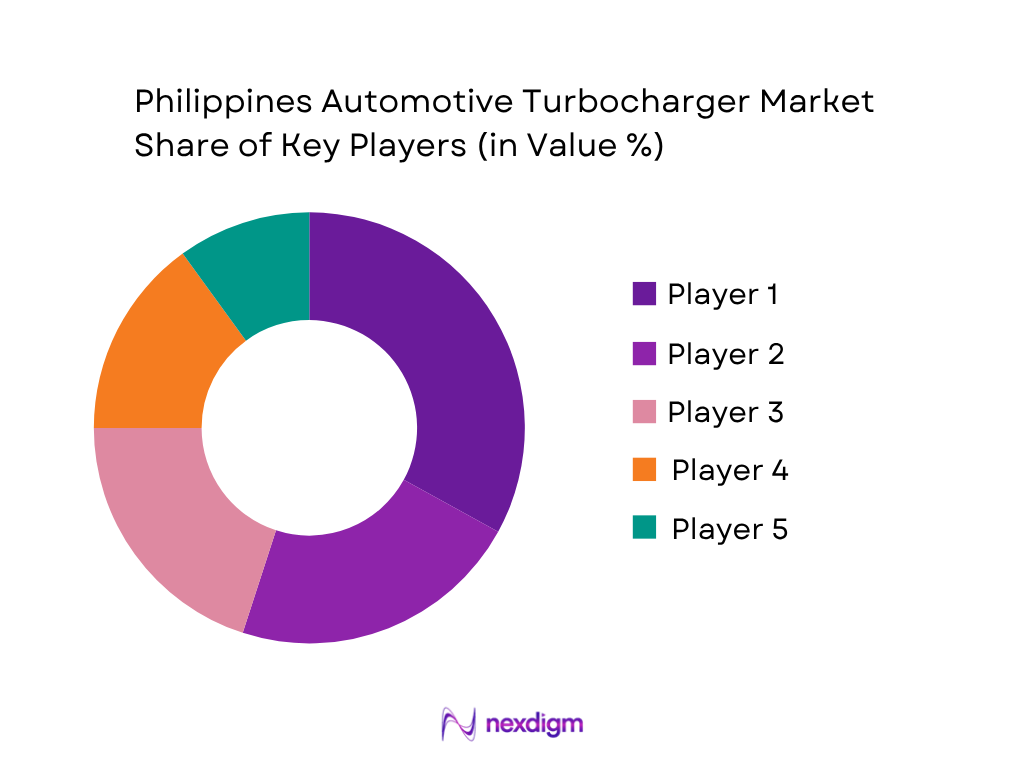
Philippines Automotive Turbocharger Market Analysis
Growth Drivers
Expanding Commercial Vehicle Base and Freight Activity
The Philippines automotive turbocharger market is supported by the expanding commercial-vehicle base and sustained requirements for freight, construction, logistics, manufacturing, and public-service transportation. CAMPI and TMA reported 346,482 commercial vehicles sold in 2024, compared with 320,543 in 2023, while total vehicle sales reached 467,252 units in 2024, according to CAMPI/TMA data reported by the Philippine News Agency. The heavy-duty truck segment remained relevant within this ecosystem, with TMA reporting 888 Category V heavy-duty trucks sold in 2025, alongside 6,783 Category III trucks and 3,690 Category IV trucks and buses. The macroeconomic environment also supports utilization: the IMF reported Philippine real GDP growth of 5.7 in 2024, gross fixed capital formation growth of 6.3, and private consumption growth of 4.9. These indicators point to continuing economic activity requiring road-based cargo movement and commercial vehicle operation. For turbocharger demand, higher utilization translates into greater relevance of boost-pressure management, air-system maintenance, turbocharger inspection, replacement and remanufacturing across diesel-powered fleets.
Infrastructure, Construction and Investment-Led Vehicle Utilization
Infrastructure development and investment activity are important demand catalysts for turbocharged commercial vehicles because construction, materials movement and project logistics depend heavily on trucks and buses operating under sustained loads. The IMF recorded 5.7 real GDP growth for the Philippines in 2024 and 6.3 growth in gross fixed capital formation, while public consumption increased 7.3 during the same period. These indicators provide a macroeconomic foundation for continued movement of construction materials, industrial goods and equipment. The automotive channel data reinforce this relationship: CAMPI and TMA recorded 346,482 commercial-vehicle sales in 2024, up from 320,543 in 2023, with commercial vehicles representing the dominant component of the assembled-vehicle market. The Truck Manufacturers Association subsequently reported 6,783 Category III trucks, 3,690 Category IV trucks and buses, and 888 Category V heavy-duty trucks sold in 2025. Such operating environments favor turbocharged diesel powertrains because turbocharging enables higher engine output and torque from relatively compact engines, particularly under payload and grade-load conditions. Consequently, stronger construction activity, infrastructure deployment and fleet utilization support demand for turbocharger servicing, replacement units, actuator-related components and associated air-management parts.
Market Challenges
Import Dependence and Exposure to International Automotive Supply Chains
The Philippines automotive turbocharger market faces supply-chain exposure because turbochargers and many precision components used in their repair and replacement are connected to international manufacturing and distribution networks. Philippine Statistics Authority trade data show that total imported goods reached USD 127.60 billion in 2024, compared with USD 126.21 billion in 2023, while transport equipment imports reached USD 11.36 billion in 2024. Total external trade reached USD 200.87 billion, demonstrating the scale of the country’s dependence on international merchandise flows. The country also recorded a goods trade deficit of USD 54.33 billion in 2024. For turbocharger distributors, this environment creates exposure to shipping interruptions, foreign-exchange movements, customs processing and changes in overseas component availability. The challenge is particularly relevant for specialized turbocharger assemblies because replacement demand often requires exact compatibility with engine families, compressor and turbine specifications, actuator configurations and vehicle applications. A shortage of a single actuator, cartridge, bearing system or compatible replacement assembly can therefore delay repairs even when workshops have immediate vehicle demand. This makes inventory planning, supplier diversification and technically accurate parts identification increasingly important competitive requirements in the Philippine turbocharger aftermarket.
Technology Transition and Increasing Complexity of Powertrain Systems
The turbocharger aftermarket must manage increasing powertrain complexity as manufacturers introduce more electronically controlled engines, tighter emissions systems and electrified vehicle technologies. The transition is already visible in Philippine vehicle demand: 2025 electrified-vehicle sales reached 58,905 units, according to industry reporting based on CAMPI and broader market data, compared with the 2024 market level, while CAMPI/TMA commercial-vehicle sales reached 370,722 units in 2025, compared with 346,482 in 2024. This creates a mixed technology environment rather than an immediate disappearance of turbocharged powertrains. Workshops must simultaneously maintain conventional turbocharged diesel and gasoline vehicles while developing capabilities for electronically controlled turbochargers, variable-geometry systems, electronic actuators and increasingly integrated engine-management systems. The challenge extends beyond mechanical repair because diagnosis can require scan tools, actuator calibration, boost-pressure testing and interpretation of electronic fault codes. Skills shortages can consequently increase turnaround time and raise the technical barrier for independent repair businesses. The continuing presence of electrified vehicles also means distributors and workshops must allocate investment across conventional forced-induction systems and emerging propulsion technologies rather than relying exclusively on traditional turbocharger expertise.
Market Opportunities
Expansion of Specialized Turbocharger Aftermarket Services
The Philippine turbocharger market presents an opportunity for specialized aftermarket businesses as the country’s commercial-vehicle population expands and fleets seek to extend vehicle operating life. CAMPI and TMA reported 346,482 commercial vehicles sold in 2024, increasing from 320,543 in 2023, while TMA’s 2025 consolidated truck data recorded 6,783 Category III trucks, 3,690 Category IV trucks and buses, and 888 Category V heavy-duty trucks. These vehicles create recurring requirements for inspection, balancing, cartridge replacement, actuator diagnosis, oil-feed assessment and complete turbocharger replacement. The opportunity is strengthened by the broader structure of Philippine road transportation: the Philippine Statistics Authority initiated the 2024 Commodity Flow Survey specifically to capture the movement of commodities transported by road between provinces and to generate information on freight weight, value and charges. This institutional focus demonstrates the importance of road freight to domestic economic activity. Specialized turbocharger centers can therefore differentiate through rapid diagnostics, model-specific component identification, remanufacturing capability, warranty support and fleet maintenance contracts. Businesses capable of combining genuine replacement components with technically validated aftermarket or remanufactured solutions can address operators seeking to reduce vehicle downtime while maintaining engine performance and reliability.
Digital Parts Distribution and Fleet-Oriented Maintenance Solutions
Digitalization of automotive parts procurement provides an opportunity for turbocharger suppliers to improve product discovery, compatibility verification and aftermarket reach. Philippine trade data show that the country imported USD 127.60 billion of goods in 2024, including USD 11.36 billion of transport equipment, illustrating the scale of products moving through international and domestic distribution networks. At the same time, the automotive market generated 467,252 vehicle sales in 2024, while commercial-vehicle sales reached 346,482 units, creating a large installed base requiring parts and maintenance services. For turbocharger suppliers, digital catalogues can connect vehicle registration information, engine codes, turbocharger part numbers and compatible cartridge or actuator references, reducing incorrect-order risk. Fleet-oriented platforms can further combine parts ordering with service scheduling, maintenance histories, warranty tracking and failure diagnostics. The opportunity is particularly relevant for geographically dispersed fleets that cannot depend on a single specialist workshop. Suppliers can use regional distributor networks supported by online ordering and technical assistance to reach independent workshops and fleet operators while maintaining centralized inventory visibility. This model can also support faster sourcing of specialized components and improve aftermarket responsiveness without requiring every customer to maintain extensive local inventory.
Future Outlook
The Philippines Automotive Turbocharger Market is expected to benefit from continued expansion of the vehicle fleet, sustained commercial-vehicle utilization and the installed base of diesel-powered vehicles. Growth in logistics, construction, distribution and intercity transportation should support replacement requirements for turbocharged commercial vehicles. The market is also likely to become more technology-oriented as manufacturers introduce variable-geometry turbochargers, electronically controlled actuators, higher-efficiency compressor systems and turbocharging solutions for downsized gasoline engines.
At the same time, electrification will gradually reshape the turbocharger opportunity, particularly as hybrid and battery-electric vehicles gain adoption. PSA reported 6,697 registered electric vehicles in 2024, compared with 1,359 in 2023, while hybrid registrations reached 17,590 in 2024 from 6,155 in 2023. This transition is likely to create pressure on conventional turbocharger volumes over the longer term while opening opportunities for electronically assisted boosting and other advanced thermal-management technologies.
Major Players
- Garrett Motion
- BorgWarner
- Cummins Technologies / Holset
- IHI Corporation
- Mitsubishi Heavy Industries
- BMTS Technology
- Marelli
- Continental
- Hitachi Astemo
- Turbo Technics
- Melett
- Rotomaster
- MAHLE
- Bosch
- DENSO
Key Target Audience
- Automotive OEMs and Vehicle Importers
- Commercial Vehicle Fleets and Logistics Operators
- Automotive Parts Distributors and Importers
- Turbocharger Repair, Reconditioning and Specialist Workshops
- Automotive Aftermarket Parts Retailers and E-Commerce Distributors
- Investments and Venture Capitalist Firms (Automotive Technology and Mobility Investors)
- Government and Regulatory Bodies (Land Transport Authority, Ministry of Transport, National Environment Agency)
- Automotive Component Manufacturers and Engineering Service Providers
Research Methodology
Step 1: Identification of Key Variables
The research begins with mapping the Philippines automotive turbocharger ecosystem, covering vehicle OEMs, engine suppliers, turbocharger manufacturers, aftermarket distributors, workshops, fleet operators and regulatory stakeholders. Secondary research is used to establish the vehicle parc, commercial-vehicle activity, engine-fuel mix and replacement ecosystem.
Step 2: Market Analysis and Construction
Historical automotive sales, registered vehicle data, vehicle-category composition, turbocharger penetration and replacement patterns are consolidated to construct the market baseline. CAMPI-TMA sales data and Land Transportation Office vehicle-registration statistics are incorporated into the demand-side assessment.
Step 3: Hypothesis Validation and Expert Consultation
Market hypotheses are validated through discussions with automotive OEM representatives, turbocharger distributors, independent workshops, fleet operators and component specialists. Inputs focus on replacement intervals, preferred brands, failure modes, OEM versus aftermarket purchasing and emerging turbocharger technologies.
Step 4: Research Synthesis and Final Output
The final analysis triangulates vehicle-parc information, commercial-vehicle sales, channel intelligence and industry interviews. Bottom-up estimates are cross-checked against the broader automotive ecosystem, while segmentation-level assumptions are reviewed for consistency with vehicle applications and aftermarket behavior.

- Executive Summary
- Research Methodology (Market Definition, Product Boundary, Turbocharger Classification, Market Sizing Framework, Unit-Volume Assessment, OEM Fitment Mapping, Vehicle-Parc Reconstruction, Replacement-Demand Modeling, Import and Distribution Mapping, Top-Down Analysis, Bottom-Up Analysis, Primary Industry Interviews, Secondary Research, Data Triangulation, Forecasting Framework, Scenario Analysis, Sensitivity Analysis, Assumptions and Limitations)

- Definition and Scope
- Philippine Automotive Industry Structure
- Evolution of Turbocharging in the Philippines
- Automotive Turbocharger Value Chain
- Philippines Turbocharger Supply Chain
- Vehicle-Parc Structure

- Growth Drivers (Vehicle-Parc Expansion, Diesel Commercial Fleet Base, Turbocharged Engine Penetration, Engine Downsizing, Fleet Replacement, Logistics Activity, Aftermarket Replacement Demand)
- Market Challenges (Imported Component Dependence, Parts Availability, Currency Exposure, Vehicle Repair Costs, Skilled Technician Requirements, Counterfeit Components, EV Substitution)
- Market Opportunities (Aftermarket Replacement, Commercial Vehicle Turbochargers, VGT/VNT Adoption, Turbocharger Remanufacturing, Hybrid Turbocharging, E-Turbo Technology, Regional Parts Distribution)
- Philippines Automotive Turbocharger Regulatory and Industry Environment (Vehicle Emission Standards, Import Requirements, Vehicle Registration, Roadworthiness, Fuel Quality, Parts Regulation, Automotive Manufacturing Policy)
- SWOT Analysis
- Porter’s Five Forces Analysis
- PESTLE Analysis

- By Market Value (2020-2025)
- By Turbocharger Unit Volume (2020-2025)
- By Average Selling Price (2020-2025)
- By OEM Turbocharger Revenue (2020-2025)
- By Aftermarket Turbocharger Revenue (2020-2025)
- By New Vehicle Turbocharger Fitment (2020-2025)
- By Replacement Turbocharger Demand (2020-2025)

- By Vehicle Type (in value %)
Passenger Cars
SUVs and Crossovers
Pickup Trucks
Vans and MPVs
Light Commercial Vehicles
Medium Commercial Vehicles
Heavy Commercial Vehicles
Buses
Taxis and Fleet Vehicles - By Engine Type (in value %)
Gasoline Engines
Diesel Engines
Turbocharged Gasoline Engines
Turbocharged Diesel Engines
Hybrid Gasoline Engines
Plug-in Hybrid Engines - By Turbocharger Technology (in value %)
Wastegate Turbochargers
Variable Geometry Turbochargers
Variable Nozzle Turbochargers
Twin-Turbochargers
Sequential Twin-Turbochargers
Two-Stage Turbochargers
Electrically Assisted Turbochargers
Electric Turbochargers - By Engine Displacement (in value %)
Below 1.0 Litre
1.0–1.5 Litres
1.5–2.0 Litres
2.0–3.0 Litres
3.0–4.0 Litres
Above 4.0 Litres - By Fuel Type (in value %)
Petrol
Diesel
Hybrid Petrol
Plug-in Hybrid
Other Alternative Fuels - By Turbocharger Configuration (in value %)
Single Turbo
Twin Turbo
Parallel Twin Turbo
Sequential Twin Turbo
Two-Stage Turbo
Variable Geometry Turbo

- Market Share of Major Players (By Revenue, Unit Volume, OEM, Aftermarket, Vehicle Type, Engine Type, Technology, Sales Channel)
- Cross Comparison Parameters (OEM Platform Coverage, Turbocharger Product Portfolio Breadth, VGT/VNT Technology Capability, Commercial Vehicle Engine Coverage, Aftermarket Part-Number Coverage, Philippines Distribution Network Reach, Turbocharger Remanufacturing Capability, Technical Service and Workshop Support)
- SWOT Analysis of Major Players
- Detailed Profiles of Major Companies
Garrett Motion
BorgWarner Inc.
Cummins Turbo Technologies / Holset
Mitsubishi Heavy Industries
IHI Corporation
MAHLE GmbH
Continental AG
Robert Bosch GmbH
Marelli
BMTS Technology
Turbo Energy Limited
Melett
Rotomaster
I.H.I. Turbo International Trade, Inc.
Rurex Turbo

- Turbocharger Buyer and Decision-Maker Profile
- Vehicle Ownership and Turbocharger Exposure
- Turbocharger Replacement Behavior
- Purchase Frequency and Replacement Cycle
- Turbocharger Failure and Pain-Point Analysis
- Consumer Awareness of Turbocharger Maintenance

- By Market Value (2026-2035)
- By Turbocharger Unit Volume (2026-2035)
- By Average Selling Price (2026-2035)
- By OEM Turbocharger Revenue (2026-2035)
- By Aftermarket Turbocharger Revenue (2026-2035)
- By New Vehicle Turbocharger Fitment (2026-2035)
- By Replacement Turbocharger Demand (2026-2035)


 Request a Sample
 Ask for Customization
 Get a Quote
 Enquire Now