
 Download PDF
 Download PDF
Market Overview
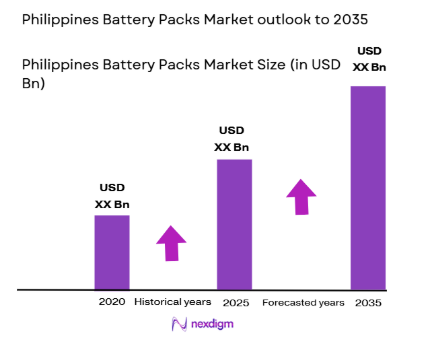
The Philippines Battery Packs market is valued at approximately USD ~ billion based on a recent historical assessment, driven primarily by accelerating demand from electric mobility, consumer electronics, and energy storage applications. Government initiatives supporting renewable energy deployment and electrification of transport systems have further stimulated demand for high-capacity battery solutions. Additionally, increasing smartphone penetration, industrial automation, and backup power requirements across commercial infrastructure continue to expand the addressable market for battery packs.
Metro Manila, Cebu, and Davao emerge as dominant regional hubs due to their concentration of industrial, commercial, and technological activities. Metro Manila leads with strong consumer electronics demand and electric vehicle adoption, while Cebu benefits from manufacturing clusters and logistics infrastructure. Davao is gaining traction due to renewable energy projects and telecom expansion. The country’s reliance on imports from China, South Korea, and Japan also shapes supply dynamics, with these countries maintaining technological and manufacturing leadership.
Market Segmentation
By Product Type
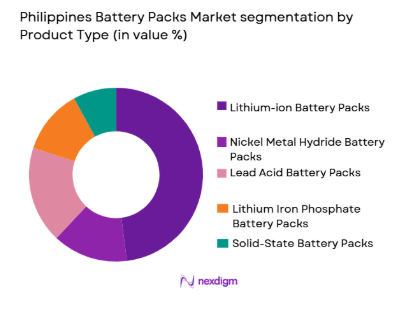
Philippines Battery Packs market is segmented by product type into lithium-ion battery packs, nickel metal hydride battery packs, lead acid battery packs, lithium iron phosphate battery packs, and solid-state battery packs. Recently, lithium-ion battery packs has a dominant market share due to factors such as higher energy density, longer lifecycle, widespread adoption in electric vehicles and consumer electronics, and strong supply chain support from global manufacturers. The growing shift toward portable devices and electrified mobility has reinforced lithium-ion’s position as the preferred chemistry, supported by continuous technological improvements and cost optimization.
By Application
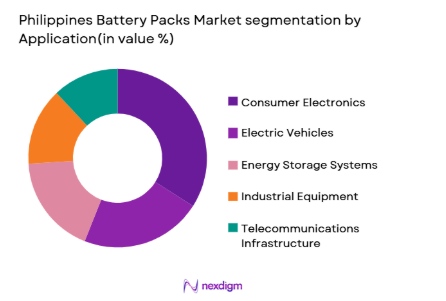
Philippines Battery Packs market is segmented by application into electric vehicles, consumer electronics, energy storage systems, industrial equipment, and telecommunications infrastructure. Recently, consumer electronics has a dominant market share due to factors such as high smartphone penetration, increasing demand for laptops and wearable devices, and rapid urbanization driving digital adoption. The consistent need for portable power solutions and replacement batteries ensures sustained demand in this segment, supported by strong retail distribution networks and frequent product upgrade cycles among consumers.
Competitive Landscape
The Philippines Battery Packs market exhibits a moderately consolidated structure, with global manufacturers dominating technology supply while regional assemblers and distributors handle local integration and distribution. Major players influence pricing, innovation, and supply chain stability, leveraging economies of scale and strong research capabilities. Strategic partnerships, localization efforts, and investments in battery recycling and manufacturing are key competitive strategies shaping the market landscape.
| Company Name | Establishment Year | Headquarters | Technology Focus | Market Reach | Key Products | Revenue (USD Billion) | Supply Chain Integration |
| LG Energy Solution | 2020 | South Korea | ~ | ~ | ~ | ~ | ~ |
| Panasonic Energy | 1918 | Japan | ~ | ~ | ~ | ~ | ~ |
| Samsung SDI | 1970 | South Korea | ~ | ~ | ~ | ~ | ~ |
| BYD Company | 1995 | China | ~ | ~ | ~ | ~ | ~ |
| Amperex Technology | 2005 | China | ~ | ~ | ~ | ~ | ~ |
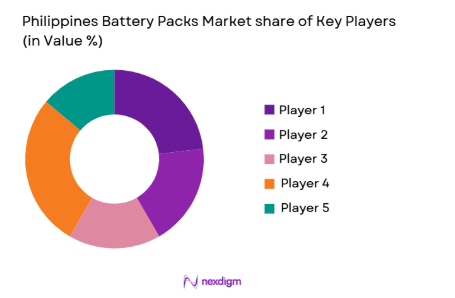
Philippines Battery Packs Market Analysis
Growth Drivers
Electric Vehicle Adoption and Electrification Policies:
The Philippines is witnessing a gradual yet consistent transition toward electric mobility, driven by government-backed initiatives aimed at reducing carbon emissions and dependency on fossil fuels. Policies promoting electric vehicle adoption, including incentives and infrastructure development, have increased demand for advanced battery packs. The rise of electric two-wheelers and public transportation electrification is particularly significant in urban centers. Battery packs serve as the core component of these vehicles, driving substantial demand growth. Investments in charging infrastructure further complement this trend. The availability of cost-effective lithium-ion technologies has made electric mobility more accessible. Automotive manufacturers are increasingly introducing electric models tailored for local conditions. This ecosystem development directly boosts battery pack consumption. Additionally, urban pollution concerns are accelerating policy support. Collectively, these factors are creating a sustained demand trajectory for battery packs in the transportation sector.
Expansion of Renewable Energy Storage Systems:
The growing focus on renewable energy integration is a key factor driving battery pack demand in the Philippines. Solar and wind energy installations require efficient energy storage systems to ensure reliability and grid stability. Battery packs play a crucial role in storing excess energy generated during peak production periods. Government programs promoting clean energy adoption are accelerating investments in storage infrastructure. The need for uninterrupted power supply in remote and island regions further supports battery deployment. Hybrid energy systems combining renewables with battery storage are becoming increasingly common. Industrial and commercial users are also investing in backup power solutions to mitigate outages. Technological advancements in battery efficiency and lifespan enhance system viability. The reduction in battery costs improves return on investment for energy projects. Overall, renewable energy expansion significantly contributes to battery pack market growth.
Market Challenges
Dependence on Imported Raw Materials and Components:
The Philippines battery packs market faces a major challenge due to its reliance on imported raw materials such as lithium, cobalt, and nickel, along with finished battery cells. This dependence exposes the market to global supply chain disruptions and price volatility. Fluctuating material costs can significantly impact manufacturing expenses and final product pricing. Limited domestic mining and processing capabilities further exacerbate the issue. Import regulations and logistics constraints also add to operational complexities. Currency exchange fluctuations can increase procurement costs for local manufacturers. Additionally, geopolitical tensions affecting major exporting countries may disrupt supply continuity. The absence of a strong local battery ecosystem limits value chain integration. This dependence reduces competitiveness against countries with established production capabilities. Addressing this challenge requires strategic investments in local sourcing and manufacturing infrastructure.
Limited Battery Recycling and Disposal Infrastructure:
The lack of robust recycling infrastructure for used battery packs presents a significant environmental and operational challenge in the Philippines. Improper disposal of batteries can lead to hazardous waste accumulation and environmental degradation. The absence of large-scale recycling facilities limits the recovery of valuable materials such as lithium and cobalt. This results in increased dependence on virgin raw materials. Regulatory frameworks for battery disposal are still evolving and lack strict enforcement mechanisms. Public awareness regarding proper battery disposal remains low. Informal recycling practices pose safety and environmental risks. Establishing formal recycling systems requires substantial capital investment and technological expertise. Without efficient recycling, sustainability goals become difficult to achieve. This challenge highlights the need for integrated waste management solutions within the battery ecosystem.
Opportunities
Development of Local Battery Manufacturing Ecosystem:
Establishing a domestic battery manufacturing ecosystem presents a significant opportunity for the Philippines. Local production can reduce dependency on imports and enhance supply chain resilience. Government incentives aimed at industrial development can attract foreign investments in battery manufacturing. The availability of a skilled workforce supports industrial expansion. Developing assembly and testing facilities can create employment opportunities and boost economic growth. Localization also reduces logistics costs and lead times for battery supply. Collaboration with global technology providers can facilitate knowledge transfer and innovation. The increasing demand for electric vehicles and energy storage systems ensures a stable market for locally produced batteries. Export potential to neighboring Southeast Asian countries adds further growth prospects. Building a strong manufacturing base can position the Philippines as a regional battery hub.
Integration of Smart Battery Management Systems:
The integration of advanced battery management systems offers a promising opportunity for enhancing battery performance and reliability. Smart systems enable real-time monitoring of battery health, temperature, and charge cycles, improving safety and efficiency. The growing adoption of IoT technologies supports the implementation of intelligent battery solutions. Industrial and commercial users benefit from predictive maintenance capabilities, reducing downtime and operational costs. Electric vehicle manufacturers are increasingly incorporating advanced management systems to optimize battery performance. Energy storage applications also require sophisticated control systems for grid integration. Technological innovation in this area can create new revenue streams for solution providers. Partnerships between technology firms and battery manufacturers can accelerate development. The demand for high-performance and durable batteries further drives adoption. This opportunity aligns with global trends toward digitalization and smart energy systems.
Future Outlook
The Philippines Battery Packs market is expected to witness steady growth driven by expanding electric mobility adoption, renewable energy integration, and increasing consumer electronics demand. Technological advancements in battery chemistry and management systems will enhance efficiency and safety. Government support for clean energy and local manufacturing will further strengthen market development. Rising investments in infrastructure and supply chain improvements are anticipated to support long-term sustainability and competitiveness.
Major Players
- LG Energy Solution
- Panasonic Energy
- Samsung SDI
- BYD Company
- Amperex Technology Limited
- SK On
- Envision AESC
- GS Yuasa Corporation
- Toshiba Corporation
- Hitachi Energy
- VARTA AG
- Saft Groupe
- EVE Energy Co Ltd
- Sunwoda Electronic Co Ltd
- CALB Group Co Ltd
Key Target Audience
- Automotive manufacturers
- Consumer electronics companies
- Energy and utility providers
- Industrial equipment manufacturers
- Telecommunications companies
- Government and regulatory bodies
- Investments and venture capitalist firms
- Renewable energy project developers
Research Methodology
Step 1: Identification of Key Variables
Market variables including demand drivers, supply constraints, technology trends, and regulatory frameworks were identified through secondary research and industry reports to establish the analytical foundation.
Step 2: Market Analysis and Construction
Comprehensive data modeling and segmentation analysis were conducted using historical data, trade statistics, and industry benchmarks to construct market size and structure.
Step 3: Hypothesis Validation and Expert Consultation
Industry experts, manufacturers, and distributors were consulted to validate assumptions, refine market estimates, and ensure accuracy of qualitative and quantitative insights.
Step 4: Research Synthesis and Final Output
All validated data and insights were synthesized into a structured format, ensuring consistency, accuracy, and alignment with market dynamics for final report generation.

- Executive Summary
- Research Methodology (Definitions, Scope, Industry Assumptions, Market Sizing Approach, Primary & Secondary Research Framework, Data Collection & Verification Protocol, Analytic Models & Forecast Methodology, Limitations & Research Validity Checks)

- Market Definition and Scope
- Value Chain & Stakeholder Ecosystem
- Regulatory / Certification Landscape
- Sector Dynamics Affecting Demand
- Strategic Initiatives & Infrastructure Growth

- Growth Drivers
Increasing adoption of electric mobility solutions across urban centers
Expansion of renewable energy storage infrastructure in the power sector
Rising demand for portable and high-capacity consumer electronics devices
Government incentives supporting clean energy and battery manufacturing
Technological advancements improving battery efficiency and lifecycle performance - Market Challenges
High dependency on imported raw materials and components
Limited domestic battery recycling and disposal infrastructure
Fluctuating raw material prices impacting production costs
Safety concerns related to thermal runaway and battery degradation
Lack of standardized battery regulations across multiple sectors - Market Opportunities
Development of local battery manufacturing and assembly facilities
Integration of smart battery management systems with IoT capabilities
Growing demand for grid-scale energy storage in renewable projects - Trends
Shift towards lithium iron phosphate batteries for safety and cost efficiency
Adoption of modular and scalable battery pack designs
Increasing investments in battery recycling technologies
Emergence of fast-charging and ultra-fast battery solutions
Collaboration between automotive and energy companies for battery innovation - Government Regulations & Defense Policy
Implementation of clean energy transition policies supporting battery adoption
Import regulations and certification standards for battery safety compliance
Incentives for local manufacturing under industrial development programs - SWOT Analysis
- Stakeholder and Ecosystem Analysis
- Porter’s Five Forces Analysis
- Competition Intensity and Ecosystem Mapping

- By Market Value, 2020-2025
- By Installed Units, 2020-2025
- By Average System Price, 2020-2025
- By System Complexity Tier, 2020-2025

- By System Type (In Value%)
Lithium-ion Battery Packs
Nickel Metal Hydride Battery Packs
Lead Acid Battery Packs
Solid State Battery Packs
Lithium Iron Phosphate Battery Packs - By Platform Type (In Value%)
Electric Vehicles
Consumer Electronics
Energy Storage Systems
Industrial Equipment
Telecommunications Infrastructure - By Fitment Type (In Value%)
OEM Integrated Battery Packs
Aftermarket Replacement Battery Packs
Modular Battery Systems
Custom Engineered Battery Packs
Retrofit Battery Solutions - By EndUser Segment (In Value%)
Automotive Manufacturers
Consumer Electronics Companies
Utility and Energy Providers
Industrial Manufacturing Firms
Telecom Service Providers - By Procurement Channel (In Value%)
Direct Manufacturer Contracts
Government Procurement Programs
Distributor Networks
Online B2B Platforms
System Integrator Partnerships - By Material / Technology (in Value %)
Lithium Cobalt Oxide Technology
Lithium Iron Phosphate Technology
Nickel Manganese Cobalt Technology
Solid Electrolyte Technology
Advanced Battery Management Systems

- Market structure and competitive positioning
- Market share snapshot of major players
- CrossComparison Parameters (Product Portfolio, Technology Type, Production Capacity, Geographic Presence, Pricing Strategy, Supply Chain Integration, R&D Investment, EndUser Coverage, Partnership Network, Sustainability Initiatives)
- SWOT Analysis of Key Players
- Pricing & Procurement Analysis
- Key Players
Amperex Technology Limited
BYD Company Limited
LG Energy Solution
Samsung SDI
Panasonic Energy
SK On
Envision AESC
GS Yuasa Corporation
Saft Groupe
Hitachi Energy
VARTA AG
Toshiba Corporation
EVE Energy Co Ltd
Sunwoda Electronic Co Ltd
CALB Group Co Ltd

- Automotive sector driving demand through increasing electric vehicle adoption
- Energy sector leveraging battery packs for grid stabilization and storage
- Consumer electronics industry requiring compact and high-density battery solutions
- Telecommunications sector utilizing battery backups for uninterrupted services

- Forecast Market Value, 2026-2035
- Forecast Installed Units, 2026-2035
- Price Forecast by System Tier, 2026-2035
- Future Demand by Platform, 2026-2035


 Request a Sample
 Ask for Customization
 Get a Quote
 Enquire Now