
 Download PDF
Market Overview
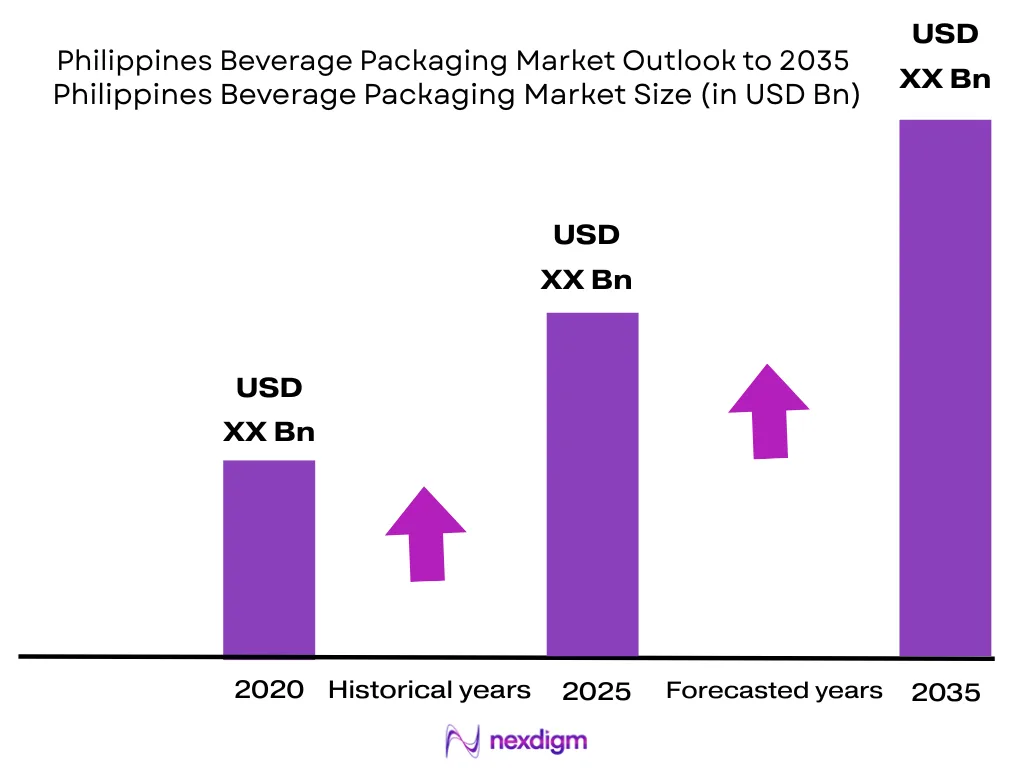
The Philippines beverage packaging market is valued at approximately USD ~ billion, based on historical demand from bottled water, carbonated beverages, beer, dairy drinks, juices and ready-to-drink products. Demand is supported by a national population of 112,729,484, compared with approximately 111.0 million in the preceding annual period, alongside average family income of PHP 353,229. Expanding beverage manufacturing, convenience retail and single-serve consumption continue to increase requirements for PET bottles, cans, cartons, closures and flexible packs. Metro Manila, CALABARZON and Central Luzon dominate beverage-packaging consumption and conversion because they combine the country’s largest consumer concentrations, beverage plants, ports, warehouses and modern retail networks. CALABARZON has 16.93 million residents, the National Capital Region has 14.00 million, and Central Luzon has 12.99 million. Together, these locations provide packaging converters with proximity to bottlers, filling plants, logistics hubs and high-volume foodservice customers, reducing empty-container transport distances and improving production-line replenishment.
Market Segmentation
By Packaging Material
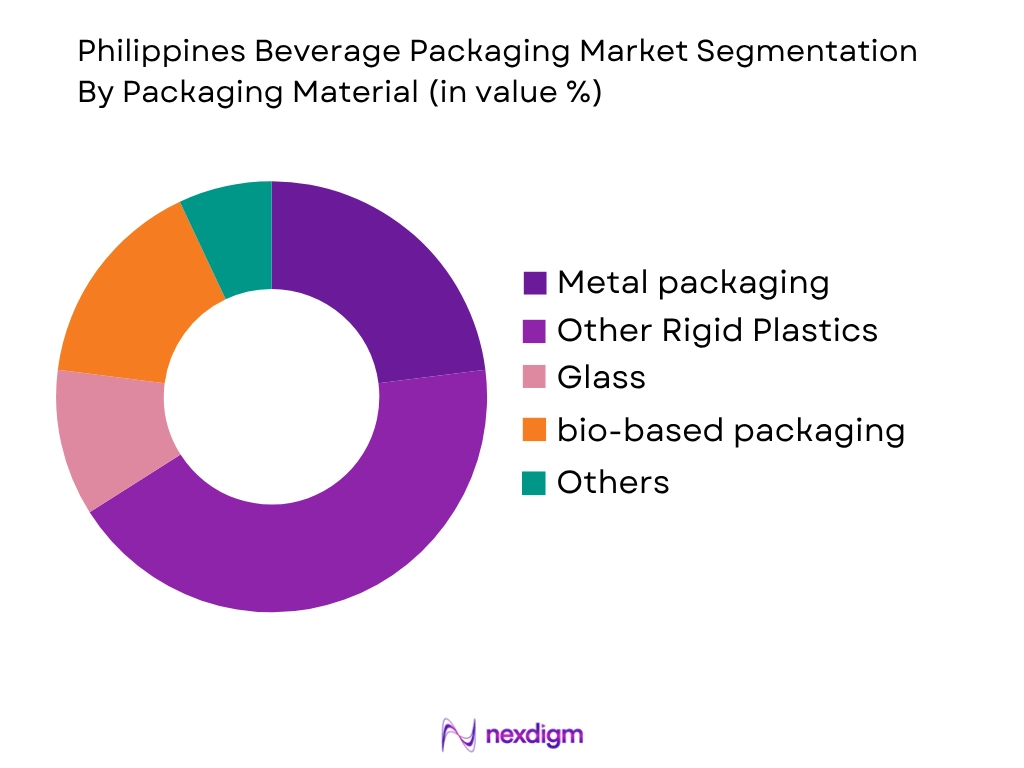
The Philippines beverage packaging market is segmented by material into rigid plastics, metal, glass, liquid paperboard cartons, flexible plastics, and other paper-based or bio-based materials. Rigid plastic packaging holds the dominant position because PET bottles are lightweight, shatter-resistant, resealable and compatible with bottled water, carbonated soft drinks, juices, energy drinks and larger family-sized beverages. PET preforms can also be transported more efficiently than finished empty bottles and blown near filling operations, an important advantage in an archipelagic country. Metal cans remain important for beer, carbonated drinks and energy beverages, while returnable glass retains a strong role in beer and selected soft-drink systems. Cartons are concentrated in shelf-stable juice, dairy and plant-based beverages. Flexible pouches and sachets serve concentrates, powdered beverage preparations and lower-volume applications. Environmental regulation is gradually encouraging lightweighting, recycled content, mono-material structures and improved recovery documentation. The figures below are report placeholders, as audited national material-share data are not publicly available.
By Beverage Category
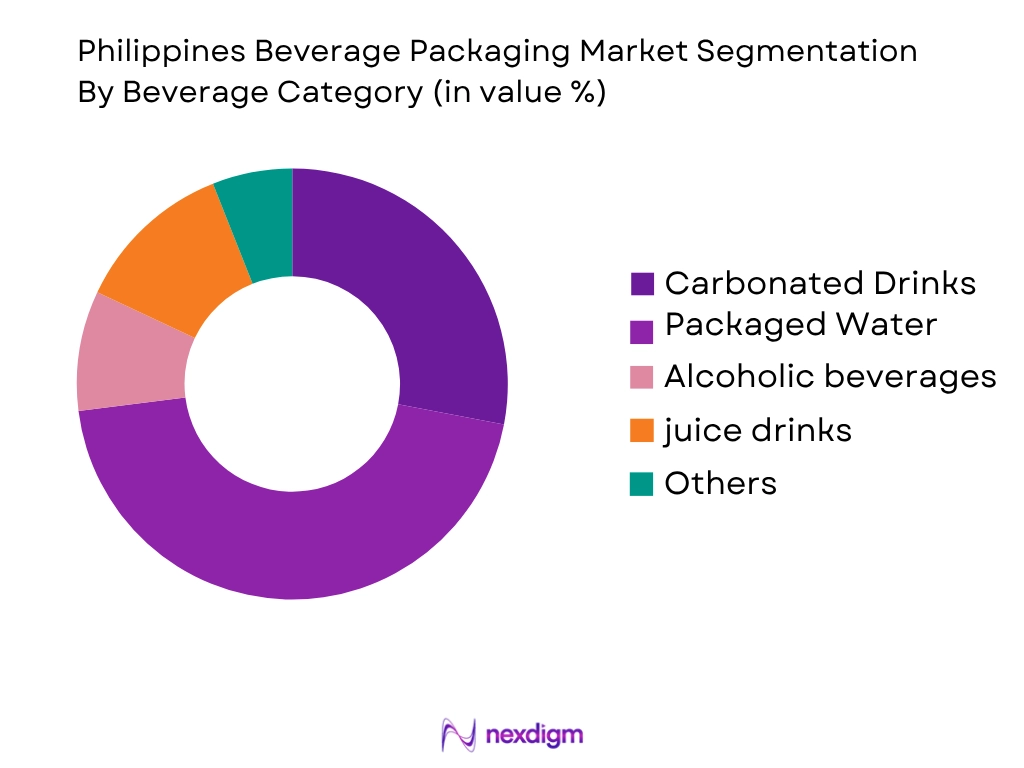
The market is segmented by beverage application into bottled water, carbonated soft drinks, alcoholic beverages, juice and juice drinks, dairy and plant-based beverages, ready-to-drink tea and coffee, and energy, sports and functional beverages. Bottled water represents the leading application because of the country’s large population, warm climate, on-the-go consumption patterns and continuing need for portable drinking-water formats. The segment supports demand for single-serve PET bottles, larger household containers, caps, labels, shrink films and corrugated transport packaging. Carbonated beverages generate substantial demand for pressure-resistant PET bottles and aluminium cans, while beer supports both returnable glass and metal-can formats. Juice and dairy applications require oxygen, light and microbiological barriers and therefore create demand for hot-fill PET, multilayer cartons and aseptic systems. Ready-to-drink coffee, tea, energy and functional drinks are particularly relevant to small cans, premium PET bottles and compact single-serve packs. The table uses placeholder shares pending primary validation with converters, beverage producers and packaging-material suppliers.
Competitive Landscape
The Philippines beverage packaging market includes an influential domestic integrated-packaging group, regional converters and multinational packaging-technology suppliers. San Miguel Yamamura Packaging has a particularly broad position across glass, metal, plastics, PET, flexible packaging and paper-based solutions. Tetra Pak and SIG are important in aseptic processing and liquid-carton systems, while Amcor and Huhtamaki compete in flexible and specialty packaging. Competition is shaped by beverage-filler relationships, manufacturing footprint, technical support, material capability, food-safety performance and the ability to support Extended Producer Responsibility compliance.
| Company | Establishment year | Headquarters | Core beverage packaging formats | Primary materials | Filling or processing capability | Sustainability capability | Customer orientation | Philippines market relevance |
| San Miguel Yamamura Packaging Corporation | 1991 | Mandaluyong City, Philippines | ~ | ~ | ~ | ~ | ~ | ~ |
| Tetra Pak | 1951 | Lund, Sweden / global corporate base in Switzerland | ~ | ~ | ~ | ~ | ~ | ~ |
| Amcor | 1860s | Zurich, Switzerland | ~ | ~ | ~ | ~ | ~ | ~ |
| Huhtamaki | 1920 | Espoo, Finland | ~ | ~ | ~ | ~ | ~ | ~ |
| Oji Holdings / Oji Containers | 1873 | Tokyo, Japan | ~ | ~ | ~ | ~ | ~ | ~ |
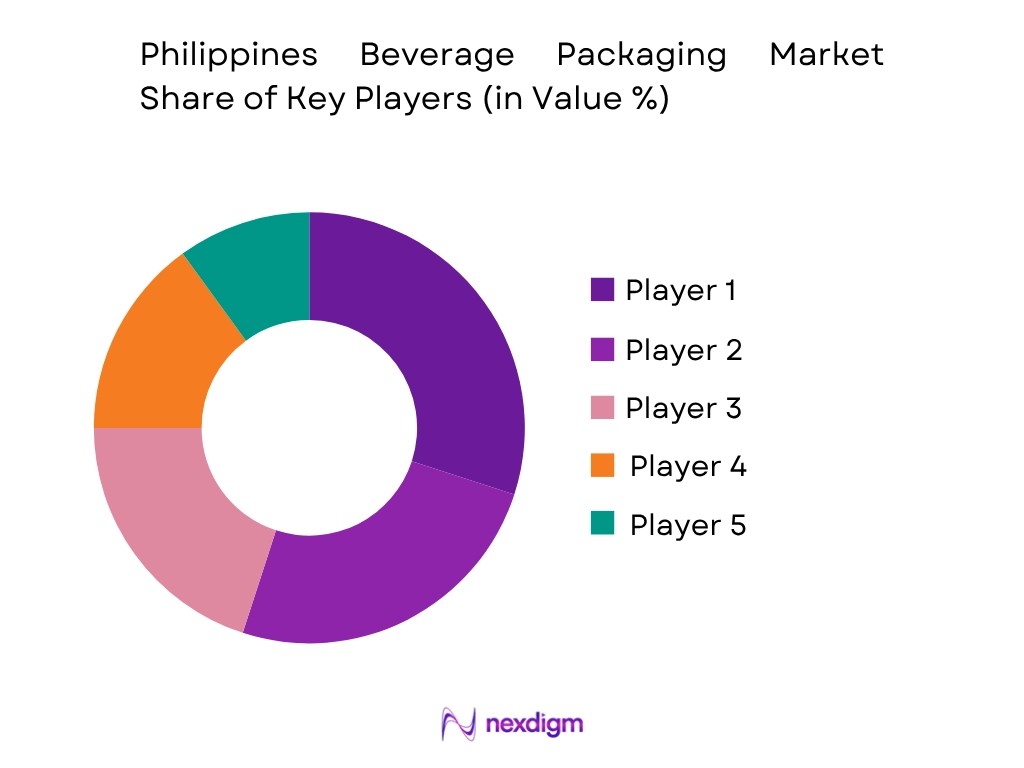
Philippines Beverage Packaging Market Analysis
Growth Drivers
Urbanization and Concentrated Beverage Consumption
Urbanization is strengthening the Philippines beverage packaging market by concentrating consumers, beverage manufacturers, filling facilities, retail outlets and foodservice establishments within high-volume metropolitan corridors. The Philippine Statistics Authority recorded a national population of 112,729,484 in July 2024, including 62.22 million urban residents. The National Capital Region contained 14,001,751 people, Central Luzon had 12,989,074, and the CALABARZON population exceeded 16 million. These densely populated regions collectively create substantial recurring demand for bottled water, carbonated beverages, juices, dairy drinks, beer, energy drinks and ready-to-drink coffee. Their concentration also improves the economics of supplying PET preforms, finished bottles, aluminium cans, glass containers, cartons, caps, labels and secondary packaging because converters can serve several large filling plants from fewer manufacturing and warehousing locations. The market effect extends beyond total population. Urban consumers commonly purchase beverages through supermarkets, convenience stores, restaurants, delivery platforms, transport terminals, offices and vending locations, creating demand for portable and individually portioned formats. Smaller PET bottles, slim cans, resealable closures, tamper-evident caps, paper cups and multilayer beverage cartons are particularly compatible with these channels. Beverage packaging suppliers consequently benefit not only from higher container throughput but also from greater SKU diversity, including multiple serving sizes, promotional labels and channel-specific multipacks.
Beverage Manufacturing Expansion and Regulatory Packaging Redesign
Expansion in beverage manufacturing is increasing demand for packaging materials, conversion capacity and filling-line-compatible container systems. Philippine Statistics Authority manufacturing data recorded a 15.6 percentage-point annual increase in the value of net sales for beverage manufacturing in July 2024. The result demonstrates increased commercial throughput across bottled water, carbonated drinks, alcoholic beverages, juices and other manufactured beverage categories. Every additional production run requires corresponding volumes of bottles, cans, cartons, closures, labels, trays, shrink films and corrugated cases, making beverage output a direct demand indicator for the packaging industry. The domestic beverage-manufacturing base is also broad. The Philippine Statistics Authority identified 2,995 establishments engaged in beverage manufacturing in its business-industry release published in 2024. Beverage producers represented one of the largest establishment groups within manufacturing, creating a diversified customer base for packaging converters. The sector includes large integrated bottlers, regional water companies, breweries, distilleries, juice processors, dairy-beverage firms and small contract-filled brands. These companies require substantially different packaging specifications, from returnable glass bottles and pressure-resistant cans to lightweight PET water bottles, aseptic cartons and flexible concentrate pouches.
Market Challenges
Capital-Intensive Manufacturing and Imported Input Exposure
Beverage packaging manufacturing requires substantial fixed infrastructure, creating a barrier for new converters and limiting the ability of smaller suppliers to expand capacity rapidly. PET packaging operations require injection moulding or preform equipment, blow moulders, mould sets, compressors, chillers, resin-drying systems, leak testers and laboratory equipment. Metal-can production requires body-making lines, end-making systems, coating and printing equipment, while glass container manufacturing depends on furnaces, forming machines, annealing lehrs and inspection systems. Aseptic carton packaging additionally requires sterile filling technology, barrier-material expertise and specialized service capabilities. These investments must be supported by consistent beverage-manufacturer orders and high utilization. The Philippine industrial environment adds macroeconomic pressure. IMF data place the country’s current-price GDP at approximately US$512.22 billion for 2026, but real output growth moderated to 2.8 percentage points in the first quarter of 2026 according to the Philippine Statistics Authority. Industry output declined by 0.1 point during the same quarter, while gross capital formation fell by 3.3 points. These conditions indicate a more cautious investment environment for capacity-intensive packaging projects, particularly when prospective customers cannot guarantee long-term container offtake.
Recycling Complexity, Collection Gaps and Technical Capability Constraints
The Philippines beverage packaging market faces a technical challenge in reconciling product protection with post-consumer recovery. Beverage containers must withstand filling pressure, heat, transport vibration, refrigeration, sunlight and extended storage. Carbonated drinks require gas retention; juice and dairy products require oxygen and microbiological barriers; beer requires protection from light and oxygen; and water packaging must maintain taste neutrality. Meeting these requirements can involve combinations of PET, polyethylene, polypropylene, aluminium, adhesives, inks, liners, shrink sleeves and barrier layers. Those combinations can complicate sorting and recycling after consumption. The scale of the challenge is tied to population and geographic dispersion. The country had 112,729,484 residents in 2024 across thousands of inhabited islands. Collection systems must recover packaging from major metropolitan areas, provincial cities, coastal communities and remote municipalities. Materials with low weight-to-volume ratios, such as empty PET bottles, are expensive to transport unless compacted or baled. Glass is heavy and vulnerable to breakage, while flexible packaging is difficult to sort and aggregate economically.
Market Opportunities
Advanced Packaging Technology, Automation and Digital Traceability
Technological modernization represents a significant opportunity for the Philippines beverage packaging market because the country combines a large consumer base, an established beverage-manufacturing sector and increasingly demanding regulatory requirements. The Philippine Statistics Authority recorded 2,995 beverage-manufacturing establishments, indicating a broad addressable base for high-speed filling equipment, PET preform systems, digital printing, inspection technology and packaging-data platforms. Beverage net-sales activity also increased by 15.6 points in July 2024, demonstrating the operational scale that can support investment in more efficient packaging lines. Automation can improve bottle consistency, line speed and material yield. Modern injection stretch blow-moulding systems can control preform heating and wall distribution more accurately, enabling lightweight bottles without compromising top-load strength or carbonation performance. Vision-inspection systems can detect damaged neck finishes, incorrect labels, cap defects and fill-level deviations before products reach distribution. Automated palletizing and warehouse systems can reduce manual handling and improve traceability across high-volume beverage operations.
Regional Manufacturing, International Partnerships and Rural Distribution
The Philippines’ geographic structure creates an opportunity to expand beverage-packaging production and service capacity beyond the principal Luzon industrial corridor. The country’s 112,729,484 residents are distributed across the National Capital Region, Luzon, Visayas and Mindanao. While Metro Manila, CALABARZON and Central Luzon host major converters and beverage plants, millions of consumers live outside these centres and must be supplied through inter-island logistics. Localized preform production, bottle blowing, corrugated conversion, labelling and contract filling can reduce freight exposure and improve supply reliability for regional beverage companies.The urban population reached 62.22 million, which means approximately 50.51 million people lived outside the urban classification based on the same population totals. Rural and provincial demand is particularly relevant to bottled water, powdered beverages, juice drinks, carbonated soft drinks, beer and affordable single-serve products. Packaging formats serving these areas must balance low transport weight, shelf stability, product protection and affordability. PET bottles, sachets, cartons and returnable glass systems can each address different parts of the market, depending on collection infrastructure and retailer density.
Future Outlook
The Philippines beverage packaging market is forecast to expand at a CAGR of approximately % during the forecast period. Growth will be supported by the increasing consumption of packaged water, ready-to-drink beverages, beer, dairy drinks and functional beverages. Population expansion, urban convenience consumption and the development of modern retail and foodservice channels will sustain packaging-unit demand. Rigid PET bottles are expected to remain central to the market, but future investment will increasingly focus on lightweight structures, recycled-content compatibility and improved label-and-closure separation. Beverage companies will require converters to supply detailed packaging-footprint data, material specifications and recovery documentation under the country’s Extended Producer Responsibility framework. The policy environment is therefore likely to affect packaging design, procurement criteria and supplier qualification.
Major Players
- San Miguel Yamamura Packaging Corporation
- Can Asia, Inc.
- Tetra Pak Philippines, Inc.
- SIG Combibloc Philippines, Inc.
- Amcor Flexibles Philippines Corporation
- Huhtamaki Philippines, Inc.
- Oji Containers Philippines, Inc.
- Crown Asia Pacific Holdings
- Filpet, Incorporated
- McBride Corporation
- Bestpak Packaging Solutions, Inc.
- Flexible Packaging Products Corporation
- Flexo Manufacturing Corporation
- Papercon Philippines, Inc.
- Shrinkpack Philippines Corporation
Key Target Audience
- Beverage packaging manufacturers and converters
- Bottled water, soft-drink, juice, dairy and alcoholic-beverage producers
- Packaging resin, aluminium, glass and paperboard suppliers
- Beverage filling, bottling and contract-packaging companies
- Packaging machinery, mould and inspection-equipment suppliers
- Investments and venture capitalist firms
- Retail, foodservice and beverage-distribution groups
- Government and regulatory bodies
Research Methodology
Step 1: Identification of Key Variables
The research begins by mapping the complete Philippines beverage packaging ecosystem, including raw-material suppliers, packaging converters, beverage fillers, distributors, producer responsibility organizations and recyclers. Key variables include beverage output, packaging units per litre, material mix, pack size, converter capacity, import dependency, filling-line type and regional demand. Definitions are standardized to avoid double counting primary, secondary and tertiary packaging.
Step 2: Market Analysis and Construction
Historical market demand is constructed through beverage-production indicators, packaging-material consumption, company revenues, import–export flows and installed conversion capacity. A top-down assessment converts beverage-category output into packaging-unit demand, while a bottom-up model aggregates estimated sales from glass, PET, metal, carton, closure, label and flexible-packaging suppliers. The two approaches are reconciled through material-yield and average-weight checks.
Step 3: Hypothesis Validation and Expert Consultation
Initial market hypotheses are validated through computer-assisted telephone interviews with packaging converters, beverage manufacturers, resin distributors, filling-line suppliers and recycling organizations. Interviews assess utilization rates, average container weights, minimum order quantities, supplier concentration, contract structures, regional logistics and packaging-format substitution. Confidential operational responses are normalized and cross-checked to prevent dependence on isolated company statements.
Step 4: Research Synthesis and Final Output
The final stage integrates secondary data, company disclosures, regulatory documents and primary-industry findings. Market size is triangulated across packaging revenue, unit shipments and material tonnage, while forecasts incorporate beverage demand, population, packaging lightweighting, EPR compliance and capacity additions. Segment shares and company positioning are reviewed against observed product portfolios, manufacturing locations and customer relationships before publication.

- Executive Summary
- Research Methodology (Market Definitions and Assumptions, Abbreviations, Packaging-Unit Conversion Framework, Top-Down Market Sizing, Bottom-Up Converter Revenue Aggregation, Beverage Production Mapping, Resin and Substrate Demand Assessment, Import–Export Reconciliation, Packaging Line Installation Mapping, Primary Interviews with Converters and Beverage Fillers, Distributor Validation, Data Triangulation, Forecasting Framework, Scenario Analysis, Research Limitations and Future Conclusions)

- Definition and Scope
- Market Evolution and Industry Genesis
- Timeline of Major Industry Developments
- Beverage Packaging Business Cycle
- Packaging Demand Linkage with Beverage Production

- Growth Drivers (Bottled Water Consumption, Expansion of Ready-to-Drink Beverages, Growth of Convenience Retail, Urban On-the-Go Consumption, Tourism and Foodservice Recovery, Expansion of Domestic Beverage Filling Capacity, Demand for Single-Serve Formats, Growth of Modern Grocery and E-Commerce)
- Market Challenges (Imported Resin and Aluminium Dependence, Raw Material Price Volatility, Archipelagic Distribution Costs, Packaging Leakage into the Environment, Limited High-Quality Recycling Infrastructure, Multilayer Packaging Recovery Constraints, Energy-Intensive Glass Production, Short Production-Run Economics)
- Market Opportunities (Food-Grade Recycled PET Integration, Aluminium Can Capacity Expansion, Aseptic Carton Penetration, Refillable Beverage Systems, Localized Packaging Production in Visayas and Mindanao, Lightweight Container Development, Collection and Material-Recovery Partnerships, Digital Printing for Emerging Beverage Brands)
- Market Trends (PET Lightweighting, Shift from Glass to Cans and PET, Smaller Single-Serve Packs, Resealable Closures, High-Barrier Shelf-Stable Formats, Premium Glass Packaging, Short-Run Digital Decoration, Recycled-Content Adoption, Packaging SKU Proliferation, Connected and Traceable Packaging)
- SWOT Analysis
- Porter’s Five Forces Analysis
- PESTLE Analysis

- By Market Value (2020-2025)
- By Packaging Units (2020-2025)
- By Packaging Material Consumption Volume (2020-2025)

- By Packaging Material (In Value %)
Rigid Plastic Packaging
Flexible Plastic Packaging
Metal Packaging
Glass Packaging
Liquid Paperboard Cartons
Paper and Paperboard Packaging - By Beverage Category (In Value %)
Bottled Water
Carbonated Soft Drinks
Fruit Juices and Juice Drinks
Ready-to-Drink Tea
Ready-to-Drink Coffee
Energy Drinks - By Sales Channel (In Value %)
Direct Business-to-Business Sales
Authorized Distributors and Dealers
Packaging Trading Companies
Digital Business-to-Business Platforms
Contract Packaging Partnerships - By Geographic Market (In Value %)
National Capital Region
CALABARZON
Central Luzon
Northern and Southern Luzon
Western Visayas

- Market Share of Major Players
- Cross Comparison Parameters (Packaging Material Portfolio, Beverage Container Production Capacity, Beverage-Segment Customer Coverage, Manufacturing Plant Footprint, Filling-Line and Technical-Service Capability, Recycled-Content and EPR Solutions, Closure and Decoration Capabilities, Inter-Island Distribution Reach)
- SWOT Analysis of Major Players
- Detailed Profiles of Major Companies
San Miguel Yamamura Packaging Corporation
Can Asia, Inc.
Tetra Pak Philippines, Inc.
SIG Combibloc Philippines, Inc.
Amcor Flexibles Philippines Corporation
Huhtamaki Philippines, Inc.
Oji Containers Philippines, Inc.
Crown Asia Pacific Holdings
Filpet, Incorporated
McBride Corporation
Bestpak Packaging Solutions, Inc.
Flexible Packaging Products Corporation
Flexo Manufacturing Corporation
Papercon Philippines, Inc.
Shrinkpack Philippines Corporation

- Packaging Demand and Utilization
- Packaging Procurement Criteria
- Beverage Filler Purchase Decision Process
- Packaging Supplier Qualification
- Large Beverage Manufacturer Analysis
- Small and Emerging Beverage Brand Analysis

- By Market Value (2026-2035)
- By Packaging Units (2026-2035)
- By Packaging Material Consumption Volume (2026-2035)


 Request a Sample
 Ask for Customization
 Get a Quote
 Enquire Now