

 Download PDF
 Download PDF
Market Overview
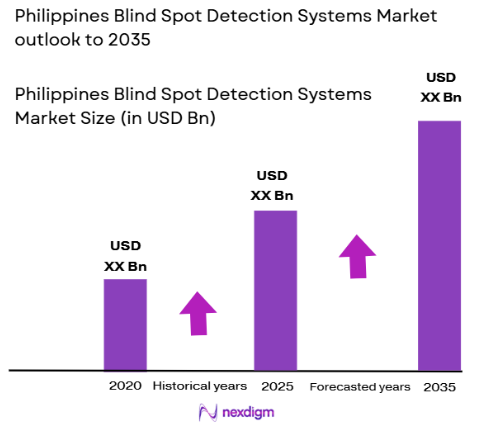
The Philippines Blind Spot Detection Systems market reached approximately USD ~ billion based on a recent historical assessment, driven by rising vehicle safety adoption and integration of advanced driver assistance systems. Increasing urban congestion and accident prevention initiatives are accelerating demand across passenger and commercial vehicles. Growth is further supported by OEM integration in mid-range vehicles and expanding aftermarket retrofitting services, enabling broader accessibility and sustained market expansion across diverse vehicle categories nationwide.
Metro Manila, Cebu, and Davao dominate the Philippines Blind Spot Detection Systems market due to high vehicle density and urban traffic complexity requiring enhanced safety technologies. These regions benefit from stronger dealership networks, higher disposable incomes, and greater awareness of advanced safety features. Additionally, import-driven automotive distribution channels concentrated in these urban hubs facilitate quicker adoption of ADAS technologies, while government-led road safety campaigns and infrastructure development further reinforce demand concentration in these cities.
Market Segmentation
By Product Type
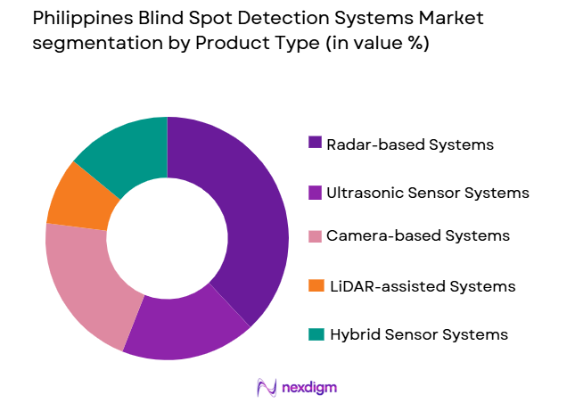
Philippines Blind Spot Detection Systems market is segmented by product type into Radar-based Systems, Ultrasonic Sensor Systems, Camera-based Systems, LiDAR-assisted Systems, and Hybrid Sensor Systems. Recently, Radar-based Systems have a dominant market share due to superior detection accuracy, long-range sensing capabilities, and reliability under diverse weather conditions. These systems are widely adopted by OEMs due to their compatibility with advanced driver assistance frameworks and cost optimization in large-scale manufacturing, making them the preferred technology across passenger and commercial vehicle segments.
By Vehicle Type
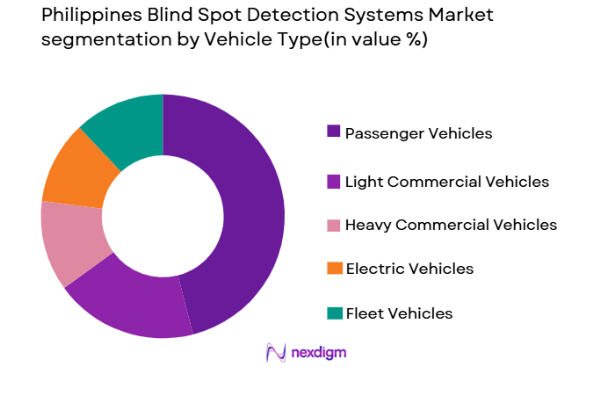
Philippines Blind Spot Detection Systems market is segmented by vehicle type into Passenger Vehicles, Light Commercial Vehicles, Heavy Commercial Vehicles, Electric Vehicles, and Fleet Vehicles. Recently, Passenger Vehicles have a dominant market share due to increasing consumer preference for safety-equipped personal mobility and rising availability of ADAS features in mid-range models. Urban commuting patterns and increasing disposable income levels are driving adoption, while OEMs are incorporating blind spot detection as standard or optional features in newer models to enhance competitive positioning.
Competitive Landscape
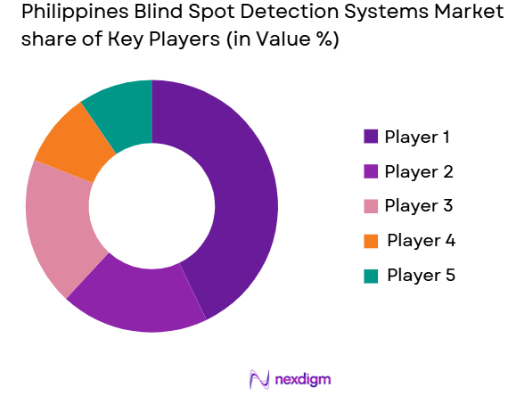
The Philippines Blind Spot Detection Systems market is moderately consolidated, with global automotive technology providers dominating due to advanced R&D capabilities and established OEM partnerships. Major players leverage sensor innovation, AI integration, and cost optimization to maintain competitive positioning. Local distributors and aftermarket solution providers also play a critical role in expanding adoption, particularly in retrofit applications, creating a balanced competitive environment between multinational corporations and regional participants.
| Company Name | Establishment Year | Headquarters | Technology Focus | Market Reach | Key Products | Revenue | Integration Capability |
| Robert Bosch GmbH | 1886 | Germany | ~ | ~ | ~ | ~ | ~ |
| Continental AG | 1871 | Germany | ~ | ~ | ~ | ~ | ~ |
| Denso Corporation | 1949 | Japan | ~ | ~ | ~ | ~ | ~ |
| Valeo SA | 1923 | France | ~ | ~ | ~ | ~ | ~ |
| Aptiv PLC | 1994 | Ireland | ~ | ~ | ~ | ~ | ~ |
Philippines Blind Spot Detection Systems Market Analysis
Growth Drivers
Rising Integration of Advanced Driver Assistance Systems in Mid-Range Vehicles
The Philippines Blind Spot Detection Systems market is experiencing strong momentum due to the increasing integration of advanced driver assistance systems into mid-range vehicle segments. Automakers are no longer limiting safety technologies to premium models, as competitive pressures and evolving consumer expectations push for broader adoption across vehicle categories. This transition is supported by advancements in sensor cost efficiency and modular system design, allowing manufacturers to incorporate blind spot detection features without significantly increasing vehicle prices. Urbanization trends in major cities have intensified traffic congestion, increasing the need for driver support technologies that enhance situational awareness and reduce accident risks. Consumers are also becoming more informed about vehicle safety features through digital platforms and dealership promotions, which further drives demand. Regulatory encouragement toward safer mobility solutions is reinforcing OEM decisions to include these systems as standard or optional features. Additionally, rising imports of vehicles equipped with ADAS capabilities are contributing to market penetration. The growing presence of ride-hailing and fleet operators adopting safety-focused vehicles is accelerating demand. These combined factors are strengthening the adoption curve of blind spot detection systems across the automotive ecosystem.
Increasing Road Safety Awareness and Government Initiatives
Increasing awareness of road safety and active government initiatives aimed at reducing vehicular accidents are significantly contributing to the expansion of the Philippines Blind Spot Detection Systems market. Public campaigns emphasizing safe driving practices and accident prevention have heightened consumer sensitivity toward vehicle safety features. Authorities are promoting stricter compliance with vehicle safety standards, encouraging automakers and distributors to integrate advanced safety technologies into their offerings. The growing number of road accidents in densely populated urban areas has further intensified the focus on preventive technologies such as blind spot detection systems. Insurance providers are also incentivizing the adoption of safety features by offering better coverage terms for vehicles equipped with advanced systems. Infrastructure improvements, including better road networks and traffic management systems, are complementing the adoption of intelligent vehicle technologies. Furthermore, collaborations between government bodies and automotive stakeholders are facilitating awareness programs and demonstrations of ADAS functionalities. These initiatives are fostering trust among consumers and encouraging them to invest in safer vehicles. As safety becomes a key differentiator in purchasing decisions, the demand for blind spot detection systems continues to strengthen across the Philippines automotive market.
Market Challenges
High Cost Sensitivity in Entry-Level Vehicle Segments
The Philippines Blind Spot Detection Systems market faces a significant challenge due to high cost sensitivity among consumers in entry-level vehicle segments. A large portion of the automotive market is dominated by budget-conscious buyers who prioritize affordability over advanced safety features. The inclusion of blind spot detection systems often increases the overall vehicle price, making it less accessible for this segment. While technological advancements have reduced sensor costs, integration expenses and system calibration requirements still contribute to higher production costs. Automakers are cautious about incorporating such features in lower-priced models to avoid pricing themselves out of competitive segments. Additionally, limited financing options for vehicles with advanced safety technologies further restrict adoption. Consumers in price-sensitive regions may not fully perceive the immediate value of these systems, especially when compared to basic vehicle functionalities. The aftermarket segment also faces similar challenges, as retrofitting costs can be prohibitive for older vehicle owners. This cost barrier slows down widespread adoption and creates a gap between premium and entry-level vehicle segments. Overcoming this challenge requires continued innovation in cost optimization and stronger awareness campaigns emphasizing long-term safety benefits.
Limited Technical Infrastructure and Aftermarket Support
Limited technical infrastructure and inadequate aftermarket support pose a critical challenge to the growth of the Philippines Blind Spot Detection Systems market. The installation and maintenance of advanced sensor-based systems require specialized technical expertise, which is not uniformly available across all regions. Many service centers lack trained personnel capable of handling calibration and diagnostics of ADAS components, leading to inconsistent performance and reliability concerns. This limitation discourages consumers from adopting aftermarket solutions, particularly in semi-urban and rural areas. Additionally, the availability of genuine spare parts and compatible components remains uneven, affecting system longevity and maintenance costs. Automotive workshops often rely on generic solutions that may not meet OEM standards, resulting in reduced effectiveness of blind spot detection systems. The lack of standardized installation procedures further complicates the situation, increasing the risk of system malfunction. Consumers may also face delays in service and higher repair costs due to limited availability of authorized service centers. These infrastructure gaps hinder the seamless expansion of the market and restrict the potential of aftermarket growth. Addressing this challenge requires investment in technical training, service network expansion, and improved supply chain efficiency.
Opportunities
Expansion of Aftermarket Retrofit Solutions for Existing Vehicle Fleet
The Philippines Blind Spot Detection Systems market presents a significant opportunity through the expansion of aftermarket retrofit solutions targeting the existing vehicle fleet. A substantial number of vehicles on the road lack advanced safety features, creating a large addressable market for retrofit technologies. Aftermarket providers are developing cost-effective and easy-to-install solutions that can be integrated into older vehicles without major modifications. These systems are gaining traction among fleet operators seeking to enhance safety without replacing their entire vehicle inventory. Increasing awareness of road safety and accident prevention is encouraging vehicle owners to invest in retrofit solutions. Technological advancements are enabling compact and wireless systems that simplify installation and reduce costs. Partnerships between technology providers and local distributors are improving product availability and service support across regions. Additionally, digital platforms are facilitating direct-to-consumer sales and awareness campaigns, further driving adoption. The growing demand for affordable safety upgrades is expected to accelerate the aftermarket segment. This opportunity allows market participants to tap into a broader customer base beyond new vehicle sales. As retrofit solutions become more reliable and accessible, they will play a crucial role in expanding overall market penetration.
Integration of Artificial Intelligence and Sensor Fusion Technologies
The integration of artificial intelligence and sensor fusion technologies offers a transformative opportunity for the Philippines Blind Spot Detection Systems market. Advanced algorithms enable more accurate detection of surrounding vehicles and objects, enhancing system reliability and reducing false alerts. Sensor fusion combines data from multiple sources such as radar, cameras, and ultrasonic sensors, providing a comprehensive view of the vehicle’s environment. This integration improves performance under challenging conditions, including low visibility and complex traffic scenarios. Automakers are increasingly incorporating AI-driven systems to differentiate their products and offer enhanced safety features. The growing trend toward connected and autonomous vehicles further supports the adoption of intelligent detection systems. Continuous advancements in computing power and data processing capabilities are enabling real-time analysis and decision-making. These innovations are also facilitating predictive safety features that anticipate potential hazards before they occur. Collaboration between automotive manufacturers and technology companies is accelerating the development of next-generation systems. As AI and sensor fusion technologies mature, they are expected to redefine the capabilities of blind spot detection systems and drive long-term market growth.
Future Outlook
The Philippines Blind Spot Detection Systems market is expected to witness steady growth driven by increasing vehicle safety awareness and expanding adoption of advanced driver assistance systems. Technological advancements in sensor fusion and artificial intelligence will enhance system performance and affordability. Regulatory support for automotive safety standards will further encourage integration across vehicle categories. Rising urbanization and traffic density will continue to create demand for driver assistance technologies. The aftermarket segment is also anticipated to expand significantly due to retrofit opportunities.
Major Players
- Robert Bosch GmbH
- Continental AG
- Denso Corporation
- Valeo SA
- Aptiv PLC
- ZF Friedrichshafen AG
- Magna International Inc
- Autoliv Inc
- NXP Semiconductors
- Infineon Technologies
- Texas Instruments Automotive
- Hella GmbH
- Mobileye Global Inc
- Hyundai Mobis
- Panasonic Automotive Systems
Key Target Audience
- Automotive OEM manufacturers
- Fleet management companies
- Automotive component suppliers
- Ride-hailing service providers
- Government and regulatory bodies
- Investments and venture capitalist firms
- Automotive dealerships
- Logistics and transportation companies
Research Methodology
Step 1: Identification of Key Variables
Primary variables such as vehicle production, safety technology adoption, and sensor integration trends are identified. Secondary variables including regulatory policies and consumer behavior patterns are also analyzed to define market boundaries.
Step 2: Market Analysis and Construction
Data is collected from industry reports, automotive databases, and trade statistics. The market is constructed using bottom-up and top-down approaches to ensure accuracy and consistency across different segments.
Step 3: Hypothesis Validation and Expert Consultation
Findings are validated through consultations with industry experts, OEM representatives, and technology providers. Assumptions are tested against real-world scenarios to ensure reliability and relevance of insights.
Step 4: Research Synthesis and Final Output
All validated data is synthesized into a structured report. Analytical models are applied to derive insights, ensuring clarity, consistency, and actionable intelligence for stakeholders.

- Executive Summary
- Research Methodology (Definitions, Scope, Industry Assumptions, Market Sizing Approach, Primary & Secondary Research Framework, Data Collection & Verification Protocol, Analytic Models & Forecast Methodology, Limitations & Research Validity Checks)

- Market Definition and Scope
- Value Chain & Stakeholder Ecosystem
- Regulatory / Certification Landscape
- Sector Dynamics Affecting Demand
- Strategic Initiatives & Infrastructure Growth

- Growth Drivers
Rising adoption of advanced driver assistance systems in urban mobility
Increasing road safety awareness and accident reduction initiatives
Growth in vehicle production and sales across passenger and commercial segments
Expansion of electric vehicle ecosystem integrating safety technologies
Government push toward automotive safety compliance standards - Market Challenges
High cost of advanced sensor integration in low-cost vehicle segments
Limited consumer awareness in rural and semi-urban markets
Technical calibration and maintenance complexities
Dependence on imported sensor components
Inconsistent regulatory enforcement across regions - Market Opportunities
Integration of AI-driven safety systems in mid-range vehicles
Expansion of aftermarket retrofit solutions for older vehicle fleets
Partnerships between OEMs and technology providers for localized innovation - Trends
Increasing deployment of sensor fusion technologies
Adoption of compact and cost-efficient radar modules
Growth in connected vehicle ecosystems enhancing safety features
Integration with autonomous and semi-autonomous driving systems
Rising demand for real-time driver assistance alerts - Government Regulations & Defense Policy
Implementation of vehicle safety standards aligned with global norms
Government incentives for adoption of ADAS technologies
Policies promoting road safety and accident reduction frameworks - SWOT Analysis
- Stakeholder and Ecosystem Analysis
- Porter’s Five Forces Analysis
- Competition Intensity and Ecosystem Mapping

- By Market Value, 2020-2025
- By Installed Units, 2020-2025
- By Average System Price, 2020-2025
- By System Complexity Tier, 2020-2025

- By System Type (In Value%)
Radar-based Blind Spot Detection Systems
Ultrasonic Sensor-based Systems
Camera-based Blind Spot Monitoring Systems
LiDAR-assisted Detection Systems
Hybrid Multi-sensor Detection Systems - By Platform Type (In Value%)
Passenger Vehicles
Light Commercial Vehicles
Heavy Commercial Vehicles
Electric Vehicles
Autonomous Vehicle Platforms - By Fitment Type (In Value%)
OEM Installed Systems
Aftermarket Installations
Integrated ADAS Packages
Modular Retrofit Systems
Dealer-installed Systems - By EndUser Segment (In Value%)
Individual Vehicle Owners
Fleet Operators
Logistics and Transportation Companies
Ride-hailing Service Providers
Government and Public Transport Agencies - By Procurement Channel (In Value%)
Direct OEM Procurement
Authorized Dealership Sales
Aftermarket Retailers
Online Automotive Platforms
Fleet Contract Procurement - By Material / Technology (in Value %)
Millimeter Wave Radar Technology
Infrared Sensor Technology
Optical Camera Systems
AI-based Object Detection Software
Sensor Fusion Technology

- Market structure and competitive positioning
- Market share snapshot of major players
- Cross Comparison Parameters (Technology Type, Sensor Accuracy, Detection Range, Integration Capability, Cost Efficiency, Power Consumption, Installation Complexity, Aftermarket Support, AI Integration, Durability)
- SWOT Analysis of Key Players
- Pricing & Procurement Analysis
- Key Players
Continental AG
Denso Corporation
Valeo SA
Robert Bosch GmbH
Aptiv PLC
ZF Friedrichshafen AG
Magna International Inc
Autoliv Inc
NXP Semiconductors
Infineon Technologies
Texas Instruments Automotive Division
Hella GmbH
Mobileye Global Inc
Hyundai Mobis
Panasonic Automotive Systems

- Fleet operators prioritizing safety technologies to reduce operational risks
- Private vehicle owners increasingly adopting ADAS features for convenience and safety
- Government agencies focusing on safer public transportation systems
- Ride-hailing companies integrating safety technologies to enhance customer trust

- Forecast Market Value, 2026-2035
- Forecast Installed Units, 2026-2035
- Price Forecast by System Tier, 2026-2035
- Future Demand by Platform, 2026-2035


 Request a Sample
 Ask for Customization
 Get a Quote
 Enquire Now