

 Download PDF
Market Overview
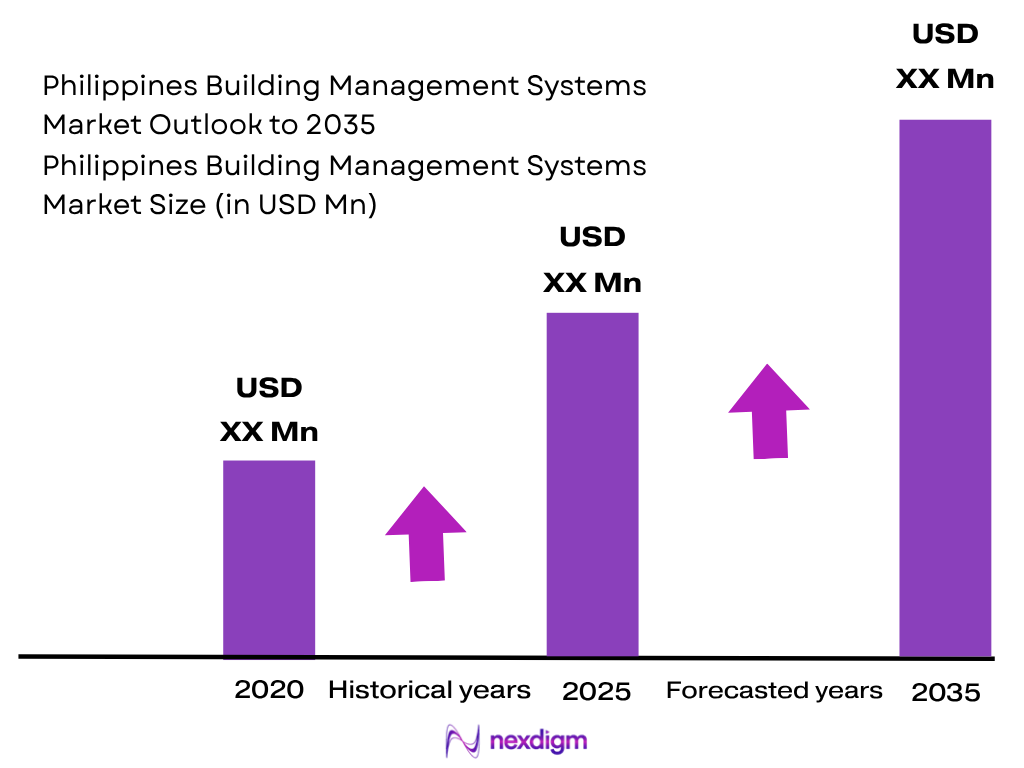
The Philippines Building Management Systems Market is valued at approximately ~USD XX million, supported by expanding commercial, industrial and institutional construction. Approved building construction increased from 171,268 projects and 41.47 million sq. m. of floor area to 180,341 projects and 42.84 million sq. m., while non-residential construction increased from 35,772 to 39,238 projects. This expanding building stock supports demand for HVAC automation, energy monitoring, DDC controllers, smart meters and centralized BMS platforms.
Metro Manila, particularly Makati, Bonifacio Global City, Ortigas and Quezon City, dominates sophisticated BMS deployment because of concentrated offices, BPO facilities, hospitals, hotels, malls and high-rise mixed-use developments. NCR approved building permits increased from 9,870 to 13,478, while approved floor area increased from 4.85 million sq. m. to 5.74 million sq. m. Cebu, Clark, Laguna and Batangas are also important because of commercial expansion, tourism, industrial estates and electronics manufacturing.
Market Segmentation
By Component Type
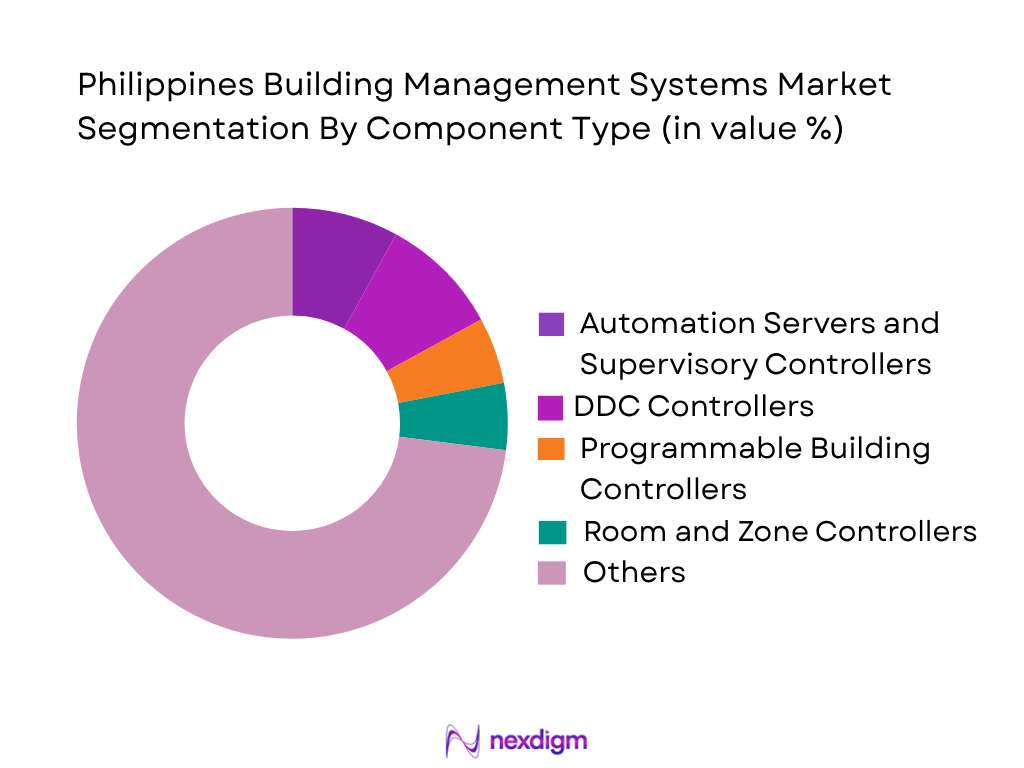
The Philippines Building Management Systems Market is segmented into automation servers and supervisory controllers, DDC controllers, programmable building controllers, room and zone controllers, sensors and transmitters, actuators and control valves, IoT gateways and edge devices, HMIs, control panels, smart meters, software platforms and engineering services. Installation and integration services hold the dominant market share because BMS deployment requires configuration and interoperability across HVAC equipment, electrical systems, meters, fire alarms, access controls and communication networks. Philippine economic-zone activity reinforces this requirement, with 255 approved projects, including 122 export-manufacturing projects, 65 IT-BPM projects and 18 facilities-development projects. Each new facility can contain equipment supplied by several vendors, making programming, protocol mapping, graphics development, control-sequence engineering and commissioning essential. DDC controllers and automation servers remain core hardware elements, while smart meters, IoT gateways and analytics software are gaining importance as operators move beyond basic equipment control toward centralized energy monitoring, fault identification and remote building operations.
By Building Type
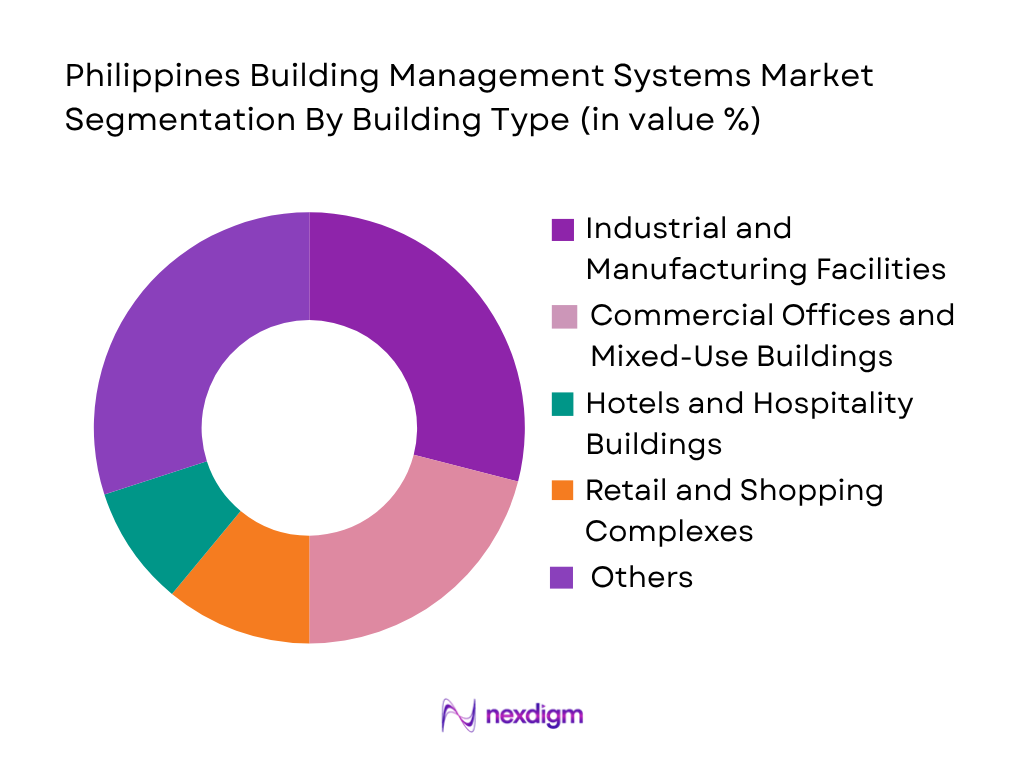
The Philippines Building Management Systems Market is segmented into industrial and manufacturing facilities, commercial and mixed-use buildings, hotels, retail facilities, hospitals, data centres, government buildings, high-rise residential developments and other institutional properties. Industrial and manufacturing facilities represent the dominant modeled sub-segment, supported by extensive electronics, semiconductor, food-processing and industrial operations across CALABARZON, Central Luzon and adjacent manufacturing corridors. These facilities require continuous monitoring of HVAC, production-area environmental conditions, chilled-water systems, electrical loads, compressed air, utility systems and equipment alarms. Commercial buildings remain another major demand base because integrated BMS is increasingly used to coordinate HVAC, lighting, energy metering, access control and common-area systems. The Department of Energy specifically recognizes BMS as a centralized platform capable of integrating multiple building systems, while the Philippine Statistics Authority classifies factories, plants, warehouses and production facilities as a significant component of the country’s non-residential building stock.
Competitive Landscape
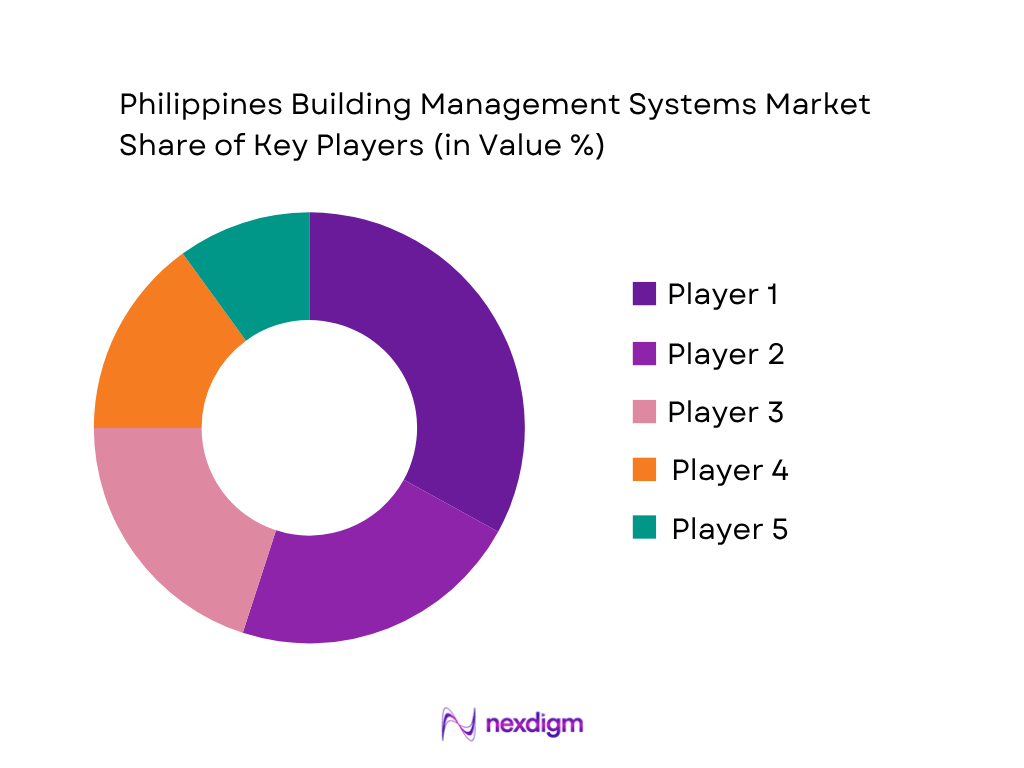
The Philippines Building Management Systems Market includes global building-automation OEMs alongside local system integrators and engineering companies. Schneider Electric, Siemens, Honeywell, Johnson Controls and ABB are prominent because they combine automation hardware, supervisory platforms, energy management, HVAC or electrical integration and enterprise-level digital capabilities. Competition increasingly depends on interoperability, cybersecurity, BACnet and Modbus support, cloud connectivity, chiller optimization, local engineering capability, commissioning expertise and long-term service rather than standalone controller supply.
| Major Player | Establishment Year | Headquarters | BMS Platform / Key Offering | Protocol & Interoperability Capability | HVAC & Energy Management Capability | Cloud / Analytics Capability | Philippines Service & Integration Presence | Key Application Verticals |
| Schneider Electric | 1871 | Rueil-Malmaison, France | ~ | ~ | ~ | ~ | ~ | ~ |
| Siemens | 1847 | Munich / Berlin, Germany | ~ | ~ | ~ | ~ | ~ | ~ |
| Honeywell | 1906 | Charlotte, USA | ~ | ~ | ~ | ~ | ~ | ~ |
| Johnson Controls | 1885 | Cork, Ireland | ~ | ~ | ~ | ~ | ~ | ~ |
| ABB | 1988 | Zurich, Switzerland | ~ | ~ | ~ | ~ | ~ | ~ |
Philippines Building Management Systems Market Analysis
Growth Drivers
Commercial Building Expansion and Rising Electricity Consumption
Expansion of the Philippines’ commercial and non-residential building stock is strengthening demand for Building Management Systems used to coordinate HVAC, lighting, electrical monitoring, smart metering, alarms and facility operations. Philippine Statistics Authority data show 39,238 non-residential constructions covering 22,380,982 square metres of floor area in 2024, while total approved construction reached 180,341 projects and 42,837,581 square metres. The pipeline remained substantial in 2025, with 181,832 approved constructions covering 45,236,312 square metres. Electricity consumption reinforces the operating need for automation: Department of Energy data show commercial users consumed 28,033 GWh in 2024, including 23,904,218 MWh in Luzon, while industrial consumers used 31,074 GWh nationally. BMS platforms help large buildings respond to these loads through chiller sequencing, scheduling, submetering, demand monitoring and equipment diagnostics. The International Monetary Fund recorded Philippine nominal GDP at USD 469.5 billion and PHP 26.432 trillion in 2024, alongside gross fixed capital formation growth of 8.3 in its 2024 Article IV framework. These construction, electricity and investment indicators directly support deployment of integrated BMS across offices, malls, hotels, hospitals and mixed-use developments.
Industrial, IT-BPM and Economic Zone Expansion Supporting Building Automation
Industrial estates, IT-BPM facilities and economic zones are creating another strong demand base for sophisticated Building Management Systems because these facilities require centralized environmental control, utility monitoring, equipment alarms and reliable HVAC operation. The Philippine Economic Zone Authority approved 255 projects during 2024, comprising 122 manufacturing projects, 64 IT-BPM projects, 28 ecozone-development projects, 18 facilities projects, 9 logistics projects, 12 domestic-market projects and 2 utilities projects. Approved PEZA investments reached PHP 214.176 billion, while the approved projects were expected to generate more than USD 4.656 billion in exports and over 72,000 direct jobs. In 2025, PEZA approved 146 manufacturing projects and 67 IT-BPM projects, demonstrating continuing expansion of automation-intensive facilities. Department of Energy figures show industrial electricity consumption reached 31,074 GWh in 2024, with Luzon industrial users accounting for 20,305,933 MWh. Such loads create direct requirements for BMS-based electrical monitoring, chiller optimization, cleanroom controls, utility dashboards and remote alarms. IMF data place Philippine nominal GDP at USD 469.5 billion in 2024, reinforcing the macroeconomic scale supporting industrial digitalization and smart-facility investment.
Market Challenges
Legacy Building Retrofit and Multi-System Integration Complexity
Retrofitting existing buildings is technically challenging for the Philippines Building Management Systems market because older commercial and institutional properties often contain different generations of HVAC controllers, electrical meters, fire panels, security devices and proprietary communication networks. Philippine Statistics Authority data recorded 13,997 alteration and repair projects in 2024, alongside 5,694 building additions covering 708,409 square metres, demonstrating the scale of building modification activity in which BMS upgrades may need to coexist with legacy infrastructure. In December 2025 alone, PSA recorded 858 alteration and repair projects, while the full construction base reached 181,832 permitted projects and 45,236,312 square metres during 2025. System integrators therefore have to manage protocol conversion, controller replacement, sensor recalibration, software migration and commissioning without disrupting occupied buildings. The challenge is particularly relevant to offices, hotels, hospitals and malls where continuous HVAC and electrical operation is essential. Department of Energy data show commercial electricity consumption of 28,033 GWh in 2024, increasing the operational consequences of poorly integrated controls. IMF data recorded Philippine nominal GDP at USD 469.5 billion and gross fixed capital formation within a rapidly expanding economy, making reliable modernization increasingly important as the installed building base grows.
Cybersecurity Exposure in Cloud-Connected and Remotely Operated BMS
Greater use of IP-based controllers, cloud dashboards, IoT gateways and remote facility access is increasing cybersecurity requirements for Philippine BMS installations. The Cybercrime Investigation and Coordinating Center recorded 10,004 cybercrime complaints during 2024, compared with 3,317 complaints in the preceding year, while reported victim losses reached nearly PHP 198 million. The National Bureau of Investigation also arrested 3 individuals in June 2024 following investigations involving unauthorized access to private and government websites, banks and online accounts, illustrating the broader threat environment affecting connected systems. This is relevant to BMS because modern automation networks may connect HVAC, metering, access-control and other operational technologies to enterprise IT infrastructure or cloud platforms. Secure authentication, network segmentation, encrypted remote access, controller firmware management and firewall protection therefore become essential project requirements. The Department of Energy’s building energy guidelines specifically address firewall protection for internet-connected BMS installations, demonstrating regulatory recognition of the issue. IMF data place Philippine nominal GDP at USD 469.5 billion and gross international reserves at USD 113.3 billion in 2024, highlighting the economic scale of digital infrastructure that increasingly depends on resilient cyber-physical systems.
Market Opportunities
Legacy BMS Modernization and Energy-Optimization Platforms
Modernization of existing commercial buildings represents a strong future opportunity for BMS suppliers because current construction and repair activity shows a substantial base of properties undergoing physical upgrades that can incorporate digital controls. Philippine Statistics Authority data recorded 13,997 alteration and repair projects and 5,694 additions in 2024, while alterations and repairs represented construction activity valued at PHP 43.051 billion. These projects create opportunities to replace obsolete DDC controllers, install smart meters, migrate proprietary networks to BACnet/IP, add cloud dashboards and integrate existing chillers with optimization software. Department of Energy statistics show commercial electricity use reached 28,033 GWh and industrial consumption 31,074 GWh in 2024, providing a substantial operational load where control improvements can support energy monitoring and equipment scheduling. The Department’s building guidelines already recognize centralized BMS monitoring for HVAC, lighting, security, fire systems, elevators, emergency power and indoor-air-quality equipment. The macroeconomic environment strengthens this opportunity: IMF data recorded nominal GDP of USD 469.5 billion and gross fixed capital formation growth of 8.3 in 2024. These current indicators support future demand for phased BMS retrofit projects across offices, hotels, hospitals, malls and industrial properties without requiring complete mechanical-system replacement.
Data Centres, IT-BPM Facilities and Multi-Site Smart Building Platforms
Growth of digitally intensive economic-zone projects creates a future opportunity for advanced BMS platforms capable of handling mission-critical cooling, electrical monitoring, alarms and remote multi-site operations. PEZA approved 255 projects in 2024, including 64 IT-BPM projects, 122 manufacturing projects, 18 facilities projects and 28 ecozone-development projects. These projects were associated with PHP 214.176 billion of approved investment and more than 72,000 projected direct jobs, while 16 new ecozones were proclaimed during the year. Momentum continued in 2025, when PEZA approved 67 IT-BPM projects, 146 manufacturing projects and 25 facilities projects. Such developments increase the number of buildings requiring reliable cooling controls, backup-power monitoring, smart metering and enterprise dashboards. Energy intensity further supports the case: commercial facilities consumed 28,033 GWh of electricity in 2024, while Luzon alone accounted for 23,904,218 MWh of commercial consumption. Cloud-connected BMS can enable operators to manage multiple buildings from centralized control environments while using fault detection and analytics to prioritize maintenance. IMF data place Philippine nominal GDP at USD 469.5 billion in 2024, providing a substantial macroeconomic foundation for continued investment in digital infrastructure and intelligent building operations.
Future Outlook
The Philippines Building Management Systems Market is expected to expand at approximately ~X.X% CAGR during 2026–2035, supported by commercial development, data-centre construction, industrial digitalization, energy-efficiency regulation and modernization of aging building controls. The market is expected to move progressively from isolated HVAC control toward integrated building platforms combining automation, energy management, analytics, remote access and cybersecurity.
Energy efficiency will remain central to future BMS adoption. Republic Act No. 11285 institutionalizes energy-efficiency and conservation requirements, while the Department of Energy’s building guidelines require new construction and building retrofits to comply with minimum energy-efficiency requirements. These policies create a stronger regulatory foundation for centralized monitoring, smart metering and HVAC control in commercial and industrial buildings.
Major Players
- Schneider Electric Philippines
- Siemens Philippines
- Honeywell Philippines
- Johnson Controls Philippines
- ABB Philippines
- Delta Controls / Delta Electronics
- Carrier Philippines
- Trane Philippines
- Mitsubishi Electric Philippines
- Panasonic Philippines
- Loxon Philippines, Inc.
- GRAM Industrial, Inc.
- Infinite Systems Technology Corporation
- RPMH IT and Engineering Services
- Rafallo Percalin Corporation
Key Target Audience
- Building Management Systems Manufacturers
- Building Automation Hardware and Software Providers
- BMS System Integrators and Automation Contractors
- Property Developers and Commercial Building Owners
- Industrial, Data Centre and Mission-Critical Facility Operators
- Facility Management and Building Operations Companies
- Investments and Venture Capitalist Firms
- Government and Regulatory Bodies (Department of Energy, Department of Public Works and Highways, Energy Regulatory Commission, Department of Information and Communications Technology, Bureau of Fire Protection and Local Government Building Officials)
Research Methodology
Step 1: Identification of Key Variables
The initial phase involves constructing a comprehensive ecosystem map covering BMS OEMs, controller and sensor manufacturers, system integrators, HVAC suppliers, MEP contractors, property developers and facility operators. Secondary and proprietary research is used to identify critical variables including installed building stock, connected control points, component mix, building type, protocol penetration, retrofit intensity and service requirements.
Step 2: Market Analysis and Construction
Historical demand is analyzed using both top-down and bottom-up market-construction techniques. Top-down analysis considers construction activity, non-residential floor area, commercial development, industrial facilities and energy-efficiency regulations, while bottom-up analysis models representative BMS projects using controller density, connected points, hardware requirements, software platforms, integration scope and lifecycle-service requirements.
Step 3: Hypothesis Validation and Expert Consultation
Market hypotheses are validated through computer-assisted telephone interviews and discussions with BMS manufacturers, system integrators, MEP contractors, facility managers, property owners and automation engineers. These consultations validate controller configurations, protocol preferences, retrofit requirements, HVAC integration depth, commissioning practices, cloud adoption and the competitive importance of service capabilities across major building applications.
Step 4: Research Synthesis and Final Output
The final phase triangulates Philippine Statistics Authority construction information, Department of Energy regulations, company disclosures, project-level information and primary interviews. Top-down construction indicators are reconciled with bottom-up control-point and equipment estimates to derive a coherent view of component demand, end-user applications, competitive positioning, installed-base modernization and long-term BMS adoption.

- Executive Summary
- Research Methodology (Market Definitions and Assumptions, BMS and BAS Market Boundary, Hardware-Software-Service Classification, Installed-Base Assessment, Connected Control Point Mapping, New-Build Deployment Assessment, Retrofit and Modernization Assessment, HVAC Automation Assessment, Energy Monitoring Assessment, Smart Metering Assessment, Lighting Control Assessment, Fire and Life-Safety Integration Assessment, Security Integration Assessment, BACnet Protocol Mapping, Modbus Protocol Mapping, KNX Assessment, MQTT and IoT Connectivity Assessment, Cloud BMS Assessment, Edge-Control Assessment, Cybersecurity Assessment, Top-Down Market Sizing, Bottom-Up Market Sizing, Demand-Side Assessment, Supply-Side Assessment, System Integrator Mapping, Primary Industry Interviews, Project Pipeline Assessment, Data Triangulation, Forecasting Framework)

- Definition and Scope
- Evolution of Building Automation in the Philippines, Transition from Standalone HVAC Controls to Integrated Building Management Systems, Evolution from DDC-Based Automation to IP-Based, IoT-Enabled and Cloud-Connected BMS, Building Management Systems Industry Value Chain, Building Automation Supply Chain, BMS Ecosystem Mapping
- BMS Hardware Manufacturers, Automation Server and Controller Manufacturers, Sensor and Actuator Suppliers, Smart Meter Suppliers, IoT Gateway Providers, BMS Software Providers, HVAC Equipment Manufacturers, System Integrators, MEP Contractors, Building Automation Contractors, Property Developers, Facility Management Companies, Data Centre Operators, Hotel Operators, Hospital Operators, Industrial Facility Operators, Energy Service Companies, Testing and Commissioning Providers, Government Agencies
Building Management Systems Technology Architecture Assessment, Covering Field Devices, Control Layer, Supervisory Layer, Management Layer, Cloud Platforms and Enterprise Integration
Building Management Systems Demand Mapping Across Commercial Offices, IT-BPM Facilities, Data Centres, Manufacturing Plants, Hotels, Hospitals, Retail Buildings, Smart Residential Developments and Government Facilities

- Growth Drivers (Commercial Building Expansion, BPO Office Development, Data Centre Construction, Energy Efficiency and Conservation Act Implementation, HVAC Optimization Requirements, Smart Building Adoption, High-Rise Residential Development, Hotel and Resort Construction, Industrial Automation, Remote Facility Monitoring)
- Market Challenges (High Initial Integration Complexity, Fragmented Legacy Building Systems, Skilled BMS Engineer Availability, Proprietary Protocol Lock-In, Cybersecurity Exposure, Building Owner Awareness, Retrofit Downtime, Multi-Vendor Integration, Sensor Calibration and Maintenance, System Obsolescence)
Market Opportunities (Legacy BMS Modernization, Cloud-Based BMS, AI-Driven Building Analytics, Chiller Plant Optimization, Smart Metering, Data Centre Environmental Controls, Hospital Building Automation, Hotel Energy Management, Industrial Campus Integration, Multi-Site Remote Facility Management) - Market Trends (BACnet/IP Adoption, Open-Protocol Integration, IoT Sensors, Edge Computing, Cloud BMS, AI-Based Fault Detection, Predictive Maintenance, Occupancy-Based Control, Indoor Air Quality Monitoring, Integrated Energy Management, Digital Twins, Mobile Facility Management)
- Government Regulations and Standards (Energy Efficiency and Conservation Act, Guidelines on Energy Conserving Design of Buildings)
- SWOT Analysis
- Porter’s Five Forces Analysis
- PESTLE Analysis
- Stakeholder Ecosystem
- Building Automation Project Ecosystem

- By Market Value (2020-2025)
- By Hardware Revenue (2020-2025)
- By Software Revenue (2020-2025)
- By Installation and System Integration Revenue (2020-2025)
- By Maintenance and Lifecycle Services Revenue (2020-2025)
- By Number of BMS-Enabled Buildings (2020-2025)
- By Number of Connected BMS Control Points (2020-2025)
- By New-Build BMS Deployments (2020-2025)
- By Retrofit and Modernization Deployments (2020-2025)
- By Commercial Building BMS Installations (2020-2025)
- By Industrial Building BMS Installations (2020-2025)
- By Data Centre BMS Installations (2020-2025)

- By Component Type (In Value %)
Automation Servers and Supervisory Controllers
DDC Controllers
Programmable Building Controllers
Room and Zone Controllers
Sensors and Transmitters
Actuators and Control Valves
IoT Gateways and Edge Devices
Human-Machine Interfaces
Control Panels and I/O Modules
Smart Energy Meters
BMS Software Platforms
Energy Management Software
Analytics and Optimization Software
Installation and Integration Services
Testing and Commissioning Services
Maintenance and Lifecycle Services - By System Architecture (In Value %)
Standalone Building Automation Systems
Centralized BMS
Distributed Control Architecture
Integrated Building Management Systems
IP-Based BMS
IoT-Enabled BMS
Cloud-Connected BMS
Edge-Control BMS
Hybrid Edge-Cloud BMS
Enterprise Multi-Site Building Management Platforms - By Controlled Building System (In Value %)
HVAC and Chiller Plant Controls
Air Handling Unit Controls
Lighting Control Systems
Electrical Power Monitoring
Energy Monitoring and Smart Metering
Fire Detection and Life-Safety Interface
Access Control and Security Integration
CCTV System Integration
Elevator and Escalator Monitoring
Water Supply and Pump Monitoring
Plumbing and Drainage Monitoring
Indoor Air Quality Monitoring
Generator and Emergency Power Monitoring
Renewable Energy and Microgrid Monitoring
EV Charging Infrastructure Integration - By Building Type (In Value %)
Commercial Office Buildings
Business Process Outsourcing Buildings
Mixed-Use Developments
Shopping Malls and Retail Complexes
Hotels and Resorts
Hospitals and Healthcare Facilities
Educational Buildings
Government and Public Buildings
Industrial and Manufacturing Facilities
Electronics and Semiconductor Facilities
Data Centres
Warehouses and Logistics Facilities
Airports and Transportation Buildings
High-Rise Residential Buildings
Premium Condominium Developments - By Deployment Type (In Value %)
New-Build BMS Installation
Existing-Building BMS Retrofit
Legacy BMS Modernization
Controller Replacement
Software Platform Migration
HVAC Controls Upgrade
Energy Metering Retrofit
Cloud Migration
Multi-Building Integration - By Region (In Value %)
Metro Manila
Makati
Bonifacio Global City
Ortigas
Quezon City
Cebu
Davao
Laguna
Cavite
Batangas
Clark and Pampanga
Iloilo
Other Luzon
Other Visayas
Other Mindanao

- Market Share of Major Players (By Philippines Revenue, Hardware Revenue, Software Revenue, Services Revenue, Installed BMS Base, Connected Control Points, Commercial Building Installations, Industrial Facility Installations, Data Centre Installations, Metro Manila Presence, Cebu Presence, System Integrator Network, Cloud Platform Capability, Lifecycle Service Coverage)
- Cross Comparison Parameters (BMS Software Platform Breadth, BACnet-Modbus-KNX-MQTT Interoperability, HVAC and Chiller Optimization Capability, Energy Management and Smart Metering Capability, Cloud-Edge and Remote Monitoring Capability, Cybersecurity and Secure Building Network Capability, Philippines System Integrator and Service Coverage, Data Centre and Mission-Critical Building Capability)
- SWOT Analysis of Major Players
- Competitive Positioning Matrix
- Major Companies
Schneider Electric Philippines
Siemens Philippines
Honeywell Philippines
Johnson Controls Philippines
ABB Philippines
Delta Controls / Delta Electronics
Carrier Philippines
Trane Philippines
Mitsubishi Electric Philippines
Panasonic Philippines
Loxon Philippines, Inc.
GRAM Industrial, Inc.
Infinite Systems Technology Corporation
RPMH IT and Engineering Services
Rafallo Percalin Corporation

- Property Developer Requirement Assessment
- Commercial Building Owner Requirement Assessment
- Facility Manager Requirement Assessment
- Data Centre Operator Requirement Assessment
- Hotel and Resort Operator Requirement Assessment
- Hospital Facility Requirement Assessment
- Industrial Facility Requirement Assessment
- Government Building Requirement Assessment
- Open-Protocol Preference Assessment
- Energy Analytics Requirement Assessment
- Remote Monitoring Preference Assessment
- Lifecycle Service Requirement Assessment
- Cybersecurity Requirement Assessment
- System Scalability Requirement Assessment

- By Market Value (2026-2035)
- By Hardware Revenue (2026-2035)
- By Software Revenue (2026-2035)
- By Installation and System Integration Revenue (2026-2035)
- By Maintenance and Lifecycle Services Revenue (2026-2035)
- By Number of BMS-Enabled Buildings (2026-2035)
- By Number of Connected BMS Control Points (2026-2035)
- By New-Build BMS Deployments (2026-2035)
- By Retrofit and Modernization Deployments (2026-2035)
- By Commercial Building BMS Installations (2026-2035)
- By Industrial Building BMS Installations (2026-2035)
- By Data Centre BMS Installations (2026-2035)


 Request a Sample
 Ask for Customization
 Get a Quote
 Enquire Now
