
 Download PDF
Market Overview
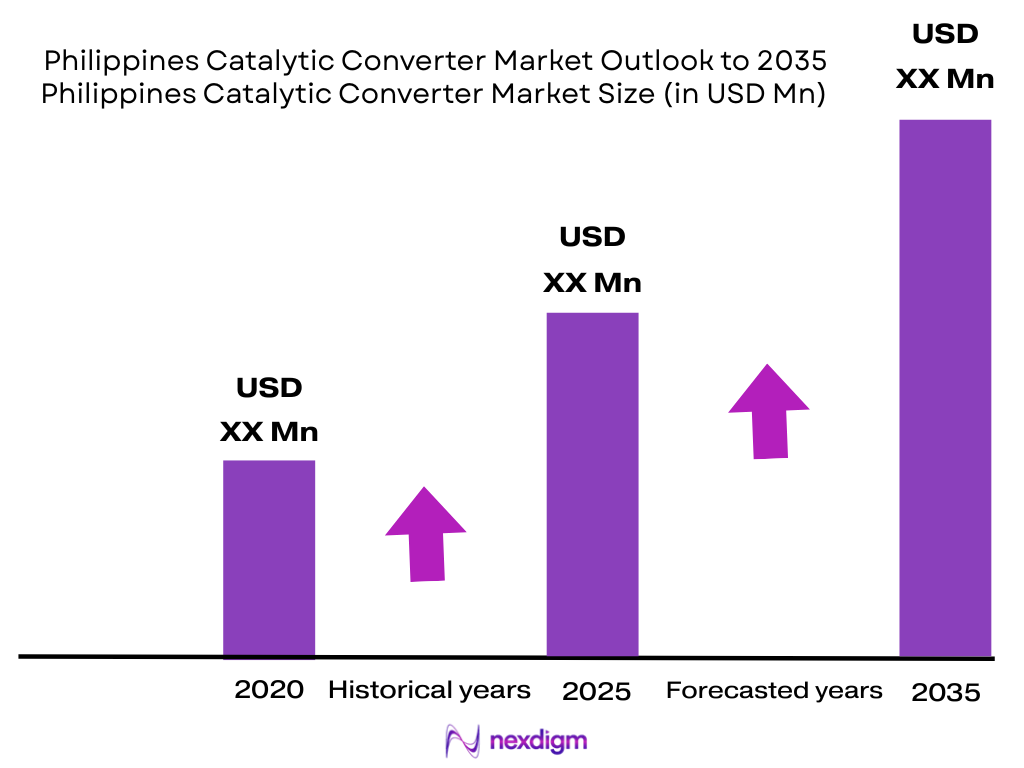
The Philippines Catalytic Converter Market is valued at USD ~ million, supported by a vehicle base that expanded from approximately 13.0 million registered motor vehicles to 14.3 million, alongside CAMPI-TMA automotive sales that rose from 429,807 units to a materially higher annual level. Motorcycles represent a major catalyst-volume pool, while passenger cars, SUVs, pickups and commercial vehicles create higher-value three-way catalyst and diesel-aftertreatment demand. Metro Manila, CALABARZON, Central Luzon, Metro Cebu and Davao dominate the Philippines Catalytic Converter Market because they concentrate vehicle ownership, motorcycles, public-utility vehicles, automotive dealerships, industrial activity and repair networks. LTO’s national motor-vehicle base increased from roughly 13.0 million to 14.3 million units, while the expanding vehicle population reinforces replacement demand around the country’s largest metropolitan and manufacturing corridors, particularly NCR and the surrounding Luzon automotive belt.
Market Segmentation
By Vehicle Type
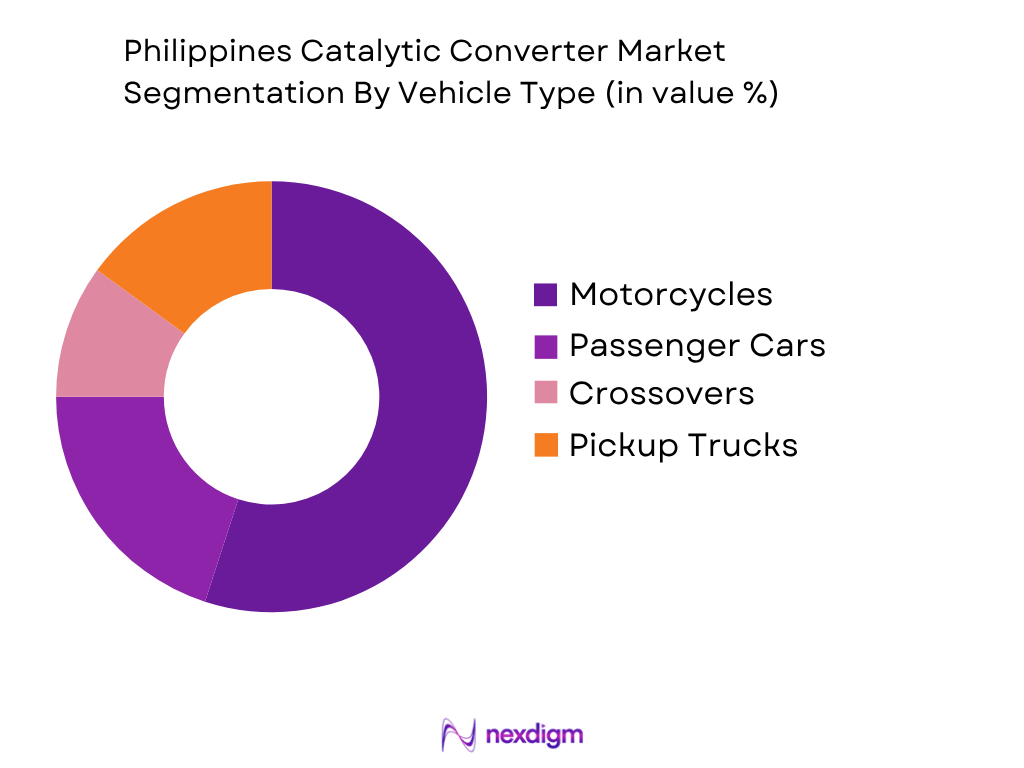
The Philippines Catalytic Converter Market is segmented into motorcycles and scooters, passenger cars, SUVs and crossovers, MPVs/AUVs, pickup trucks, public-utility vehicles, light commercial vehicles, trucks and buses. Motorcycles and scooters dominate the market by unit volume, primarily because two-wheelers form a very large share of the country’s registered motor-vehicle population and are used extensively for commuting, delivery activity and provincial mobility. Each Euro 4-compliant motorcycle generally carries a compact exhaust-integrated catalyst designed for rapid light-off during short urban journeys. Passenger vehicles and SUVs, however, generate substantially greater value per converter because their systems use larger ceramic substrates, more precious-metal loading and potentially multiple catalyst bricks. Public utility and commercial vehicles add demand through intensive operating cycles, particularly where diesel oxidation catalysts are integrated with particulate-control and NOx-treatment technologies. The combination of high two-wheeler volume and increasing four-wheel vehicle ownership therefore creates a broad, application-diverse catalyst market.
By Powertrain Type
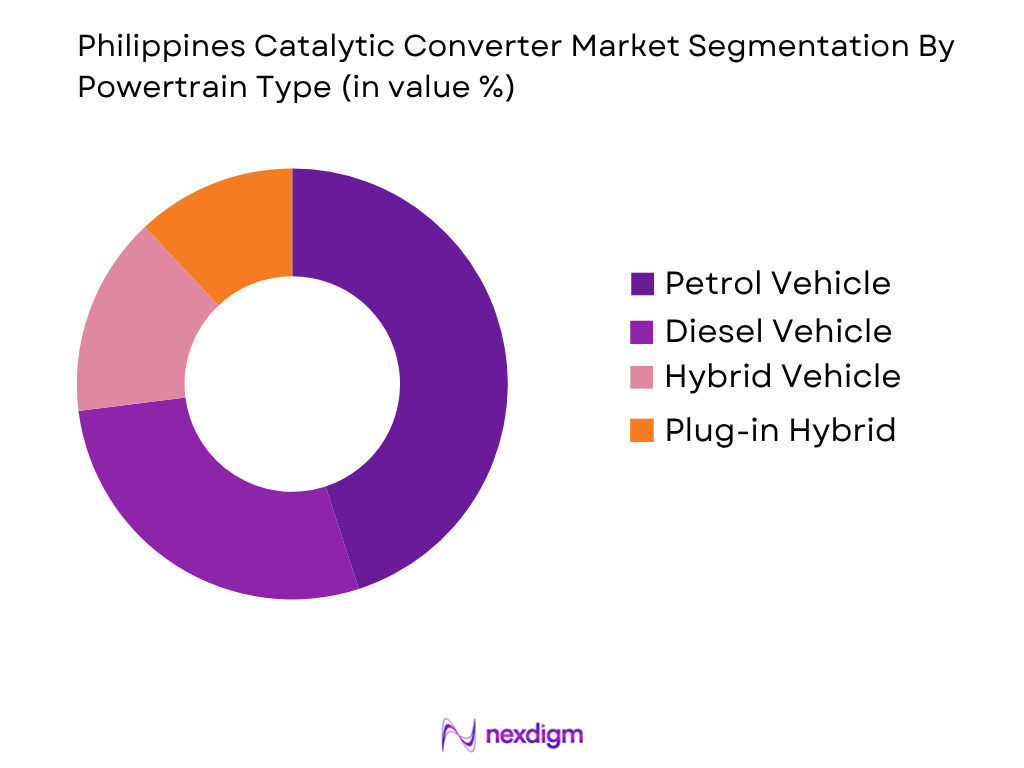
The Philippines Catalytic Converter Market is segmented into conventional petrol vehicles, diesel vehicles, petrol-electric hybrids, plug-in hybrids and other combustion-based powertrains. Conventional petrol vehicles dominate current market value because the country’s motorcycle, passenger-car and crossover populations are strongly gasoline-oriented and require three-way catalysts for simultaneous control of carbon monoxide, hydrocarbons and nitrogen oxides. Diesel remains strategically important in pickups, public-utility vehicles, vans, buses and trucks, where oxidation catalysts may form part of larger DOC-DPF-SCR architectures. Hybrid vehicles are still smaller in installed-base terms but are becoming increasingly relevant because electrification incentives have been extended to hybrids while these vehicles continue to use catalytic converters. Unlike battery-electric vehicles, hybrids retain combustion engines and require efficient catalyst light-off after repeated engine shutdown and restart, favouring close-coupled substrates, high oxygen-storage capacity and optimized palladium-rhodium formulations.
Competitive Landscape
The Philippines Catalytic Converter Market is supplied largely through international catalyst-technology companies, exhaust-system manufacturers, substrate producers, OEM supplier networks and imported aftermarket brands rather than a deeply localized catalyst-coating industry. Competitive differentiation depends on motorcycle and passenger-vehicle application breadth, Euro 4 compatibility, diesel-aftertreatment capability, platinum-group-metal formulation, direct-fit accuracy, ASEAN inventory access and relationships with Japanese automotive OEMs. The presence of local vehicle assembly creates additional opportunities for Tier-1 exhaust integration even when coated catalyst substrates remain imported.
| Major Player | Establishment | Headquarters | Core Offering | Motorcycle/Passenger Coverage | PGM Capability | Substrate/Exhaust Capability | OEM Position | ASEAN Relevance |
| Tenneco / Walker | 1940 | Northville, USA | ~ | ~ | ~ | ~ | ~ | ~ |
| FORVIA Clean Mobility | 2022 | Nanterre, France | ~ | ~ | ~ | ~ | ~ | ~ |
| Purem by Eberspächer | 1865 group roots | Esslingen, Germany | ~ | ~ | ~ | ~ | ~ | ~ |
| BASF ECMS | 1865 group roots | Global network | ~ | ~ | ~ | ~ | ~ | ~ |
| DENSO Corporation | 1949 | Kariya, Japan | ~ | ~ | ~ | ~ | ~ | ~ |
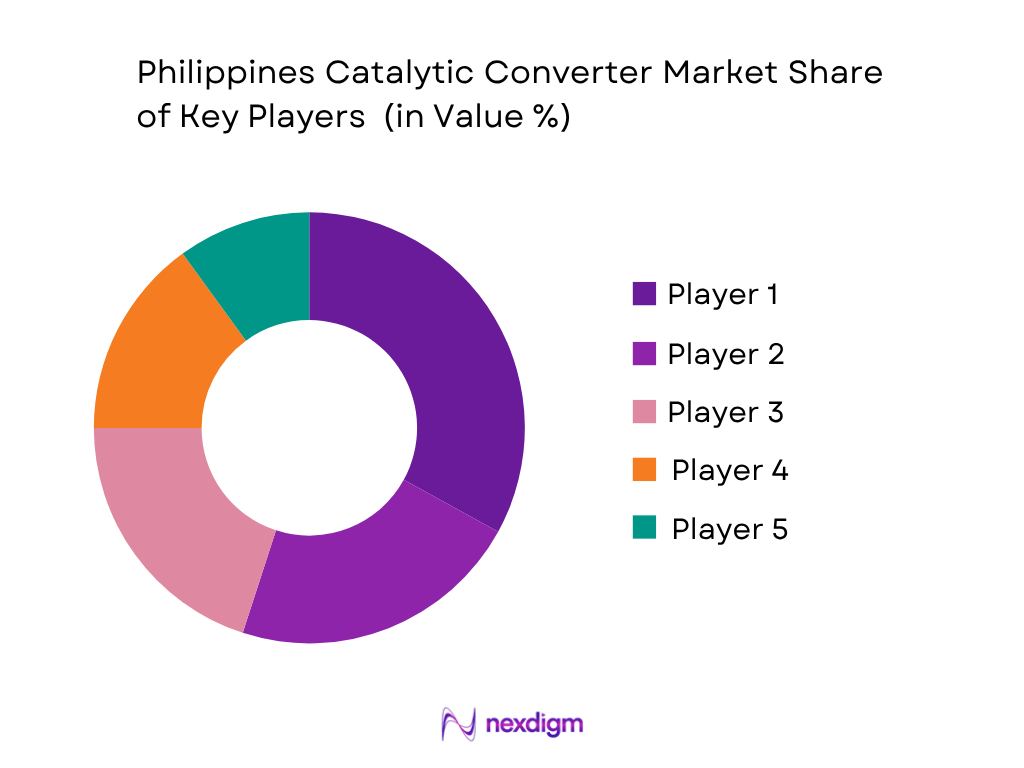
Philippines Catalytic Converter Market Analysis
Growth Drivers
Large Gasoline-Powered Vehicle Parc and Expanding Registered Vehicle Base
The Philippines’ large combustion-powered vehicle population remains the most important structural growth driver for catalytic converters because motorcycles, passenger cars, SUVs, pickups, jeepneys, vans and commercial vehicles require exhaust-aftertreatment throughout their usable lives. Philippine Statistics Authority data based on Land Transportation Office records show that total registered vehicles increased from 14.27 million units in 2023 to 14.56 million units in 2024. More importantly for catalytic-converter demand, gasoline-powered vehicles reached 11.45 million units in 2024, compared with 11.23 million units in 2023, while diesel-powered vehicles accounted for another 3.08 million units. These figures create a broad addressable installed base for three-way catalytic converters, motorcycle catalysts and diesel oxidation catalysts. The road network further supports intensive usage: the Philippines had 35.53 thousand kilometres of national roads in 2024, including 22.03 thousand kilometres of concrete pavement and 13.18 thousand kilometres of asphalt pavement, supporting inter-city freight, commuting and public-utility operations. Catalytic-converter demand is particularly significant because the Philippine fleet is not composed only of low-mileage private cars. Motorcycles are widely used for commuting and delivery activity, while jeepneys, vans, buses and light commercial vehicles operate intensive daily cycles that expose catalyst substrates and oxygen sensors to repeated thermal loading. Gasoline vehicles generally employ three-way catalysts containing palladium and rhodium to oxidize hydrocarbons and carbon monoxide while reducing nitrogen oxides; diesel vehicles can use oxidation catalysts alongside particulate filters and SCR systems. Continued vehicle registration growth therefore expands both initial catalyst fitment and the eventual aftermarket replacement pool. The macroeconomic backdrop reinforces this demand. World Bank data place Philippine GDP at USD 461.62 billion in 2024, GDP per capita at USD 3,984.8, and real GDP growth at 5.7. The economy subsequently reached USD 487.09 billion in 2025, while GDP per capita rose to USD 4,170.7, supporting continued spending on personal mobility, fleet expansion and vehicle maintenance. The IMF likewise recorded 5.7 economic growth in 2024, demonstrating resilient domestic activity before external pressures moderated subsequent performance. For the catalytic-converter market, these indicators matter because rising incomes, urban commuting, logistics expansion and increased vehicle utilization progressively enlarge the stock of engines requiring functioning emission-control systems. The replacement channel also becomes more important as the vehicle parc ages. Catalytic converters can deteriorate through ignition misfires, rich fuel mixtures, oil consumption, coolant contamination, substrate cracking and repeated high-temperature operation. In motorcycles and public-utility vehicles, aftermarket exhaust modification can create additional replacement or compliance-related requirements. The combination of 11.45 million gasoline vehicles, 3.08 million diesel vehicles, a national fleet exceeding 14.5 million units, and extensive road-based mobility therefore provides a substantial recurring demand base for vehicle-specific catalytic converters, compact motorcycle catalysts, oxygen-sensor-compatible systems and commercial diesel aftertreatment.
Vehicle Emission Inspection and Continued Expansion of the Automotive Aftermarket
Vehicle roadworthiness and emission inspection provide a second important growth driver because catalytic-converter functionality is directly connected to maintaining compliant exhaust emissions during registration and continued vehicle operation. The Land Transportation Office states that vehicles inspected at Private Motor Vehicle Inspection Centers must satisfy roadworthiness and emission requirements, creating an institutional mechanism through which deteriorated exhaust systems can be identified. LTO documentation issued for vehicle processes in 2024 and 2025 includes requirements for a Motor Vehicle Inspection Report or PMVIC inspection documentation, while its January 2026 memorandum addressed dual transmission of vehicle-emission test results from PMVICs as part of motor-vehicle renewal registration. For catalyst suppliers and workshops, this matters because a failed catalytic converter can increase tailpipe hydrocarbons, carbon monoxide or nitrogen oxides even if the vehicle remains mechanically drivable. Inspection creates a practical trigger for diagnosis, repair and replacement rather than allowing inefficient aftertreatment to remain unnoticed indefinitely. The aftermarket base supporting this mechanism is large. The Philippine registered vehicle population increased from 14.27 million units in 2023 to 14.56 million units in 2024, including 11.45 million gasoline vehicles and 3.08 million diesel vehicles. New vehicle additions continue to enlarge that installed base. CAMPI and the Truck Manufacturers Association reported 37,604 new motor vehicles sold in January 2025, including 29,875 commercial vehicles and 7,729 passenger cars. Commercial vehicles are especially relevant to catalytic-converter demand because they accumulate high annual mileage and frequently operate under heavier engine loads than privately owned passenger cars. Each additional light commercial vehicle, pickup or bus ultimately contributes to the future replacement population for oxidation catalysts and related exhaust components. The vehicle market is supported by robust domestic economic activity. The World Bank records USD 461.62 billion in national GDP in 2024, increasing to USD 487.09 billion in 2025. The IMF’s 2025 Article IV assessment reported that economic growth remained resilient despite global trade pressures, while its country profile lists a Philippine population of 115.299 million, giving the country a large underlying mobility and consumer base. The importance of inspection becomes greater as vehicles age because catalytic-converter failures are often secondary consequences of engine problems rather than isolated exhaust faults. Misfires can send unburned fuel into a converter and overheat its substrate; worn piston rings can contaminate the washcoat with oil-derived compounds; exhaust leaks can distort oxygen-sensor readings; and low-quality replacement units may trigger P0420 or P0430 efficiency codes if they cannot maintain the required conversion performance. A regulatory environment where emissions testing is integrated into renewal creates incentives for proper diagnosis and technically suitable replacement. The opportunity extends strongly to motorcycles, which constitute a large portion of Philippine road mobility and use compact catalyst-equipped exhaust assemblies. Exhaust modification remains common within enthusiast and utility segments, meaning tighter enforcement can increase demand for compliant replacement exhausts containing functional catalysts rather than empty or de-catalyzed pipes. Combined with the continued addition of passenger and commercial vehicles, PMVIC-linked emission testing strengthens the role of catalytic converters as a recurring compliance component rather than merely an OEM-installed part.
Market Challenges
Rapid Electric Vehicle Adoption, Especially in Two- and Three-Wheel Mobility
Electric-vehicle adoption is emerging as the clearest structural challenge to the Philippines Catalytic Converter Market because a battery-electric vehicle has no combustion engine, exhaust manifold, oxygen sensor or catalytic converter. The substitution effect is already visible in official registration data. PSA reported 6,697 registered electric vehicles in 2024, up from 1,359 units in 2023, while hybrid registrations increased from 6,155 to 17,590 units over the same interval. The distinction between those two categories is critical: hybrids continue to require catalytic converters because they retain combustion engines, whereas battery-electric vehicles eliminate exhaust aftertreatment entirely. The pace of adoption accelerated substantially after 2024. Philippine government reporting indicates that approximately 24,000 EVs were registered during 2024, while 29,715 EV registrations had already been recorded during the first seven months of 2025, essentially matching or surpassing the prior full-year total depending on reporting coverage. This trend presents a particularly large threat in motorcycles, scooters and three-wheelers because these categories constitute a significant portion of Philippine mobility and can electrify with comparatively small battery packs. Each electric motorcycle or e-tricycle replacing a gasoline unit eliminates a compact three-way catalyst permanently. The policy environment reinforces this transition. The Department of Energy’s Electric Vehicle Industry Development Act framework mandates the Comprehensive Roadmap for the Electric Vehicle Industry, covering charging infrastructure, domestic manufacturing, research and development, and workforce capability. By February 2026, DOE reported 250 accredited EV charging-station providers, demonstrating that infrastructure supply is broadening alongside vehicle adoption. Nationwide charging infrastructure reached approximately 1,600 charging stations in 2026, providing a substantially larger physical base for electric mobility than existed during the earlier market-development phase. Macroeconomic conditions make this transition more feasible. The Philippine economy generated USD 461.62 billion in 2024 and USD 487.09 billion in 2025, while GDP per capita increased from USD 3,984.8 to USD 4,170.7. Although the IMF’s latest 2026 profile projects more moderate real GDP expansion, the country’s population remains above 115 million people, supporting a large mobility market in which vehicle technology substitution can occur at substantial scale. For catalytic-converter companies, the long-term impact extends beyond loss of initial OEM fitment. A gasoline motorcycle or passenger car may generate revenue from its original converter, future oxygen-sensor replacement, direct-fit catalyst replacement and end-of-life precious-metal recovery. A battery-electric replacement removes this entire emissions-control lifecycle. The threat is therefore greatest for suppliers concentrated in compact motorcycle catalysts and entry-level gasoline vehicles, where electrification can move rapidly. Commercial diesel and public-utility vehicle aftertreatment should remain more resilient in the near term, while hybrids provide a bridge segment that retains catalyst demand. Suppliers need to adjust their portfolios toward hybrid three-way catalysts, older ICE aftermarket replacements, heavy-duty diesel oxidation catalysts and PGM recovery rather than assuming that growth in the overall vehicle population will translate proportionally into catalytic-converter demand.
Import Dependence, Wide Vehicle Diversity and Quality Variability in the Replacement Market
A second major challenge is the Philippines’ dependence on imported catalyst technologies and the complexity of servicing an unusually diverse vehicle parc. Catalytic converters require specialized ceramic or metallic substrates, platinum-group metals, high-surface-area washcoats and vehicle-specific canning. The Philippines has automotive assembly and parts manufacturing capability, but advanced catalyst coating and PGM refining remain largely dependent on international supply chains. This exposure matters because the country had 14.56 million registered vehicles in 2024, including 11.45 million gasoline units and 3.08 million diesel vehicles, creating an enormous number of possible engine-and-exhaust applications. The vehicle base spans Japanese passenger cars and MPVs, Korean vehicles, Chinese models, American pickups, European luxury cars, motorcycles from multiple Asian manufacturers, jeepneys and locally configured commercial vehicles. Each can use different converter volumes, flange locations, oxygen-sensor positions, PGM loading and exhaust backpressure characteristics. A universal catalytic converter may physically connect to an exhaust pipe but still fail to provide the light-off speed or conversion efficiency expected by the vehicle’s engine-control unit. This creates risks of persistent P0420/P0430 faults, failed emissions tests or repeated workshop repairs. The challenge is amplified by the size and fragmentation of the independent repair channel. Motorcycles and older vehicles are often maintained outside OEM dealerships, and exhaust components can be modified for sound, performance or low-cost repair. Replacement products with insufficient washcoat or PGM content may provide limited emissions performance despite appearing externally similar to compliant converters. For fleet operators and ordinary motorists, this increases uncertainty over durability and compatibility. Regulatory enforcement partly mitigates the risk. LTO requires roadworthiness and emission inspection through PMVIC processes, with inspection documentation continuing to be referenced in 2024–2026 vehicle-registration procedures. However, the geographic scale of the Philippines, its archipelagic structure and large number of independent workshops make uniform supply and enforcement difficult. Distributors therefore need wide SKU catalogues and logistics capability across Luzon, Visayas and Mindanao rather than concentrating inventory solely in Metro Manila. The macroeconomic context underscores why efficient supply matters. World Bank data show Philippine GDP of USD 461.62 billion in 2024, increasing to USD 487.09 billion in 2025, while the IMF recorded a population exceeding 115 million in its 2026 country profile. This is a large automotive service economy, but per-capita income remains far below developed-market levels, making purchasers sensitive to the tradeoff between quality and affordability. Suppliers must therefore engineer products that meet emissions needs without relying solely on high-cost OEM replacement assemblies. Imported PGM exposure adds another vulnerability because palladium, rhodium and platinum supply is concentrated globally; disruptions can affect production availability even when local vehicle demand remains stable. Over time, better application catalogues, localized converter canning and recovered PGM supply can reduce some of these constraints, but the present market remains highly dependent on international catalyst technology and fragmented aftermarket distribution.
Market Opportunities
Hybrid Three-Way Catalysts and High-Mileage Commercial Vehicle Aftertreatment
Hybridization presents one of the strongest forward opportunities for the Philippines Catalytic Converter Market because it allows vehicle electrification without removing the combustion engine or exhaust-aftertreatment system. Philippine Statistics Authority data show registered hybrid vehicles rising from 6,155 units in 2023 to 17,590 units in 2024, creating an increasingly relevant installed base for advanced three-way catalysts. Unlike battery-electric vehicles, full hybrids and plug-in hybrids continue using gasoline engines and must control carbon monoxide, hydrocarbons and nitrogen oxides whenever combustion operates. Hybrid duty cycles can actually make catalytic-converter engineering more demanding because engines switch off during electric-only operation and restart repeatedly during traffic movement. Each engine-off period allows exhaust temperature to fall, making rapid catalyst light-off important when combustion resumes. This supports close-coupled converters, low-thermal-mass ceramic substrates, highly active palladium-rhodium washcoats and strong oxygen-storage materials. The opportunity is especially relevant in Metro Manila and other congested urban markets where repeated stop-start driving is routine. Commercial vehicles create a second high-value opportunity. CAMPI-TMA reported 29,875 commercial vehicles sold in January 2025, compared with 7,729 passenger cars during the same month, illustrating the importance of pickups, vans and light commercial vehicles within new vehicle demand. Commercial platforms often accumulate greater mileage and carry heavier operating loads than private cars, increasing exhaust thermal cycling and eventual replacement requirements. Diesel-powered vehicles also represented 3.08 million registered units in 2024, providing a large installed base for diesel oxidation catalysts and integrated systems containing DPF and SCR technologies. Public-utility vehicles, logistics vans, pickups and buses are particularly attractive because high utilization can shorten the effective life of exhaust components relative to low-mileage passenger cars. The broader economy provides support for this demand. Philippine GDP reached USD 461.62 billion in 2024 and USD 487.09 billion in 2025, while the World Bank reported GDP per capita increasing from USD 3,984.8 to USD 4,170.7. The IMF also observed resilient domestic demand through its 2025 Article IV review, which is relevant because logistics, retail and infrastructure activity translate directly into commercial vehicle utilization. For catalyst suppliers, the opportunity is therefore to shift from generic ICE exposure toward applications with more defensible technological and operating requirements. Hybrid catalysts need rapid warm-up and precise sensor integration; commercial diesel systems need durability and integration with particulate and NOx controls; public utility vehicles require reliable systems capable of sustained daily operation. Distributors can additionally target fleet contracts where standardized vehicle models simplify inventory and replacement planning. As BEV adoption expands, these hybrid and high-utilization commercial segments provide a path for catalytic-converter demand to remain relevant while becoming more technologically sophisticated and service-intensive.
Local Converter Integration, Spent-Catalyst Recovery and Circular PGM Supply
The Philippines has an opportunity to capture more value from catalytic converters by localizing selected exhaust-system operations while developing organized recovery of platinum, palladium and rhodium from end-of-life converter units. The country’s installed vehicle base provides sufficient feedstock for both activities. PSA reported 14.56 million registered vehicles in 2024, including 11.45 million gasoline vehicles and 3.08 million diesel units, compared with 14.27 million vehicles in 2023. Even if only a fraction of this population replaces or retires catalytic converters each year, workshops and dismantlers collectively handle a meaningful volume of PGM-bearing material. Spent three-way catalysts contain recoverable palladium and rhodium, while diesel oxidation catalysts frequently contain platinum and palladium. Rather than treating failed converter assemblies as ordinary exhaust scrap, specialized collectors can identify units by vehicle application, separate high-value ceramic monoliths, consolidate material and route it to regional refiners. This opportunity becomes more strategically important as EV adoption accelerates because each combustion vehicle retired in favor of a BEV can release its existing converter for recovery, turning part of the technology-substitution challenge into a secondary-material opportunity. Electric-vehicle registrations already show the direction of travel: 29,715 EV registrations were recorded during the first seven months of 2025, compared with around 24,000 registrations for the whole of 2024 under government reporting. On the manufacturing side, the Philippines already maintains an automotive industrial base. CAMPI states that its member ecosystem includes 15 assembly facilities and approximately 500,000 jobs, demonstrating existing capability in vehicle assembly, metalworking, logistics and components. These industrial competencies can support local converter canning, exhaust-pipe fabrication, heat shields, brackets and manifold assembly even if advanced catalyst washcoating continues to be imported from specialist suppliers. Localization would reduce dependence on importing complete exhaust assemblies and could improve responsiveness for high-volume Japanese and ASEAN vehicle applications. The opportunity is supported by a growing economy: World Bank data show GDP increasing from USD 461.62 billion in 2024 to USD 487.09 billion in 2025, while the IMF’s 2026 country profile records a population of 115.299 million. The scale of the domestic vehicle market therefore provides a credible base for component integration and recycling services. A practical closed-loop business model could link distributors, workshops, PMVIC-adjacent repair facilities and dismantlers: a customer receives a compliant direct-fit converter, while the spent unit is retained as a recoverable core and routed to an accredited aggregator. Digital identification by VIN, engine code or converter stamping would improve traceability and PGM valuation. This system could reduce informal leakage, create additional earnings for workshops and eventually lower dependence on purely primary PGM supply. Local converter integration and structured recycling would therefore allow Philippine industry to capture value from both ends of the catalyst lifecycle—new replacement-system assembly and end-of-life precious-metal recovery—even as electrification gradually reduces conventional new-fitment demand.
Future Outlook
The Philippines Catalytic Converter Market is forecast to expand at ~ CAGR during 2026–2035 under the placeholder framework. Near-term growth should remain supported by rising vehicle registrations, high motorcycle penetration, increasing four-wheel vehicle sales, Euro 4 compliance, public-utility and commercial-fleet use, and an extensive independent aftermarket. The first major demand pillar is the sheer size of the road-vehicle base. Philippine Statistics Authority quick statistics indicate registered motor vehicles rising from roughly 13.0 million to 14.3 million units across the latest comparable observations. This expands the eventual replacement pool for oxygen sensors, exhaust manifolds and catalytic converters as vehicles accumulate mileage. Motorcycles should remain especially important in unit terms. The country’s commuting structure, delivery economy and lower vehicle-acquisition threshold make two-wheelers fundamental to mobility outside and within major metropolitan areas. Euro 4-compliant motorcycles require compact catalysts with rapid light-off characteristics, meaning growth in scooter and motorcycle registrations creates direct demand for small ceramic or metallic substrates and integrated exhaust systems.
Four-wheel automotive demand also supports higher-value catalyst systems. CAMPI and TMA reported 429,807 vehicle sales in the earlier annual base, while cumulative sales through October in the subsequent period reached 384,310 units compared with 352,971 during the corresponding prior period. Rising new-vehicle activity supports OEM converter fitment while enlarging the future aftermarket. Regulation remains central. DENR’s Environmental Management Bureau issues Certificates of Conformity only to vehicles satisfying Euro 4/IV standards for applicable new registrations, and the standard covers passenger cars, light- and heavy-duty vehicles, motorcycles and other motorized categories. LTO inspection and PMVIC processes reinforce emissions-system maintenance within the operating vehicle population. Commercial-vehicle aftertreatment represents another opportunity. Jeepneys, UV Express vehicles, delivery vans, pickups, buses and trucks operate at comparatively high mileage. Diesel oxidation catalysts in these vehicles may operate alongside DPF and SCR systems, generating greater aftertreatment value per vehicle than a basic motorcycle or compact-car catalyst.
The most important structural counterforce is electrification. Four-wheel EV sales increased from 1,028 units to 3,880 units, while electric two- and three-wheel sales increased from 172 to 43,441 units across the latest reported annual comparison. This is particularly significant for motorcycle catalyst suppliers because electric scooters and three-wheelers directly eliminate the exhaust system and catalytic converter. The EV policy framework will continue supporting this transition. The Electric Vehicle Industry Development Act and Comprehensive Roadmap for the Electric Vehicle Industry establish a national framework for charging infrastructure, vehicle deployment and local manufacturing. Electric and hybrid vehicle tariff incentives also broaden adoption pathways. However, hybrids preserve catalyst demand and can serve as a bridge technology, particularly in passenger vehicles where charging access remains uneven. The wider economy provides a supportive foundation for vehicle and aftermarket demand. World Bank data put Philippine GDP at USD 461.62 billion and GDP per capita at USD 3,984.8 in 2024. Economic expansion, urban household mobility requirements, logistics activity and the large working-age population sustain vehicle utilization despite the gradual shift toward cleaner powertrains. PGM recovery is likely to become more commercially relevant as the installed ICE population ages. End-of-life motorcycle and vehicle converters contain platinum, palladium and rhodium that can be aggregated by workshops, dismantlers and scrap processors for regional refining. This provides a way for catalyst companies to derive value from electrification-related ICE retirement rather than treating deregistered converter-equipped vehicles solely as lost future demand.
Major Players
- Tenneco / Walker Emissions Control
- FORVIA Clean Mobility
- Purem by Eberspächer
- BOSAL
- MagnaFlow
- BASF Environmental Catalyst and Metal Solutions
- Umicore
- Johnson Matthey
- Corning Incorporated
- DENSO Corporation
- Cataler Corporation
- NGK Insulators
- IBIDEN
- Futaba Industrial
- Sango Co., Ltd.
Key Target Audience
- Catalytic Converter and Automotive Exhaust-System Manufacturers
- Automotive and Motorcycle OEMs and Local Vehicle Assemblers
- Automotive Parts Importers and Aftermarket Distributors
- Motorcycle Parts Dealers and Exhaust-System Specialists
- Public Utility, Logistics and Commercial Fleet Operators
- Platinum-Group-Metal Refiners and Automotive Recyclers
- Investments and Venture Capitalist Firms
- Government and Regulatory Bodies (Department of Environment and Natural Resources, Land Transportation Office, Department of Transportation, Board of Investments, Department of Energy)
Research Methodology
Step 1: Identification of Key Variables
The initial phase constructs an ecosystem map covering automotive and motorcycle OEMs, local assemblers, converter manufacturers, substrate suppliers, PGM suppliers, distributors, workshops, PMVIC operators, public-utility fleets and recyclers. Key variables include registered vehicle population, motorcycle penetration, powertrain, Euro 4 compliance, converter count, catalyst loading, vehicle age and replacement lifecycle.
Secondary research incorporates LTO, DENR, PSA, DOE and automotive-industry data to identify the major drivers governing catalytic-converter demand and replacement behavior.
Step 2: Market Analysis and Construction
The top-down approach begins with the registered vehicle parc and allocates vehicles by motorcycle, passenger car, SUV, pickup, PUV, commercial vehicle and powertrain. Catalyst content is differentiated between compact motorcycle converters, three-way passenger-vehicle catalysts and diesel commercial aftertreatment.
The bottom-up model maps local vehicle assembly, imported converter volumes, direct-fit aftermarket catalogues, motorcycle exhaust suppliers, workshop activity and fleet replacement. OEM fitment and aftermarket demand are calculated separately to prevent double counting.
Step 3: Hypothesis Validation and Expert Consultation
Market hypotheses are validated through CATIs with OEM suppliers, automotive-parts distributors, motorcycle dealers, independent workshops, PMVIC operators, public-utility fleets and recycling companies.
Interviews evaluate converter replacement frequency, Euro 4 compliance, motorcycle exhaust modification, diesel aftertreatment requirements, P0420/P0430 diagnostics, direct-fit availability and PGM recovery practices across key Philippine regions.
Step 4: Research Synthesis and Final Output
The final stage triangulates vehicle-registration data, emissions regulations, industry sales, supplier technology and primary interviews. The Philippines Catalytic Converter Market is segmented by converter type, vehicle type, powertrain, fitment, emissions compliance, substrate, catalyst metal composition, channel and geography.
Forecast scenarios incorporate motorcycle growth, passenger-vehicle motorization, PUV modernization, hybrid penetration, EV adoption, local automotive production, vehicle ageing, PGM availability and spent-catalyst recycling.

- Executive Summary
- Research Methodology (Market Definitions and Assumptions, Abbreviations, Catalytic Converter Market Boundary, Motorcycle and Four-Wheel Vehicle Parc Mapping, Converter-per-Vehicle Assessment, Powertrain Mapping, OEM Fitment Assessment, Replacement Cycle Analysis, LTO/PMVIC Emission Inspection Mapping, PGM Loading Assessment, Imported Converter Mapping, Local Assembly Assessment, Market Sizing Approach, Top-Down Analysis, Bottom-Up Analysis, Demand-Side Assessment, Supply-Side Assessment, OEM and Parts Distributor Interviews, Workshop and PMVIC Interviews, Recycler Interviews, Data Triangulation, Forecasting Framework, Scenario Analysis, Limitations and Future Conclusions)

- Definition and Scope
- Evolution of Automotive Catalytic Emission Control in the Philippines
- Development of Vehicle Emission Standards
- Evolution of Three-Way Catalytic Converter Technology
- Motorcycle Catalytic Converter Ecosystem

- Growth Drivers (Large Motorcycle Fleet, Increasing Passenger Vehicle Ownership, Euro 4 Emission Compliance, LTO/PMVIC Inspection Requirements, High-Mileage Public Utility Vehicles, Automotive Assembly Activity, Hybrid Vehicle Adoption, Expanding Aftermarket)
- Market Challenges (Battery-Electric Vehicle Adoption, PGM Import Dependence, Counterfeit and Low-PGM Converters, Exhaust Modification, Limited Domestic Catalyst-Coating Capability, Application Complexity, Imported Converter Dependence, Informal Vehicle Repair Channels)
- Market Opportunities (Motorcycle Catalysts, Hybrid Three-Way Catalysts, PUV Aftertreatment, Direct-Fit Replacement, Local Converter Canning, PGM Recycling, Digital VIN-Based Fitment, ASEAN Supply Integration)
- Market Trends (Compact Motorcycle Catalysts, Hybrid Low-Light-Off Catalysts, PGM Thrifting, Direct-Fit Converter Growth, OBD Diagnostics, Local Exhaust Integration, Online Automotive Parts Distribution, Spent Catalyst Recovery)
- Technology Substitution Risk (Battery-Electric Cars, Electric Motorcycles, Electric Jeepneys, Electric Buses, Hybridization, Range-Extended EVs)
- SWOT Analysis
- Porter’s Five Forces Analysis
- PESTLE Analysis

- By Market Value (2020-2025)
- By Catalytic Converter Unit Volume (2020-2025)
- By OEM-Fitted Converter Volume (2020-2025)

- By Converter Type (In Value %)
Three-Way Catalytic Converters
Motorcycle Catalytic Converters
Close-Coupled Catalytic Converters
Manifold-Integrated Catalytic Converters
Underfloor Catalytic Converters - By Vehicle Type (In Value %)
Motorcycles and Scooters
Passenger Cars
SUVs and Crossovers
MPVs and AUVs
Pickup Trucks - By Powertrain Type (In Value %)
Conventional Petrol Vehicles
Petrol-Electric Hybrid Vehicles
Plug-in Hybrid Vehicles
Diesel Vehicles
Alternative-Fuel ICE Vehicles - By Sales Channel (In Value %)
OEM Vehicle Assembly
OEM Dealerships
Authorized Service Centres
Independent Automotive Parts Distributors
Motorcycle Parts Dealers - By Region (In Value %)
National Capital Region
CALABARZON
Central Luzon
Central Visayas
Davao Region

- Market Share of Major Players by Value
- Cross Comparison Parameters (Philippines/ASEAN Vehicle Application Coverage, Motorcycle-Passenger-PUV-Commercial Converter Portfolio Breadth, Platinum-Palladium-Rhodium Catalyst Formulation Capability, Euro 4 Catalyst and Emission-Compliance Capability, Ceramic/Metallic Substrate and Washcoat Engineering Capability, Philippines/ASEAN Distribution and Inventory Footprint, OEM-Dealer-Motorcycle-Shop-Workshop-Fleet Channel Reach, PGM Recycling and Closed-Loop Material Capability)
- SWOT Analysis of Major Players
- Detailed Profiles of Major Companies
Tenneco / Walker Emissions Control
FORVIA Clean Mobility
Purem by Eberspächer
BOSAL
MagnaFlow
BASF Environmental Catalyst and Metal Solutions
Umicore
Johnson Matthey
Corning Incorporated
DENSO Corporation
Cataler Corporation
NGK Insulators
IBIDEN
Futaba Industrial
Sango Co., Ltd.

- Automotive OEM Procurement
- Local Vehicle Assembler Procurement
- Vehicle Importer Procurement
- Motorcycle OEM Procurement
- OEM Dealership Replacement Demand

- By Market Value (2026-2035)
- By Catalytic Converter Unit Volume (2026-2035)
- By OEM-Fitted Converter Volume (2026-2035)


 Request a Sample
 Ask for Customization
 Get a Quote
 Enquire Now