

 Download PDF
Market Overview
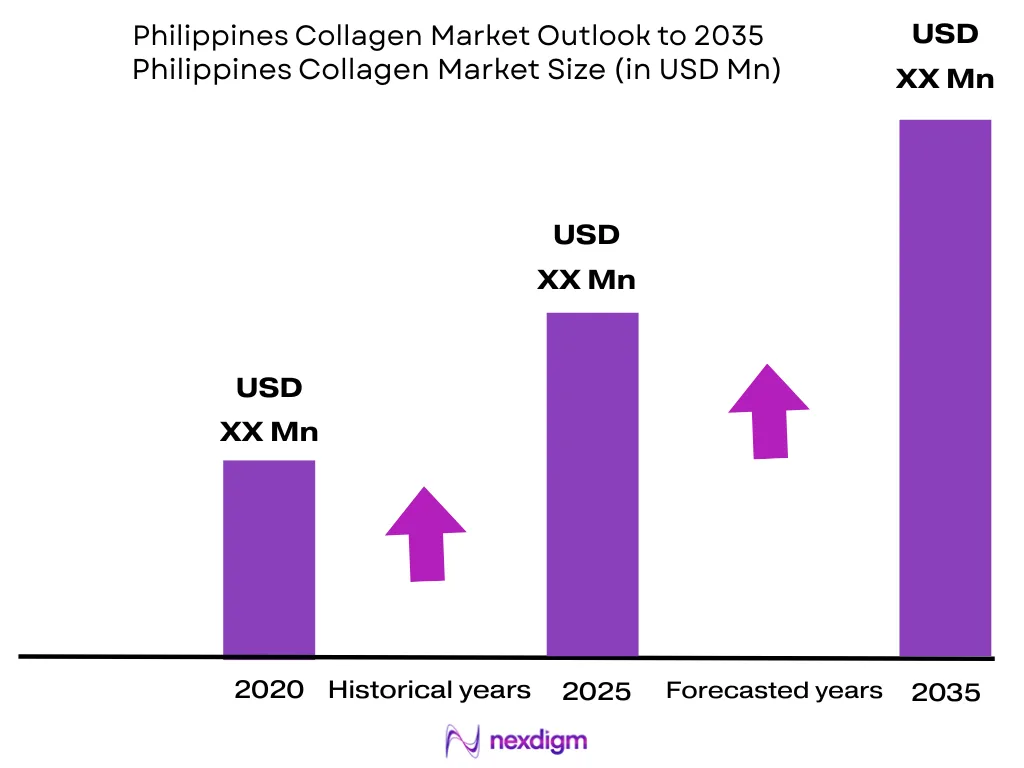
The Philippines collagen market is valued at USD ~ million, based on a five-year historical analysis of collagen supplements, gelatin use, beauty supplements and imported collagen peptide demand. Public Philippines-specific collagen disclosures remain limited; therefore, the long-range 2026–2035 benchmark used is 6.2% CAGR, aligned with ASEAN collagen peptide growth. The category is supported by the Philippines dietary supplements market, valued at USD 795.8 million, and GDP of USD 461.62 billion. Metro Manila, CALABARZON, Central Luzon, Cebu, Davao and Iloilo dominate Philippines collagen demand because they concentrate pharmacies, beauty retail, dermatology clinics, e-commerce fulfilment, social-commerce sellers and higher-income urban consumers. The Philippines’ population reached more than 115 million, while GDP per capita reached USD 3,984.8, supporting collagen powders, tablets, gummies, beauty drinks and marine sachets across pharmacy, Shopee, Lazada, TikTok Shop and modern retail channels.
Market Segmentation
By Product Type
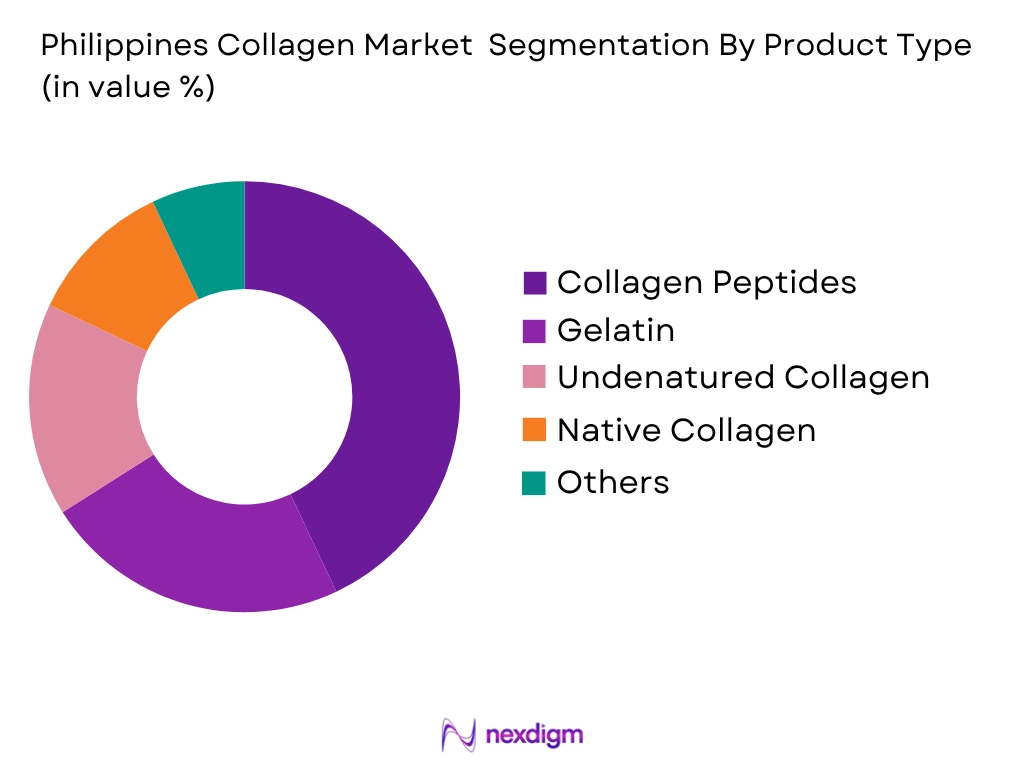
Philippines collagen market is segmented by product type into hydrolyzed collagen peptides, gelatin, native collagen, undenatured Type II collagen and collagen-builder products. Recently, hydrolyzed collagen peptides have a dominant market share in the Philippines under product type segmentation, because the country’s consumer-facing collagen demand is led by skin-glow, anti-aging, hair, nail and beauty supplement positioning. Hydrolyzed peptides are suitable for powders, sachets, tablets, capsules, gummies, drinks and collagen-glutathione combinations. Gelatin remains important in capsules, gummies, confectionery and food applications, but it is more B2B-oriented and less visible in retail beauty supplementation. The broader collagen supplement market also identifies hydrolyzed collagen as a leading product format, while the Philippines’ large dietary supplement base supports collagen’s movement into daily beauty routines.
By Distribution Channel
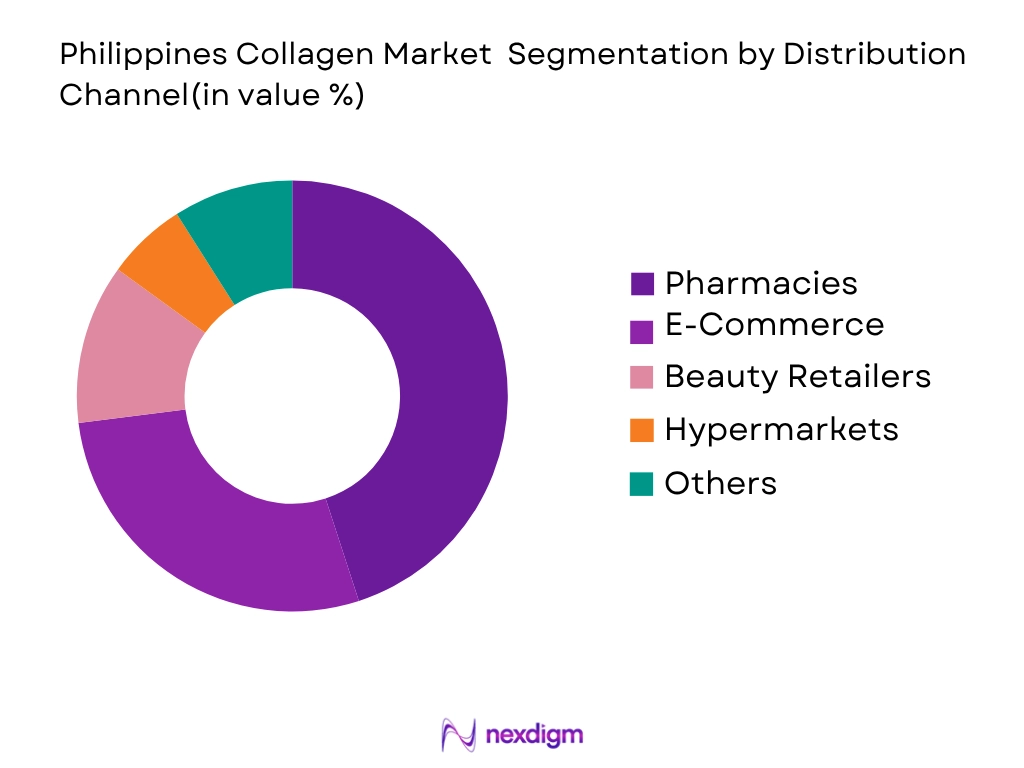
Philippines collagen market is segmented by distribution channel into pharmacies and drugstores, e-commerce marketplaces, health and beauty retailers, supermarkets and hypermarkets, and social commerce. Recently, pharmacies and drugstores have a dominant market share in the Philippines under distribution channel segmentation because food supplements require consumer trust, product registration visibility, correct labeling and authenticity. Mercury Drug, Watsons, Southstar Drug and Rose Pharmacy support collagen access among consumers purchasing beauty, wellness, hair-skin-nail and joint-health products. E-commerce is expanding quickly through Shopee, Lazada and TikTok Shop because collagen relies heavily on product reviews, influencer education and bundle promotions, but pharmacies remain stronger for credibility. The Philippines’ dietary supplements market scale supports formal pharmacy distribution and registered supplement positioning.
Competitive Landscape
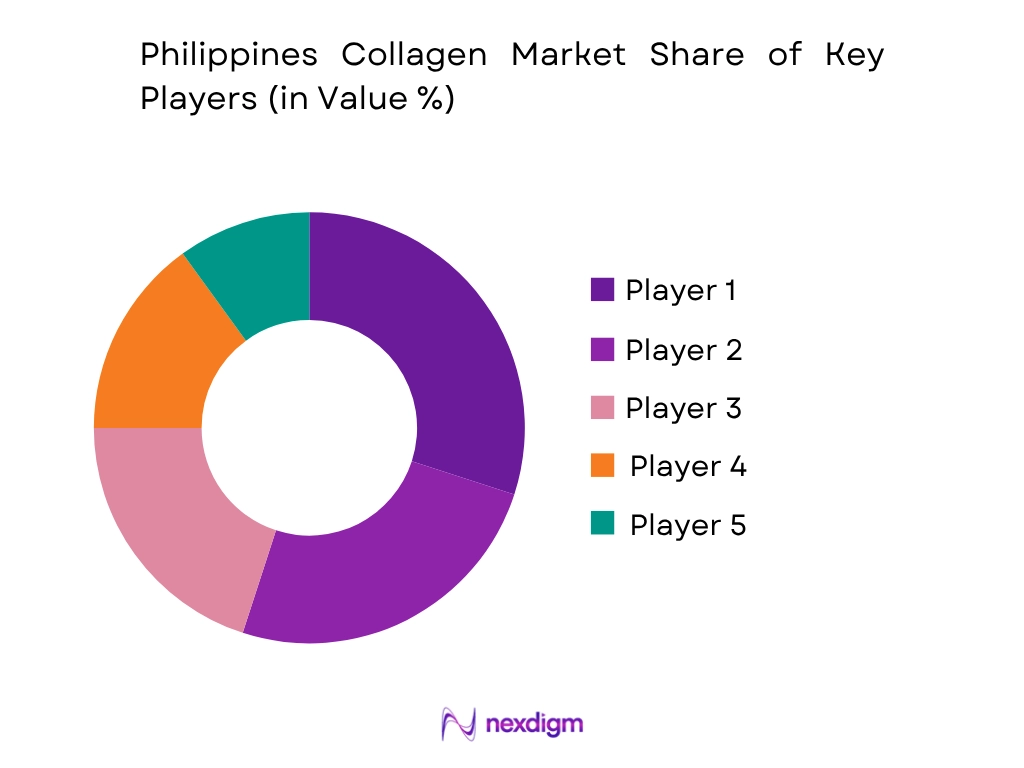
The Philippines collagen market is fragmented and import-led, with Japanese, Korean, U.S. and local beauty supplement brands competing through pharmacies, Watsons, Shopee, Lazada, TikTok Shop and beauty retailers. Local beauty brands compete through glutathione-paired skin supplements and dermatology-linked credibility, while Japanese and Korean brands compete through collagen drinks, tablets, powders and jelly formats. The market rewards FDA registration, source disclosure, product authenticity, country-of-origin trust, visible reviews, influencer support and pack-size affordability.
| Company | Establishment Year | Headquarters | Collagen Portfolio | Main Source Focus | Application Coverage | Philippines Market Role | Distribution Model | Strategic Strength |
| Watsons Philippines / Nutrabliss | 1841 | Hong Kong / Manila operations | ~ | ~ | ~ | ~ | ~ | ~ |
| Belo Nutraceuticals | 1990 | Manila, Philippines | ~ | ~ | ~ | ~ | ~ | ~ |
| Shiseido The Collagen | 1872 | Tokyo, Japan | ~ | ~ | ~ | ~ | ~ | ~ |
| Meiji Holdings | 1917 | Tokyo, Japan | ~ | ~ | ~ | ~ | ~ | ~ |
| NeoCell | 1998 | Irvine, USA | ~ | ~ | ~ | ~ | ~ | ~ |
Philippines Collagen Market Analysis
Growth Drivers
Large Consumer Base Supporting Beauty and Joint-Health Collagen Adoption
Philippines collagen market is supported by a large consumer base for marine collagen sachets, bovine collagen powders, collagen-glutathione capsules, gummies, drinks and tablets positioned around skin hydration, hair support, nail health, joint mobility and active wellness. The Philippine Statistics Authority reported total population of 112,729,484 as of July 1, 2024, while World Bank reported GDP of USD 461.62 billion and GDP per capita of USD 3,984.8 in 2024. This supports a broad addressable base for pharmacy, beauty retail, Shopee, Lazada, TikTok Shop and social-commerce collagen distribution.
Digital Economy Expansion Supporting Collagen Discovery and Online Sales
Philippines collagen market is driven by online discovery because collagen products depend on reviews, influencer education, source comparison, FDA-registration visibility and bundle promotions across Shopee, Lazada, TikTok Shop, Facebook and Instagram sellers. The Philippine Statistics Authority reported that the digital economy reached PhP 2.25 trillion at current prices in 2024 and employed 10.27 million persons in 2024. World Bank also reported Philippines GDP at USD 461.62 billion in 2024. These figures support stronger digital infrastructure for collagen powders, beauty drinks, sachets, gummies and collagen-glutathione products sold through verified e-commerce and social-commerce channels.
Market Challenges
Affordability Pressure for Imported Marine and Multi-Collagen Products
Philippines collagen market faces affordability pressure because premium marine collagen, Japanese beauty drinks, Korean jelly sticks, collagen-glutathione combinations and imported multi-collagen powders are discretionary wellness purchases. World Bank reported GDP per capita of USD 3,984.8 in 2024 against a population base of 112,729,484, showing a large but value-sensitive consumer market. This affects repeat-use collagen because most products are consumed daily and compete with vitamins, glutathione, hair-skin-nail supplements and basic health products. Smaller sachets, tablets, capsules and promotional bundles become critical for expanding beyond Metro Manila, Cebu and high-income beauty consumers.
FDA Registration and Unregistered Collagen Product Risk
Philippines collagen market faces a regulatory challenge because collagen gummies, powders, capsules, chewables and collagen-glutathione drinks are frequently sold through pharmacies, marketplaces and social-commerce sellers. The Philippines FDA issued 2024 public health warnings against unregistered collagen-related products, including FDA Advisory No. 2024-0202 for unbranded collagen gummies with biotin and vitamin C, FDA Advisory No. 2024-0448 for NaturesPlus Collagen Peptides, and FDA Advisory No. 2024-1170 for a glutathione-collagen powdered drink. With PSA reporting 112,729,484 people in 2024, compliance is important for formal national-scale collagen distribution.
Market Opportunities
Local Marine Collagen Positioning Through Fishery By-Product Utilization
Philippines collagen market has an opportunity in marine collagen because the country has a large fishery base that can support future fish-skin and fish-scale valorization for beauty, joint-health and functional beverage ingredients. The Philippine Statistics Authority reported total fisheries production of 4.06 million metric tons in 2024 and 3.96 million metric tons in 2025. In first quarter 2026, fisheries production was 856.29 thousand metric tons. These official volumes support future local marine collagen positioning for products using fish-derived Type I collagen, especially for beauty sachets, drinks, capsules and collagen-glutathione combinations.
Verified Pharmacy and E-Commerce Channels for FDA-Registered Collagen Products
Philippines collagen market has an opportunity in verified pharmacy and e-commerce channels because consumers buying collagen for skin glow, hair support, nail health, joint mobility and anti-aging increasingly require registration trust, importer details, batch traceability and source disclosure. The FDA homepage highlights Certificate of Product Registration and License to Operate services for pre-packaged food products and establishments, which are relevant for formal supplement distribution. PSA reported the digital economy at PhP 2.25 trillion in 2024 and 10.27 million digital-economy workers in 2024, supporting stronger online reach for registered collagen brands.
Future Outlook
Over the next decade, the Philippines collagen market is expected to expand steadily from a small but fast-forming consumer base. Growth will be driven by beauty-from-within demand, Japanese and Korean inner-beauty formats, pharmacy-led trust, FDA-registered food supplements, e-commerce education, collagen-glutathione combinations and active-aging products. The most relevant long-range public benchmark for the Philippines is the ASEAN collagen peptide outlook, which indicates growth through 2035. This is applicable because the Philippines is part of ASEAN and shares regional demand drivers such as beauty supplements, marine collagen, functional beverages, imported peptide dependency and e-commerce-led supplement discovery.
Future demand will concentrate in marine collagen powders, collagen-glutathione capsules, ready-to-drink collagen, jelly sticks, Type II joint-health supplements, bovine collagen powders, gummies and collagen coffee. Metro Manila and Cebu will remain the strongest premium clusters, while CALABARZON, Central Luzon and Davao will support broader retail expansion. Regulatory credibility will become more important. Brands that show FDA registration, importer details, batch traceability, clear country-of-origin labels, allergen disclosure and responsible claims will gain an advantage over grey imports. This is especially relevant for collagen products sold through TikTok Shop, Shopee, Lazada, Facebook sellers and Instagram stores.
Major Players
- Watsons Philippines / Nutrabliss by Watsons
- Belo Nutraceuticals
- Myra
- Shiseido The Collagen
- Meiji Holdings
- DHC
- FANCL
- Kinohimitsu
- Puritan’s Pride
- NeoCell
- Youtheory
- 21st Century HealthCare
- Vital Proteins / Nestlé Health Science
- Swisse
- Nature’s Way
Key Target Audience
- Collagen supplement importers
- Dietary supplement and nutraceutical brands
- Pharmacy and drugstore chains
- Health and beauty retail chains
- E-commerce and social-commerce wellness sellers
- Beauty and nutricosmetic brands
- Investments and venture capitalist firms
- Government and regulatory bodies, Philippines Food and Drug Administration, Department of Health, Department of Trade and Industry, Bureau of Customs
Research Methodology
Step 1: Identification of Key Variables
The initial phase involves constructing an ecosystem map of the Philippines collagen market, covering imported supplement brands, pharmacies, health-beauty retailers, e-commerce platforms, social-commerce sellers, beauty brands, distributors, aesthetic clinics and regulators. The objective is to identify key variables such as source, form factor, product type, channel, FDA status, claim positioning and consumer use case.
Step 2: Market Analysis and Construction
In this phase, historical and current data is compiled across collagen supplement sales, gelatin demand, imported peptide availability, pharmacy listings, marketplace SKUs, social-commerce visibility and source mix. The analysis evaluates marine, bovine, poultry, porcine and collagen-builder products across beauty, joint health, functional foods, sports nutrition and pharmaceutical applications.
Step 3: Hypothesis Validation and Expert Consultation
Market hypotheses are validated through computer-assisted interviews with importers, pharmacy buyers, beauty retailers, Shopee and Lazada sellers, FDA-registration specialists, dermatology clinics and supplement distributors. These consultations help validate assumptions around hydrolyzed peptide leadership, pharmacy dominance, marine premiumization, affordability constraints and grey-import risk.
Step 4: Research Synthesis and Final Output
The final phase combines top-down macroeconomic and supplement-category indicators with bottom-up SKU, channel and company-level checks. This approach validates Philippines collagen market size, segmentation, competitive structure, regulatory risk, demand outlook and growth opportunities for manufacturers, importers, investors, retailers and consumer-health companies.

- Executive Summary
- Research Methodology (Market Definitions and Assumptions, Abbreviations, Market Sizing Approach, Top-Down Validation, Bottom-Up Validation, Import Mapping, SKU Benchmarking, Primary Interviews, Regulatory Review, Competitive Mapping, Forecast Model, Limitations)

- Definition and Scope
- Market Genesis and Evolution
- Timeline of Major Players
- Business Cycle and Beauty Supplement Seasonality

- Growth Drivers (Beauty-from-Within Demand, Japanese and Korean Inner Beauty Influence, Social Commerce Education, Pharmacy Channel Trust, E-Commerce Penetration, Active Aging Demand, Functional Beverage Adoption)
- Market Challenges (FDA Registration Burden, Unregistered Food Supplements, Grey Imports, Counterfeit Risk, Misleading Claims, Price Sensitivity, Source Disclosure)
- Market Opportunities (Premium Marine Collagen, Collagen Drinks, Jelly Sticks, Glutathione-Collagen Combinations, Active Aging Joint Formulas, Pharmacy-Led Registered Products, Functional Beverages, Fishery By-Product Collagen)
- Market Trends (Marine Collagen Sachets, Ready-to-Drink Collagen, Korean Jelly Sticks, Glutathione Pairing, TikTok Shop Education, QR Authentication, FDA CPR Display, Sugar-Free Gummies)
- SWOT Analysis
- Porter’s Five Forces
- PESTLE Analysis

- By Value (2020-2025)
- By Volume (2020-2025)
- By Average Selling Price (2020-2025)

- By Source (In Value %)
Marine Collagen
Bovine Collagen
Poultry Collagen
Porcine Collagen
Eggshell Membrane Collagen - By Product Type (In Value %)
Hydrolyzed Collagen Peptides
Gelatin
Native Collagen
Undenatured Type II Collagen
Multi-Collagen Blends - By Distribution Channel (In Value %)
Pharmacies and Drugstores
Health and Beauty Retailers
E-Commerce Marketplaces
Supermarkets and Hypermarkets
Social Commerce
Direct-to-Consumer - By Region (In Value %)
Metro Manila
CALABARZON
Central Luzon
Central Visayas
Davao Region

- Market Share of Major Players on the Basis of Value and Volume
- Cross Comparison Parameters (Collagen Source Portfolio, Product Format Portfolio, FDA CPR Readiness, Pharmacy and E-Commerce Reach, Country-of-Origin Positioning, QR Authentication and Traceability, Ingredient Stacking Capability, Social Commerce and Influencer Strength)
- SWOT Analysis of Major Players
- Detailed Profiles of Major Companies
Watsons Philippines / Nutrabliss by Watsons
Belo Nutraceuticals
Myra
Shiseido The Collagen
Meiji Holdings
DHC
FANCL
Kinohimitsu
Puritan’s Pride
NeoCell
Youtheory
21st Century HealthCar
Vital Proteins / Nestlé Health Science
Swisse
Nature’s Way

- Supplement Brand and Importer Demand
- Beauty and Nutricosmetic Brand Demand
- Pharmacy and Drugstore Buyer Demand
- E-Commerce Seller Demand
- Social Commerce Seller Demand

- By Value (2026-2035)
- By Volume (2026-2035)
- By Average Selling Price (2026-2035)


 Request a Sample
 Ask for Customization
 Get a Quote
 Enquire Now