
 Download PDF
Market Overview
The Philippines Commercial Ice Cream Freezers Market is valued at USD ~ million, compared with USD ~ million in the preceding recorded period, using WITS/UN Comtrade HS 841850 imports for “other refrigerating or freezing chests, cabinets.” The category recorded 330,750 imported items, led by China with 210,934 items, India with 8,135 items, Thailand with 4,531 items, and Italy with 441 items, reflecting demand for imported freezer cabinets used across sari-sari stores, supermarkets, QSRs, cafés and ice cream parlors. Demand is concentrated in National Capital Region, CALABARZON, Central Luzon, Cebu, Iloilo and Davao because these areas combine dense populations, modern retail, convenience stores, malls, foodservice chains and tourism. PSA records CALABARZON at 16.93 million people, NCR at 14.00 million, and Central Luzon at 12.99 million; USDA FAS lists top supermarkets as SM, Robinsons, Puregold, WalterMart and Metro, and top convenience stores as 7-Eleven, Alfamart, Uncle John’s, All Day and Lawson.
Market Segmentation
By Product Type
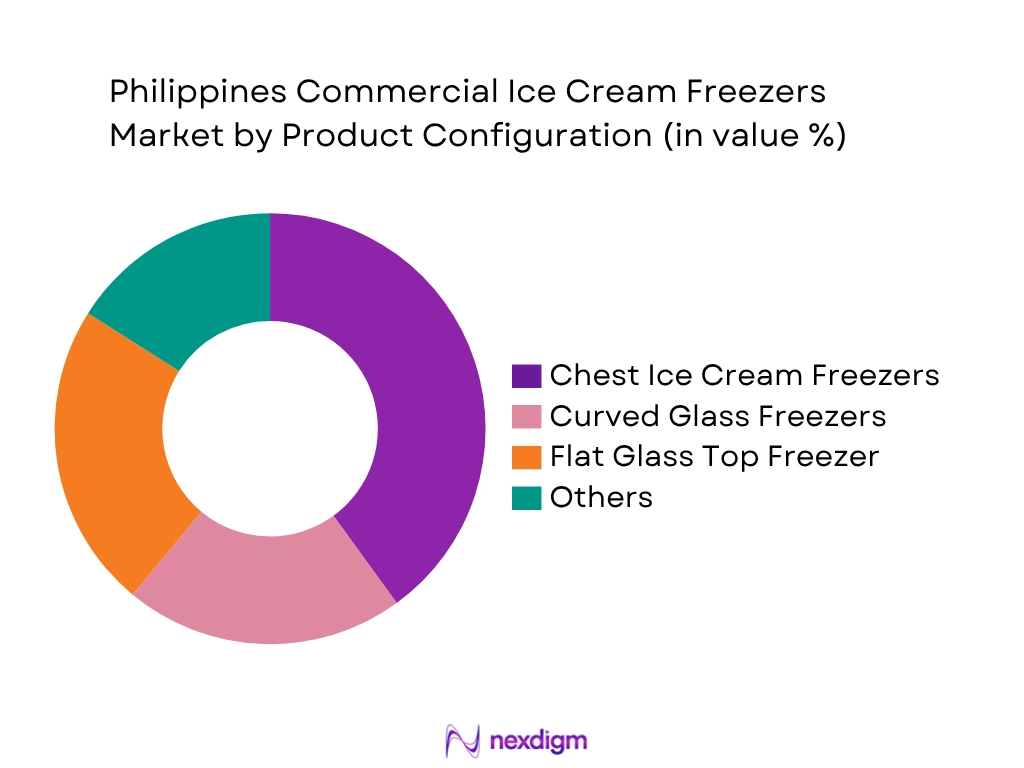
Philippines Commercial Ice Cream Freezers Market is segmented by product type into glass-top chest ice cream freezers, flat glass-top freezers, upright glass-door display freezers, scoop display cabinets, countertop freezers, gelato showcases and mobile cart freezers. Glass-top chest ice cream freezers hold the dominant market share because they fit the country’s community retail structure, especially sari-sari stores, neighborhood groceries, convenience stores and supermarket impulse zones. These cabinets combine storage and display, allow branded lid-panel visibility, and are easier to place in small-format stores than larger upright freezers. They also support common ice cream formats such as cones, cups, sticks, tubs and family packs. WITS data shows large imports of refrigerating and freezing cabinets, with 330,750 items imported under HS 841850, supporting the category’s dependence on cabinet-based retail freezer formats.
By End User
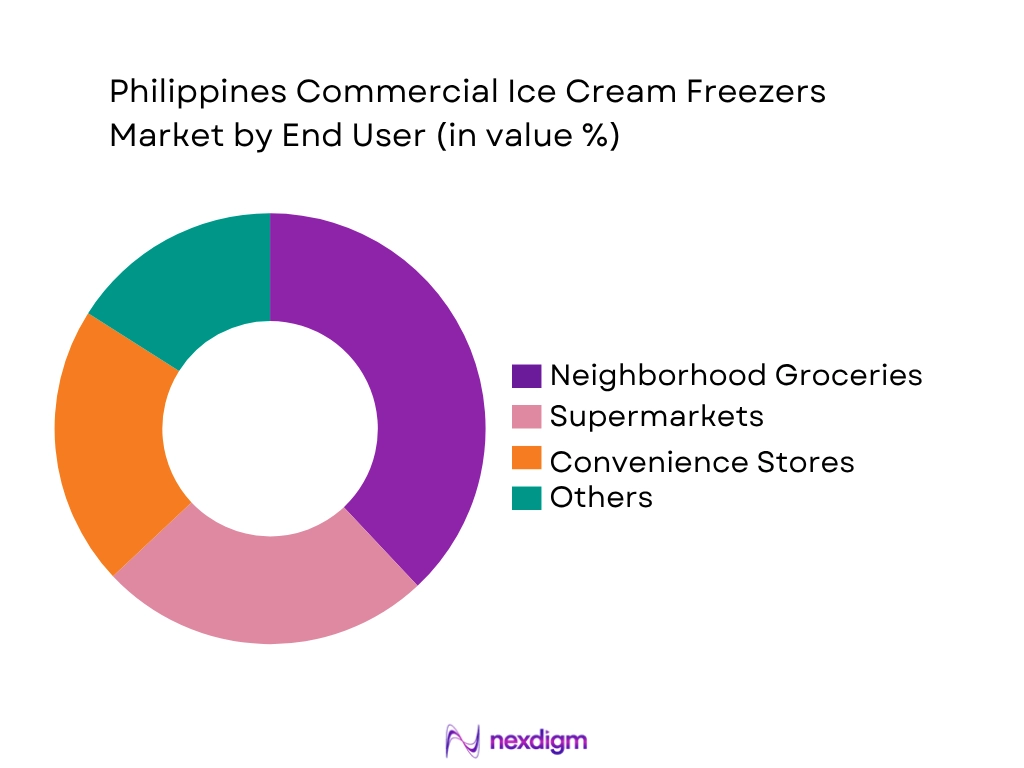
Philippines Commercial Ice Cream Freezers Market is segmented by end user into sari-sari stores, neighborhood groceries, supermarkets, hypermarkets, mini-marts, convenience stores, ice cream parlors, gelato shops, dessert cafés, QSRs, restaurants, cafés, hotels, resorts, caterers, schools, cinemas, events and mobile vendors. Sari-sari stores and neighborhood groceries dominate because ice cream companies and distributors use branded freezer placement to reach consumers close to residential areas. These stores require compact, durable and relatively low-maintenance cabinets suitable for single-serve ice cream sales. The dominance is reinforced by the country’s large population clusters and modern retail expansion; USDA FAS notes that the foodservice sector exceeded pre-pandemic outlet numbers with 96,650 outlets, while retail food and beverage sales grew alongside modern store expansion.
Competitive Landscape
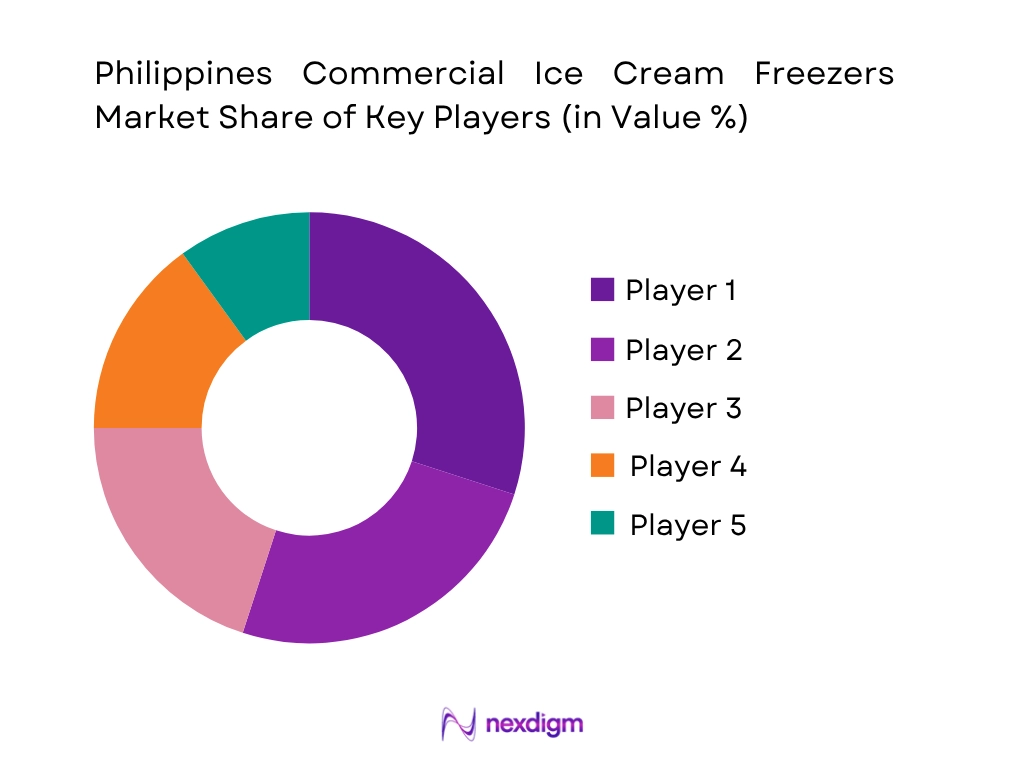
The Philippines Commercial Ice Cream Freezers Market is moderately fragmented, with local appliance brands, Japanese and global refrigeration specialists, Chinese OEM-linked suppliers, regional commercial freezer brands and ice cream manufacturer freezer programs competing across price tiers. Condura and Fujidenzo are highly relevant for SME and neighborhood retail buyers, while Hoshizaki, Sanden Intercool and Carrier Commercial Refrigeration are stronger in commercial foodservice, retail refrigeration and project-based cold equipment. Competition is shaped by tropicalized compressor performance, brownout tolerance, freezer holdover time, provincial service reach, warranty strength, spare-part availability and compatibility with branded ice cream cabinet programs.
| Player | Establishment Year | Headquarters | Core Freezer Positioning | Main Channel Strength | Market-Specific Product Relevance | Service / Warranty Signal | Technology Positioning | Buyer Focus |
| Condura | 1987 | Philippines | ~ | ~ | ~ | ~ | ~ | ~ |
| Fujidenzo | 1990s | Philippines | ~ | ~ | ~ | ~ | ~ | ~ |
| Hoshizaki | 1947 | Nagoya, Japan | ~ | ~ | ~ | ~ | ~ | ~ |
| Sanden Intercool | 1960s | Thailand / Japan-linked group | ~ | ~ | ~ | ~ | ~ | ~ |
| Carrier Commercial Refrigeration | 1915 | United States | ~ | ~ | ~ | ~ | ~ | ~ |
Philippines Commercial Ice Cream Freezers Market Outlook to 2035
Growth Drivers
Expansion of Foodservice Outlets and Dessert-Adjacent Channels
Philippines Commercial Ice Cream Freezers Market is supported by the expansion of foodservice formats that require freezer cabinets for cups, cones, tubs, frozen cakes, milkshake bases and single-serve ice cream products. The USDA Foreign Agricultural Service records 96,650 foodservice outlets in the Philippines in 2024, with an addition of 328 outlets, indicating a broader installed-location base for chest freezers, scoop cabinets, countertop units and upright display freezers. Limited-service restaurants generated USD 8,635 million in sales, street stalls and kiosks generated USD 1,880 million, cafés and bars generated USD 1,627 million, and full-service restaurants generated USD 2,107 million. These channels are directly relevant because QSRs, kiosks, cafés, bakeries and dessert outlets require frozen dessert storage at point of sale and back of house. The macro base supports equipment demand: World Bank records Philippines GDP at USD 461.62 billion and GDP per capita at USD 3,984.8 in 2024, reflecting a consumption economy with large urban foodservice activity.
Population Concentration in Retail-Heavy Regions Supporting Freezer Placement
Philippines Commercial Ice Cream Freezers Market is driven by population concentration in regions where supermarkets, sari-sari stores, convenience stores, QSRs, malls and neighborhood groceries act as freezer-placement points. The Philippine Statistics Authority states that CALABARZON recorded 16.93 million people, the National Capital Region recorded 14.00 million people, and Central Luzon recorded 12.99 million people in 2024. These three regions form the country’s highest-density demand belt for branded ice cream freezers, glass-top chest cabinets and small-format freezer programs. The same PSA release states that the Philippine population increased by 3.69 million people from the 2020 census to the 2024 census, creating a larger retail-consumer base for single-serve frozen desserts. World Bank records the country’s GDP at USD 461.62 billion and GDP per capita at USD 3,984.8 in 2024, supporting regional expansion of food retail and foodservice outlets. For freezer suppliers, this strengthens demand in Metro Manila, CALABARZON and Central Luzon before wider provincial rollouts.
Market Challenges
Import Dependence and Foreign Supplier Concentration
Philippines Commercial Ice Cream Freezers Market faces a supply-side challenge because commercial freezer cabinets are heavily import-linked, especially for display cabinets, chest freezers and specialized freezer formats. WITS/World Bank trade data for HS 841850, covering refrigerating or freezing chests, cabinets, display counters and showcases, records exports to the Philippines from China at 217,553 items, India at 8,275 items, Other Asia at 4,597 items, the United States at 1,329 items, and the European Union at 1,177 items in 2024. This supplier structure makes the market dependent on overseas manufacturing, port clearance, distributor inventory and spare-part availability. The challenge is market-specific because ice cream freezer buyers need fast compressor, thermostat, gasket and glass-lid replacement to prevent freezer downtime. PSA also states that imports accounted for a larger portion of Philippine external merchandise trade, with imported goods forming 63.5 of total external trade in 2024, reinforcing the country’s broader import exposure. World Bank places GDP per capita at USD 3,984.8, indicating sensitivity among small retailers to equipment delays and replacement constraints.
Energy Reliability and Operating Pressure on Freezer Users
Philippines Commercial Ice Cream Freezers Market is challenged by the operating burden of continuous freezing in a tropical and island-based retail environment. Commercial ice cream freezers must run for long hours in sari-sari stores, convenience stores, kiosks, supermarkets, cafés and resorts, where product melting directly affects sales and customer trust. The Department of Energy lists official 2024 Key Energy Statistics and the 2024 Energy Supply and Demand Situationer, confirming that energy availability and consumption remain formal policy-monitoring priorities for the country. Energy infrastructure matters because freezer buyers increasingly evaluate low-voltage compressors, inverter technology, insulation thickness, stabilizer compatibility and holdover time. World Bank records Philippine GDP at USD 461.62 billion, GDP per capita at USD 3,984.8, and consumer inflation at 3.2 in 2024, while IMF’s World Economic Outlook lists the Philippines at USD 512.22 billion GDP in 2026 current prices. These macro indicators show a growing economy, but one where retailers must still protect margins through efficient freezer operations and lower downtime.
Market Opportunities
Branded Freezer Programs for Sari-Sari, Convenience and Kiosk Channels
Philippines Commercial Ice Cream Freezers Market has a strong opportunity in branded freezer fleet placement across sari-sari stores, neighborhood groceries, convenience stores, kiosks and QSR-linked retail points. USDA FAS records 96,650 foodservice outlets in 2024, while limited-service restaurants generated USD 8,635 million and street stalls/kiosks generated USD 1,880 million. These channels are highly relevant for branded glass-top freezers because they sell impulse-format ice cream products such as sticks, cones, cups and single-serve tubs. WITS/World Bank trade data shows China supplied 217,553 items and India supplied 8,275 items of HS 841850 refrigerating or freezing cabinets to the Philippines in 2024, indicating available imported cabinet supply for branded freezer deployment. The macro base also supports expansion: PSA records NCR at 14.00 million people, CALABARZON at 16.93 million, and Central Luzon at 12.99 million. The opportunity is to place asset-tracked, branded and service-backed freezer cabinets in dense residential and commuter retail corridors.
Tourism and Regional Dessert Retail Supporting Premium and Mobile Freezers
Philippines Commercial Ice Cream Freezers Market has an opportunity in premium display freezers, gelato showcases and mobile freezer units for tourism-linked locations such as Cebu, Boracay, Palawan, Bohol, Metro Manila and Clark. Government-linked tourism reporting records 5.95 million international visitor arrivals in 2024, while the Department of Tourism’s regional overnight-traveler data identifies high-traffic destinations such as Lapu-Lapu City, Cebu City, Boracay, Panglao, El Nido and Makati. These locations create use cases for scoop cabinets, gelato showcases, countertop freezers and event freezer rentals in resorts, malls, beach destinations, hotels, airports and cafés. USDA FAS also notes that hotels and caterers reached full capacity during peak events and that 108 restaurants were featured at the debut of the Michelin Guide in the Philippines, strengthening premium foodservice relevance. World Bank records the Philippines’ GDP at USD 461.62 billion and GNI per capita at USD 4,470 in 2024, supporting formal foodservice investment. The opportunity lies in premium cabinets, rental fleets and service-backed freezer supply for tourist-heavy dessert retail.
Future Outlook
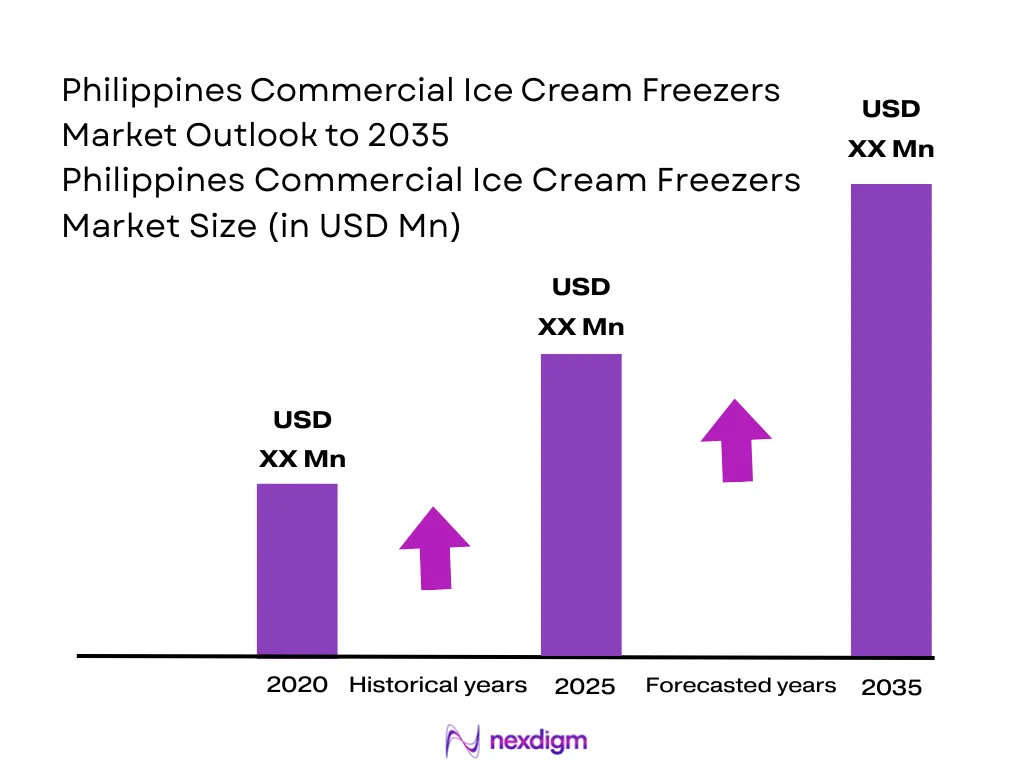
The Philippines Commercial Ice Cream Freezers Market is expected to grow at a forecast CAGR of 6.1% during 2026-2035, benchmarked to the global commercial ice cream freezers outlook. Growth will be supported by branded freezer fleet expansion, sari-sari freezer placement, supermarket modernization, convenience-store rollouts, QSR dessert menus, café chains, hotel and resort demand, and replacement of older cabinets with energy-efficient and tropicalized models. Over the next period, demand will increasingly shift toward low-voltage, high-holdover and inverter-based freezer models because ice cream retailers require temperature reliability during brownouts, high ambient heat and frequent lid opening. The strongest freezer formats will remain glass-top chest freezers and branded display cabinets, while premium gelato showcases will grow mainly in malls, tourist corridors and upscale cafés. Provincial and island markets will remain important because ice cream distribution depends on freezer availability at the last retail point. Suppliers with regional dealers, fast compressor replacement, gasket availability, thermostat servicing and distributor financing will be better positioned. Ice cream manufacturers are also expected to expand freezer asset-control programs to strengthen stocking compliance, route visibility and single-serve product availability.
Major Players
- Condura
- Fujidenzo
- Panasonic
- Hoshizaki
- Carrier Commercial Refrigeration
- Sanden Intercool
- Frigoglass
- True Manufacturing
- Turbo Air
- Liebherr
- Midea
- Haier
- Berjaya
- Everest
- Koppel
Key Target Audience
- Commercial ice cream freezer manufacturers
- Commercial refrigeration equipment distributors
- Ice cream and frozen dessert manufacturers
- Supermarket, hypermarket and mini-mart chains
- Sari-sari store networks and neighborhood grocery operators
- HoReCa, QSR, café, bakery, hotel and resort operators
- Investments and venture capitalist firms
- Government and regulatory bodies
Research Methodology
Step 1: Identification of Key Variables
The initial phase involves constructing an ecosystem map for the Philippines Commercial Ice Cream Freezers Market, covering OEMs, importers, distributors, appliance retailers, commercial kitchen suppliers, ice cream companies, sari-sari stores, supermarkets, QSRs, cafés, hotels, resorts and service technicians. The objective is to identify variables influencing demand, including freezer type, capacity band, ownership model, end-user format, regional demand and service coverage.
Step 2: Market Analysis and Construction
In this phase, historical import data for refrigerating and freezing cabinets is compiled and analyzed as the official proxy for commercial freezer cabinet supply. Bottom-up construction is developed by mapping demand across sari-sari stores, modern retail, convenience stores, ice cream parlors, dessert cafés, QSRs, hotels, resorts and institutional kitchens. Product segmentation is built around cabinet format, capacity, temperature range and cooling technology.
Step 3: Hypothesis Validation and Expert Consultation
Market hypotheses are validated through computer-assisted telephone interviews with appliance dealers, commercial refrigeration distributors, ice cream route operators, freezer technicians, supermarket buyers and HoReCa procurement teams. These interviews verify product dominance, replacement cycles, low-voltage requirements, service pain points, branded freezer placement and provincial distribution challenges.
Step 4: Research Synthesis and Final Output
The final phase integrates official trade data, desk research, competitive benchmarking, primary interviews and channel checks. The output presents market size, segmentation, competitive landscape, demand drivers, challenges and outlook. The research combines top-down import-based sizing with bottom-up end-user demand modeling to deliver a validated view of the Philippines Commercial Ice Cream Freezers Market.

- Executive Summary
- Research Methodology (Market definitions and assumptions, commercial ice cream freezer taxonomy, abbreviations, top-down market sizing approach, bottom-up outlet-level demand approach, import-flow triangulation, branded freezer fleet mapping, dealer and distributor interviews, sari-sari and mini-grocery channel checks, supermarket and convenience-store freezer audit, HoReCa buyer interviews, service technician validation, limitations and future conclusions)

- Definition and Scope
- Overview Genesis
- Evolution of Commercial Ice Cream Freezer Adoption
- Business Cycle
- Supply Chain and Value Chain Analysis

- Growth Drivers (Urban population, hot weather demand, ice cream brand cabinet deployment, convenience retail expansion, supermarket frozen aisle growth, sari-sari distribution, tourism and resort demand, QSR dessert menu expansion, compact freezer affordability)
Sari-Sari Store and Neighborhood Retail Penetration
Expansion of Supermarkets, Convenience Stores and Mini-Marts - Market Challenges (Power interruptions, brownouts, high electricity sensitivity, port and island logistics, spare-part delays, fragmented service network, outlet affordability, counterfeit or low-quality units, compressor failure risk)
- Opportunities (Energy-efficient freezers, tropicalized cabinets, branded freezer leasing, sari-sari freezer programs, solar-compatible freezer pilots, smart temperature monitoring, provincial dealer expansion, freezer fleet maintenance platforms)
- Market Trends (Inverter compressor adoption, R600a and R290 migration, curved glass branded cabinets, compact footprint, branded ice cream panels, freezer rentals, online equipment purchasing, preventive maintenance contracts)
- Government Regulation and Compliance (Department of Trade and Industry product standards, Bureau of Philippine Standards certification, Bureau of Customs import procedures, Department of Energy appliance efficiency requirements, Food and Drug Administration food safety, local government business permits, refrigerant and environmental compliance)
- Supply Chain Analysis
- SWOT Analysis
- Porter’s Five Forces
- PESTLE Analysis
- Competition Ecosystem (Japanese refrigeration brands, Philippine appliance brands, Chinese OEM imports, European display cabinet suppliers, ice cream manufacturer freezer fleets, commercial kitchen equipment dealers, refurbished freezer traders)

- By Value (2020-2025)
- By Volume (2020-2025)
- By Average Selling Price (2020-2025)

- By Product Configuration (In Value %)
Chest Ice Cream Freezers
Curved Glass-Top Display Freezers
Flat Glass-Top Freezers
Upright Glass-Door Display Freezers - By End User (In Value %)
Sari-Sari Stores and Neighborhood Groceries
Supermarkets and Hypermarkets
Convenience Stores and Mini-Marts
Ice Cream Parlors and Gelato Shops - By Region (In Value %)
National Capital Region
CALABARZON and Central Luzon
Central Visayas and Western Visayas
Davao Region and Northern Mindanao
Tourist and Island Markets - By Cooling Technology (In Value %)
Static / Natural Circulation
Forced‑Air / Ventilated
Remote Condensing Units
Low‑GWP Refrigerant Systems
IoT & Smart Temperature Control

- Cross Comparison Parameters (Low-voltage and brownout tolerance, tropicalized compressor performance, freezer holdover time, capacity and cabinet footprint, refrigerant type and energy efficiency, dealer and provincial service coverage, spare-part availability and repair turnaround time, branded cabinet customization and fleet management capability)
- SWOT Analysis of Major Players
- Pricing Analysis by SKU Basket
- Dealer and Distributor Network Benchmarking
- After-Sales Service Benchmarking
- Detailed Profiles of Major Companies
Condura
Fujidenzo
Panasonic
Hoshizaki
Carrier Commercial Refrigeration
Sanden Intercool
Frigoglass
True Manufacturing
Turbo Air
Liebherr
Midea
Haier
Berjaya
Everest|
Koppel

- Market Demand and Utilization
- Purchasing Power and Budget Allocation
- Regulatory and Compliance Requirements
- Needs, Desires and Pain Point Analysis
- Decision-Making Process
- End-User Cohort Mapping
- Procurement Channel Preference
- Replacement and Upgrade Triggers

- By Value (2026-2035)
- By Volume (2026-2035)
- By Average Selling Price (2026-2035)


 Request a Sample
 Ask for Customization
 Get a Quote
 Enquire Now