
 Download PDF
 Download PDF
Market Overview
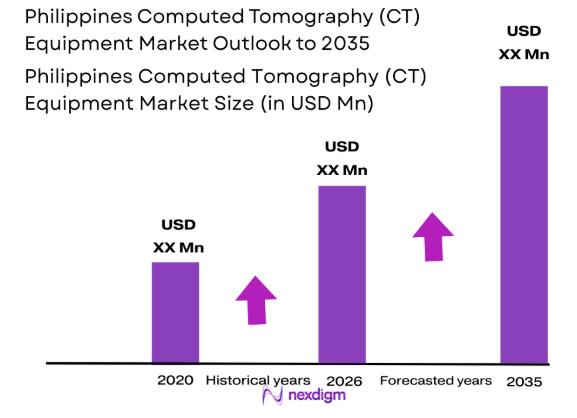
The Philippines Computed Tomography (CT) Equipment market is projected to reach a size of approximately USD ~ million based on a recent historical assessment. The market growth is driven by factors such as an increasing demand for advanced diagnostic tools, expanding healthcare infrastructure, and greater government focus on upgrading medical facilities. In addition, the rise in the aging population, which is more prone to diseases requiring diagnostic imaging, further drives demand for CT equipment.
Key cities like Manila and Cebu dominate the Philippines’ CT equipment market due to their well-established healthcare infrastructure and proximity to major hospitals and research centers. These urban areas benefit from better access to advanced medical technologies, skilled professionals, and significant investments in healthcare. Additionally, government initiatives to improve healthcare facilities in rural areas have boosted the adoption of CT scanners across the nation.
Market Segmentation
By System Type
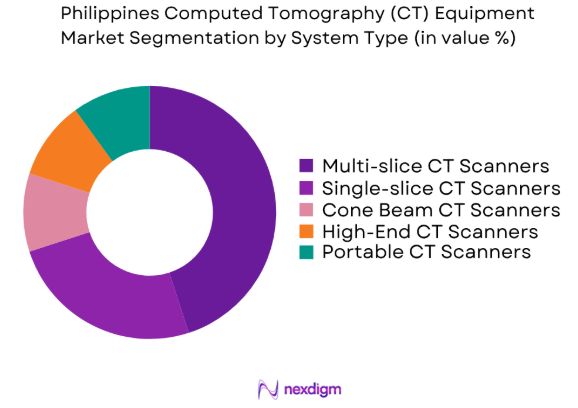
The Philippines Computed Tomography (CT) Equipment market is segmented by system type into various sub-segments. The multi-slice CT scanner segment has shown a dominant market share, primarily due to its superior imaging quality, faster scan times, and reduced radiation exposure compared to single-slice models. As healthcare providers focus on offering better patient care with more advanced imaging capabilities, the preference for multi-slice CT scanners has significantly increased, driving this sub-segment’s growth.
By Platform Type
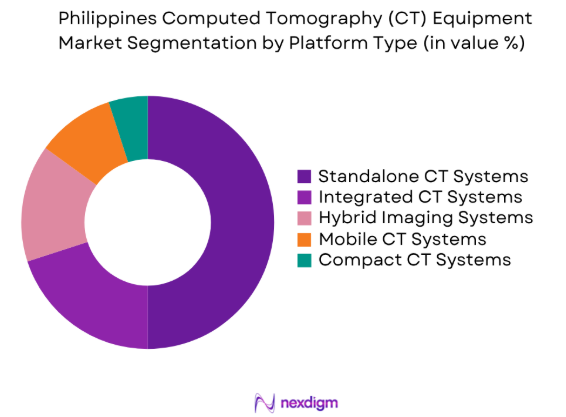
The Philippines Computed Tomography (CT) Equipment market is segmented by platform type into standalone CT systems, integrated systems, hybrid imaging systems, mobile CT systems, and compact CT systems. Standalone CT systems have gained a dominant position, mainly due to their reliability and efficiency in providing high-resolution scans for various diagnostic applications. These systems are commonly used in large hospitals and diagnostic centers due to their performance and technological advancements.
Competitive Landscape
The competitive landscape of the Philippines Computed Tomography (CT) Equipment market is highly consolidated, with a few key players dominating the market. These companies leverage technological advancements, brand reputation, and strong distribution networks to secure their positions. While global leaders hold significant market share, regional players also contribute to the competition by offering more affordable solutions and localized customer service.
| Company Name | Establishment Year | Headquarters | Technology Focus | Market Reach | Key Products | Revenue (USD) | Additional Parameter |
| Philips Healthcare | 1891 | Amsterdam, Netherlands | ~ | ~ | ~ | ~ | ~ |
| Siemens Healthineers | 1847 | Erlangen, Germany | ~ | ~ | ~ | ~ | ~ |
| GE Healthcare | 1892 | Chicago, USA | ~ | ~ | ~ | ~ | ~ |
| Canon Medical Systems | 1933 | Tokyo, Japan | ~ | ~ | ~ | ~ | ~ |
| Hitachi Medical | 1949 | Tokyo, Japan | ~ | ~ | ~ | ~ | ~ |
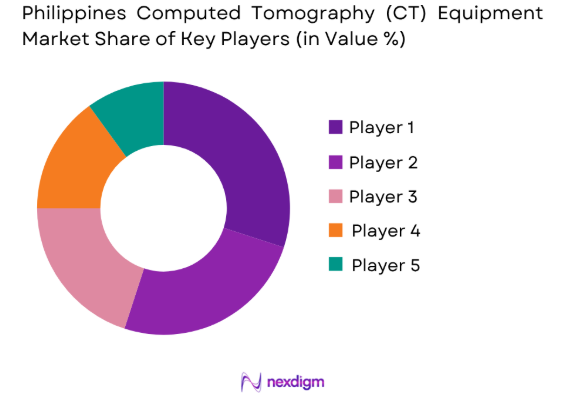
Philippines Computed Tomography (CT) Equipment Market Analysis
Growth Drivers
Technological Advancements
The main growth driver in the Philippines Computed Tomography (CT) Equipment market is the ongoing advancement in CT imaging technology. Innovations like multi-slice CT scanners, which offer faster and more precise diagnostic imaging, are significantly contributing to this growth. These technologies enable healthcare providers to enhance patient care by improving diagnostic accuracy and overall outcomes. As a result, hospitals and diagnostic centers are increasingly upgrading their equipment to keep up with technological advancements. This constant evolution in CT technology is stimulating market growth by encouraging investment in more sophisticated systems, thus improving diagnostic capabilities across the healthcare sector and leading to higher adoption rates of advanced CT equipment.
Increasing Healthcare Investment
Another important growth driver is the increase in healthcare investments from both public and private sectors. The Philippines has experienced a surge in funding aimed at expanding and modernizing healthcare facilities, particularly in urban areas like Manila. This influx of capital has directly boosted the demand for advanced medical equipment, including CT scanners. Additionally, the government’s focus on enhancing healthcare infrastructure through its Universal Health Care initiative has played a crucial role in the market’s growth. These efforts are driving the adoption of advanced diagnostic technologies across the country, ensuring better access to quality healthcare services and further fueling the demand for CT equipment in the Philippines.
Market Challenges
High Capital Investment
A major challenge hindering the growth of the Philippines Computed Tomography (CT) Equipment market is the high upfront cost of acquiring CT systems. Despite increasing demand for advanced diagnostic tools, many healthcare facilities, especially those in rural areas, struggle to secure the necessary capital for purchasing high-end CT machines. The significant initial investment required for these systems makes it difficult for smaller hospitals and clinics to afford and implement cutting-edge imaging technologies. As a result, access to quality diagnostic tools is limited in these regions, slowing the adoption of CT equipment and preventing healthcare providers from offering enhanced patient care. This financial barrier is a key obstacle for the broader market expansion of CT systems in the country.
Regulatory Barriers
Another challenge faced by the Philippines Computed Tomography (CT) Equipment market is the stringent regulatory environment, which slows the approval process for medical devices, including CT scanners. Despite the clear need for advanced medical imaging equipment, the complex and time-consuming regulatory hurdles delay the introduction of new devices into the market. These delays prevent the swift adoption of more efficient and modern CT systems, limiting the overall growth of the sector. The lengthy approval processes hinder the ability of healthcare providers to access the latest technologies, which could improve diagnostic capabilities and patient care. This regulatory barrier remains a significant challenge for the expansion of the CT equipment market in the Philippines.
Opportunities
Expansion of Medical Tourism
The Philippines has emerged as a leading destination for medical tourism, thanks to its affordable healthcare services and highly skilled healthcare professionals. As demand for high-quality healthcare continues to rise, particularly from international patients, the opportunity for growth in the CT equipment market expands. Healthcare facilities catering to medical tourists will increasingly require advanced diagnostic tools, such as CT scanners, to meet the needs of this growing patient base. This trend presents a significant opportunity for the market, as healthcare providers invest in state-of-the-art equipment to maintain competitive advantage and deliver top-tier care. With the expanding medical tourism sector, the demand for advanced imaging technologies like CT scanners is expected to increase, fostering further growth in the market.
Rural Healthcare Development
The Philippine government’s efforts to enhance healthcare infrastructure in rural and underserved areas create significant opportunities for the CT equipment market. Through its Universal Health Care initiative, the government has been allocating funds to expand access to diagnostic services in remote regions. This focus on rural healthcare development will drive the demand for CT scanners, especially portable and mobile solutions that can be deployed in smaller healthcare facilities. These mobile systems are ideal for reaching areas with limited resources, improving diagnostic capabilities and patient care. As the government continues to prioritize healthcare access, the need for advanced, adaptable CT solutions is expected to grow, offering new avenues for market expansion.
Future Outlook
The future outlook for the Philippines Computed Tomography (CT) Equipment market over the next five years shows strong growth. Technological advancements in imaging systems, along with increasing demand for better diagnostic tools, are expected to drive market expansion. Government initiatives to improve healthcare infrastructure, especially in rural areas, will also contribute to this growth. Additionally, the market will likely see a rise in demand for portable CT systems due to their adaptability in diverse healthcare settings.
Major Players
- Philips Healthcare
- Siemens Healthineers
- GE Healthcare
- Canon Medical Systems
- Hitachi Medical Corporation
- Toshiba Medical Systems
- Fujifilm Holdings
- Mindray
- Samsung Medison
- Shimadzu Corporation
- Hologic Inc.
- Agfa Healthcare
- Carestream Health
- Neusoft Medical Systems
- United Imaging
Key Target Audience
- Investments and venture capitalist firms
- Government and regulatory bodies
- Hospital chains and healthcare providers
- Diagnostic imaging centers
- Medical equipment distributors
- Healthcare equipment procurement agencies
- Medical research organizations
- Medical technology investors
Research Methodology
Step 1: Identification of Key Variables
The initial phase involves identifying the key variables that influence the Computed Tomography (CT) Equipment market, including technological trends, market size, and economic factors.
Step 2: Market Analysis and Construction
In this step, detailed market analysis is performed, and the structure of the market is created based on historical data, competitive landscape, and future projections.
Step 3: Hypothesis Validation and Expert Consultation
Expert consultations are conducted to validate the hypotheses and gather insights on emerging trends, consumer preferences, and industry dynamics.
Step 4: Research Synthesis and Final Output
The research findings are synthesized into a comprehensive report, with actionable insights and forecasts that inform market strategies

- Executive Summary
- Research Methodology (Definitions, Scope, Industry Assumptions, Market Sizing Approach, Primary & Secondary Research Framework, Data Collection & Verification Protocol, Analytic Models & Forecast Methodology, Limitations & Research Validity Checks)

- Market Definition and Scope
- Value Chain & Stakeholder Ecosystem
- Regulatory / Certification Landscape
- Sector Dynamics Affecting Demand
- Strategic Initiatives & Infrastructure Growth

- Growth Drivers
Advancements in CT technology improving diagnostic accuracy
Increasing healthcare expenditure driving demand for advanced imaging solutions
Growing geriatric population and demand for diagnostic imaging - Market Challenges
High initial cost of CT scanners
Limited access to advanced healthcare infrastructure in rural areas
Regulatory challenges in the medical equipment approval process - Market Opportunities
Growth in medical tourism in the Philippines
Expansion of diagnostic imaging in rural healthcare centers
Rising adoption of portable and mobile CT scanners - Trends
Shift towards low-dose and radiation-reducing CT technology
Integration of AI and machine learning in CT imaging
Increase in demand for point-of-care CT systems - Government Regulations
- SWOT Analysis of Key Competitors
- Porter’s Five Forces

- By Market Value, 2020-2025
- By Installed Units, 2020-2025
- By Average System Price, 2020-2025
- By System Complexity Tier, 2020-2025

- By System Type (In Value%)
Multi-slice CT Scanners
Single-slice CT Scanners
Cone Beam CT Scanners
High-End CT Scanners
Portable CT Scanners - By Platform Type (In Value%)
Standalone CT Systems
Integrated CT Systems
Hybrid Imaging Systems
Mobile CT Systems
Compact CT Systems - By Fitment Type (In Value%)
Ceiling-Mounted CT Scanners
Floor-Mounted CT Scanners
Mobile CT Scanners
Table-Integrated CT Scanners
Compact CT Systems - By End User Segment (In Value%)
Hospitals
Diagnostic Centers
Ambulatory Surgical Centers
Research and Academic Institutions
Clinics - By Procurement Channel (In Value%)
Direct Procurement
Indirect Procurement
Online Procurement
Distributor/Dealer Procurement
Government Procurement

- Market Share Analysis
- Cross Comparison Parameters (Price per Unit, Technology Type, Installation Base, Regional Presence, Brand Loyalty, Service and Maintenance Contracts, Product Warranty, Ease of Integration, Training and Support Services, System Reliability)
- SWOT Analysis of Key Competitors
- Pricing & Procurement Analysis
- Key Players
Philips Healthcare
Siemens Healthineers
GE Healthcare
Canon Medical Systems
Hitachi Medical Corporation
Toshiba Medical Systems
Fujifilm Holdings
Mindray
Samsung Medison
Shimadzu Corporation
Hologic Inc.
Agfa Healthcare
Carestream Health
Neusoft Medical Systems
United Imaging

- Growing demand from urban hospitals and diagnostic centers
- Expansion of private healthcare facilities adopting advanced CT technology
- Increasing penetration of CT scanners in academic and research institutions
- Rising usage of CT in emergency care and trauma diagnostics

- Forecast Market Value, 2026-2035
- Forecast Installed Units, 2026-2035
- Price Forecast by System Tier, 2026-2035
- Future Demand by Platform, 2026-2035


 Request a Sample
 Ask for Customization
 Get a Quote
 Enquire Now