
 Download PDF
Market Overview
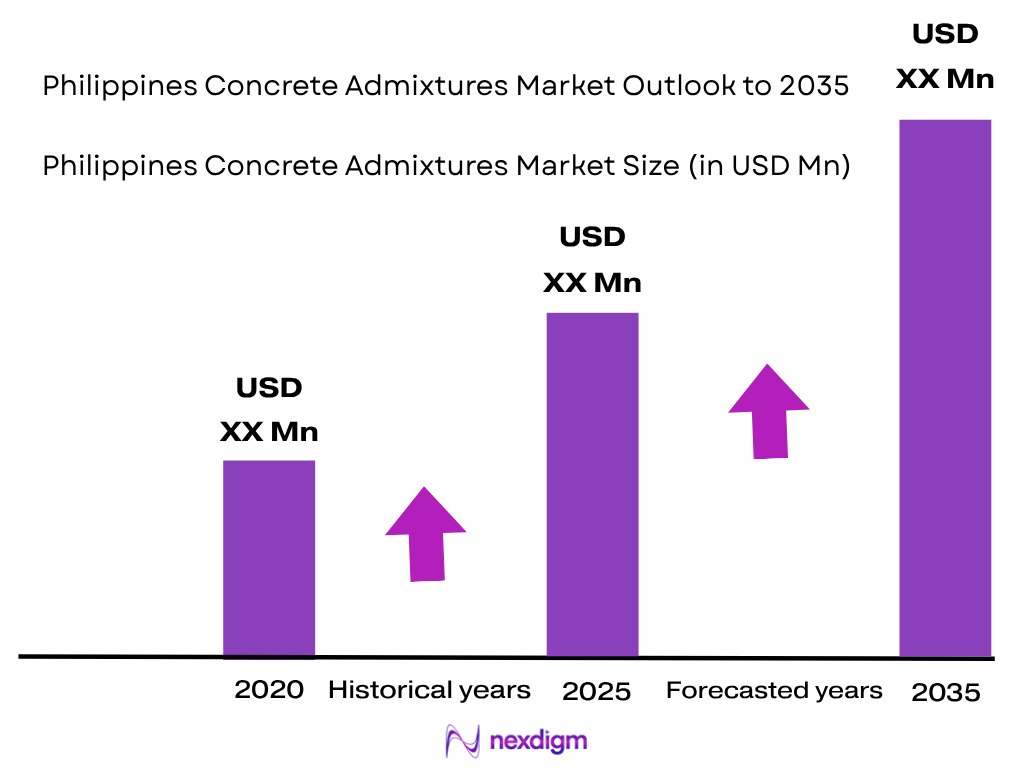
The Philippines Concrete Admixtures Market is valued at approximately ~USD XX million, supported by expanding ready-mix concrete, infrastructure development, residential construction and non-residential projects. Approved construction value increased from PHP 515.30 billion to PHP 563.89 billion, while associated floor area expanded from 41.47 million square meters to 42.84 million square meters across the latest two comparable annual observations, strengthening demand for superplasticizers, retarders and waterproofing admixtures.
Metro Manila, CALABARZON, Central Luzon, Cebu and Davao represent the principal demand hubs because they combine high-rise development, industrial estates, infrastructure and ready-mix capacity. Construction value reached PHP 118.37 billion in CALABARZON, PHP 112.84 billion in NCR and PHP 76.50 billion in Central Luzon in the latest annual construction-permit dataset, while Davao’s construction gross value added increased from PHP 132.84 billion to PHP 156.58 billion across two annual observations.
Market Segmentation
By Admixture Type
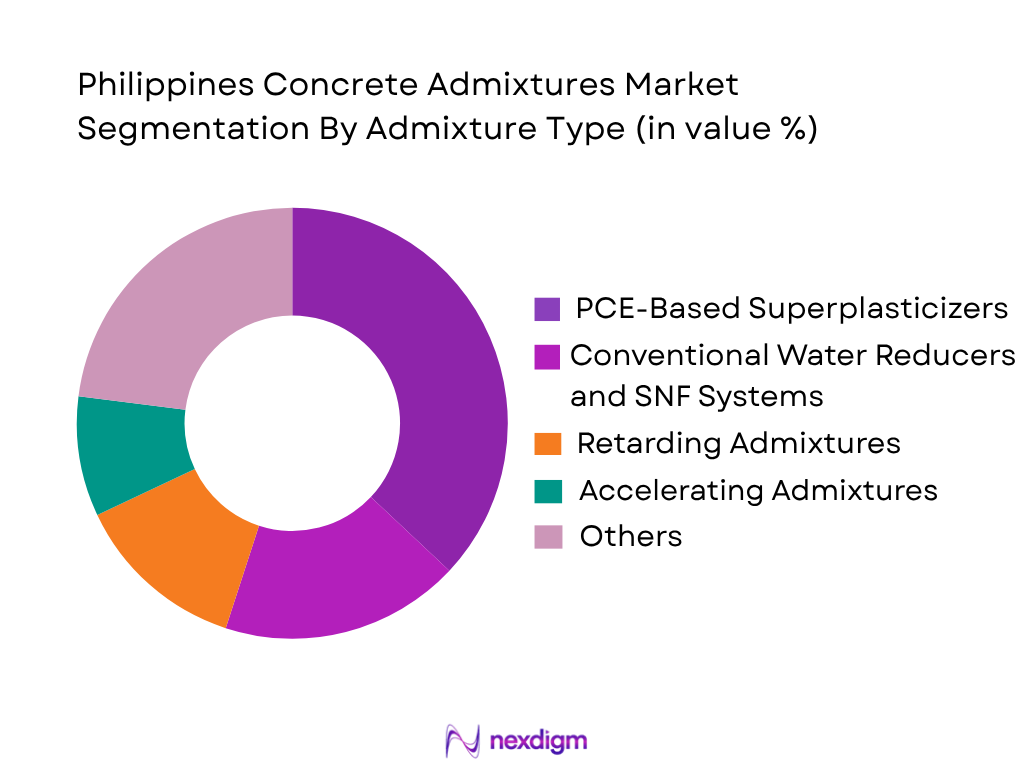
The Philippines Concrete Admixtures Market is segmented into PCE-based superplasticizers, conventional water reducers and SNF systems, retarders, accelerators, waterproofing admixtures, viscosity modifiers and other specialty admixtures. PCE-based superplasticizers hold the dominant market share because concrete producers increasingly require high water reduction together with extended workability under tropical temperatures and congested urban delivery conditions. Their performance is particularly valuable for Metro Manila high-rise pumping, expressway and bridge concrete, precast production and high-strength structural applications. The Philippine market also has established access to PCE technology: Sika Philippines markets several ViscoCrete high-efficiency superplasticizers and long-slump-keeping products, while CHRYSO Philippines offers PCE-based high-range water reducers designed for workability retention and challenging concrete production conditions. Buildrite also supplies locally manufactured high-range water-reducing and polymer-based admixtures, increasing domestic availability across multiple strength classes.
By Application
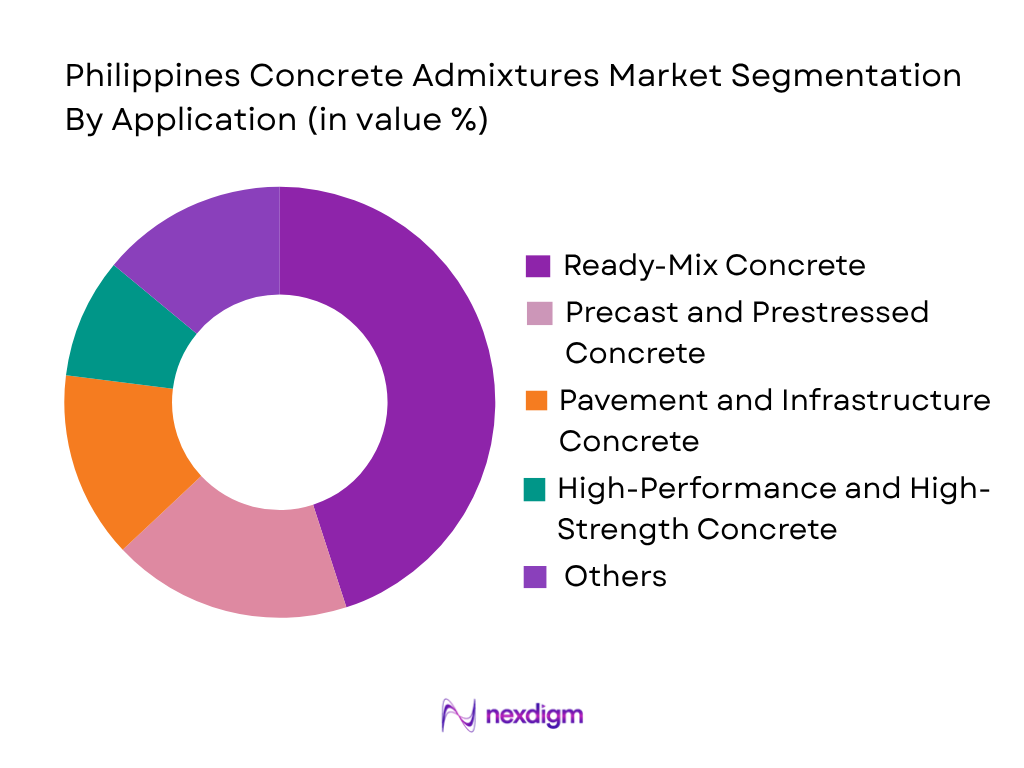
The Philippines Concrete Admixtures Market is segmented into ready-mix concrete, precast and prestressed concrete, pavement concrete, high-performance concrete, shotcrete and other applications. Ready-mix concrete accounts for the dominant market share because large projects increasingly require centralized batching, consistent quality control, pumpability and controlled slump retention. Approved construction floor area reached 42.84 million square meters in the latest annual dataset, including 22.38 million square meters of non-residential construction and 19.75 million square meters of residential construction, providing a broad demand base for ready-mix supply. Large-scale activity in NCR, CALABARZON and Central Luzon further supports centralized concrete production. Ready-mix operations particularly require retardation and long workability retention because transport through congested urban areas can lengthen the interval between batching and placement. Sika and CHRYSO both maintain Philippine portfolios specifically targeting ready-mix water reduction, slump retention and flow, reinforcing the importance of this application segment.
Competitive Landscape
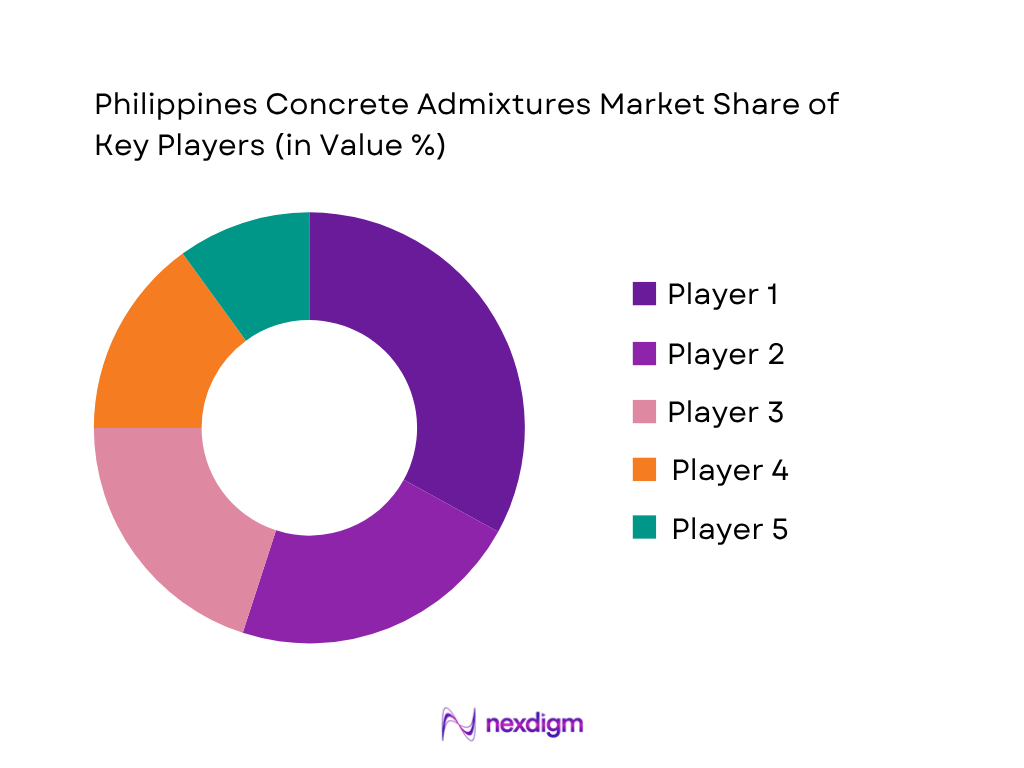
The Philippines Concrete Admixtures Market combines multinational construction-chemical suppliers with domestic manufacturers and formulators. Sika Philippines and CHRYSO maintain established local operations and extensive ready-mix portfolios, while Mapei Philippines maintains a physical presence in Laguna. Fosroc competes through broad water-reducer, precast, waterproofing and viscosity-modifying technologies, while Buildrite provides locally manufactured concrete admixtures complying with ASTM C494 and ASTM C1017. Competition therefore centers on PCE formulation, tropical slump retention, project qualification, local technical support, cement compatibility and distribution reach.
| Company | Establishment Year | Headquarters | Superplasticizer Capability | Slump-Retention Capability | Precast / Early-Strength Capability | Waterproofing / Durability | Technical Mix Support | Philippines Presence |
| Sika | 1910 | Baar, Switzerland | ~ | ~ | ~ | ~ | ~ | ~ |
| CHRYSO | 1942 | Courbevoie, France | ~ | ~ | ~ | ~ | ~ | ~ |
| Mapei | 1937 | Milan, Italy | ~ | ~ | ~ | ~ | ~ | ~ |
| Fosroc | 1972 | Dubai, UAE | ~ | ~ | ~ | ~ | ~ | ~ |
| Buildrite Construction Chemicals | 2001 | Bulacan, Philippines | ~ | ~ | ~ | ~ | ~ | ~ |
Philippines Concrete Admixtures Market Analysis
Growth Drivers
Infrastructure Construction and Expansion of Concrete-Intensive Public Works
Infrastructure construction is a major growth driver for the Philippines Concrete Admixtures Market because roads, bridges, flood-control structures, public buildings, transport facilities and water infrastructure require large volumes of specification-controlled concrete. Government gross fixed capital formation in construction reached PHP 1.626 trillion in 2024, compared with PHP 1.434 trillion in the preceding annual observation, while total construction-related fixed capital formation across government, corporations and households exceeded PHP 4.07 trillion. Approved building activity also remained substantial at 180,341 constructions, covering 42.84 million square meters and representing PHP 563.89 billion of construction value. These projects require water reducers, PCE superplasticizers, retarders, accelerators and durability-enhancing admixtures to control water demand, pumpability, setting time and strength development. Concrete-intensive DPWH works also include Portland cement concrete pavements, bridges, reinforced flood-control structures and road reconstruction, creating recurring demand beyond vertical construction. The broader macroeconomic environment supports this activity: Philippine GDP reached USD 461.67 billion in 2024, with GDP per capita of USD 3,984.8. This combination of public construction expenditure and a large national project base directly increases admixture usage across ready-mix, pavement and structural concrete applications.
Residential, Non-Residential and Industrial Construction Expanding Ready-Mix Demand
The diversification of Philippine building construction is strengthening demand for concrete admixtures because residential towers, factories, warehouses, commercial buildings and institutional facilities increasingly depend on ready-mix concrete with controlled workability and predictable strength. Approved residential construction reached PHP 248.65 billion in 2024, covering 19.75 million square meters, while non-residential construction reached PHP 250.86 billion across 22.38 million square meters. CALABARZON recorded PHP 118.37 billion of total approved construction value, NCR recorded PHP 112.84 billion, and Central Luzon recorded PHP 76.50 billion, concentrating admixture demand in regions with dense ready-mix networks and industrial development. Investment approvals reinforce this pipeline: projects approved by the Board of Investments reached PHP 1.62 trillion in 2024, including PHP 37.26 billion in mass housing, PHP 31.67 billion in manufacturing and PHP 16.28 billion in water supply, sewerage and waste-management activities. Philippine GDP reached USD 461.67 billion in 2024, while GDP per capita stood at USD 3,984.8. These current construction and investment levels support continuing consumption of PCE superplasticizers, retarders, waterproofing admixtures and early-strength systems used in centralized ready-mix and precast production.
Market Challenges
Tropical Slump Loss, Urban Delivery Delays and Cement Compatibility
The Philippines Concrete Admixtures Market faces a substantial technical challenge because ready-mix concrete must retain workability under warm tropical conditions while often travelling through congested urban corridors before placement. This issue becomes more significant as construction activity becomes concentrated in major metropolitan and industrial regions. CALABARZON recorded 41,471 approved constructions and PHP 118.37 billion in construction value in 2024, while NCR recorded PHP 112.84 billion and Central Luzon PHP 76.50 billion. Across the country, 180,341 approved constructions covered 42.84 million square meters, creating thousands of individual concrete mix designs using different cement sources, aggregates and supplementary cementitious materials. PCE-based superplasticizers can respond differently to cement fineness, sulfate balance and fine-particle content, producing rapid slump loss, delayed setting or viscosity problems if formulations are not optimized. Suppliers therefore need local laboratory testing, trial batching and project-site adjustment instead of relying on universal formulations. Philippine GDP reached USD 461.67 billion in 2024, with GDP per capita at USD 3,984.8, supporting large construction volumes but also raising technical expectations for dependable concrete performance. The challenge favors suppliers with strong cement-compatibility testing and field technical-service capability.
Dependence on Imported Specialty Chemical Feedstocks and Inter-Island Logistics
The Philippines Concrete Admixtures Market remains exposed to imported raw materials because advanced superplasticizers and specialty systems rely on polyether monomers, acrylic derivatives, surfactants, preservatives and other chemical intermediates that may not be produced domestically at sufficient scale. Philippine imports totaled USD 127.60 billion in 2024, while imports of raw materials and intermediate goods alone reached USD 46.47 billion. Total external merchandise trade amounted to USD 200.87 billion, highlighting the economy’s dependence on international supply chains for industrial inputs. China supplied USD 32.83 billion of Philippine imports, while ASEAN members supplied USD 36.04 billion, demonstrating the importance of regional chemical and industrial supply routes. For admixture formulators, interruptions in specialty feedstocks can complicate batch consistency, local blending schedules and safety-stock requirements, especially for customized PCE products. The archipelagic market adds another layer of complexity because finished chemicals must be distributed from major Luzon hubs to Visayas and Mindanao projects. Philippine GDP stood at USD 461.67 billion in 2024, with GDP per capita of USD 3,984.8, supporting strong domestic construction demand but not eliminating feedstock dependence. Suppliers with local formulation, multiple qualified sources and regional warehousing are therefore better positioned to mitigate supply risk.
Market Opportunities
Advanced PCE Superplasticizers and Long Slump-Retention Systems
The current scale and geographic concentration of Philippine construction activity create a strong future opportunity for PCE-based superplasticizers engineered for extended slump retention, high water reduction and long-distance pumping. Approved construction activity reached 180,341 projects in 2024, covering 42.84 million square meters and representing PHP 563.89 billion in construction value. CALABARZON alone accounted for PHP 118.37 billion, NCR for PHP 112.84 billion, and Central Luzon for PHP 76.50 billion, placing a large share of concrete demand in urban and industrial corridors where travel time, high ambient temperatures and pumping distances make conventional water reducers less effective. Government and corporate construction fixed capital formation reached PHP 1.626 trillion and PHP 1.346 trillion, respectively, further supporting high-performance concrete applications. Philippine GDP stood at USD 461.67 billion in 2024, while GDP per capita reached USD 3,984.8, providing the macroeconomic base for continued urban development and infrastructure execution. These current conditions support future growth in tailored PCE polymers for high-rise pumping, precast production, self-compacting concrete and low water-cement-ratio mixes. The strongest opportunity lies in products that combine high water reduction with stable retention under tropical conditions rather than relying on basic superplasticization alone.
Durability, Waterproofing and Infrastructure-Specific Admixture Systems
Future growth opportunities are also emerging in concrete admixtures designed for durability, waterproofing, early strength and exposure resistance because the Philippine project pipeline increasingly includes water infrastructure, transport assets, pavements and flood-control structures. Board of Investments approvals included PHP 121.20 billion in air and water transport projects and PHP 16.28 billion in water supply, sewerage, waste-management and remediation activities during 2024. Manufacturing projects added another PHP 31.67 billion, while mass-housing investments contributed PHP 37.26 billion, widening the application base for watertight foundations, industrial floors, drainage infrastructure and structural concrete. Government gross fixed capital formation in construction reached PHP 1.626 trillion, while the overall value of approved building construction reached PHP 563.89 billion. These current levels create a foundation for future adoption of crystalline waterproofing admixtures, corrosion inhibitors, shrinkage reducers, non-chloride accelerators, anti-washout admixtures and high-early-strength systems for pavement and precast applications. Philippine GDP reached USD 461.67 billion in 2024, with GDP per capita of USD 3,984.8. Suppliers that can combine durability chemistry with ASTM- and DPWH-aligned technical support should be positioned to capture increasing specification-driven demand across public infrastructure and private development.
Future Outlook
The Philippines Concrete Admixtures Market is projected to expand at approximately ~XX.X% CAGR during 2026–2035, supported by infrastructure development, private construction, industrial expansion and increasing adoption of performance-engineered concrete. Growth is expected to shift toward PCE superplasticizers, extended slump-retention systems, high-early-strength admixtures, integral waterproofing technologies and products compatible with supplementary cementitious materials.
The construction base remains substantial. Gross fixed capital formation in construction reached PHP 4.07 trillion at current prices across government, corporate and household sectors in the latest annual dataset, compared with approximately PHP 3.65 trillion in the preceding observation. Government construction formation alone increased from PHP 1.43 trillion to PHP 1.63 trillion, supporting concrete-intensive transport, public works and utility projects.
Major Players
- Sika Philippines, Inc.
- CHRYSO Philippines
- Mapei Philippines Inc.
- Fosroc
- Buildrite Construction Chemicals
- Philippine SkyBird Industrial Corporation
- Vega Materials Corporation
- M.M. U-Chem Industries, Inc.
- Sealbond Chemical Industries, Inc.
- MC-Bauchemie
- Normet
- Xypex Chemical Corporation
- Penetron
- Kryton International
- MUHU Construction Materials
Key Target Audience
- Concrete Admixture and Construction Chemical Manufacturers
- Ready-Mix Concrete Producers
- Precast and Prestressed Concrete Manufacturers
- Cement Manufacturers
- Infrastructure, EPC and General Contractors
- Property and Industrial Developers
- Investments and Venture Capitalist Firms
- Government and Regulatory Bodies (Department of Public Works and Highways, Department of Trade and Industry, Department of Environment and Natural Resources, Bureau of Philippine Standards)
Research Methodology
Step 1: Identification of Key Variables
The initial phase involves constructing an ecosystem map covering chemical raw-material suppliers, admixture manufacturers, distributors, cement producers, ready-mix plants, precast manufacturers, infrastructure contractors and developers. Key variables include concrete consumption, admixture dosage, PCE penetration, application type, cement chemistry, slump-retention requirement, regional construction activity and product sourcing structure.
Step 2: Market Analysis and Construction
Historical market development is evaluated through top-down and bottom-up models. The top-down approach assesses construction activity, infrastructure investment, building permits, fixed capital formation and industrial development. The bottom-up approach evaluates concrete volumes, average admixture dosage, chemistry mix, ready-mix and precast consumption, project specifications and regional supplier penetration.
Step 3: Hypothesis Validation and Expert Consultation
Market hypotheses are validated through structured interviews and CATI-based consultation with admixture manufacturers, concrete producers, cement companies, precast plants, contractors and technical specialists. Discussions focus on PCE adoption, slump-retention requirements, cement compatibility, dosage practices, procurement, customer qualification and technical service requirements.
Step 4: Research Synthesis and Final Output
The final phase triangulates primary feedback with construction statistics, infrastructure indicators, company product portfolios and technical standards. Bottom-up concrete-admixture consumption estimates are reconciled with top-down construction activity to develop the final market size, segmentation, competitive landscape and long-term outlook for the Philippines Concrete Admixtures Market.

- Executive Summary
- Research Methodology (Market Definitions and Assumptions, Philippines Concrete Admixtures Market Classification, Chemical Admixture Scope, Ready-Mix Concrete Assessment, Precast Concrete Assessment, Prestressed Concrete Assessment, Pavement Concrete Assessment, Plasticizer Assessment, Superplasticizer Assessment, PCE-Based Admixture Assessment, SNF-Based Admixture Assessment, Lignosulfonate-Based Admixture Assessment, Retarding Admixture Assessment, Accelerating Admixture Assessment, Waterproofing Admixture Assessment, Crystalline Admixture Assessment, Corrosion-Inhibiting Admixture Assessment, Shrinkage-Reducing Admixture Assessment, Viscosity-Modifying Admixture Assessment, High-Performance Concrete Assessment, Self-Compacting Concrete Assessment)

- Definition and Scope
- Philippines Concrete Admixtures Industry Evolution and Development of Conventional Water Reducers, Lignosulfonate-Based Plasticizers, Sulfonated Naphthalene Formaldehyde Superplasticizers, Polycarboxylate Ether Superplasticizers, Extended Slump-Retention Admixtures, Retarding Admixtures, Accelerating Admixtures, Viscosity-Modifying Admixtures, Integral Waterproofing Admixtures, Crystalline Waterproofing Technologies, Corrosion-Inhibiting Admixtures, Shrinkage-Reducing Admixtures, High-Early-Strength Pavement Admixtures, High-Performance Concrete Technologies, Self-Compacting Concrete Technologies, Tropical Hot-Weather Concrete Solutions, Underwater Concrete Admixtures, Shotcrete Accelerators, Low-Carbon Concrete Admixtures
- Concrete Admixtures Value Chain Analysis
- Concrete Admixtures Supply Chain Analysis
- PCE Monomer Suppliers, Acrylic Polymer Suppliers, Lignosulfonate Suppliers, Naphthalene-Based Chemical Suppliers, Specialty Chemical Manufacturers, Concrete Admixture Manufacturers, Local Chemical Formulators, Ready-Mix Concrete Producers, Precast Concrete Manufacturers, Prestressed Concrete Producers, Construction Chemical Distributors

- Growth Drivers (Build Better More Infrastructure Pipeline, Metro Manila High-Rise Construction, CALABARZON Industrial Expansion, Central Luzon Infrastructure Development, Cebu and Davao Urban Construction, Road and Bridge Construction, Concrete Pavement Programs, Airport Development, Seaport Expansion, Ready-Mix Concrete Demand, Precast Concrete Adoption, High-Strength Concrete Demand, Tropical Slump-Retention Requirements)
- Market Challenges (Cement Chemistry Variability, Aggregate Quality Variability, Tropical Ambient Temperature, Rapid Slump Loss, Long Ready-Mix Delivery Distances, Metro Manila Traffic Delays, Raw Material Import Dependence, PCE Monomer Supply Exposure, Admixture-Cement Compatibility, Local Formulation Consistency, Technical Qualification Requirements, Remote-Island Distribution, Concrete Supply Bottlenecks)
- Market Opportunities (PCE Superplasticizer Penetration, Extended Slump-Retention Technologies, High-Early-Strength Pavement Admixtures, Precast and Prestressed Concrete Admixtures, Data Centre Concrete Solutions, Crystalline Waterproofing Admixtures, Corrosion Inhibitors, Underwater Concrete Admixtures, Shotcrete Accelerators, Marine Concrete Durability)
- Market Trends (PCE-Based Water Reducers, Long Slump-Retention Admixtures, High-Early-Strength Concrete, Cement Optimization, SCM-Compatible Admixtures, Reduced-Clinker Concrete, High-Pumpability Concrete, Self-Compacting Concrete, Integral Waterproofing, Crystalline Technologies, Automated Dosing, Customized Mix-Specific Admixtures, Digital Concrete Monitoring)
- Government Regulations and Standards (DPWH Standard Specifications, ASTM C494 Chemical Admixture Requirements, ASTM C1017 Flowing Concrete Admixture Requirements, AASHTO M194 Requirements, DPWH Portland Cement Concrete Pavement Specifications, Philippine National Standards for Cement and Concrete, Occupational Chemical Handling Requirements, Environmental Chemical Management Requirements, Construction Material Product Compliance Requirements)
- SWOT Analysis
- Porter’s Five Forces Analysis
- PESTLE Analysis
- Stakeholder Ecosystem
- Concrete Admixtures Manufacturing and Construction Project Ecosystem

- By Market Value (2020-2025)
- By Admixture Consumption Volume (2020-2025)
- By Superplasticizer Consumption Volume (2020-2025)
- By PCE-Based Admixture Consumption (2020-2025)
- By Retarding Admixture Consumption (2020-2025)
- By Accelerating Admixture Consumption (2020-2025)
- By Waterproofing Admixture Consumption (2020-2025)
- By Ready-Mix Concrete Admixture Consumption (2020-2025)
- By Precast and Prestressed Concrete Admixture Consumption (2020-2025)
- By Pavement Concrete Admixture Consumption (2020-2025)
- By Infrastructure Concrete Admixture Consumption (2020-2025)
- By Locally Formulated Admixture Consumption (2020-2025)
- By Imported Admixture Consumption (2020-2025)

- By Admixture Type (In Value %)
Plasticizers and Water Reducers
High-Range Water Reducers and Superplasticizers
Retarding Admixtures
Accelerating Admixtures
Viscosity-Modifying Admixtures
Air-Entraining Admixtures
Integral Waterproofing Admixtures
Crystalline Waterproofing Admixtures
Corrosion-Inhibiting Admixtures
Shrinkage-Reducing Admixtures
Hydration-Control Admixtures
Underwater Anti-Washout Admixtures
Shotcrete Accelerators
Pumping Aids
Specialty Performance Admixtures - By Chemical Technology (In Value %)
Polycarboxylate Ether-Based Admixtures
Sulfonated Naphthalene Formaldehyde-Based Admixtures
Lignosulfonate-Based Admixtures
Modified Acrylic Polymer-Based Admixtures
Polymer-Modified Hybrid Admixtures
Crystalline Reactive Chemicals
Hydrophobic Pore-Blocking Admixtures
Calcium Nitrate-Based Corrosion Inhibitors
Non-Chloride Accelerator Chemistries
Organic Retarder Systems
Other Specialty Chemistries - By Application (In Value %)
Ready-Mix Concrete
Precast Concrete
Prestressed Concrete
Pavement Concrete
High-Strength Concrete
High-Performance Concrete
Self-Compacting Concrete
Shotcrete and Sprayed Concrete
Piling Concrete
Raft Foundation Concrete
Mass Foundation Concrete
Pumped High-Rise Concrete
Tunnel and Underground Concrete
Marine and Coastal Concrete
Underwater Concrete
Water-Retaining Structures - By Performance Requirement (In Value %)
Extended Slump Retention
High Water Reduction
High Early Strength
Delayed Setting
Rapid Setting
Improved Pumpability
Self-Compacting Performance
Segregation Control
Reduced Permeability
Chloride Resistance
Corrosion Protection
Crack and Shrinkage Control
Underwater Stability
Tropical High-Temperature Concrete Performance - By Source (In Value %)
Locally Manufactured Admixtures
Locally Blended and Formulated Admixtures
Imported Finished Admixtures
Imported Raw Materials with Local Formulation - By Region (In Value %)
Metro Manila
CALABARZON
Central Luzon
Cebu
Davao Region
Western Visayas
Northern Mindanao
SOCCSKSARGEN
Ilocos Region
Cagayan Valley
Bicol Region
Eastern Visayas
Rest of Philippines

- Market Share of Major Players (By Philippines Revenue, Admixture Consumption Volume, Superplasticizer Volume, PCE-Based Admixture Portfolio, Ready-Mix Concrete Exposure, Precast Concrete Exposure, Pavement Concrete Exposure, Infrastructure Project Exposure, High-Rise Project Portfolio, Waterproofing Admixture Portfolio, Local Manufacturing Capacity, Local Formulation Capability, Technical Laboratory Capability, Regional Distribution Coverage, DPWH and ASTM Compliance Capability)
- Cross Comparison Parameters (PCE Superplasticizer Portfolio Breadth, Tropical Slump-Retention Capability, Ready-Mix Precast and Pavement Concrete Customer Coverage, Philippines Manufacturing and Local Formulation Capability, High-Early-Strength and Infrastructure Admixture Capability, Waterproofing Durability and Marine Concrete Capability, Cement Compatibility Testing and Mix-Design Support, Luzon Visayas and Mindanao Distribution and Field-Service Network)
- SWOT Analysis of Major Players
- Competitive Positioning Matrix
- Major Companies
Sika Philippines, Inc.
CHRYSO Philippines
Mapei Philippines Inc.
Fosroc
Buildrite Construction Chemicals
Philippine SkyBird Industrial Corporation
Vega Materials Corporation
M.M. U-Chem Industries, Inc.
Sealbond Chemical Industries, Inc.
MC-Bauchemie
Normet
Xypex Chemical Corporation
Penetron
Kryton International
MUHU Construction Materials

- Ready-Mix Concrete Producer Requirement Assessment
- Precast Concrete Manufacturer Requirement Assessment
- Prestressed Concrete Producer Requirement Assessment
- Concrete Pavement Contractor Requirement Assessment
- Infrastructure Contractor Requirement Assessment
- High-Rise Building Concrete Requirement Assessment
- Industrial Project Concrete Requirement Assessment
- Property Developer Concrete Specification Assessment
- Government Infrastructure Project Requirement Assessment
- Tropical Concrete Performance Requirement Assessment
- Superplasticizer Compatibility Assessment
- Technical Laboratory and Field Service Requirement Assessment

- By Market Value (2026-2035)
- By Admixture Consumption Volume (2026-2035)
- By Superplasticizer Consumption Volume (2026-2035)
- By PCE-Based Admixture Consumption (2026-2035)
- By Retarding Admixture Consumption (2026-2035)
- By Accelerating Admixture Consumption (2026-2035)
- By Waterproofing Admixture Consumption (2026-2035)
- By Ready-Mix Concrete Admixture Consumption (2026-2035)
- By Precast and Prestressed Concrete Admixture Consumption (2026-2035)
- By Pavement Concrete Admixture Consumption (2026-2035)
- By Infrastructure Concrete Admixture Consumption (2026-2035)
- By Locally Formulated Admixture Consumption (2026-2035)
- By Imported Admixture Consumption (2026-2035)


 Request a Sample
 Ask for Customization
 Get a Quote
 Enquire Now
