
 Download PDF
Market Overview
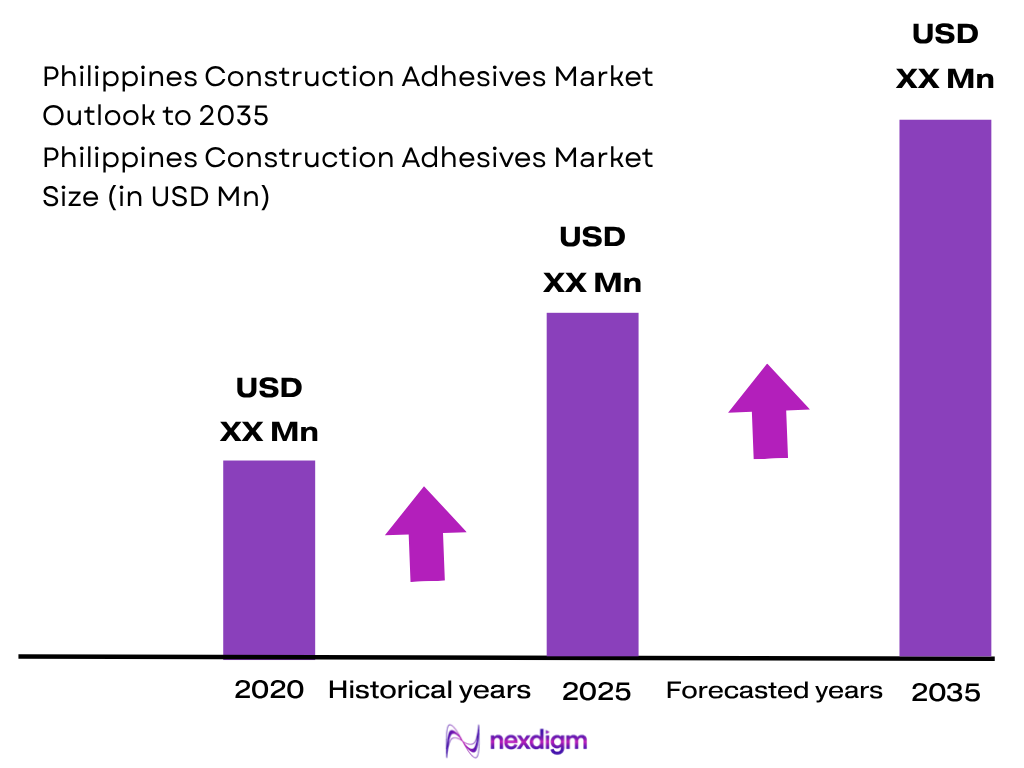
The Philippines Construction Adhesives Market is valued at approximately USD ~XX million, supported by expanding building activity and increasing use of packaged tile-setting and structural-bonding products. Approved constructions increased from 171,268 projects and 41.47 million square metres in the preceding observation to 180,341 projects and 42.84 million square metres subsequently. Residential floor area reached 19.75 million square metres, while non-residential construction contributed 22.38 million square metres, sustaining adhesives consumption across tiling, flooring, fit-out and repair applications.
Metro Manila, CALABARZON, Central Luzon and Central Visayas dominate construction-adhesive demand because they concentrate condominium developments, commercial projects, industrial facilities, logistics buildings, hospitality assets and renovation activity. NCR construction businesses generated PHP384.08 billion in revenue, followed by CALABARZON at PHP49.39 billion and Central Visayas at PHP40.04 billion. Their dense contractor networks, hardware distribution, tile retail channels and large project pipelines favour packaged tile adhesives, structural epoxies, flooring products and high-performance bonding systems.
Market Segmentation
By Adhesive Chemistry
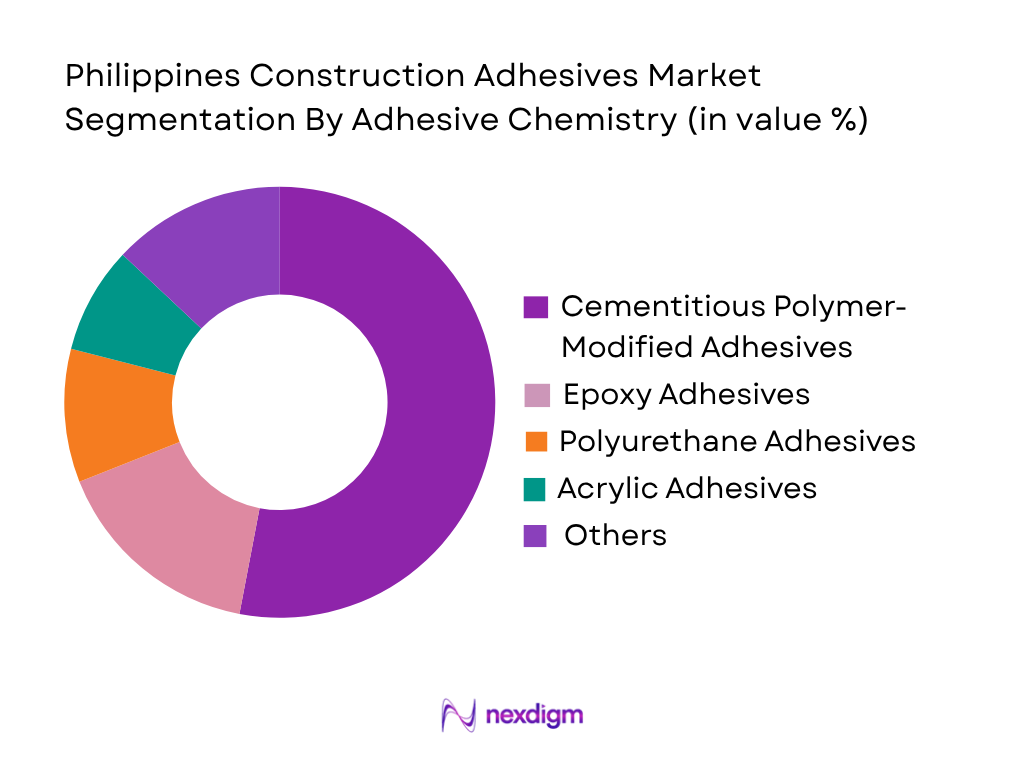
The Philippines Construction Adhesives Market is segmented into cementitious polymer-modified adhesives, epoxy adhesives, polyurethane adhesives, acrylic adhesives, hybrid polymer adhesives and other specialty formulations. Cementitious polymer-modified adhesives hold the dominant market share because ceramic, porcelain and stone tiling represents a broad application base across housing, condominiums, hotels, malls and institutional buildings. Philippine construction practice has progressively shifted from traditional site-mixed sand-and-cement bedding toward factory-controlled thin-bed tile adhesive systems that provide better consistency, reduced material waste and easier installation. Local product portfolios also support ceramic, porcelain, natural stone, wet-area and heavy-duty applications. ABC, which began operations in 1981, identifies itself as an early introducer of tile adhesive and grout into the Philippines, while Bostik markets dedicated cement-based products for wall, floor, porcelain and swimming-pool applications. Epoxy and polyurethane systems occupy smaller but higher-performance niches in structural repair, anchoring, flooring and multi-material bonding.
By Application
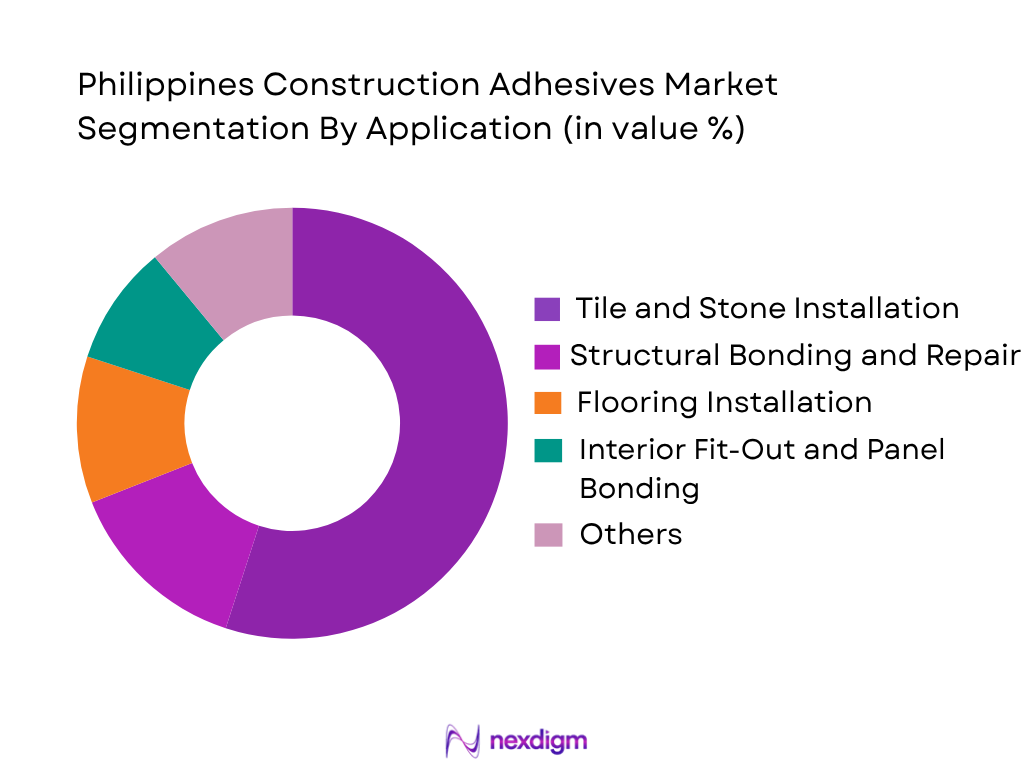
The Philippines Construction Adhesives Market is segmented into tile and stone installation, structural bonding and repair, flooring installation, interior fit-out and panel bonding, anchoring applications and other construction uses. Tile and stone installation holds the dominant share because Philippine residential and commercial construction makes extensive use of ceramic and porcelain finishes across floors, bathrooms, kitchens, façades and common areas. Approved residential construction alone covered 19.75 million square metres in the latest annual building-permit dataset, while commercial buildings represented the largest component of non-residential construction value. Increasing adoption of porcelain and larger tile formats raises requirements for stronger polymer modification, longer open time, reduced slip and improved deformability. Philippine suppliers offer heavy-duty adhesives for porcelain, mosaic and natural stone, including products suitable for exterior installation. Structural adhesives remain important in rehabilitation, anchoring, precast and infrastructure applications, while flooring and grab adhesives gain from office, retail and hospitality fit-outs.
Competitive Landscape
The Philippines Construction Adhesives Market includes multinational construction-chemical groups alongside long-established domestic manufacturers. Bostik, Sika and Mapei compete through broad technology portfolios, while Allgemeine Bau-Chemie and Pioneer Adhesives possess strong local-market heritage and distribution familiarity. Competitive differentiation depends on tile-adhesive performance, structural bonding capability, local manufacturing, hardware and dealer reach, installer training, project specification support and availability of application-specific solutions.
| Major Player | Establishment Year | Headquarters | Tile Adhesive Capability | Structural Bonding Capability | Flooring / Fit-Out Portfolio | Local Manufacturing / Presence | Distribution Reach | Technical & Installer Support |
| Bostik | 1889 | Colombes, France | ~ | ~ | ~ | ~ | ~ | ~ |
| Sika | 1910 | Baar, Switzerland | ~ | ~ | ~ | ~ | ~ | ~ |
| Mapei | 1937 | Milan, Italy | ~ | ~ | ~ | ~ | ~ | ~ |
| Allgemeine Bau-Chemie Phil., Inc. | 1981 | Muntinlupa, Philippines | ~ | ~ | ~ | ~ | ~ | ~ |
| Pioneer Adhesives, Inc. | 1958 | Quezon City, Philippines | ~ | ~ | ~ | ~ | ~ | ~ |
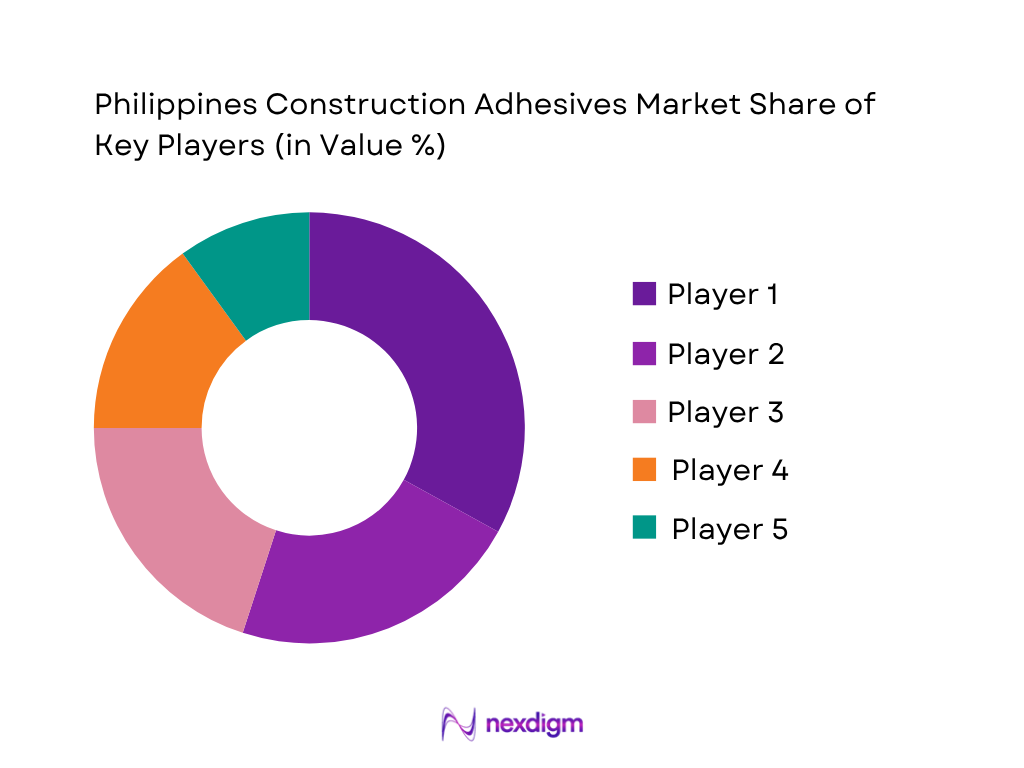
Philippines Construction Adhesives Market Analysis
Growth Drivers
Expanding Residential and Non-Residential Construction Supporting Adhesive Consumption
Construction activity in the Philippines is creating sustained demand for tile adhesives, structural epoxies, flooring adhesives and interior bonding products. The Philippine Statistics Authority recorded 180,341 approved constructions in 2024, covering 42,837,581 square metres of floor area. Residential projects accounted for 116,427 constructions and 19,748,190 square metres, while non-residential developments contributed 39,238 projects and 22,380,982 square metres. The construction pipeline strengthened further in 2025, reaching 181,832 approved projects and 45,236,312 square metres of floor area. This volume directly expands installation requirements for ceramic tiles, porcelain finishes, flooring materials, wall panels, structural repair systems and concrete bonding products. Larger commercial and residential projects increasingly favour factory-formulated construction adhesives because controlled formulations offer predictable bond strength, open time and application consistency compared with traditional site-mixed systems. The macroeconomic environment also supports construction activity: World Bank data show Philippine GDP at US$461.67 billion in 2024 and GDP per capita at US$3,985.3. These construction and economic indicators create a broad demand base for both cementitious and resin-based construction adhesive technologies.
Increasing Public Infrastructure Expenditure Expanding Structural Adhesive Applications
Government infrastructure spending is strengthening demand for high-performance construction adhesives used in concrete rehabilitation, anchoring, segmental bonding, flooring and structural repair. The Department of Budget and Management reported PHP5,925.4 billion of national government disbursements in 2024, while infrastructure and other capital outlays reached PHP146.7 billion in December 2024 alone. Capital outlays during that month totalled PHP167.0 billion, indicating the substantial scale of public works activity flowing through roads, bridges, buildings, drainage and other civil infrastructure. Such projects generate requirements for epoxy bonding agents, chemical anchors, repair mortars, structural adhesives and specialty bonding systems where conventional cementitious materials alone cannot provide the necessary load transfer or adhesion. Infrastructure rehabilitation also supports demand for products capable of bonding new concrete to existing substrates and fixing reinforcement into hardened concrete. Philippine GDP reached US$461.67 billion in 2024, while GDP per capita stood at US$3,985.3, according to World Bank data, providing a macroeconomic foundation for continued capital formation. Expanding public infrastructure therefore broadens the construction adhesives market beyond tile installation into technically demanding civil-engineering applications.
Market Challenges
Regional Construction Dispersion Increasing Distribution and Inventory Complexity
The Philippines Construction Adhesives Market faces significant distribution complexity because construction demand is spread across several geographically separated regional centres rather than being concentrated only in Metro Manila. Philippine Statistics Authority data show that CALABARZON recorded 41,471 constructions in 2024, while Central Luzon registered 22,824, the National Capital Region 19,585, Central Visayas 13,478 and Western Visayas 13,315. Construction values were also substantial across multiple areas, including PHP118.37 billion in CALABARZON, PHP112.84 billion in NCR, PHP76.50 billion in Central Luzon, PHP45.89 billion in Central Visayas and PHP40.07 billion in Western Visayas. Construction adhesive suppliers therefore need warehouses, dealer inventories and technical coverage across Luzon, Visayas and Mindanao to maintain availability of cementitious adhesives, epoxy kits, cartridges, flooring products and specialized systems. Product shortages can push contractors toward alternative brands or traditional cement-based installation methods. The national economic base remains substantial, with World Bank data showing US$461.67 billion of GDP in 2024 and US$3,985.3 GDP per capita. This geographically distributed construction footprint raises logistics, stock-management and contractor-support requirements for adhesive manufacturers and distributors.
Diverse Construction and Renovation Applications Raising Product Selection Complexity
Construction adhesive suppliers face increasing technical complexity because products must perform across new housing, commercial buildings, industrial facilities, renovation projects and multiple substrate conditions. In 2024, the Philippines recorded 116,427 residential constructions, 39,238 non-residential constructions, 5,694 additions and 13,997 alteration and repair projects. Residential floor area reached 19,748,190 square metres, while non-residential floor area reached 22,380,982 square metres. These different applications require distinct adhesive characteristics: wall tiles require slip resistance, large-format porcelain requires improved tensile adhesion and deformability, wet areas demand water resistance, structural repairs require high mechanical bonding, and interior fit-outs may require elastic or low-VOC products. Incorrect selection or inadequate substrate preparation can result in tile debonding, flooring failure or premature repair requirements, making installer knowledge and product specification important barriers to reliable market penetration. World Bank data place Philippine GDP at US$461.67 billion in 2024 and GDP per capita at US$3,985.3, indicating a large but diverse construction economy. Suppliers therefore need broader technical portfolios, installer training and application-specific documentation rather than relying on a single general-purpose adhesive.
Market Opportunities
Renovation and Repair Activity Creating Future Demand for Specialized Adhesives
The expanding renovation and repair base creates a significant future opportunity for construction adhesive manufacturers because refurbishment projects typically use more specialized bonding technologies than conventional structural construction. Philippine Statistics Authority data show 13,997 alteration and repair projects in 2024, compared with a large existing stock of residential and commercial buildings requiring periodic tile replacement, flooring upgrades, bathroom renovation, façade repair and structural rehabilitation. The associated reported construction value reached PHP43.05 billion, demonstrating the scale of refurbishment work available to adhesive suppliers. Demand can expand for tile-on-tile adhesives, rapid-setting products, structural epoxies, nail-free grab adhesives, flooring adhesives and small-pack repair solutions that reduce demolition and shorten installation time. Renovation applications also favour polymer-modified formulations capable of bonding to existing tiles, concrete, wood, metal and board substrates. The broader macroeconomic environment provides further support, with World Bank data reporting Philippine GDP of US$461.67 billion in 2024 and GDP per capita of US$3,985.3. As the installed building base grows, renovation becomes a recurring rather than one-time source of adhesive demand, allowing manufacturers to address both professional contractor and retail-oriented repair channels.
Expanding Non-Residential Floor Area Opening Premium Adhesive Applications
The growing non-residential construction pipeline offers a future opportunity for premium construction adhesives used in commercial, industrial, hospitality, healthcare and institutional developments. Philippine Statistics Authority data show non-residential floor area increasing from 22,380,982 square metres in 2024 to 24,847,366 square metres in 2025, while the number of non-residential constructions reached 38,991 in 2025. Total nationwide construction floor area also expanded to 45,236,312 square metres, compared with 42,837,581 square metres in the preceding annual period. This expanding base creates opportunities for higher-performance flooring adhesives, structural epoxies, chemical anchors, large-format tile adhesives, façade bonding systems and hybrid polymers. Commercial and industrial facilities commonly require faster installation, higher bond strength, moisture resistance and compatibility with multiple substrates, supporting migration from basic cement-sand systems toward formulated adhesive technologies. Philippine GDP reached US$461.67 billion in 2024, while GDP per capita stood at US$3,985.3, according to World Bank data. Suppliers with stronger project specification, contractor training and regional distribution capabilities can use this current construction base to expand into higher-value adhesive applications as non-residential building complexity increases.
Future Outlook
The Philippines Construction Adhesives Market is expected to register approximately ~XX% CAGR during 2026-2035, supported by residential construction, commercial fit-outs, infrastructure development and greater acceptance of packaged construction chemical systems. The market is expected to move progressively toward higher-performance tile adhesives, structural epoxies, hybrid polymers and specialized renovation products.
Packaged tile adhesive adoption should remain a major growth area as contractors move away from traditional site-batched cement-sand installation. Larger porcelain tiles and increasingly demanding substrates require stronger adhesion, extended open time, deformability and better slip control. Renovation and repair will also broaden the demand base. Alteration and repair activity increased to 13,997 approved projects, while the associated construction value reached PHP43.05 billion, supporting tile replacement, flooring refurbishment, structural repairs and interior fit-out adhesive consumption.
Major Players
- Bostik Philippines, Inc.
- Sika Philippines, Inc.
- Mapei Philippines Inc.
- Saint-Gobain Weber Philippines
- Allgemeine Bau-Chemie Phil., Inc.
- Pioneer Adhesives, Inc.
- Buildrite Construction Chemicals / Magna Prime Chemical
- Technologies, Inc.
- Fosroc
- Master Builders Solutions
- Henkel Philippines, Inc.
- 3M Philippines, Inc.
- Terraco
- Mortabond
- Kryton International Inc.
- Penetron Philippines
Key Target Audience
- Construction Adhesive and Construction Chemical Manufacturers
- Tile, Flooring and Interior Finishing Contractors
- General and Infrastructure Contractors
- Property Developers and Real Estate Companies
- Hardware, Building Material and Tile Distribution Companies
- Adhesive Raw Material and Polymer Suppliers
- Investments and Venture Capitalist Firms
- Government and Regulatory Bodies (Department of Public Works and Highways, Department of Trade and Industry–Bureau of Philippine Standards, Department of Human Settlements and Urban Development, Construction Industry Authority of the Philippines)
Research Methodology
Step 1: Identification of Key Variables
The initial phase involves constructing an ecosystem map covering adhesive manufacturers, raw-material suppliers, dry-mix producers, distributors, contractors, tile installers, flooring specialists and property developers. Critical variables include approved construction floor area, tile installation intensity, adhesive coverage rates, chemistry mix, renovation activity, project type, distribution penetration and local-versus-imported product supply.
Step 2: Market Analysis and Construction
Historical data for the Philippines Construction Adhesives Market is compiled using building permits, residential and non-residential construction activity, renovation indicators and infrastructure exposure. Bottom-up calculations estimate adhesive consumption from applicable floor area and application-specific product usage, while top-down calculations evaluate construction activity and construction-chemical expenditure to establish and validate the market baseline.
Step 3: Hypothesis Validation and Expert Consultation
Market hypotheses are validated through computer-assisted telephone interviews with adhesive producers, distributors, contractors, tilers, flooring installers and procurement professionals. Discussions evaluate product selection, cementitious versus resin-based adhesive usage, installer preferences, pack sizes, dealer margins, structural bonding requirements, tile-format transitions, local manufacturing and technical support requirements.
Step 4: Research Synthesis and Final Output
Primary insights are triangulated with Philippine Statistics Authority construction data, government infrastructure information, product technical literature and manufacturer disclosures. Market estimates from top-down and bottom-up approaches are reconciled, after which forecast assumptions are applied to construction activity, renovation demand, packaged tile-adhesive migration, premium tile adoption, infrastructure bonding and regional distribution expansion.

- Executive Summary
- Research Methodology (Market Definitions and Assumptions, Philippines Construction Adhesives Market Classification, Cementitious Adhesive Scope, Polymer-Modified Mortar Assessment, Epoxy Adhesive Assessment, Polyurethane Adhesive Assessment, Acrylic Adhesive Assessment, Hybrid Polymer Adhesive Assessment, Tile Adhesive Assessment, Flooring Adhesive Assessment, Structural Bonding Assessment, Concrete-to-Concrete Bonding Assessment, Anchoring Adhesive Assessment, Segmental Bonding Assessment, AAC Block Adhesive Assessment, Grab Adhesive Assessment, Large-Format Tile Assessment, Wet-Area Tiling Assessment, Exterior Tiling Assessment, Swimming Pool Adhesive Assessment, ISO 13007 Assessment, EN 12004 Classification Mapping, ANSI A118 Assessment, Tensile Adhesion Strength Assessment)

- Definition and Scope
- Philippines Construction Adhesives Industry Evolution and Development of Conventional Cement-Sand Tile Setting, Cementitious Polymer-Modified Tile Adhesives, Acrylic-Modified Bonding Systems, Epoxy Structural Adhesives, Polyurethane Construction Adhesives, Synthetic Rubber Grab Adhesives, Hybrid Polymer Adhesives, High-Grab Nail-Free Adhesives, Large-Format Tile Adhesives, Flexible Tile Adhesives, Underwater and Wet-Area Adhesives, Flooring Adhesives, AAC Block Adhesives, Concrete Bonding Agents, Anchoring Epoxies, Segmental Bonding Adhesives, Façade and Panel Bonding Systems, Low-VOC Construction Adhesives and C1-C2-S1-S2 Performance-Classified Tile Adhesive Systems
- Construction Adhesives Value Chain Analysis
- Construction Adhesives Supply Chain Analysis
- Cement Suppliers, Redispersible Polymer Powder Suppliers, Cellulose Ether Suppliers, Acrylic Polymer Suppliers, Epoxy Resin Suppliers, Polyurethane Raw Material Suppliers, Silane and Hybrid Polymer Suppliers, Mineral Filler Suppliers, Construction Adhesive Manufacturers, Dry-Mix Mortar Producers, Local Blenders, Importers, Distributors, Hardware and Building Material Dealers, Tile and Stone Retailers, Flooring Contractors, Tile Installers, General Contractors, Fit-Out Contractors, Property Developers, Infrastructure Contractors, Testing Laboratories and Government Agencies

- Growth Drivers (Residential Construction Activity, Non-Residential Building Development, Condominium Construction, Commercial Fit-Out, Renovation and Repair Activity, Ceramic and Porcelain Tile Adoption, Large-Format Tile Penetration, Infrastructure Expansion, Hotel and Resort Construction, Urban Housing Demand, Hardware Retail Expansion, Shift from Traditional Cement-Sand Setting to Packaged Tile Adhesives)
- Market Challenges (Price Sensitivity, Traditional Cement-Sand Installation Practices, Informal Contractor Market, Counterfeit and Low-Quality Products, Inconsistent Substrate Preparation, Installer Skill Gaps, Humidity and Moisture Exposure, Adhesive Storage Conditions, Imported Polymer Raw Material Dependence, Product Misapplication, Regional Distribution Fragmentation, Specification Enforcement)
- Market Opportunities (Flexible C2S1 and C2S2 Tile Adhesives, Large-Format Tile Installation, Renovation Adhesives, Structural Epoxy Bonding, Anchoring Adhesives, AAC Block Adhesives, Low-VOC Adhesives, Hybrid Polymer Grab Adhesives, Wet-Area and Swimming Pool Systems, Infrastructure Segmental Bonding, Flooring Adhesives, E-Commerce and Small-Pack DIY Products, Local Dry-Mix Manufacturing)
- Market Trends (Polymer-Modified Cementitious Adhesives, Flexible Tile Adhesives, Large-Format Porcelain Tiles, Extended Open-Time Products, Low-Dust Tile Adhesives, Ready-to-Mix Dry Mortars, High-Grab Construction Adhesives, Hybrid Adhesive-Sealants, Low-VOC Formulations, Single-Component Products, Small-Pack Repair Products, Installer Training Platforms, Digital Product Calculators)
- Government Regulations and Standards (National Building Code of the Philippines, DPWH Standard Specifications, DTI Bureau of Philippine Standards Requirements, ISO 13007 Tile Adhesive Testing, EN 12004 Tile Adhesive Classification, ANSI A118 Tile Installation Standards, Product Labeling Requirements, Chemical Safety and SDS Requirements, Occupational Safety and Health Requirements, Construction Material Compliance Requirements)
- SWOT Analysis
- Porter’s Five Forces Analysis
- PESTLE Analysis
- Stakeholder Ecosystem
- Construction Adhesives Manufacturing and Project Ecosystem

- By Market Value (2020-2025)
- By Consumption Volume (2020-2025)
- By Cementitious Adhesive Consumption (2020-2025)
- By Tile Adhesive Consumption (2020-2025)
- By Epoxy Adhesive Consumption (2020-2025)
- By Polyurethane and Hybrid Adhesive Consumption (2020-2025)
- By Flooring Adhesive Consumption (2020-2025)
- By Structural Bonding Adhesive Consumption (2020-2025)
- By Residential Construction Adhesive Consumption (2020-2025)
- By Commercial Construction Adhesive Consumption (2020-2025)
- By Infrastructure Construction Adhesive Consumption (2020-2025)
- By Renovation and Repair Adhesive Consumption (2020-2025)
- By Locally Manufactured Adhesive Consumption (2020-2025)
- By Imported Adhesive Consumption (2020-2025)

- By Adhesive Chemistry (In Value %)
Cementitious Polymer-Modified Adhesives
Epoxy Adhesives
Polyurethane Adhesives
Acrylic Adhesives
Synthetic Rubber Adhesives
Silicone-Based Adhesives
MS Polymer and Hybrid Adhesives
Vinyl and PVA-Based Adhesives
Other Specialty Construction Adhesives - By Product Type (In Value %)
Standard Tile Adhesives
Heavy-Duty Tile Adhesives
Flexible Tile Adhesives
Large-Format Tile Adhesives
Rapid-Setting Tile Adhesives
Underwater and Swimming Pool Adhesives
Ready-Mixed Tile Adhesives
Structural Epoxy Adhesives
Concrete Bonding Adhesives
Anchoring Adhesives
Segmental Bonding Adhesives
Grab and Nail-Free Adhesives
Flooring Adhesives
Panel and Façade Adhesives
Block and AAC Adhesives - By Application (In Value %)
Floor Tiling
Wall Tiling
Large-Format Tile Installation
Porcelain and Vitrified Tile Installation
Natural Stone Installation
Swimming Pool and Wet-Area Tiling
Tile-on-Tile Installation
Wood and Laminate Flooring
Vinyl and Resilient Flooring
Concrete-to-Concrete Bonding
Precast Element Bonding
Structural Repair Bonding
Rebar and Anchor Fixing
Façade and Wall Panel Bonding
Interior Fit-Out and Decorative Bonding
AAC and Lightweight Block Bonding - By Performance Requirement (In Value %)
High Tensile Adhesion Strength
Extended Open Time
Slip Resistance
High Deformability
Rapid Setting
Water Immersion Resistance
Heat Resistance
Exterior Weather Resistance
High Initial Grab
Gap-Filling Capability
Wet-Surface Adhesion
Structural Load Transfer
Low-VOC Performance
Chemical Resistance - By Region (In Value %)
National Capital Region
CALABARZON
Central Luzon
Central Visayas
Western Visayas
Davao Region
Northern Mindanao
Ilocos Region
Cagayan Valley
Bicol Region
Eastern Visayas
SOCCSKSARGEN
Caraga
Cordillera Administrative Region
BARMM

- Market Share of Major Players (By Philippines Revenue, Adhesive Consumption Volume, Tile Adhesive Portfolio, Structural Adhesive Portfolio, Flooring Adhesive Portfolio, Flexible Adhesive Portfolio, Retail Presence, Contractor Coverage, Project Specification Exposure, Local Manufacturing Capacity, Local Blending Capability, Technical Laboratory Capability, Installer Training Coverage, Distributor Network, Infrastructure Project Exposure)
- Cross Comparison Parameters (Tile Adhesive Performance-Class Portfolio, Structural Epoxy and Anchoring Adhesive Capability, Large-Format and Flexible Tile Adhesive Capability, Philippines Manufacturing and Local Blending Presence, Hardware Dealer and Distributor Network Reach, Technical Training and Installer Support Capability, Waterproof and Wet-Area Bonding Capability, Infrastructure and Project-Specification Exposure)
- SWOT Analysis of Major Players
- Competitive Positioning Matrix
- Major Companies
Bostik Philippines, Inc.
Sika Philippines, Inc.
Mapei Philippines Inc.
Saint-Gobain Weber Philippines
Allgemeine Bau-Chemie Phil., Inc.
Pioneer Adhesives, Inc.
Buildrite Construction Chemicals / Magna Prime Chemical Technologies, Inc.
Fosroc
Master Builders Solutions
Henkel Philippines, Inc.
3M Philippines, Inc.
Terraco
Mortabond
Kryton International Inc.
Penetron Philippines

- Tile Contractor Requirement Assessment
- General Contractor Procurement Assessment
- Flooring Contractor Requirement Assessment
- Structural Repair Contractor Requirement Assessment
- Property Developer Adhesive Specification Assessment
- Infrastructure Contractor Requirement Assessment
- Fit-Out Contractor Requirement Assessment
- Hardware Dealer Requirement Assessment
- Large-Format Tile Installation Requirement Assessment
- Wet-Area Adhesive Requirement Assessment
- Structural Adhesive Performance Assessment
- Technical Service and Installer Training Requirement Assessment

- By Market Value (2026-2035)
- By Consumption Volume (2026-2035)
- By Cementitious Adhesive Consumption (2026-2035)
- By Tile Adhesive Consumption (2026-2035)
- By Epoxy Adhesive Consumption (2026-2035)
- By Polyurethane and Hybrid Adhesive Consumption (2026-2035)
- By Flooring Adhesive Consumption (2026-2035)
- By Structural Bonding Adhesive Consumption (2026-2035)
- By Residential Construction Adhesive Consumption (2026-2035)
- By Commercial Construction Adhesive Consumption (2026-2035)


 Request a Sample
 Ask for Customization
 Get a Quote
 Enquire Now
